Showing posts with label Alan Hale. Show all posts

Monday, September 20, 2021

Ida Goes Mad

Joe (George Raft) and Paul Fabrini (Humphrey Bogart) are trying to beat the odds by running their own trucking service.  With their one truck, They Drive by Night (1940) moving produce from one city to another. It's an exhausting and dangerous job, as they try to acquire enough money to pay off their truck and build a successful business.

This is a well-acted film with an engaging storyline that will keep you interested throughout.  It's got an impressive cast, but frankly, it's Ida Lupino (Lana Carlsen) who steals the entire film.  More on her later.

George Raft is convincing as the determined trucker who's trying to beat the odds in building his own business. While I'm generally not a fan of Mr. Raft, he does a good job in this film, primarily because of the actors he plays against. Raft and Humphrey Bogart make convincing brothers; there is a subtle intimacy between the two. While we witness the strain between the brothers - Paul wants to be home more with his wife, while Joe is convinced they can beat the system - there is affection and understanding too.

Humphrey Bogart's role in the film is relatively small. As Joe's brother, he is constantly complaining about the stress of their work and his ongoing reluctance to leave his wife alone yet again.  Gale Page (Pearl Fabrini) is in much the same situation - she's there to represent the wives who fear for their husbands' safety. She's a much better actress than the whining Pearl allows her to be.

Alan Hale (Ed Carlsen) fairs much better as the jovial, if hard drinking, owner of a major trucking company.  Ed came up through the ranks and built a thriving business.  He's a loyal friend, who's been trying to convince Joe to join his company. The fly in the ointment is Ed's wife Lana - unbeknownst to Ed, Lana has been pursuing Joe, who is having none of it.  Mr. Hale is awfully good in the part, and his loss is felt.

Ann Sheridan (Cassie Hartley) gets to wisecrack in her early scenes in the film but as she becomes more involved with Joe, she becomes more subdued.  By the end, we know who is going to be in charge in their marriage; Cassie is a strong and loyal woman who will always support her man. We particularly enjoyed the scene when Joe collapses on her bed in exhaustion, and Cassie spends the night on the sofa.

It was George Raft who recommended Ida Lupino for the role of Lana (TCM article), and as we mentioned previously, she steals the film.  She's crafty and scheming; disgusted by her husband but eager to spend his money. She dominates every scene in which she appears, but it is the last part of the picture where she rules. Her desire to get Joe into her bed, her growing guilt over her husband's death, and her resentment of Cassie all lead to a perfect storm in the film's conclusion. 

They Drive by Night is also blessed with a number of Warner Brothers contract players, including Roscoe Karns (as pinball addict Irish McGurn), George Tobias (as fruit seller George Rondolos), and William Bendix (as another truck driver).  All combine to make a very well-rounded film.

The story is loosely based on the 1935 film Bordertown (AFI Catalog).  It was aired by Lux Radio Theatre  in June of 1941 with George Raft, Lana Turner, and Lucille Ball.

New York Times review by Bosley Crowther was positive, calling it "an entertaining ride".  We concur; if you are a fan of Ms. Lupino, you must see this. And if not, there is still plenty of good acting to catch your eye. We'll leave you with the film's trailer:


Monday, September 13, 2021

Errol Escapes

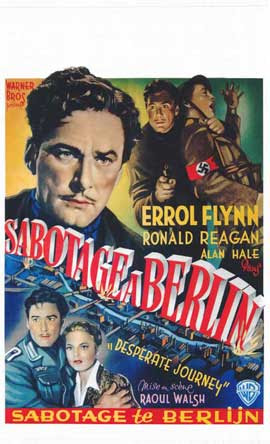
When their bomber crashes in Nazi Germany, a group of Allied airmen make a Desperate Journey (1942) to get out of the country with information that may help the war effort. 

Let's begin by admitting that this is very much a wartime propaganda film.  According to this movie, five Allied officers can take down the entire Nazi war machine and defeat it without breaking into much of a sweat.  Regardless, it's an interesting adventure, with snappy (albeit somewhat jingoistic) dialog and a good rapport among the lead and supporting actors.

Errol Flynn gets top billing as Flight Lt Terrence Forbes, an Australian working with the Allied command in Europe.  This is one of the few times in which Flynn gets to play someone from his native land, and he's quite good as the cocky, but competent Forbes. Errol Flynn was examined by the draft board, but physicians discovered that he had tuberculosis.  Knowing that he would be unable to work (and would not be entitled to any money during his recuperation), Mr. Flynn declined to let the studio know of his illness, nor accept any of the treatments available to him (TCM article). As a result, he lost  a tremendous amount of weight (forcing wardrobe adjustments). Frequently late for work, he was difficult to work with during the shoot.

Ronald Reagan (Flying Officer Johnny Hammond) was just off his rousing success in King's Row (1942), and gets second billing above the title with Errol Flynn.  He's good as the devil-may-care American, and got to be the hero of the piece, knocking out Major Otto Baumeister (Raymond Massey), albeit off-camera.  Errol Flynn wanted to the the one to do that particular deed, but he was told no.  Mr. Reagan was called up for military service while shooting the picture - they allowed him a week to finish up the production.  His three years of service did not help his career; he was never able to regain the momentum following King's Row. However, he eventually had other career goals.

The role of Kaethe Brahms was originally intended for Kaaren Verne, but she was replaced by Nancy Coleman (AFI Catalog). It's not a big part, but Ms. Coleman does her best to make Kaethe heroic and appealing.  If there is one fault in the film, it is the scene where the escaping flyers share a meal with Kaethe's parents. Relaxing for the first time in awhile, the men talk liberally - something no soldier would do in these circumstances.  

Raymond Massey has the most thankless part. Major Otto Baumeister is downright stupid, and his Nazi soldiers resemble nothing more than the Keystone Kops.  Massey is a good actor, but you wouldn't know it here.  He's really given nothing with which to work.

We have a number of other good actors in the film - Alan Hale as Flight Sergeant Kirk Edwards gets to do some of the comic relief. Arthur Kennedy (Flying Officer Jed Forrest) is the conscience of the group - trying to keep them on task towards getting home with the information they've obtained.  This would be Ronald Sinclair (Flight Sergeant Lloyd Hollis) last acting role (he'd been a child actor) -  he became a film editor, working with Roger Corman.

Bosley Crowther, in his The New York Times review, was unimpressed with the movie - "an invasion of Nazi Germany which would put the Commandos to shame." It was nominated for an Oscar for Special Effects (it lost to Reap the Wild Wind). While this is not the best movie ever made, it's fun, with an enjoyable cast.  We'll leave you with this trailer:


Monday, March 22, 2021

Cary Writes Words and Music

Cole Porter (Cary Grant), a law student at Yale opts to discard a career as a jurist to take up songwriting in Night and Day (1946) a very loose interpretation of Mr. Porter's life and career.

Since the release of  DeLovely (2004), Night and Day has had to bear the brunt of its claim to being a biography of Cole Porter. Quite frankly, it's not. It's a way of incorporating a vast array of Mr. Porter's glorious music into a film, and tell a story at the same time. Let's go over a few of the facts, and then we can talk about the film as a story, not a biography. 

Cole Porter did attend Yale, and one of his classmates was Monty Woolley (Mr. Woolley, who plays himself, was NOT a professor at Yale). The sinking of the Lusitania had nothing to do with the failure of See America First, as the ship sunk in May 1915, and the musical opened in March 1916. Mr. Porter was not wounded in combat during World War I; he is listed as serving in the French Foreign Legion during the war (Broadway, The American Musical). He also spent time in Paris partying and met his future wife in Paris. Linda Lee Thomas was well aware of Mr. Porter's sexuality when they married - she had come from an abusive first marriage. Linda Lee Porter never officially left Cole - in fact, it was she that worked with the doctors to keep them from amputating his leg following his horseback riding accident. She continued as his health advocate until her death in 1954 (Cole Porter obituary). Following her death, doctors convinced him to allow the amputation, and he lived as a recluse for the rest of his life (as Linda feared). Mr. Porter was as openly gay as the era would allow (The New Yorker). Regardless, he and Linda loved one another and were inseparable - les Colporteurs (Smithsonian Magazine). 

As you can see from the photo, The Porters looked nothing like their on-screen imitators.  Linda wanted Alexis Smith to play her, and when she expressed her desires to Warner Brothers executives, Cole jokingly said that Cary Grant should play him (Cary Grant: In Name Only by Gary Morecambe & ‎Martin Sterling). Mr. Grant and Ms. Smith are wonderful together, and Ms. Smith was thrilled to be working with him. Though he could be very definite in his opinions - for example, Mr. Grant demanded that his suit be cut so that only an eighth of an inch of cuff should show, Ms. Smith commented on his "care and attention" to the character (TCM article).  This was Mr. Grant's first technicolor film.
Warner Brothers incorporated their best character people into the film. Eve Arden finally gets a chance to sing as French performer Gabrielle, who introduces Porter's song "I'm Unlucky at Gambling." Jane Wyman (Gracie Harris) also gets a chance to show her vocal talents.  Dorothy Malone (Nancy) has some brief scenes with Donald Woods (Dr. Ward Blackburn) as her husband and Cole's friend and physician. Alan Hale (Leon Dowling) turns up as a theatrical producer who doesn't see the beauty of Cole's compositions. And Henry Stephenson (Omer Porter) is sympathetic as Cole's grandfather.
Monty Woolley gets to play himself, and get off some bon mots while he is at it. He pops in and out of the film, as Woolley wanders in and out of the Porters' lives (and back and forth from New York to Hollywood). There is some amusing banter as he goes off to film The Man Who Came to Dinner - he'd starred in the Broadway play (he almost didn't get the movie role - Warner Brother considered Fredric March, Charles Laughton, Robert Benchley, John Barrymore, and Charles Coburn). 
Mary Martin, who got her start in Cole Porter's Leave it to Me, reprises her hit song from the musical, "My Heart Belongs to Daddy" (though this song, along with several of the others, are cleaned up versions of Mr. Porter's sometimes rather racy lyrics).  Ginny Simms (Carole Hill), the woman who works with Porter in a music store in the film, is very loosely based on Ethel Merman. Ms Merman had appeared in earlier plays, but her first starring role was as Reno Sweeney in Mr. Porter's Anything Goes (AFI catalog).

The New York Times review by Thomas M. Prior (T.M.P.) was positive, though even Mr. Prior pointed out that it wasn't really a biography.  When the film  DeLovely was released in 2004, The Times again wrote about Night and Day as part of a discussion of the biographical aspects of the two movies. 

If you are not a stickler for facts, and would like to see some fine acting, pleasant singing, and spectacular songs, this film is worth a viewing or two.  We'll leave you with the trailer:


Monday, September 21, 2020

Ida Sings

Petey Brown (Ida Lupino) is moderately successful as a torch singer in a New York club, but it is nearing Christmas and Petey misses her sisters and brother in California. She arrives on the West Coast to find her brother Joey (Warren Douglas) working for nightclub owner Nicky Toresca (Robert Alda); sister Sally Otis (Andrea King) dealing with her husband Roy’s (John Ridgely) post-war mental issues; and sister Virginia (Martha Vickers) avoiding the world. Petey decides she better stay to set things in order. Our film this week is The Man I Love (1947).

While there is nothing extraordinarily unique about the story, this is a fantastic film, with an exceptional cast. The focal point is the always stunning Ida Lupino as a determined and strong woman. Even when we think she is weakening, Petey bounces back and dominates every scene and the situation.  She is supportive of her sisters and brother, and glides in and out of their lives like the hero in a western - she stays while they need her, then rides off into the sunset! Ms. Lupino was not the first choice for Petey; Warner’s purchased it with Ann Sheridan in mind (AFI catalog). Peg LaCentra provided Ms. Lupino's singing voice in this film, though later (in Road House), she did her own singing (Ida Lupino, Director: Her Art and Resilience in Times of Transition by Therese Grisham and Julie Grossman).
Also providing a noteworthy performance is Robert Alda. A highly-regarded singer, Mr. Alda - the original Nathan Detroit on Broadway, (and the father of actor Alan Alda) - does not sing here. As Nicky Toresca, he is as far from the boy singer as you can get.  Nicky is sleazy - first he is on the prowl for Sally Otis, then Petey, and eventually Sally’s neighbor Gloria O'Connor (Dorothy Moran).  Mr. Alda bring a smoothness tinged with menace to Toresca.  It’s clear he is interested in Petey primarily because she is not interested in him, making the character all the more perverse. Like Ms. Lupino, Mr. Alda wasn’t even the first choice for the role - originally it was intended for Humphrey Bogart; later Jack Carson was scheduled to do it (Music in the Shadows: Noir Musical Films by Sheri Chinen Biesen). 

Bruce Bennett (San Thomas) spends much of his time in his films being a forlorn and moody victim (for example, his turn as Bert Pierce in Mildred Pierce), but it works in this film. San spends much of The Man I Love pining for his ex-wife; the audience gets to shake their respective heads at his denseness. Why on earth is he still mourning this feckless woman when he has the magnificent Ida waiting for him? However, faced with Petey's determination, the viewer is left with the feeling that San will be getting over his past in time. Dane Clark was also considered for the role; he surely would have brought an entirely different vibe to the character.

The film is blessed with an excellent supporting cast: Andrea King's almost matches Petey with her strength of character. Faced with a husband who has been hospitalized following his service in the Army, she is forced to work to support her young son, as well as deal with a husband whose illness causes him to expresses his hatred for her when she is able to visit. Dorothy Moran as the next-door neighbor with a husband, twin babies, and a penchant for the night life that husband Johnny (Don McGuire) can't afford, is convincing as a lady with more than housework on her mind. The few brief scenes in which Alan Hale appears are always a pleasure. As Riley, Toresca's good natured assistant, he brings a bit of comic relief to the proceeding. Both Craig Stevens (Johnson) and Florence Bates (Mrs. Thorpe) have minor parts - blink and you will miss them. Also worth noting are the beautiful gowns that were designed by Milo Anderson, one of which was so tight, Mr. Lupino had to be literally cut out of it (see below).

Ms. Lupino became ill during the filming, at one point fainting during a scene (partially caused by the tightness of her dress) - Mr. Alda caught her before she hit the ground. (Ida Lupino: A Biography by William Donati). As a result of her illness, the film ran 19 days overtime and $100,000 over budget (TCM article). It did earn a profit, however, and came in at number 71 on the year's list of top grossing movies (Ultimate Movie Rankings).

Based on the 1942 novel Night Shift by Maritta Wolff, Bosley Crowther's New York Times review of The Man I Love was not all that complementary, but it seemingly didn't hurt the movie.  Frequently cited as a film noir, Eddie Muller in a 2017 "Noir or Not" segment said it was not noir because "the protagonist (Petey) is not flawed". His book Dark City: The Lost World of Film Noir goes into detail on Ms. Lupino's career both inside and outside of noir. 

We'll leave you with a trailer and the suggestion you keep your eyes peeled for this one:

Monday, May 20, 2019

Clark Rides the Night Bus

When Ellie Andrews (Claudette Colbert) literally jumps ship to join her new husband King Westley (Jameson Thomas) - over her father's vehement objections - hell breaks loose. Alexander Andrews (Walter Connolly) hires every detective he can find to search for Ellie, but she has other ideas. She boards the night bus to New York City to reach Westley. Unfortunately, Ellie has no idea of how to be on the lam; she is befriended by reporter Peter Warne (Clark Gable) who plans on using her story to get back in good graces with his editor. Our film is It Happened One Night (1936).

Victoria Riskin provided an introduction to this film, which was part of the Fay Wray/Robert Riskin Retrospective at the AFI Silver Theatre.  Mr. Riskin collaborated with Frank Capra on the film -  Mr. Capra read the story Night Bus by Samuel Hopkins Adams, which was published in Cosmopolitan, and approached Mr. Riskin about adapting it for the screen (Fay Wray and Robert Riskin: A Hollywood Memoir by Victoria Riskin); they pitched it to Harry Cohn at Columbia.

Myrna Loy, Miriam Hopkins, Constance Bennett and Margaret Sullavan were all approached to play Ellie. Finally, Claudette Colbert (who was not enthusiastic) consented to do the part, contingent upon a hefty salary. Similarly, Robert Montgomery was requested for the part of Peter, but Louis B. Mayer decided to send Clark Gable instead; Mayer resented Gable's increased salary demands and decided four weeks at a Poverty Row studio was fit punishment (AFI Catalog).  By the film's conclusion, no one was particularly thrilled with the result - except the audiences!
Claudette Colbert is excellent as Ellie. It's a difficult part - Ellie needs to be snooty enough to be believable as a spoiled brat, but warm enough to attract Peter's attentions from the start. Ms. Colbert had not wanted to work with Frank Capra again (there had been some animosity on the 1927 film For the Love of Mike) and she was unwilling to show her legs for the now-famous hitchhiking scene. However, when Mr. Capra brought in a model to be "the leg," Ms. Colbert said, "get her out of here, I'll do it -- that's not my leg!" and did the scene that has become synonymous with the film (TCM article). She left the film convince it was "the worst picture in the world," but by 1982, when Frank Capra received the AFI Lifetime Achievement award, she was much more enthusiastic. (You can see her speech here).
While Mr. Gable had worn a mustache in other films, the reaction to his appearance in It Happened One Night convinced him that he should keep it permanently (Clark Gable: A Biography by Warren G. Harris). He also began wearing a trenchcoat as a lucky charm. Mr. Gable gives Peter Warne just enough arrogance to stand up to Ellie, but he's also warm and gentle. There's a scene in which a woman faints on the bus - Peter's ambivalence in wanting to help her, but knowing that he hasn't very much money, makes you warm to the character. Gable also has the unique ability to play comedy without being silly. Watch him undress in a scene that could have been ridiculous - with him doing it, it's a masterpiece.
The film is replete with some very impressive character performances. Roscoe Karns is decidedly slimy as Oscar Shapeley, the lecherous traveling salesman.  Alan Hale seems friendly and innocuous as Danker, the driver who picks up our hitchhikers (but he's not). And finally, there is Walter Connolly as Ellie's beleaguered father, a man who only wants the best for his only child, but isn't always very good at letting her know that.
It Happened One Night became the first comedy to win an Oscar, and the first film to win Oscars in the five major categories: Picture, Actor, Actress, Director and Writing (Robert Osborne commentary).  It became the model for a subset of the screwball comedy genre (See: The Runaway Bride: Hollywood Romantic Comedy of the 1930's by Elizabeth Kendall). It spawned two remakes (both musicals): Eve Knew Her Apples (1945) with Ann Miller, and You Can't Run Away from It (1956) with June Allyson. It appears on multiple AFI lists: #46 on 100 Years, 100 Movies (Anniversary Edition) and #36 on the original list; #8 on 100 Years, 100 Laughs; and #38 on 100 Years, 100 Passions. In 1993, it was added to the National Film Registry.

If you've never seen this excellent film, treat yourself and find a copy. In the meantime, we'll leave you with the scene that nearly bankrupted the men's undershirt industry:

Sunday, April 19, 2015

Barbara Gives Up Everything

Barbara Stanwyck desperately wanted to play Stella Dallas (1937), despite the fact it that it would be the hardest part she had played up til that point.  In Victoria Wilson's epic biography of Stanwyck, A Life of Barbara Stanwyck: Steel-True 1907-1940, the author goes into some detail on Stanwyck's remarkable performance as Stella Martin Dallas and Stanwyck's efforts to get the job.  Stella is a working class girl, who lives in the small factory town of Millhampton, Massachusetts.  She is attracted to the new man in town, Stephen Dallas (John Boles), the son of a wealthy family.  His money lost, his father dead, Stephen has escaped to Millhampton, to take a job and try to put his life back together.  In doing so, he has abandoned his fiancée, Helen (Barbara O'Neil).  Stella and Stephen date, eventually marrying.  At first, she says she is eager to become like him, but after a year of trying to live his life, she wants more fun, with the people she understands.  However, the Dallases now have a little girl, Laurel (who will grow up to be Anne Shirley), and though Stella and Stephen bicker constantly, they agree on one thing - Laurel is the center of their world.

It's interesting that the studio originally wanted Ruth Chatterton for the part, and it is not unlikely casting - she had done a similar role in Frisco Jenny.  But Stanwyck IS Stella Dallas.  She takes a woman who could become unappealing and ridiculous and creates a character with appeal and sympathy.  Her Stella is a lonely woman, stuck between two worlds, unable to find her place in either of them. Her only pleasure is her child, for whom she will devote her life, and for whom she wants the best things in life - the life that ultimately only Laurel's father can give her.
Also excellent is Anne Shirley as Laurel.  Shirley gives us a portrait of a girl who dearly loves her mother, and while she doesn't have her mother's same way of dressing, she sees nothing odd about this woman who is a fashion nightmare.  It isn't until she hears others ridiculing her mother that she realizes how outlandish her mother appears.  Laurel's desire to whisk her mother away from these people is a mix of embarrassment and the desire to protect Stella from hurt.  Even when Laurel believes that her mother doesn't want her around, there is still a deep love on the child's part.  In her heart, she knows that Stella will never reject her.  Interestingly, the studio originally wanted Bonita Granville for the role, but she was deemed too young for the older Stella. 

Another impressive performance is that of Barbara O'Neil; her character is so idealized - the perfect society woman, perfect spouse, perfect mother - that it would be easy to just make her a caricature, but O'Neil carefully makes Helen genuine and sympathetic.  The scene between her and Stanwyck is magnificent, each accomplishing communication with their eyes and body that hearkens back to the silent era, but still retains the subtlety of the conversation.  It's a truly heartbreaking scene.
We can't forget the men - especially John Boles, who is also not afraid of making Stephen a bit unattractive.  Though Stephen tells Stella not to change, ultimately, that is what he is trying to force her to do.  And while we may not agree with Stella's wardrobe or attitudes, she is correct in her comment to him that SHE is the one who always has to change, not him.  And though this is not a pre-code film, there is the slightest implication that he is living with Helen while still married to Stella. 


Alan Hale as Ed Munn creates a character that is a companion to Stella, but clearly not a romantic interest.  Where Stella is over-the-top in her garb and attitudes, Ed is crude, foolish, and finally, a drunk (Stella, interestingly, never drinks).  We can't really like Ed - Hale doesn't let us, and with good reason - we need to understand why Stella will never be with him.  This TCM article comments briefly on Hale's outstanding performance.
Costumes for this film were by Omar Kiam, and he does a good job of defining the characters of Stella and Laurel through their dress.  The story was reprised by Ms. Stanwyck, Mr. Boles, Ms. Shirley, and Ms. O'Neil on the Lux Radio Theatre in October of 1937. 

I also wanted to bring to your attention this excellent salute of Stanwyck by Laura Dern, in which she comments that this is "one of the great performances of all time".  Be aware (if you've not seen the film before) that you WILL see the conclusion in this clip.  If you've seen the film, it will provide a reminder of how stunning Stanwyck is as Stella's story concludes.

We will leave you with the film's opening.  Next time, more Stanwyck! 

Thursday, October 17, 2013

Back to Sherwood Forest

Some years ago, we discussed The Adventures of Robin Hood, but the opportunity to see it on a big screen (at the AFI Silver Anniversary Celebration) begs for revisiting the film via this blog.  Last time, we looked primarily at Olivia de Havilland; this time, we'll look a bit more closely at the wonderful character actors that grace this fantastic film.

That wonderful trio of villains, Prince John (Claude Rains), Guy of Gisborne (Basil Rathbone) and the Sheriff of Nottingham (Melville Cooper) are first on our agenda.  We were fascinated that Prince John never shows fear.  Even when Richard returns, there is not a line of apprehension on his face - John is much too busy perfecting his "spin" on his actions to worry about a little thing like death.  Rains plays John with the bravura of a man who knows he will ultimately be successful.  And of course, historically John survived his brother by many years, and ruled England after Richard's death.  Perhaps he was not England's most popular monarch - remember the Magna Carta - but his longevity (he ruled for 17 years) show he had nothing but time on his side.

On the other hand, the one character we expect to have a lot of nerve, Guy of Gisborne, does not.  Watch Rathbone's face throughout the movie. Gisborne is afraid.  And when he is captured by Robin Hood, he makes not a move to defend himself or Maid Marian.  He talks a good line, but the only time he really seems confident is when he confronts Lady Marian.  This Gisborne is a bully, pure and simple.  And not even a smart one.  Remember, it is the dim-bulb Sheriff of Nottingham who comes up with the plan to trap Robin, not Gisborne.  Then again, one gets the feeling that Gisborne would just be happier picking on women and unarmed peasants than confronting a talented swordsman.  Rathbone is so beautifully subtle in his portrayal that Gisborne's true character is just a hint rather than outright cringing.  Were he too obviously a coward, John's regard for him would be laughable.  This way, the audience understands Gisborne's nature.  John can only suspect (as he does when Gisborne and the Sheriff return from their forest meal with Robin), but it's not anything John can prove.

On the good guy side of the equation, we have the always wonderful Alan Hale as Little John.  With his hearty laugh and amiable manner, Hale is the perfect John Little.  His best (and most famous scene) is the "duel" with Robin on the tree bridge.  It's a thing of beauty to watch Little John take Robin down a peg.  Robin seems to always have this air of invincibility; Little John lets him know that even for the best fighter, there is always someone a little better.  

Similarly,  Eugene Pallette as Friar Tuck is another no-nonsense character, with nerves of steel. Overweight, years older, and a supposed man of peace, Friar Tuck confronts the Merry Men even when outnumbered, and fights boldly in all battles.  He has brains but is a compassionate man of the cloth.  Pallette, with his impressive voice and physique, make Tuck a memorable character.  
Finally, Una O'Connor as Bess, is another gutsy character.  Watch her in the ambush scene: her eyes fire when she believes her lady is in danger, and she is not afraid to verbally confront her attackers! Unlike Gisborne, she is more than willing to go toe-to-toe with any of Robin's men.  Yet, she is immediately attracted to Much (Herbert Mundin), and flirts with him like a teenager.  Her loyalty and devotion to Marian make her fearless; she risks all to save her lady, even when it is clear she will be killed if caught.  

I'll leave you with a trailer from the film.  Next time, we'll return to our usual discussion.

Friday, June 28, 2013

Barbara Likes Asparagus

Over the next two sessions, we are going to watch two versions of the same story - So Big, from the novel by Edna Ferber.  This week, we begin with the 1932 version, starring Barbara Stanwyck as Selina Peake De Jong.

The story opens in Chicago; Selina Peake's mother is dead, and she is being raised by her father, Simeon Peake(Robert Warwick), a professional gambler.  Simeon is a good man, devoted to his child.  He advises her to realize that "... Life is just a grand adventure. The trick is to act in it and look out at the same time. And remember: no matter what happens - good or bad - it's just so much velvet."  His murder results in Selina having to fend for herself.  She becomes a teacher, and heads to a Dutch settlement in Illinois.  She lives with the family of Klass Poole (Alan Hale), a fairly dense farmer who resists sending his son, Roelf  (Dick Winslow) to school, and is oblivious to the fact that their lifestyle is killing his wife.  Selina forms a friendship with the artistic Roelf (who develops a crush on her), but she falls in love with local farmer Pervus De Jong (Earle Fox), and, much to Roelf's disappointment, marries Pervus.

Stanwyck is, not surprisingly, magnificent.  We see her convincingly age from young girl to old woman.  It should be noted that the old age makeup is very well done.  It is subtle, but it certainly gets the point across that Selina's life has not been easy.  Some scenes that really jump out are the early ones between Selina and her father - both actors really help to demonstrate the strong bond that exists between them.  Another is the scene in the Chicago Haymarket, when the local "fancy women", who feel sorry that Selina and Dirk (Dickie Moore, being very adorable as "So Big", Selina's nickname for her little boy) have to sleep in the wagon, offer them money.  Selina's gracious refusal really tells us so much about the character.  Her later scenes with the grown-up Dirk (Hardie Albright) demonstrate her love and concern for her son, as well as her unwillingness to meddle in his life.  She wants him to see the beauty in life, to have a career that he loves, and not be someone who is only about making money.  Yet, she tries not to criticize, only to love and let Dirk find his own way.


We were also pleased to see  Bette Davis in a supporting role as Dallas O'Mara, a career-minded, independent young lady who attracts Dirk.  One scene that was particularly interesting was a dinner between Dirk and Dallas.  We had previously seen Dirk dining with a wealthy married woman.  She orders "De Jong Asparagus", and comments on the Dirk's name.  He immediately denies any relationship to the produce.  Yet, on his first date with Dallas, he is quite open about his mother's asparagus farm. Dallas' delight at knowing Dirk is from the country is quite lovely, as is the scene when she finally meets Selina. 

George Brent (Roelf Pool) is wasted here.  We don't really seem him until the very end of the film, and only for a short period of time. Of course, this is the beginning of Brent's extensive career.  He would finally get second billing on his next film, The Rich are Always with Us (which we discussed recently).

It is hard to imagine the well-educated, independent Selina with Pervus.  He's rather hard-headed (though NOT like the moronic Klaas Poole), has no education to speak of, and very little ambition.  But, it is obvious that he loves Selina, is willing, up to a point, to learn from her, and wants the best for her and their little son.  But we also know that, in the end, she is probably going to do better financially without him. He is stuck in the past. Selina (and perhaps Dallas) are the future.

Next time, we'll discuss the 1953 version of the film. In the meantime, here is a scene with Stanwyck as Selina (and Noel Francis as Mabel):

Monday, September 27, 2010

Olivia Goes to Sherwood Forest

This week, our discussion looks at the ever wonderful The Adventures of Robin Hood.  I have to admit that it is hard to add anything worthwhile to a discussion of this movie.  Oh, I'm willing to admit to some flaws - perhaps Errol's tights are a little to green and shiny; perhaps Sherwood Forest is a TAD too perfect, but still - has ANYONE ever approached a role with a more appropriate swagger than Flynn.  His introduction to our Ms. de Havilland is perfect: "Welcome to Sherwood, my Lady", issued with aplomb from a tree limb! And then there is Olivia - so beautiful, radiant even, as Maid Marian.  She is spunky, in all the best senses of the word, brave, and daring.  Here, she is put on trial for helping Robin's cause:


And then, there is the perfect character castings - the ever wonderful Claude Rains as Prince John. He is unctuous, supercilious, and all-together bad to the bone.  His perfect match in evil is provided by Basil Rathbone as Sir Guy of Gisbourne. His fencing scene with Flynn is magical - and it so delightful to remember that Rathbone was himself an excellent fencer; easily the match of anyone to whom he (almost always) lost to.  

Eugene Pallette as Friar Tuck is delightful (though I always seem to see him in The Mark of Zorro, bopping the enemy on the head as he mutters, in his gravel voice, "God forgive me"). And of course, let us not forget Alan Hale as Little John, and Una O'Connor as Marian's maid Bess.  This is an exceptional cast - a representation of the brilliant character casts available at Warner Brothers.

Tune in next time for another Olivia de Havilland movie. 

Monday, September 13, 2010

Olivia Rides the Wagon Train

This week, we're discussing Errol Flynn's first western, 1939's Dodge City. In it, Olivia plays Abbie Irving, a young woman who is forced to move to the godless Dodge City after the death of her father.  Unfortunately, she has to get there with her drunken brat of a brother (William Lundigan), who starts a cattle stampede with his gun-play, and ends up getting himself killed.  Of course, Abbie blames wagon master Wade Hatton (Flynn).  Wade meanwhile, enters Dodge City to find it being run by former adversary Jeff Surrett (Bruce Cabot), and after a horrible incident decides he is the one to bring law and order to Dodge.

This movie is full to the brim with wonderful character performances. We have the usual Flynn sidekick, Alan Hale as well as Guinn "Big Boy" Williams.  We have a rare character visit from the gorgeous Ann Sheridan (one wonders if Jack Warner was angry at her that week to give her such a small part), as well as the ever-wonderful Frank McHugh as newspaper publisher Joe Clemens. And the adorable Bobs Watson as Harry Cole, the reason that law comes to Dodge.  With a cast like this, (and these names are just the tip of the iceberg) can you really lose?

I have major problems with seeing Bruce Cabot in pretty much anything since I heard about his horrible actions to Errol Flynn later in their careers.  But one must admit he is truly loathsome here. Olivia is spunky, in all the best senses of the word, especially in the later portions of the movie (it is as though we get to watch Abbie grow up).  Here is one of their love scenes:


It is truly funny to see the screenwriters making an excuse for Flynn's presence in a Western (Wade is from Ireland, and has traveled the world).  Finally, we all adored Frank McHugh - he is funny and touching in this small, but important role. His performance in the film is well worth emphasizing.

Join us next week for another Olivia epic.