Marsha Meredith (Rosalind Russell) has been nominated for a federal judgeship. Standing in her way is her recent divorce from Peter Webb (Bob Cummings), an acrimonious affair that is frowned upon by the Senate committee investigating her. To make matters worse, Peter is interfering in the proceedings; Peter wants Marsha back. But Marsha - and her Grandfather (Harry Davenport) - want him out of her life. Marsha suspects him of having an affair with Ginger Simmons (Marie McDonald) who Peter - a lawyer - claims is a witness; Grandpa just doesn't like him. Our film is Tell it to the Judge (1949). We are all admirers of the wonderful Rosalind Russell, and were looking forward to this film. We were, unfortunately, quite wrong - it's awful on many levels. Primarily, it's really hard to view in 2019 - the antics of Peter Webb in his quest to get his wife back are horrific. Why any woman would want to marry him is really beyond our ken. Ms. Russell does her level best to make some sense of Marsha, but it's quite impossible, and by the end of the film, you wonder why she would involve herself with such a bunch of schlemiels. Jeanine Basinger calls Marsha one of the "nightmare career women" Ms. Russell played during the 1940s (A Woman's View: How Hollywood Spoke to Women, 1930-1960) - Ms. Russell recalled at least 23 such parts (TCM article). Which brings us to Robert Cummings - I've mentioned before that most of my group are not fans (see our entry on him in For Heaven's Sake). He's even worse in Tell It to the Judge. He doesn't bother to act - he mugs, he overdoes everything, he's shrill. The character is abusive and stupid, constantly putting Marsha into situations designed to do her bodily injury. Even a scene as simple as Cleo (the badly used Louise Beavers) trying to get a ton of luggage out of the room points out his callousness. Certainly, a lot of it is the script, but Mr. Cummings brings nothing to the part. We wondered if a more competent and appealing actor (Cary Grant) might have had a more positive effect on the film - it would certainly be an uphill battle.
Harry Davenport is an actor we always enjoy, but not here. Gramps is a bully in a different direction. HE'S decided Marsha should be a federal judge, and it is implied that he has helped manipulate the divorce because he sees Peter as a hindrance. With the exception of a scene in the middle of the film where he attempts to shanghai Peter, Mr. Davenport has precious little to do. It's a waste of a wonderful actor. Marie MacDonald's character is in genuine danger from gangsters, but the film plays this down to rev up the "other woman" angle. She's not at all interested in Peter (a woman of sense), but she is afraid for her life, and he's the only person in a position to help her. By trivializing her danger the film again demonstrates that Peter is a jackass who cares for no one but himself.
When we meet Alexander Darvac (Gig Young), we initially think he might be a better match for Marsha. But as the film progresses, we realize he is just as bad - if not worse - than Peter. It's clear that Mr. Young has no clue who this fellow is; basically he's just another abusive male in this woman's life. With a screenplay - originally titled My Next Husband (AFI catalog) - that has random scenes that are way too long and characters that are cruel manipulators, we have to agree with Bernard F. Dick when he calls the film "low farce jacked up a few notches to screwball without the accompanying wit" (Forever Mame: The Life of Rosalind Russell). Unless you are a Rosalind Russell complete-ist, this is one to avoid.
Valerie Stanton (Rosalind Russell) a star of the theatre, has spent her career in light comedies, but she wants to try her hand at more serious plays. She’s been offered the lead in Hedda Gabler, and she's eager for the opportunity. But she is being thwarted by her manager, Gordon Dunning (Leon Ames) who has also been her lover. Dunning threatens to tell her fiance, Michael Morrell (Leo Genn) of her past. As they argue, he physically attacks her. In a panic, she strikes him with a trophy. With Dunning dead, Valerie is in faced with owning up to the event or trying to hide it. Our film is The Velvet Touch (1948)
Rosalind Russell leads an exceptional cast in this noir drama, which concerns itself with the impact of guilt on our lead character's life. Valerie is less afraid of getting caught than she is of living with her crime - if the death of Gordon Dunning can really be labeled a crime. Leon Ames plays Dunning as a cruel, careless bully. He's discarded his former lover Marian Webster (Claire Trevor) in favor of Valerie. He controls Valerie, as we can assume he did Marian. When Valerie seeks to end their relationship, he threatens her, not only with a revelation of their past to her new love, but also with death. When she hits him, there is a real sense of danger - it does appear he is about to strike out at her. It's because of Mr. Ames that we can sympathize with Valerie throughout the film.
The Velvet Touch was the first film made by Independent Artists, the production company formed by Ms. Russel and her husband Frederick Brisson (TCM article). Mr. Brisson first saw Ms. Russell when she appeared in The Women (1939). Immediately smitten with her, he later asked his friend, Cary Grant, who was filming His Girl Friday (1940) to introduce him to her. Mr. Grant did (he brought Mr. Brisson along on a date he had with Ms. Russell). The rest is history - the couple married in 1941, had a son, and were together until Ms. Russell's death of breast cancer in 1976. Rosalind Russell started her career on Broadway, so the setting of this film was not unfamiliar to her. In the 1950s, she returned to Broadway to make Wonderful Town and Auntie Mame - and starred in the film versions of both plays (and if you've never seen Auntie Mame, walk, don't run to get access to a copy). Before doing Wonderful Town, she appeared in the film My Sister Eileen (1942), upon which Wonderful Town was based. She won the Tony for Wonderful Town, and was nominated for Auntie Mame. Nominated 4 times for an Oscar, she received the Jean Hersholt Humanitarian Award in 1972
Claire Trevor gives us a characterization of a bitter, but weak, woman. It's almost unbelievable that she could have feelings for a heel like Dunning, but Marian is so dependent upon him for her self-image that she is lost by his abandonment and by his death. Ms. Trevor, an actress who spent her career in character parts, appeared in another movie the same year as this one - Key Largo, for which she was awarded the Oscar for Best Supporting Actress (Her competition that year was impressive: Agnes Moorehead in Johnny Belinda, Barbara Bel Geddes and Ellen Corby in I Remember Mama, and Jean Simmons in Hamlet.) This snippet from TCM features Ms. Trevor discussing her work on Key Largo - it's a fascinating story. The actor that really gives Ms. Russell someone to bounce off is Sydney Greenstreet, in his final film (he would continue his radio career for several more years). His Captain Danbury is a cuddly detective, whose warm familiarity hides an intelligent, observant man. How much he knows and when he knows it is always the question in this film. And though the audience sympathizes with Valerie, we like Danbury and almost want him to succeed.
It is worth mentioning that we have some familiar actors in supporting roles. Frank McHugh as stage manager Ernie Boyle is always amusing; Dan Tobin as Jeff Trent appears in a few scenes, and Lex Barker as young actor Paul Banton was just two years into his film career. We were excited to see Theresa Harris (Nancy) as Valerie's maid. Yes, she's a maid again, but Ms. Harris shines in everything she does, even with a role as minimally written as Nancy. The costumes by Travis Banton are wonderful - we were especially impressed by a cape decorated in gold (yes, it's a black and white movie, but we know gold when we see it!). If we have any complaint at all with the film it is the ridiculous title song, which must have been written for another film. Don't listen to it when you watch the film - it will make you NOT want to watch the film!
Ms. Russell and Mr. Greenstreet reprised their roles for the Lux Radio Theatrebroadcast in January 1949 (AFI catalog). As demonstrated by the poster above, in one Latin country, the film was released with the title Hedda Gabler (which must have confused some audience members)! Not surprisingly, Bosley Crowther in his New York Timesreview was dismissive: "a long and tortuous survey of Miss Russell's efforts to elude discovery
as the rather obvious murderess and get on with her promising career." We disagree - this is an enjoyable film that illustrates the impact of guilt on a good person. We'll leave you with the opening scene from the film, and a suggestion that you take a look at it.
We continue our investigation of the view of women in the medical professions with the biography of Sister Kenny (1946). Elizabeth Kenny (Rosalind Russell) returns from nursing school to her parent's home in Brisbane, Australia, where she begins a career as a bush nurse. It was a career urged on her by her mentor Dr. Aeneas McDonnell (Alexander Knox) and she finds satisfaction in work, though she intends to continue only until her fiance, Kevin Connors (Dean Jagger) returns from the military. Called to the bedside of a seriously ill child, she cables the symptoms to Dr. McDonnell, who responds with a horrible diagnosis - infantile paralysis (polio) and instructions to "treat the symptoms" as no other remedies exist. Elizabeth does so, and the child fully recovers from the devastating illness - as do five other children likewise afflicted - much to the shock of Dr. McDonnell. He determines that Elizabeth's treatment must be shared, but when Dr. Charles Brack (Philip Merivale), a leading orthopedist, ridicules and mocks her, Elizabeth determines to begin treating children with her method, regardless of the opinion of the "medical men" who despise her.
While the basic facts presented about Sister Kenny are accurate, by all accounts the story of her "great love," Kevin Connors, was fictitious. Given all she had to go through to get her work taken seriously, it seems silly that Hollywood felt, that as a woman, she had to give up a man in order for her sacrifice to be truly important. But, putting that aside, this is a sensitive and well-acted enactment of work that possibly helped in the efforts to wipe out polio.
Let's spend a moment talking about infantile paralysis.
When this film was released, it was only 17 months since the death of
one of polio's most famous victims - Franklin Delano Roosevelt. Though
many Americans were unaware that the disease had left the President in a
wheelchair (in the 1930s and 1940s, reporters were willing to help
conceal the President's condition), most realized he had been afflicted
with the disease years earlier. Polio, generally a disease of the
summer months, affected everyone, regardless of race, creed, income and age, (children were the primary targets; Roosevelt was 39 when he
contracted it in 1921), and there was no way to prevent it. It wasn't
until the Salk and Sabin vaccines of the 1950s that polio could be prevented. The result: a disease that is virtually unknown in the
U.S. today. (I taught a class to junior high school students on doing
medical/health research, and I would always ask them about polio. Most
had never heard of it.) For more information on polio, visit the PBS Whatever Happened to Polio? and this New York Timesarticle on polio treatment.
An FYI - both Alan Alda and Martin Sheen, who contracted polio as
children, credit the Kenny Method as the reason they can walk today.
Rosalind
Russel is magnificent as Kenny, a role that was a labor of love for her. She became friends with Sister Kenny because of her work with The League for Crippled Children. Russell's youngster, Lance, was unable to walk, and on a visit to Russell's home, Kenny noted a spastic muscle. Lance was admitted to the Kenny Institute in Minneapolis, and left able to walk (TCM article). Sister Kenny was pleased at Rosalind Russell's involvement in the film, and Russell was eager to tell her story. Though the film did not do well financially, it did earn Russell an Oscar nomination (she lost to Olivia de Havilland in To Each His Own). Russell would say of Kenny: " If she hadn't
gone stamping through the world, stirring people up, we'd have been a
whole lot longer getting the Salk vaccine" (Naomi Rogers. Polio Wars: Sister Kenny and the Golden Age of American Medicine, 2013). One more thing to note: Elizabeth Kenny was not a member of a religious order. In the UK and in Australia, "Sister" is a title given to a nurse manager. It's a term that may disappear, according to this article in The Telegraph.
An interesting bit of trivia: in a brief hospital scene in
the film, Ellen Corby appears as a scrubwoman. The performance is
uncredited (but listed in the IMDB). Years later, when Ms. Corby appeared as Grandma Walton on The
Waltons, the Kenny Method is used to treat Olivia Walton (Michael Learned) in the first season episode "An Easter Story".
If there is one downside to the film, it is the fact that there are really no grey areas - Elizabeth Kenny is "good" and right, the most of doctors, like Brack are "bad" and wrong. But as this biography of Elizabeth Kenny points out, two years after she established her first clinic in Townsville, more Kenny clinics opened in Brisbane. While the more conservative medical community did not support her, there were physicians who did, and much earlier than we are led to believe in the film. That "deliberate manufacture of emotional blacks and whites" is the main criticism of this New York Timesreview.
But, to our minds, what the Times saw as a major failing, we see as a quibble. As the story of a notable woman, who dedicated her life to a cause she saw as important, we found this an excellent and moving film. It makes you want to learn more about Sister Kenny and about the cause she was espousing. As time has progressed, her therapeutic methods became the norm; thankfully, in the U.S., her clinics are no longer needed for the treatment of polio victims. Today, the Kenny Clinic still exists, as the Courage Kenny Rehabilitation Institute, treating people with injuries and disabilities.
We'll leave you with a scene from the film, in which Sister Kenny faces down Dr. Brack.
A few weeks ago, we watched two different versions of the same story. We are doing it again. The time, we begin with the 1936 version of the Pulitzer Prize winning play be George Kelly (uncle of Grace Kelly), Craig's Wife. This is the story of a woman who married for a house, rather than for love or position. And it is directed by Hollywood's only woman director in this period, Dorothy Arzner.
Harriett Craig (as played by Rosalind Russell) is the very model of a total bitch (one of our group said that if you look up "bitch" in the dictionary, Harriet's picture is there). She is cold and calculating, a liar and a snob. Her attitude to everyone is supercilious, no one is as smart as she and no one is good enough to set foot in her precious house. She has no friends, and has made sure her husband Walter (John Boles) is distanced from his friends. Friends, after all, might want to visit, and no one is allowed into the temple that Harriet has created. Harriet is fascinated by objects, and revolted by anything that she perceives as mess. Flowers are forbidden in her "temple". The petals might get on the table.
The film opens while Harriet is away. Her sister is ill, and Harriet goes to visit her for a few days. While there, Harriet decides to bring her niece Ethel (Dorothy Wilson) home with her (Harriet has decided that he sister will recover more quickly if she is left alone). On the trip back, Harriet lectures the young woman on the benefits of a loveless marriage, and the security of a well-to-do husband. Meanwhile, back home, her husband has used her time away to visit his friend Fergus Passmore (Thomas Mitchell), an unhappy alcoholic, who suspects his wife's fidelity.
There really is no motivation given for Harriet's obsessive behavior about her home. We also don't know much about the marriage; in the play, Harriet and Walter have been married for only 18 months. This film gives us no idea of the length of the marriage. Since Walter doesn't seem to be unhappy at the start of the film, his switch to utter disgust of his wife is rapid. Certainly, a lot of small things happen to tarnish his image of her (his Aunt Austen's lecture, Harriet's unwillingness to cooperate with the police), but he's been living with her for awhile. His rebellion seems a bit precipitous here. We found it amusing that Harriet forbids Walter to smoke in the house, something that would have been quite offensive to viewers in 1936 (maybe she suspected that second-hand smoke is bad!).
We were very impressed by Rosalind Russell in this film. She is not afraid to make Harriet unlikeable. Even her attitude towards her sister and niece is reserved to the point of disinterest. Her Harriet is totally dead inside. Also quite good was Billie Burke as the neighbor, Mrs. Frazier, a warm, affectionate woman with a love for flowers and children. She serves as the perfect foil to Harriet. We've already been told at multiple points what a harridan Harriet is and how difficult it is for her staff. Poor Mazie (played beautifully by Nydia Westman) is treated shabbily by Harriet, even though she has taken on the cooking responsibilities (she was hired as a housemaid), the most recent cook having resigned. We find out that there is so much turnover in the staff, the employment agency won't send a new cook until the home has been inspected. So, when Jane Darwell, as the housekeeper, Mrs. Harold has her final confrontation with Harriet, you want to cheer as Mrs. Harold takes the
match.
One thing to note, when you see Thomas Mitchell, you will assume that this subplot will actually have a conclusion. Like a lot of the subplots here, it does not. Primarily because these incidents don't affect Harriet - she won't let them.
We recommend to you the excellent TCM article for more insights into the making of this interesting picture. This is an excellent film, and well worth your viewing.
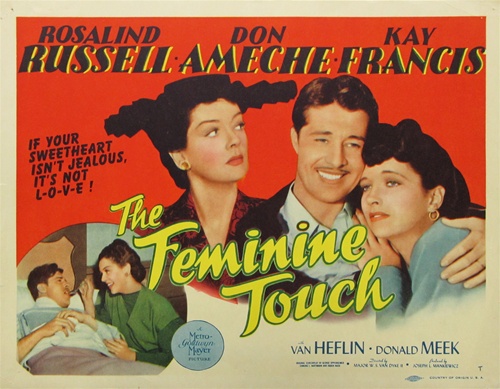
At its best, screwball comedy is a wonderful thing. It is a manic, charming, delightful walk into the wacky world of a person who lives very much in an alternate universe. The Feminine Touch (1941) does NOT fall into this category. The film features Rosalind Russell as Julie Hathaway, the wife of Prof. John Hathaway (Don Ameche), a college professor who despises jealousy as a worthless emotion, and who has decided to ditch his university job and write a book on the subject. Enter Nellie Woods (Kay Francis), the editor for publisher Elliott Morgan (Van Heflin). Elliott's not very involved in his business - Nellie does all the work in the publishing house, as her boss is too busy pursuing the high life and women. Unfortunately, Nellie is also in love with Elliott, and sees this book as an opportunity to force Elliott into paying some attention to her. Elliott, of course, is much more interested in wooing Julie. Julie's problem is that while she is not the least bit interested in Van, she is dismayed that John doesn't care that another man is trying to seduce her.
While the film has some amusing moments, primarily it is just annoying. We're presented with a number of characters who are just, quite frankly, stupid. Nellie is the only one with any brains. And Elliott, besides being an idiot, is a pest. You spend most of the movie wanting to smack him. It is amazing how long it takes him to realize that Julie is not interested in anyone but her husband. Plus, Heflin, usually such a disciplined actor, here is hugely overacting. He spends much of the movie distorting his face, to no real purpose.
Russell and Ameche are similarly annoying. She is overacting; he is just being smug. Worse still, there is NO chemistry between the two of them. Perhaps that's why this is their only film together. Though, given that both are excellent actors when given a decent script, one would have liked to have seen them together in a more sympathetic venue. With the writing talent (George Oppenheimer and Ogden Nash, specifically) and the producer (Joseph L. Mankiewicz) of the film also people's who work we admire, we were surprised that the script wasn't sharper. As it is, it just seems to go on forever. Even the final scene seems gratuitous.
We did enjoy, as New Yorkers all, the scenes of New York City, specifically the depiction of the subways. (We remember the old rattan seats and the overhead straps, which gave NYers the name "straphangers". Actually, one of us - the short one - misses those straps!). In spite of everything, Kay Francis is really quite good. As always, she gets great clothing - her hats, especially, are something to be seen. We suspected the costumers wanted to look a bit avant garde and daring - they do succeed. Her character, as we said, is the only one with a brain - she is running the company, and we suspect, will continue to run it. Ms. Francis is the breath of fresh air in the middle of chaos.
We should note that, according to this article from TCM, The Feminine Touch was actually quite well received when it was released, so you may want to judge for yourself whether it is a hit or a miss. To get you started, here is a trailer:
Based on a play which starred Tallulah Bankhead, Forsaking All Others
(1934) is an absolutely delightful film. With an exceptional cast,
which includes Ms. Crawford, Clark Gable, Robert Montgomery, Billie
Burke, and a brief appearance by Rosalind Russell; and a screenplay by
Joseph L. Mankiewicz, the viewer is given a delightful 84 minutes of
great acting and witty dialogue. Joan's Mary Clay is preparing for her
long-anticipated wedding to her childhood friend Dillon Todd (Robert
Montgomery). The day before her wedding, unsuspecting Jeff
Williams (Clark Gable) returns from Spain, with enough money to propose
to Mary, whom he has loved since they were children. His disappointment
is palpable when he discovers he is too late, but rather than burden the
ecstatic Mary, he agrees to give away the bride. Come the day of the
wedding, however, Mary learns that Dill has eloped with his former
paramour Connie Barnes (Frances Drake). Mary tries to
start over without Dill, but when he renews his pursuit of her, she
begins to succumb to his charms.
The script is just full of little bon mots, like
"I saw [a fan dance] with electric fans once, it was awful" that keep
you giggling through the movie, along with sight gags like Robert
Montgomery sound asleep in a lacy nightie. And you can't do better
than this cast. Gable is just commanding as Jeff. He conveys so much
by just LOOKING; all his hurt and love shine out of his eyes. And
Crawford was never more endearing. Even when she is about to mess up
her life totally by returning to Dill, you still adore her, and just
want her find her way to Jeff. Robert Montgomery, a versatile actor who
played everything from the love interest, lunatic, war hero, and second
banana, walks a very thin rope here. He manages to keep Dill appealing,
while you still want him to lose the girl. A hard job, but Montgomery
is more than up to the task.
Finally, a word about another
performance: that of Billie Burke as Mary's dear friend, Paula. One is
so used to seeing Ms. Burke as a ditz, that it is a pleasure to see her
play someone with some sense. Yes, Paula is still a bit of a nut, but
she is sensible and loving. Her regard for Mary know no limitation, and
she does everything in her power to protect this girl who is nearly her
own child.
This film is not shown enough. It should be shown more. Next time it is around, do see it.
That wonderful year of 1939 brought us Joan Crawford, along with a galaxy of
female stars, playing the gold-digging, husband-stealing Crystal
Allen in The Women. Norma Shearer is the star here; Mary
Haines, the woman whose husband is stolen by Crystal. The movie, as the
tagline says, stars all women, but is about men - the men in their
lives, who they talk about constantly. We have all kinds of women here,
from the innocent (Joan Fontaine) to the experienced (Paulette Goddard)
to the nearly idiotic (Mary Boland, as the hysterical Countess de
Lave). Rosalind Russell, in a supporting role, shines as the gossipy
Sylvia Fowler, and there is an equally enjoyable performance by Lucile
Watson as Mary Haines mother.
Much of our conversation focused on
the position of this movie within the "chick flick" universe - starring
only women, could it be a chick flick? Interestingly, the movie was
marketed to men. One assumes the moviemakers figured the men were the
harder sell, so the ads point up many lovely, undressed ladies ("Zips up
the back and no bone"). It is surely a movie about women; and the
little fashion show demonstrates it is a movie FOR women. But there is
enough, we thought, to keep a man watching.
Crawford is just
magnificent here. And she surely has the best line in the whole movie:
"There's a name for you ladies, but it no used in high society, outside a
kennel". Crystal may lose the fight, but she'll be back again; perhaps
to win the war!
This week, our movie is the 1938 comedy Four's a Crowd.
Olivia plays Lorri Dillingwell, the daughter of a wealthy businessman.
She is engaged to publisher Patterson Buckley (Patric Knowles), who is
being forced to shut down his newspaper. Jean Christy (Rosalind
Russell), a reporter about to lose her job, decided to entice former
reporter (and now successful PR man) Robert
Kensington Lansford (Errol Flynn) back to the paper. Easier said than
done, of course; Bob decides to use Pat as a means to potential client
Dillingham (thought Lorri, of course). Jean is in love with Bob; Pat is
in love with Lorri; Lorri develops a mad crush on Bob. And Bob? Well, we
THINK he loves Jean. Or maybe he loves Lorri. Or maybe he just is in it
for the money. We're not exactly sure for quite a while. But, it's a
WB comedy, so it all turns out right in the end (and I won't tell you
who ends up with whom. You'll have to watch the film).
Sure,
this is a little piece of fluff. Rather silly at times, but with such
wonderful actors, how can you go wrong? Olivia is back playing a
character very similar to Marcia West in It's Love I'm After - somewhat
silly, and rather easily swayed. Errol Flynn gets to be decidedly
silly - the scenes of him running from the dogs that guard the
Dillingham mansion are a riot (and it doesn't hurt that we get to see
him without his shirt. The man had QUITE a nice physique).
Rosalind
Russell is very adorable as Jean, who knows what she wants, but can't
seem to quite get him into her grasp. And while none of us are
particular fans of Patric Knowles as a rule, he's actually pretty good
here. He manages to hold his own, for the most part, with this
powerhouse of talent.
As always, we see some nice character parts - Walter Connolly as Mr. Dillingham, is, as always, very funny. And Margaret Hamilton as Amy, who would easily walk on hot coals for Bob. Both actors it is a pleasure to see. We do get to see a lot of Connolly. Not enough of Hamilton.
Next week, we'll be watching something none of use were familiar with: Call it a Day. In the meantime, here's a trailer to introduce you to the characters: