Showing posts with label Henry O'Neill. Show all posts

Thursday, May 20, 2021

Barbara is on Her Own

Patrice Harkess (Barbara Stanwyck) sits holding her baby, Bill Harkess (John Lund) nearby. They are waiting for something, and Patrice believes that, when it comes, Bill will leave her.  The phone rings - it's the police, and they are on their way over.  Our film tonight is No Man of Her Own (1950), part of the Hidden Classics Blogathon, hosted by the Classic Movie Blog Association.

This has long been one of my personal favorite Barbara Stanwyck films, and it was one she was eager to do (Barbara Stanwyck: The Miracle Woman by Dan Callahan).  She is perfection as a woman thrown into a morass, and comes back to look it square in the eye. For Patrice Harkness is a name forced on unwed mother Helen Ferguson. Abandoned by her lover, Stephen Morley (Lyle Bettger), with only a train ticket to New York to her name, she finds herself on the train, unable to find a seat, and with no money for food. She's "adopted" by Patrice (Phyllis Thaxter) and Hugh Harkness (Richard Denning), a young couple pregnant with their first child, en route to meet his family for the first time. In less capable hands, it would be hard to understand just why the Harknesses take on this needy young woman, but Ms. Stanwyck makes you understand from the start the inner goodness of Helen Ferguson, who only wants to be able to make a decent life for her and for her coming child. That Helen was originally to be a prostitute (AFI catalog) seems outlandish having seen the film.  The audience must care for her, and Ms. Stanwyck wraps her audience around her lovely finger. She also has the inner determination to handle the problem that is Stephen Morley (TCM article).

While it is true that John Lund is not an actor in Ms. Stanwyck's league (then again, who is?), he does a good job in keeping their relationship on an even keel.  A particularly telling scene is one in which his father (Henry O'Neill) adjusts his will.  The audience is starting to realize that Bill is suspicious of Patrice; but when she reacts with horror at the news about the will, Bill's reaction sets us up for the rest of their relationship - it doesn't matter to him any longer who she is. He knows the kind of person she is and that is all the information he requires. 

Jane Cowl (Mrs. Harkness) is superb as the loving mother who looks to Patrice and her baby as the final link to her deceased son. She's warm, friendly, and protective. But she is also smart; she knows very quickly that Patrice is in some kind of trouble and she begins immediately to find a way to safeguard her family - including Patrice - from any danger. Ms. Cowl only made a total of seven pictures (in Stage Door Canteen, she played herself). However, between 1903 and 1947, she was in 33 Broadway plays, many of which she wrote and/or directed, including Smilin' Through (which was made into a film with Norma Shearer). She died in 1950, at the age of 65.

Lyle Bettger  (Stephen Morley) is deliciously evil as a horrible man who keeps the audience on tenderhooks. We never really believe him, but at the same time, it's hard to think that anyone could be as bad as he is.  In his first scene, we watch him ENJOY Helen's heartbreak.  This is his lover, pregnant with his child, but he's done with her. He's like a peacock preening at her misery, which of course he sees as her need for HIM.  A little hint of the future is given when we meet his new inamorata, Irma (Carole Matthews) who is disgusted at his treatment of Helen.

Using Phyllis Thaxter (Patrice Harkness) and Richard Denning (Hugh Harkness) as the young married couple is an interesting conceit. Both are well enough known to the audiences that one is  lulled into thinking they will be with you for the whole movie. Sadly, that is not to be, but both are lovely in their brief scenes with Ms. Stanwyck.  Their warmth echos what Helen will find when she inadvertently adopts Patrice's identity.

The film was based on a story by Cornell Woolrich, I Married a Dead Man (Senses of Cinema). The New York Times review by Bosley Crowther is unimpressive, but in a 2012 New York Times commentary upon the DVD release, Dave Kehr discusses the intricacies of director Mitchell Leisen's work. 

The Screen Director's Playhouse aired a version on television in September 1951 with Ms. Stanwyck in the lead. The film was remade in 1996 as Mrs. Winterbourne  with Ricki Lake in the title role. Nothing, however, can beat Ms. Stanwyck, and we heartily recommend this wonderful film. We'll leave you with a trailer

Before you go, I suggest you visit the Classic Movie Blog Association page for this blogathon, and look at some of the other films being discussed for this celebration. 


Monday, March 23, 2020

White House Kay

Lucy Chase Wayne (Kay Francis), the wife of Secretary of State Stephen Wayne (Preston Foster) is the granddaughter of a U.S. President. She has ambitions for her husband to achieve the same position.  Lucy also wants to circumvent the efforts of Irene Hibbard (Verree Teasdale), the wife of Supreme Court Justice Carter Hibbard (Walter Connolly) to romance Senator Gordon Keane (Victor Jory). So, to tweak Irene's nose, she suggests to woman's club president Lavinia Mae Creevey (Louise Fazenda) that Carter would be an excellent presidential candidate, never dreaming it will interfere with her own desire to be the First Lady (1937).

Kay Francis doesn't often get the chance to do comedy, but she's a excellent comedienne, as we've seen in films like The Goose and the Gander, Jewel Robbery, and Cocoanuts. First Lady is in the category of the first two films - a romp, where Ms. Francis gets to figuratively wink at the goings-on in the political arena, circa 1937.

This is a fictitious Washington - no mention is made of the current political administration, and there is certainly no President Chase in U.S. history. Regardless, the film is gently poking fun at the ways in which candidates for office are selected, and it looks like not much has changed in that regard. Though Lucy knows politics (she writes and/or edits her husband's speeches), she cannot run for office - it is a man's world; women can maneuver from behind the scenes, and be the "power behind the throne."  
Most of the action focuses on the two female adversaries, Lucy and Irene. There has long been bad blood between the two, and Lucy now sees a way to embarrass Irene. The reasons for Lucy's ire are, not surprisingly petty - Irene stole Lucy's cook, and is also making a play for the man Stephen's niece Emmy Page (Anita Louise) loves. But, her plans backfire horribly, and Lucy has to concoct a new means of besting Irene. 


Where Ms. Francis plays her part tongue-in-cheek, Verree Teasdale is downright serious. Ms. Teasdale's Irene is an avaricious woman, who wants power and men (though not necessarily in that order). As a result, the interplay between the two is spot-on, with each getting good lines, but with Ms. Francis coming off as the more sympathetic character. Without such a strong actress to play against, Lucy would seem ridiculous. Opposite Ms. Teasdale, she is delicious. It is worth noting that Irene's prior divorce does not seem to be an impediment to her husband seeking higher office.
The men in the film mainly serve as support to the the two women. Preston Foster does a good job in a part that could resemble a tree in the hands of a lesser actor.  Victor Jory gets the rare opportunity to play the juvenile and romantic interest to both Emmy and Irene. Walter Connolly, however, steals every scene as the somewhat bumbling Supreme Court Justice who would rather listen to the radio than romance his bored wife. 

It's unfortunate that Anita Louise doesn't have more to do than look innocent, she's a good actress, but the part pales in comparison to the lead actresses.  Louise Fazenda, however, as the annoying Mrs. Creevey is hilarious. The script has a lot of fun with her strict abstinence. Her inability to understand that she is drinking strong alcohol when she given a glass of absinthe -  and keeps asking for more - is very funny. 

Unfortunately, the film did not do well at the box office, and helped to begin Ms. Francis' slide from the top at Warner Brothers (TCM article).  It may not be her best film, but we really enjoyed it and suggest you add it to your list.

Monday, July 15, 2019

Bette Designs

Con man Sherwood Nash (William Powell) decides to forgo financial scams in favor of fashion scams when he meets would-be designer Lynn Mason (Bette Davis). Using Lynn's talent for sketching and eye for successful dresses, Nash "borrows" dresses en route from Paris to New York design houses, and sells cheap copies ("designed" by Lynn) to low-end competitors. He then convinces the New York designers to send him to Paris to do the same for them - get the  Fashions of 1934 (1934) to them at a lower price.

Part of the AFI Silver Theatre's Library of Congress Film Preservation Showcase. Fashions of 1934 was projected with a newly restored 35mm print of this film. Like it's sister film, In Caliente, Fashions of 1934 is an excuse for elaborate musical numbers as well as stunning dresses exhibited in various fashion shows. If you've seen The Women, you are familiar with this kind of scene - lovely, period dresses, but the kind no member of the film audience would probably ever be able to afford. However, add a little Busby Berkeley magic, and you've got production numbers that you will long remember.

The biggest number involves human harps - yes, you read that right. The image below will give you just an idea of the piece. The trailer will show you another - lovely ladies with feather fans that are used to create gorgeous shapes. There's no way these routines would ever be on a stage at a fashion show, but I doubt anyone really cared.
William Powell is delightfully suave as the con man extraordinaire "Sherry" Nash. The part is reminiscent of the role he played in Jewel Robbery (1932). Even though he's unabashedly dishonest, the audience roots for him - he's just charming. He also has quite a good rapport with his two female co-stars, Bette Davis and Verree Teasdale (Grand Duchess Alix/Mabel McGuire), two very different actresses with extremely different acting styles.  With Mr. Powell there, you don't notice a change of tone.
Not surprisingly, Bette Davis was not thrilled to be in this picture. She wanted meatier parts, and this certainly was not what she was looking for. She stated that she was "all done up like a third-rate imitation of the MGM glamour queens. That isn't me. I'll never be a clothes horse or romantic symbol." (TCM article). Regardless of her discomfort with the part, she acquits herself well (though she is much better looking as a brunette). As for her desire for better parts, she would get her wish later that year, when she FINALLY was given permission to play Mildred in Of Human Bondage (1934) (The Lonely Life: An Autobiography by Bette Davis).

Verree Teasdale is amusing as Hoboken native and faux countess Alix. Ms. Teasdale started on Broadway, ultimately performing in 13 plays between 1924 and 1932; she appeared in her first film in 1929, and worked fairly steadily until 1941; thereafter, she did some radio work, often with her husband, Adolphe Menjou. Their marriage lasted from 1935 until his death in 1963 (they had one child). Ms. Teasdale died in 1987 at the age of 83.
In a part reminiscent of his character in One-Way Passage (1932),Frank McHugh plays Snap, a photographer - and con man/thief - who is Sherry's right-hand man.  Mr. McHugh makes the most of what he's got, though the part is mostly comedic.  It must be mentioned that, as intriguing as his little cane camera is, it's odd that he has to constantly hold it up to his eye to get pictures - resulting in the "secret camera" being not very secret.  There is an emphasis on this particular gimmick, and our reaction was that you'd have to be particularly stupid to not figure out what he is doing.

Several other character parts are worth mentioning - Hugh Herbert (Joe Ward) is actually not annoying in this film.  Reginald Owen (Oscar Baroque) and Henry O'Neill (Duryea) as part of the fashion industries in Paris and New York (respectively) are frankly as dishonest as Sherry and his crew.  Arthur Treacher makes a brief appearance as - what else - a butler.
Originally titled King of Fashion (AFI Catalog), this is a pleasant film with some lovely Berkeley numbers. Certainly, it is reminiscent of other films released around the same time, but with William Powell delivering the dialogue, you barely notice that it's typical.  I'll leave you with a trailer from the film (and a preview of one of the amazing dance routines.

Monday, May 13, 2019

Margaret Hires a Maid

Having not been paid by her employer for four months, housekeeper extraordinaire Lizzie (Ruth Donnelly) quits her job and heads off to an employment agency. She meets Joan Smith (Margaret Lindsay), a young married woman who is searching for a maid. But with her limited income, Joan can't really afford a maid of Lizzie's qualifications. Lizzie, however, is intrigued by Joan and  her son Bobby (Ronnie Crosby), and agrees to take a pay cut to work in the household. Lizzie has a plan to bring Joan and husband Jimmy (Warren Hull) up to her employer standards. This week, we're discussing Personal Maid's Secret (1935).

Every once in a while you fall into a film you've never even heard of, and that provides low expectations.  Personal Maid's Secret is one of them. Originally entitled Living Up to Lizzie, (AFI catalog), it is in fact a delightful little comedy. While the plot is pretty transparent, the acting is so good that you warm to the film almost immediately. Leading the cast (though she got fourth billing) is Ruth Donnelly. Her Lizzie is a practical sort - she leaves her current employment confident that she can secure another position immediately. While she is qualified for a much more well-paid position, she takes on the job with the Smiths because she has a good feeling about them - and because she feels she can help them. Finally Lizzie is a woman with a past - we know it from the start, and when we discover the truth about her, she becomes even more endearing (we wondered if perhaps the film was originally written before the code, as some of the early hints about Lizzie's past suggest a bit of hanky-panky).
Margaret Lindsay gets first billing and is engaging as the young wife trying to help her husband make his way in the world of business. Jimmy is an insurance salesman, and as such, needs contacts. Lizzie suggests to Joan that the best way for Jimmy to get ahead is for the Smith's to entertain. But to do that, they'll need to have a display of affluence. Using her pin money and some ingenuity, Joan is able to get the ball rolling. Ms. Lindsay plays the part with warmth - there is never a suggestion that Jimmy needs to succeed to make her life easier. Their marriage is a partnership, and his success is hers as well.

It's not often that one gets to see Frank Albertson (Kent Fletcher) play a good guy, but he does here, and is quite appealing as Joan's inventor-brother. As with the other characters, there is no hint of grubbiness - Kent lives with his sister because it is expedient for both of them. He is working - and working to develop a new engine carburetor, which he hopes will increase gas mileage. When he becomes enamored of Diana Abercrombie (Anita Louise), you root for him to get the girl. Ms. Louise is lovely as the wealthy young lady whose life is about to change. And it's nice to see Arthur Treacher (Owen) - as always, playing Arthur Treacher!
One 21st Century problem with the film is the character of Bobby. Bobby is fascinated by "colored" people (in the 1930s, "colored" was a polite term. Think of the NAACP). The Smiths had a maid who was African-American at one point, and Bobby clearly adored her. So, he's decided that he wants a friend who is African-American. But what makes his constant queries interesting is that Bobby doesn't really see race - he asks the very white Palmers (Henry O'Neill and Lillian Kemble Cooper) if their son is colored. So, while his questions can be a bit unnerving, it's also an interesting comment on the ability of children to accept regardless of race. The song "You've Got to be Carefully Taught" comes to mind.

Our villain, Warren Sherrill, is convincingly played by Gordon Elliott. If he seems familiar, you might know him from his later career as a Western actor and the role Red Ryder - Will Bill Elliott. Born on a ranch in Missouri, Mr. Elliott came by his Western expertise naturally. He became a horse breeder, and retired to a ranch in Nevada after his retirement. He died in 1965 at the age of 61.

Given that this was a B movie, the set design and costuming are outstanding. The Smith's home needs to reflect their life, and the work done by Carl Jules Weyl are an important part of the story.  Orry-Kelly did the costume design, and, as always, it is impressive.

The film was not widely reviewed, but Variety gave it a very positive review (Wild Bill Elliott: A Complete Filmography by Gene Blottner), as did the Sydney Morning Herald, which complimented Ruth Donnelly for "the warmth with which she plays this part and the perfectlon of the portrait's detail," and said the film itself is" shrewd and humorous and the conversation is so natural that the spectator is able to forget the plot, which contains no surprises." There ARE a couple of slight surprises, though by and large it's a convention plot; but with such fine acting and such appealing characters, you won't care.


We'll leave you with a trailer and a suggestion that you seek this one out.

Tuesday, January 16, 2018

Margaret Looks for Magic

An infant is abandoned at a New York City foundling hospital and the matron on duty makes a phone call to the Institute of Child Psychology. Professor Peter Vincent (Philip Merivale) and Dr. Woodring (Alan Napier) arrive to conduct a series of evaluations on the infant; she is adjudged satisfactory, and removed to the Institute for education. The Institute has a theory about education, and have taken on the infant girl, named Alpha (Margaret O'Brien) to test their theories. Alpha will be taught Chinese, music, chess, math and history, but will be removed from the rest of the world, so as to eliminate any corrupting influences. At age 6, Alpha, now fluent in Chinese, able to read complicated books, and an expert in world history, is ready to be tested by Professor Josh Pringle (Henry O'Neill). When word gets out about Prof. Pringle's arrival, reporter Mike Regan (James Craig) arrives at the Institute to do a story on the prodigy. Bemused by Alpha's concrete understanding of the world, Mike tells her the world is full of magic, a concept that has been rejected by her tutors. So the Lost Angel (1944) ventures out of the Institute to find Mike and prove the validity of magic.

This is a truly delightful film, both moving and funny, with a cast that is in top form. Margaret O'Brien is excellent as Alpha, a little girl who is, at times, more mature than her elders. She manages to make Alpha smart without being a show-off, but also to retain Alpha's innocence and child-wonder of the new world she is being revealed. (The character is somewhat reminiscent of Natalie Wood's Susan Walker in Miracle on 34th Street.)  In 1945, Ms. O'Brien was presented a special juvenile Oscar, for her work that year (including this picture) (AFI catalog) The story of that Oscar did not end in 1945 - it was stolen from Ms. O'Brien's home in 1954, shortly before her mother's death, found 50 years later (for the full story, visit this blog post) and returned to the ecstatic Ms. O'Brien.
But Ms. O'Brien would be lost if it was not for the rapport that she has with both James Craig and Marsha Hunt (Katie Mallory).  Ms. Hunt is particularly terrific, combining a developing motherly affection for the child with a wariness of her. The scene of their meeting at Katie's nightclub is especially funny. The image of the Alpha and Katie staring at one another in a game of visual chicken is wonderful (Katie loses the match!). They would appear in another film together that same year: Music for Millions.

Ms. Hunt, who just celebrated her 100th birthday, began her film career in 1936 with The Virginia Judge; she retired from acting in 2008, following her appearance in the short film The Grand Inquisitor (for more on her appearance in this film, listen to this Film Noir Foundation podcast on Ms. Hunt). A truly underrated performer (watch her extraordinary performance in Cry 'Havoc' (1943), her career was foreshortened when she was blacklisted. Her crime - she was a member of the Committee for the First Amendment, and protested HUAC's questioning of the Hollywood Ten.  Offered the opportunity to apologize for her protest, she steadfastly refused, and channeled herself into working for world peace and the environment (Deadline Hollywood). Now retired, there are ongoing efforts to make a documentary on her life.

The film is gifted with a number of fantastic supporting actors. Keenan Wynn had already appeared in four films, only one of which credited, when he appeared as Packy Roos in our film, and he is  wonderful as a gangster who doesn't read very well.  His interactions with Ms. O'Brien are very funny, resulting in several sweet and amusing scenes. Alan Napier, Philip Merivale, Donald Meek (Professor Katty), and Sara Haden (Rhoda Kitterick) also handle their parts with extreme delicacy. It would be easy to make the members of the Institute into villains, something these remarkable actors avoid. Their love for Alpha is apparent from the beginning of the film - though she is their job, she is also a responsibility, and one that requires understanding and affection.

There are a few more actors to watch for - Ava Gardner in an unbilled roll as a Hat Check Girl. Even though you don't get a good look at her, the voice is unmistakable. Robert Blake, as Mike's neighbor Jerry is credited, but Bobby Driscoll (as Bobby, the boy on the train) is not. This was Mr. Driscoll's film debut (TCM article).
Radio versions of the film would appear on the Lux Radio Theatre in  June 1944, with Mr. Craig, Ms. Hunt, and Ms. O'Brien reprising their screen roles, and in December 1946 with Ms. O'Brien again enacted Alpha on Academy Award Theater. The story had been written specifically for Ms. O'Brien at Louis B. Mayer's orders (he wanted her to be the next Shirley Temple).

After reading Bosley Crowther's review of the picture in the New York Times , we wondered if he had seen the same movie as we did.  Variety, however, did enjoy the film, as did my fellow blogger at Laura's Miscellaneous Musings. We'll leave you with the meeting of Alpha and Mike, and the suggestion that you settle down in front of the TV with this little gem. It's an evening well spent.

Tuesday, August 8, 2017

Barbara's Secret Marriage

Ruth Vincent (Barbara Stanwyck) and State Attorney General Robert Sheldon (Warren William) elope. When the ceremony ends, they look for a phone - he to call his office; she to contact her father, Governor W. H. Vincent (Arthur Byron) with their good news.  But Robert's call results in a roadblock to their happiness; Ruth's father has been accused of taking a bribe, and the only way for Robert to investigate the charges is for Ruth to remain The Secret Bride (1934).

Audiences at the time of release would have known from the trailer the serious nature of the film, though the title really makes one believe this is a romantic comedy. Based on an unproduced play, Concealment, by Leonard Ide, this was not really a movie anyone wanted to make (except producer Hal Wallis) - William Dieterle later said "the script was bad..." (TCM article).  Both director Dieterle and Ms. Stanwyck were under contract to Warner Brothers, however and neither could afford to be suspended  - Ms. Stanwyck was supporting herself, her son, and her then husband Frank Fay, and the Fays were having financial issues with the Internal Revenue Service [A Life of Barbara Stanwyck: True Steel 1907-1940 by Victoria Wilson]. So, rather than go on suspension, Ms. Stanwyck apparently grit her teeth and took on a role that was certainly beneath her talents.

The role of Ruth is really not one of Ms. Stanwyck's best - the part is under-written and she has little to do except be morose about her hidden marriage. She's only given one really good scene - Ruth goes to confront her father with evidence that his personal typewriter was used to write a letter demanding bribe money. Ruth, who has a close and loving relationship with her father, is distraught and feels betrayed by her suspicions about her father's actions. His denial of the charges, and her reactions to his protestations of innocence are strong and convincing. It's interesting that Dan Callahan in his biography, Barbara Stanwyck: The Miracle Woman, felt exactly the opposite. We, however, thought that Ms. Stanwyck played the scene perfectly. Stanwyck plays her as young and inexperienced, making the scene strong and appropriate for what little we know about Ruth.
Also wasted is Glenda Farrell as Robert's secretary, Hazel Normandie. She SHOULD have a pivotal role - she's romantically involved with one of the villains (she doesn't know he is a villain), and she is accused of a murder. But by the end of the film, she's all but disappeared from view. She doesn't even really figure into her own murder trial. A shame really, because Ms. Farrell is able to deliver a clever line like no one else.
Grant Mitchell's Willis Martin, the pawn in the scheme, should be a more interesting character, but that role too is poorly outlined. As a result, Martin, with his constant weeping and quivering, is merely annoying. You really want to shake him and tell him to get a grip on himself. It's a shame because, again, Grant Mitchell is a strong character actor who is given no opportunity to grow his characterization. (To see him in better form, try The Man Who Came to Dinner (1942).
The only actor who really gets to do anything in the piece is Warren William, and he runs with it. He does appear a trifle old for Ruth, but he's clearly well established in his political career, so the age difference is consistent with character. Mr. William started his acting career on Broadway (as Warren W. Krech  - he was born Warren William Krech) in 1920. The advent of sound brought hime to Hollywood and a contract with Warner Brothers. With his impressive speaking voice, he was likely a godsend to the studio, and was a leading actor in many pre-code films, including Three on a Match (1932)  and Gold Diggers of 1933 (1933). He also was cast in several series - Perry Mason and the Lone Wolf among them. Besides film work, he also did some radio, specifically a series entitled Strange Wills.  He died in 1948, at the age of 53; his wife of 25 years died a few months later.

There is a very nicely done scene which features 1930s criminal forensic science - an analysis of the typewriter used to type a bribery note. Of course, it helps if one knows what a typewriter is! 
The costuming by Orry-Kelly is stunning, especially a fur-trimmed dress that Ms. Stanwyck gets to wear (you can see it in the trailer). She also gets several really stunning hats. But Ms. Stanwyck deserves more than nice clothing - a script would help. We'll leave you with the trailer to the film:

Wednesday, February 10, 2016

Kay Carries a Lamp

The early life of Florence Nightingale, as portrayed by Kay Francis, is the subject of The White Angel (1936).  The film follows Nightingale's announcement of her intention to be a nurse, to her training at the Deaconess Institute in Kaiserwerth (Germany), to her work in Scutari during the Crimean War.

 In an era where nursing is a respected profession, it is important to emphasize the impact of Florence Nightingale in the creation OF the profession.  Nightingale horrified her well-to-do family when she told them that she had a calling to become a nurse.  The job that was nursing in England during this period involved hiring slatterns to primarily sit in hospitals and drink.  Hospitals were NOT a place you wanted to be - they were filthy, and the "nurses" did little to help the situation.  But Nightingale changed all that, first with her work in Scutari, and then with the books and reports she published after her return to England.  This film, while rather loose in its faithfulness to the story of Nightingale's life, emphasizes the spirit of the adoration that was heaped upon Miss Nightingale during and after the War. 

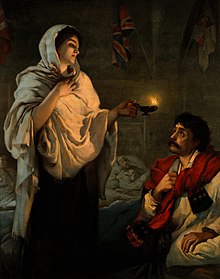
It's interesting that The New York Times, though they liked Kay Francis, is disturbed the the "reverential tone" of the film.  Yes, Ms. Francis does sometimes seem to be "striving to live up to Longfellow's 'Lady With the Lamp.'", but that is a hard image to lose.  Below is a copy of the film's poster, alongside an 1891 painting.  Tthe film mirrors the idolization of Ms. Nightingale that came down from the 1850s.  As referenced in the film, Henry Wadsworth Longfellow did write Santa Filomena (1857) about Miss Nightingale.  To a 21st century mind, this adoration can be off-putting, but it is well within the attitudes that prevailed during Miss Nightingale's life.

The Lady with the Lamp popular lithograph reproduction of a painting by Henrietta Rae, 1891.
We do take exception to some of the a-historical elements in the film. The most egregious examples is the introduction of the character of Ella Stevens (Ara Gerald), a woman who comes from nowhere to act as a nurse supervisor in Scutari.  Given all the tensions that are already present in the film, most notably with the character of Dr. Hunt (Donald Crisp), was it really necessary to import this inane woman as a foil to Florence?  It adds nothing to the plot, and only serves to reiterate the importance of the rules that were established by Miss Nightingale at the start of her venture (and the audience is already well aware that she is correct in her judgements).

What the screenplay DOESN'T do is to add a phony romantic subplot.  Charles Cooper (Donald Woods) professes his love for Florence, but she has absolutely no  interest in him.  In his biography, Eminent Victorians (which the film credits as their key source), Lytton Strachey notes that at one point, Nightingale found someone she considered to be "a desirable young man", but whom she ultimately rejected in preference to "A profession, a trade, a necessary occupation, something to fill and employ all my faculties, I have always felt essential to me..."  Woods fills that bill nicely; and Francis is excellent at displaying affection, but not romantic love.
It was interesting to see Donald Crisp fill the role of the overtly hostile Dr. Hunt.  Crisp shows much more of the imperious tone he would display in The Uninvited, but NONE of the affection and kindness.  This was a Donald Crisp we were unused to, though with 170 film and television credits, Crisp has played just about everything.  His film career began in the silent era (he played Ulysses S. Grant in Birth of a Nation); prior to that, he had served as a trooper in the Boer Wars. He studied with D.W. Griffith to become a director and during the silent and early sound eras, he directed 72 films.  Ultimately, he found the work trying, and returned to acting exclusively.  He appeared in some of the truly great films: Wuthering Heights (1939), How Green Was My Valley (for which he won the Academy Award as Best Supporting Actor of 1941), Lassie Come Home (1943), and National Velvet (1944). Married and divorced twice, Crisp worked until 1963 - his last role was as Grandfather Spencer in Spencer's Mountain.  He died in 1974, at the age of 91. 

It's unusual for Kay Francis to not spend an entire film in eye-catching clothing, but her few lovely gowns are still designed by Orry-Kelly.  Even with such an interesting subject, this movie still didn't do well at the box office (see this TCM article). As mentioned, it is not Ms. Francis' acting tht is the problem, but perhaps audiences so used to seeing her in melodramas were not prepared to watch her as an actual historical character. 

This was not the first time Nightingale's life had been portrayed.  During the silent era, Julia Swayne Gordon would portray her in The Victoria Cross (1912), and Elisabeth Risdon starred in Florence Nightingale (1915).  After our film, the story would be attempted again - this time by the British in the 1951 film The Lady with the Lamp starring Anna Neagle.  And, in 1985, a television movie with Jaclyn Smith was released. Though the 1951 film is probably the best of the bunch, we think this movie is worth your time, most especially for Ms. Francis' excellent performance.  Here is a trailer to give you a taste: