Showing posts with label Zachary Scott. Show all posts

Monday, June 14, 2021

Ann is Unfaithful

Christine Hunter (Ann Sheridan) returns home after a late party and is accosted on her front porch. She's forced into the house; we hear a scream and fighting. The next morning, her husband returns from a business trip to discover homicide detectives, a dead body, and his distraught wife. Our film this week is The Unfaithful (1947).

An exceptional cast and a tight script make this film thoroughly enjoyable. Led by the always excellent Ann Sheridan, the cast portray characters that feel like real people.  Ms. Sheridan plays Christine with an underlying insecurity that makes you believe she could be swayed by loneliness and grief. But her clear love for her husband, Bob (Zachary Scott) also makes us sympathize with her as her world begins to fall apart. The film reflects the aftermath of the war - an increasing divorce rate as couples who married quickly find that they are incompatible. Chris and Bob are not, but the misery brought about by wartime separation is really the crux of this movie.

Ms. Sheridan is ably supported by Lew Ayres (Larry Hannaford), an attorney who spends much of his time in the divorce court. Larry sees Chris and Bob as a model of marital happiness, so when the truth about Christine is revealed, he is as offended by her "crime" as her husband.  However, Mr. Ayres makes his character pull back mentally and apply some objectivity to the case, which also helps the audience to side with Chris.  

This was Mr. Ayres second film after returning from service during World War II.  He was derided before the war for declaring himself a conscientious objector. Though he refused to kill, he was was quite to serve as a non-combatant; he won three battle stars as a medic and chaplain's aide in the Pacific.  He returned to his film career, which must have seemed an impossibility at the start of the War - his studio (MGM) and the public were horrified at his unwillingness to kill the enemy - he continued working in films and television until two years before his death at age 88 (Washington Post obituary). 

Zachary Scott is frequently the villain in films, but not here. He's a loving husband who watches his life fall apart when his wife is assaulted.  Once he discovers Chris' indiscretion, Bob does come across as petulant. He is redeemed by his interactions with Eve Arden.

Eve Arden (Paula) steals the movie in her big scene with Zachary Scott. Paula, Bob's cousin, appears on the surface to be a completely thoughtless person - a gossip who rather dislikes her cousin-by-marriage and takes a certain amount of joy in putting Chris in her place. But when the chips are down, it is Paula who sees the truth in Chris' story, and is not going to let Bob get away with his judgemental attitude. It's a magnificent scene.

Normally, we enjoy Jerome Cowan (the Prosecuting Attorney), but he ends up being distracting more than convincing. We found that we sought out Larry Hannaford during the courtroom scenes. His quiet dignity made the courtroom scenes more believable.

The Unfaithful is loosely based on The Letter (1940); though much of script was unfinished when production started (TCM article). In his New York Times review, Thomas M. Prior (T.M.P.) was not impressed with the script, though he was full of praise for the three leads.

This is very much a film about forgiveness, and as Jeanine Basinger points out, the topic is unique in this post-war film (I Do and I Don't: A History of Marriage in the Movies). Clearly, the MPAA thought so as well, as they allowed a film about adultery to be shot, though with one proviso: "the MPAA agreed to allow this if the film clearly conveyed the message that divorce is undesirable" (AFI catalog)

We really enjoyed this film and heartily recommend it. We'll leave you with the trailer:


Monday, October 26, 2020

Faye is in Danger

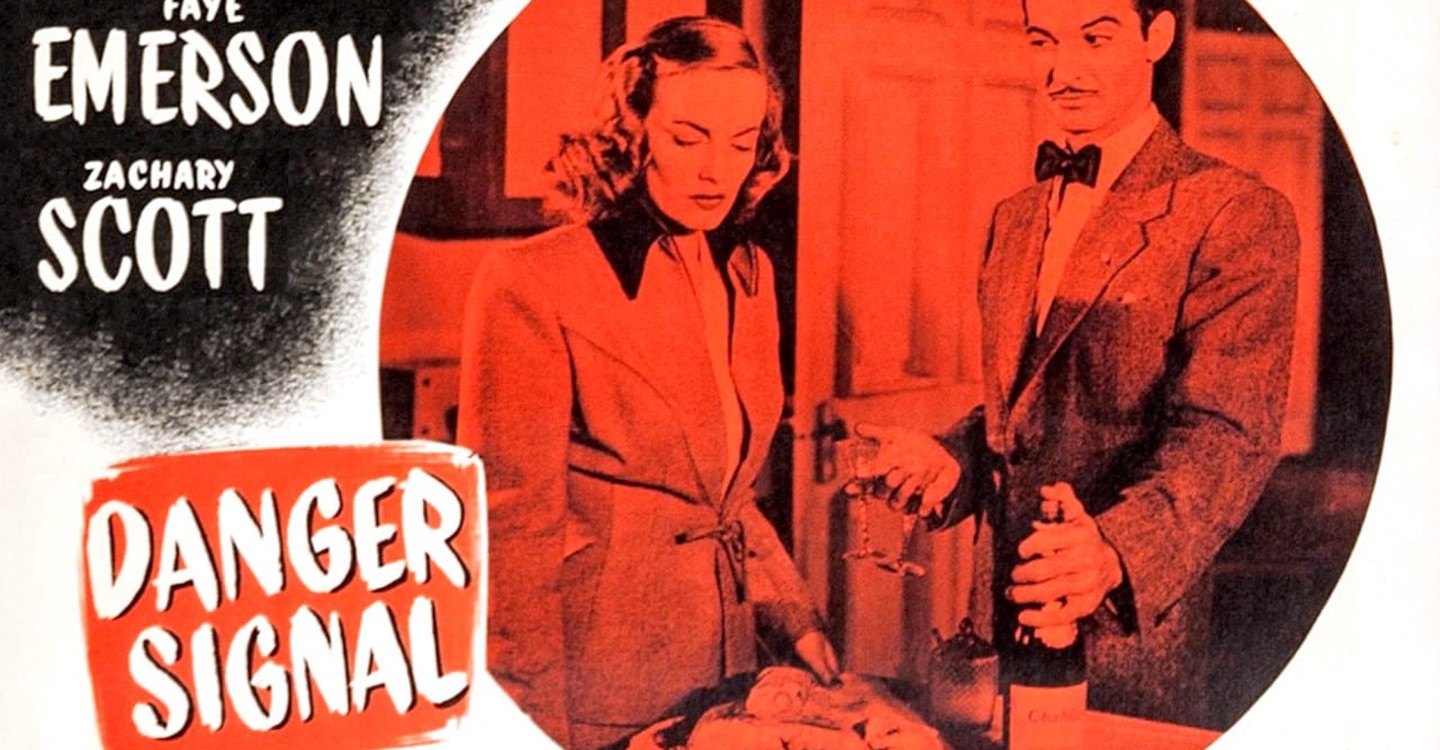
Ronnie Marsh (Zachary Scott) is a fast talking, fascinating man, who manages to convince Hilda Fenchurch (Faye Emerson) to rent him a room in the home she shares with her mother (Mary Servoss). Ronnie recently beat a hasty retreat from another town, where he was almost found with the dead body of Alice Turner. Ronnie rapidly decides that Hilda and her home offer a nice way for him to live comfortably, and he successfully woos her. But he changes his mind about his target when Hilda's younger sister Anne (Mona Freeman) returns home - Anne, you see has a substantial inheritance. Watch for the Danger Signal (1945)!
 
With Zachary Scott (who interestingly is not given top billing) in this film, you are in for a wild ride. He's perfect as an amoral seducer who is also probably a murderer. He has just the right amount of appeal that you understand why Hilda would fall for him, as well as the ability to make the audience cringe as you realize what an absolute heel he is.  Mr. Scott has an odd smile, and he has a way of turning it from endearing to menacing at the drop of a hat. The audience keeps watching because you're never sure what he will do next.

This film was released the same year as Mildred Pierce, in which Mr. Scott plays another remarkable scoundrel.  Though the characters have been compared to each other (Zachary Scott: Hollywood's Sophisticated Cad by Ronald L. Davis), these really are very different roles. You never fear Monty Beragon - he's lazy and, relatively speaking, harmless. Ronnie, on the other hand is a snake - he hypnotizes his victims, and then bites. 
Faye Emerson is equally appealing as Hilda. You have to like her if you are to appreciate the film - you need to worry about her, and wonder just what she is capable of doing to preserve her family. She's fascinated by Ronnie from their first meeting; her poise and obvious intelligence help to convince the audience of Ronnie's power over women. It's one thing when her mother and sister succumb to his charms. It's quite another when Hilda falls.

Ms. Emerson moved to California as a small child; in 1941, she landed a Warner Brother's contract after appearing in local stage productions.  She had small parts in a number of a movies, like Air Force (1943) and Destination Toyko (1943), but B movies - like Lady Gangster
(1942) - were her forte. Her first marriage disintegrated primarily because of her career; in  1943, she met Elliot Roosevelt, the son of the President. They married during the filming of this movie (which was one of a number of delays caused by their relationship), but the marriage only lasted until 1950. During the marriage, she left her Warner Brothers' contract, planning to spend the time with her husband. When she decided to return to work, she went first to Broadway (appearing in The Play's the Thing (1948) - she would ultimately appear in 5 Broadway plays) and to television, where she hosted The Faye Emerson Show. She would later work with her third husband, Skitch Henderson and become a regular on game shows and talk shows (Women Pioneers in Television: Biographies of Fifteen Industry Leaders by Cary O'Dell). Ms. Emerson retired in 1963; she died in 1983 at the age of 65.
Ann Blyth was originally slated for the role of Anne, but a back injury caused her to drop out (AFI catalog). Mona Freedman does a good job in a thankless role; Anne makes a good contrast to Hilda - she's silly, feckless, and uncaring. It's hard to like or care about Anne - she has little regard for the rest of her family and seems to get pleasure out of hurting her sister. In contrast, Rosemary DeCamp is excellent and convincing as psychiatrist Dr. Jane Silla - the voice of reason and experience in the film. The character is a tip of the hat to the novel’s author, Phyllis Bottome, who was a student of psychologist Alfred Adler (Eddie Muller intro). Ms. DeCamp would later state this was her favorite film role (TCM article).

Dick (Richard) Erdman, who has a small amount of screen time as Anne's would-be love interest, Bunkie, died last year at the of 93, after a career in films and television that lasted from 1944 until 2017.  Bruce Bennett (Dr. Andrew Lang) is banal as Hilda's boss - a research physician working in botulism. Appearing opposite Zachary Scott again (he was Bert Pierce in Mildred Pierce), Mr. Bennett fades into the background - he's not really a dynamic personality, and placed in contrast to Mr. Scott, well, there simply is no comparison.

Thomas M. Pryor's (TMP) review in the New York Times was lukewarm, however, the film showed a profit at the box office.   There's only one problem - it's the ending, which takes a very bizarre turn that can make you feel a like you have a slight case of whiplash. Regardless, you will spend the film engaged with the characters and the story.  We'll leave you with the trailer:
Monday, January 13, 2020

Joan Bakes

There's been a murder. Monte Beragon (Zachary Scott), the second husband of Mildred Pierce (1945) is dead, and the prime suspect is Mildred's (Joan Crawford) ex-husband, Bert (Bruce Bennett). As Mildred relates the story of her life with Bert, Monte, and her children, we realize there are several suspects to the crime, including Bert's former partner Wally Fay (Jack Carson) and the Pierce's oldest daughter, Veda (Ann Blyth).

Our group discussed Mildred Pierce back in 2011;  we decided it was time for a re-watch.  The first reaction to the film this time was remembering how much we all despised Veda Pierce.  Ann Blyth plays her part with such supreme self-obsession that it's hard to find anything good about Veda. Even when she is telling her doting mother how much she loves her, Ms. Blyth has a look in her eyes that displays her manipulative behavior.  It's a remarkable performance, and one which Ms. Blyth does not couch by trying to make the audience like her (Shirley Temple was considered for the part - Director Michael Curtiz was not sympathetic).   Ms. Blyth did an interview at the TCM Film Festival (you can see her discussion of this film begins beginning at 5:14).
Jack Carson  was, at one point, considered for the role of Monte Beragon (AFI catalog). It's hard to imagine him as a loafer - Wally Fay is constantly in motion, always looking for a deal, always on the make for one woman or another. Zachary Scott, on the other hand seems tailor-made for the passive Monte, a man who's never lifted a finger to do anything besides play polo and take other people's money.  The casting of Mr. Scott is an easy choice - it's helpful that he looks rather caddish, and since we know from the start that Monte is the victim, the audience can just wait to find out what he did that resulted in his murder (Zachary Scott: Hollywood's Sophisticated Cad by Ronald L. Davis).
Zachary Scott was born in Austin, TX; he left his home town at age 19 - he dropped out of college and worked on a freighter bound for London, where he worked in repertory theatre for nearly two years. Once back in Texas, he continued to appear on the stage; there, he was noticed by Alfred Lunt. Small parts on Broadway followed (he appeared in 6 Broadway productions throughout his career), which led to a contract from Warner Brothers. He never really evolved much beyond supporting roles in films like Shadow on the Wall (1950) and Flamingo Road (1949); his major starring role was in The Southerner (1945). By the 1950s, he was moving to television like many of his colleagues. Married twice (he had a child with each wife), he died in 1965 at the age of 51 of a brain tumor. 
If there is one person who comes close to stealing the film from Joan Crawford, it's Eve Arden (Ida Corwin). Besides bringing some humor to this melodramatic story, she the voice of truth She has what is perhaps the best line in the film (certainly the best comment on Veda): "Personally, Veda's convinced me that alligators have the right idea. They eat their young."  Ms. Arden received her only Oscar nomination (with Ann Blyth) in the Supporting Actress category (they both lost to Anne Revere in National Velvet).  She would later say that she never expected the part to bring her a nomination (TCM articles). 

Though it was nominated for 6 Oscars, the only winner that night was Joan Crawford, who wasn't even the first choice for the role - Michael Curtiz wanted Barbara Stanwyck. Ms Crawford wasn't at the ceremony, however. Fearing she would not win (see Ann Blyth's TCM tribute to Joan Crawford), Ms. Crawford took to her bed and called in sick. However, when she was notified that she had indeed won the award, she invited the press into her bedroom, where she prettily sat in her sickbed with the Oscar in her hand. 
 

The story was remade as a television miniseries in 2011 starring Kate Winslet.  With more time (five one-hour episodes), and no production code to deal with, the miniseries is closer in plot to James M. Cain's original book.  Carol Burnett did one of her memorable spoofs, "Mildred Fierce" (shoulder pads and all!). The film was added to the National Film Registry in 1996.

If you've never seen this production, treat yourself and find a copy - it's one of Ms. Crawford's finest performances (allegedly, her favorite role), and a film noir par excellence. Here's a trailer to whet your appetite.

Monday, June 4, 2018

Ann is in Front of the Wall

David Starrling (Zacharay Scott) returns from a business trip; his daughter Susan (Gigi Perreau) is thrilled by his return. But his wife, Celia (Kristine Miller) is not. When David goes out of the apartment, he spots Celia in a car with Crane Weymouth (Tom Helmore) and their interaction are clearly intimate.  When David questions her casually, Celia tells him she went to a play with a girlfriend, but that evening, when Celia's sister Dell Faring (Ann Sothern) arrives for dinner with her fiance - Crane - David is able to confirm that Celia and Crane are having an affair. As they argue in their bedroom that night, David picks up a gun, and Celia decks him with a metal handmirror. Dell's arrival a few minutes later precipitates another argument, resulting in Dell firing the gun and killing Celia. As Dell runs out of the bedroom, the screams of young Susan echo down the hall. Our film this week is Shadow on the Wall (1950).

Though this is NOT a remake of The High Wall, the plot elements are remarkably similar - a spouse murdered, an orphaned child, a female psychiatrist trying to figure out what is going on, and a murderer who has no scruples when it comes to protecting his - or herself. And like Herbert Marshall in our last film, Ann Sothern is in far different acting territory in this film. She'd made a big success at MGM in the Maisie series, and had spent most of her career there doing light comedy. But with A Letter to Three Wives, she demonstrated her gifts as a dramatic actress. It's hard to sympathize with the dead Celia - she's spent her life backstabbing her sister and has graduated to cheating on her husband.  But this film takes her crime one step further - Dell Faring will stop at nothing to protect herself, even if it involves the murder of a child. (TCM article). Ms. Sothern makes Dell sympathetic up to the point when she realizes that Susan is a danger to her. At that point, her obsession with getting rid of the girl turn the audience firmly to the Starrling family, and to Dr. Caroline Canford (Nancy Davis) who's attempting to piece together what Susan saw.
I'm not a fan of Nancy Davis (Reagan) ordinarily, but she is perfect in this film. She plays Caroline with an appropriate detachment that emphasizes the professionalism of the woman. Her conversations with Pike Ludwell (John McIntire) demonstrate her concerns about the Susan and her father, but she never lets it get in the way of her duties as a physician. Her subtle performance make Dr. Canford one of my favorite onscreen physicians.

Zachary Scott's biography by Ronald L. Davis is entitled Zachary Scott: Hollywood's Sophisticated Cad. And while he certainly did play a lot of them, he doesn't here. David is a good man; he truly believes that he is guilty of the crime with which he is charged - albeit accidentally - and is ready to pay the price. His only concern is his child - everything he does while in prison hinges on his desire to find a safe and loving environment for Susan. That we know he is innocent helps in making him sympathetic, much of the credit goes to Mr. Scott's fine performance.
The role of Susan was originally intended for Margaret O'Brien (AFI catalog) - one can almost hear the screams echoing from her mouth! Regardless, Ms. O'Brien was not available for loan from MGM, so Gigi Perreau was cast. Ms. Perreau started her career at age 2, as Eve Curie in Madame Curie (1943). Two years later, she played Fanny Skeffington, Jr. in Mr. Skeffington. In 1956, she was the budding ballerina in Fred MacMurray's family in There's Always Tomorrow. Married and divorced twice, Ms. Perreau has four children. She taught drama for several years at her alma mater, Immaculate Heart High School, and for a time managed an art gallery with her brother Peter Miles (also a child actor). Like most child actors, she saw a gap in her career as she got older, but she is still working today, often as a voice actor.
If the two reviews posted in Ann Sothern: A Bio-Bibliography are any example, Shadow on the Wall was not really all that well received. It appears the reviewers had problems remembering that Ms. Sothern was not Maisie. Regardless, we found this an engaging film, with an excellent cast and well-written screenplay. We'll leave you with the trailer to the film, and the suggestion that you give it a try.

Monday, March 7, 2011

Joan Gets Arrested

Flamingo Road (1949) features Joan Crawford as Lane Bellamy, a carnival dancer who gets bored with the constant running from creditors, and decides to settle down in the town of Boldon City.  Boldon City is run, in every negative context of that word, by its malevolent sheriff, Titus Semple (Sydney Greenstreet).  His assistant, Fielding Carlisle (Zachary Scott) is enchanted by Lane, much to the chagrin of Semple, who has other plans for her personable aide - he plans to use him as a political stooge, a body and a voice that will allow Semple to create his own political machine. Lane, of course, will put those ambitions in jeopardy - too strong to be manipulated, too common to be an attractive political wife, she becomes an obstacle for Semple to get out of the way.

While Crawford is a bit old to play Lane, her power as an actress is still well used.  You can well appreciate her character's ability to land on her feet despite any obstacle, and her tenacity in going head-to-head with Sheriff Semple.  But, good as she is, it is Sydney Greenstreet who steals the movie.  He is so amazingly EVIL - you cannot take your eyes from him the minute he walks into a scene.  Poor Zachary Scott is faced with the unenviable task of playing a weakling. There isn't ANYONE that can't push this man around, from his idiotic, daddy-obsessed wife (Virginia Hudson) to Lane to Semple. We did especially enjoy the scenes between Lane and Dan Reynolds (David Brian). Again, we get to see another side of Lane, as she begins to love the man she had only hoped to use. 

Flamingo Road is a surprisingly enjoyable movie.  We hope you'll give it a try one day.  Here's a trailer:


Monday, January 17, 2011

Joan Wins an Oscar

Let's just get it out of the way, Mildred Pierce (1945) is an essential film.  From the first moment that we see Mildred (Joan Crawford), as she contemplates a leap off a bridge, to the conclusion, this is a film that sucks you in with its performances, dialog, and images.  It is a quintessential film noir, and perhaps Ms. Crawford's finest performance. Mildred Pierce tells the story of the ultimate movie Mom.  Mildred wants the best for her two daughters, teenage Veda (Ann Blyth) and tomboy Kay (Jo Ann Marlowe).  Mildred's efforts to create a better world for her daughters, however, seems to have created a monster in Veda, a selfish, nasty, and snobbish young lady who looks down on her mother, and has no appreciation for Mildred's sacrifices.  After husband Bert (Bruce Bennett) loses his job, and seems uninterested in getting another, Mildred strikes off on her own, using her talent for cooking and her own personal determination to open a successful restaurant.  And that, of course, is when the problems really start for Mildred.  Her involvement with two men Monte Beragon (Zachary Scott) and Wally Fay (Jack Carson) will only bring her more misfortune.  And Veda, now running with the wealthy crowd, is doing all in her power to make sure she remains in the upper classes.
The cast here is exceptional, most especially Eve Arden as Mildred's friend and partner Ida Corwin.  Ms. Arden is wonderful in everything she does, but here she brings a tone to the movie that it so desperately needs. Without her, the movie would have been a morass of sorrow. With her jibes and asides, Ida acts as both chorus and comic relief in this most serious of films. Much of our discussion focused on Jack Carson's Wally vs. Zachary Scott's Monte; which of the two men was the bigger creep.  The votes seemed to favor Monte, who is so selfish and craven.  But there was commentary on Wally's ability to betray his business partner, his ability to immediately attempt to seduce his wife, AND his willingness to turn on Mildred when it is advantageous for HIM.  And, when handing out the prizes for evil, we did not forget that most famous of movie bitches, Veda Pierce, truly a remarkably evil lady.

Oh, and the next time you watch the movie, take a look at the scene where Mildred and Monte go swimming.  The suit Mildred wears could have been loaned to Lana Turner for The Postman Always Rings Twice!  To those who felt Ms.Crawford had no sex appeal, take a look at her here.  We surely know why all the men are interested in her!  Here is a trailer:
If you haven't ever seen Mildred Pierce, run don't walk to your local library and borrow it (or put it on your Nexflix cue, or watch it the next time it airs on TCM). You won't be disappointed.