Showing posts with label Frank McHugh. Show all posts

Sunday, December 6, 2020

Jimmy is a Bootlegger

The First World War has ended. Eddie Bartlett (James Cagney) returns to New York City to find all the jobs gone - taken by the men who remained home during the war. As The Roaring Twenties (1939) begin, Eddie falls into a new career - bootlegging - and enters into the world of organized crime.

Let's start by admitting that, no matter who else we discuss in this space, this is James Cagney's movie. Period. When he is on the screen, it's him you are watching. Don't get me wrong, I'm a huge Bogart fan, but this is one where Cagney shines. His Eddie Bartlett is a man of depth. We watch him change because of the circumstances of his life; we don't like most of those changes, but because it is Mr. Cagney playing him, we understand them. Director Raoul Walsh encouraged Mr. Cagney to improvise a bit, which adds to his impact (including a scene where he punches out two men with one throw!)  (TCM article).  From beginning to end, James Cagney is the linchpin of the film. 
 
Humphrey Bogart (George Hally) also provides a fascinating character - he's a monster from the moment we see him. Unlike Eddie, he seems to have no reason for doing the things he does. He enjoys inflicting pain and death. There are no shades to George's character - he is a murderer who we would like to forget (and do, when he disappears immediately after the war). What Mr. Bogart brings to the role is someone you can genuinely hate - Bogart is not afraid to make George horrific, with no attempts to gain the audience's sympathy.

A great deal of our conversation centered on Jean Sherman (Priscilla Lane). I, for one, find her hard to like or sympathize with. From the start, we discover she is a liar (she'd misled Eddie into thinking she was a woman in her twenties, when she is actually a high school student). She's self-centered, caring only for her career, and very willing to use Eddie to get ahead. She's well aware that he loves her. She tells him she doesn't love him, yet she takes expensive gifts from him, while she carries on a relationship with Lloyd Hart (Jeffrey Lynn). Because she is played by Ms. Lane, who is an engaging actress, you want to like her, but Jean is a passive person, who floats from man to man.  One wonders why all these men are smitten with her; it is perhaps because they are that we get distracted from the reality of Jean - that she is a thoughtless woman who likes Eddie because of what she can get from him.  Perhaps the character needed a firmer hand in the writing; as written, she's not a person that one can countenance.

Gladys George, however, is perfect as Panama Smith. She was not the first choice for the part - it was originally intended for Ann Sheridan; Lee Patrick and Glenda Farrell had also been cast at various points  (The Films of James Cagney by Homer Dickens). It is hard to imagine any of them playing the character. Panama's love for Eddie is selfless - she is truthful with him, even when he doesn't want to hear it (especially about Jean). With her husky voice, it's easy to accept her as a "tuneless canary" (the name given to her by a minor character); she also is the epitome of the tough broad after which she was patterned - Texas Guinan. 

Also worth noting is the performance of Frank McHugh (Danny Green). A gentle man who gets pulled into bootlegging  through his friendship with Eddie, he's too kind for the business and eventually pays the price. Mr. McHugh gives him a simplicity and sympathy that makes him believable.  Jeffrey Lynn (Lloyd Hart), on the other hand, has the thankless task of being "the other man." Like Jean, Lloyd works with Eddie, while protesting his distaste for the business. It's not a great part because the character is very underwritten.

New York reporter Mark Hellinger wrote the 1938 story The World Moves On, on which the film is based.  He was writing about real people that he had encountered (AFI catalog). Mr. Hellinger also served as a producer on the film.

The New York Times review by Frank S. Nugent was not enthusiastic, however he praised both Mr. Cagney and Ms. George (who "breathed poignance into the stock role of the night club hostess") for their work. Given that it was released in 1939 (and had stiff competition), no Oscar nominations were given, but Mr. Cagney won the National Board of Review for Best Actor.  On a side note, Carol Burnett did her own take on the story as "The Boring Twenties." As always, Ms. Burnett (as Panama Smith) is hysterical. 

This is an engaging film; if you are an admirer of Mr. Cagney or Ms. George, it is an essential. It was also one of my father's favorite films. We'll leave you with a trailer to introduce you to the action:

Monday, October 7, 2019

Aline Pumps Gas

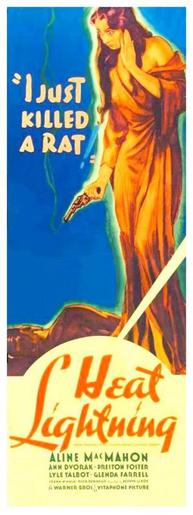
Sisters Myra (Ann Dvorak) and Olga (Aline MacMahon) run a gas station/diner/motel deep in the desert of the American Southwest. Isolated from the rest of the world (except for the customers who are always heading somewhere else), Olga is protective of her younger sister.  She forbids her from socializing with men, especially Steve Laird (Theodore Newton), much to Myrna's fury. Olga's life is disrupted by the arrival of George (Preston Foster), a man who was once Olga's lover. Our film this week is Heat Lightning (1934).

Aline MacMahon is always remarkable, and this film is no exception. When we meet Olga, her face is closed. She interacts with strangers on a business level only. She is not unfriendly, but distant and cautious. With the arrival of George (who Olga - and only Olga - calls Jerry), Ms. MacMahon changes her whole demeanor. The suspicion begins to slowly melt into affection, and finally into the hope for a resumption of their earlier relationship. Some of this is accomplished with costuming, as Olga literally lets down her lush hair (George had commented on the beauty of her thick, long hair), but most accomplished with Ms. MacMahon's eyes and posture. This was the first picture in which she received star billing, and she makes the most of it.

Ann Dvorak's part is relatively small, but the last scenes in which she appears are very strong and truly heartbreaking. Myra's early rebellion and the results that revolt make it appear that the sisters will end up very much alike. The emptiness in Ms. Dvorak's face tell us the future of Myra far better than words could.
We're not used to seeing Lyle Talbot (Jeff) play a weakling, but he does here. By the end, he develops a small amount of backbone, but primarily he is under the thumb of the domineering - and nasty - George. We previously discussed his impressive film career when we viewed A Lost Lady, but this was a new side to a decidedly versatile, and underrated, actor.

Frank McHugh (Frank) is also playing a somewhat different part from his usual sidekick roles. He's a chauffeur to Mrs. Feathers Tifton (Glenda Farrell) and Mrs. Tinkle Ashton-Ashley (Ruth Donnelly), two new divorcees, on their way home (with LOTS of expensive jewelry) from Reno. Surprisingly, Mr. McHugh is also the current object of both their affections! Mr. McHugh is amusing and effective with relatively little screen time. But seeing him as an object of lust does take some getting used to.

As is often the case, Glenda Farrell doesn't get enough to do, though her interplay with Ruth Donnelly is especially fun. They are a good combination; in the end, Ms. Donnelly gets the better lines and the stronger part. 
The script is intriguing, in that the backstory is supplied in tiny spoonfuls - you get just enough to understand Olga, and no more. It's script writing by insinuation, and is effective. You keep watching the movie to find out more, as you are given just a tad more information about Olga's life in the city. While several of the characters seem extraneous  - the girls who arrive with "Popsy" (Harry C. Bradley), for example - it's evident by the end of the story that each of these visitors is telling us more about Olga and her decision to live in the desert. 

As you can see, it's an amazing group of character actors - Jane Darwell also appears in the opening scene as Gladys, wife to henpecked husband Herbert (Edgar Kennedy), a couple motoring through the desert with a really unreliable jalopy. It's another humorous interlude, but fascinating as well - Olga is a skilled mechanic, better than most men - even in the precode era, it's not usual to see a woman who is skilled at a trade. 
The story was based on the play, Heat Lightning which was on Broadway for a month in 1933. and starred Jean Dixon as Olga. In 1941, there was remake (of course, drastically altered. The remake was, after all, well within the code) as Highway West (1941) (AFI catalog).  Reviewer Mordaunt Hall of the New York Times was not enthusiastic about the film in his review, but did like Ms. MacMahon, saying "she gives a believable performance the rĂ´le is not well suited to her". We disagree; there is not a part written which Ms. MacMahon cannot in some way make suit herself.

Released in March of 1934 (just 4 months before the Code began to be strongly enforced), the picture has not been widely circulated since then, as it was on the Legion of Decency's Banned List (TCM article). We think that it's a shame it - and its star - are not better known, and really recommend a viewing. Here's a trailer to get you started:

Monday, July 15, 2019

Bette Designs

Con man Sherwood Nash (William Powell) decides to forgo financial scams in favor of fashion scams when he meets would-be designer Lynn Mason (Bette Davis). Using Lynn's talent for sketching and eye for successful dresses, Nash "borrows" dresses en route from Paris to New York design houses, and sells cheap copies ("designed" by Lynn) to low-end competitors. He then convinces the New York designers to send him to Paris to do the same for them - get the  Fashions of 1934 (1934) to them at a lower price.

Part of the AFI Silver Theatre's Library of Congress Film Preservation Showcase. Fashions of 1934 was projected with a newly restored 35mm print of this film. Like it's sister film, In Caliente, Fashions of 1934 is an excuse for elaborate musical numbers as well as stunning dresses exhibited in various fashion shows. If you've seen The Women, you are familiar with this kind of scene - lovely, period dresses, but the kind no member of the film audience would probably ever be able to afford. However, add a little Busby Berkeley magic, and you've got production numbers that you will long remember.

The biggest number involves human harps - yes, you read that right. The image below will give you just an idea of the piece. The trailer will show you another - lovely ladies with feather fans that are used to create gorgeous shapes. There's no way these routines would ever be on a stage at a fashion show, but I doubt anyone really cared.
William Powell is delightfully suave as the con man extraordinaire "Sherry" Nash. The part is reminiscent of the role he played in Jewel Robbery (1932). Even though he's unabashedly dishonest, the audience roots for him - he's just charming. He also has quite a good rapport with his two female co-stars, Bette Davis and Verree Teasdale (Grand Duchess Alix/Mabel McGuire), two very different actresses with extremely different acting styles.  With Mr. Powell there, you don't notice a change of tone.
Not surprisingly, Bette Davis was not thrilled to be in this picture. She wanted meatier parts, and this certainly was not what she was looking for. She stated that she was "all done up like a third-rate imitation of the MGM glamour queens. That isn't me. I'll never be a clothes horse or romantic symbol." (TCM article). Regardless of her discomfort with the part, she acquits herself well (though she is much better looking as a brunette). As for her desire for better parts, she would get her wish later that year, when she FINALLY was given permission to play Mildred in Of Human Bondage (1934) (The Lonely Life: An Autobiography by Bette Davis).

Verree Teasdale is amusing as Hoboken native and faux countess Alix. Ms. Teasdale started on Broadway, ultimately performing in 13 plays between 1924 and 1932; she appeared in her first film in 1929, and worked fairly steadily until 1941; thereafter, she did some radio work, often with her husband, Adolphe Menjou. Their marriage lasted from 1935 until his death in 1963 (they had one child). Ms. Teasdale died in 1987 at the age of 83.
In a part reminiscent of his character in One-Way Passage (1932),Frank McHugh plays Snap, a photographer - and con man/thief - who is Sherry's right-hand man.  Mr. McHugh makes the most of what he's got, though the part is mostly comedic.  It must be mentioned that, as intriguing as his little cane camera is, it's odd that he has to constantly hold it up to his eye to get pictures - resulting in the "secret camera" being not very secret.  There is an emphasis on this particular gimmick, and our reaction was that you'd have to be particularly stupid to not figure out what he is doing.

Several other character parts are worth mentioning - Hugh Herbert (Joe Ward) is actually not annoying in this film.  Reginald Owen (Oscar Baroque) and Henry O'Neill (Duryea) as part of the fashion industries in Paris and New York (respectively) are frankly as dishonest as Sherry and his crew.  Arthur Treacher makes a brief appearance as - what else - a butler.
Originally titled King of Fashion (AFI Catalog), this is a pleasant film with some lovely Berkeley numbers. Certainly, it is reminiscent of other films released around the same time, but with William Powell delivering the dialogue, you barely notice that it's typical.  I'll leave you with a trailer from the film (and a preview of one of the amazing dance routines.

Monday, April 22, 2019

Rosalind is on Stage

Valerie Stanton (Rosalind Russell) a star of the theatre, has spent her career in light comedies, but she wants to try her hand at more serious plays. She’s been offered the lead in Hedda Gabler, and she's eager for the opportunity. But she is being thwarted by her manager, Gordon Dunning (Leon Ames) who has also been her lover. Dunning threatens to tell her fiance, Michael Morrell (Leo Genn) of her past. As they argue, he physically attacks her. In a panic, she strikes him with a trophy. With Dunning dead, Valerie is in faced with owning up to the event or trying to hide it. Our film is The Velvet Touch (1948)

Rosalind Russell leads an exceptional cast in this noir drama, which concerns itself with the impact of guilt on our lead character's life. Valerie is less afraid of getting caught than she is of living with her crime - if the death of Gordon Dunning can really be labeled a crime.

Leon Ames plays Dunning as a cruel, careless bully. He's discarded his former lover Marian Webster (Claire Trevor) in favor of Valerie. He controls Valerie, as we can assume he did Marian. When Valerie seeks to end their relationship, he threatens her, not only with a revelation of their past to her new love, but also with death. When she hits him, there is a real sense of danger - it does appear he is about to strike out at her. It's because of Mr. Ames that we can sympathize with Valerie throughout the film.
The Velvet Touch was the first film made by Independent Artists, the production company formed by Ms. Russel and her husband Frederick Brisson (TCM article).  Mr. Brisson first saw Ms. Russell when she appeared in The Women (1939). Immediately smitten with her, he later asked his friend, Cary Grant, who was filming His Girl Friday (1940) to introduce him to her. Mr. Grant did (he brought Mr. Brisson along on a date he had with Ms. Russell). The rest is history - the couple married in 1941, had a son, and were together until Ms. Russell's death of breast cancer in 1976.

Rosalind Russell started her career on Broadway, so the setting of this film was not unfamiliar to her. In the 1950s, she returned to Broadway to make Wonderful Town and Auntie Mame - and starred in the film versions of both plays (and if you've never seen Auntie Mame, walk, don't run to get access to a copy). Before doing Wonderful Town, she appeared in the film My Sister Eileen (1942), upon which Wonderful Town was based. She won the Tony for Wonderful Town, and was nominated for Auntie Mame. Nominated 4 times for an Oscar, she received the Jean Hersholt Humanitarian Award in 1972
Claire Trevor gives us a characterization of a bitter, but weak, woman. It's almost unbelievable that she could have feelings for a heel like Dunning, but Marian is so dependent upon him for her self-image that she is lost by his abandonment and by his death. Ms. Trevor, an actress who spent her career in character parts, appeared in another movie the same year as this one - Key Largo, for which she was awarded the Oscar for Best Supporting Actress (Her competition that year was impressive: Agnes Moorehead in Johnny Belinda, Barbara Bel Geddes and Ellen Corby in I Remember Mama, and Jean Simmons in Hamlet.) This snippet from TCM features Ms. Trevor discussing her work on Key Largo - it's a fascinating story.

The actor that really gives Ms. Russell someone to bounce off is Sydney Greenstreet, in his final film (he would continue his radio career for several more years). His Captain Danbury is a cuddly detective, whose warm familiarity hides an intelligent, observant man. How much he knows and when he knows it is always the question in this film. And though the audience sympathizes with Valerie, we like Danbury and almost want him to succeed.
It is worth mentioning that we have some familiar actors in supporting roles. Frank McHugh as stage manager Ernie Boyle is always amusing; Dan Tobin as Jeff Trent appears in a few scenes, and Lex Barker as young actor Paul Banton was just two years into his film career.  We were excited to see Theresa Harris (Nancy) as Valerie's maid. Yes, she's a maid again, but Ms. Harris shines in everything she does, even with a role as minimally written as Nancy.

The costumes by Travis Banton are wonderful - we were especially impressed by a cape decorated in gold (yes, it's a black and white movie, but we know gold when we see it!). If we have any complaint at all with the film it is the ridiculous title song, which must have been written for another film. Don't listen to it when you watch the film - it will make you NOT want to watch the film!

Ms. Russell and Mr. Greenstreet reprised their roles for the Lux Radio Theatre broadcast in January 1949 (AFI catalog).  As demonstrated by the poster above, in one Latin country, the film was released with the title Hedda Gabler (which must have confused some audience members)! Not surprisingly, Bosley Crowther in his New York Times review was dismissive: "a long and tortuous survey of Miss Russell's efforts to elude discovery as the rather obvious murderess and get on with her promising career." We disagree - this is an enjoyable film that illustrates the impact of guilt on a good person.  We'll leave you with the opening scene from the film, and a suggestion that you take a look at it. 

Monday, March 18, 2019

Kay Cruises

After escaping from San Francisco following a murder conviction, Dan Hardesty (William Powell) is arrested in Hong Kong by Steve Burke (Warren Hymer), a police officer tasked with returning Dan to the U.S. for execution. Dan is determined to escape from the ship during the voyage home, but a complication arises in the form of Joan Ames (Kay Francis), a pleasure cruiser to whom he is immediately attracted. But there is a further complication - Joan is dying, and this cruise is, for her, a One Way Passage (1932)

This is perhaps one of Kay Francis' best dramatic roles. She sympathetic as a woman who has little time to live, and has decided to live a shorter, more interesting life, rather than just sit in bed and wait for the inevitable. Ms. Francis, without any backstory, provides that history to the audience simply with her demeanor. We know that Joan has heretofore lived the life an an invalid; informed that the end is now truly near, she has one last chance to experience the world before she leaves it. It seems the film was a favorite of Ms. Francis' as well - it was one that she would regularly show to her beaus to acquaint them with her work (Kay Francis: I Can't Wait to be Forgotten: Her Life on Film and Stage by Scott O'Brien).  

Equally excellent is William Powell as a decent man about to be executed for murder. Dan Hardesty has killed a man, though according to his friend Skippy (Frank McHugh), the victim "needed killing". We get no more information than that. But, we know that Dan is ethical - while attempting to escape from Steve, he plunges them both into the water. But when he realizes that Steve cannot swim, he puts off his escape attempt to rescue his captor. With that simple gesture, we know all we need to know about the integrity of Dan.

In their sixth film together, Ms. Francis and Mr. Powell are a dynamic team. Their chemistry is palpable, and their camaraderie is apparent.  This film would prove to be their biggest box-office hit, yet it was also their last film together (TCM article). Powell would soon leave Warner Brothers for MGM, and The Thin Man series, while Ms. Francis remained at Warners. If you are interested in some of their other films together, start with Jewel Robbery (1932) - their interplay is remarkable.
One Way Passage also has the advantage of co-starring the remarkable Aline MacMahon (Barrel House Betty aka Countess Berilhaus) in the cast. As a con artist who starts off using her wiles to distract Steve from Dan, but ends up falling in love with Steve, she's terrific. Ms. MacMahon is an actress who makes everyone around her look better. As a result, Warren Hymer (who is usually, to my mind, an uninteresting actor) shines as Steve. He becomes more than just the dumb cop he usually plays.  In his book Mothers, Mammies and Old Maids: Twenty-Five Character Actresses of Golden Age Hollywood, Axel Nissen says that "because she didn't look like anyone [Aline MacMahon] could play everyone" and that is certainly the case here. You believe that she is could be a countess, even though you know almost immediately that she is not. Ms. MacMahon can play anything or anyone.  For a brief bio on this wonderful actress, visit our post on Heroes for Sale (another film in which she basically stole every scene).
The screenplay for One Way Passage won the Oscar for Best Writing - Original Story in 1933 for Walter Lord. Director Tay Garnett allegedly felt he deserved credit for some of the writing, which he did not receive (AFI catalog).  The costuming by Orry-Kelly is lovely; he was also tasked with making Kay Francis look ill, which he succeeds in doing by giving her lovely, flowing gowns that hint at frailty. Mr. Kelly would return to costume the 1940 remake, 'Til We Meet Again, this time starring George Brent and Merle Oberon as the doomed lovers.  Also returning for the remake - Frank McHugh!.
Surprisingly, the New York Times review by Mordaunt Hall actually praised the film, stating that it "offers quite a satisfactory entertainment. It has an original idea and the characters stand out..." We would be much more effusive in our praise, but regardless, this is a film for fans of both Ms. Francis and Mr. Powell.  We'll leave you with a brief scene - the meeting of  Joan and Dan:

Monday, October 16, 2017

Ginger is on the Radio

Glory Eden (Ginger Rogers), America's "Purity Girl" has had it. She's been on the radio for a year. She's popular, she's making plenty of money, but she is banned from going ANYWHERE. She wants to go out and dance in Harlem, she wants to wear makeup and date. But under her present contract, she is forbidden from doing anything that might compromise her image of innocence. When she threatens her boss, Sam Ipswich (Gregory Ratoff) with leaving his employ, he agrees to get her a Professional Sweetheart (1933) - and potential husband - that will allow her to date discreetly.

Though at times a fairly silly movie, Professional Sweetheart is enjoyable. Ginger Rogers is very cute as a girl who just wants to have fun, and while Norman Foster (as Jim Davey) is perhaps not the most dynamic actor in the world, he is convincingly sincere. Add a group of excellent character actors, including Gregory Ratoff (playing a part not dissimilar to his role in All About Eve), Frank McHugh (as Speed Dennis), and Allen Jenkins (as O'Connor), and you have a film that is fun and ever so slightly titillating (as you can see from the still below!)
We were pleased to also see Theresa Harris (Vera) in a small role.  She's relegated to playing a maid, of course, and is not even billed in the credits, but she is again (as she was in Baby Face) intelligent and attractive, and more of a confidant to the unhappy Glory than a mere servant.  Unlike Ginger Rogers, Ms. Harris actually gets to do her own singing (Etta Moten sings for Ms. Rogers; why, is a big question).  Ms. Harris has a lovely voice, and is an excellent actress: with 99 film and television credits to her name, Ms. Harris SHOULD be better known. She was the inspiration for a play, By the Way, Vera Stark, which performed off-Broadway in 2011. Married from 1933 until her death, to a physician, Ms. Harris retired from acting in 1958. She died at age 79, in 1985.

Normally, we enjoy ZaSu Pitts (Elmerada de Leon),  but her vagueness gets annoying after a time.  Of course, Elmerada is supposed to be annoying, but she is also supposed to be funny. The film really carries the act a bit too far, so we found ourselves groaning when Ms. Pitts started to open her mouth.
Norman Foster is okay as the romantic lead, but not much more than that. He would continue acting until 1938 (he returned to acting in the 1970s in a few television shows and movies), but he is best known as a director. He directed several of the Mr. Moto films, 1948's Rachel and the Stranger (starring his sister-in-law, Loretta Young), and the noir classic Woman on the Run (1950). He also did much television directing (including 39 episodes of Ms. Young's television shows). He was married for 7 years to Claudette Colbert; after their divorce in 1935, he married Sally Blane; they had two children and were married until his death from cancer in 1976 (age 72).

This was Ms. Rogers' first film under a three picture deal with RKO (TCM article). All three pictures (Rafter Romance, also co-starring Norman Foster, and Chance at Heaven were the other two) were released in 1933, as was her next film, under a new seven-year contract - Flying Down to Rio, her first film with Fred Astaire. They didn't dub her singing voice after that!
Original titles for the film include Careless and Purity Girl, (AFI Catalog) but we felt the release title was the best choice - after all, but Jim AND Glory turn out to be professional sweethearts! Besides the character actors mentioned above, there are brief glimpses of Betty Furness (as a reporter) and Akim Tamiroff (as a waiter).

The New York Times liked the film (which premiered in Radio City Music Hall), as did my colleague at Pre-code.com (for an outline of some of the pre-code naughtiness, please to visit his posting). You can see some of that naughtiness in this clip from the film. A good opportunity to see Ginger Rogers early in her career, Professional Sweetheart is a pleasant romp. 

Monday, July 11, 2016

Olivia and the Pilots

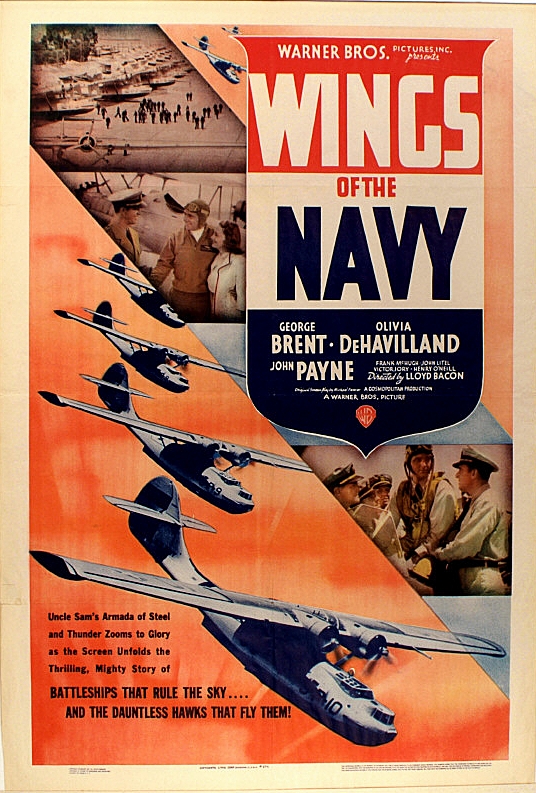
Cass Harrington (George Brent) is a Navy flyer through and through, with a family history in the service.  His father was a highly regarded flyer for the Navy, and his brother Jerry (John Payne), also career Navy, wants to join Cass in the Air Corps, though Cass would rather Jerry stay in the submarine service.  Cass is in love with Irene Dale (Olivia de Havilland), but once Irene meets Jerry, she wonders if she has made the wrong choice - Cass is too wrapped up in his work designing a new fighter plane to pay her much attention.  When the brothers both end up at the Naval Air School in Pensacola, where Cass is an instructor, it's clear that something's got to give.  Wings of the Navy (1939) tells the story of these three individuals and of the making of a Navy airman.

In the July 2016 issue of TCM's Now Playing, Robert Osborne writes that Olivia de Havilland, who had signed a contract with Warner Brothers to star in A Midsummer Night's Dream (1935), "...considered [Wings of the Navy] the absolute nadir of her career.  It was as far afield from Shakespeare as one could get...."  While this isn't the worst film ever made (and probably not her worst either.  There is, after all The Swarm...), it's not all that good.  However, in many ways (according to this TCM article), it was this film that helped Ms. de Havilland appear in her most famous role - she was so irritated that she had been forced to do Wings of the Navy, she redoubled her efforts to land the part of a lifetime - that of Melanie in Gone With the Wind
Really, this film is an advertisement for the Navy, and a means for Warner Brothers to inform the public on the state of the armed services.  It was evident that a war in Europe was in the offing, and the Brothers Warner had already shown their dislike of fascism in 1937's Black Legion.  Shortly after this film was released (February of 1939), Warner Brothers would be the first studio to openly brand Nazi Germany as an enemy in Confessions of a Nazi Spy (released in May, 1939) [PBS History Detectives].  With its emphasis on the flying service, Wings of the Navy is a documentary praising the U.S. Navy Air Corps.  Even the New York Times review felt that "the educational part [of the film] is so interesting that we return to the romantic part... with a feeling almost akin to pain."   The advertising for the release also (discussed on WarnerBrothers.com)  displays the studio's primary interest in creating this film:  "'For all the world to witness that America will not be unprepared!' [it declared] —and backed it up with bravura footage shot at Pensacola Naval Station in Florida and North Island Naval Station at Coronado, California."
 
Because this really is a documentary-type film focusing on the military, the interactions between Brent and Payne, and between Frank McHugh (as Scat Allen) are pretty good, and while we always want to see more of Ms. de Havilland, the love story is pretty pointless - just a way to have the girlfriends agree to come with their dates to see the planes.
There are several surprise appearances in the movie, not the least of which is the appearance of Frank McHugh, who brings both humor and gravitas to the role of Scat, a man who has joined the Air Corps to perfect his flying skills.  He is not planning on a career in the Navy - he plans to return to his profession as a crop duster after his term is over, but Scat ends up being the voice of reason in most situations.  Also appearing are John Litel as Commander Clark, and Victor Jory as Lieutenant Parsons.  Jory's part is so small that if you blink, you might miss him!

Much as Ms. de Havilland disliked the film, she did not immediately escape it.  According to this article from the AFI Catalog, she ended up reprising her role (with George Brent and John Payne) in the Lux Radio Theatre production of October 1940.  While we agree with her, it is not all that wonderful a film, we'll leave you with a clip of Ms. de Havilland and Mr. Payne:

Wednesday, June 22, 2016

The O'Hara Boys Love Olivia

Ma O'Hara (Mary Gordon) lives with her three sons, Police Officer Pat  (Pat O'Brien), Fireman Mike (Frank McHugh), and Danny (James Cagney),  the black sheep of the family (and Ma's darling) who is trying to forge a career as a fight promoter (much to brother Pat's disgust).  The Irish in Us (1935) looks into the lives of the family as Pat plans for a marriage to Lucille Jackson (Olivia De Havilland) - without telling Lucille.

Sure, this is a rather silly movie, but we enjoyed it.  The interplay among the three O'Hara brothers is spot on, and, not surprising, when James Cagney is on the screen, you really can't take your eyes off of him.  Equally wonderful is the relationship between Cagney and Mary Gordon, who plays his mother.  You can sense the affection within the family group, and Ms. Gordon, especially paints a picture of a woman who is the thread that binds the family unit together.

Though the plotline is so-so, this TCM article points out that director Lloyd Bacon, well aware of the script's limitations, encouraged the actors to ad-lib during the production.  As a result, the dialogue has a bounce and energy to it.  And while boxing match at the end does seem a bit prolonged, it gives the character of Pat time to recover from the circumstances that have alienated him from his youngest brother.  O'Brien and Cagney do a wonderful job of creating a brotherly dynamic that it made us imagine Pat and Danny as children, with Danny always getting into scrapes from which big brother Pat needed to rescue him.
Normally, we love Allen Jenkins, but his Carbarn Hammerschlog is a bit over the top.  One wonders how Danny could possibly see this rather insane man as a successful boxer (but that is Danny - always looking for the underdog!).  It's one of the weaker aspects of the plot, but does serve as a means of getting Cagney into a boxing ring (the AFI Catalog states that Cagney did his own boxing in the picture). 

We're also treated to a picture of bygone era in New York City - a time when you knew all your neighbors, and it was a fact of life that everyone knew what the other person was doing.  One scene in particular - Ma O'Hara passing a bit of butter wrapped in a napkin to her neighbor via the clothes-line between their apartments, brought up memories of my childhood, when my mother would lend a bowl or some eggs to the neighbor through a narrow kitchen shaft window!
The strength of the film is that strong sense of family.  Pat's anger at Danny's haphazard lifestyle centers more on his fear that Danny will not be able to help support the family when Pat marries and moves out than on any jealousy or dislike of his brother.  And the relationship between Ma and Lucille also emphasizes the family as a unit - Ma is immediately welcoming to a potential new member of her family.  Lucille senses that she is now an O'Hara, and seems to find in Ma the mother that she has lost (Lucille has a father, but it seems he may be widowed).

We'll end this discussion with a scene from the film, as Danny and Lucille get to know one another:

Thursday, June 5, 2014

George's Wives

The silence on our end was occasioned by a number of activities involving your humble scribe - one of which was her recent marriage.  Now that we are back to our normal routine, we begin with a 1936 film.  Snowed Under stars George Brent as playwright Alan Tanner, Genevieve Tobin as his first ex-wife Alice Merrit, and Glenda Farrell as SECOND ex-wife Daisy Lowell, all trapped in the mountains after a snowstorm.

Alan Tanner is a successful playwright, however his latest play is proving to be a difficult nut to crack - he can't seem to get the third act written.  He's retreated to a mountain cabin to write.  His publisher is not convinced that Alan can complete the play, so he asks ex-wife Alice to go up and visit Alan, and possibly help him with the writing.  She arrives to find Alan under siege from his would-be next wife (Patricia Ellis as Pat Quinn), Daisy, Sheriff Orlando Rowe (Frank McHugh), and Daisy's lawyer McBride (John Eldredge) - the latter two enlisted by Daisy to collect back alimony.  Thus, a quiet weekend devolves into a loud, frantic mess.

Quite frankly, this is a fairly stupid film.  Sure, it's a farce, with lots of running around and slamming doors and yelling.  While you want it to be a film version of the famous play Noises Off, what you get instead is a not-very-witty hodgepodge of romance and mayhem.

There are so many good actors here, you would think they could pull something out of their hat to rescue this mess, but they can't.  George Brent is given very little character to work with.  Mostly, he is passive, with his various women throwing things at him. Genevieve Tobin has a little more to work with, and as a result is more enjoyable.  But when  you get to such usually fantastic actors as Frank McHugh and Glenda Farrell, one throws up one's hands in frustration.  McHugh is downright annoying as Orlando, and Farrell is WAY too  over-the-top as Daisy.  You can't wait for the scenes with them to be over.  It's rather hard to understand why Alan married Daisy (just as it is equally hard to understand his attraction to Pat).  While both are attractive in their own way, they are equally hard on the nerves - a quality that is already visible in Pat.  And Daisy's crudeness is clearly not of recent vintage.

Both Ellis and Tobin retired shortly after the release of Snowed Under - Tobin to marry William Keighley; Ellis to wed a Kansas City businessman.  Both women had over 40 films credits when they left the industry, but neither had been able to rise to leading lady status.  This TCM article provides some history for the film, as well as some information on the critical reception.

We end with a trailer which will give you a quick overview of the film.  Next time, we turn back to the Pre-code era for a Nancy Carroll film.

Monday, September 30, 2013

Sisters in Love with the Same Man

When the AFI Silver opened in 1938, their premier film was Four Daughters.  As part of their anniversary festival, this was one of the three films we viewed. 

The Lemps are a musical family - father Adam (Claude Rains) is a conductor, instructor, and flutist; his daughters Thea (piano, played by Lola Lane), Ann (violin, played by Priscilla Lane), Emma (harp, played by Gail Page), and Kay (vocalist, played by Rosemary Lane) accompany him on classical recitals in their home; their audience is their Aunt Etta (May Robson).  Their home is a happy one, and the girls have a busy social life.  Emma has a beau, Ernest (Dick Foran), and Thea has just met someone (Frank McHugh as Ben Crowley).  Young Ann, however, has no interest in a beau; she has decided to be an "old maid", and live always with her beloved sister Emma.  But that is before Felix Dietz (Jeffrey Lynn), a young composer enters their lives.  In short order, all four girls are smitten with the young man.  He however, only has eyes for Ann.  And while it seems there will be a happy ending for Felix and Ann, the arrival of  Mickey Bordon (John Garfield), and Ann's realization that Emma loves Felix will have devastating results.   

From a novel by Fannie Hurst, Four Daughters is certainly a woman's picture in the traditional sense.  In some sense, the men (Felix, Ernest, Ben) are merely objects for the women to discuss.  But the character of Mickey, as portrayed by Garfield is far more than that.  Garfield's intensity (which he brought to all of his film roles), makes Mickey a force of nature that blows violently into the lives of all around him.  Mickey is both selfish and caring at the same time.  He loves Ann passionately, is able to see the pain of those around him (he and Aunt Etta are the only ones that realize how deeply Emma cares for Felix), but he is also willing to destroy the lives of Ann and Felix so he can have Ann. 

The Lane Sisters and Gail Page are flawless as the Lemp girls.  Their love for one another and for the family unit is true - watch the scene as the girls rummage through each other's closets to compile an appropriate date outfit.  Ann's decision to be with Mickey rather than Felix is as much about sparing Emma pain, as it is her need to bring some joy into Mickey's life.  We quickly realize that Ann DOES love Mickey - not in the way she does Felix; she feels an almost motherly responsibility for Mickey that she cannot escape. Ann's extreme youth is further demonstrated by her decisions.  She is unable to differentiate between love of a spouse and love of family.  Mickey should be family, but Ann can't quite see it.

The film resulted in two sequels, Four Wives and Four Mothers, as well as a companion film, Daughter's Courageous.  While neither is quite as powerful as the first film, the chemistry among the Lemp family is emphasized in this continuing series.  The impact of Garfield as a performer is highlighted in this clip.  Enjoy!


Monday, September 13, 2010

Olivia Rides the Wagon Train

This week, we're discussing Errol Flynn's first western, 1939's Dodge City. In it, Olivia plays Abbie Irving, a young woman who is forced to move to the godless Dodge City after the death of her father.  Unfortunately, she has to get there with her drunken brat of a brother (William Lundigan), who starts a cattle stampede with his gun-play, and ends up getting himself killed.  Of course, Abbie blames wagon master Wade Hatton (Flynn).  Wade meanwhile, enters Dodge City to find it being run by former adversary Jeff Surrett (Bruce Cabot), and after a horrible incident decides he is the one to bring law and order to Dodge.

This movie is full to the brim with wonderful character performances. We have the usual Flynn sidekick, Alan Hale as well as Guinn "Big Boy" Williams.  We have a rare character visit from the gorgeous Ann Sheridan (one wonders if Jack Warner was angry at her that week to give her such a small part), as well as the ever-wonderful Frank McHugh as newspaper publisher Joe Clemens. And the adorable Bobs Watson as Harry Cole, the reason that law comes to Dodge.  With a cast like this, (and these names are just the tip of the iceberg) can you really lose?

I have major problems with seeing Bruce Cabot in pretty much anything since I heard about his horrible actions to Errol Flynn later in their careers.  But one must admit he is truly loathsome here. Olivia is spunky, in all the best senses of the word, especially in the later portions of the movie (it is as though we get to watch Abbie grow up).  Here is one of their love scenes:


It is truly funny to see the screenwriters making an excuse for Flynn's presence in a Western (Wade is from Ireland, and has traveled the world).  Finally, we all adored Frank McHugh - he is funny and touching in this small, but important role. His performance in the film is well worth emphasizing.

Join us next week for another Olivia epic.