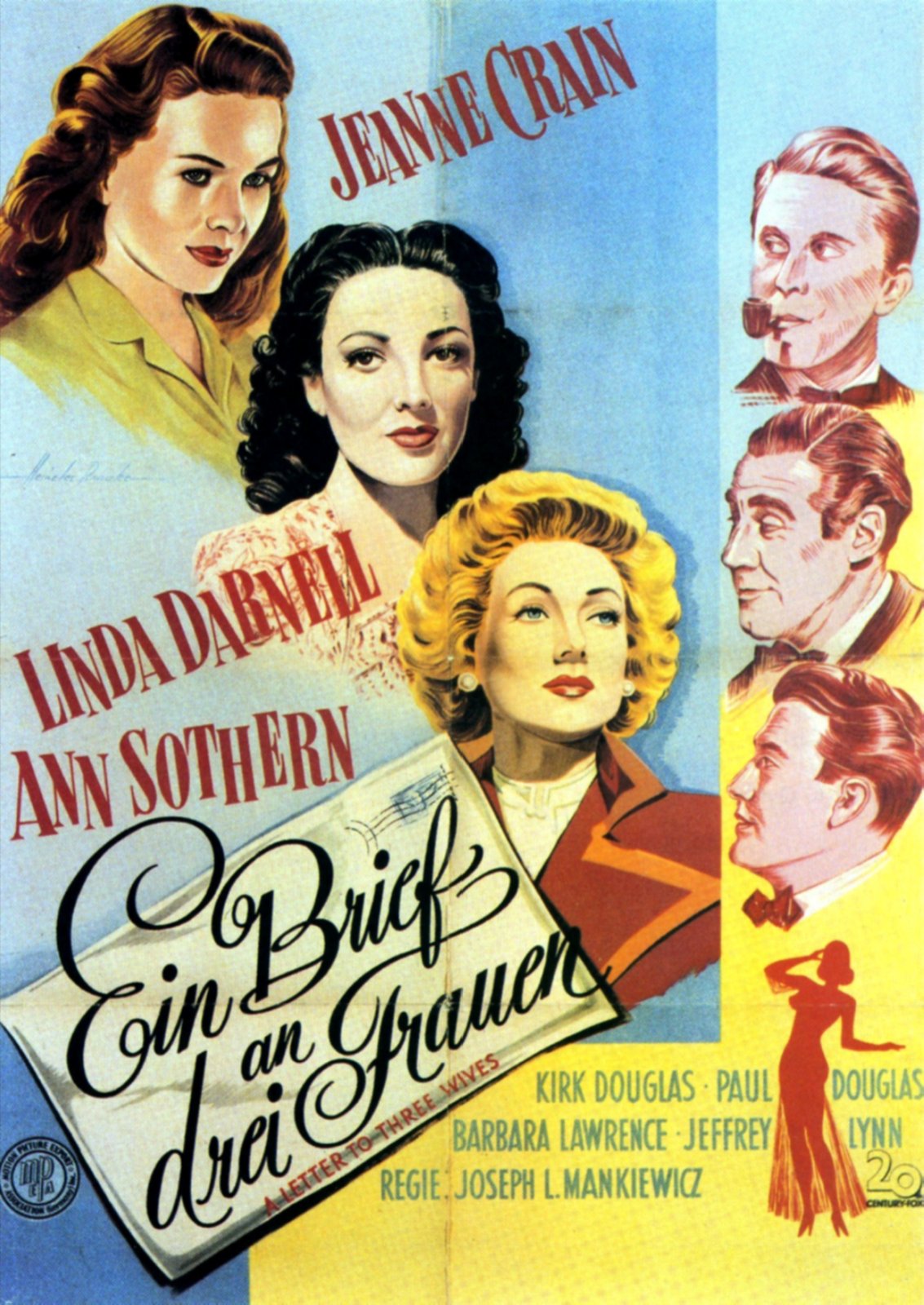
As Deborah Bishop (Jeanne Crain), Lora May Hollingsway (Linda Darnell), and Rita Phipps (Ann Sothern) are about to leave on a charity boat ride, a young man delivers A Letter to Three Wives (1949). The letter informs them that their "friend", Addie Ross (voiced with just the right amount of venom by Celeste Holm) has left town - with one of their husbands. Unable to leave the boat, the women spend the day worrying about their husbands and reviewing their marriages. Based on A Letter to Fives Wives by John Klempner (the film eliminated two wives, which tightens it up), this is an exceptional film, especially given that it is really a series of vignettes. The use of Addie's narration as a glue to hold together this tale of three marriages in trouble is both inspired and entertaining. That narration brings the tale to a different level, making the film a fully cohesive unit instead of a series of short stories. Two of the stories especially stand out. Rita and George Phipps (Kirk Douglas) are a relatively happy couple, but Rita, a successful radio writer, is trying to have it all - career, husband, and children. She's pretty good at doing it, but George is frustrated that he and their twins often take second place to the demands of her clients (ably represented by Mr. (Hobart Cavanaugh) and Mrs. (Florence Bates) Manleigh). Kirk Douglas plays George as an educated, reasonable and progressive man; he really doesn't mind that his wife works and that she out-earns him by quite a bit. Her job and her impressive salary afford them all a good life, and enable him to pursue his career - an underpaid high school teacher - without guilt. George loves his job and his wife. He just wishes that she wasn't constantly afraid, and would occasional say no to her clients unreasonable demands.
In flashback, we see the courtship of Lora May Finney (Linda Darnell) and Porter Hollingsway (Paul Douglas). Both are from the wrong side of the tracks (in Lora May's case, quite literally - she lives with her sister Georgianna (Barbara Lawrence) and mother, Ruth (Connie Gilchrist) on the edge of the train tracks). But Porter, the owner of a successful department store, is now well-off, and enamored of Lora May's beauty. But he is not interested in marriage; Porter's been married, and he didn't care for it. Plus, his ideal is Addie Ross - he keeps her picture on his piano, and talks about her "class," a quality he doesn't find in Lora May. Linda Darnell is impressive as the tough talking Lora May. The viewer is quick to realize that, despite her comments to the contrary, she loves Porter. But she knows the only way to keep him is to play the game his way - Porter likes to fight, and Lora May is more than willing to oblige him to get what she wants. To a point, of course. When Porter shows up at her front door, honking his horn for her to come out, Lora May ignores it: "Anybody wants me can come in and get me, this ain't a drive-in." For more on the life of Ms. Darnell, please see our blog post on her work in The Mark of Zorro (1940).
The third story, the marriage of Deborah and Brad Bishop (Jeffrey Lynn) is possibly the weakest of the three. It's not bad, its just that Deborah seems weak next to these two dynamic women. One sympathizes with her truly ugly dress, since we know she's not had time to procure a new one, but really, it is so hideous, it's hard to understand why even a simple farm girl would purchase it. And WHY does Rita have to TELL her to cut off those ugly flowers? But it should be acknowledged that Deborah has left the farm, the WACs, and her past life for a new, more upscale environment with a husband she really doesn't know - the story of Brad and Deborah is a brief glimpse into the marriages that began because of the war. Jeanne Crain began her film career at age 18, with a bit part in The Gang's All Here (1943). Winner of the Miss Pan Pacific pageant, she attracted the attention of film scouts; by 1945, she was starring in State Fair and Leave Her to Heaven. She could sing, dance, ice skate, and she was a pretty good actress, but also in 1945 she married Paul Brinkman, and began having babies - seven in total. She was pregnant during the filming of this movie, and may have lost the role of Eve in All About Eve due to one of her pregnancies. Regardless, her portfolio is quite impressive: I'm particularly fond of Cheaper by the Dozen (1950) and People Will Talk (1951) Ms. Crain and her husband remained married until his death in 2003, but after a messy divorce proceeding (which was never completed), they lived apart. She also lost two of her sons before she died in 2003 of a heart attack at age 78.
We've raved about Thelma Ritter (here playing Sadie Dugan) before, and she does not disappoint in this film. Whether it is her interactions with her pal, Ruth Finney or her sass when she is working as a maid for Rita Phipps, Ms. Ritter is the queen of the bon mot. Take, for example, her response to Rita's request that she wear a uniform: "The cap's out. Makes me look like a lamb chop with pants on." or her answer to the Manleighs about their radio program: "You know what I like about your program? Even when I'm running the vacuum I can understand it." At the same time, it is Sadie who cautions Ruth about her passion for her new refrigerator, when Ruth seemingly puts keeping it (in many respects, for Ruth, the refrigerator is a symbol of respectability) above her daughter's happiness: "
You got to make up your mind whether you want your kids happy or your icebox paid up." A number of different actors were proposed for the film, including both Joan Crawford and Ida Lupino as the voice of Addie Ross (AFI catalog). Though the film was nominated for Best Picture, Screenplay, and Directing Oscars (winning the latter two), no acting nominations came its way. Interestingly, Jeanne Crain, Kirk Douglas, and Celeste Holm were all nominated for other film work that same year (none of them won, however).
Contemporary critics received the film enthusiastically (see this New York Timesreview and this TCM article). Since then, regard for the film has increased, as is evident by this New Yorkerdiscussion, especially as a sophisticated examination of marriage. As Jeanine Basinger notes in her book I Do and I Don't: A History of Marriage in the Movies, films that actually examine marriage itself are rare. A Letter to Three Wives does this, and does it well.
Both Lux Radio Theatre (1950) and Screen Players Guild (1952) performed radio versions of the play. Then, in 1985, the story made its way to television, with Ann Sothern appearing as Ruth Finney in a version which starred Loni Anderson, Michele Lee, Stephanie Zimbalist as the three wives. We'll leave you with a trailer from the film - an introduction to the three wives.
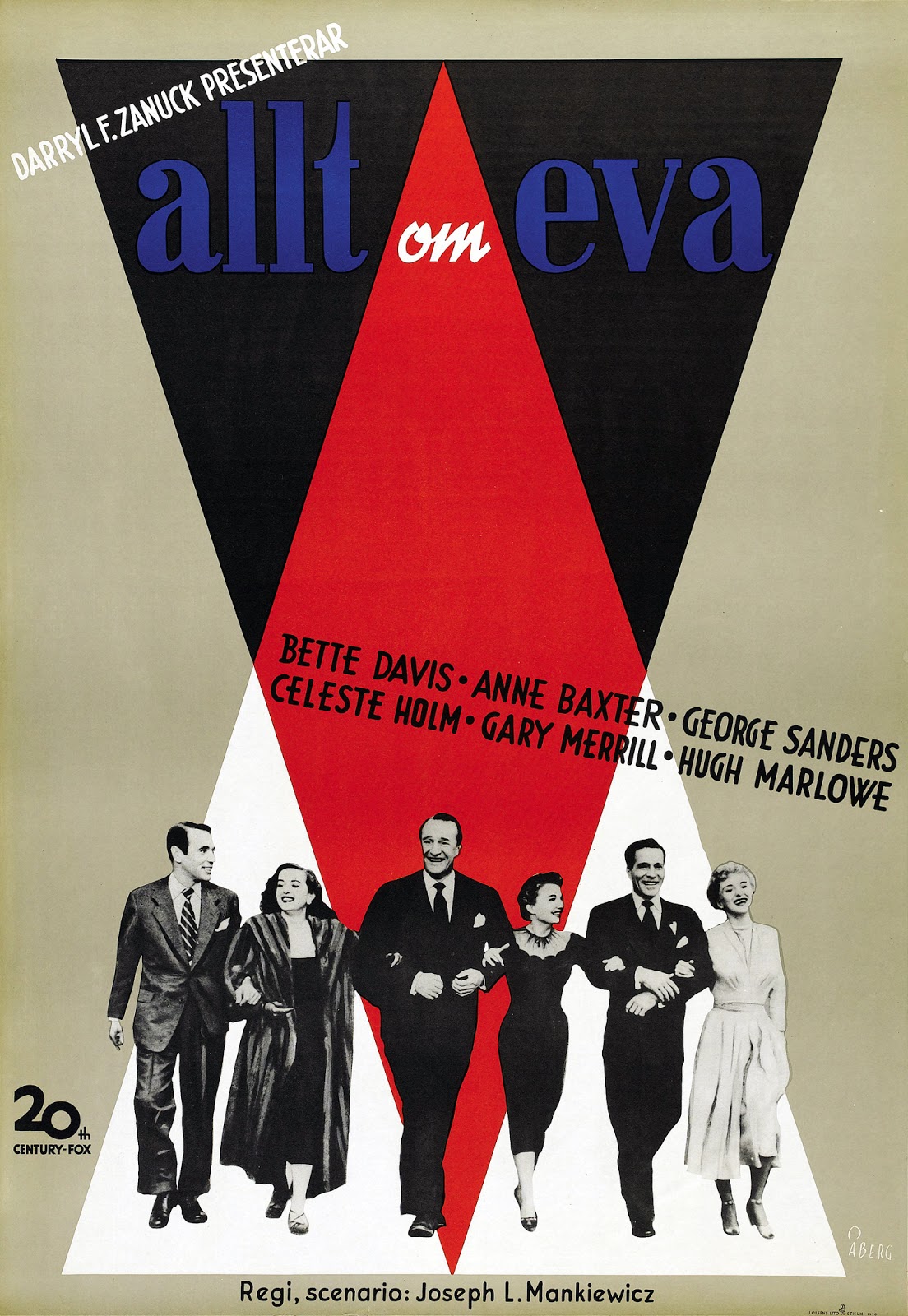
This month TCM Presentsoffered a theatrical screening of the story of the woman who is #23 (on the Villain side) of the Greatest Heroes and Villains of all time (according to the American Film Institute). We are speaking, of course, of Eve Harrington (Anne Baxter) in All About Eve (1950) The event was hosted by TCM's own Ben Mankiewicz. In his commentary, he spoke briefly about his Uncle Joe, who at the 1951 Oscar ceremony took home two Oscars for the film as Best Director and Best Adapted Screenplay. The was the second year in a row for him to receive the same awards: he had won the previous year, for A Letter to Three Wives, and he remains the only person in Oscar history to accomplish this feat. All About Eve was nominated for 14 awards (a record at the time. It has since been tied by Titanic), and won 6, including Best Picture. Two of the nominations were in the category of Best Actress. Both Bette Davis (Margo Channing) and Anne Baxter vied for the Award (Ms. Baxter was not willing to be nominated in the Supporting Category, since she was the title character). It's been speculated that they split the vote, resulting in Judy Holliday winning for her performance in Born Yesterday (certainly a worthy winner as well) If you are not familiar with the story, a few words are in order. On the evening of the annual Sarah Siddons Society Awards, Broadway actress Eve Harrington is being presented with its highest honor. From the audience, fellow awardees director Bill Sampson (Gary Merrill) and playwright Lloyd Richards (Hugh Marlowe), Lloyd's wife Karen (Celeste Holm), and famed actress Margo Channing look on. As she watches the action, Karen recalls the night she met Eve, introduced her to Margo, and changed their lives forever.
The film has a fascinating history, and I heartily recommend the book All About "All About Eve" by Sam Staggs. The film was based on a short story that appeared in Cosmopolitan. "The Wisdom of Eve" is allegedly based on a real incident involving actress Elisabeth Bergner and her secretary Martina Lawrence, but it has also been speculated that supposed impetusis a rivalry between Tallulah Bankhead and Lizabeth Scott, when Scott understudied Bankhead in The Skin of Our Teeth. Regardless of who was the factual inspiration, the screenplay gives us a portrait of a woman who will stop at nothing to achieve her goals - a woman who is just one in a long line of ambitious individuals. Once you've seen the film, it's hard to imagine anyone but Bette Davis in the role of Margo. She literally inhabits the character. However, Ms. Davis stepped in at the last minute when Claudette Colbert severely injured her back, and had to bow out. At age 42, Davis was fast becoming a has-been - her last part was in Beyond the Forest (1949), after which she and Warner Brothers studio bid each other a not-so-fond farewell. Beyond the Forest has one major claim to fame - it's the film in which Davis uttered the immortal - and often parodied line - "What a dump." When Joseph L. Mankiewicz called and offered her the part, if she could be ready in 10 days, she jumped. She credited Mankiewicz with "resurrecting her from the dead." (TCM article) Tallulah Bankhead would claim that the film was "all about" her. And while Ms. Davis steadfastly denied Ms. Bankhead as an inspiration, some aspects of the role do seem to very much hearken up images of Ms. Bankhead. When she started filming, Ms. Davis had laryngitis, so she maintained a lower
vocal range throughout the film - a voice that closely resembles that of Ms. Bankhead. The "surprise"
curtain call as Margo stands alone on the stage of "Aged in Wood" was
also taken directly from Ms. Bankhead, who it was reported used that
gimmick when she did her own curtain calls. And accidentally or not, Ms. Davis' most famous dress in the film looks amazingly like dresses worn by Ms. Bankhead (see below).
About the dress - Edith Head had to quickly alter or remake dresses for her new star. When Ms. Davis tried on the party dress, Ms. Head was horrified to realize that the dress was too big above the waist. Davis saved the day by pulling the neckline down around her shoulders, giving the dress a sexy (and coincidentally more Bankhead-like) look. Ms. Davis' is not the only stellar performance in the film. Anne Baxter is an impressive Eve, going from wide-eyed innocence to malevolence with the merest flick of an eye. Eve will use anyone and anything to get what she wants, and it is never more apparent than when she sets her cap at Lloyd Richards. Watch as she sexually manipulates her friend (Randy Stuart) to call Lloyd for her. There's a hint of relationship that's more than just friendly between the two.
Marilyn Monroe, in an early role as would-be actress Miss Casswell is quite amusing - the scene in which she sets set her sails to accost Max Fabian (Gregory Ratoff) after calling him an "unhappy rabbit" is priceless. And Celeste Holm brings charm and poise to the part of Karen. But for me, it's the "character" performances that make this film what it is. Let's start with Thelma Ritter as former vaudevillian, and Margo's dresser, Birdie Coonan. It sometimes seems that Birdie gets a good portion of the wonderful lines. For example, after Eve tells the story of her life, Birdie retorts "What a story! Everything but the bloodhounds snappin' at her rear end." Or, when Bill asks her what message she would like delivered to Tyrone Power once Bill arrives in Hollywood - "Just give him my phone number; I'll tell him myself." But more than the lines (and this is a phenomenal script for good lines), it is Ritter's delivery that makes them. Her Birdie is smart and cagey - she is the first person to spot Eve as a phony. As always, Thelma Ritter is a gem, and it is always sad for me that Birdie disappears in the last third of the film. But can any discussion of the perfect delivery of perfect lines be complete without a discussion of George Sanders. His Addison DeWitt (who may have been based on critic George Jean Nathan - AFI catalog). is a masterpiece of wit and malice. A theatre critic who describes himself as: "My native habitat is the theater. In it, I toil not, neither do I spin. I
am a critic and commentator. I am essential to the theater." We learn quickly that Addison is an impressive judge of people. Without a word, Sanders shows us that Addison, like Birdie, knows that something about Eve is not right. Eve, who has managed to play nearly everyone like a violin, does not realize Addison is not be played. Sanders is a perfect partner for Eve, and a perfect foil for Bill Sampson and Lloyd Richards, both of whom remain far to oblivious of Eve's manipulations for a very long time.
Claudette Colbert was not the only person considered for Margo - Susan Hayward (deemed too young), Ingrid Bergman (didn't want to leave Italy), Marlene Dietrich, and Gertrude Lawrence were all in the running at one time or another. Jeanne Crain was also considered for Eve, but her third pregnancy prevented her from getting the role (she and her husband eventually had 7 children). John Garfield and Ronald Reagan were discussed for Bill, and both Jose Ferrer and Clifton Webb mentioned as Addison. The film would be performed four times as radio productions (the last one, in 1954 featured Claire Trevor, Ann Blyth, William Conrad and Don Randolph). It would ultimately be remade as a musical - Applause, which starred Lauren Bacall as Margo in the original cast. (I saw it after Ms. Bacall left. Her replacement - Anne Baxter!) As I mentioned before, All About Eve is an awards favorite, and the praise just keeps on coming. It was #28 in AFI's 100 Years, 100 Movies, and in 2014, Richard Brody of the New Yorker discussed the film as a commentary on the difference between film and theatre. But All About Eve was not just a film that was discovered later in its life. These reviews in Variety and the New York Times demonstrate that the film was immediately a critical hit. I'll leave you today with a clip from the film - perhaps the most famous line in the film (though there are others that are just as magnificent). It was voted #9 in AFI's 100 Greatest Quotes; so here's Ms. Davis warning us to "Fasten your seatbelts. It's going to be a bumpy night"
As we near the end of our Olivia de Havilland Festival, we have saved
the best for next to the last (we have one more to go after this one).
It's The Snake Pit - Olivia's Academy Award nominated performance as the tortured Virginia
Stuart Cunningham, whose mental collapse lands her in a mental
institution. This is truly a tour-d-force performance. What Ms. de
Havilland does with a brief glance, other actors could not do with their
entire bag of tricks. Watch her reactions change from ignorance to
disbelief to suspicion to anger in the briefest second - it is truly
magnificent. That Ms. de Havilland did not win the Oscar for 1948 is
due perhaps to the fact that her competition was fierce - she lost to
Jane Wyman in Johnny Belinda.
This
film is full of wonderful performances, and features some of the
premiere actresses of the day. Let's start with Celeste Holm and Betsy
Blair as Grace and Hester, the bookends to Virginia's confinement.
Holm's Grace cares for Virginia as she begins her confinement; as
Virginia heals, she becomes mentor to the disturbed Hester (Blair).
Other patients in the hospital are portrayed by Beulah Bondi, Ruth
Donnelly, Lee Patrick, and Isabel Jewell. Though their parts are small,
each adds to the atmosphere of the hospital in their own unique way.
Another interesting performance is that of Natalie Schafer as Virginia's
mother, certainly high on the list of dysfunctional parents! On
the distaff side, we have Leo Genn as Dr. Kik, Virginia's psychiatrist,
Mark Stevens as her husband Robert, and Leif Erickson as her one-time
boyfriend, Gordon. The men however, merely serve as window-dressing.
It is the women who rule this picture. It is their performances you will
remember.