In 1950, Joan Crawford was back at Warner Brothers (and with director
Vincent Sherman for the second time) in a fairly turgid gangster movie, The Damned Don't Cry. Told in flashback, as on Lorna Hansen Forbes flees to her parents house following the discovery of a murdered man, we learn that Lorna was actually Ethel
Whitehead. Living in relative poverty in her parents home, with her
husband and small son, Ethel's life has few pleasures, thanks to her
penny-pinching husband (Richard Egan). When their little boy is killed
suddenly, Ethel leaves her husband, landing work as a dress model,
gradually becoming a call girl to make a few extra dollars. Her life's
direction changes again when she meets accountant Martin Blackford (Kent Smith); thanks to Ethel's intervention, Martin becomes enmeshed with gangster George Castleman. And
so it goes. Quite frankly, we found this movie WAY too long. The
section that introduced Lorna's life story for example, when we see the
death of her son, was totally unnecessary (and could have been briefly
outlined within the body of the movie). Also, Crawford is not really
convincing here. Her speech pattern is very peculiar. She seems to
think that she needs to change the way she talks with each small change
in her life: the housewife has a quiet, precise speech; the whore talks
like she just escaped from a Damon Runyon novel, and Lorna adopts the
pronunciation of the Vanderbilts. All very bemusing.
It was nice
to see Richard Egan (in a very small part as Ethel's miserly husband);
David Brian (as George Castleman) was used to much better advantage in
the previously discussed Flamingo Road. Steve Cochrane as gang
member Nick Prenda was interesting to watch, as was Kent Smith as the
loyal Martin. But all-in-all, we've seen better movies. Here's a trailer to give you an idea of the film's marketing:
We'll be back shortly with another Crawford film from the 1950s.
The Movie Night Group had the wonderful opportunity to join Robert Osborne and Angela Lansbury for a screening of the 1962 The Manchurian Candidate
in New York City. Like most of the attendees, we had never seen this
film on a big screen, and what a knockout. The story of a Korean war
troup that is kidnapped by the enemy, with one member programmed to be a
stone-cold killer, it features outstanding performances by Frank
Sinatra, Laurence Harvey, Janet Leigh, and Angela Lansbury. As Ms.
Lansbury pointed out in the introduction, none of the actors was afraid
to look bad, and all (except Ms. Leigh) have scenes in which the tension
and horror of the movie is reflected in their face. In particular is a
scene towards the end of the film in which Ms. Lansbury's face seems
distorted, bloated, and truly ugly (if one could believe that!).
If you have never seen The Manchurian Candidate (big
screen or small), it is one that you owe to yourself. It has a script
that will keep you on the edge of your seat til the conclusion. However,
if you have seen it before, you will see new things with each new
viewing. On our way out of the theatre, we heard a woman mentioning that
she had seen the film before, but this time noticed the constant
references to Abraham Lincoln (something I don't believe I had picked up
on during my many small screen viewings).
So thanks again to TCM
for a remarkable opportunity to see classic movies the way they should
be seen. And thanks too, to Mr. Osborne and Ms. Lansbury for sharing
their insight into the film with an eager audience. For those of you who have never seen this magnificent film, here is the trailer (there is another scene on YouTube, but it gives away too much of the ending. We'll put that at the bottom. DON'T watch it if you are new to the movie)
More Joan Crawford
soon, but we felt our "readers" might like to join us for a few minutes
at the special event.
Flamingo Road (1949) features Joan Crawford as Lane
Bellamy, a carnival dancer who gets bored with the constant running
from creditors, and decides to settle down in the town of Boldon City. Boldon City is run, in every negative context of that word, by its malevolent sheriff, Titus Semple (Sydney Greenstreet). His assistant, Fielding Carlisle
(Zachary Scott) is enchanted by Lane, much to the chagrin of Semple,
who has other plans for her personable aide - he plans to use him as a
political stooge, a body and a voice that will allow Semple to create
his own political machine. Lane, of course, will put those ambitions in
jeopardy - too strong to be manipulated, too common to be an attractive
political wife, she becomes an obstacle for Semple to get out of the
way.
While Crawford is a bit old to play Lane, her power as
an actress is still well used. You can well appreciate her character's
ability to land on her feet despite any obstacle, and her tenacity in
going head-to-head with Sheriff Semple. But, good as she is, it is
Sydney Greenstreet who steals the movie. He is so amazingly EVIL - you
cannot take your eyes from him the minute he walks into a scene. Poor
Zachary Scott is faced with the unenviable task of playing a weakling.
There isn't ANYONE that can't push this man around, from his idiotic,
daddy-obsessed wife (Virginia Hudson) to Lane to Semple. We did
especially enjoy the scenes between Lane and Dan Reynolds (David Brian). Again, we get to see another side of Lane, as she begins to love the man she had only hoped to use.
Flamingo Road is a surprisingly enjoyable movie. We hope you'll give it a try one day. Here's a trailer:
We got to view another winner, this time from 20th Century Fox
(Crawford was on loan from WB): Joan Crawford's next film at WB was the
excellent Daisy Kenyon. Joan plays the title character, a
successful graphic artist involved with a married lawyer, Dan O'Mara
(Dana Andrews). Daisy is dissatisfied with her life with Dan - she
knows that he has no intention of divorcing his wife (Ruth Warrick as
Lucile O'Mara). Enter Peter Lapham (Henry Fonda), a veteran with his
own demons from the past, who falls in love with Daisy almost at first
sight. As the two men war for Daisy's affections, Daisy and Dan's
family, are torn apart by the complicated relationships.
This is
an amazing cast - Crawford's Daisy is powerful and independent. You
cannot help but like her. Her relationship with Dan is so complex, yet
we end up liking Dan. One rather wants to kick him at times, but it is
not possible to truly dislike him. He is too caring of his children,
and we always felt he did indeed love Daisy. Henry Fonda also shines as
Peter, giving us a depth the the character, so that ending (not to be
revealed here) is totally believable. And the story will keep you
involved til the last scene!
We also tip our hat to Ruth Warrick
as Lucile O'Mara, Dan's high-strung wife. We found it interesting that a
film from 1947 would not only imply physical child abuse, but would
implicate a mother in the action. While we never actually SEE Lucile
beat her younger daughter, the film makes it abundantly clear that Dan
and Daisy suspect something of the sort is going on. It is not
surprising that Otto Preminger, who created such a row with his
discussions of rape in Anatomy of a Murder is the director here as well.
After
watching the movie, we also watched the brief, but interesting,
documentary that is included on the DVD. We did have one big argument
with the discussion. Several of the critics, including our personal hero
Robert Osborne, argued that Ms. Crawford was too old (she was 43 at the
time) to play Daisy. We disagree wholeheartedly. First off, Henry
Fonda is exactly the same age so, if she is too old, so is he.
Secondly, Daisy is supposed to be a successful career woman. Given her
position in life (she says she has been working for many years), she
would need to be at least into her late 30s; the same with Dan O'Mara -
if we figure out his age at graduation from law school, and factor in
the age of his oldest child, he must be at LEAST 39 year old. Our
question was, why is it so impossible to believe that Daisy could be a.
near 40, b. still be sexy, and c. that the lovely Ms. Crawford could
pass for a women a few years under 40? Here's a trailer - you tell us if you think Ms. Crawford still has IT:
After her wonderful role in Humoresque, Crawford got an equally interesting part in Warner Brother's Possessed. Crawford plays private nurse Louise Howell, who has fallen passionately in love with David
Sutton (Van Heflin). David, as we grow to learn, is a total bounder - a
"love 'em and leave 'em" cad who enjoys the chase, and is immediately
bored once he wins his prey. Bored now with Louise, he has informed her
of his disinterest in commitment. She however, has become obsessed
with David, and is badly damaged by his rejection; damage that will
eventually spiral her downwards into madness.
The
opening scene of this picture is fascinating. We see Crawford wandering
alone down what is obviously Los Angeles city streets. First is the
shock of actually seeing the city of Los Angeles (and not the WB back
lot) in a picture. Second is the surprise of seeing Crawford without a
drop of makeup on her face! Actually, the beauty of her face is even
more evident plain as it is. She was a stunning woman, without the
overdrawn lips and arched eyebrows! And here, is that very scene:
The film begins after Louise has
suffered a severe mental breakdown. Her story is told in flashback, as
her psychiatrist (Stanley Ridges) attempts to ferret out the reason for
her illness. We found the character of David Sutton
to be totally reprehensible. It is hard to discuss, as I'm loathe to
give away the ending of the picture for anyone who has not seen it (and
we heartily suggest that you see it. You will not be disappointed), but
David is not content with destroying Louise, he has another victim in
his sights, and Louise is perhaps the only one who understands what he
is about to do. Van Heflin does an excellent job of making David
loathsome, yet, we can still understand why women would be attracted to
this snake-in-the-grass. Raymond Massey's Dean Graham is also an
interesting portrayal. Graham, too, has been battered by life, but has
an inate strength that will serve those around him well. Most
of the film is told from Louise's point-of-view. We are, after all,
hearing her story as told to her doctor. However, the POV work is
fascinating, as we actually SEE her mind breaking down. We see her
hallucinations; as a result, we are often not sure what is real and
what is not. Which makes for an even more interesting and intense
story. Crawford is wonderful in showing us the confusion in Louise; she
makes us care about this woman and appreciate her pain.
Next time, more from Crawford's Warner Brother's years.
Joan Crawford followed her Oscar win with another excellent film, 1947's Humoresque,
in which she plays socialite Helen Wright, an unhappy woman who becomes
fascinated with a violinist (played by John Garfield). Though Crawford
gets top billing here, this movie is really about Garfield's Paul
Boray, following him from boyhood (as played by Bobby - or later Robert
- Blake), when he receives his first violin, through his relationship
with Helen.
Boray is a man obsessed by music and with his career.
Helen is a woman whose life has been one unhappiness after another. Her
current (third) husband is a kind, but ineffectual man, for whom Helen
has no respect and little affection. We learn that her prior marriages
were appreciably worse: "One was a crybaby and the other was a
caveman" she tells Boray.
Crawford's subtle skills as an actress are in
evident here: when Boray attempts to touch her, Crawford cringes,
harkening back to her former"caveman" husband - and perhaps explaining
why she remains married to current husband, Victor (Paul Cavanagh)), a
weakling with no desire to do more than watch his wife from afar.
Helen's nearsightedness (and reluctance to wear glasses) become of
symbol of Helen's narrowed life vision - again, Crawford plays it
carefully, using Helen's glasses as a sign of her attempts to really SEE
Boray for who he is.
Certainly, this is an almost painful movie -
Helen's misery and Boray's need for success give little room for
happiness. However, we do have some relief from the pain of these two
people trying to develop a relationship against their own personalities
and the dismay of both their families. It is from Oscar Levant's Sid
Jeffers. Playing Garfield's closest friend since boyhood and his
pianist, Levant's irreverence provides some humor to a film otherwise
filled with unhappiness. Sid also provides a moral compass,
alerting the viewer (and the protagonists) to the dangers of this
relationship with seems to cause nothing but pain.
Regardless,
this is an excellent film, with sterling performances. Watch Crawford's
telephone monologue towards the end should you have any doubts. It is a
piece of brilliance. And, the delicate portrayals of Paul's parents
(played by J. Carrol Naish and Peggy Knudson) are also lovely. Papa's
reluctance to waste money on a violin, counter-posed with his pride of
his son, when the boy sees the birthday present he has yearned for are
quite nicely played. Before we leave for this week, here is a trailer from Humoresque:
Next week, we continue with Ms. Crawford's Warner Brother's years. Please join us.
Let's just get it out of the way, Mildred Pierce (1945) is an
essential film. From the first moment that we see Mildred (Joan
Crawford), as she contemplates a leap off a bridge, to the conclusion,
this is a film that sucks you in with its performances, dialog, and
images. It is a quintessential film noir, and perhaps Ms. Crawford's
finest performance. Mildred Pierce tells the story of the
ultimate movie Mom. Mildred wants the best for her two daughters,
teenage Veda (Ann Blyth) and tomboy Kay (Jo Ann Marlowe). Mildred's
efforts to create a better world for her daughters, however, seems to
have created a monster in Veda, a selfish, nasty, and snobbish young
lady who looks down on her mother, and has no appreciation for Mildred's
sacrifices. After husband Bert (Bruce Bennett) loses his job, and
seems uninterested in getting another, Mildred strikes off on her own,
using her talent for cooking and her own personal determination to open a
successful restaurant. And that, of course, is when the problems
really start for Mildred. Her involvement with two men
Monte Beragon (Zachary Scott) and Wally Fay (Jack Carson) will only
bring her more misfortune. And Veda, now running with the wealthy
crowd, is doing all in her power to make sure she remains in the upper
classes.
The cast here is exceptional, most especially Eve Arden as Mildred's friend and partner Ida
Corwin. Ms. Arden is wonderful in everything she does, but here she
brings a tone to the movie that it so desperately needs. Without her,
the movie would have been a morass of sorrow. With her jibes and asides,
Ida acts as both chorus and comic relief in this most serious of films.
Much of our discussion focused on Jack Carson's Wally vs. Zachary
Scott's Monte; which of the two men was the bigger creep. The votes
seemed to favor Monte, who is so selfish and craven. But there was
commentary on Wally's ability to betray his business partner, his
ability to immediately attempt to seduce his wife, AND his willingness
to turn on Mildred when it is advantageous for HIM. And, when handing
out the prizes for evil, we did not forget that most famous of movie
bitches, Veda Pierce, truly a remarkably evil lady. Oh,
and the next time you watch the movie, take a look at the scene where
Mildred and Monte go swimming. The suit Mildred wears could have been
loaned to Lana Turner for The Postman Always Rings Twice! To
those who felt Ms.Crawford had no sex appeal, take a look at her here.
We surely know why all the men are interested in her! Here is a trailer:
If you haven't ever seen Mildred Pierce,
run don't walk to your local library and borrow it (or put it on your
Nexflix cue, or watch it the next time it airs on TCM). You won't be
disappointed.
Our film this time is the 1942 anti-Nazi film Reunion in France. Released in January of 1942, this would have been produced before the United States entered World War II, but while our hero Pat Talbot is flying for the RAF, he is clearly an American - played by John Wayne! Here, Ms. Crawford plays Michele
de la Becque, a spoiled aristocrat whose world turns upside down when
the Nazis invade France. Her family dispersed (we learn her parents
have escaped to Lisbon), Michele struggles back to Paris, only to find
that her fiance, Robert Cortot (Philip
Dorn) is a Quisling. Thus, Michele begins her own form of resistance,
first by walking out on the promised easy life that Cortot would
provide; then by helping downed flyer Talbot get back to his unit in
England.
This is the only film in
which Wayne and Crawford ever appeared. They are actually quite good
together. Their unique acting styles come together nicely; but is it
surprising that Crawford looks good next to a strong male co-star?
Billing-wise, Crawford came first in list, with Wayne and Dorn listed
side-by-side under Ms. Crawford. And while we might expect Wayne to be
the romantic interest, he is, in fact, only a trigger to the action. We
won't say more than that, because this movie is more than just an
anti-Nazi propaganda film, and more than a romance. It is an espionage
film as well. Who is working with the Nazis? Who is working for the
Resistance? Watch the film - you will be pleasantly surprised by the way
director Jules Dassin makes the action unfold.
Some
nice supporting work here as well - we were especially pleased to see
Natalie Schafer as the snooty wife of a German officer, and John
Carradine as a Gestapo official. We very much enjoyed the scene in the
dress shop, where Michele and the dress shop staff try to keep Frau Schroeder (Schafer) from discovering money hidden in a coat that Frau Schroeder covets.
This
is an interesting movie, like some of the others we've viewed, rather
underrated. We think you might find this a good selection. Here's a trailer:
The east coast ice storms delayed our meeting for a week. We resumed with a rather unusual film, if only for the cast: 1941's When Ladies Meet.
Ms. Crawford plays Mary Howard, an author who has recently changed
publishers, primarily due to the fact that she has fallen in love with Rogers
Woodruff (Herbert Marshall), a philanderer who has enticed Mary to come
under his wings, in more ways than one. Mary's best friend is
Jimmy Lee (Robert Taylor); finally able to afford a wife, he proposes
to Mary, only to discover SHE has moved on to Rogers. Her new book
reveals her plan - confront the wife of her lover, and reveal her love
for him. Certainly, she assumes, no woman would willingly hold on to a
man who so truly loves another.
This is by no means a comedy. Though Jimmy's plan to break up Mary and Rogers - introduce Mary to Rogers wife Clare
(Greer Garson), in the belief that once Mary KNOWS Clare, she won't
want to break up the marriage - sounds like it SHOULD be the plot of a
comedy, it is wholely in earnest. Unfortunately, the plot line turns
out to be cruel, hurting the two women, and really having very little
impact on the two men who should have been penalized for their actions.
We
did NOT like either off the men. Taylor's Jimmy is a silly, vain,
unthinking moron, who cares about what he wants, and uses poor Clare as
his scapegoat to get his way. And then there is Marshall's Rogers -
WHAT a cad! Our hope was that Clare would dump his clothes out the
window and change the locks on him! We also thought that Mary would be
better off remaining single (she certainly is capable of taking care of
herself) than tying herself to either of these idiots.
The bright point in this movie is Spring Byington as Bridget
Drake. Bridget is a delight, a kind, caring woman who is sweet and
gentle. She claims to not be particularly bright, but give me her innate
kindness and regard for other people over the pseudo-intellectual
snobbery of Rogers and Mary!
Here's a trailer for your enjoyment:
Next week, we venture into WWII territory with our Ms. Crawford.
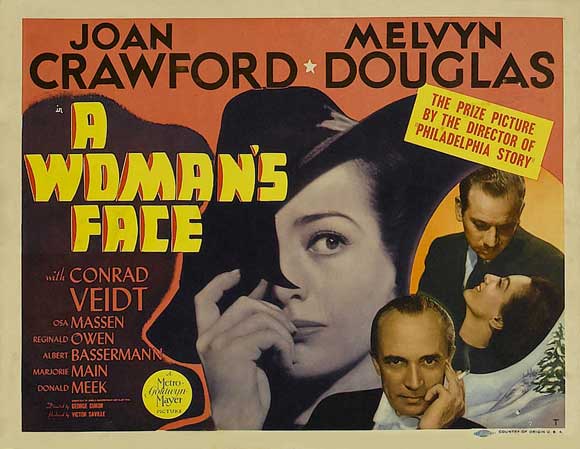
When we decided to view Joan Crawford's movies, A Woman's Face
(1941) was one of the movies I was most looking forward to seeing with
my friends. A totally underrated movie, with a beautiful, understated
performance by Ms. Crawford, I was sure everyone would love it. And they
did.
Joan plays Anna Holm, a young woman who works as a blackmailer,
and who was horribly scarred as a child. During one of her blackmail
missions, she encounters Dr. Gustav Segert
(Melvyn Douglas), a plastic surgeon with a remarkable record of
successes. Fascinated by Anna's scars, he offers to attempt a series of
surgeries that will possibly correct the damage. Anna consents; she
had recently met Torsten Barring (Conrad
Veidt), and hopes to be part of his life, scar-free. Unbeknownst to her,
Barring is far more interested in luring her into a murder plot, a murder that
would leave him the heir to millions.
Crawford
is just perfect in this role. Her acting is subtle; watch her
reactions to fire (Anna is terrified of fire), her mannerisms before
and after her surgery, and the restrained but definite reactions that
we see in her eyes as she reacts to a variety of frightening and
horrifying issues. Also magnificent is the always wonderful Conrad
Veidt. Veidt began his career in the silent cinema of his native
Germany, and generally played the hero. In the 1930s, he managed to
alienate the Nazis (he loathed Hitler and everything Hitler stood for),
and escape to England (where he became a citizen). Of course, his
career in American movies generally cast him as either a villain (as
here) or a Nazi (as in his most famous performance - Major Strasser in Casablanca).
While we know at the start that there is something a tad slimy about
Barring, we are able to watch Veidt construct a maniac before our eyes.
We watch as his insanity is more clearly and definitely revealed with
each passing scene.
Finally, we wanted to say a word about Richard Nichols as Lars-Erik. Nichols did not have a long career, but we've seen him in several films (most notably Kitty Foyle and All This and Heaven, Too).
Nichols has a rather childlike speech pattern that is hard to miss, but
he is SO much the little boy in this movie (and in everything he does),
that it is hard to remember he IS an actor. Witness Lars-Erik bouncing
around on a cable car, and then looking back to see if he will be
scolded for doing something so dangerous. So totally 5 year old boy!!
And with a sense of tension ably supplied by the astute direction of
George Cukor! We hope you will give this one a try. We think it is worth a viewing, especially if you've not seen it before. Here's a brief scene to give you a glimpse of the film: