As promised, this week we viewed the1953 So Big, with Jane Wyman as Selina Peake DeJong. It's fun and interesting to view these films back-to-back. This version is considerably longer than the 1932 film. A lot of information that we lacked in the earlier film in filled in here. For example, the love between Selina and Pervus (Sterling Hayden) is very clearly delineated in this version. Certainly, Pervus is not an educated man; as with the first film, their love grows as she teaches him enough arithmetic to survive in the Haymarket. But this Pervus is a loving man, who calls his wife "Little Lina" and brings her wildflowers, because their land will not support a flower garden. But Jane Wyman's Selina is not as self-reliant as Barbara Stanwyck's Selina. This Selina is not able to vend her produce in the Haymarket, and the growth of her farm is largely due to the intervention of August Hempel (Jaques Aubuchon), the father of her old friend Julie (Elizabeth Fraser). There is a narrative voice (not any of the characters; assumedly, it is the voice of the author) who makes it clear that August was the prime mover in Selina's success. However, a quick review of the book plot reveals that the the 1932 version of the film is actually closer to the book in this regard. Selina makes a success of the farm on her own, not because of old friends.
Another change here is Selina's father, who is remarkably cleaned up. In the book (and in the Stanwyck film), Mr. Peake is a gambler, and the victim of a murder. Here, he is a stockbroker, and dies of a heart attack, as he unsuccessfully attempts to preserve his fortune for his daughter. We do gain a lovely piece of dialogue, however, that was lost in the last film and preserves for us the theme of Ferber's novel. Mr. Peake tells his daughter that: "there are only two kinds of people in the world that really count. One
kind's wheat and the other kind's emeralds." The wheat are the people
who feed us; the emeralds are those that create the beauty in the world. Of course, Selina becomes wheat, while the life she desires for Dirk is that of emeralds. (In the prior film, this line was given to Roelf, towards the end of the film). In this version, we never see Mr. Peake, only his portrait, which becomes integral to the development in the story.
There are some other interesting changes from the earlier movie. Young Roelf Poole, played by here Richard Beymer, is a musician (rather than a painter), which allows Selina to be his tutor both in reading and in music (the film opens with Selina playing the piano). Dirk in this version is considerably older in this when his father dies, which makes his contributions to their work in the Haymarket much more convincing. And finally, there is the introduction of Selina's friend, Julie and her daughter Paula (played by Martha Hyer) Julie is portrayed as a good woman who, unlike her daughter, is not a snob; she cares for Selina despite the fact that Selina is now poor. Paula, on the other hand, values only money, and becomes the temptress who lures Dirk away from the "emerald" life his mother desires for him. The film contains some lovely performances - Jane Wyman is excellent as Selina, and Steve Forrest (who died this past May) is quite good as the grown Dirk. It was a pleasant surprise to see Tommy Rettig as the young Dirk DeJong. Nancy Olsen, however, as Dallas O'Mara was unimpressive, especially since we had just seen Bette Davis conquer the character in the previous version. The pluck and humor of Dallas was lost here; Olsen seems to spout platitudes, making it hard to see why Dirk is so taken with her. The performance that really stands out, however, was that of Sterling Hayden. He imbues Pervus with humanity. His good looks, combined with his strength and his gentleness finally revealed what attracts Selina. He is a gentle man, a man of the land, and a man whose love for his wife, his son, and his farm run deep.
In conclusion, we thought the 1953 version contained the better script (though we were a tad annoyed that the character of Selina was weakened by the interventions of August Hempel.) And while Jane Wyman was exceptional, the performances of Barbara Stanwyck and Bette Davis really sold us on the 1932 film. Here is the trailer from the Jane Wyman film, to introduce you to the major characters:
Over the next two sessions, we are going to watch two versions of the same story - So Big, from the novel by Edna Ferber. This week, we begin with the 1932 version, starring Barbara Stanwyck as Selina Peake De Jong.
The story opens in Chicago; Selina Peake's mother is dead, and she is being raised by her father, Simeon Peake(Robert Warwick), a professional gambler. Simeon is a good man, devoted to his child. He advises her to realize that "... Life is just a grand adventure. The trick is to act in it and look out
at the same time. And remember: no matter what happens - good or bad -
it's just so much velvet." His murder results in Selina having to fend for herself. She becomes a teacher, and heads to a Dutch settlement in Illinois. She lives with the family of Klass Poole (Alan Hale), a fairly dense farmer who resists sending his son, Roelf (Dick Winslow) to school, and is oblivious to the fact that their lifestyle is killing his wife. Selina forms a friendship with the artistic Roelf (who develops a crush on her), but she falls in love with local farmer Pervus De Jong (Earle Fox), and, much to Roelf's disappointment, marries Pervus.
Stanwyck is, not surprisingly, magnificent. We see her convincingly age from young girl to old woman. It should be noted that the old age makeup is very well done. It is subtle, but it certainly gets the point across that Selina's life has not been easy. Some scenes that really jump out are the early ones between Selina and her father - both actors really help to demonstrate the strong bond that exists between them. Another is the scene in the Chicago Haymarket, when the local "fancy women", who feel sorry that Selina and Dirk (Dickie Moore, being very adorable as "So Big", Selina's nickname for her little boy) have to sleep in the wagon, offer them money. Selina's gracious refusal really tells us so much about the character. Her later scenes with the grown-up Dirk (Hardie Albright) demonstrate her love and concern for her son, as well as her unwillingness to meddle in his life. She wants him to see the beauty in life, to have a career that he loves, and not be someone who is only about making money. Yet, she tries not to criticize, only to love and let Dirk find his own way.
We were also pleased to see Bette Davis in a supporting role as Dallas O'Mara, a career-minded, independent young lady who attracts Dirk. One scene that was particularly interesting was a dinner between Dirk and Dallas. We had previously seen Dirk dining with a wealthy married woman. She orders "De Jong Asparagus", and comments on the Dirk's name. He immediately denies any relationship to the produce. Yet, on his first date with Dallas, he is quite open about his mother's asparagus farm. Dallas' delight at knowing Dirk is from the country is quite lovely, as is the scene when she finally meets Selina.
George Brent (Roelf Pool) is wasted here. We don't really seem him until the very end of the film, and only for a short period of time. Of course, this is the beginning of Brent's extensive career. He would finally get second billing on his next film, The Rich are Always with Us (which we discussed recently). It is hard to imagine the well-educated, independent Selina with Pervus. He's rather hard-headed (though NOT like the moronic Klaas Poole), has no education to speak of, and very little ambition. But, it is obvious that he loves Selina, is willing, up to a point, to learn from her, and wants the best for her and their little son. But we also know that, in the end, she is probably going to do better financially without him. He is stuck in the past. Selina (and perhaps Dallas) are the future. Next time, we'll discuss the 1953 version of the film. In the meantime, here is a scene with Stanwyck as Selina (and Noel Francis as Mabel):
Last week, I had the unique opportunity to see a classic film with music played by a symphony orchestra. West Side Story (1961) was shown at Strathmore (in suburban Maryland), with the Baltimore Symphony Orchestra (conducted by Marin Alsop) performing the music. All I can say was that it was glorious. I had previously seen films with live music, but these were silent films and Disney's Fantasia - music with dialog or vocals. Here, so much of the film relies on the words of the songs, lyrics which propel the action of the story forward, I wondered how this would be accomplished. Though I have no idea (technically) how it was done, I happily report that the orchestra, the singers, and the film all synced beautifully. At times, I forgot there WAS a live orchestra, but the power of the music was so intense that I fell into the film in a way I never had before. With music by Leonard Bernstein, Lyrics by Stephen Sondheim, and choreography by Jerome Robbins, this film is a one-of-a-kind experience.
If you are not familiar with the story, West Side Story is a modern retelling of Romeo and Juliet. It focuses on two gangs, the Jets and the Sharks, who are struggling to retain control of their small neighborhood in New York City's West Side. The Sharks are recent immigrants from Puerto Rico. The Jets are white, also of immigrant roots; several ethnic groups are represented, including Polish, Irish, and Italian. In the midst of this strife, two young people, Tony (Anton) and Maria fall in love. As in Romeo and Juliet, these outside forces doom their pure love.
Two performances stand out. Rita Moreno as Anita, is, as always, breathtaking. I'm familiar with Ms. Moreno from a number of her performances, and I was not surprised that she blew the roof off every time she performed. More surprising, to me at least, was the electrifying performance of George Chakiris as Bernardo. When he is on the screen, it is impossible to take your eyes from him. He is a lithe and powerful dancer; his movements beyond graceful, and with a masculinity that is palpable.
Natalie Wood is quite lovely here, and her Maria is sweet and innocent at the start. She is especially good in the final scene, when she confronts the two gangs. It's well known that neither she nor Richard Beymer (Tony) do their own singing. Maria is sung by the estimable Marnie Nixon (who also sang for Deborah Kerr, Audrey Hepburn, and Margaret O'Brien). Beymer is subbed by Jimmy Bryant (who also sang for James Fox in Thoroughly Modern Millie). When these pros do A Time for Us, I dare you to listen dry-eyed. (And it is as much the power of the singing voices as it is the skill of the acting).
Some interesting pieces of trivia were discussed in the playbill: The play was originally titled East Side Story, and the rival groups were to be Catholics and Jews. This was finally rejected, because it seemed to close to Abie's Irish Rose. Warren Beatty was in contention for the role of Tony - and Natalie Wood came with him when he auditioned, which is how she was selected. The film was shot in the area that is now Lincoln Center. The film crew was allowed to work just before the tenement buildings were demolished. I was also quite taken with the opening montage of shots of New York City, circa 1961.
With or without an orchestra, I highly recommend this excellent film. TCM has named it one of The Essentials, and it surely is. Wonderful acting, great music, splendid dancing. Here is a clip that features Rita Moreno and George Chakiris singing and dancing "America". Enjoy!
Some time ago, before we began this blog, our group watched Red-Headed Woman (1932), the wonderful pre-code film starring Jean Harlow as Lil "Red" Andrew. Since then, I rewatched the film with one of our newer group members, and thought it might be nice to add this fun and rather raunchy movie to our blog.
The film opens in a hairdresser's salon.Our "heroine", Lil, has opted to become a redhead (with probably one of the best lines in movie history!). Here is the scene, it's delicious:
We quickly discover that Lil has more than just hair-color on her mind. She has decided that it is time for her to come up in the world, and she aims to do this by seducing her happily-married boss, Bill Legendre, Jr. (Chester Morris). Tricks such as working her way into his home and revealing his picture on her garter work wonders. She also succeeds in making sure his wife finds them in a compromising position. Bill tries to resist her, but, as we see below, he isn't very good at staying away from our siren.
Wife Irene (Leila Hyams) has no patience with Bill's philandering, and they divorce. Lil is all set to move in as the new Mrs. William Legendre, but, as the film progresses, we find out even marriage to a wealthy, attractive man is not enough to keep this social climber happy. This film provides some outstanding performances. The always attention-getting Ms. Harlow is stellar here as a woman with one goal and no morals. Also delightful is Una Merkel as Lil's best friend and confidant, Sally. While Sally appears to have a few more morals than Lil, there's not much difference in them, except that Lil is willing to go to any lengths to get what she wants, while Sally hasn't quite got the nerve.
Some interesting casting notes are Henry Stephenson as Charles Gaerste, one of Lil's conquests. The sight of the usually powerful Stephenson as Lil's plaything is something to behold. And, as a surprise, we have an early appearance by Charles Boyer as Albert, Gaerste's chauffeur. This was only his fifth film, and he is certainly a standout. Our pre-code delights are a little sado-masochism (take a good look at the clip above!), lots of lingerie, and a bad woman who does not get her just deserts in the end. According to this article on the TCM website, the film was also one of many (but an important one) in pushing the film industry towards enforcement of The Motion Picture Production Code. So, why did Harlow dye her trademark locks red for the film? Well, the story was based on a novel of the same by Katherine Brush, and we can assume the studio wanted to attract readers to the film. Regardless, Harlow as a red-headed woman is still a powerful sight to behold.
We are present at the birth of a baby girl - we are told she will be the richest woman in America when she grows up. Thus begins The Rich are Always with Us (1932), starring Ruth Chatterton as Caroline Grannard, that now all-grown-up baby. Caroline is married to Greg Grannard (John Miljan), but is also loved by Julian Tierney (George Brent). Though Julian wants her to divorce Greg (he suspects Greg is not faithful), Caroline loves Greg, and refuses to leave him. However, she quickly discovers that Julian is right, her husband has become enamored of Alison Adair (Adrienne Dore), and Greg wants a divorce. Thus begins the quest of Caroline and Julian to find one another. Though the plot seems fairly standard, the film is really quite intelligent and well done, as well as being a lot of fun. Ruth Chatterton is always excellent, and here she gives some real depth to Caroline. It's interesting that before we even meet her, we are told of Caroline's immense wealth.
Especially since her money plays no real part in her as a character. Are we being told this to make us expect a different person? Someone not
particularly nice? Caroline, however, is a good, kind person; the men with whom she is involved are financially well-off; we are never led to assume she was married for her money. The film really could be about any woman whose life is thrown into turmoil by an unfaithful partner. The title perhaps, refers more to a woman who is rich in goodness, rather than in money.
In her 9th film (and her 2nd year in Hollywood), Bette Davis appears in a supporting part as Caroline's friend Malbro. Davis is truly at her loveliest; here she appears, as she did in many of her earliest films, as a blonde and it is really quite becoming. Malbro is in love with Julian, but she is also close friends with Caroline, which presents her with a real problem. As you watch the film, you wonder if she will betray her friend in her pursuit of Julian.
Julian, as portrayed by George Brent, is a great guy with a lot of patience. In a sense, Brent doesn't have a lot to do but be long-suffering, but one of his powers as an actor is that he can always get you involved with him, without detracting from the rest of the action.
If Malbro is our example of the good friend, then Alison the exact opposite. As portrayed by Adrienne Dore, Alison is a piece of work; nasty, conniving
and a liar to boot. Despite the fact that she is treated well by Caroline's friend, we begin to see that they don't really
like or trust her. The relation between John and Alison reminded us of The Women, which we discussed some time ago. Watch for the scene, late in the movie where she is spying on Caroline.
We had seen Dore before, playing Tony in
Famous Ferguson Case. There doesn't seem to be a lot of information about her. She had a very brief career - she made 12 films between 1929 and 1933, and was in
the Miss American pageant for 1925. You can view a brief bio at the Allure blog. You can also see her in this clip, which features appearances by all of our main characters:
Finally, the film, in portraying the wealthy, again treats us to great clothing and great home furnishings. Long Island appears as the playground of the rich. We will leave you with the trailer to this film. We heartily suggest you to give The Rich are Always With Us a viewing.
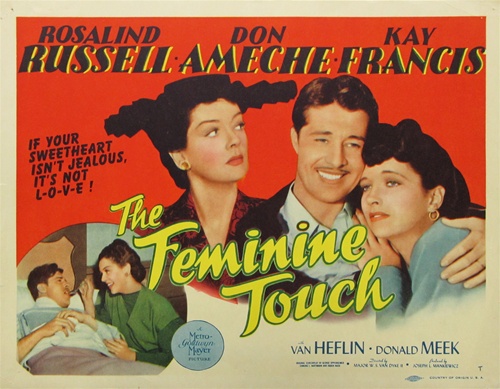
At its best, screwball comedy is a wonderful thing. It is a manic, charming, delightful walk into the wacky world of a person who lives very much in an alternate universe. The Feminine Touch (1941) does NOT fall into this category. The film features Rosalind Russell as Julie Hathaway, the wife of Prof. John Hathaway (Don Ameche), a college professor who despises jealousy as a worthless emotion, and who has decided to ditch his university job and write a book on the subject. Enter Nellie Woods (Kay Francis), the editor for publisher Elliott Morgan (Van Heflin). Elliott's not very involved in his business - Nellie does all the work in the publishing house, as her boss is too busy pursuing the high life and women. Unfortunately, Nellie is also in love with Elliott, and sees this book as an opportunity to force Elliott into paying some attention to her. Elliott, of course, is much more interested in wooing Julie. Julie's problem is that while she is not the least bit interested in Van, she is dismayed that John doesn't care that another man is trying to seduce her.
While the film has some amusing moments, primarily it is just annoying. We're presented with a number of characters who are just, quite frankly, stupid. Nellie is the only one with any brains. And Elliott, besides being an idiot, is a pest. You spend most of the movie wanting to smack him. It is amazing how long it takes him to realize that Julie is not interested in anyone but her husband. Plus, Heflin, usually such a disciplined actor, here is hugely overacting. He spends much of the movie distorting his face, to no real purpose.
Russell and Ameche are similarly annoying. She is overacting; he is just being smug. Worse still, there is NO chemistry between the two of them. Perhaps that's why this is their only film together. Though, given that both are excellent actors when given a decent script, one would have liked to have seen them together in a more sympathetic venue. With the writing talent (George Oppenheimer and Ogden Nash, specifically) and the producer (Joseph L. Mankiewicz) of the film also people's who work we admire, we were surprised that the script wasn't sharper. As it is, it just seems to go on forever. Even the final scene seems gratuitous.
We did enjoy, as New Yorkers all, the scenes of New York City, specifically the depiction of the subways. (We remember the old rattan seats and the overhead straps, which gave NYers the name "straphangers". Actually, one of us - the short one - misses those straps!). In spite of everything, Kay Francis is really quite good. As always, she gets great clothing - her hats, especially, are something to be seen. We suspected the costumers wanted to look a bit avant garde and daring - they do succeed. Her character, as we said, is the only one with a brain - she is running the company, and we suspect, will continue to run it. Ms. Francis is the breath of fresh air in the middle of chaos.
We should note that, according to this article from TCM, The Feminine Touch was actually quite well received when it was released, so you may want to judge for yourself whether it is a hit or a miss. To get you started, here is a trailer:
This week, we return to one of our favorites, the lovely Olivia de Havilland in the 1938 technicolor epic Gold is Where You Find It. Olivia plays Serena Farris, the daughter of Colonel Ferris (Claude Rains). She is at odds with her wastrel brother, Lance (Tim Holt), who has no regard for the land, while she endeavors to build a fruit orchard on the farm.
Enter Jared Whitney (George Brent), the new mining foreman at the Golden Moon Mining Company. He shares Serena's love for the land, but at the same time, he is the person now responsible for its destruction. He befriends Lance, loves Serena, and earns the enmity of the Colonel.
Set in California's Sacramento Valley, the story is both a romance between Serena and Jared as well as the more serious story of the effects of hydraulic mining on the environment. The film vividly portrays the damage caused by high-pressure mining, and on the farmers who are trying to live and work in the midst of this destruction. The opening is done in an almost documentary style, making its statements about mining even more powerful. That much of the back-story - the mining itself, its consequences, and the lawsuits initiated by the farmers (specifically Edwards Woodruff v. North Bloomfield Mining and Gravel Company) increase the impact of the film. This chapter from the Public Policy Institute of California may be of interest to those of you who would like more information about this period of history.
Filmed in Technicolor, Gold is Where You Find It was likely the first western to use the process. (It was also a test balloon for The Adventures of Robin Hood, an attempt to see the results of the process. Interestingly, Michael Curtiz directed both films). The special effects are tremendous - though today, we can spot the miniature work for what it is, in 1938 (and on a big screen), it must have been amazing. And if you want to see a really beautiful scene, watch the very last shot. The technicolor vistas will take your breath away. We've got some amazing performances here as well. Let's start with the lovely Olivia. Serena is only 17 years old when the film begins. The character is well named. Though she has a temper, there is a serenity about her when she works in her orchard. She rather reminded us a bit of Candide, looking to create the best of all possible worlds in her small piece of land.
George Brent's Jared is a good man, in the best sense of the word. He wants to do his job, and do it well, but he also understands and appreciates that his work is creating damage. He wants to change it, but he is hamstrung by the greedy, careless men for whom he works. He loves the land, and falls in love with Serena because she is so much a part of the land. Margaret Lindsay (Rosanne Ferris), who is married to Colonel Ferris' dull and avaricious brother Ralph (John Litel) is literally a piece of work. Flirtatious in the worst sense of the word, she has no love for anyone. She has no interest in her niece and nephew. Then again, she apparently has no children herself; she's selfish and vain enough that children of any age are a burden. We loved her line to Serena to "not call her Aunt, just Rosanne". Heaven forbid anyone suspect she has an adult niece!! The costuming of Serena and Rosanne give us more information. Look at the lovely, simple country clothing, contrasted with Rosanne's citified, overdone gowns. We learn a lot about the women from the way they are dressed.
Claude Rains as Colonel Ferris is, as always, amazing. He is in the midst of a firestorm, with tensions between him and his brother and between him and his son. Rains' attitude towards Brent is understandable; he sees him as stealing his daughter, corrupting his son, and destroying his farm. Ultimately, Ferris is shows as a fair man; Rains lets us see the goodness in the man, even when we most dislike his actions.
Tim Holt gets very low billing in the film, but he treads a fine line in his portrayal of Lance. And he succeeds admirably. He manages to show a young man who clearly has depth, but chooses not to always plumb it.
Finally, one of our favorite moments happened about midway through the film, when we meet Senator Hearst, whose son "Willie wants to be a journalist". The senator is horrified - running a paper will never make a profit!
For an interesting analysis of the film, visit the article on the TCM website about the film. Here is a trailer:
This week, we watched Penthouse, a 1933 film starring Myrna Loy as Gertrude Waxstead, a young woman "with a past" and Warner Baxter as Jackson Durant. Durant is engaged to Sue Leonard (Martha Sleeper), but the wealthy young woman is distressed that her fiance has lowered himself to practicing criminal law. Bored with the current activities in his law practice, Durant has just defended (and gotten acquitted) gangster Tony Gazotti (Nat Pendleton). While acknowledging that he craves the excitement of criminal law, Durant was also convinced that Tony was innocent of the crime for which he was accused (otherwise, he would not have defended him). But his new interest in the law causes friction between Durant and his partners, and with Sue. Plus, Sue has found a new boyfriend - Tom Siddall (Philip Holmes), an upper-crust young man, who is not all that pure of heart. Once Sue tells him she is interested in him, Tom agrees to break up with his mistress, Mimi Montagne (Mae Clarke). However, the breakup is just the start of problems for Tom, for Sue and for Durant. And it also serves as Durant's introduction to Gertie.
Myrna Loy is just adorable in the film. Invited to Durant's apartment, she discusses spending the night there; he provides her with pajamas, and then, much to her amazement, leaves the bedroom. Later, she discusses her feelings for Jackson, but tells him that it would be inappropriate for their relationship to be public - she will live as his mistress. It's quite clear that she is not quite the prim and proper virgin. She knows her way around the seamier side of the City. If there is a slight problem with the film, it is the fact that the murder (we won't say who is murdered), seems motiveless. We really never find out why the victim was targeted. Was there a threat perceived by the murderer? The murder is a very complex setup - yet the reason behind it is never discussed. Long Island here becomes the playground of the rich (Sue's family has a mansion there) - much the way it does in The Great Gatsby. We suspect that it is just far enough from the City as to have the aura of entitlement. As New Yorkers, we found that amusing.
We found Charles Butterworth as Layton, Durant's manservant, very amusing. We also had a long discussion about Warner Baxter. We have so rarely seen him in films, though he had a long career. He was the Crime Doctor in the 40s, as well as playing The Cisco Kid in several films. He had a substantial career in silent films, before making the switch to talkies - even playing the original Daddy Long Legs in 1931. He died at age 62, the result of infection following a lobotomy (in this case, being used for the relief of extreme pain caused by arthritis. A quick look at the medical literature for the late 1940s and early 1950s does show that lobotomy was being considered as a relief for intractable pain!) Again, the costuming is quite good, though Myrna Loy only gets one dress - it's gorgeous, but except for a change of costume at the end, this is all we see. There is a very funny scene in which she tries to describe to Warner Baxter what dress he should bring her from her apartment. Clearly she has quite a nice wardrobe at home. Before we go, here is a clip from the film - featuring Myrna in her dress. Next week, another classic film.
Bachelor Apartment (1931) really stars Lowell Sherman as Wayne Carter, the owner of the apartment, which comes equipped with hot and cold running women. One evening, while his is entertaining a recent conquest, Helene Andrews (Irene Dunne) arrives, looking for her younger sister. Turns out, Carter's manservant has enticed the girl there, pretending to be the wealthy Carter. Attracted to the out-of work Helen, he offers her a job in his organization - and help sister Lita (Claudia Dell) get a chorus job. The course of true love does not, of course, run smooth. We had seen Lowell Sherman before - playing the drunken director in What Price Hollywood? We found him a lot more believable there, than as a roue being pursued by an endless number of women. WHY they found him so attractive, was beyond us. Our conclusion - he is quite wealthy, though that did not explain the constant presence of Agatha Carraway (Mae Murray), his former lover, who is now married and eager to restart their affair. Either he is the world's greatest lover, or something else is going on here. Regardless, the film, as a result, is very risque, amusingly so. We particularly enjoyed the scene where Helene appears in a bathrobe to protect Carter from Agatha's irate husband. The costuming, especially Dunne's business clothing is quite impressive. The wardobe for Murray is very over-the-top, but it perfectly matches her rather loud persona. It is worth noting that our star, Lowell Sherman is the director here as well. While not a great film, this is a fun one, and is worth a view. Certainly an opportunity to see Dunne at the start of her impressive career is always welcome. And while Sherman is not our idea of manly beauty, he is an amusing actor. Here's a scene to whet your appetite:
Trouble in Paradise (1932) is a film that requires you to keep your eyes on the screen. So much happens here that concentration is essential. The film opens when two thieves - Herbert Marshall (as Gaston Monescu) and Miriam Hopkins (as Lily) - meet and fall in love in Venice, as each attempts to rob the other one! The following year, they are still together and still on the prowl for victims. Enter wealthy widow Mariette Colet (Kay Francis); Gaston steals her purse, collects the reward for returning it, and convinces Mariette to hire him as her secretary (with Lily as his assistant). Sound simple? It's not. All of the characters are well developed, from our leads to various supporting characters. Besides the ever wonderful Ms. Francis - who makes Mariette a bit of an airhead, but a brainy one (yes, a contradiction, but this film is full of contradictions), we have Herbert Marshall being oh-so debonaire, and Miriam Hopkins. Quite honestly, Ms. Hopkins can be an annoying actress - she is mannered and at times over-blown. However, here she is quite funny as the naughty Lily. When she morphs into Gaston's assistant, Mlle. Votier, she is hysterical -wearing glasses, talking about her little brother, and her mother (who, of course, are sadly dead), and trying to be Mariette's new best friend. For supporting players, we have some remarkable actors: Edward Everett Horton as Gaston's Venice victim François Fileba, Charlie Ruggles as The Major, one of Mariette's many suitors (men she loves to lead on, but has no intention of marrying. She's quite happy being in control of her own life), and C Aubrey Smith as Giron, the Chairman of Mariette's company who has been embezzling from her for years. He is a riot when he threatens to resign... eventually. Director Ernst Lubitsch is having lots of fun here. Watch for the love scene between Mariette and Gaston. We know exactly what is going on, as their shadows superimpose on a bed. Lubitsch doesn't need to be crass; he easily gets his points across by innuendo. We also have gowns by Travis Banton, and gorgeous accessories and set design. A major focus of an early scene is a purse, and an exquisite purse it is! We end with a clip - including the purse!




.jpg)


