When the AFI Silver opened in 1938, their premier film was Four Daughters. As part of their anniversary festival, this was one of the three films we viewed. The Lemps are a musical family - father Adam (Claude Rains) is a conductor, instructor, and flutist; his daughters Thea (piano, played by Lola Lane), Ann (violin, played by Priscilla Lane), Emma (harp, played by Gail Page), and Kay (vocalist, played by Rosemary Lane) accompany him on classical recitals in their home; their audience is their Aunt Etta (May Robson). Their home is a happy one, and the girls have a busy social life. Emma has a beau, Ernest (Dick Foran), and Thea has just met someone (Frank McHugh as Ben Crowley). Young Ann, however, has no interest in a beau; she has decided to be an "old maid", and live always with her beloved sister Emma. But that is before Felix Dietz (Jeffrey Lynn), a young composer enters their lives. In short order, all four girls are smitten with the young man. He however, only has eyes for Ann. And while it seems there will be a happy ending for Felix and Ann, the arrival of Mickey Bordon (John Garfield), and Ann's realization that Emma loves Felix will have devastating results. From a novel by Fannie Hurst, Four Daughters is certainly a woman's picture in the traditional sense. In some sense, the men (Felix, Ernest, Ben) are merely objects for the women to discuss. But the character of Mickey, as portrayed by Garfield is far more than that. Garfield's intensity (which he brought to all of his film roles), makes Mickey a force of nature that blows violently into the lives of all around him. Mickey is both selfish and caring at the same time. He loves Ann passionately, is able to see the pain of those around him (he and Aunt Etta are the only ones that realize how deeply Emma cares for Felix), but he is also willing to destroy the lives of Ann and Felix so he can have Ann.
The Lane Sisters and Gail Page are flawless as the Lemp girls. Their love for one another and for the family unit is true - watch the scene as the girls rummage through each other's closets to compile an appropriate date outfit. Ann's decision to be with Mickey rather than Felix is as much about sparing Emma pain, as it is her need to bring some joy into Mickey's life. We quickly realize that Ann DOES love Mickey - not in the way she does Felix; she feels an almost motherly responsibility for Mickey that she cannot escape. Ann's extreme youth is further demonstrated by her decisions. She is unable to differentiate between love of a spouse and love of family. Mickey should be family, but Ann can't quite see it. The film resulted in two sequels, Four Wives and Four Mothers, as well as a companion film, Daughter's Courageous. While neither is quite as powerful as the first film, the chemistry among the Lemp family is emphasized in this continuing series. The impact of Garfield as a performer is highlighted in this clip. Enjoy!
Constance Bennett is back in the 1931 melodrama, The Easiest Way. She plays Laura Murdock, a department store saleswoman who is offered the opportunity to pose as an artist's model for the Brockton Advertising Agency. She readily agrees, and finds the work agreeable. However, she comes to the attention of Willard Brockton (Adolphe Menjou), who offers her a different kind of employment - that of his mistress. While visiting friends of Brockton in the country, Laura meets Jack Madison (Robert Montgomery). He knows of her life, but loves her unconditionally. She eagerly agrees to leave Brockton, and live a respectable life. Only problem is, Jack is leaving the country, and Laura will need to fend for herself 'til he returns. Can she do it? Or is the easiest way the only way for her?
This film very much reminded us of Primrose Path, where our heroine struggled to avoid the oldest profession. But, while that film was set in the early 40s, this one is set smack in the center of the Great Depression - it was hard for a man to get a job, much less a woman. And while Laura is working, she has a lot on her plate - siblings, a mother, and an alcoholic, perpetually unemployed father. The money that Brockton provides supports Laura in style, but also allows her to provide for her family. Mother Agnes (Clara Blandick) refuses to see Laura once she is living with Brockton, yet clearly Laura's money is supporting her. The only family member who refuses to live on Laura is her brother-in-law Nick (Clark Gable, in one of his first major films). While NIck is hard, he is true
to his principles; he doesn't approve of what she is doing, so he won't
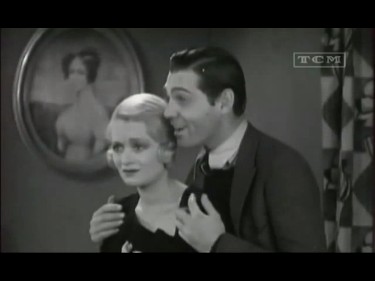
take anything from her. Gable is able to give him that rugged handsomeness for which he was later known. TCM points out in that he was the hit of film - women came out of the film asking who he was.
Some interesting period views here - the film is obviously precode - among other things, we see Laura's parents in bed together. We see an old New York City railroad flat, and we are provided a view into the world of advertising, circa 1931. It was fascinating to see the rooms of artists providing copy for department stores; almost an assembly line of painters and models.
We found Robert Montgomery's Jack to be somewhat uncaring; he insists that Laura
abandon Brockton, but isn't concerned that she might not be able to earn a living, then stops writing for a time without telling her it might happen. He even tells her to return Brockton's expensive gifts of jewelry and furs (which might have supported her til Jack's
return). It's a relatively small part for Montgomery, but we always enjoy seeing him.
We were pretty sure that Brockton would have demanded the jewelry back anyway. Adolphe Menjou's Brockton is a very
callous, calculating individual. He is only interested in controlling a woman, and Menjou is VERY good in the part. He plays Brockton as matter-of-fact, rather than
over-the-top evil. We leave you with a glimpse of Laura's work as a model, and a hearty recommendation to give this film a look. With the paring of Constance Bennett and young Clark Gable, this is a definite winner.
This past Sunday (September 15th, 2013) was the 75th Anniversary of the Silver Theatre (now the AFI Silver Theatre and Cultural Center). To commemorate this notable event (and the restoration of the theatre by AFI in 2003), AFI ran exactly the same program that the Silver Theatre ran in 1938. We went to see 3 of the 5 films that were part of the celebration, all released in 1938. I'll be blogging about each of them over the next few weeks. Carefree, with Fred Astaire as Dr. Tony Flagg, Ginger Rogers as Amanda Cooper, and Ralph Bellamy as Stephen Arden, was our first film of the day. The plot, as in most Astaire-Rogers movies, is secondary to the dancing, but in this movie, Ginger Rogers is given a lot more to do than in some of the pairings. Amanda Cooper thinks she is in love with Stephen Arden, but she can't bring herself to marry him. So, Stephen asks his friend, Tony Flagg, a psychiatrist, to talk to Amanda, to see if her can find out why she is reluctant to wed. Tony encourages Amanda to dream, to find out the subconscious reason for her concerns - turns out, she's in love with Tony. But when she tells him, Tony hypnotizes her to hate him, then has second thoughts. Okay, so it's a rather silly plot. But there is some magnificent dancing here. One of my personal favorites is The Yam, a boisterous, energetic number, which has Fred throwing Ginger over his upraised leg. The picture below gives you just a taste of the grace and joy of the routine. It's also one of the few dance numbers where Ginger sings and Fred doesn't, and where she wants him to dance, and he is the holdout. This article at TCM discusses that dance in some detail, including the fact that Ginger Rogers came up with the idea of the leg lifts.
Rogers really gets a chance to show her comedic skills here. After Tony gives her a sedative and leaves the room while it takes effect, Amanda is whisked out of the room by the totally ignorant Stephen. She then proceeds to create mayhem everywhere she goes. Rogers manages to make you love her, even as she does all kinds of outlandish things under the influence of the gas.
Another rarity in an Astaire-Rogers film occurs in the dream sequence - at the end of the dance Amanda kisses Tony. While kisses are often suggested in Astaire-Rogers films, you seldom see them kiss. Here, you do! The dream dance is performed mostly in slow
motion. It's a shame the modern audience has become so jaded about slow
motion, thanks primarily to its overuse. Here, the slowed speed allows
you to see the precision of the dance moves. They have to be absolutely perfect,
or the speed would show every flaw.
That Astaire was a golfer is evident in the Since They Turned 'Loch Lomond' into Swing. Astaire taps as he swings, his movements are beautiful, and he even carefully changes clubs when he wants a different shot. It's a clever and challenging dance.
Finally, there is the pièce de résistance of the film - Change Partners. The song is one of Irving Berlin's best; it has probably been performed by every major popular singer since it came out, but has there ever been a better rendition than that of Astaire? Though his voice is not the quality of, say, Frank Sinatra or Ella Fitzgerald, Astaire brings a grace to his songs that few can match. Here, he uses his voice and movements to hypnotize Rogers, in hopes of telling her of his love. It's been said that many composers wrote just for Astaire. When you hear him do this, you understand why. To close, let Rogers and Astaire hypnotize you via this magnificent number. We'll be back next week with more discussion from AFI and from our weekly meetings.
Sin Takes a Holiday (1930), stars Constance Bennett as Sylvia, secretary to the wealthy Gaylord Stanton (Kenneth MacKenna). Stanton has been seeing a married woman. He is perfectly satisfied with the situation, since he has no intention to marry, and Grace's (Rita La Roy) husband is not interested in a divorce. But, to his surprise, Grace decides she is ready for husband #3, and intends to divorce her husband, with Stanton as corespondent. To circumvent this (and continue his affair), Stanton convinces the shy Sylvia (who loves him) to marry him. It will be a one-year (we assume he thinks he will be done with Grace by that time), marriage in name only, with Sylvia safely ensconced in Europe, and Stanton sewing his wild oats in New York. However, complications ensue when Sylvia, while in Europe, meets Stanton's friend Durant (Basil Rathbone), who is quite impressed with the young woman, and determines to marry her himself.
In many respects, Sin Takes a Holiday is reminiscent of Lady with a Past. As in that film, Constance Bennett is considered plain and dull (hard to believe), and while abroad, develops the confidence to take control of her appearance and her life. Of course, in this film, her "marriage" has given the bankroll to assist in the metamorphosis. The major difference here is the motivating factor for the change. While Venice in Lady with a Past decides to make a complete change in her image, Sylvia's emergence as a fascinating beauty occurs because of the attentions of Durant, the first man who has ever seen her as an attractive woman.
For those of us used to seeing Basil Rathbone playing a cad, Durant is a revelation. When we first meet him at Stanton's house, he seems, to all intents and purposes, to be that bounder that Rathbone plays so well. But Durant is actually a good man. He loves Sylvia deeply; he is charming and kind. And, unlike Stanton, he can see below the surface to the inner Sylvia. Stanton never does, and we ended up rooting for Sylvia and Durant to end up as a couple.
We also enjoyed ZaSu Pitts as Syvia's roommate, Anna. Having seen a bit of the silent film, Greed a few days earlier, it is interesting to see change in her career in talkies. She continued to work, even appearing in television shows (like The Gale Storm Show) until her death in 1963, usually (as she does in this film) as the best friend of the lead actress. EliZa Susan Pitts also wrote a candy cookbook: Candy Hits by ZaSu Pitts - it seems she collected candy recipes!
We were less impressed with Kenneth MacKenna. It didn't help that Stanton is such an unlikeable character, but MacKenna does not (in this film) have the dynamic screen personality of his foil, Rathbone. MacKenna's career was relatively short, though he did return to films briefly in the early 1960s, playing one of the judges in Judgement at Nuremberg. In the early 1930s, he even played Bullldog Drummond (a role that would later be played by Ronald Colman and John Howard) in 1930's Temple Tower. MacKenna died in 1962.
We really enjoyed this film. The characters are well developed, the scenery and settings are lovely, and, as always, we have Bennett wearing some wonderful clothing. In an article on theTCM website we find the following quote from Constance Bennett: "I'm a lot more sartorial than thespian. They come to see me and go out humming the costumes." We disagree; while we love the costumes, we really left this film humming Constance Bennett.
We are at a train station in San Francisco. Amid the hustle and bustle of people traveling, we meet Lynn Palmer (Kay Francis), a Travelers' Aid employee who has dedicated her life to assisting those in need, from a little girl en route to meet her father to an old man who is down to his last penny. Thus begins Stranded (1935), a wonderful little film that pairs Francis with George Brent as Mack Hale, a gruff engineer who has arrived to supervise the construction of the Golden Gate Bridge. There's quite a bit of plot in this little film, which is a romance, a gangster film, and a social injustice film all rolled into one. Though not a pre-code film, it takes a feminist perspective on the working woman, and portrays a tough, intelligent woman who likes and values her work life, and wants to combine it with home and family. While Lynn dedicates herself to assisting those in need as they arrive in San Francisco, Mack deals with a protection racketeer, Sharkey, and with bridge construction workers who arrive on the job drunk - encouraged to do so by Sharkey (played with his usual relish by Barton MacLane). We also have a couple of sub-plots: there's society girl Velma Tuthill (Patricia Ellis), who has volunteered to work at Travelers' Aid to get away from her mother, and meet up with her boyfriend du jour. And then there is Jimmy Rivers (Frankie Darrow), a poor boy who is hired by Mack to work on the bridge (with the help of Lynn).
If there is one problem with
the film, it is the fact that there are SO many plots that some just get
left in the wayside. The character of Velma virtually disappears after
she makes a pass at Mack. She is there more as a foil to Lynn; where
Lynn is caring and dedicated to her job, Velma is uninterested and
callous; Lynn's love for Mack is counter-posed to Velma's obvious
lust. The scene in which Mack finally responds to Velma's blatant
attentions is very funny; it is worth having her there just for the
brief moment of comeuppance.
The other character who
doesn't really get enough time is Jimmy. When one sees Frankie Darrow
in a film, one expects him to be a major part of the plot. However,
Jimmy has only a few brief scenes, and while Darrow makes the most of
them (and Jimmy's presence is important to the finale), one wishes for a
little more development of the character. At one point in the action,
Mack fires Jimmy. Though not directly stated, we wondered if this was
Mack's way of protecting Jimmy from Sharkey and his minions.
What makes this film special, however, is the truly progressive attitude towards women. This article at the TCM website discusses the strength of Lynn's devotion at some length. This is not just a woman who likes to work. This is someone who feels the power of what she can do for a small strata of humanity, and who knows it is important work. She is also not afraid of or intimidated by men. Though Mack is a brusk, opinionated individual, who sometimes lives life at the top of his lungs, Lynn is not afraid to go toe-to-toe with him. There relationship is one not only of love, but finally of mutual regard. She will never let him bully her. Their relationship is one of equals.
We are all admirers of George Brent, and this film did not let us down. While he portrays Mack as rigid and dogmatic, one realizes that his job requires him to BE rigid - one inch of error and his workers or the people who use his bridges could die. The problem is that it carries over to his everyday life - he has a very jaded view of people, and he wants Lynn to adhere to that view. Francis, always a powerful actress, holds her own against him, and gives us a loving, and equally partisan individual - but one who believes in the essential good and value in the ordinary person. Several scenes in the film really popped out. First, is a scene where Mack is forced to wait for the ever-busy Lynn - and wait he does. Another is the scene (previously mentioned) where Mack lets Velma know whom he really prefers. And finally, there is a really funny bit where Lynn has to get a group of foreign brides to their new homes in San Francisco. Mack shares the ride with the women. It's a hoot.
The film also makes nice use of stock footage of the Golden Gate Bridge while under construction (as well as providing some interesting detail about the work). Clothes-horse Francis mostly has practical, business clothing here (though she gets a gown or two, courtesy of Orry-Kelly). Her wardrobe (and her lovely apartment) are not totally out of place, as the film establishes that Kay is not without economic resources. She works because she wants to, not because she has to.
Finally, we wondered if Kay Francis in these kinds of roles, was an inspiration for women? We've
see her in many roles in which her character is a strong professional woman. What impact did
those roles have on the viewer? Was there a woman who was convinced to become a social worker or physician based on a Kay Francis film? We close with Lynn and Mack on the phone.
As the film The Common Law (1931) opens, we meet Valerie West (Constance Bennett). She has just informed her lover Dick Cardemon (Lew Cody) that she is leaving. Dick is angered by her departure, and is sure she will return. Valerie, however, is determined to make it on her own and applies for a modeling job with artist John Neville (Joel McCrea), who is struggling with a painting for which he needs the right model. He finds that model in Valerie, and finds too a woman to love.
Though struggling to make it as an artist on his own income, John is the son of the wealthy John Neville, Sr. (Walter Walker). John, Jr.'s sister Claire Collis (Hedda Hopper), who we know is not thrilled by his career choice, is horrified when she discovers that her brother is in love with such a - to her view - common woman. So, Claire devises a plan to break up the relationship.
There is a real chemistry between Constance Bennett and Joel McCrea. It was evident in their other movies together (this is the fourth of their four films together that we've viewed and discussed). An article on the TCM website (in a discussion of Born to Love) talks about Bennett telling McCrea that he was to be her co-star in that film, and the fact that many in Hollywood thought there was more to their relationship than just work.
Certainly this film falls nicely into the Pre-code realm. We watch Valerie shyly drop her clothing as she poses nude for painter John, and we see a number of paintings that make it clear she doesn't wear a whole lot of clothing for the series of pictures he does of her. And then there is their relationship. Terrified he will be driven away if they marry, Valerie agrees to a relationship with John ONLY if there is no marriage involved. As in the film Illicit, it is the woman who opts for the "common law" relationship. The men in these films are much more desirous of marriage than the women.
John is clearly more conventional than Valerie - his double-standard is quite pronounced when he learns of her prior affair with Dick. But it does not bother him in the least that she is willing to pose in the nude. And, while they are in Paris, John and Valerie live together openly, when they return to New York, John feels compelled to hide their relationship.
This film is also notable for the presence of notorious gossip columnist Hedda Hopper. Her Claire is annoying from the minute we meet her. She is dull and conventional, has no understanding of her brother, and is more interested in her position and reputation than his happiness (unlike John's father, who just wants John to be happy). We don't learn a whole lot about Claire Collis - she seems to be either a widow or a divorcee, as we never meet a husband, nor is he even mentioned. In the TCM article about this film, Hopper's relationship with Bennett is discussed. Bennett did not like her one bit; even though at this point in her career, Hopper was still primarily acting. However, she had started selling stories to the press about her colleagues. It was after she realized how much more lucrative being a member of the press would be that Hopper changed her career focus (though, even after she was a columnist, she still appeared in films, most notably, as Dolly DePuyster in The Women.
The film opens with a stock shot of Paris from the 1930s which was quite fun to watch. The clothing this time was by Gwen Wakeling. We were not familiary with her, but as always, Bennett's clothing is gorgeous; but quite honestly, Constance looks good in anything.
All in all, this is an enjoyable film. We heartily recommend it.
Untamed from 1929 is a peculiar movie! It stars Joan Crawford as Alice "Bingo" Dowling and Robert Montgomery as her love interest, Andy MacAllister, and was the first talkie to be released by MGM - they were the last studio to abandon silent films - as well as Crawford's first featured sound film.
Untamed opens in South America, where Bingo Dowling is living with her ne'er-do-well father. Dad obviously doesn't supervise his child all that much. She's off with the natives, singing and dancing wildly. As you will see in the clip below, Crawford really is no singer, and her dancing is odd, at best. We discussed her dancing some time ago, when she appeared with Fred Astaire inDancing Lady. While her dancing there was energetic, here she is all angular knees and elbows. It's rather frenetic and crazy, but it sets the tone for the character of Bingo, who is at heart a wild child.
Enter Ben Murchison (Ernest Torrence) and Howard Presley (Holmes Herbert), old friends of Bingo's dad (Lloyd Ingraham). They find him gambling and drunk (his normal pass-times), but they have news. They have struck oil, and he is a partner in the endeavor. No sooner does Papa Dowling get the news than he is shot. He begs his old friends to look after his daughter, hears her voice, and dies. Being genuinely good men, "Uncle" Ben and "Uncle" Howard determine to bring Bingo to New York, where she can have a life proper to that of an oil heiress. However, Ben is not prepared for the trip to New York City, for on the boat, Bingo meets, and become immediately smitten with Andy MacAllister, a poor but noble young man (with an equally bad singing voice).
Since Bingo has spent her life in the
jungle alone with only her father as a role-model (and he's no exemplar), her reactions to a man are rather unique and inappropriate. She sees nothing wrong with being alone in a man's room; she peers into
his room without permission - Bingo has no sense of propriety. Crawford does a nice job of taking the wild child and transitioning her into a New York sophisticate. From rebelling at the prospect of shoes on her trip over, she wears the height of fashion. Bingo is shown as friendly (and seeming liked by "The Kids" who become her circle), yet Crawford is able to show the wild child is still bubbling within. For those of us used to the Crawford of the late 1930s and 1940s, this is a very different actress. Even Crawford's
posture is different than in her later career. We really are seeing the silent screen actress that she was, as she begins to grow into the dramatic actress she would become.
It's always a pleasure to see Robert Montgomery, always a
consummate actor, in anything. We've seen some of his later films with Crawford (Forsaking All Others and The Last of Mrs. Cheyney), so we knew that the pair are excellent together. This film did not disappoint. His Andy is a "good man"; even though it would be easy for him to take advantage of Bingo, he is
careful of her. So, when "Uncle" Ben forms a dislike for Andy, it's really hard to understand why. We understand that he is reluctant for Bingo to marry the first man she's ever met, but Ben is wise enough to know that Andy is not after her money. Yes, he knows that Howard is very attracted to Bingo, and hopes perhaps they will make a match. But knowing the individuals involved (and he does), it's hard to understand why he keeps trying to force Andy and Bingo apart.
The island
where the film opens is dark and dingy. This makes a nice counterpoint
as Bingo moves from that dark jungle to Park Avenue. Having seen where she began, it is not hard to understand that a bit of the jungle is
still in Bingo - she is quite temperamental and often violent. Watch
Crawford's eyes during a boxing match - they positively glow with delight
as the two men pound on one another. She
also seems to know the rules of fighting - maybe the one thing her
father taught her!
Another interesting aspect of the film is the amount of drinking that goes on. Prohibition won't end for another four year, yet there is a constant flow of alcohol. In one scene, Bingo's pet monkey breaks the only bottle of alcohol on the boat, so the two gentlemen are going
to save it by soaking it up with a sponge. While the film is a talking, it includes periodic explanatory cards, a hangover from the
silent era, as well as being heavy visual. The actors still sport the
heavy makeup (lipsticks and eye shadows) that were a staple of the
silent era. It looks very much like a silent film, with words stuck
into it; but what we are seeing
is the birth of the sound film, with silent motifs aplenty amid the
sound, and actors and crew still learning their new craft. For a more complete discussion of this topic, please stop by the TCM website for this article, which looks at this film in the context of the beginnings of the sound era. In the meantime, we will leave you with Robert Montgomery (badly) serenading Joan Crawford.
"Last night I dreamt I went to Manderley again..." is perhaps one of the most famous opening lines of a novel. Last night, I too went to Manderley again, submerging myself in the wonder that is Rebecca (1940), Alfred Hitchcock's first American film, and his only film to win a Best Picture Oscar. Aired as part of TCM's Summer Under the Stars tribute to Joan Fontaine, Rebecca is a remarkable film. Starring Joan Fontaine as the nameless second Mrs. deWinter, Laurence Olivier as her husband - and the widower of the unseen, but always felt, Rebecca - Maxim, and Judith Anderson as the always creepy Mrs. Danvers, it faithfully represents the Daphne du Maurier novel, yet creates compelling cinema AND manages to placate the Production Code.
The story of Rebecca open in Monte Carlo. Our heroine is wandering the cliff-side, when she sees a man gazing over the edge of the precipice. Alarmed, she cries out. He reacts violently, telling her loudly to mind her own business. That evening, as she sits in the lobby of the hotel with her employer, the crude Edyth van Hopper (played by the always wonderful Florence Bates), who should appear but That Man - Maxim de Winter, the wealthy owner of Manderley, and a lion of the social set. Mrs. van Hopper tries to ingratiate herself to him, to no avail (though she is oblivious to Maxim's disregard of her). Maxim is much more intrigued by her paid companion, and when Mrs. van Hopper is relegated to her room by a cold, the girl and Maxim begin to keep company. She, of course, is immediately smitten by him. He treats her as a child, needing constant care and correction. But, when Mrs. Van Hopper decides to drag the girl back to America, Maxim proposes marriage. Following a happy honeymoon, the couple returns to Manderley, and the second Mrs. De Winter finds that her life is a constant stream of insecurity and fear.
Joan Fontaine is really perfect as the second Mrs. De Winter. Her mannerisms, which can sometimes be annoying, work beautifully here; they highlight her naivety and anxiety. Laurence Olivier provides the perfect balance of superciliousness and affection as Maxim. One is never quite sure of his love for his second wife, nor his feelings for Rebecca. Which is as it should be - Rebecca needs to hover over the proceedings, as her minion, the magnificent Mrs. Danvers attempts to destroy Maxim's marriage, as well as his new wife. Ms. Anderson was rightfully nominated for an Oscar for her performance (losing to Jane Darwell in The Grapes of Wrath). Watch her as she shows the second wife Rebecca's room and belongings. Her obsession with, and passion for, Rebecca oozes from her. She is frightening and fascinating. Also notable is George Sanders as Rebecca's "cousin" Jack Favell. Sanders revels in his "hail fellow well met" persona, as he tries to figure out the best way to wring some money out of Maxim, and intimidate the second Mrs. De Winter. Just seeing his character, you get a clearer picture of who Rebecca really was (and don't like her much, as a result). TCM has a wealth of information about this film. One place to start is this article which discusses the uneasy relationship between director Hitchcock and David Selznick. Where Hitchcock had intended to use the novel of Rebecca as merely a jumping-off point, Selznick required an exact retelling of the novel. Though one change did have to be made - Rebecca's death in the book is somewhat different than the circumstances described in the movie. The Production Code would not have allowed the film to end as it did with the original story line. So great was Hitchcock's antipathy for Selznick, that he used him as the model for Raymond Burr's character in Rear Window! A trailer from the film is below. If you've never seen Rebecca, do yourself a favor and put it at the top of your list.
Several months ago, we discussed a film with Warner Baxter, and decided we wanted to view another of his movies. This week, we watched Adam Had Four Sons (1941), with Baxter as Adam Stoddard, Fay Wray as his wife Molly, and Ingrid Bergman as their governess, Emilie Gallatin. The action opens with the arrival of Emilie, a young woman from Europe, who is immediately accepted - and adored - by her four young charges, Jack (who will grow up to be Richard Denning), David (Johnny Downs), Chris (Robert Shaw) and Phillip (Charles Lind). The story follows the hardships of this good family, and the woman who becomes an intrinsic part of it, through a stock market crash, the First World War, and interpersonal catastrophes. Through it all, Adam, his four sons, and Emilie remain true to each other, despite the attempts of the world to break them apart.
The film emphasizes the strength of this family. Despite everything, the brothers, their father, and even the adopted family member, Emilie, remain loyal to one another. Torn apart by the world's events, they cope and regroup. Even when one seemingly insurmountable outside force - Jack's wife, Hester, played with relish by Susan Hayward - tries to fracture the brothers, she cannot succeed. It is interesting that their home is named Stonehenge, symbolizing the durability and longevity of those that abide in the home.
The film features several strong women characters. Fay Wray's Molly is the heart of the family. Meeting her, we understand WHY the boys are so good and loyal. She is the epitome of the good wife and mother. Yet, she is not cloying or ridiculous. Ingrid Bergman's Emilie, the adopted mother, begins as a naive girl and grows into a powerful woman. She comes to the family as an employee, is forced to leave because of Adam's sudden impoverishment, but returns, not as an employee, but as substitute for the mother the boys have lost. This was only Bergman's fourth film in the United States, but you can already see her skills. Cousin Phillipa (Helen Westley) is the traditional cagey old lady. She knows more than she says, hides her wisdom behind her relish for a good, stiff drink, but works for the good of her nephews. Vance (played by June Lockhart) is another innocent. The childhood sweetheart of Phillip, she does not waver in her love, even when Phillip is severely injured. And then there is Hester.
Susan Hayward's Hester is quite the conniver. She enters the story as the wife of David, but the audience knows immediately that she is up to no good. Of course, while Emilie and Cousin Phillipa are also well aware that she is merely an opportunistic schemer, it takes the men a bit longer to catch on. Hayward truly makes the part her own; she uses sly glances, and the most subtle of movements to convey who Hester really is beneath all the artifice, she makes you want to slap her silly! Given the title, one would think this is a film about five men. But, really, it isn't. It is about a family, and the women in the family that help the men to remain true to themselves. Here, we see Emilie's return and the introduction of Hester:
As promised, this week we viewed the 1950 Harriet Craig, in which Joan Crawford plays the title role. As with the previous film, this movie centers on a manipulative, dishonest, demanding, and snobbish woman obsessed with her home. However, this story ditches the subplots that seemed to go nowhere in the prior film. Here, the screenwriters build on the original plot by George Kelly, and add more character development. As a result, Harriet becomes a more three-dimensional person.
The film opens with Harriet preparing for a trip to visit her ailing mother. Harriet is running the small house staff (Mrs. Harold played here by Viola Roache, and Lottie, played by Ellen Corby), and her cousin Clare (K.T. Stevens) ragged. Harriet is also incensed that she cannot contact her husband, Walter (Wendell Corey). But in the next scene, much about Harriet is revealed. Her
mother is quite ill, but it is a mental illness, and a severe one. Harriet is eager to please her mother; it becomes quickly apparent that her mother is only person she really loves. We also discover that Harriet was abandoned by her father when she was 14 (after she discovered him having an affair with a co-worker). As a result, she has no trust at all for men.
This film also subtly changes the relationship between Harriet and Walter. They have been married for over four years. She does rule the roost, but there is an affection for him that we did not see in the prior film. When she returns to find the house in disorder (Walter had friends over for a poker party), she goes up to reprimand him, but looking at him asleep, a small smile creeps across her face, and she rumples his hair to wake him. And, while she does scold him for the mess (what wife wouldn't), it is kindly done. And they end up kissing in the bed. It should be noted that this Harriet uses sex to control her Walter (but it is pretty clear that she enjoys it as well!) When he wants to go out golfing, she points out that she will be upstairs in the bathtub. The look on Walter's face as he cancels his outing tells us everything we need to know. Obviously, this Harriet is FUN in the bedroom! Her actions are usually motivated by jealousy and fear. Everything is about keeping him close to home and close only to HER.
Harriet's nastiness is
especially apparent in her behavior towards the servants. Lottie (Ellen
Corby) is an especial victim of her bile. Harriet is contemptuous of
her; even giving her flowers for her room is a sign of her disregard for
the woman (Harriet dislike flowers and especially dislikes that they
came from Mrs. Frazier.)
And then there is cousin Clare. Clare is portrayed as a doormat. She takes everything Harriet dishes out, and whines about how grateful she is. When she finally realizes that Harriet has been manipulating her to keep her away from her boyfriend, Wes, Clare leave, because she hopes that Wes will now take care of her. In the end, we found Clare to be almost as unpleasant as Harriet.
Other changes in this version: Harriet's is willing to have a party in her home; but while she consents to entertain, but only the guests SHE chooses. None of Walter's friends are welcome. The
Vase, which is quickly established in both films as Harriet's pride and joy, here is described as Ming China, and therefore quite valuable; in the prior film, no such claim was made. As mentioned before, the loss of the subplots is a definite plus here, as is the addition of Walter's friend, Billy Birkmire (Allyn Joslyn). Finally, there is her attitude towards children. In both films, she dislikes children, but in this version we discover she lied to Walter about her ability to conceive. We also find out she is willing to have a child IF it will keep Walter in place.
As in the first film, we were particularly taken with the scene in which Mrs. Harold (Viola Roache) resigns. It's quiet different in many respects, but the impact is the same. Both actresses shine as they face each other down. We also very much enjoyed Lucile Watson as Celia Fenwick. Mrs. Fenwick takes an immediate liking to Walter, and has Harriet's number in about two seconds. She seems to be trying to separate Harriet and Walter. But she is funny - we realize that she is cheating at cards, and that Walter knows it!
A nod as well to Sheila O'Brien, Crawford's designer in the 1950s. She creates the gowns for the film, and they were noteworthy. Here's a suit that we found particularly beautiful. We particularily loved the delicate collar.