Thursday, October 31, 2013

She SHOULD Have Said "No"!!!

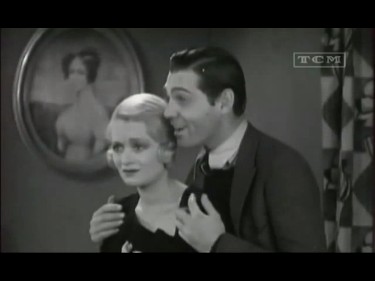
From the opening of  She Had to Say Yes (1933), it's obvious that this is a precode film.  At a meeting of the salesmen from the Sol Glass Clothing Company, all the salesmen are bemoaning the fact that their "customer's girls" are just too hard and too greedy to be appealing to the buyers who frequent their establishment.  But, the company needs to provide entertainment to these poor, lonesome men - so why not ask the secretaries in the steno pool to take on the duties of the customer's girls.  They are younger, nicer, and not as hard looking, so they will be more appealing to the buyers.  Of course, the girls won't be FORCED to take on the job (of course not...), but it will mean extra money in their pockets and free dinners and shows at the company's expense.  At first, only one girl (Birdie, played with a certain sluttish charm by Suzanne Kilborn) is willing to participate, but soon, Tommy Nelson (Regis Toomey) has convinced his fiance Florence Denny (Loretta Young) to go out with Daniel Drew (Lyle Talbot) to close a sale - and give Tommy some "alone" time with Birdie.

This film does not paint a pretty picture of men.  Without exception, the men in this film are total creeps; there is not a nice guy in the flick.  Take a look at this commentary from TCM, in which
Jeanine Basinger says that the film "puts the capper on showing how women are used by men."   You know that the secretaries will be forced to participate, and you know that if they do not "play the game" properly, they will be fired.  One of our group once worked in the garment industry, and she shook her head at what she saw as a totally accurate portrayal of the attitudes of men in that business. It seems in over 50 years, female employees were still being treated as commodities for the pleasure of the men.
The opening credits immediately inform you that you are entering the world of the fashion industry.  With stunning gowns by Orry-Kelly, the costuming is never a disappointment.  Loretta Young (who in later years was noted for her magnificent wardrobe in her eponymous television show) is garbed in some truly lovely outfits.  

Much of our discussion focused on Ms. Young.  She's quite good here.  Her Flo is sympathetic and intelligent (though we really thought that Maizie played with wit by Winnie Lightner is the smartest of the lot; she's a bit older and a lot wiser, a good character and a good friend.  And someone who really knows how to handle these horrible men).  In a different age, Flo would have been an executive rather than a secretary.  She's certainly much smarter than her fiance, the ever-creepy Tommy. 

It's hard to talk about Loretta Young without getting into some discussion of her later, personal life. We spoke at some length of Young's relationship with Clark Gable and the daughter that was the result of the liaison.  Young was a complicated woman - devoted to her Catholic faith, yet with a past that many might find the antithesis of her own beliefs.   But, here she is, two years before her life took this unwanted turn, glowing with youth and beauty and appeal.   
 
Regis Toomey pulls no punches in presenting a character that is truly unlikeable.  An underrated actor, Toomey spent much of his film career playing second bananas.  He found a place in television, where he appeared in a variety of shows, including Burke's Law (where he played Gene Barry's Aide-de-Camp), and 6 episodes of The Loretta Young Show.   Toomey died in 1991, at the age of 93, after over appearing in over 200 films.

Lyle Talbot's Danny Drew isn't much better than Tommy Nelson.  You want to like him as the film progresses, but he is really just as despicable as Tommy.   The double-standard is thick enough to spread on toast.  Do what I ask you to do, the film says, but don't be surprised when I dump you afterwards.

Here's an amusing trailer from the film - note the script at the beginning: "...because she was hired to be 'nice' to out-of-town buyers, she had to take orders from THEM until they gave their signed orders to HER.  Could a good girl stay good WHEN She Had to Say Yes...

Wednesday, October 23, 2013

George and Ann (AND Bette)

William Reynolds (George Brent) is an office worker in a high-power advertising firm.  He has a mundane job that he tolerates.  He also has a wife, Nan (Ann Dvorak) who thinks he deserves a better, more important job.  She suggests that he take an advertising campaign to his boss, an idea that was primarily Nan's.  Thus begins 1934's Housewife, a movie that wants to be precode, but doesn't quite make it.  Released in early August, the film may have originated before strict enforcement of the code; as a result, Housewife is rather a mishmash that doesn't quite ever gel.

One problem is, the film has not aged as well as it might.  Bill Reynolds is a bit of a dolt - he is selfish, and not really all that smart - though he thinks he is an advertising genius.  The brains in the family belong to Nan, and Bill has no clue in his utter self-absorption of how much he owes to her. You never see him come up with a good advertising campaign; Nan does them all. To publicize a product, Bill comes up with the idea of a radio show.  The "comedy" show is tasteless; Nan saves the day by suggesting a format change to a romance (since the company sells skin cream). Quite honestly, we wanted to take Bill by the scruff of the neck and throw him out with the trash. He is very reminiscent of Bill in Women are Like That, though Pat O'Brien's character is at least intelligent.


Why Nan wants him is beyond us. Because he is a big football player in high school?  Bill is openly unfaithful; he in facts flaunts his affair in his wife's face (and in front of her guests.)
John Halliday's Paul Duprey is a much more attractive character and obviously attracted to Nan; if she had any sense Nan would be with him.

We wondered how this particular film was received in 1934 - a quick look at the  New York Times shows that our reaction was about the same as that of the reviewer.  Bette Davis as Patricia never really quite seems comfortable with the character (again, why she would want Bill is a mystery).  We did enjoy the gowns by Orry-Kelly, who, as always, lives up to expectations. And Ruth Donnelly as Dora is a breath of fresh air.

So, while this is not really a pre-code film (this was released in August and the code was enforced beginning July 1, 1934),  there are no real repercussions for all the adultery that is going on. Here's a clip to give you a peek.

Tuesday, October 22, 2013

Kay Wants to be a Mentor

Play Girl (1941) features Kay Francis as Grace Herbert.  Grace has spent most of her life living off men (her favorite gambit is the "breach of promise" lawsuit), and has been quite successful at it.  However, now that she is no longer in the bloom of youth, she is finding it harder to live in the lifestyle to which she has become accustomed.  She's in debt; forced to sell her most valuable piece of jewelry just to pay the rent, and finance a trip to new stomping grounds in Miami.  Enter pretty Ellen Daly (Mildred Coles), a stenographer who Grace sees as a potential mentee - Grace will teach Ellen how make her living by romancing - and dumping - wealthy men.

En route to Miami, the car breaks down, and Tom Dice (James Ellison) stops to held.  Ellen is immediately smitten, but Grace is not intrigued by the seemingly destitute young man, so she makes sure he and Ellen lose touch while she entices the vain Bill Vincent (Nigel Bruce) to become Ellen's sugar daddy.  

This is a well-paced and enjoyable film, primarily because of the excellent performances.  Kay Francis creates an especially an attractive person in Grace - she seems to regard Ellen as a daughter, and in her own way, Grace is honest. Even when Ellen is not available, Grace regards Ellen's earnings as sacrosanct.  We also have a good ingenue in Mildred Coles.  She does a nice job of being innocent without appearing stupid, and her hesitancy about what she is doing makes her more appealing.  Coles had a very short career - only 26 films between 1939 and 1948, most of which were bit parts.  She died in 1995; why she left films is not clear.


Two character actresses who just don't get enough press are also in this film.  First, and foremost is Margaret Hamilton as Grace's loyal companion and maid, Josie is both confidante and adviser to Grace; she has been there through the good times, and will stick during the bad.  And of course, she gets all the best lines!  Katharine Alexander (Mrs. Dice), plays James Ellison's mother.  There is a 12 years age difference between her and Ellison, but she doesn't look old enough to be his mother.  Nevertheless, she is quite good in the part, playing a warm and likeable person.  You don't see her for very long, but you remember her at the end.  Alexander's film career went from 1930 to 1951.  As movie roles became harder to come by, she went to the stage, ultimately playing Linda Loman in the 1949 London production of Death of a Salesman, got sterling reviews, then retired within two years.

The credit sequence, which features lovely shots of expensive jewelry, was fun, and really served as a taste of the film's theme.  As always in Kay Francis' films, the costuming and scenery are great; though now she is at RKO, her contract at Warner's at an end.  This article from TCM looks describes in some detail the problems that were facing Francis after she was included on the "Box Office Poison" list from 1938 (yes, that one).  Though the men here are mere ornaments to the female characters, we did enjoy the "sauna" scene in which Bill and Van (G.P. Huntley) scheme to bring Grace down. By 1941 standards, this film is rather racy, and while not great, it's a fun 77 minute visit with Kay Francis.


Thursday, October 17, 2013

Back to Sherwood Forest

Some years ago, we discussed The Adventures of Robin Hood, but the opportunity to see it on a big screen (at the AFI Silver Anniversary Celebration) begs for revisiting the film via this blog.  Last time, we looked primarily at Olivia de Havilland; this time, we'll look a bit more closely at the wonderful character actors that grace this fantastic film.

That wonderful trio of villains, Prince John (Claude Rains), Guy of Gisborne (Basil Rathbone) and the Sheriff of Nottingham (Melville Cooper) are first on our agenda.  We were fascinated that Prince John never shows fear.  Even when Richard returns, there is not a line of apprehension on his face - John is much too busy perfecting his "spin" on his actions to worry about a little thing like death.  Rains plays John with the bravura of a man who knows he will ultimately be successful.  And of course, historically John survived his brother by many years, and ruled England after Richard's death.  Perhaps he was not England's most popular monarch - remember the Magna Carta - but his longevity (he ruled for 17 years) show he had nothing but time on his side.

On the other hand, the one character we expect to have a lot of nerve, Guy of Gisborne, does not.  Watch Rathbone's face throughout the movie. Gisborne is afraid.  And when he is captured by Robin Hood, he makes not a move to defend himself or Maid Marian.  He talks a good line, but the only time he really seems confident is when he confronts Lady Marian.  This Gisborne is a bully, pure and simple.  And not even a smart one.  Remember, it is the dim-bulb Sheriff of Nottingham who comes up with the plan to trap Robin, not Gisborne.  Then again, one gets the feeling that Gisborne would just be happier picking on women and unarmed peasants than confronting a talented swordsman.  Rathbone is so beautifully subtle in his portrayal that Gisborne's true character is just a hint rather than outright cringing.  Were he too obviously a coward, John's regard for him would be laughable.  This way, the audience understands Gisborne's nature.  John can only suspect (as he does when Gisborne and the Sheriff return from their forest meal with Robin), but it's not anything John can prove.

On the good guy side of the equation, we have the always wonderful Alan Hale as Little John.  With his hearty laugh and amiable manner, Hale is the perfect John Little.  His best (and most famous scene) is the "duel" with Robin on the tree bridge.  It's a thing of beauty to watch Little John take Robin down a peg.  Robin seems to always have this air of invincibility; Little John lets him know that even for the best fighter, there is always someone a little better.  

Similarly,  Eugene Pallette as Friar Tuck is another no-nonsense character, with nerves of steel. Overweight, years older, and a supposed man of peace, Friar Tuck confronts the Merry Men even when outnumbered, and fights boldly in all battles.  He has brains but is a compassionate man of the cloth.  Pallette, with his impressive voice and physique, make Tuck a memorable character.  
Finally, Una O'Connor as Bess, is another gutsy character.  Watch her in the ambush scene: her eyes fire when she believes her lady is in danger, and she is not afraid to verbally confront her attackers! Unlike Gisborne, she is more than willing to go toe-to-toe with any of Robin's men.  Yet, she is immediately attracted to Much (Herbert Mundin), and flirts with him like a teenager.  Her loyalty and devotion to Marian make her fearless; she risks all to save her lady, even when it is clear she will be killed if caught.  

I'll leave you with a trailer from the film.  Next time, we'll return to our usual discussion.

Monday, October 14, 2013

Kay Advertises


Women are Like That (1938) stars Kay Francis as Claire King Landin;  Claire is about to marry Martin Brush (Ralph Forbes), her father's business partner, when she elopes with agency employee Bill Landin (Pat O'Brien).  A year later, the marriage is still happy, when Bill discovers that his father-in-law (Thurston Hall as Claudius King) has embezzled several thousand dollars from the firm, leaving it on the verge of bankruptcy.    Bill agrees to make up the lost money, with the proviso his wife is not told of her father's dishonesty.  As a result, Bill loses control of his stock, and of the company to the penny-pinching and incompetent Brush.

Bill is about to lose another client thanks to Brush's interference, when Claire intervenes, and lands the account.  Furious, Bill rails against her, and walks out.   A year later, they are divorced, Claire is a valued employee in Brush-King, and Bill has disappeared into a bottle as he travels the world on a tramp steamer.

We wanted to drop-kick Pat O'Brien out a window; he is a total male chauvinist in this part.  While it was noble that he wants to protect his wife, we felt he should have told Claire why he is so angry at the politics at work.  She sees the drastic difference in him; he is already drinking quite heavily, is constantly depressed, and when she tries to help, he becomes enraged.  Quite frankly, he is a very unattractive character.  We expected better from Pat O'Brien.

Francis' Claire is such an asset to her husband; it's obvious that she would have been an help to Bill, but he is so stubborn that he will not admit it.  That he eventually offers her a job, shows some growth in his character and in their relationship.  However, we thought that Claire should just dump Bill and Martin, and her morally bankrupt father and run the company herself.  We despised Claudius;  he cares for nothing but his own pleasure and doesn't care what the consequences will be for this child and her spouse.

The film gives us a some beautiful clothing by Orry-Kelly, and art direction by Max Parker.  Claire's bachelor apartment is spectacular.  But the script was lacking.  It has no depth. We felt that a lot was missing.  That Claire had no women friends detracted greatly from the story - with no one to confide in except Bill, we never get to look deeply inside of Claire.  As a result, Ms. Francis' character is left hanging.  This TCM article looks at the film within Francis' work at Warner Brothers.  

On the plus side, the scene where Claire goes through multiple beauty treatments  is hysterical.  We felt her pain! (and it is the only time when her husband appreciates her involvement).

While amusing, this is not one of Kay Francis' best movies.  Below is a trailer from the film.  We'll revisit Ms. Francis with one of her later roles next week. 


Saturday, October 5, 2013

The Ones They Love Belong to Somebody Else


Consolation Marriage (1931) is the story of two good, loving people in love with a pair of the most selfish, careless people on the planet.  Steve Porter (Pat O'Brien) is engaged to Elaine Brandon (Myrna Loy).  He has been out of the country, trying to build his career; he returns to find his great love has married a wealthy man.  Mary Brown (Irene Dunne) is in the same situation - musician Aubrey (Lester Vail) has found a patron interested in him in more than a business way, and he has consented to become her husband.  

Steve and Mary find  kinship, not only in their grief, but in their senses of humor.  On a lark, they decide to marry.  Each understands it is not a love-match, and they agree that should either become dissatisfied with the relationship, they will part, with no hard feelings.  But the business relationship quickly become more intimate, with the result being a young daughter, the light of both their eyes.  Only one problem - both Aubrey and Elaine are back, and they want to start over.
 
This is a very adult without being smutty;  it's obvious that Steve and Mary are intimate, and the end of the film, when Mary has to decided between Steve and Aubrey is the stuff of precode films.  But it is delicately handled, with our couple becoming supportive spouses, people that we as the audience genuinely liked.  

Like Mary and Steve's friends, we realize they are in love with each other, and that the image of Elaine and Aubrey they have concocted is an idealized version.  They are not able to see the reality of their lovers. John Halliday as their friend Jeff is just great here; he's a really good man who knows they are in love (he comments that only Mary and Steve don't know it), and does his best to keep them together.  We loved the scene where Jeff and Steve joke about Mary's Shoppé (with the accent on the final e!).  

We enjoyed seeing Myrna Loy again appear as the temptress.  She's even a blonde here.  It's not often one gets to see Ms. Loy doing the platinum thing.  But the golden locks fit her predatory, golddigger image.

The film very much reminded us of Smart Woman Again, we have a woman fighting for her marriage. And both have John Halliday as the supportive friend. We also have a film with a great wardrobe. The picture above will give you a peek at the lovely gowns worn by Dunne and Loy. Max Rée, who was the costumer here, worked as costumer and art director until 1935, then didn't work again until 1947's Carnegie Hall. You'll also get some great views of old New York. We enjoyed this one. We hope you do too. 

Monday, September 30, 2013

Sisters in Love with the Same Man

When the AFI Silver opened in 1938, their premier film was Four Daughters.  As part of their anniversary festival, this was one of the three films we viewed. 

The Lemps are a musical family - father Adam (Claude Rains) is a conductor, instructor, and flutist; his daughters Thea (piano, played by Lola Lane), Ann (violin, played by Priscilla Lane), Emma (harp, played by Gail Page), and Kay (vocalist, played by Rosemary Lane) accompany him on classical recitals in their home; their audience is their Aunt Etta (May Robson).  Their home is a happy one, and the girls have a busy social life.  Emma has a beau, Ernest (Dick Foran), and Thea has just met someone (Frank McHugh as Ben Crowley).  Young Ann, however, has no interest in a beau; she has decided to be an "old maid", and live always with her beloved sister Emma.  But that is before Felix Dietz (Jeffrey Lynn), a young composer enters their lives.  In short order, all four girls are smitten with the young man.  He however, only has eyes for Ann.  And while it seems there will be a happy ending for Felix and Ann, the arrival of  Mickey Bordon (John Garfield), and Ann's realization that Emma loves Felix will have devastating results.   

From a novel by Fannie Hurst, Four Daughters is certainly a woman's picture in the traditional sense.  In some sense, the men (Felix, Ernest, Ben) are merely objects for the women to discuss.  But the character of Mickey, as portrayed by Garfield is far more than that.  Garfield's intensity (which he brought to all of his film roles), makes Mickey a force of nature that blows violently into the lives of all around him.  Mickey is both selfish and caring at the same time.  He loves Ann passionately, is able to see the pain of those around him (he and Aunt Etta are the only ones that realize how deeply Emma cares for Felix), but he is also willing to destroy the lives of Ann and Felix so he can have Ann. 

The Lane Sisters and Gail Page are flawless as the Lemp girls.  Their love for one another and for the family unit is true - watch the scene as the girls rummage through each other's closets to compile an appropriate date outfit.  Ann's decision to be with Mickey rather than Felix is as much about sparing Emma pain, as it is her need to bring some joy into Mickey's life.  We quickly realize that Ann DOES love Mickey - not in the way she does Felix; she feels an almost motherly responsibility for Mickey that she cannot escape. Ann's extreme youth is further demonstrated by her decisions.  She is unable to differentiate between love of a spouse and love of family.  Mickey should be family, but Ann can't quite see it.

The film resulted in two sequels, Four Wives and Four Mothers, as well as a companion film, Daughter's Courageous.  While neither is quite as powerful as the first film, the chemistry among the Lemp family is emphasized in this continuing series.  The impact of Garfield as a performer is highlighted in this clip.  Enjoy!


Friday, September 27, 2013

Connie is Kept


Constance Bennett is back in the 1931 melodrama, The Easiest Way.  She plays Laura Murdock, a department store saleswoman who is offered the opportunity to pose as an artist's model for the Brockton Advertising Agency.  She readily agrees, and finds the work agreeable.  However, she comes to the attention of Willard Brockton (Adolphe Menjou), who offers her a different kind of employment - that of his mistress. 

While visiting friends of Brockton in the country, Laura meets Jack Madison (Robert Montgomery). He knows of her life, but loves her unconditionally.  She eagerly agrees to leave Brockton, and live a respectable life.  Only problem is, Jack is leaving the country, and Laura will need to fend for herself 'til he returns.  Can she do it? Or is the easiest way the only way for her?

This film very much reminded us of Primrose Path, where our heroine struggled to avoid the oldest profession.  But, while that film was set in the early 40s, this one is set smack in the center of the Great Depression - it was hard for a man to get a job, much less a woman.  And while Laura is working, she has a lot on her plate - siblings, a mother, and an alcoholic, perpetually unemployed father.  The money that Brockton provides supports Laura in style, but also allows her to provide for her family.  Mother Agnes (Clara Blandick) refuses to see Laura once she is living with Brockton, yet clearly Laura's money is supporting her.  The only family member who refuses to live on Laura is her brother-in-law Nick (Clark Gable, in one of his first major films).  While NIck is hard, he is true to his principles; he doesn't approve of what she is doing, so he won't take anything from her.  Gable is able to give him that rugged handsomeness for which he was later known.  TCM   points out in that he was the hit of film - women came out of the film asking who he was.  

Some interesting period views here - the film is obviously precode - among other things, we see Laura's parents in bed together.  We see an old New York City railroad flat, and we are provided a view into the world of advertising, circa 1931.  It was fascinating to see the rooms of artists providing copy for department stores; almost an assembly line of painters and models.

We found Robert Montgomery's Jack to be somewhat uncaring; he insists that Laura abandon Brockton, but isn't concerned that she might not be able to earn a living, then stops writing for a time without telling her it might happen.  He even tells her to return Brockton's expensive gifts of jewelry and furs (which might have supported her til Jack's return). It's a relatively small part for Montgomery, but we always enjoy seeing him. 

We were pretty sure that Brockton would have demanded the jewelry back anyway.  Adolphe Menjou's Brockton is a very callous, calculating individual.  He is only interested in controlling a woman, and Menjou is VERY good in the part.  He plays Brockton as matter-of-fact, rather than over-the-top evil. 

We leave you with a glimpse of Laura's work as a model, and a hearty recommendation to give this film a look.   With the paring of Constance Bennett and young Clark Gable, this is a definite winner.

Friday, September 20, 2013

Fred Analyzes Ginger

This past Sunday (September 15th, 2013) was the 75th Anniversary of the Silver Theatre (now the AFI Silver Theatre and Cultural Center).  To commemorate this notable event (and the restoration of the theatre by AFI in 2003), AFI ran exactly the same program that the Silver Theatre ran in 1938.  We went to see 3 of the 5 films that were part of the celebration, all released in 1938.  I'll be blogging about each of them over the next few weeks.

Carefree, with Fred Astaire as Dr. Tony Flagg, Ginger Rogers as Amanda Cooper, and Ralph Bellamy as Stephen Arden, was our first film of the day.  The plot, as in most Astaire-Rogers movies, is secondary to the dancing, but in this movie, Ginger Rogers is given a lot more to do than in some of the pairings.  Amanda Cooper thinks she is in love with Stephen Arden, but she can't bring herself to marry him.  So, Stephen asks his friend, Tony Flagg, a psychiatrist, to talk to Amanda, to see if her can find out why she is reluctant to wed.  Tony encourages Amanda to dream, to find out the subconscious reason for her concerns - turns out, she's in love with Tony.  But when she tells him, Tony hypnotizes her to hate him, then has second thoughts.  

Okay, so it's a rather silly plot.  But there is some magnificent dancing here.  One of my personal favorites is The Yam, a boisterous, energetic number, which has Fred throwing Ginger over his upraised leg.  The picture below gives you just a taste of the grace and joy of the routine.  It's also one of the few dance numbers where Ginger sings and Fred doesn't, and where she wants him to dance, and he is the holdout. This article at TCM discusses that dance in some detail, including the fact that Ginger Rogers came up with the idea of the leg lifts.

 Rogers really gets a chance to show her comedic skills here.  After Tony gives her a sedative and leaves the room while it takes effect, Amanda is whisked out of the room by the totally ignorant Stephen.  She then proceeds to create mayhem everywhere she goes.  Rogers manages to make you love her, even as she does all kinds of outlandish things under the influence of the gas.

Another rarity in an Astaire-Rogers film occurs in the dream sequence - at the end of the dance Amanda kisses Tony.  While kisses are often suggested in Astaire-Rogers films, you seldom see them kiss. Here, you do!  The dream dance is performed mostly in slow motion.  It's a shame the modern audience has become so jaded about slow motion, thanks primarily to its overuse.  Here, the slowed speed allows you to see the precision of the dance moves.  They have to be absolutely perfect, or the speed would show every flaw.

That Astaire was a golfer is evident in the Since They Turned 'Loch Lomond' into Swing.  Astaire taps as he swings, his movements are beautiful, and he even carefully changes clubs when he wants a different shot.  It's a clever and challenging dance.

Finally, there is the pièce de résistance of the film - Change Partners.  The song is one of Irving Berlin's best; it has probably been performed by every major popular singer since it came out, but has there ever been a better rendition than that of Astaire? Though his voice is not the quality of, say, Frank Sinatra or Ella Fitzgerald, Astaire brings a grace to his songs that few can match.  Here, he uses his voice and movements to hypnotize Rogers, in hopes of telling her of his love.   It's been said that many composers wrote just for Astaire.  When you hear him do this, you understand why.

To close, let Rogers and Astaire hypnotize you via this magnificent number.  We'll be back next week with more discussion from AFI and from our weekly meetings.


Monday, September 16, 2013

Connie Gets Married

Sin Takes a Holiday (1930), stars Constance Bennett as Sylvia, secretary to the wealthy Gaylord Stanton (Kenneth MacKenna).  Stanton has been seeing a married woman. He is perfectly satisfied with the situation, since he has no intention to marry, and Grace's (Rita La Roy) husband is not interested in a divorce.  But, to his surprise, Grace decides she is ready for husband #3, and intends to divorce her husband, with Stanton as corespondent.  To circumvent this (and continue his affair), Stanton convinces the shy Sylvia (who loves him) to marry him.  It will be a one-year (we assume he thinks he will be done with Grace by that time), marriage in name only, with Sylvia safely ensconced in Europe, and Stanton sewing his wild oats in New York.  However, complications ensue when Sylvia, while in Europe, meets Stanton's friend Durant (Basil Rathbone), who is quite impressed with the young woman, and determines to marry her himself.

In many respects, Sin Takes a Holiday is reminiscent of  Lady with a Past.  As in that film, Constance Bennett is considered plain and dull (hard to believe), and while abroad, develops the confidence to take control of her appearance and her life.  Of course, in this film, her "marriage" has given the bankroll to assist in the metamorphosis.  The major difference here is the motivating factor for the change.  While Venice in Lady with a Past decides to make a complete change in her image, Sylvia's emergence as a fascinating beauty occurs because of the attentions of Durant, the first man who has ever seen her as an attractive woman.


For those of us used to seeing Basil Rathbone playing a cad, Durant is a revelation.  When we first meet him at Stanton's house, he seems, to all intents and purposes, to be that bounder that Rathbone plays so well.  But Durant is actually a good man.  He loves Sylvia deeply; he is charming and kind.  And, unlike Stanton, he can see below the surface to the inner Sylvia.  Stanton never does, and we ended up rooting for Sylvia and Durant to end up as a couple.


We also enjoyed ZaSu Pitts as Syvia's roommate, Anna.  Having seen a bit of the silent film,  Greed a few days earlier, it is interesting to see change in her career in talkies.  She continued to work, even appearing in television shows (like The Gale Storm Show) until her death in 1963, usually (as she does in this film) as the best friend of the lead actress.   EliZa Susan Pitts also wrote a candy cookbook: Candy Hits by ZaSu Pitts - it seems she collected candy recipes!
We were less impressed with Kenneth MacKenna.  It didn't help that Stanton is such an unlikeable character, but MacKenna does not (in this film) have the dynamic screen personality of his foil, Rathbone.   MacKenna's career was relatively short, though he did return to films briefly in the early 1960s, playing one of the judges in Judgement at Nuremberg. In the early 1930s, he even played Bullldog Drummond (a role that would later be played by Ronald Colman and John Howard) in 1930's Temple Tower.  MacKenna died in 1962.

We really enjoyed this film.  The characters are well developed, the scenery and settings are lovely, and, as always, we have Bennett wearing some wonderful clothing.  In an article on the TCM website we find the following quote from Constance Bennett: "I'm a lot more sartorial than thespian. They come to see me and go out humming the costumes."  We disagree; while we love the costumes, we really left this film humming Constance Bennett.