Back in January, our group watched Illicit, a fascinating precode with Barbara Stanwyck. As part of the AFI tribute to Stanwyck, I was able to see it again, this time in a theatre. As always, a big screen does make a difference in your viewing experience.
Stanwyck is Anne Vincent; Anne is deeply in love with Dick Ives (James Rennie), but is terrified of marrying him. Marriage, she believes, will destroy their love, just as it destroyed her parents' love for one another. Though Dick is sure she is wrong, he is willing to continue their current arrangement (each has an apartment, but they visit overnight on a regular basis) until his father (Claude Gillingwater) reveals that their affair is the subject of gossip. Anne agrees to marry, but within a couple of years, Anne is distressed to discover that her prediction has come true. Dick is more concerned with being out with friends than with her. And he has seemingly succumbed to the charms of his ex-girlfriend, Margie True (Natalie Moorhead). The film is very careful to set up similar romantic situations for our hero and heroine. Dick rejected Margie when he met Anne; Anne left Price Baines (Ricardo Cortez) for Dick. Both exes are eager to win back their former love; but while Dick is easily led by Margie, Anne is not deceived at all by Price. Try as he might, Price cannot get Anne to betray Dick, even after she knows that Dick has been seeing Margie. In fact, Anne seems to find Price rather distasteful in his pursuit of her. Stanwyck nearly cringes at his advances, and is quite prepared to throw him out of her home (and one suspects she could do it, too) Both Margie and Price are vain, predatory individuals. They don't so much love as seek to possess. One can imagine that, once they win their battle, they will start seeking other prey. Anne possibly is able to see this. It takes Dick quite a long time to understand Margie.
Another couple (of sorts) is also thrown into the mix. We have Charles Butterworth as the always inebriated Georgie, and his constant companion Helen "Duckie" Childers (Joan Blondell in a fairly small part). Where Georgie is a lush, "Duckie" (who does like to party) is sober, and is a good friend to Anne, while Georgie is busy gossiping about Anne and Dick. Playing a society girl, Blondell still retains her brash appeal. The good news is, she gets better clothing; the bad news is that she isn't on the screen often enough.
This TCM article gives some picture of the critical reception of the film. While some local censor boards banned the film, The New York Times was pleased with the story, giving the cast overall approval for their work.
The film still has a great deal of appeal because it still seems so timely. This trailer will give you a taste of this interesting movie:
A Night to Remember (1942) is one of those films that doesn't seem to know what it wants to be when it grows up. Screwball comedy? Horror? Suspense? Romance? Take your pick, because the film really doesn't do any of them very well. The film opens on Nancy (Loretta Young) and Jeff Troy (Brian Aherne). They have just arrived at their new Greenwich Village basement apartment, which Nancy found for them (Jeff's never been there before). He's a hack mystery writer (he writes as Jeff Yort), and wants to work in the Village, in hopes of writing the Great American Novel. They have arrived early (without notifying their landlord), and are stunned that the apartment isn't ready for them (who arrives two days early, and expects to just move in? They haven't even paid for the apartment yet). But the real problem is, the landlord is more frightened than annoyed that they are there. And there is this weird housekeeper who says something keeps crawling on her feet.
The film is extremely repetitious. The housekeeper keeps telling the same story over and over; there is a door that is always getting stuck. It's like the writers had a few jokes, and decided they could keep using them. Rather than build on humor, the repetitions become inane.The one humorous bit is the introduction of Old Hickory, a turtle that was the mascot of the speakeasy that used to be in the apartment building. Old Hickory keeps turning up (scaring everyone), and MANY people, including the police inspector investigating the murder (of course, there is a murder!), are fans of Old Hickory.
The film is based on the third in a series of nine mystery books about the exploits of Jeff and Haila Troy, entitled The Frightened Stiff. There was also a Screen Guild Theatre radio production of the film, with Lucille Ball playing Nancy Troy and Brian Donlevy playing Jeff on May 1, 1944. The supporting cast is good, albeit not well used. Sidney Toler
as Inspector Hankins (shades of Charlie Chan!) is the only smart one within a group of fairly dumb police officers, That's probably why he is an inspector. At one point, Jeff comments that the police are no longer allowed to used rubber hoses during an interrogation - shades of the Miranda Warning!. You get to see the wonderful Lee Patrick
(playing apartment house resident Polly Franklin) right away, but you have to wait quite a while before Gale Sondergaard
(as Mrs. DeVoe) shows up. Both are fun to watch. We would have liked to have seen more of them, as both Aherne and Young got a bit annoying after awhile. As the movie opens, it has a creepy air. We felt that the writers should have emphasized that suspense aspect more, as we think they would have had a better movie. Not that humor and murder can't be done - Miss Pinkerton, which we saw a bit ago, was able to do it. So did the wonderful Cat and the Canary. But the problem with A Night to Remember is that nothing really makes sense. Why would the landlord would rent an apartment in the building to an outsider, when he and all the tenants are so frightened that an outsider will discover their crimes. And, the ending is very abrupt. The murderer is revealed with almost no explanation, and the film is over. We kinda
liked the little apartment, though, with its private garden in the back. It is supposed to be on Gay Street, which is a
real Village street. But other than that (and Old Hickory), this movie was missing that certain something that makes you want to come back for more. It's no wonder there were no further Troy mysteries.
I had the opportunity this weekend to attend part of a Barbara Stanwyck festival that was held at the AFI Silver Theatre in downtown Silver Spring, MD. The festival was held to celebrate volume one of a new biography of the magnificent Ms. Stanwyck, A Life of Barbara Stanwyck: Steel-True 1907-1940 by Victoria Wilson. As part of the series, I viewed three of the films. Over the next few weeks, I'll be sharing some thoughts with you about these films (one of which was previously reviewed).
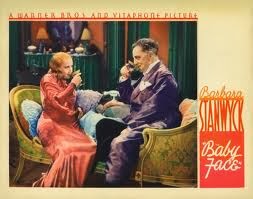
The first film was the infamous Baby Face (1933), starring Barbara Stanwyckas Lily Powers, a young woman from the absolutely wrong side of the tracks. Lily lives with her father, a nasty, evil man who runs a speakeasy Erie, Pennsylvania. It's clear that he has been prostituting his daughter, just as he did with his wife (before she left him and ultimately died). Lily despises him, and, as a result of her experiences, has no use for, as she puts it, "Dirty rotten men!". At the urging of the local cobbler (a fan of Nietzsche), Lily packs up her meager belongings and heads for New York, to "use men, not let them use [her]." And use men she does; from the minute she begins her trip, Lily is using her body to work her way to wealth and power.
Quite a bit has been written about this film. Since the restored versionwas discovered by Library of Congress curator Michael Mashon, many authors have looked at the original version in contrast to the version that finally ended up in theaters. Of particular interest are these, from Precode.com and from Electric Sheep. Obviously, many changes had to be made to make the film compliant with the newly enforced production code. The result was a hodgepodge, with the film being neither the somewhat subversive, shocking film we can see today, nor the moral tale that Hays Office required. Just a quick look at the New York Times review from the period shows how the film suffered. The reviewer said the film was about "an unsavory subject, with incidents set forth in an inexpert fashion."
The film is actually beautifully crafted. One brief moment that, I felt, said so much about Lily was an early view of her leaning out the window of her Erie home, and trying to brush the soot off the flowers in her windox box. It serves as a comment about the environment in which Lily has always lived, but also demonstrates her desire for beauty, as well as her stubbornness. The men in Lily's life are a
real back of losers. From the railway engineer who is her first
conquest, to J.R. Carter (Henry Kolker), men as shown as lascivious,
vain, and quite stupid. It's fun to see John Wayne in a very NON John Wayne role, the easily manipulated Jimmy McCoy. You can't really imagine that they are totally unable to see that Lily is controlling them to her own aims. Of course, they are so self-involved that it never strikes any of them as odd that a creature like Lily would want them.
One person who is wasted, however, is Margaret Lindsay as Ann Carter, the fiance of the somewhat insane Ned Stevens (Donald Cook). Ann's whole part involves walking in on Lily and Ned, and then running out of the room in tears. Cook gets more to do as Ned melts down when Lily dumps him. Cook is such a low-key actor, it's hard to imagine his character being so volatile. However, watch Stanwyck in that particular scene. Her control is amazing.
George
Brent, as Courtland Trenholm, is something different from the other
men. He does not immediately fall prey to Lily's charms; when they
first meet, he is not willing to bow to her blackmail demands, and the
look between them is one of mutual admiration. When they encounter one
another two years later, his admiration for her abilities turns to a
love that is deeper and more meaningful than anything Lily has ever
confronted. Trenholm knows exactly who Lily is, yet he doesn't care.
He is willing to look beyond her past to what she might become.
All through the movie, Lily has only one constant relationship, and that is with Chico (Theresa Harris), a young African-American woman who is an employee in the speakeasy. Lily's loyalty to Chico (and Chico's to Lily) is unique in films of this era. Chico is Lily's partner and confidant; she masquerades as Lily's maid, but we are always aware that the relationship is deeper. To the very end, Chico is there; no man can come between them.
If you've not seen Baby Face, treat yourself. Here is a trailer:
For another look at the film, take a look at this posting by
Electric Sheep
The Doctor Takes a Wife (1940) is about two extremely obnoxious people, who are supposedly funny when they get together. Loretta Young plays June Cameron, author of the bestselling book "Spinsters aren't Spinach," a tome that urges women to be independent, and seek careers rather than marriage. Ray Milland is Dr. Timothy Sterling, a medical school instructor and researcher in head pain. They meet at an inn, when June, desperate to return to New York, intrudes herself into Tim's car, and demands (yes, demands!) that he drive her home. During a stop, a young boy accidentally attaches a "Just Married" sign to Tim's car, and the local telegrapher is horrified to discover her hero (June) is married! To avoid scandal, June's publisher convinces her to pretend marriage (she'll also get another book out of it - "Marriage Ain't Measles"), and then "divorce" Tim once it is published. Tim agrees when he is given a long sought-after promotion BECAUSE he is married.
The biggest problem with this film is that neither Tim nor June is particularly likeable. June intrudes herself into Tim's car (too cheap to get a taxi?), then refuses to reimburse him for gas or her lunch (for which he paid), then breaks a piece of his medical equipment (a head, which bears remarkable resemblance to a Chia pet) because it looks like her hatbox. Certainly, Tim has more reason to be obnoxious (he didn't request her company or expenses), but then he proceeds to pay her debt by getting drunk on her liquor, and falling asleep in her bed. One would think that the approximately $2 he was out was worth losing to get away from her.
We're all fond of Ray Milland, though most of us are more familiar with his dramatic work (The Uninvited, The Lost Weekend, Ministry of Fear), than with his comedies. That being said, we're all fans of The Major and the Minor, and looked forward to seeing him again in a comedy. The problem with The Doctor Takes a Wife is that it isn't all that funny. It has some funny moments, but the leads end up being more of a hindrance than a benefit, and the screwball elements - like the scene where Tim runs back and forth between apartments (in an effort to keep his medical colleagues and his fiance apart) - strain credulity. The plot is so segmented that it just doesn't hold together very well, and June's very abrupt reversal regarding Tim is hard to believe.
The
characters that we would loved to have seen more of were Marilyn
Thomas, played with verve by Gail Patrick and the always wonderful
Edmund Gwenn, as Tim's father
Dr. Lionel Sterling. Gwenn is barely used - an absolute shame, as his
character was just lovely, and he is such an excellent actor. Patrick
here is (again), the other woman. Except, if you look at it closely,
June really is the other woman - Marilyn and Tim are engaged when the
whole marriage ruse is cooked up. If Marilyn is a bit much, it is
merely a device to make her more unappealing than June (and it's hard to
make someone more unappealing that June). It's Marilyn who is the
wronged party; she is quite loyal to Tim, even after she believes he has
married someone else while she was out of town.
Reginald Gardiner playing June's publisher (and would-be husband) is really just playing the
same character he played in Christmas in Connecticut. John is even more unlikeable than June, and is openly dishonest - it's his idea to milk the pretend marriage for yet another advise book (from a woman who knows nothing about the subject). He's even planning for a "divorce" book once June is able to ditch Tim.
The
film's opening
scene is a lovely, idealized view of the contemporary
bookstore. Another fantastic set design is June's two-story New York
City apartment. Her book is obviously doing well - among other touches,
the apartment has a lovely spiral staircase up to the balcony.
It's also interesting to note that the title "Spinsters aren't Spinach" was probably influenced by the book "Fashion is Spinach" by
fashion designer Elizabeth Hawes, which was published in 1938. One of our group discovered the title's multiple copies in her library (which has a fashion focus). She suspects that the
book was very popular in those days since since so many copies were available.
Another little oddity in the film was June's display of a knitted baby sweater. Never mind her complete about face regarding marital bliss. As someone who knits, the author is rather perplexed at how she knit that thing so quickly! Just to get an idea of the reception of the film in 1940, we took a look at this rather blah New York Times review. The problem, we think is that the film is trying to be screwball, but is it really? Does one farcical scene make a screwball comedy? It's not the
worst movie ever done, but neither is it really top of the game for any of the
leads. Here's a trailer from the film, to give you a chance to decide for yourself.
A man sits on a park bench, casually feeding pigeons. He is dressed in dinner clothes; he appears to be quite wealthy, both in his garb and demeanor. Beside him, a young woman quietly cries. He brusquely asks her why. She has lost her job, and hasn't eaten for 2 days. He opines that there is absolutely no reason for her to starve, and whisks her off for a meal. Thus begins Man's Castle (1933), a precode film, starring Spencer Tracy as
Bill and Loretta Young
as Trina.
Considering the disposable nature of movies in this period, and the fact that the plot centers on a couple living together without benefit of marriage, it is fascinating that the film was reissued in 1938, with about 9 minutes of content deleted (this is the cut of the film we can see today). Included in these cuts is a shot of Loretta Young jumping nude into the water. Yet, even with this elimination, it is obvious that Trina (who we see enter the water) is skinny-dipping. It's puzzling how even this version was able to pass the censors. A shortened version of Man's Castle was also aired twice (in 1939 and 1941) on the Lux Radio Theatre, both times with Spencer Tracy reprising his role.
Set amid the Depression, Man's Castle presents a picture of a man running from responsibility and the woman who loves him and is
willing to tolerate his constant dreaming. We found Bill very much like the little boy who smacks you to tell you
he likes you. Though it is apparent that he loves Trina, he is constantly plaguing her with speeches about his eminent departure. He continually belittles her, calling her Whoositz", and poo-pooing her dreams of a future. Bill is a pipe dreamer, with little grasp of reality. Even his attempts to steal enough
money so that Trina can live comfortably demonstrate his immaturity.
Though we have no
real back-story on either character, it is clear that Trina recently became unemployed. What she did before she met Bill is not discussed. She also has been
evicted from her apartment; again, it is clear that this is a recent event. Despite her loneliness and destitution, Trina retains a positive view of life, and of Bill. While Bill thinks he is smart, is is clear that Trina is much smarter than he is. She is able to run the house; she plans for them both, and (while she fears his departure), she knows his heart better than he knows it himself. The real-life relationship between Loretta Young and Spencer Tracy is discussed in this TCM article. The couple fell in love, but as we discussed last week, marriage between the two was as impossible here as it would be for Young and Gable several years later. Ultimately, Young decided to end what had become a very public affair.
As always, we have some interesting character performances. We've seen the Marjorie Rambeau before, when she played Ginger Roger's mother in Primrose Path.
Here, as Trina's only real
friend, the alcoholic Flossie, she becomes the avenging angel for pair against the rather distasteful Bragg
(Arthur Hohl). She is both sympathetic and frightening. It becomes obvious early on in the film that things will not end well for Flossie. Always delightful is Walter Connolly as Ira. A man of religion, Ira also protects Trina and Bill. But where Flossie's response to the events of her life are anger and escape, Ira looks at life squarely, and looks to his God for guidance. It's an interesting movie - one that makes you hunger for the uncut version. You may also be interested in Richard Brody's discussion of the film for The New Yorker. Regardless of the cuts, it is worth a look - here's a look at the scene we first discussed:
From the opening of She Had to Say Yes (1933), it's obvious that this is a precode film. At a meeting of the salesmen from the Sol Glass Clothing Company, all the salesmen are bemoaning the fact that their "customer's girls" are just too hard and too greedy to be appealing to the buyers who frequent their establishment. But, the company needs to provide entertainment to these poor, lonesome men - so why not ask the secretaries in the steno pool to take on the duties of the customer's girls. They are younger, nicer, and not as hard looking, so they will be more appealing to the buyers. Of course, the girls won't be FORCED to take on the job (of course not...), but it will mean extra money in their pockets and free dinners and shows at the company's expense. At first, only one girl (Birdie, played with a certain sluttish charm by Suzanne Kilborn) is willing to participate, but soon, Tommy Nelson (Regis Toomey) has convinced his fiance Florence Denny (Loretta Young) to go out with Daniel Drew (Lyle Talbot) to close a sale - and give Tommy some "alone" time with Birdie.
This film does not paint a pretty picture of men. Without exception, the men in this film are total creeps; there is not a nice guy in the flick. Take a look at this commentary from TCM, in which Jeanine Basinger says that the film "puts the capper on showing how women are used by men." You know that the secretaries will be forced to participate, and you know that if they do not "play the game" properly, they will be fired. One of our group once worked in the garment industry, and she shook her head at what she saw as a totally accurate portrayal of the attitudes of men in that business. It seems in over 50 years, female employees were still being treated as commodities for the pleasure of the men.
The opening credits immediately inform you that you are entering the world of the fashion industry. With stunning gowns by Orry-Kelly, the costuming is never a disappointment. Loretta Young (who in later years was noted for her magnificent wardrobe in her eponymous television show) is garbed in some truly lovely outfits.
Much of our discussion focused on Ms. Young. She's quite good here. Her Flo is sympathetic and intelligent (though we really thought that Maizie played with wit by Winnie Lightner is the smartest of the lot; she's a bit older and a lot wiser, a good character and a good friend. And someone who really knows how to handle these horrible men). In a different age, Flo would have been an executive rather than a secretary. She's certainly much smarter than her fiance, the ever-creepy Tommy.
It's hard to talk about Loretta Young without getting into some discussion of her later, personal life. We spoke at some length of Young's relationship with Clark Gable and the daughter that was the result of the liaison. Young was a complicated woman - devoted to her Catholic faith, yet with a past that many might find the antithesis of her own beliefs. But, here she is, two years before her life took this unwanted turn, glowing with youth and beauty and appeal. Regis Toomey pulls no punches in presenting a character that is truly unlikeable. An underrated actor, Toomey spent much of his film career playing second bananas. He found a place in television, where he appeared in a variety of shows, including Burke's Law (where he played Gene Barry's Aide-de-Camp), and 6 episodes of The Loretta Young Show. Toomey died in 1991, at the age of 93, after over appearing in over 200 films.
Lyle Talbot's Danny Drew isn't much better than Tommy Nelson. You want to like him as the film progresses, but he is really just as despicable as Tommy. The double-standard is thick enough to spread on toast. Do what I ask you to do, the film says, but don't be surprised when I dump you afterwards.
Here's an amusing trailer from the film - note the script at the beginning: "...because she was hired to be 'nice' to out-of-town buyers, she had to take orders from THEM until they gave their signed orders to HER. Could a good girl stay good WHEN She Had to Say Yes...
William Reynolds (George Brent) is an office worker in a high-power advertising firm. He has a mundane job that he tolerates. He also has a wife, Nan (Ann Dvorak) who thinks he deserves a better, more important job. She suggests that he take an advertising campaign to his boss, an idea that was primarily Nan's. Thus begins 1934's Housewife, a movie that wants to be precode, but doesn't quite make it. Released in early August, the film may have originated before strict enforcement of the code; as a result, Housewife is rather a mishmash that doesn't quite ever gel. One problem is, the film has not aged as well as it might. Bill Reynolds is a bit of a dolt - he is selfish, and not really all that smart - though he thinks he is an advertising genius. The brains in the family belong to Nan, and Bill has no clue in his utter self-absorption of how much he owes to her. You never see
him come up with a good advertising campaign; Nan does them all. To publicize a product, Bill comes up with the idea of a radio show. The "comedy" show is tasteless; Nan saves the day by suggesting a format change to a romance (since the company sells skin cream). Quite honestly, we wanted to take Bill by the scruff of the neck and throw him out with the trash. He is very reminiscent of Bill in Women are Like That, though Pat O'Brien's character is at least intelligent.
Why
Nan wants him is beyond us. Because he is a big football player in high
school? Bill is openly unfaithful; he in facts flaunts his affair in
his wife's face (and in front of her guests.) John
Halliday's Paul Duprey is a much more attractive character and
obviously attracted to Nan; if she had any sense Nan would be with him.
We wondered how this particular film was received in 1934 - a quick look at the New York Times
shows that our reaction was about the same as that of the reviewer. Bette Davis as Patricia never really quite seems comfortable with the character (again, why she would want Bill is a mystery). We
did enjoy the gowns by Orry-Kelly, who, as always, lives up to
expectations. And Ruth Donnelly as Dora is a breath of fresh air. So,
while this is not really a pre-code film (this was released in August
and the code was enforced beginning July 1, 1934), there are no real
repercussions for all the adultery that is going on. Here's a clip to give you a peek.
Play Girl (1941) features Kay Francis as Grace Herbert. Grace has spent most of her life living off men (her favorite gambit is the "breach of promise" lawsuit), and has been quite successful at it. However, now that she is no longer in the bloom of youth, she is finding it harder to live in the lifestyle to which she has become accustomed. She's in debt; forced to sell her most valuable piece of jewelry just to pay the rent, and finance a trip to new stomping grounds in Miami. Enter pretty Ellen Daly (Mildred Coles), a stenographer who Grace sees as a potential mentee - Grace will teach Ellen how make her living by romancing - and dumping - wealthy men.
En route to Miami, the car breaks down, and Tom Dice (James Ellison) stops to held. Ellen is immediately smitten, but Grace is not intrigued by the seemingly destitute young man, so she makes sure he and Ellen lose touch while she entices the vain Bill Vincent (Nigel Bruce) to become Ellen's sugar daddy. This is a well-paced and enjoyable film, primarily because of the excellent performances. Kay Francis creates an especially an attractive person in Grace - she seems to regard Ellen as a daughter, and in her own way, Grace is honest. Even when Ellen is not available, Grace regards Ellen's earnings as sacrosanct. We also have a good ingenue in Mildred Coles. She does a nice job of being innocent
without appearing stupid, and her hesitancy about what she is doing makes her more appealing. Coles had a very short career - only 26 films between 1939 and 1948, most of which were bit parts. She died in 1995; why she left films is not clear.
Two character actresses who just don't get enough press are also in this film. First, and foremost is Margaret Hamilton as Grace's loyal companion and maid, Josie is both confidante and adviser to Grace; she has been there through the good times, and will stick during the bad. And of course, she gets all the best lines! Katharine Alexander (Mrs. Dice), plays James Ellison's mother. There is a 12 years age difference between her and Ellison, but she doesn't look old enough to be his mother. Nevertheless, she is quite good in the part, playing a warm and likeable person. You don't see her for very long, but you remember her at the end. Alexander's film career went from 1930 to 1951. As movie roles became harder to come by, she went to the stage, ultimately playing Linda Loman in the 1949 London production of Death of a Salesman, got sterling reviews, then retired within two years.
The credit sequence, which features lovely shots of expensive jewelry, was fun, and really served as a taste of the film's theme. As always in Kay Francis' films, the costuming and scenery are great; though now she is at RKO, her contract at Warner's at an end. This article from TCM looks describes in some detail the problems that were facing Francis after she was included on the "Box Office Poison" list from 1938 (yes, that one). Though the men here are mere ornaments to the female characters, we did enjoy the "sauna" scene in which Bill and Van (G.P. Huntley) scheme to bring Grace down. By 1941 standards, this film is rather racy, and while not great, it's a fun 77 minute visit with Kay Francis.
Some years ago, we discussed The Adventures of Robin Hood, but the opportunity to see it on a big screen (at the AFI Silver Anniversary Celebration) begs for revisiting the film via this blog. Last time, we looked primarily at Olivia de Havilland; this time, we'll look a bit more closely at the wonderful character actors that grace this fantastic film.
That wonderful trio of villains, Prince John (Claude Rains), Guy of Gisborne (Basil Rathbone) and the Sheriff of Nottingham (Melville Cooper) are first on our agenda. We were fascinated that Prince John never shows fear. Even when Richard returns, there is not a line of apprehension on his face - John is much too busy perfecting his "spin" on his actions to worry about a little thing like death. Rains plays John with the bravura of a man who knows he will ultimately be successful. And of course, historically John survived his brother by many years, and ruled England after Richard's death. Perhaps he was not England's most popular monarch - remember the Magna Carta - but his longevity (he ruled for 17 years) show he had nothing but time on his side.
On
the other hand, the one character we expect to have a lot of nerve, Guy
of Gisborne, does not. Watch Rathbone's face throughout the movie.
Gisborne is afraid. And when he is captured by Robin Hood, he makes not
a move to defend himself or Maid Marian. He talks a good line, but the
only time he really seems confident is when he confronts Lady Marian.
This Gisborne is a bully, pure and simple. And not even a smart one.
Remember, it is the dim-bulb Sheriff of Nottingham who comes up with the
plan to trap Robin, not Gisborne. Then again, one gets the feeling
that Gisborne would just be happier picking on women and unarmed
peasants than confronting a talented swordsman. Rathbone is so
beautifully subtle in his portrayal that Gisborne's true character is
just a hint rather than outright cringing. Were he too obviously a
coward, John's regard for him would be laughable. This way, the
audience understands Gisborne's nature. John can only suspect (as he
does when Gisborne and the Sheriff return from their forest meal with
Robin), but it's not anything John can prove.
On the good guy side of the equation, we have the always wonderful Alan Hale as Little John. With his hearty laugh and amiable manner, Hale is the perfect John Little. His best (and most famous scene) is the "duel" with Robin on the tree bridge. It's a thing of beauty to watch Little John take Robin down a peg. Robin seems to always have this air of invincibility; Little John lets him know that even for the best fighter, there is always someone a little better.
Similarly, Eugene Pallette as Friar Tuck is another no-nonsense character, with nerves of steel. Overweight, years older, and a supposed man of peace, Friar Tuck confronts the Merry Men even when outnumbered, and fights boldly in all battles. He has brains but is a compassionate man of the cloth. Pallette, with his impressive voice and physique, make Tuck a memorable character.
Finally, Una O'Connor as Bess, is another gutsy character. Watch her in the ambush scene: her eyes fire when she believes her lady is in danger, and she is not afraid to verbally confront her attackers! Unlike Gisborne, she is more than willing to go toe-to-toe with any of Robin's men. Yet, she is immediately attracted to Much (Herbert Mundin), and flirts with him like a teenager. Her loyalty and devotion to Marian make her fearless; she risks all to save her lady, even when it is clear she will be killed if caught.
I'll leave you with a trailer from the film. Next time, we'll return to our usual discussion.
Women are Like That (1938) stars Kay Francis as Claire King Landin; Claire is about to marry Martin Brush (Ralph Forbes), her father's business partner, when she elopes with agency employee Bill Landin (Pat O'Brien). A year later, the marriage is still happy, when Bill discovers that his father-in-law (Thurston Hall as
Claudius King) has embezzled several thousand dollars from the firm, leaving it on the verge of bankruptcy. Bill agrees to make up the lost money, with the proviso his wife is not told of her father's dishonesty. As a result, Bill loses control of his stock, and of the company to the penny-pinching and incompetent Brush.
Bill is about to lose another client thanks to Brush's interference, when Claire intervenes, and lands the account. Furious, Bill rails against her, and walks out. A year later, they are divorced, Claire is a valued employee in Brush-King, and Bill has disappeared into a bottle as he travels the world on a tramp steamer.
We
wanted to drop-kick Pat
O'Brien out a window; he is a total male chauvinist in this part. While
it was noble that he wants to protect his wife, we felt he should have
told
Claire why he is so angry at the politics at work. She sees the drastic
difference in him; he is already drinking quite heavily, is constantly
depressed, and when she tries to help, he becomes enraged. Quite
frankly, he is a very unattractive character. We expected better from
Pat O'Brien.
Francis' Claire
is such an asset to her husband; it's obvious that she would have been an help to Bill, but he is so
stubborn that he will not admit it. That he eventually offers her a
job, shows some growth in his character and in their relationship. However, we thought that Claire should just dump Bill and Martin, and her morally
bankrupt father and run the company herself. We despised Claudius; he cares for nothing but his own pleasure and doesn't care what the
consequences will be for this child and her spouse.
The film gives us a some beautiful clothing by Orry-Kelly, and art direction by Max Parker. Claire's bachelor apartment is spectacular. But the script was lacking. It has no depth. We felt that a lot was missing. That Claire had no women friends detracted greatly from the story - with no one to confide in except Bill, we never get to look deeply inside of Claire. As a result, Ms. Francis' character is left hanging. This TCM article looks at the film within Francis' work at Warner Brothers. On the plus side, the scene where Claire goes through multiple beauty treatments is hysterical. We felt her pain! (and it is the only time when her husband appreciates her involvement).
While amusing, this is not one of Kay Francis' best movies. Below is a trailer from the film. We'll revisit Ms. Francis with one of her later roles next week.