We returned from the Christmas holiday week to discuss Three Girls About Town (1941), which stars Joan Blondell as Hope Banner and Binnie Barnes as sister Faith. The girls work as hostesses in a convention hotel, and are pooling their funds to get their younger sister Charity (Janet Blair) through private school. Of course, complications arise - first, Charity runs away from school and decides that Hope's boyfriend, reporter Tommy Hopkins (John Howard) is just perfect for her. Then, to top it all off, the girls discover a corpse in one of the hotel rooms, and decide the best way to avoid a scandal at the hotel (and lose the business of a convention of morticians) is to get the body out of the hotel without anyone's knowledge. A task that is much easier said than done.
The film has the feeling of the The Marx Brothers meet Weekend at Bernie's, with the dead body being toted all over the hotel, and passed off as a very tired man. Though the plot is rather strained (you KNOW the body is going to end up in one of the morticians' display caskets), it has some amusing moments - a scene in which John Howard and our dead friend sit in on a poker game, and our "lucky stiff" (yes, that's what they said), keeps winning poker hands is actually very funny. Naturally, as long as he is winning, Tommy and friend can't leave; and try as he might to lose, Tommy just can't get the wrong cards.
Another amusing bit has Hope trying to rid herself of a persistent drunk, who is singing in the hallway outside the dead man's room. To shoo him away, Hope tells him that there is "a singer is in the next room - Dick Powell". Joan Blondell was married to Powell at this point, so the "in" joke would have been very obvious for the audience. (The Blondell-Powell union lasted until 1945, when Powell left after falling in love with June Allyson).
Another bit of trivia - our trio of actresses were not originally considered for the parts of the Banner sisters: the studio first wanted Constance Bennett, Joan Bennett and Virginia Bruce. While it would have been amusing to see the Bennett sisters together, Virginia Bruce, who was already 30, would have been far too old (lovely as she was) to pass for the approximately 17 year old Charity. Janet Blair, who was just 20 when the film was released, was far closer to Charity's age. Blair certainly looks older than 17 in this, but Charity is purposely dressing up to look older. It does work better to try to make Blair look older than it would have done to make Bruce look like a kid playing dress-up. And while our heroines, Hope and Faith are accused by the local woman's group of being indecent, it's Charity who is actually a bit of slut. One looks forward to Charity getting her comeuppance - she is truly an unethical brat.
Also seen in bit parts are Charles Lane as an undertaker, Una O'Connell as a scrubwoman, and a VERY young Lloyd Bridges (blink and you'll miss him) as a reporter. We especially enjoyed seeing Bridges appear - he's quite handsome, and while you only get a glimpse of him, his voice is distinctive.
The film was directed by Leigh Jason. We were familiar with one of his films - Dangerous Blondes, which we discussed in September, and we hope to be looking at some of his films with Barbara Stanwyck (The Mad Miss Manton and The Bride Walks Out) in the future. Jason had a lengthy career, which extended from the silent era to 50's television. He appears to have finally retired in 1961; he died in 1979, at age 74.
We'll return next week with a film with a more historical focus. We hope you will join us then.
A weekly examination of classic films by a group who meet to discuss a selected film.
Tuesday, December 30, 2014
Tuesday, December 23, 2014
Cary Meets a Dancing Caterpillar
Once Upon a Time (1944) is not one of Cary Grant's best known films. A war-time film, with no mention of the conflict, it is a fairy tale designed to entertain and allow escape from the horrors of that war. The film is based on a 30 minute radio play "My Client Curley," by Norman Corwin (which was based on a short story by Lucille Fletcher Herrmann). It aired on the Columbia Workshop on March 7, 1940, with Fred Allen in the lead role (the radio play was redone in 1946, this time with Robert Montgomery in the lead). It's hard to imagine Cary Grant in a role which Fred Allen initiated, but the studio originally wanted Humphrey Bogart, then Brian Donlevy for that part. Either would have resulted in a very different film.
The action opens on Jerry Flynn (Cary Grant), a Broadway producer, who after three flops is about to lose his theatre. He's literally down to his last nickel, so when he sees two young boys performing on the street, he tosses the coin to them. The boy who is obviously in charge of the operation, Arthur "Pinky" Thompson (Ted Donaldson), insists Jerry gets his nickel's worth, and look into the shoebox, which his friend holds. Pinky plays "Yes Sir, That's My Baby" on his harmonica, as Jerry peers into the box. There, Jerry sees Curley, young Pinky's pet caterpillar. And Curley is dancing in time to the music. Jerry hatches a plan - he will sign Pinky on as a client, sell Curley to the highest bidder, and use the proceeds to save his theatre.
Having Cary Grant play Jerry contributes to making this film sympathetic. It's hard to dislike Grant, but Jerry is eminently unlikeable. He's vain and greedy - yes, he is having a bad stretch, but he is quite willing to betray a child to save himself. At one point, he even slaps Pinky, but Grant is an actor who is able to come back from that incident, and make us believe that Jerry is repentant. It is hard to think of either Bogart or Donlevy being able to re-engage the audience after that particular incident. Though both are magnificent actors, both had been on the wrong side of the law too often to engender that kind of sympathy.
Another almost-ran in the film was Rita Hayworth, but she went on suspension rather than accept the role of Pinky's sister Jeannie. It's not hard to see why. Janet Blair does her best with Jeannie, but there is precious little to work with. Regardless, Blair had a respectable career, starting as one of the Three Girls About Town (1941). She was Rosalind Russell's choice for Eileen in My Sister Eileen (1942), and even ventured into television as Henry Fonda's wife in The Smith Family. She died in 2007 of pneumonia, at age 85.
The film shines all its light on Grant and Donaldson; while we have wonderful actors in the cast, including James Gleason as Jerry's right-hand man, McGillicuddy (aka The Moke) and William Demarest as a reporter named Brandt (who dislikes Flynn intensely), they get almost nothing to do. But young Ted Donaldson shines in his first role - he is sweet and engaging as Pinky, but never sloppy. He (and Grant) make us believe in a dancing caterpillar we never actually see. This TCM article discusses the long, friendly relationship between Grant and Donaldson, with Grant (and then wife Betsy Drake) even attending Donaldson's high school graduation. Years later, Donaldson would pen a heartfelt letter (synopsized in Evenings with Cary Grant) to Grant, thanking him for his friendship. Donaldson would continue in films until 1953, appearing in the Rusty series and as Peggy Ann Garner's younger brother in the wonderful A Tree Grows in Brooklyn, as well as voicing Bud on the radio version of Father Knows Best. But, like so many child actors, he found no demand for her services as a teen and young adult, so left acting to write. This chapter in Growing Up on the Set will provide some insight into Donaldson's later life.
We'll end this week's discussion with a clip of Cary Grant trying to get an "angel", in the form of a banker who is about to foreclose on the Flynn Theatre. While not a great film Once Upon a Time is worth a look, just to see Cary Grant. We'll return after the holiday!
Having Cary Grant play Jerry contributes to making this film sympathetic. It's hard to dislike Grant, but Jerry is eminently unlikeable. He's vain and greedy - yes, he is having a bad stretch, but he is quite willing to betray a child to save himself. At one point, he even slaps Pinky, but Grant is an actor who is able to come back from that incident, and make us believe that Jerry is repentant. It is hard to think of either Bogart or Donlevy being able to re-engage the audience after that particular incident. Though both are magnificent actors, both had been on the wrong side of the law too often to engender that kind of sympathy.
Another almost-ran in the film was Rita Hayworth, but she went on suspension rather than accept the role of Pinky's sister Jeannie. It's not hard to see why. Janet Blair does her best with Jeannie, but there is precious little to work with. Regardless, Blair had a respectable career, starting as one of the Three Girls About Town (1941). She was Rosalind Russell's choice for Eileen in My Sister Eileen (1942), and even ventured into television as Henry Fonda's wife in The Smith Family. She died in 2007 of pneumonia, at age 85.
The film shines all its light on Grant and Donaldson; while we have wonderful actors in the cast, including James Gleason as Jerry's right-hand man, McGillicuddy (aka The Moke) and William Demarest as a reporter named Brandt (who dislikes Flynn intensely), they get almost nothing to do. But young Ted Donaldson shines in his first role - he is sweet and engaging as Pinky, but never sloppy. He (and Grant) make us believe in a dancing caterpillar we never actually see. This TCM article discusses the long, friendly relationship between Grant and Donaldson, with Grant (and then wife Betsy Drake) even attending Donaldson's high school graduation. Years later, Donaldson would pen a heartfelt letter (synopsized in Evenings with Cary Grant) to Grant, thanking him for his friendship. Donaldson would continue in films until 1953, appearing in the Rusty series and as Peggy Ann Garner's younger brother in the wonderful A Tree Grows in Brooklyn, as well as voicing Bud on the radio version of Father Knows Best. But, like so many child actors, he found no demand for her services as a teen and young adult, so left acting to write. This chapter in Growing Up on the Set will provide some insight into Donaldson's later life.
We'll end this week's discussion with a clip of Cary Grant trying to get an "angel", in the form of a banker who is about to foreclose on the Flynn Theatre. While not a great film Once Upon a Time is worth a look, just to see Cary Grant. We'll return after the holiday!
Friday, December 19, 2014
Bing and Danny Trim the Tree
We attended another Fantom Event - this time a screening of White Christmas (1954), starring Bing Crosby and Danny Kaye, a film which certainly deserves a big screen viewing. It's Christmas, 1944. Captain Bob Wallis (Crosby) is saved from a falling building by Private Phil Davis (Kaye), a budding performer. Reluctantly, Wallis consents to talk to Davis about a partnership after the war (Davis saved his life after all). The partnership is a rousing success, with Wallis and Davis becoming major performers; Wallis even takes them into the producing arena - again, they strike gold.Davis, however, would like a break. Bob works 24/7 and expects Phil to do the same thing. So, Phil decides it is time for Bob to marry - then maybe Phil will get a 45 minute break after the wedding. So, when the pair meet the Haynes sisters, Betty (Rosemary Clooney) and Julie (Vera-Ellen), Phil and Julie begin a conspiracy to unite Bob and Betty, so they can both get some time off. At Phil's urging, Wallis and Davis follow the girls to a small ski-lodge in Vermont, only to discover it is run by their old commander Major-General Thomas F. Waverly (Dean Jagger). Of course, the General has a problem - it hasn't snowed at all, and General Waverly is going broke. So, the boys concoct a plan to bring their entire theatrical troupe to New England, and use the show to publicize the inn.
By 1954, the motion picture industry was seeing television as a huge threat, in a way that radio had never been. This film is interesting in that it shows us a television broadcast (and our heroes using TV to spread the word about General Waverly's difficulties). But what is also intriguing is that we (sitting in the dark, in a theatre, seeing the film on a huge screen) watch others watching a television. So, on this large, gloriously colorful VistaVision screen, we watch folks crowded around a small, black and white television. It makes for a fascinating - and pointed - contrast.
My husband was interested in some of the military details from the prologue to the film. We're told that the army is waiting for a battle to begin in Monte Cassino at Christmas of 1944. However, the battle of Monte Cassino took place was over by May of 1944, and Allied troops safely installed in Rome. It is more likely that the big battle would have been The Battle of the Bulge (which was December 1944 through January 1945), but since that would have conjured up more of a sense of loss among the viewers, it seems likely the writers brought up the name of a more successful campaign.
The dance numbers are also something worth noting, and this TCM article gives a hint as to why. Originally, Fred Astaire was to reprise his partnership with Bing Crosby. However, Astaire was not thrilled with the script, so he bowed out of the production. Donald O'Connor was quickly substituted, but he became very ill and had to leave the production. Paramount turned to Danny Kaye (who requested a huge paycheck - and got it). As a result, some of the dance numbers feature neither of the stars. Crosby never was a dancer, and while Kaye could dance (his ballroom number with Vera-Ellen is quite good), he would not have been able to keep up with Vera-Ellen in a tap number, so dancer John Brascia (as Joe) filled in. Also, we have George Chakiris in two numbers (a little bit of a goof here - we see him as part of the Wallis and Davis troupe, then we see him in New York dancing with Rosemary Clooney). Take a look at the photo above. Many a young lady saw that pose, and hearts went aflutter. Chakiris noted (in the interview that accompanied the film) that he became quite marketable as a result of that quick glimpse.
Let's end with some musical numbers. Above, are Ms. Clooney and Ms. Ellen performing the "Sisters" number, with Ms. Clooney singing both roles (Trudy Stevens sang the rest of Vera-Ellen's songs). The men did a reprise of the number (below). Mr. Crosby, it seems, was somewhat uncomfortable with the performance, so Mr. Kaye began hitting him with his fan. Crosby broke up and director Michael Curtiz kept in the impromptu performance. It's great! In fact, they both are, so treat yourself by taking a look.
Monday, December 15, 2014
Stewart Stalks Jean... and Visa Versa
Footsteps in the Fog (1955) opens on a funeral. One of the mourners seems particularly moved by the events. He is Stephen Lowry (Stewart Granger), whose wife died suddenly of gastreoenteritis. His friends, Alfred Travers (David MacDonald) and Travers' daughter Elizabeth (Belinda Lee), rally to the Lowry home to show their support. They are accompanied by barrister David MacDonald (Bill Travers). In spite of the fact that Elizabeth is adored by David, she is in love with Stephen, and is now wondering if she can reveal her affections. Once Stephen is alone, however, we learn that the late Mrs. Lowry, who was considerably older than her handsome husband, did not die innocently. And Stephen is quite enjoying his freedom and the fortune that came to him with his wife's death.
Stephen has several servants. One of them is a rather careless, lazy girl, Lily Watkins (Jean Simmons), who the cook, Mrs. Park (Marjorie Rhodes) and the butler, Grimes (Norman Macowan) have to keep their eyes on. But Lily isn't entirely inept. She's managed to discover what no one else even suspects - that her master has poisoned his wife. And Lily intends to use the information to her own advantage. So, while Lily rids the house of the other servants, and blackmails her employer into becoming his lover, Stephen is contemplating ways in which he can rid himself of Lily.
When we discussed A Yank at Oxford, we talked about the ways in which filming in the United Kingdom helped the studios to use up monies that were legally tied up in that country. Footsteps in the Fog was filmed in the UK, with local crew and actors for that very reason. According to this TCM article, Stewart Granger was especially keen to return home and suggested that he and his wife, Jean Simmons, would star in it. Though ambilient about both the script and director (Arthur Lubin was best known for the Francis, the Talking Mule series), the couple accepted the part, and Granger worked with a screenwriter in England to make the script (based on a short story, "The Interruption," by W.W. Jacobsmore) palatable to him and Simmons. It is a technically lovely movie, however - glorious technicolor and splendid costuming. It could have been an excellent film, had it had a believable script.
The Grangers reservations about the script is certainly understandable. The female characters, Lily and Elizabeth, are both fairly stupid, and the ending (which we won't discuss - I like to avoid spoilers) doesn't really work all that well. Even Granger's character makes one wonder how he actually managed to plot the demise of his late wife - he isn't exactly a rocket scientist. That being said, Jean Simmons - given what she has to work with - is very good as Lily. This was her fourth film with husband Granger. They met on the set of Caesar and Cleopatra (1945), where Simmons had a bit part, and also worked together in Adam and Evelyne (1949) and Young Bess (1953). Footsteps in the Fog was their final film together; they would divorce in 1960. This obituary from The Independent goes into more detail on the life of Ms. Simmons. A brilliant actress, best known for her roles in Elmer Gantry, The Big Country, and Spartacus, she died in 2010 of lung cancer at age 83.
Belinda Lee worked steadily in UK films, then moved to Italy to be with her lover. While there, she starred in Constantine and the Cross (1961) with Cornel Wilde. She died that same year, age 25 in a car accident. While she is quite pretty, given the limitations of her role, it's hard to judge her overall abilities. Quite frankly, the more talented Simmons drives her from memory.
We'll close with a trailer from the film:
Stephen has several servants. One of them is a rather careless, lazy girl, Lily Watkins (Jean Simmons), who the cook, Mrs. Park (Marjorie Rhodes) and the butler, Grimes (Norman Macowan) have to keep their eyes on. But Lily isn't entirely inept. She's managed to discover what no one else even suspects - that her master has poisoned his wife. And Lily intends to use the information to her own advantage. So, while Lily rids the house of the other servants, and blackmails her employer into becoming his lover, Stephen is contemplating ways in which he can rid himself of Lily.
When we discussed A Yank at Oxford, we talked about the ways in which filming in the United Kingdom helped the studios to use up monies that were legally tied up in that country. Footsteps in the Fog was filmed in the UK, with local crew and actors for that very reason. According to this TCM article, Stewart Granger was especially keen to return home and suggested that he and his wife, Jean Simmons, would star in it. Though ambilient about both the script and director (Arthur Lubin was best known for the Francis, the Talking Mule series), the couple accepted the part, and Granger worked with a screenwriter in England to make the script (based on a short story, "The Interruption," by W.W. Jacobsmore) palatable to him and Simmons. It is a technically lovely movie, however - glorious technicolor and splendid costuming. It could have been an excellent film, had it had a believable script.
The Grangers reservations about the script is certainly understandable. The female characters, Lily and Elizabeth, are both fairly stupid, and the ending (which we won't discuss - I like to avoid spoilers) doesn't really work all that well. Even Granger's character makes one wonder how he actually managed to plot the demise of his late wife - he isn't exactly a rocket scientist. That being said, Jean Simmons - given what she has to work with - is very good as Lily. This was her fourth film with husband Granger. They met on the set of Caesar and Cleopatra (1945), where Simmons had a bit part, and also worked together in Adam and Evelyne (1949) and Young Bess (1953). Footsteps in the Fog was their final film together; they would divorce in 1960. This obituary from The Independent goes into more detail on the life of Ms. Simmons. A brilliant actress, best known for her roles in Elmer Gantry, The Big Country, and Spartacus, she died in 2010 of lung cancer at age 83.
Belinda Lee worked steadily in UK films, then moved to Italy to be with her lover. While there, she starred in Constantine and the Cross (1961) with Cornel Wilde. She died that same year, age 25 in a car accident. While she is quite pretty, given the limitations of her role, it's hard to judge her overall abilities. Quite frankly, the more talented Simmons drives her from memory.
We'll close with a trailer from the film:
Friday, December 12, 2014
Barbara Cooks
I haven't been to a double feature in a lot of year, and I miss it. So, it was a pleasure to attend the Fathom Event which featured two Christmas films. I've already discussed the first feature in an earlier post. Christmas in Connecticut (1945) was feature two. Barbara Stanwyck stars as Elizabeth Lane, the popular author of a cooking column in a national magazine. She's an imaginative writer, who shares wonderful recipes and household hints, speaking at length about her life in Connecticut with her loving husband and baby. There's only one little problem. She isn't married, has no children, lives in a small New York City apartment, and she can't cook. At all. Her recipes come from her adored Uncle Felix Bassenak (S. Z. Sakall), the owner of a popular restaurant which Elizabeth helped to fund at start-up. Her editor Dudley Beecham (Robert Shayne) is well aware of her deception, but the magazine owner Alexander Yardley (Sydney Greenstreet) is not. And he's a stickler for the truth.
The action starts just before Christmas, and a young sailor, Jefferson Jones (Dennis Morgan) is hospitalized, after spending 18 days on a raft, with little food and water. His nurse, Mary Lee (Joyce Compton), is eager to get a husband, and Jeff (or "Jeffy-boy" as she calls him) seems like a prime candidate. To encourage a yearning for family in Jeff (who claims to have no family roots), she contacts Mr. Yardley (she once nursed his granddaughter), and asks if Jeff can spend the holiday with his favorite author, Elizabeth Lane. To save her and Beecham's jobs, Elizabeth consents to marry John Sloan (Reginald Gardiner), who has a home in Connecticut where she can host Jeff - and Mr. Yardley, who's decided to tag along. Hijinks, as they say, ensue.
In the various Barbara Stanwyck films we've discussed thus far, we've not had a chance to look at her comedies. She was a brilliant comedienne, but didn't always get the chance to demonstrate her remarkable timing. Interestingly, this film is only one year after the role that she is probably most remembered for - Phyllis Dietrichson in Double Indemnity (1944); definitely NOT a comic part. Ben Mankiewicz, in the introduction to Christmas in Connecticut, informed us that Ms. Stanwyck was not the first choice for the role of Elizabeth Lane - Bette Davis was (this is, after all, a Warner Brothers film, and Davis was under contract). But Ms. Davis declined, and Ms. Stanwyck, who had already shown her comedic abilities in The Lady Eve and Ball of Fire, was hired.
The film was released two days after the Japanese surrender, but (since it was filmed while the war was in progress), the military and the war are very much in the forefront of the story. Jeff is at a military hospital when Mary Lee contacts Mr. Yardley; Yardley sees hosting a war hero as a civic duty (and good publicity for his magazines) and there is an implication at the end of the movie that Jeff will be returning to active service in the Pacific (where he was when his ship was destroyed). War efforts abound in the film - even the dance which Elizabeth and Jeff attend is more a war bond function than a Christmas party. This doesn't detract from the humor, but it is a note in the background of the film. This TCM article briefly discusses the film's positive reception (though the New York Times did NOT like it very much). As a side note, I discovered that, when it was released in New York City (at the Rialto) it was on a double bill with a Lon Chaney, Jr. horror film: The Frozen Ghost!
Wonderful character actors abound in the film. Una O'Connor as Sloane's housekeeper, Norah is very funny. Sidney Greenstreet as Yardley is also amusing, in his always gruff way. But the film is really stolen by S.Z. "Cuddles" Sakall, primarily because of the way he reacts with both Greenstreet and O'Connor. His love for and loyalty to Elizabeth is ever-present. His tacit dislike of Sloane is always evident. He methodically finds ways to prevent the wedding of Elizabeth and Sloane, making him all the more endearing. He is the film's Cupid, trying to make sure his beloved Elizabeth finds the right man.
I'll close with a clip. It's probably the most famous scene in the film, in which Elizabeth Lane tries to flip a flapjack. Stanwyck, as always, is priceless.
The action starts just before Christmas, and a young sailor, Jefferson Jones (Dennis Morgan) is hospitalized, after spending 18 days on a raft, with little food and water. His nurse, Mary Lee (Joyce Compton), is eager to get a husband, and Jeff (or "Jeffy-boy" as she calls him) seems like a prime candidate. To encourage a yearning for family in Jeff (who claims to have no family roots), she contacts Mr. Yardley (she once nursed his granddaughter), and asks if Jeff can spend the holiday with his favorite author, Elizabeth Lane. To save her and Beecham's jobs, Elizabeth consents to marry John Sloan (Reginald Gardiner), who has a home in Connecticut where she can host Jeff - and Mr. Yardley, who's decided to tag along. Hijinks, as they say, ensue.
In the various Barbara Stanwyck films we've discussed thus far, we've not had a chance to look at her comedies. She was a brilliant comedienne, but didn't always get the chance to demonstrate her remarkable timing. Interestingly, this film is only one year after the role that she is probably most remembered for - Phyllis Dietrichson in Double Indemnity (1944); definitely NOT a comic part. Ben Mankiewicz, in the introduction to Christmas in Connecticut, informed us that Ms. Stanwyck was not the first choice for the role of Elizabeth Lane - Bette Davis was (this is, after all, a Warner Brothers film, and Davis was under contract). But Ms. Davis declined, and Ms. Stanwyck, who had already shown her comedic abilities in The Lady Eve and Ball of Fire, was hired.
The film was released two days after the Japanese surrender, but (since it was filmed while the war was in progress), the military and the war are very much in the forefront of the story. Jeff is at a military hospital when Mary Lee contacts Mr. Yardley; Yardley sees hosting a war hero as a civic duty (and good publicity for his magazines) and there is an implication at the end of the movie that Jeff will be returning to active service in the Pacific (where he was when his ship was destroyed). War efforts abound in the film - even the dance which Elizabeth and Jeff attend is more a war bond function than a Christmas party. This doesn't detract from the humor, but it is a note in the background of the film. This TCM article briefly discusses the film's positive reception (though the New York Times did NOT like it very much). As a side note, I discovered that, when it was released in New York City (at the Rialto) it was on a double bill with a Lon Chaney, Jr. horror film: The Frozen Ghost!
Wonderful character actors abound in the film. Una O'Connor as Sloane's housekeeper, Norah is very funny. Sidney Greenstreet as Yardley is also amusing, in his always gruff way. But the film is really stolen by S.Z. "Cuddles" Sakall, primarily because of the way he reacts with both Greenstreet and O'Connor. His love for and loyalty to Elizabeth is ever-present. His tacit dislike of Sloane is always evident. He methodically finds ways to prevent the wedding of Elizabeth and Sloane, making him all the more endearing. He is the film's Cupid, trying to make sure his beloved Elizabeth finds the right man.
I'll close with a clip. It's probably the most famous scene in the film, in which Elizabeth Lane tries to flip a flapjack. Stanwyck, as always, is priceless.
Wednesday, December 10, 2014
Reginald Hates Christmas
TCM hosted another Fantom Event this weekend - a double feature of two excellent Christmas films. I'll be posting about both of them, starting with the 1938 A Christmas Carol, starring Reginald Owen as Ebenezer Scrooge. A later post will deal with the second feature on the double bill.
In the spirit of total honesty, I'm going to admit right off that my favorite Christmas Carol is the Alistair Sim version from 1951. My husband is a fan of The Muppet Christmas Carol (Michael Caine as Scrooge). And I have a fondness for Mr. Magoo's Christmas Carol as well (I love the music). But this version, with Gene Lockhart as Bob Cratchit, and real life wife Kathleen Lockhart as Mrs. Cratchit is excellent (oh, and there is also young daughter June in an unbilled appearance as Belinda Cratchit). It does alter the book in many respects. We get much more exposure to Scrooge's nephew, Fred (Barry McKay) and fiance Bess (Lynne Carver) than in the book. That's not a bad thing, but does skew the story a bit. We also have an incident in which Scrooge fires Bob Cratchit on Christmas Eve (for hitting him with a snowball). THAT is a big change from the book, and very much changes the dynamic of the story. While we gain a more preoccupied Bob, we lose so much of his Christmas spirit - remember that, in the book, to the dismay of Mrs. Cratchit, Bob insists on toasting "Mr. Scrooge, the founder of the feast" in the Christmas Present visit. This Bob has no reason to toast Scrooge - and does not. To my mind, the elimination of this brief dialogue is unfortunate, because, in one sentence, you can appreciate the genuine goodness of Bob Cratchit.
That being said, seeing A Christmas Carol in a theatre is a moving experience. Reginald Owen plays Scrooge as a man looking for redemption. Certainly, it is a short film (only 69 minutes. Both the Alistair Sim version and the Muppet version are 85 minutes), so Owen doesn't have a whole lot of time to accept his future, but he is believable as someone who faces his destiny and resolves to be a better person.
Owen was not the first choice for the role. For years, it had been performed on radio by Lionel Barrymore, and MGM was eager to have him recreate the role on screen. However, Barrymore broke his hip on the set of Saratoga, and was unable to participate in the film. Always a gracious man, Barrymore consented to do the trailer for the film (as this TCM article points out, in the 1930's, Barrymore WAS the character of Scrooge to the general public), and handed over the radio broadcast for 1938 to Reginald Owen, so there would be no unfair comparison. Though bitterly disappointed that he would be unable to enact the part, Barrymore suggested Owen for the role, and supported his substitute as much as was possible. Interested in hearing Mr. Barrymore's interpretation? Old Time Radio has a recording of the Campbell Playhouse production, hosted by Orson Welles.
I'll end with the beginning of the Scrooge's journey towards redemption. Pictured above is Leo G. Carroll as the Ghost of Jacob Marley. I felt that Carroll played to the ambiguity of the character - Marley, a selfish and grasping man in his lifetime, reaches out to his old partner to try and help him to avoid Marley's fate. Will Marley receive some heavenly brownie points for this effort? It's not clear from the dialogue between the two, but Carroll's is on a man more concerned with his old friend than with any credit he will garner. See if you agree.
Here's the trailer, with commentary from Lionel Barrymore, himself.
In the spirit of total honesty, I'm going to admit right off that my favorite Christmas Carol is the Alistair Sim version from 1951. My husband is a fan of The Muppet Christmas Carol (Michael Caine as Scrooge). And I have a fondness for Mr. Magoo's Christmas Carol as well (I love the music). But this version, with Gene Lockhart as Bob Cratchit, and real life wife Kathleen Lockhart as Mrs. Cratchit is excellent (oh, and there is also young daughter June in an unbilled appearance as Belinda Cratchit). It does alter the book in many respects. We get much more exposure to Scrooge's nephew, Fred (Barry McKay) and fiance Bess (Lynne Carver) than in the book. That's not a bad thing, but does skew the story a bit. We also have an incident in which Scrooge fires Bob Cratchit on Christmas Eve (for hitting him with a snowball). THAT is a big change from the book, and very much changes the dynamic of the story. While we gain a more preoccupied Bob, we lose so much of his Christmas spirit - remember that, in the book, to the dismay of Mrs. Cratchit, Bob insists on toasting "Mr. Scrooge, the founder of the feast" in the Christmas Present visit. This Bob has no reason to toast Scrooge - and does not. To my mind, the elimination of this brief dialogue is unfortunate, because, in one sentence, you can appreciate the genuine goodness of Bob Cratchit.
That being said, seeing A Christmas Carol in a theatre is a moving experience. Reginald Owen plays Scrooge as a man looking for redemption. Certainly, it is a short film (only 69 minutes. Both the Alistair Sim version and the Muppet version are 85 minutes), so Owen doesn't have a whole lot of time to accept his future, but he is believable as someone who faces his destiny and resolves to be a better person.
Owen was not the first choice for the role. For years, it had been performed on radio by Lionel Barrymore, and MGM was eager to have him recreate the role on screen. However, Barrymore broke his hip on the set of Saratoga, and was unable to participate in the film. Always a gracious man, Barrymore consented to do the trailer for the film (as this TCM article points out, in the 1930's, Barrymore WAS the character of Scrooge to the general public), and handed over the radio broadcast for 1938 to Reginald Owen, so there would be no unfair comparison. Though bitterly disappointed that he would be unable to enact the part, Barrymore suggested Owen for the role, and supported his substitute as much as was possible. Interested in hearing Mr. Barrymore's interpretation? Old Time Radio has a recording of the Campbell Playhouse production, hosted by Orson Welles.
I'll end with the beginning of the Scrooge's journey towards redemption. Pictured above is Leo G. Carroll as the Ghost of Jacob Marley. I felt that Carroll played to the ambiguity of the character - Marley, a selfish and grasping man in his lifetime, reaches out to his old partner to try and help him to avoid Marley's fate. Will Marley receive some heavenly brownie points for this effort? It's not clear from the dialogue between the two, but Carroll's is on a man more concerned with his old friend than with any credit he will garner. See if you agree.
Here's the trailer, with commentary from Lionel Barrymore, himself.
Monday, December 1, 2014
Lauren Has Designs on Gregory
The theme of marrying in haste and repenting at leisure is again explored, this time in Designing Woman (1957), a romantic comedy starring Gregory Peck and Lauren Bacall. Peck is Mike Hagen, a sportswriter who is on assignment in California. He's been out drinking, and awakens hung over and unable to recall whether he filed an important story. Later that day, he re-meets Marilla Brown (Bacall), with whom he spent his night of drinking. She, however, stayed sober, helped him to write his story (and filed it), AND has been carefully holding the $700 he gave her in his stupor. They spend a romantic two weeks together, and end their vacation by marrying. Mike is blissfully unaware of pretty much anything about Marilla, but on the plane ride home, after she excuses herself and returns in a high-fashion dress, he begins a learning experience. Marilla is a highly respected, and highly paid, fashion designer. Mike's shabby apartment would fit into Marilla's bedroom, and Marilla's friends are NOT the kind of people with whom Mike associates. Thus, their newlywed bliss begins to deteriorate as each is forced to inhabit the world of the other.
Some interesting background information on Designing Woman is available from this TCM article.
The film employs narration from Mike and Marilla to tell much of the story. It's a interesting technique, and works well. We leave you with this clip from the film, in which Bacall and Peck have a row:
Some interesting background information on Designing Woman is available from this TCM article.
Originally, Grace Kelly and James Stewart were slated for the leads, but then Grace got married, and Jimmy opted out (He had really wanted to work with Kelly; after the film's release, he said he was sorry he had turned down the role). Bacall consented to do the role, despite that fact that her husband, Humphrey Bogart, was dying. Bogart encouraged her take it; he died four months before the film's release. Gregory Peck commented on her professionalism during this trying period in his tribute to Ms. Bacall.
The story for the film came from Helen Rose, the costumer for the production. The wardrobe here is outstanding. Bacall's quick change in the plane from tourist to professional is one noteworthy example of Ms. Rose's talent. The costume defines the character for the audience - Marilla's flair skirt and casual blouse change to a tailored dress and matching hat. Another example is her costume for the scene in which she meets Mike at the fights. Her professional outfit immediately places her as a fish out of water in this extremely funny episode. One of my group recalls seeing pieces of Ms. Rose's personal wardrobe, which were donated to the Fashion Institute of Technology in New York City.
Another thing to notice in the film is the amazing set decoration; the contrast between Mike and Marilla's apartments quickly establish the conflict that is to come. And Marilla's apartment is a showpiece - down to exquisite door knobs (with star decorations on them).
The story for the film came from Helen Rose, the costumer for the production. The wardrobe here is outstanding. Bacall's quick change in the plane from tourist to professional is one noteworthy example of Ms. Rose's talent. The costume defines the character for the audience - Marilla's flair skirt and casual blouse change to a tailored dress and matching hat. Another example is her costume for the scene in which she meets Mike at the fights. Her professional outfit immediately places her as a fish out of water in this extremely funny episode. One of my group recalls seeing pieces of Ms. Rose's personal wardrobe, which were donated to the Fashion Institute of Technology in New York City.
Another thing to notice in the film is the amazing set decoration; the contrast between Mike and Marilla's apartments quickly establish the conflict that is to come. And Marilla's apartment is a showpiece - down to exquisite door knobs (with star decorations on them).
A few words on the always fantastic Gregory Peck. In Gregory Peck: A Biography, by Gary Fishgall, the author relates that after seeing Peck's reaction to having a plate
of ravioli dumped in his lap, George Burns - no slouch when it came to reacting to the ridiculous - was "in stitches". Peck's responsed that it was "worth as much as the Academy Award" to have made Burns laugh.
Besides Peck and Lauren Bacall, the film has an excellent supporting cast. Dolores Gray (Lori Shannon) was familiar to some of us from her appearance as the television personality Madeline Bradville in It's Always Fair Weather. But Ms. Grey had a very limited film and television career - only 10 credits appear in IMDB, but two of her films are noteworthy: Sylvia (the Rosalind Russell role) in The Opposite Sex and Lalume in the 1955 version of Kismet. However, Ms. Grey had an exceptional career on Broadway, winning the Tony for her appearance in Carnival in Flanders (she also has the record for winning a Tony a play with the shortest run - 6 performances!). She gives us a memorable character in Lori, one that can stand toe-to-toe with actors of the caliber of Bacall and Peck.
Jack Cole, who plays choreographer Randy Owens was perfect. Without giving too much away (slight spoiler here), the image of Randy taking down a cadre of villains, including Chuck Connors (as gangster Johnny O), who is twice his size, is an absolutely perfect touch. It was one of my favorite scenes in the film.
Besides Peck and Lauren Bacall, the film has an excellent supporting cast. Dolores Gray (Lori Shannon) was familiar to some of us from her appearance as the television personality Madeline Bradville in It's Always Fair Weather. But Ms. Grey had a very limited film and television career - only 10 credits appear in IMDB, but two of her films are noteworthy: Sylvia (the Rosalind Russell role) in The Opposite Sex and Lalume in the 1955 version of Kismet. However, Ms. Grey had an exceptional career on Broadway, winning the Tony for her appearance in Carnival in Flanders (she also has the record for winning a Tony a play with the shortest run - 6 performances!). She gives us a memorable character in Lori, one that can stand toe-to-toe with actors of the caliber of Bacall and Peck.
Jack Cole, who plays choreographer Randy Owens was perfect. Without giving too much away (slight spoiler here), the image of Randy taking down a cadre of villains, including Chuck Connors (as gangster Johnny O), who is twice his size, is an absolutely perfect touch. It was one of my favorite scenes in the film.
Many TV favorites are featured in the film, including the aforementioned Connors, Edward Platt, the Chief of CONTROL from Get Smart as gangster Martin J. Daylor, Richard Deacon (Mel Cooley from The Dick Van Dyke Show) as a newspaper reporter, and Dean Jones in a small role as an assistant stage manager.
The film employs narration from Mike and Marilla to tell much of the story. It's a interesting technique, and works well. We leave you with this clip from the film, in which Bacall and Peck have a row:
Friday, November 28, 2014
Ms. Blondell's Sorta Engaged
We were in the mood for a comedy this week, so we selected Kansas City Princess (1934), starring Joan Blondell
as Rosie Sturges and Glenda Farrell
as her best friend, Marie Callahan. Though technically this film was released after the Code was being enforced, it has a lot of the earmarks of a pre-code film. For one thing, our two heroines are clearly on the make for rich husbands, at whatever cost, and they are usually up to hijinks that hint at the risque. The movie was filmed in the pre-code era, and originally set for a July release (making it on the borderline of Code enforcement), but Joan Blondell was pregnant (with son Norman S. Powell - the biological child of her first husband, George Barnes, but adopted son of second husband Dick Powell), so the studio opted to wait to release the film until October, after her child's birth. This TCM article gives a quick overview of the film's history.
The plot is fairly simple. Rosie is seeing petty gangster Dynamite Carson (Robert Armstrong), much to the disgust of Marie, who thinks Rosie can get a more wealthy husband. Dynamite presents Rosie with an engagement ring, but Rosie isn't quite sure (thanks to Marie) that she WANTS to be married to Dynamite. So, she goes out on a date with Jimmy the Dude (Gordon Westcott), who appears to be wealthy, but, it turns out, is an even more petty thief than Dynamite. Jimmy proceeds to steal Rosie's engagement ring, which forces Rosie and Marie to skip town, rather than tell Dynamite how the ring was stolen. The girls disguise themselves as Outdoor Girls of America (shades of The Major and the Minor!) to board the train, then manage to get two men to pay their boat fare to Paris, after they get "stranded" on the ship. However, Dynamite is in hot pursuit, having discovered his ring in Jimmy's possession.
We leave you with a scene from the film. Gotta love the Pre-codes!
The plot is fairly simple. Rosie is seeing petty gangster Dynamite Carson (Robert Armstrong), much to the disgust of Marie, who thinks Rosie can get a more wealthy husband. Dynamite presents Rosie with an engagement ring, but Rosie isn't quite sure (thanks to Marie) that she WANTS to be married to Dynamite. So, she goes out on a date with Jimmy the Dude (Gordon Westcott), who appears to be wealthy, but, it turns out, is an even more petty thief than Dynamite. Jimmy proceeds to steal Rosie's engagement ring, which forces Rosie and Marie to skip town, rather than tell Dynamite how the ring was stolen. The girls disguise themselves as Outdoor Girls of America (shades of The Major and the Minor!) to board the train, then manage to get two men to pay their boat fare to Paris, after they get "stranded" on the ship. However, Dynamite is in hot pursuit, having discovered his ring in Jimmy's possession.
In one of the three films in which they appeared together, Glenda Farrell and Joan Blondell make a fun team. Their chemistry is good, and both can talk at the speed of light - Farrell especially is adept at the rapid dialogue, as noted in the article above. We were amused at the change in mores from the 1930s - our leads are manicurists, and have opted for that occupation because they are more likely to meet wealthy men (something that we are not as used to in the 21st century. The nail salon has become the haven for women, and not even wealthy women). We've noticed this before, primarily in Hands Across the Table, but it is still an interesting cultural phenomena.
Robert Armstrong's Dynamite is not the brightest bulb in the pack. It never occurs to him that Jimmy stole the ring from Rosie (and he lets Jimmy keep it!). He blithely assumes Rosie is engaged to him (he never really ASKS her to marry him - he just presents her with a ring, which he shoves on her finger). The biggest flaw in the character is that he just isn't really all that scary; he's more stupid and obsessed and tenacious. One rather think that the much smarter Rosie could deflect his interest without a great deal of effort, if she wanted to.
Before we go, a few words on two of the supporting players. We have Hugh Herbert
as Junior Ashcraft, a benign, albeit wealthy idiot who serves as a means to get Marie a wealthy husband. At least Herbert wasn't clapping his hands all the time (as you can tell, I'm not a fan). The other is Osgood Perkins as detective
Marcel Duryea. We had never seen Mr. Perkins before, so it was interesting to finally see the father of actor Anthony Perkins. He's good here, though a bit slimy (but he is supposed to be offputting). Perhaps we will get to see him again, though he had a very short film career - appearing in only 21 films before he died of a heart attack at age 37. Robert Armstrong's Dynamite is not the brightest bulb in the pack. It never occurs to him that Jimmy stole the ring from Rosie (and he lets Jimmy keep it!). He blithely assumes Rosie is engaged to him (he never really ASKS her to marry him - he just presents her with a ring, which he shoves on her finger). The biggest flaw in the character is that he just isn't really all that scary; he's more stupid and obsessed and tenacious. One rather think that the much smarter Rosie could deflect his interest without a great deal of effort, if she wanted to.
We leave you with a scene from the film. Gotta love the Pre-codes!
Thursday, November 20, 2014
Ray is Haunted
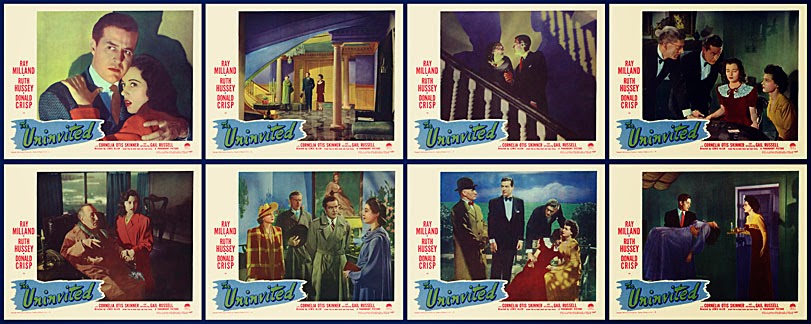
This week, we revisited one of my favorite movies, the suspenseful The Uninvited (1944). Ray Milland
stars as Roderick Fitzgerald, a music critic for a London newspaper who is vacationing on the Cornwall coast with his sister Pamela (Ruth Hussey). Rick and Pam are NOT rich. They have enough money to get by, and some small savings, but on this fateful day, they encounter a wonderful old house that apparently has not been inhabited for some time. The house reminds the siblings of their childhood home, the view and seaside location are breathtaking; the Fitzgeralds decide immediately to pool their savings and try to buy the house.
To their surprise and delight, Rick and Pamela find that the owner of Windward House, Commander Beech (Donald Crisp), is eager to sell the house at a price they can afford. However, it is over the loud protests of his young granddaughter, Stella Meredith (Gail Russell). The brother and sister take possession of their new home and Rick finds himself becoming involved with the "sleeping beauty" quality that is Stella Meredith. But before he can move in, Rick must return to London to settle affairs with his employer. When he returns, he finds Pamela's dog, Bobby, has run away, and Pamela seems tense and withdrawn. That evening, Rick's first in Windward House, all becomes clear. The sound of a woman sobbing reverberates through the house. Only no one is there.
The fabulous thing about this film is that it never denies the existence of ghosts. It doesn't end by having all the fantastic occurrences explained away by natural phenomena. The house is haunted; there are ghosts, and while ghosts can be either good or evil, they remain on earth for a reason. And that goodness or evil is a reflection of their human personality, not something that came after death. It is up to the mortals to determine WHY the ghosts are in the house and try to satisfy them, so both ghost and mortal can at last have peace. This TCM article goes into more detail on the unique nature of this film.
As the article mentioned above states, by today's standards, this is NOT a scary film - no one gets killed in some particularly gory manner, nor are there long chase scenes by a masked stalker with a chainsaw. But what there is is a delightfully eerie feeling - enough to put you on edge and keep you there. Much of this is thanks to the acting, especially the remarkably talented Ray Milland and Gail Russell. Milland is able to give Rick a controlled panic - he's just invested his life savings in a house that may be uninhabitable, and the girl he loves is dangerously attracted to a house that seems to want to harm her. And so as Rick, Pamela, and Dr. Scott (Alan Napier) begin to investigate just WHAT causes spirits to stay at Windward House, and why they would want to harm Stella, Milland remains the focal point for the audience. He is our anchor to reality and our connection to the supernatural; we trust the ghosts are real because HE believes it.
Which brings us to Gail Russell. Much has been written about her beauty and her sad, short life. An alcoholic, originating from her severe stage fright (and probably started while filming The Uninvited), she ended up dead at age 36 from malnutrition and liver disease. (This Los Angeles Times history outlines Ms. Russell's unfortunate life). But her history should not detract from her performance. Her Stella is delicate, but determined; innocent yet wise in many things. She is the glue that binds Rick to Windward, she is the song he composes. Who can hear "Stella by Starlight" and NOT see Gail Russell's lovely face rise as the inspiration? She gives Stella a heart that makes you want her to finally live in the house she loves, and find the man of her dreams. In some senses, she is the soul of The Uninvited.
If Stella is goodness incarnate, then Miss Holloway, as portrayed by Cornelia Otis Skinner is the human link to pure evil. The dear friend of Stella's mother, Mary Meredith, Miss Holloway hates Mary's daughter with the same passion that she adores Mary. As the TCM article above mentioned, there is a lot in common between Miss Holloway and Rebecca's Mrs. Danvers, not the least of which is both of their overtly sexual obsession with a long-dead intimate. Ms. Skinner, a noted stage actress and author, had a very limited screen career - only four films (one silent) and several appearances on television. She's wonderfully spooky here, letting the viewer glimpse the madness that is underneath her calm exterior.
There is another rarely seen actress, Dorothy Stickney as Miss Bird, a resident at the Mary Meredith home. Though Miss Bird is supposed to be the one who is sick, she seems a lot saner than Miss Holloway! We'd seen another one of Ms. Stickney's rare film appearances - she appeared as Henry Fonda's obnoxious mother in I Met My Love Again. Ms Stickney had a very distinct voice, which led to her portraying a number of eccentrics on film and on stage. She had a long career on Broadway, from her debut in 1926 in The Squall to the mid-1970s, when she appeared in Pippin (assuming the role of Pippin's grandmother after Irene Ryan's sudden death). Of her many stage roles, two are worth mention here: in 1928, she played Mollie Malloy in The Front Page and, beginning in 1939, she appeared as Lavinia in the original production of Life with Father. She was, in fact, in that play for its entire run (til 1947), following it up with a short run, again as Lavinia, in Life with Mother. Ms. Stickney died in 1998, just shy of her 102nd birthday.
The film was given a well-deserved cinematography nomination by the Academy of Motion Picture Arts and Sciences (it lost to Laura), but interestingly, the song "Stella by Starlight" was not even nominated, nor was the film's score. The songs that were nominated include some standards like "The Trolley Song" (Meet Me in St. Louis), "Long Ago and Far Away" (Cover Girl), "I'll Walk Alone" (Follow the Boys), and (the winner) "Swingin' on a Star" (Going My Way). Regardless, "Stella by Starlight" became a popular and jazz favorite, performed by such artists as Frank Sinatra, Ella Fitzgerald, Sarah Vaughan, Ray Charles, and Miles Davis.
Though it appears that the NY Times' Bosley Crowther was not paying attention during his viewing of the film in 1944, we know you will enjoy it. We'll leave you with a trailer from this wonderful fillm.
To their surprise and delight, Rick and Pamela find that the owner of Windward House, Commander Beech (Donald Crisp), is eager to sell the house at a price they can afford. However, it is over the loud protests of his young granddaughter, Stella Meredith (Gail Russell). The brother and sister take possession of their new home and Rick finds himself becoming involved with the "sleeping beauty" quality that is Stella Meredith. But before he can move in, Rick must return to London to settle affairs with his employer. When he returns, he finds Pamela's dog, Bobby, has run away, and Pamela seems tense and withdrawn. That evening, Rick's first in Windward House, all becomes clear. The sound of a woman sobbing reverberates through the house. Only no one is there.
The fabulous thing about this film is that it never denies the existence of ghosts. It doesn't end by having all the fantastic occurrences explained away by natural phenomena. The house is haunted; there are ghosts, and while ghosts can be either good or evil, they remain on earth for a reason. And that goodness or evil is a reflection of their human personality, not something that came after death. It is up to the mortals to determine WHY the ghosts are in the house and try to satisfy them, so both ghost and mortal can at last have peace. This TCM article goes into more detail on the unique nature of this film.
As the article mentioned above states, by today's standards, this is NOT a scary film - no one gets killed in some particularly gory manner, nor are there long chase scenes by a masked stalker with a chainsaw. But what there is is a delightfully eerie feeling - enough to put you on edge and keep you there. Much of this is thanks to the acting, especially the remarkably talented Ray Milland and Gail Russell. Milland is able to give Rick a controlled panic - he's just invested his life savings in a house that may be uninhabitable, and the girl he loves is dangerously attracted to a house that seems to want to harm her. And so as Rick, Pamela, and Dr. Scott (Alan Napier) begin to investigate just WHAT causes spirits to stay at Windward House, and why they would want to harm Stella, Milland remains the focal point for the audience. He is our anchor to reality and our connection to the supernatural; we trust the ghosts are real because HE believes it.
Which brings us to Gail Russell. Much has been written about her beauty and her sad, short life. An alcoholic, originating from her severe stage fright (and probably started while filming The Uninvited), she ended up dead at age 36 from malnutrition and liver disease. (This Los Angeles Times history outlines Ms. Russell's unfortunate life). But her history should not detract from her performance. Her Stella is delicate, but determined; innocent yet wise in many things. She is the glue that binds Rick to Windward, she is the song he composes. Who can hear "Stella by Starlight" and NOT see Gail Russell's lovely face rise as the inspiration? She gives Stella a heart that makes you want her to finally live in the house she loves, and find the man of her dreams. In some senses, she is the soul of The Uninvited.
If Stella is goodness incarnate, then Miss Holloway, as portrayed by Cornelia Otis Skinner is the human link to pure evil. The dear friend of Stella's mother, Mary Meredith, Miss Holloway hates Mary's daughter with the same passion that she adores Mary. As the TCM article above mentioned, there is a lot in common between Miss Holloway and Rebecca's Mrs. Danvers, not the least of which is both of their overtly sexual obsession with a long-dead intimate. Ms. Skinner, a noted stage actress and author, had a very limited screen career - only four films (one silent) and several appearances on television. She's wonderfully spooky here, letting the viewer glimpse the madness that is underneath her calm exterior.
There is another rarely seen actress, Dorothy Stickney as Miss Bird, a resident at the Mary Meredith home. Though Miss Bird is supposed to be the one who is sick, she seems a lot saner than Miss Holloway! We'd seen another one of Ms. Stickney's rare film appearances - she appeared as Henry Fonda's obnoxious mother in I Met My Love Again. Ms Stickney had a very distinct voice, which led to her portraying a number of eccentrics on film and on stage. She had a long career on Broadway, from her debut in 1926 in The Squall to the mid-1970s, when she appeared in Pippin (assuming the role of Pippin's grandmother after Irene Ryan's sudden death). Of her many stage roles, two are worth mention here: in 1928, she played Mollie Malloy in The Front Page and, beginning in 1939, she appeared as Lavinia in the original production of Life with Father. She was, in fact, in that play for its entire run (til 1947), following it up with a short run, again as Lavinia, in Life with Mother. Ms. Stickney died in 1998, just shy of her 102nd birthday.
The film was given a well-deserved cinematography nomination by the Academy of Motion Picture Arts and Sciences (it lost to Laura), but interestingly, the song "Stella by Starlight" was not even nominated, nor was the film's score. The songs that were nominated include some standards like "The Trolley Song" (Meet Me in St. Louis), "Long Ago and Far Away" (Cover Girl), "I'll Walk Alone" (Follow the Boys), and (the winner) "Swingin' on a Star" (Going My Way). Regardless, "Stella by Starlight" became a popular and jazz favorite, performed by such artists as Frank Sinatra, Ella Fitzgerald, Sarah Vaughan, Ray Charles, and Miles Davis.
Though it appears that the NY Times' Bosley Crowther was not paying attention during his viewing of the film in 1944, we know you will enjoy it. We'll leave you with a trailer from this wonderful fillm.
Monday, November 10, 2014
Olivia Loves a Thief
A. J. Raffles (David Niven) is a young man of society - a well-known cricket player and man about town. Though Raffles has no real income, he lives quite well. He supports himself with his hobby - in his spare time, he is the notorious Amateur Cracksman, a thief who has been bedeviling the local police. Thus begins the fourth remake of Raffles (1939).The film had already been made in 1917 (as Raffles, the Amateur Cracksman, with John Barrymore), in 1925 (with House Peters) and in 1930 (with Ronald Colman). We were lucky enough to see some commentary from Robert Osborne, and he mentioned that this version was an almost scene by scene recreation of the Colman film. Director Sam Wood (who had just come off Gone With the Wind) was too tired to waste effort on a new version, so he just cribbed from the Colman version. This TCM article goes into a bit more detail. We hope, at some later date, to view the 1930 Colman film and compare those two films.
Also fresh from Gone With the Wind was Olivia de Havilland, who was assigned to play Gwen Manders, Raffles love interest. Ms. de Havilland had little interest in the role - it was mere window dressing to Niven's more rakish part (Cary Grant actually pursued the role of Raffles - he even offered to lower his normal salary). Her disgust at being forced into roles that she viewed as inferior was the impetus for her eventual suit against the studio system. For more information on this story - and it should be noted that Ms. de Havilland was a leader at great cost to herself in this protest - see this interview at the Academy of Achievement.
So, while Olivia doesn't have a whole lot to do here (except be intelligently gorgeous, which is also quite a skill.) Her Gwen is no dummy, and Ms. de Havilland can show you with just the merest glint in the eye what is going in within Gwen's head), David Niven shines. He is quite dashing as A.J. Our group found the film quite reminiscent of To Catch a Thief, and were fascinated by Cary Grant's interest in Raffles. It seemed to us that, while it took nearly 20 years, Mr. Grant DID finally get to play The Amateur Cracksman.
Many films from the period portray the police as complete dolts. Not Raffles. The police inspector MacKenzie, played by Dudley Digges, is a worthy adversary to Raffles, and someone that Raffles respects. In fact, it is a mutual admiration society - MacKenzie also admires The Amateur Cracksman's skill and daring. Nevertheless, MacKenzie is determined to put him behind bars.
There is an attempt on the part of the screenwriter to make Raffles a more attractive - and admirable - character. At least twice we see him steal in order to help someone else. In the first scene, he snatches a piece of art, then secretly presents it to a retired (and hard up) actress, so she can collect the reward. This bit of Robin Hood in the character is surely meant to placate the code - we can't quite condemn him when the only thefts we see are those that help a destitute old lady and his future brother-in-law, Bunny Manders (Douglas Watson).
The screenplay is very well done, and there are some well-crafted scenes. In one instance, Raffles needs to get down to the first floor of Lady Melrose's (Dame May Whitty) home. However, he knows Inspector MacKenzie is hovering around his door. His solution, to pretend to put his shoes outside the room, is done in total silence. It's an effectively done sequence, and David Niven is quite excellent in his execution. Also fun was Raffles attempt to stash a stolen bracelet in a humidor. Only he doesn't realize that Inspector MacKenzie is a pipe smoker. And the Inspector has forgotten his tobacco. Finally, there is a wonderful bit where Raffles realizes another thief is in the house. Niven's relish at getting the best of his competition is delightful.
All in all, a fun film well worth a viewing. We leave you with a clip from the beginning of Raffles:
Subscribe to:
Posts (Atom)