Though Christmas is now but a memory, theTCM presentation of Miracle on 34th Street (1947) on the big screen was a real treat for the holiday season. The story focuses on Kris Kringle (Edmund Gwenn), an elderly gentleman who takes Christmas quite seriously. When he encounters a drunken Santa Claus at the Thanksgiving Day Parade in New York City, he confronts the parade's organizer Doris Walker (Maureen O'Hara), who immediately hires him as a substitute Santa, both for the parade, and later to work in the store. Doris is rather matter of fact about Christmas; she's raised her daughter Susan (Natalie Wood) to view it as a commercial holiday - Santa Claus isn't real nor are fairy tales to be regarded as anything more than silly fictions. There is, she tells Susan, no such thing as "happily ever after," something their neighbor Fred Gailey (John Payne) finds distressing, since he is hoping for a "happily ever after" with Doris. So, when Kris announces he IS the real Santa Claus, and is labeled as mentally incompetent by Mr. Sawyer (Porter Hall), the Macy's staff psychologist, Fred decides to represent Kris in court - and prove Kris is the REAL Santa. As someone who grew up in New York City, shopping at Macy's and Gimbel's, this film has resonances that cannot be escaped. At one point, we see a shopper's book that Macy's has created to help guide customers to products they don't carry (but that other stores do - one of Kris' innovations). Most of the stores in the book, including Gimbels - have since closed. I've been to the Parade once, and watched it on television nearly every year - and the metamorphosis of the Parade from a "home town" event to an advertisement for New York City tourism is something this film makes very apparent. (I'm not complaining - I like seeing the Broadway plays show their stuff). So, regardless that this is an annual event, the film provides a time capsule view of a New York that is long gone, when the parade was a local event run by a local store, not a national pastime. (To this day, Macy's in Herald Square uses Miracle on 34th Street as a window display at Christmastime.)
This Fathom presentation of the film was made especially poignant by the death of Maureen O'Hara on October 24, 2015. The last survivor of the lead actors in the cast, her portrayal of Doris is on spot. She makes the character tough, but never heartless - her affections radiate from her lovely eyes, but she is always in charge of her home and her business. Born in Ireland as Maureen FitzSimmons in 1920, Ms. O'Hara started her career at the Abbey Theatre in Dublin. After a screen test, Charles Laughton signed her to a contract and starred her, with him, in Jamaica Inn (1939). The rest, as they say, is history. In 1941, she appeared as Angharad in director John Ford's How Green Was My Valley, the first of their 4 films together. Her most famous screen partner was certainly John Wayne - a collaboration that didn't begin until 1950 in Rio Grande. Never even nominated for an Academy Award (is that even possible), Ms O'Hara was finally given an Honorary Oscar in 2014. With her flaming red hair and a complexion that looks like pure butter, Ms. O'Hara was so staggeringly beautiful in color films she was sometimes called The Queen of Technicolor. Regardless of that beauty, she was an actor without compare.
Edmund Gwenn actually appeared as Santa in the 1946 Thanksgiving Day Parade, and other members of the cast (like Ms. O'Hara) were shot in the parade to add scenes to the film (see these TCM articles and the AFI catalog for more background on the film). Ms. O'Hara was initially reluctant to appear in the film, as she had JUST been allowed to visit her family in Ireland (she was barred from visiting her homeland because of War restrictions. Ireland was a neutral country during World War II), and was now being called back immediately to appear in " silly little movie about Santa Claus". She stated that, once she saw the script, she changed her mind - the film, by the way is still #9 in AFI's 100 Years, 100 Cheers.
There have been other attempts to trap the lightning in a bottle that is Miracle on 34th Street, with limited success. Maureen O'Hara, John Payne and Edmund Gwenn reprised their roles for the Lux Radio Theatre version on December 22, 1947. In 1955, Thomas Mitchell appeared as Kris in a live television version (also starring Teresa Wright and MacDonald Carey) for the Twentieth Century Fox Hour. Meredith Wilson (of The Music Man fame) wrote a musical version of the tale in 1963 entitled Here's Love, which ran for 334 performances and starred Laurence Naismith as Kris. On December 14, 1973, another television version ran, starring Sebastian Cabot as Kris and Jane Alexander as Doris (now named Karen!). Finally, a big screen version was again attempted in 1994, with Richard Attenborough as Kris - Macy's refused to allow their name to be used in the film! Even star John Payne tried for many years to produce a sequel to the story, based on his own screenplay, but the attempts ended when he died in 1989.
Many character actors contribute to this film - Gene Lockhart as Judge Henry X. Harper, the man who must rule on the reality of Santa Claus; William Frawley as Charles Halloran, Judge Harper's cagey political advisor; Jerome Cowan as district attorney Thomas Mara, whose own son is called to testify as to the reality of Santa Claus (how does Tommy know there really is a Santa Claus: "Because my Daddy told me so"), and Philip Tonge as Doris' colleague Mr. Shellhammer. But in many senses, the film is stolen in one brief scene by Thelma Ritter as the harried mother who can't find the fire truck her son wants in time for Christmas. This was Ms. Ritter's first role, and of course, she shines. We'll close with the scene in which Doris asks Kris to tell Susan he isn't really Santa Claus:
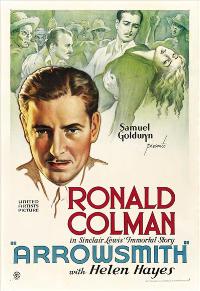
Ronald Colman plays a physician with an interest in research in Arrowsmith (1931). Dr. Martin Arrowsmith (Colman) knows from early in his career that he wants to do big things. He wants, he tells his mentor Dr. Max Gottleib (A.E. Anson) to cure cancer. But when he meets and falls in love with Leora Tozer (Helen Hayes), Arrowsmith decides to set up a clinical practice in a rural area, where he can make some money to support what he hopes will be a growing family. But research is in his blood, and he begins to work on a finding a cure for Black Leg Disease, a bovine infection that is decimating the area. His success leads to an offer to join the prestigious McGurk Institute in New York City, where, he hopes, he can begin to cure the ills of mankind. Based on the novel by Sinclair Lewis, Arrowsmith is a layered film, though drastically shortened from the novel. Helen Hayes, whose wonderful portrayal of Leora gives us a strong but insecure woman, alleged that director John Ford excised much of the script in order to shorten the production time - she claimed that as he had promised to not drink during the filming, he was in a hurry to finish the film (this TCM article outlines the story that is included in her autobiography, My Life in Three Acts. In John Ford: Hollywood's Old Master by Ronald L. Davis, the story is elaborated on to discuss in a bit more detail the affection that resulted between Hayes and Ford.)
In spite of Ford's alleged trimming of the plot, the film still retains a lot of depth and character development. Martin Arrowsmith is carefully played by Colman, and he makes the relationship between Martin and Leora especially poignant before and after her miscarriage. While Martin is always genuinely caring of her, once she loses their child and is told she will not be able to conceive again, his attentions shift more towards his work. Is Arrowsmith afraid of losing Leora, or does he have problems confronting a life without the family for which he sacrificed his early career? Having married a nurse, it would seem obvious that Leora would become a helpmeet in his research, but, with the exception of one scene, she does not. In fact, there are no women scientists in this film (it is the 1930s, after all), and often the female characters are given short shrift. But, regardless, the story and Colman's portrayal document a marriage that is loving, but tenuous at best. John Ford: The Man and His Films by Tag Gallagher looks briefly at the marriage of Martin and Leora (but be aware, there are spoilers here). In a brief role is Myrna Loy as Joyce Lanyon. In the novel, the character of Joyce was much more substantial, and figured heavily in the conclusion of the story. Though filmed in the pre-code era (see this commentary by my fellow blogger at Pre-code.com), this movie is remarkably tame. There is a hint of attraction between Joyce and Martin (is there an affair? It's not clear. In the book, there is some kissing, but nothing more), but the film does not dwell on any possible infidelity. Still several years away from her breakthrough role in The Thin Man, Ms Loy was still being cast as the vamp or the exotic, so it is not surprising her part is so suspicious. But even a brief appearance by Myrna Loy is welcome, and she does not disappoint. (For more information on the MPAA and the film, see this listing from the AFI Catalog).
In an even more brief appearance is Beulah Bondi as Leora's mother. She has all of one scene, and gets to say very little. Too bad, as Ms. Bondi is an asset to any film in which she appears. Born in 1889, she began her career at age 7 in her hometown of Valparaiso, Indiana (playing Little Lord Fauntleroy!) After receiving a master's degree in oratory at Valparaiso University, she began to get roles on Broadway (she would appear in 11 Broadway productions in her lifetime) in plays such as Street Scene and Rain (a part she would reprise in the screen version starring Joan Crawford). One of the first actresses to be nominated in the category of Best Supporting Actress (for her work in The Gorgeous Hussy) by AMPAS, she never won an Oscar (she was nominated one more time for Of Human Hearts). Interestingly, she played the same character three times, over a span of 18 years, appearing in On Borrowed Time in the 1939 film, the 1953 Broadway production, and a 1957 Hallmark Hall of Fame TV version. With 86 film and television credits (many of them named Granny or Mom), she is probably best remembered as James Stewart's loving mother in It's a Wonderful Life (though one of my favorite Beulah Bondi moments is her dance with Ginger Rogers in Vivacious Lady!). Her final role, in a career of 49 years, would be an Emmy Award winning performance in The Waltons. She died in 1981, at the age of 92. This TCM tribute to Beulah Bondi is well worth a viewing:
It is important to mention the presence of Dr. Oliver Marchand, as played by actor Clarence Brooks. Dr. Marchand is of African descent, and is treated by Drs. Arrowsmith and Sondelius (Richard Bennett) with respect and courtesy. Though a small part, it is a remarkable one, given the time period. Dr. Marchand is shown a competent doctor, concerned with in the health of his patients, with an understanding of Arrowsmith's need to check his research with a clinical trial. Marchand is willing to have his patients serve as test subjects, as it means many who would other die will survive. That a man of color in the 1930s was shown as a knowledgeable professional is something that should be noted. One interesting aspect of the film is the need for Dr, Arrowsmith to prove his theory on the plague vaccine with a clinical trial. The film gives us both a population who refuse to be "guinea pigs" (even though the serum may save some of their lives), and another population who willingly participates. But, like Dr. Ehrlich's Magic Bullet (1940), the clinical trial is shown as something that prevents patients from receiving medication that will save their lives. In the 21st Century, we have embraced the notion of the clinical trial, but in the era of heroic medicine, the clinical trial was seen as an unnecessary delay in delivering a cure.
We'll leave you with an early scene in the film in which Arrowsmith learns the joys of primary care medicine.
TCM's Fathom Events series in November featured Audrey Hepburn's introduction to American audiences with Roman Holiday (1953). Ms. Hepburn plays the Princess Anya, a young woman born into royalty, but oh so tired, after a long world tour, of the protocols that come with being a representative of her country. After she has a stress reaction to her duties, her physician gives her a sedative, which only succeeds in making her, to all intents and purposes, drunk. With her inhibitions gone, Anya makes a break for it, sneaking out of her country's Embassy in Rome. She's found napping in the park by American correspondent Joe Bradley (Gregory Peck), who winds up taking her to his apartment, and dumping her on his sofa. It is only the next morning that he realizes he has a princess - and a doozie of a story on his hands - as Anne Smith (Smitty) takes a day to explore the life of a commoner.
As is outlined in one of these TCM articles, Gregory Peck, whose contracted stipulated sole star billing, called the powers that be at the studio and insisted that Audrey Hepburn be given star billing with him. Ever the gentleman, Mr. Peck would later claim that it was merely enlightened self-interest - that he would look ridiculous being labeled as the only "star," when Ms. Hepburn so clearly dominated the film. But it is also a mark of his total professionalism and dedication to his craft that he so quickly recognized the birth of a new star.
For dominate she did - has any actress ever looked more radiant in her first starring role? Of course, she had the magnificent William Wyler as her director - Wyler guided her (along with Bette
Davis, Barbra Streisand (also in her first film role), Greer Garson,
Teresa Wright - a grand total of 14 actors) to an Oscar in the acting
category. Hepburn is glorious here - she conveys both the innocence and
strength of Anne. Especially effective is a scene at the end of the
film, which counterpoints a similar scene at the beginning. In both,
Anya meets with her courtiers, but the results of each scene
are quite different. Hepburn effectively grows the character before
your eyes, and you believe in Anya's development as a future monarch.
Hepburn was not the first choice for the part - it was considered as a role for Jean Simmons, Elizabeth Taylor (the first choice of the Frank Capra, who at one point was going to direct), and Suzanne Cloutier (who was screen tested by Wyler). Cary Grant (who declined the part) was the first choice for Joe Bradley (thankfully - he and Ms. Hepburn would work together FINALLY in Charade. They were a match made in heaven!). For more detail on the background of the film, see this extensive article in the AFI Catalog.
Eddie Albert plays photographer Irving Radovich, Joe's friend and conspirator in the quest to get a story about the runaway
princess. Mr. Albert gets to show off his acrobatic side - he was at
one point a trapeze performer - becoming the victim of a number of
"accidents," as Joe is continually trying to prevent him from spilling the
beans about one secret or another (and Joe has lots of them). Mr. Albert was working as a radio host when was offered a contract with Warner
Brothers. His first film role was Bing in Brother Rat, a role he had originated in the Broadway production. He, in fact, appeared in 9 Broadway productions, including The Music Man (as a replacement for Robert Preston), and The Seven Year Itch
(replacing Tom Ewell). With a film career that started in 1938 and
continued until 1994, he has a large body of work, including film such
as My Love Came Back (1940), The Sun Also Rises (1957), and Oklahoma
(1955). His career might have been even more substantial had he and
his wife, the actress Margo (they were married from 1945 until her death
in 1985), not been caught up the Hollywood Blacklist. Eventually,
Albert segued into television - most famously in the series Green Acres, but also in Switch and a daytime variety show called The Eddie Albert Show. He lived til age 99, dying in 2005 of Alzheimer's disease.
Eddie Albert wasn't the only person on this film touched by the Blacklist. In 1992, AMPAS finally awarded to Dalton Trumbo his Oscar for Best Motion Picture Story, which had previously been credited to Ian McClellan Hunter (who himself was later blacklisted) as sole author. Having just seen Roman Holiday, it was interesting to also see Trumbo, which goes into some detail about the help Hunter provided in getting Trumbo's screenplay to film.
Roman Holiday has been included in the Library of Congress's National Registry of Historic Films as well as being number 4 on the AFI's 100 Years, 100 Passions list. It's a lovely film, with a visualization of true emotions and adult responsibilities. I'm going to close with perhaps the most famous scene in the film, the Mouth of Truth. Allegedly, Mr. Hepburn didn't know that Gregory Peck was going to pretend his hand had been bitten off, and her quite convincing scream was real. Regardless, it's a joy to watch, and expertly done. Enjoy!
We aren't quite done with swashbucklers, as our film for this week is The Prisoner of Zenda (1937). Ronald Colman plays Major Rudolf Rassendyll, an English officer on a fishing trip to Ruritania, when he meets Colonel Zapt (C. Aubrey Smith) and Fritz von Tarlenheim (David Niven). Both are flabbergasted at Rassendyll's resemblance to King Rudolf V (also played by Colman); Rassendyll, it turns out, is descended from the Ruritania royalty on the wrong side of the blanket. The King is also amused at the resemblance, and invites Rassendyll to his palace for a night of conversation and drinking, at the end of which, the Rassendyll, Zapt and von Tarlenheim discover the King unconscious, his wine drugged by servants in the pay of his half-brother, Black Michael (Raymond Massey). With the King's coronation scheduled for that afternoon, Zapt convinces Rassendyll to step in for the King, for if King Rudolf doesn't show up, Michael will stage a coup to take over the goverment. Reluctantly, Rassendyll agrees, only to discover that Michael and his henchman Rupert of Hentzau (Douglas Fairbanks, Jr.) are all too quickly aware of the masquerade, and kidnap the King from his vacation palace. Add to the problems - Rassendyll has fallen head over heels in love with the Princess Flavia (Madeleine Carroll), Rudolf's betrothed.
With an absolutely magnificent cast, this is a film that is not be missed. Colman creates distinctive personalities in the characters of King Rudolf and Rassendyll (and given he has very little to work with when it come to the King - who we barely see - it is all the more exceptional). With his fantastic voice and his engaging personality, it is quite clear why Flavia would fall for him almost instantly, even when she thinks he is the King (who she dislikes).
His equal is Douglas Fairbanks, Jr as the arch-villain Rupert of Hentzau. Fairbanks gives him a sparkle that makes him attractive and treacherous at the same time. When the film was remade in 1952, James Mason took over the role; while Mason had the evil down perfectly, he just doesn't have the charm that Fairbanks does in the role. That little twinkle in his eyes, as he performs his nefarious deeds is the difference. Interestingly, Fairbanks badly wanted the lead role, and almost turned down the part of Rupert when that was offered instead. His father, Douglas Sr, is the one who talked him into doing it - he told him the character was "witty, irresistible, and as sly as Iago". That the part was "so actor-proof... that Rin Tin Tin could play the part and walk away with it!", we are inclined to disagree (in our opinions, Mason didn't walk away with it!). It's proof of the talent of Fairbanks, Jr. that he could make you look away from Colman on occasion. (This TCM article goes into more detail on the history of the film).
With actors like Mary Astor (as Michael's lover, Antoinette de Mauban), David Niven and Madeleine Carroll in the film, even the small parts are performed by experts. Niven, who had started in films in 1932, primarily in unbilled parts, was about to become a star. By 1939, he was the second lead in Wuthering Heights and starred (with Ginger Rogers) in Bachelor Mother. A versatile actor, noted for his wit (if you've never read his autobiography, The Moon's A Balloon, you owe yourself a treat - many stories of him and Errol Flynn and their bachelor pad are included), Niven was highly regarded in the Hollywood community; in his article for Niven's Star of the Month turn on TCM, Robert Osborne recalled being at an event where a group was laughing at someone's tales. Mr. Osborne surreptitiously wandered over, to discover Mr. Niven regaling the table with stories. Mr. Niven married twice - he was widowed when Primula Rollo died after falling down a flight of stairs during a game of hide and seek. Two years later, he wed Hjördis Tersmeden, and though they were together until his death in 1983 of ALS, it was allegedly not a happy marriage (Niven's close friends Roger Moore and Robert Wagner actively disliked her). Niven served in the British Army during the Second World War, returning home from America when war broke out. This hiatus had little effect on his career - he returned from military duty to make such excellent films as A Matter of Life and Death (1946), The Bishop's Wife (1947), and his Oscar-winning turn in Separate Tables (1958).
Madeleine Carroll is probably one of the most beautiful women in Hollywood history, but not only is she lovely, she is a strong, intelligent, and talented actress. You believe that Princess Flavia could lead a nation, thanks to Ms. Carroll's strength of character. After appearing in two Hitchcock films (his earliest "cool blonde") in Great Britain, Ms. Carroll came to America to appear in this film and The General Died at Dawn. The parts she was given were uneven in quality, and she left filmwork in 1949. She continued for a few years more in television (appearing, for example, in a Robert Montgomery Presents of "The Letter" in 1950). She also appeared on Broadway in Goodbye, My Fancy, in the role Joan Crawford would assume on screen). She also worked on film production aimed at promoting "better understanding among the peoples of the world". He efforts also helped to raise money for an orphanage housing children injured in France during World War II. She died in 1987, at age 81.
The film that we see today did change from the original concept. It seems there was a prologue and an epilogue that were filmed and never used. The film would have opened with the much older Rassendyll recounting the story of his adventures in Ruritania, now many years in the past. As the film ended, he would have learned of the death of Princess Flavia. Interestingly, this differs from the sequel written by Anthony Hope, entitled Rupert of Hentzau, in which Flavia become Queen after the deaths of King Rudolf and Rassendyll.
We'll close with the fencing scene from the end of the film. According to the AFI Catalog, David O. Selznick was not satisfied with the scenes originally filmed by John Cromwell and brought in W.S. Van Dyke to reshoot them. The fencing, as you will see, is excellent:
A wealthy woman decides she has found religion in Susan and God (1940). Joan Crawford stars as Susan Trexel, the estranged wife of Barrie Trexel (Fredric March). Susan has been in England for several months, and as the action of the film opens, has returned to America, accompanied by her mentor, Lady Millicent Wigstaff (Constance Collier), the founder of Susan's new obsession. While Susan's friends are not amused by her ardent proselytizing, they like her a lot more than they like her husband, a drunk who can be rather unpleasant in his cups. They plot to keep the two apart as long as possible, to avoid the inevitable scene. But, when Barrie and Susan finally do meet up, they agree to reconciliation of sorts, primarily for the sake of their daughter, Blossom (Rita Quigley). Susan has one proviso - if Barrie takes another drink, she gets a divorce. We are big fans of Crawford, and she does not disappoint in the film. Susan's obsessive personality is very reminiscent of two portrayals that were years off - the over-the-top mother in Mildred Pierce and the maniacal homemaker in Harriet Craig. Crawford purposefully makes Susan annoying, with a patronizing voice and attitude that make you want to throttle her. The minute we meet her, we understand her friends' mixed reaction to her return - she's unable to do anything without making everyone else a party to her interest.
Crawford was stepping into some big shoes in this character - on Broadway (the play by Rachel Crothers opened in October of 1937), the role of Susan was played by Gertrude Lawrence. Added to that, MGM had purchased the play for Norma Shearer (who is reputed to have turned it down due to her reluctance to play the mother of a teenager), and later considered Greer Garson (who, the year before had played her breakthrough role in Goodbye, Mr. Chips) for the part (briefly noted in the AFI Catalog).
Frederic March, usually a very powerful actor, plays Barrie as a very weak man. The slightest pressure results in his again hitting the bottle. It's hard to understand what Barrie and Susan ever saw in one another, because they are so totally different and so unkind to one another. It sometimes feels that Barrie is still married to Susan so he has an excuse to drink. Without giving too much away, we were disappointed with the story line, which we felt really needed a lot of tweeking. The ending was too off-center, and felt as though it came out of nowhere. The screenwriter is Anita Loos, no stranger to comedy, or to satire, but the film doesn't really continue the satirical tone that allegedly made the play popular, though this TCM article maintains that some felt the film improved on the play. Without comparison, it's hard to say, but we felt that the satire was severely muted by the film's conclusion.
The film is rich, however, in supporting players: John Carroll in an exceedingly small part as Clyde Rochester, Nigel Bruce as 'Hutchie', Bruce Cabot as Michael, a very young Gloria De Haven as Enid, Blossom's rival for the affections of a boy and Rita Hayworth as Hutchie's young bride, Leonara. But the person who really shines is Ruth Hussey as Charlotte, probably the only decent human being among Susan's cadre of friends. Hussey is a longtime favorite - especially as Ray Milland's sister Pamela in The Uninvited (one of my personal favorite films, and perhaps the best ghost story ever put to film - we can argue between that and The Ghost and Mrs. Muir, but I digress). She really never seemed to get the lead parts (which is a shame) - the preceding year, she had appeared for what seemed an instant as the over-efficient Miss Watts in The Women. She started in films in 1937, had the lead in a few "B" movies like Bedside Manner (1945), and eventually moved over to television, where she appeared in shows like Marcus Welby, M.D. (which starred her H.M. Pulham, Esq. co-star Robert Young) and The Jimmy Stewart Show (featuring her love interest in The Philadelphia Story). Married for 60 years (and the mother of 3 children), she also performed on Broadway in the 1940s and 1950s (including the lead in State of the Union). She died in 2002, aged 93. While not the best of Crawford's film, Susan and God is rich in excellent performances. Here is a trailer to get you acquainted:
We selected an excellent pre-code film for this week's discussion - Double Harness (1933) (Femme aux gardénias in France), starring Ann Harding and William Powell.
The marriage of Valerie Colby (Lucile Browne) and Dennis Moore
(George Meeker) leads Joan Colby (Ann Harding) to seek a spouse for
herself. Though she claims not to love him, Joan selects wealthy playboy
John Fletcher (William Powell),
despite the fact that he pays no attention to his family's business (to
the consternation of Joan's father, Colonel Sam Colby (Henry
Stephenson)) and had been carrying on a very open affair with Monica
Page (Lilian Bond). Since John claims he'll never marry, Joan concocts a
plan - have her father walk in on them when she and John are in a
compromising position in John's apartment. But there is a problem -
Joan has fallen in love with John, and his suggestion of a marriage of
convenience to placate her father is not really what Joan had in mind
for her future.
Our reference to the French title is
purposeful, because the gardenia plays a major role in the film,
symbolizing the relationship of Joan and John. The gardenia is Joan's
favorite flower, and a corsage or bouquet telegraphs important moments
in their lives. The film was based on the novel Double Harness by Anthony Hope (of The Prisoner of Zenda fame) and a play of the same name by Edward Poor Montgomery. Elegant costumes were provided by Walter Plunkett - we were especially impressed with a fur embellished dress worn by Ms. Harding.
Ann Harding brings a matter-of-factness to Joan's pursuit of John which precludes disliking her, even when we believe her only motivations are selfish. Harding makes Joan something of a businesswoman - she sees potential in John, and in return for their marriage, she'll be his helpmeet. After her realization that she, in fact, loves John deeply, Harding makes Joan warmer and more sympathetic. But never does she make her a doormat - Joan is strong and smart - she never allows the viewer to believe she is otherwise.
William Powell approaches John in much the same way he would later play Nick Charles - he has humor, but is a casual man, seemingly more concerned with his pleasures than anything else. But like Nick, he has depth. Though at first, he doesn't know how to do anything but play, he is taught by Joan that there is a joy in accomplishing something outside of a nightclub. Powell's scenes with the two women in his life - Joan and Monica - are wonderful. His eyes always let us know how he feels, no matter what his lips are saying. Would
he marry Joan eventually if he hadn't been tricked? We think so.
Neither of the other women in the film are particularly likable. Of course, we aren't supposed to like Monica, but Joan's sister Valerie, as portrayed by Lucile Browne, is a selfish bubblehead, who milks her sister for money after running up a debt of $1,000 (nearly $18,000 in today's dollars) for clothing and doo-dads. In revenge for her sister denying her more money, Valerie tries to break up Joan's marriage. Browne does a decent job with the character - she doesn't try to make her attractive; our dislike for Valerie was powerful. Browne appeared in 45 films and shorts between 1930 and 1950, mostly in small and/or uncredited roles. She primarily was a homemaker from 1938 on, after her marriage to William James Flavin (who also left acting to teach). 17 days after his death in 1976, the grief-stricken Lucile died at the age of 69.
While the New York Times reviewer was not particularly taken with this film, fellow blogger at Pre-code.com agreed with us that this is a film well worth your time. Essentially lost for years (these TCM articles and notes from the AFI catalog
describe the history behind the film's disappearance), the film (along
with five other Merian C. Cooper films) were aired on TCM and released
under their TCM Vault logo in 2007. When the film was restored, a scene that had been cut - Joan emerging from a bedroom in lounging pajamas, as John awaits her return - was reinserted. Unfortunately, the film is out of
print on DVD again (though still being shown on occasion on TCM). We leave you with clip of Joan (in her gardenias), beginning her seduction of John.
The Nurse's Secret (1941), based on a novel by Mary Roberts Rinehart, (Miss Pinkerton) is a remake of two prior films: Miss Pinkerton(1932) (which we'd already seen) and While the Patient Sleeps (1935). The plot of this film is identical to that of Miss Pinkerton - a young man is found dead of a gunshot wound in his room. Is it murder, suicide, or an accident? Police inspector Tom Patten (Regis Toomey) figures this case is the one that can get him promoted. When the doctor of the woman who found the victim, his aunt and insurance beneficiary Miss Juliet Mitchell (Clara Blandick), needs a nurse, Patten suggests his girlfriend, Ruth Adams, R.N. (Lee Patrick). Though annoyed at Patten for his constant cancellation of their dates, Ruth is thrilled to be a female Sherlock Holmes. However, someone is wandering around the house, and whoever it is may be a murderer.
Miss Pinkerton was a much more lighthearted effort than The Nurse's Secret. Ms. Patrick makes Ruth far more serious than Joan Blondell's Miss Adams, and while we liked Lee Patrick, we missed Joan Blondell's sassy attitude. This is a plot that can get very convoluted, and the humor from the first iteration deflected some of the confusion. Early in The Nurse's Secret, we even get a reference to the first film, when Patten (responding to Ruth's comment about being a lady Sherlock Holmes) replies "Or Miss Pinkerton."
What this film does offer is a panoply of wonderful character people. First and foremost is Ms. Patrick, who spent most of her career as second lead and in character parts. As this TCM article points out, the biggest surprise here is that Ms. Patrick gets to carry the film, and she does an excellent job. Born in 1901, Lee Patrick has 110 film and television credits (and 26 Broadway plays) to her name. She started her career in films in 1929, and continued until 1965 when she retired to become a painter. She was lured back to films once more, however - in 1975 she reprised the role of Effie from The Maltese Falcon in the spoof The Black Bird. Looking at a list of her film gives one pause - you remember her character, but sometimes forget it was her - even with her chirpy voice, she was a chameleon who changed to fit the part she played. When you realize that the same person who played Mrs. Biederhof in Mildred Pierce also played Doris Upson in Auntie Mame, it's almost surprising. Married to the same man from 1937 until her death in 1982, Ms. Patrick was a talent that we sometimes forget (and shouldn't), but should NEVER ignore.
The film also contains performances from some interesting character people, most notably Clara Blandick, best known for playing Auntie Em in The Wizard of Oz. With over 100 film credits, Ms. Blandick spent much of her career playing crotchety old ladies, as she does here. But she was also a noted stage actress, appearing in such Broadway plays as Raffles, the Amateur Cracksman and The Enchanted Cottage (as Mrs. Minnett, the role that would go to Mildred Natwick in the film version). Following her retirement in 1951, Ms. Blandick was quite ill. Finally, wracked with pain, she committed suicide in 1962, at age 85.
While we think Miss Pinkerton is the better film, this one is not bad, especially if you are more interested in a serious take on the material. We have a trailer to get you started:
The poster to the left says it all. Murder, My Sweet (1944), which was one of the films on the TCM Cruise, was a new beginning in the career of Dick Powell. He'd spent the 1930s as a juvenile crooner in such films as 42nd Street and Gold Diggers of 1933, but with this movie he changed the trajectory of his career. Powell was approaching his 40s, and a middle aged juvenile was a hard sell. By taking on the part of hard-nosed detective Philip Marlowe, Powell would become a film noir leading man.
A poolside midnight showing of Murder, My Sweet capped day four of the cruise. Eddie Muller of the Film Noir Foundation provided the introduction (Mr. Muller was also the host of the 2015 Summer of Darkness on TCM). Based on the book
Farewell, My Lovely by Raymond Chandler, the studio found it necessary to change the name, as audiences thought they were going into a musical comedy (the star was Dick Powell, after all). And, while it completely altered the career of star Powell, it also was the swan song for Anne Shirley, who retired at the end of the film. (For more on Ms. Shirley, see our recent post on Anne of Green Gables, as well as this TCM article).
Told in flashback by Marlowe, his eyes completely bandaged, the fairly complicated story begins with Detective Marlowe
alone in his office. A man arrives - Moose Malone (Mike Mazurki) matches his nickname - he is huge and not too bright, but he is in love, and his girlfriend, Velma Valento has disappeared while Moose was in prison. He wants Marlowe to find her. Then, Marlowe is approached to by Lindsay Marriott (Douglas Walton) help him pay ransom for stolen jewels. That doesn't go well, and at the drop, Marlowe catches a glimpse of a woman, who will also show up at his office when he gets back from the "drop". That woman is Ann Grayle (Anne Shirley), and the jewels were stolen from her stepmother. As the story unfolds, these seemingly unrelated events begin to merge into one big case, as Marlowe is knocked around, kidnapped, and drugged.
Released three years earlier than The Lady in the Lake, this film has a similar feel in the point-of-view references. Where The Lady in the Lake rarely lets you see leading man Robert Montgomery (we only see him in mirrors), Murder, My Sweet makes it clear that what we are seeing is Marlowe's story, with blurred effects and blackouts as he is injured or intoxicated. It's a very powerful effect, making the story more intense and engaging.
When the film was released, Dick Powell had just hit his 40th birthday, and he looked it. Type-cast as a musical comedy actor, Powell wanted to expand his roles. He bought his release from Warner Brothers, and signed a contract with RKO, on the proviso that his first role would be a dramatic one. This film ended Powell's career in musicals (though he would continue in occasional comedic roles, including The Reformer and the Redhead with his third wife, June Allyson. He'd also been married to Joan Blondell). Powell also began to branch out to work behind the scenes - as a producer on TV's Four Star Playhouse and The Dick Powell Theatre, and as a director of films such as Woman on the Run and The Conqueror. It was on this last film that Powell was most like exposed to the radiation that contributed in his death from lung cancer at age 58. Filmed in Utah, the crew members were onsite at the time of a nearby nuclear test. Susan Hayward, John Wayne, Ted de Corsia, Agnes Moorehead, and Pedro Armendáriz were also affected.
Let's not ignore the wonderful Claire Trevor as Mrs. Helen Grayle. Her languid delivery is perfect for a woman seemingly more interested in drinking than jewelry or intrigue. You KNOW she is up to something, but until the end, it's not really clear WHAT she is planning. Trevor was no stranger to Noir she'd already appeared in Crossroads (1942) when she was cast in our film - she has often been called the Queen of Film Noir, notably appearing in such renowned noirs as Born to Kill (1947) and Key Largo (1948), winning the Academy Award for Best Supporting Actress for the latter. Married three times, Trevor had one child, Charles, who was killed in a plane crash. That same year, her husband died of a brain tumor. For the most part, she stopped acting in the mid 1960s, but in 1982, she appeared in the movie Kiss Me Goodbye, and subsequently did several TV episodes. She died in April of 2000 at age 90.
The AFI database notes that Ann Dvorak was at one point considered for the role of Ann Grayle. The film would be remade under it's original title in 1975, with Robert Mitchum as Marlowe (it had already been made as a The Falcon Takes Over in 1942).
Trevor, Powell and Mike Mazurki would reprise their roles in a Lux Radio Theatre version, with June DuPrez voicing Ann. Even a year later in the radio play, host Irving Pitchel comments that "in answer to the proverb that a leopard cannot change its spots, we bring you tonight a gentleman who turns his back on many years of light and frothy roles by which he climbed to stardom and takes the part of a ruthless, hard-as-nails detective... He's Dick Powell...." Such was the impact of Powell's career change. As I go, I leave you with the trailer to Murder, My Sweet:
This week, we returned to the pre-code period, and early to an Bette Davis effort (back when she was blonde) with The Big Shakedown (1934). Bette plays Norma Nelson, a clerk in the neighborhood pharmacy run by her fiancé, chemist Jimmy Morrell (Charles Farrell). Jimmy is an easygoing sort, who runs his store more as a local gathering place than as a business. He's not able to afford for he and Norma to marry, and he is being threatened by a large pharmacy chain that wants to buy him out for peanuts. Enter Dutch Barnes (Richardo Cortez), a bootlegger who is finding it hard to pedal his wares now that Prohibition is over. Dutch has a brainstorm - hire Jimmy to pirate PearlyDent toothpaste; Dutch will then sell the identical, but more cheaply made product for less money. Norma is furious when Jimmy agrees to the scheme, but Jimmy doesn't see the problems (he's making it, after all. He's not SELLING it). Things get complicated, however, when Dutch decides to branch out, first into cosmetics, but then into pharmaceuticals. And by then, Jimmy can't get out. The strength of Bette Davis' personality is a real plus in this film. Charles Farrell's Jimmy is so lackluster that Davis dominant personality gives the film the power that it needs. In this TCM article, the reviewer laments that Davis as the good girl is wasted, but we think not. Without the character's innate integrity and willingness to stand up for
what is right, the picture would flounder. You believe that Davis is
able to disregard Jimmy AND the mobsters.
One of the wiser choices of the writers is to begin with a fairly inane crime (counterfeiting toothpaste), provide it with some humor (a group of fairly dumb gangsters - including Allen Jenkins - taste testing the product), but then build up to the true crimes: blackmarket drugs, murder, and the destruction of a company. Besides Davis, we're treated to two of our favorites - Glenda Farrell as Lilly Duran, Dutch's mistress, and Ricardo Cortez. Farrell here gets to play both the ditsy blonde and the wronged woman. Where at first you think that Lily is rather stupid, you quickly discover she's quite smart and observant. She's also the wrong person to cross, to her misfortune.
Cortez provides a villain who is smart, disarmingly charming, and deadly. He's seductive, a human cobra sucking in anyone who peers too deeply into his eyes. Dutch knows how to gauge people's weaknesses, but ultimately his reach exceeds his grasp. Our group has a fondness for Cortez, an actor who, unfortunately, is not well remembered today. Born Jacob Krantz in New York City, he started in silents, with studio executives billing him as a Latin lover (to get in on the Rudolph Valentino craze). While that worked before pictures spoke, sound was a give-away that Cortez, with his Lower East Side accent, was not a Latino. So, while his roles changed, his popularity did not. He played more character parts; often the villain, though sometimes a good guy (see Ten Cents a Dance; he's quite good!) He even played Perry Mason at one point (The Case of the Black Cat, 1936). He appeared in over 100 films, and directed 7. By the mid 1940s, he was finding parts hard to get, so he "retired" and became a successful stockbroker (though he did appear in two films in the 1950s, and even was in an episode of Bonanza! Cortez died in 1977 at the age of 76. That this is a pre-code film is apparent, even though it came out as the Code was going into closer effect. A murderer is left unpunished, and our lead character (while he does have to pay a price for his deeds) really doesn't suffer all that much in the long-run. Fellow blogger at Pre-code.com disliked the film; New York Times, however, rather liked it. While this is not great literature (and drug counterfeiting plotnotwithstanding, it surely is NOT The Third Man), we think it is worth a look. The trailer below will give you a taste.
This year's TCM Cruise presented a number of films with Tyrone Power (which is never a hardship for me); not surprisingly, I saw them all. The third night of the cruise featuredThe Razor's Edge (1946), based on W. Somerset Maugham's novel, and introduced by Alex Trebek and Robert Osborne, both huge fans of this excellent rendition. (For those of you who liked the Bill Murray remake, sorry - I didn't care for it, and neither did the evening's hosts). The story focuses on Larry Darrell (Power), He has physically survived the First World War, but is tormented by the death of a friend, who died saving Larry's life on the eve of the armistice. Why, Larry wonders, should he live, when this man is dead, and what can he do with his life to make up for that death? Larry's fiance, Isabel Bradley (Gene Tierney) is sympathetic, and agrees that Larry should travel for a while, to try and find the answers to his questions. But when, a year later, Larry is still determined to continue his quest, Isabel balks - she is not willing to live as an itinerant, with a husband who has no ambitions to anything but the life of a nomad. So, they separate, only to be reunited years later, when both their lives - and the lives of their friends and relatives - have drastically changed.
This is a complex film, following the lives of a number of central characters over a period of nearly 15 years, all of whom are in some way related to Larry and Isabel. The characters are real - with faults and flaws. We admire Larry, but would find him impossible to live with. We sympathize with Isabel, but gasp at her machinations. It's a film of greys - there are almost no black and whites. Elliot Templeton (Clifton Webb) is a prime example of a "grey" character. Wealthy, selfish, and somewhat arrogant, Elliot is also generous and intrinsically good. Late in the film, a priest characterizes Elliot as "a good man. His defects were on the surface, but he was generous of heart ...and kindly toward his fellow creatures." That he is basically good is reflected in the fact that our narrator, Maugham (Herbert Marshall), actually likes Elliot (also calling him "kind and generous"), even though he feels that Elliot " has no friends, only acquaintances." Elliot's wealth has allowed him to live his life in Europe, hobnobbing with the wealthy and noble, and to look with aghast at his much loved sister, Louisa (Lucile Watson), who has chosen to spend her life in the Midwest. But, when his niece and nephew-in-law lose all their money in the Stock Market crash, it is Elliot who takes them in, and supports them and their children until they can get on their feet. Webb paints a picture of a man whom you like in spite of yourself; he allows us to the see the inner Elliot.
Anne Baxter won her Academy Award for playing Sophie
MacDonald, a
loving wife and mother whose life is shattered after an
automobile accident. Other actresses were considered for the part
(Susan Hayward, Betty Grable, Judy Garland, Anabel Shaw, Nancy Guild,
and Bonita Granville, according to Ms. Baxter), but it is hard to
imagine anyone else doing it. The character of Sophie floats in and out
of the
story, as she does in the lives of the other characters. Sophie's alcoholism
becomes a major focus of the film, and it is Baxter's seering portrait
of Sophie's problem that more than likely cinched the award for her.
While we sympathize with Sophie, Baxter is careful to make her
unappealing in the latter half of the film - again, she is painted in
grey tones. And her alcoholism is not something that just appears
because of the accident - early on, Sophie tells us that her husband Bob
(Frank Latimore) doesn't like her to drink because of what it does to
her. Of course, Joseph Breen tried to get the alcoholism eliminated
from the film - Darrel Zanuck refused to take it out, as essential to
the story (for more on this and other casting issues see these AFI notes.)
Gene Tierney was not the first choice for Isabel. Both Joan Fontaine and
Olivia de Haviland were considered, as was Maureen O'Hara. In her autobiography, 'Tis Herself, Ms O'Hara recalls that the deal was all but completed. There was one proviso, however: producer Darrell Zanuck told her to keep quiet about her casting. She didn't - she told her friend Linda Darnell - who was in a relationship with Zanuck at that point, unbeknownst to Ms. O'Hara- and Zanuck fired her later that day for blabbing.Regardless of the fact she was not the first choice, Ms. Tierney
shines (she was nominated for an Oscar - losing to Joan Crawford in Mildred Pierce) as Isabel, and creates a character of dimension and layers. As hideous as some of
her actions are, even narrator Maugham cannot dislike her, nor in a
sense can we do more than shake our heads at her selfishness. According
to this TCM article,
Tyrone Power (newly back from his service in World War II), developed
on crush on her. She privately let him know that, though divorced from
Oleg Cassini, she was seeing someone else - future president John
Kennedy. Though Tierney loved JFK deeply, it was not too be. Kennedy
was already looking towards his future in politics, and men married to
divorcees just didn't get to be president in the 1940s.
Gray Maturin (John Payne) is the man who has loved Isabel for years,
and who ends up married to her when Isabel is unwilling to wait for
Larry. It's interesting that his name is "Gray", because he is perhaps
the only non-gray character in the film. Gray is, in fact, the only really "good"
person we meet. He loves Isabel unquestioningly and he likes Larry, even
though Larry is the competition. It is Gray who has to interact
with Sophie on the most critical day of her life - Payne gives us a man who is caring, but unable to do more than just sympathize. Payne works hard to
make Gray a complex, but not weak character; he mostly succeeds, as we care about Gray and understand how deeply honorable he is. One other character of note is that of Miss Keith (played by Elsa Lanchester). As the private secretary of the Princess Novemali, the part is tiny - at one point, we see her in the background of the action, but finally get to meet her at the film's end. Like Gray, she is someone who is deeply good. Though Lanchester only has this one brief scene with Tyrone Power, you will remember her. Her Miss Keith is a woman of integrity in a world of mere surface. In the discussion prior to the film, Robert Osborne cited one scene in the film that he thought one of the most beautiful on film. You can see it below, as Isabel tries to seduce Larry, to keep him from going away again. A magnificent setting, and two of filmdom's most attractive people - this scene does shine. We'll be returning to more films from the festival in coming weeks (along with our regular conversations).
 Though Christmas is now but a memory, the TCM presentation of Miracle on 34th Street (1947) on the big screen was a real treat for the holiday season. The story focuses on Kris Kringle (Edmund Gwenn), an elderly gentleman who takes Christmas quite seriously. When he encounters a drunken Santa Claus at the Thanksgiving Day Parade in New York City, he confronts the parade's organizer Doris Walker (Maureen O'Hara), who immediately hires him as a substitute Santa, both for the parade, and later to work in the store. Doris is rather matter of fact about Christmas; she's raised her daughter Susan (Natalie Wood) to view it as a commercial holiday - Santa Claus isn't real nor are fairy tales to be regarded as anything more than silly fictions. There is, she tells Susan, no such thing as "happily ever after," something their neighbor Fred Gailey (John Payne) finds distressing, since he is hoping for a "happily ever after" with Doris. So, when Kris announces he IS the real Santa Claus, and is labeled as mentally incompetent by Mr. Sawyer (Porter Hall), the Macy's staff psychologist, Fred decides to represent Kris in court - and prove Kris is the REAL Santa.