Suzy (1936) stars Jean Harlow as Suzanne "Suzy" Trent, an American showgirl living in London during the first World War. She meets inventor Terry Moore (Franchot Tone), who quickly falls in love with Suzy and convinces her to marry him. But when Terry is murdered by a group of German spies, Suzy, afraid she will be accused of the crime, runs to Paris. There, she meets a French flyer, Andre Charville (Cary Grant); it's nearly love at first sight, and the two quickly wed. Things get complicated when she discovers that Terry was not killed in the attack, and that Andre still has an eye for the ladies.
As always, Jean Harlow is wonderful in a part that could come off as rather sleazy, but in her capable hands becomes charming. Suzy announces her ambitions to marry a rich man in the first scene, but when push comes to shove, she is just too intrinsically honest to let money influence her decisions. Certainly, some bits of the plot seem transparent - we KNOW the German spies will be back, and we are aware that Terry is alive when Suzy thinks he's been murdered. In spite of this, it's a story that keeps you involved, with just enough twists to keep you engaged. And while this TCM article comments that at least one reviewer felt that casting Harlow in a drama was a huge waste of her talents (likewise this New York Times review would banish her completely to comedy), her subtle humor is a big help in the film, and her dramatic talents completely live up to the script.
It's always a pleasure to see Cary Grant in anything - even when he is a cad (and a third billed cad at that!) He's one year away from his magnificent (and arguably starmaking) performance in The Awful Truth, but his aura is already there. When he's on screen, it's hard to take your eyes off him. He had been loaned to by Paramount to MGM for this film, much to his disgust. It was only when he was allowed to work with screenwriter Lenore Coffee to make his character more palatable that he agreed to participate. The work shows. He and Coffee create a man who is a scamp, a spoiled brat used to getting his own way. But they imbue him with just the right amount of charm so that the audience understands Suzy's deep love for him. It's interesting to note that Clark Gable was at one point considered for the role.
Suzy really has two loves in the Charville household - her affection for Baron Charville (Lewis Stone) is also boundless. The Baron is initially horrified at his son's impetuous marriage to a showgirl, but grows to love her for her caring ways. Lewis Stone, who would go on to acclaim as Judge Hardy in the Andy Hardy series, is quite wonderful in this film. With just the slightest flicker in his eye, he conveys both his affection for Suzy as well as the knowledge that the letters she is reading from his neglectful son are made up for the Baron's benefit. Much as she truly loves Andre, by film's end we know that her actions are motivated more by her love for her father-in-law.
Andre's paramour, Madame Diane Eyrelle is played by Benita Hume. Ms Hume started her acting career on the London stage (she would also appear in one Broadway play in 1930), switching to film acting in 1925. In 1926, she appeared in Easy Virtue, directed by Alfred Hitchcock and written by Noel Coward. She segued easily into talkies, but was primarily relegated to supporting roles. When she married Ronald Colman in 1938, she retired from films, though she did frequently appear on the Jack Benny radio show with her husband, playing Benny's neighbors. Eventually, the Colmans even had their own radio (and later TV) show, The Halls of Ivy. Colman died in 1958. The following year, Ms. Hume wed George Sanders, a union which lasted until her death of bone cancer in 1967. Below is a small piece from Colman and Hume in the TV version of The Halls of Ivy (from 1955, with a little Mary Wickes for good measure!):
We'll end today with the scene, noted in this entry from the AFI Catalog as one that is frequently shown in retrospectives. And why not - we get to hear both Jean Harlow (dubbed) and Cary Grant (not dubbed) sing! The song, "Did I Remember" (Music by Walter Donaldson; Lyrics by Harold Adamson), was nominated for an Oscar in 1936 (It lost to "The Way You Look Tonight" from Swing Time, Music by Jerome Kern; Lyrics by Dorothy Fields).
Following their dynamic introduction in The Strange Love of Martha Ivers (1946), Van Heflin and Barbara Stanwyck reunite in B.F.'s Daughter (1948). When Polly Fulton (Barbara Stanwyck), the daughter of wealthy industrialist Barton F. Fulton (Charles Coburn) meets Thomas W. Brett (Van Heflin) in a speakeasy, the sparks fly. Polly is almost engaged to Robert S. Tasmin, III (Richard Hart), an up-and-coming young lawyer who refuses to consider marriage until he has a stable income. Tom Brett is an economist, who is earning extra cash by lecturing, and who's books have decried B.F.'s capitalist methods. Despite this, the two fall in love and marry. But once Tom starts to become successful, his relationship with Polly - and with her beloved father - begins to deteriorate. While not the best Barbara Stanwyck movie ever made, this is an interesting and well acted film. Based on the novel by John P. Marquand (the author of H.M. Pulham, Esquire and the creator of Mr. Moto), the story centers on the relationship between Polly and Tom, and less on that of Polly and B.F., as the title implies. (This TCM article points out that the novel was much more of a political satire than the movie could ever include). The film establishes immediately the loving relationship between father and daughter; the tensions between B.F. and Tom are more fodder for the problems of the newlyweds than an issue for B.F. and Polly.
When you have an actress as strong as Stanwyck in the part (according to this AFI catalog entry, Katharine Hepburn was also considered for Polly), some things become much easier. Polly's need for something to keep her involved in her husband's life radiates from Stanwyck. When Tom no longer needs her to help manage his career, she throws her passion into creating a home worthy for him (or one that SHE sees as worthy of him!). As the war starts, a brief glimpse of Polly in a uniform immediately telegraphs her involvement in the home front efforts. Stanwyck makes Polly a woman of action, rather than a passive onlooker. Polly's finances become a recurring issue throughout the film. Bob won't wed her because he will not live off her money (actually, B.F.'s money). Thought Tom initially says that her money makes no difference to him - B.F. can continue to supply her with an allowance, since Tom doesn't want Polly to feel she cannot live the life to which she is accustomed -Tom reneges once he a success. The house she builds - with her money - becomes symbolic of what he sees as his dependence on her. A lovely desk, with a typewriter that mechanically hides under the surface becomes an irritant that Tom can't get past. Helfin's Tom is a bit of a disappointment, though it isn't Heflin's fault. He often seems petulant and inconstant. He demands that Polly need him, but when she does, he just isn't available. As a result, the character is more annoying than appealing.
The character that was perhaps the most puzzling was Martin Delwyn Ainsley (Keenan Wynn), a reporter who never seems to get much of anything right. We learn of him almost immediately, when B.F. listens to Ainsley criticizing B.F. for ostensibly bringing on the Great Depression (the film opens in 1932) . Polly meets Ainsley through Tom - of course, they are friends - and Ainsley is complicit in Polly's campaign to secretly get Tom a lucrative lecture tour. Though Polly has worked with Ainsley and welcomed him to her home, Ainsley betrays her confidence, and further fractures her already fragile marriage. Late in the film, a series of radio broadcasts show Ainsley's ineptitude as a commentator - his grand predictions continually prove to be wrong; Tom also says that Ainsley never gets anything right. If that is the case, is Tom wrong as well, since he has always held Ainsley in such high regard? It gives one pause.
We were all very impressed with the wonderful Margaret Lindsay as Polly's best friend, "Apples" Sandler. "Apples" (she has no real first name) is a loyal friend, a loving wife, and a smart, practical human being. She hasn't a mean or jealous bone in her body, and Lindsay plays her as a stalwart. Her love for Bob is true and deep, though she has an awareness of his regard for her. Ultimately, she is the one with the stable marriage, because she accepts Bob for who he is. A wonderful actress, who worked steadily in the 1930s and 1940s, Lindsay is probably best remembered as Henry Fonda's Northern bride in Jezebel (1938). She also appeared as Kay Francis' gambler-daughter in The House on 56th Street(1933) and as Olivia de Havilland's nasty aunt in Gold is Where You Find It (1938). By the 1950s, Lindsay was finding film work harder to come by, so she segwayed into episodic television. Never married, she had a partner, actress Mary McCarty. Lindsay died in 1981, aged 70.
Repeating her role as Stanwyck's mother is Spring Byington (Gladys Fulton), again playing (as she had in Meet John Doe) a gentle soul the total opposite of her assertive daughter. We get a brief glimpse of Marshall Thompson as a young sailor, and Barbara Laage (who would later appear in The Happy Road with Gene Kelly) is Eugenia Taris.
This New York Times review was not enamored of the film, and we did think that the ending felt abrupt and hastily slapped together. That being said, it's a good movie, with some excellent acting, and definitely worth seeing. We'll leave you with an early scene, with the Fulton family.
This month, TCM Presents featured The Maltese Falcon (1941) as their Fathom Events entry. The private detective firm of Spade and Archer is visited one day by the intriguing Miss Wonderly (Mary Astor). During her interview with partner Samuel Spade (Humphrey Bogart), she relates the story of her younger sister, Corrine, who has been seduced by Floyd Thursby. Miss Wonderly wants Sam to find Corrine and steal her back from Thursby. The entrance of Miles Archer (Jerome Cowan) changes the dynamic, though. He takes one look at Miss Wonderly and announces he will personally handle the case. But when Archer is killed that night, Spade begins his own investigation, finding that Miss Wonderly is not who she said she was, and that there is a lot more to the story than she let on. Often discussed as the first film noir, The Maltese Falcon is beyond doubt, a masterpiece. It has been placed at #23 in the 100 Years, 100 Films; #26 in their list of 100 Years, 100 Thrills, #6 in their Top 10 Mystery films. It was one of the first films entered into the National Film Registry. Even back in 1941, New York Timesreviewer Bosley Crowther was singing its praises, especially for the Humphrey Bogart's "excellent revelation of character". At the 14th Annual Academy Awards, it scored three nominations: Best Picture (losing to How Green Was My Valley. I make no comments here. I LOVE How Green Was My Valley. Plus, it was a tough year to pick just one best picture.), Best Supporting Actor (Sydney Greenstreet, who lost to Donald Crisp in How Green Was My Valley), and best adapted screenplay for John Huston (who lost to Here Comes, Mr. Jordan. Yes - I love that movie too).
Mary Astor was also nominated that year, but not for her role as Bridget O'Shaughnessy/Miss Wonderly. In 1941, she also appeared as the bitchy concert pianist, Sandra Kovak in The Great Lie. She was nominated as Best Supporting Actress for that film, and won.
When you see The Maltese Falcon on a big screen, some little, but interesting things pop out at you. As Spade walks down the street, we see a movie theatre marquee behind him. Playing at the theatre - The Great Lie! A little product placement by Warner Brothers? It's small, but you can see it in the image below. The Great Lie was released in April of 1941; The Maltese Falcon in October.
This was Sydney Greenstreet's (Kasper Gutman) first film role - he was 62 at the time. He began his career on the London stage (in 1902). By 1905, he was in America. and from 1907 through 1940, he appeared in 30 Broadway plays, including the works of Shakespeare (As You Like It, The Merchant of Venice, The Merry Wives of Windsor), Chekov (The Seagull), Ben Jonson (Volpone), and Oscar Wilde (Lady Windemere's Fan). Though both the British and American film industries approached him to enter the medium early on, he refused until he was signed by Warner Brothers for our film. Paired with Peter Lorre (Joel Cairo) for the first time in The Maltese Falcon, the two would become a virtual team, eventually appearing in 9 films together. Between 1941 and 1949, when he retired, Greenstreet appeared in 54 films, including Christmas in Connecticut, The Woman in White (where he does a magnificent Count Fosco), Flamingo Road, They Died with Their Boots On, and Devotion. He died in 1954, the result of diabetes, aged 74. Another thing that was very noticeable on a big screen was the reaction of Wilmer, aka the Gunsel (Elisha Cook Jr.) to Gutman's intention to give him over to Spade as a scapegoat. Wilmer is crying as he attempts to escape from the apartment. The he original Dashiell Hammett novel hints at an intimate relationship between Wilmer and Joel Cairo. That Cairo (and Gutman) would be willing to sacrifice him to Spade is perhaps part of the motivation for his reaction - and subtly hints at a subject the film would not have been able to tackle.
Kudos to Lee Patrick as Effie Perine, the indomitable secretary to Spade and Archer. Effie is no fool - she knows everything that is going on in the office, but also knows how to keep a secret. Her loyalty to Spade is boundless, yet we don't have the requisite lover pining for the man who doesn't notice that she's alive. Effie likes Spade, but she knows who he is, and also knows he's not likely to fall for her. And she seems just fine with that. TheseTCM articles point out that George Raft was (again) slated to star in the role that eventually went to Bogart. The film, being handled by a new director, was not important enough for Raft's taste (and was he ever wrong!). Edward G. Robinson was also briefly considered. Thankfully, though Warner's decided that Bogart's star was on the rise (he'd just had a huge success with High Sierra), and gave him the part. Bogart is quoted as saying that The Maltese Falcon "was practically a masterpiece. I don't have many things I'm proud of but that's one." A fascinating array of actresses were considered for the role of Bridget: Olivia de Havilland, Loretta Young, Rita Hayworth, Paulette Goddard,
Brenda Marshall, Janet Gaynor, Joan Bennett, Betty Field and Ingrid
Bergman (AFI Catalog), and Lee Patrick was originally considered for the part of Iva Archer (which eventually went to Gladys George), with Eve Arden a first choic for Effie.
When a film has the acclaim that this one has, physical objects which represent it become iconic. The Black Bird that Bogart holds at the end of the film is one of those items. In this recent Vanity Fair article, the tale of the elusive bird, which sold at auction for $4.1 million, is detailed. You'll also find a slide show about the Falcon. We'll leave you with this opening sequence from The Maltese Falcon, and the question - would you trust this woman?
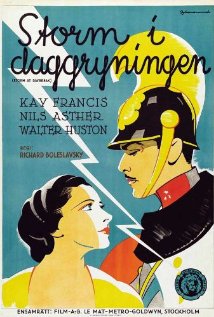
Following the assassination of the Archduke Franz Ferdinand and the Duchess Sophia, a small town in Hungary begins to feel the effects of the war. Kindly mayor Dushan Radovic (Walter Huston) and his friend, Captain Geza Petery (Nils Asther) do what they can to minimize the effects, but, they have problems. The first is that Radovic is a Serbian, while Petery is Hungarian. The second is that Geza and Petery's wife Irina (Kay Francis) have fallen desperately in love. Storm at Daybreak (1933) could have been a good movie. The elements are there. Unfortunately, the film is way too long, and feels as though it were padded for no very good reason. A party scene seems to go on forever, and to no apparent purpose - it attempts to inject humor into a situation where there is precious little. A scene in a railway yard brings Geza momentarily back into the lives of Irina and Dushan, but for no reason; he's gone in an instant, and it doesn't forward the action a jot. One wonders what the writers were trying to accomplish. The script makes Walter Huston's Dushan comes across as a complete moron
who is unable to see that his wife and his supposed best friend are
having real problems. Despite the fact that Irina makes it clear that
she would rather Geza not be around their home, Dushan keeps bringing
him back, making it hard for two people who want to forget their
feelings for one another to function. And Huston, a remarkable actor in so many other roles (watch him in Dodsworth, for example) overacts horribly. Also opting for over-the-top is C. Henry Gordon as the villainous Panto Nikitch. He manages to twirl his mustache without even having one. One can almost hear the director (Richard Boleslawski - this TCM article provides a bit more information about him) shouting "Give me MORE!!" We wanted a lot less.
The New York Times review (the reviewer was Andre D. Senwald), though calling the film "dull entertainment", was far more impressed than we were with Huston (who "blusters picturesquely"), but not very complementary of Ms. Francis (she "hardly seems suited to the enigmatic and mysterious qualities demanded in the rôle of the wife.") Quite honestly, Kay Francis is the best thing in the movie. She doesn't have a whole lot to work with - the part is formulaic at best. But she carefully underplays Irina, making her far more attractive. That being said, a scene in which she runs out into a rainstorm in a huge dress (she could barely get it through the door) to warn her lover of impending doom, was almost ridiculous. Not her fault - she actually GOT the dress through the door - but a true waste of her talents.
We have two favorite character actors present: Eugene Pallette as Janos, Geza's aide-de-camp, and Louise Closser Hale as Militza Brookska, the housekeeper in Dushan's home. Attempts are made to milk their performances for some humor; mostly, it doesn't work (though Pallette does get all the best lines.) By and large they are wasted, as is everyone else in the cast. That the film is formulaic is not really a problem, usually it's a formula we like. But this one is not going down as our favorite Kay Francis movie.
The purchase of a newspaper by the powerful D.B. Norton (Edward Arnold) results in the firing of most of the staffwhen Norton hires Henry Connell (James Gleason) as his new managing editor. Norton wants circulation numbers, and that means that "dead wood" needs to be cut. Included is columnist Ann Mitchell (Barbara Stanwyck), who is the sole support of her mother and two young sisters. Ordered to supply her final column before she leaves, Ann tosses off a letter, supposedly from a man, John Doe, who intends to commit suicide on Christmas morning in protest for the ills of the world. When her prank results in a nationwide outcry to find and help John Doe, Ann and Norton manufacture a "John Doe" in the form of down-on-his-luck baseball play Long John Willoughby (Gary Cooper), who agrees to pose as Doe for a fee. Her job secure, Ann happily works for Norton, unaware his motives are far from pure. Thus begins Meet John Doe (1941), one of director Frank Capra's most well-regarded films. Number 49 on AFI's 100 Years, 100 Cheers, it's one of the films that helped to invent the term "Capraesque" - films about the ability of the honest underdog to achieve his goals through courage and perseverance (sometimes called Capra-corn). Capra's abilities as a director held such trust with his actors that Gary Cooper, Barbara Stanwyck, Edward Arnold, Walter Brennan, James Gleason and Spring Byington all agreed to appear in the film without a completed script. Capra went into the project without a satisfactory ending, and actually test marketed FIVE different endings (TCM). The one we see today is the one that garnered the most public appeal, and was suggested in an anonymous letter to Capra from someone who had seen the multiple endings (AFI catalog).
Originally, Capra thought in terms of Jean Arthur and
James Stewart for his leads. He also considered Ronald Colman (who
would have been all wrong!), and he tested both Ann Sheridan and Olivia
de Havilland as well. Barbara Stanwyck came on board when Warner
Brothers refused to allow Ms. Sheridan to do it (she was being punished). We are indeed lucky that the stars were willing to
take on such a nebulous project, because the casting is spot-on. Cooper
is able to convey the innocence and confusion of John, without making
him into a complete idiot. And then there is Stanwyck. The role of Ann
is a difficult one - we have to understand her desire for money, but
still like her and root for her. The rapport between her and Spring
Byington (as Ann's mother) is essential; there bond in the film is
undeniable. As a result, we root for Ann, even when we know that she
has really gone over the edge in the push for John Doe's stardom.
Spring Byington provides the focus that we need to understand Ann. Generous, kind, loving; a mother who adores her children, and whose love for her late husband ventures almost into adoration, Mrs. Mitchell is both inspiration for Ann as well as motivation. Ann sighs as her mother donates money to those she feels are in need, even as the family is on the verge of being penniless. And, as Ann struggles with the motivations needed to make John Doe convincing, it is Mrs. Mitchell who suggests her late husband's diary as a source of inspiration. With 119 film and television credits to her name, Byington was a dependable and much admired character actress, usually playing a mother or older relative of the lead character. She started on Broadway; her first feature film role was as Marmee in Little Women (1933) (We've discussed her films When Ladies Meet (1941) and My Love Came Back (1940)). She worked in both film and television until 1968. She died in 1971, aged 84.
Interestingly, this was one of the first films to deal with Fascism in America (this glowing New York Times review is very appreciative of the "inspiring message for all good Americans" that is present in the film. Capra, who had been born in Italy (he had settled in Los Angeles by age five, so it is unlikely that he remembered much of his birthplace), may be reacting to the fact that it had already been overtaken by fascism. Though the fact that the ending was an afterthought is often evident when you watch Meet John Doe, it doesn't detract from your enjoyment of the film or of the performances of these amazing actors. We'll leave you with a trailer:
I Found Stella Parish (1935) is the story of an actress, Stella Parish (Kay Francis) who is making her London stage debut. Her producer, Stephen Norman (Paul Lukas), eagerly anticipates her opening. He believes her performance will garner stellar reviews. He has also fallen in love with her and wants her to marry him. But Stella, who keeps a small London apartment, rarely ventures from her home for anything but work. She has a secret life - living in the country are her mother (Jessie Ralph as Nana) and her small daughter, Gloria (Sybil Jason), both of whom she carefully shields from the public eye. Stella has good reason to fear - she has a secret past, which catches up to her on her opening night. In terror, she snatches up her little family and runs, pursued, unbeknownst to her, by reporter Keith Lockridge (Ian Hunter). We were fortunate enough to see this with some commentary by Robert Osborne, who talked about Kay Francis as the star of melodramas that sometimes leave you with questions, but questions for which you don't really care about getting answers. So, while the plot doesn't ALWAYS make sense (for example, who IS the man who threatens Stella, and why do we never see him again), we really didn't care. The fun in this movie is just going with it and not worrying about the slight vagaries of plot. According to this TCM article, most of the reviews for this film were favorable (and the film made a quite hefty profit), though the New York Times reviewer Frank S. Nugent, no Kay Francis fan, was not impressed. He seems to find her lisp distracting (he comments that she could not be a success on the London stage with her lisp. I have two words for him. Claude Rains).
In the relatively small part of Stephen, Paul Lukas shines. Warren William was supposed to play Stephen (he had been considered for Lockridge, but was moved into the smaller role.) William was not pleased to be given such a minuscule part, so the studio let him out of it. Lukas appears only in the beginning and the end of the film, and is in the rather thankless position of a man in love with a woman who does not reciprocate (and who ultimately falls in love with someone else). Lukas plays his part with subtlety, and gains the affection of the audience by his generosity of spirit. He had already appeared with Kay Francis in three other films: Illusion (1929), Behind the Make-Up (1930), and The Vice Squad (1931). This would be their last one together. Probably his most notable role was in Watch on the Rhine (1943), as Kurt Muller, an anti-Nazi agent for which he won the Best Actor Oscar. He had segued into television by 1949, and continued working in both film, television and on Broadway until 1970. He died in 1971 at the age of 80.
Sybil Jason is quite adorable as little Gloria. We were very impressed with her scenes with Ian Hunter - he seems especially engaged when he is interacting with her, and those moments appear unforced and even spontaneous. Sybil Jason was born in South Africa in 1927, and had a very short career. Her first part was an uncredited appearance in 1934; her last was in 1940. She starred opposite Ms. Francis twice (our film, and Comet Over Broadway (1938), which also starred Ian Hunter). Her final two film appearance teamed her with Shirley Temple - The Blue Bird (1940) and the film that is probably her most famous one The Little Princess (1939) in which she played the scullery maid, Becky. Basically retired at 13, she would eventually marry (a marriage that lasted for 58 years) and have a child. Though she believed that Shirley Temple's mother requested most her of best scenes be excised from The Blue Bird, Ms. Jason and Ms. Temple-Black remained lifelong friends. Ms. Jason died in 2011 at age 83.
Several scenes in the film were quite interesting. In one, Lockridge meets Stella, who has disguised herself as an older woman. He takes her hand, and his eyes betray to the audience that he has notice her hand is not that of an old lady. Another is a scene in which reporters harass Stella for more information about her illicit past. That one in particular was quite reminiscent of the paparazzi of today. Ms. Francis again gets a wonderful array of lovely dresses designed by Orry-Kelly. I was particularly impressed with a Greek-key designed dress she wears onstage, as well as some amazing hats! We'll close with a trailer from the film. We highly recommend it!
At the outbreak of the Second World War, Captain Beth Ainsley (Jane Wyatt) is onboard a military transport ship. This is not her first time in the military, and the action of Army Surgeon (1942) flashes back to Beth's experiences as a member of the Army Nurse Corps in World War I. We later find out that Beth is a physician, who has chosen to serve her country in the only way she can, by volunteering as a nurse. In Europe, she meets a former admirer, pilot Lieutenant Philip Harvey (Kent Taylor), and Captain James Mason (James Ellison), a doctor who is eager to get to the front. This is not a particularly good film - the story is all over the place, and it never really decides what it want to be. Is it a love story? A war movie? You'll not be able to decide, even after watching it. By trying to be all things to all people, what you really have is a mess. While Jane Wyatt is always a pleasure to watch, we found Kent Taylor to be quite annoying. According to this TCM article, Randolph Scott was considered for this part; we were intrigued as how this would have changed the quality of the film. Not that he could have done much for the overall story; he'd have needed a script doctor for that. This AFI catalog entry does give an excuse for Taylor's lackluster performance - following a fight scene with Ellison, he ended up with SEVEN broken ribs. Likewise James Ellison, a decent, if slight actor (you might know him from Vivacious Lady or The Plainsman) only gets to bristle periodically. Sure, it's a B picture, but they really could have done better. And that was reflected in the box office - it lost over $46,000.
As someone who is interested in the portrayal of women physicians on film, this did have at least one component that was fascinating. The film is very vague about Beth's military position in the frame portions of the film. We know she is an officer - a Captain in fact (and was a Lieutenant in the First World War). But, since the Sparkman-Johnson Bill, which allowed women physicians to serve in the military AS physicians (Dr. Margaret D. Craighill was the first woman doctor to enter the military), was not passed until April of 1943, Beth cannot be in as a physician. Do the authors intend this to be a call to the public for women physicians in the armed forces? And, I'm told that her rank as Captain does speak to the fact that she has re-entered the service, not stayed in the military. Were she a career nurse now, her rank would be higher. We have to assume that she is back in as a nurse, perhaps hoping that she will eventually be allowed to practice her real profession. Next week, we'll return with a more interesting film. Sorry, we just can't recommend this one.
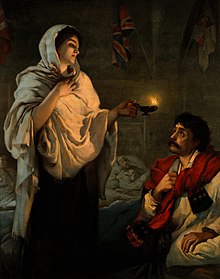
The early life of Florence Nightingale, as portrayed by Kay Francis, is the subject of The White Angel (1936). The film follows Nightingale's announcement of her intention to be a nurse, to her training at the Deaconess Institute in Kaiserwerth (Germany), to her work in Scutari during the Crimean War. In an era where nursing is a respected profession, it is important to emphasize the impact of Florence Nightingale in the creation OF the profession. Nightingale horrified her well-to-do family when she told them that she had a calling to become a nurse. The job that was nursing in England during this period involved hiring slatterns to primarily sit in hospitals and drink. Hospitals were NOT a place you wanted to be - they were filthy, and the "nurses" did little to help the situation. But Nightingale changed all that, first with her work in Scutari, and then with the books and reports she published after her return to England. This film, while rather loose in its faithfulness to the story of Nightingale's life, emphasizes the spirit of the adoration that was heaped upon Miss Nightingale during and after the War. It's interesting that The New York Times, though they liked Kay Francis, is disturbed the the "reverential tone" of the film. Yes, Ms. Francis does sometimes seem to be "striving to live up to Longfellow's 'Lady With the Lamp.'", but that is a hard image to lose. Below is a copy of the film's poster, alongside an 1891 painting. Tthe film mirrors the idolization of Ms. Nightingale that came down from the 1850s. As referenced in the film, Henry Wadsworth Longfellow did write Santa Filomena (1857) about Miss Nightingale. To a 21st century mind, this adoration can be off-putting, but it is well within the attitudes that prevailed during Miss Nightingale's life.
We do take exception to some of the a-historical elements in the film. The most egregious examples is the introduction of the character of Ella Stevens (Ara Gerald), a woman who comes from nowhere to act as a nurse supervisor in Scutari. Given all the tensions that are already present in the film, most notably with the character of Dr. Hunt (Donald Crisp), was it really necessary to import this inane woman as a foil to Florence? It adds nothing to the plot, and only serves to reiterate the importance of the rules that were established by Miss Nightingale at the start of her venture (and the audience is already well aware that she is correct in her judgements). What the screenplay DOESN'T do is to add a phony romantic subplot. Charles Cooper (Donald Woods) professes his love for Florence, but she has absolutely no interest in him. In his biography, Eminent Victorians (which the film credits as their key source), Lytton Strachey notes that at one point, Nightingale found someone she considered to be "a desirable young man", but whom she ultimately rejected in preference to "A profession, a trade, a necessary occupation, something to fill and employ all my faculties, I have always felt essential to me..." Woods fills that bill nicely; and Francis is excellent at displaying affection, but not romantic love.
It was interesting to see Donald Crisp fill the role of the overtly hostile Dr. Hunt. Crispshows much more of the imperious tone he would display in The Uninvited, but NONE of the affection and kindness. This was a Donald Crisp we were unused to, though with 170 film and television credits, Crisp has played just about everything. His film career began in the silent era (he played Ulysses S. Grant in Birth of a Nation); prior to that, he had served as a trooper in the Boer Wars. He studied with D.W. Griffith to become a director and during the silent and early sound eras, he directed 72 films. Ultimately, he found the work trying, and returned to acting exclusively. He appeared in some of the truly great films: Wuthering Heights (1939), How Green Was My Valley (for which he won the Academy Award as Best Supporting Actor of 1941), Lassie Come Home (1943), and National Velvet (1944). Married and divorced twice, Crisp worked until 1963 - his last role was as Grandfather Spencer in Spencer's Mountain. He died in 1974, at the age of 91. It's unusual for Kay Francis to not spend an entire film in eye-catching clothing, but her few lovely gowns are still designed by Orry-Kelly. Even with such an interesting subject, this movie still didn't do well at the box office (see this TCM article). As mentioned, it is not Ms. Francis' acting tht is the problem, but perhaps audiences so used to seeing her in melodramas were not prepared to watch her as an actual historical character.
This was not the first time Nightingale's life had been portrayed. During the silent era, Julia Swayne Gordon would portray her in The Victoria Cross (1912), and Elisabeth Risdon starred in Florence Nightingale (1915). After our film, the story would be attempted again - this time by the British in the 1951 film The Lady with the Lamp starring Anna Neagle. And, in 1985, a television movie with Jaclyn Smith was released. Though the 1951 film is probably the best of the bunch, we think this movie is worth your time, most especially for Ms. Francis' excellent performance. Here is a trailer to give you a taste:
Based on the 1933 novel by James Hilton, Lost Horizon (1937) tells the story of Robert Conway (Ronald Colman), a highly respected author, former soldier, and now an influential member of the British diplomatic corp. When unrest breaks out in the Chinese city of Baskul, Robert and his younger brother George (John Howard) go there to rescue the 90 white citizens who are trapped in the city. The last plane out is boarded by Robert and George, along with three other escapees: Henry Barnard (Thomas Mitchell), a swindler who escaped to China to avoid imprisonment, Alexander P. Lovett (Edward Everett Horton), a paleontologist who was one of Barnard's victims, and Gloria Stone (Isabel Jewell), a woman with a past who is dying of tuberculosis. Exhausted by their ordeal, the group does not notice til the morning that they are flying in the wrong direction, and have been kidnapped by an unknown Asian man. The plane crash-lands in the Himalayans, and the group is miraculously rescued by Chang (H.B. Warner), who takes them to his home, the monastery of Shangri-La. The group's immediate reaction is to demand ways to get home to "civilization," but very quickly they, one by one, begin to think about making a life in Shangi-La. Except George, who is desperate to return to London, and to drag his brother there by whatever means possible.
If you saw this film before the restoration that was released in 1986, you owe yourself another viewing. The film was severely cut by the studio in both 1937 and in 1942, deleting a lot of information on the motivations of the the secondary characters. It was those expurgated versions that made their way to television in later years. Though some of the filmed footage is lost, a soundtrack of the full film was discovered in 1973; using still photographs, the American Film Institute was able to reconstruct the film according to director Frank Capra's original vision. The DVD version of the film also includes an alternate ending to the film (which was thankfully eliminated from the film early one) - Capra's ending is far better (this article from the AFI Catalog goes into more detail on the film's production, and this article in the Chicago Tribune gives a more complete outline of the scenes that were added to the restored version). James Hilton based his tale of Shangri-La on another legendary location - the mythical Tibetan city of Shambala. This article from PBS's In Search of Myths and Heroes will provide a little more information on Hilton's inspiration for the place of perfect harmony. Principle photography on the film ran from March 23 to July 17, 1936, and in the months before and during production, Germany occupied the Rhineland, and Italy invaded Ethiopia. With Hitler beginning his reign of terror, it was becoming apparent to Europeans - and to Americans - that another war was in the offing. Though written by Hilton between the wars, by the time the film was released in
1937, Robert's despair of a world gone mad was perfectly relate-able to
the contemporary audience.
The character of George, as portrayed by John Howard, is an interesting one. George has spent his life reflecting in his brother's glory; were he to stay in Shangri-la, his one source of self-esteem - that of being the great Robert's brother - would be gone. At first, it's easy to sympathize with George; the group is being lied to, and he is more than angry at being held against his will. But Howard brings George's resentment to a fever pitch. Ultimately, it's hard to like him - he claims to be in love with Maria, but his actions don't speak of love - they display his willingness to use any means or any one to get out. John Howard does an excellent job of creating a character that has no self esteem, but much pride. Sam Jaffe, who portrays the High Lama, was 46 when this film was released, and this was only his third feature film. His career began in the Yiddish theatre; during the period from 1918 to 1937, he appeared in 14 Broadway plays, including The Jazz Singer and Grand Hotel. He was actually the third choice for the role of the High Lama - the first two choices (A. E. Anson and Henry Walthall) both died before filming began. This TCM article provides more detail on the early casting of the film. Two years after this Lost Horizon, Jaffe starred in the title role in Gunga Din (1939). He later appeared in such notable productions as The Asphalt Jungle (1950) and The Day the Earth Stood Still (1951), but by 1955, he was blacklisted after he refused to name names to HUAC. His greatest fame occurred in television, when he appeared as Ben Casey's mentor, Dr. Zorba, in Ben Casey. Married twice (his first marriage to Lillian Taiz ended with her death in 1941. His second was to the actress Bettye Ackerman - who appeared as Dr. Maggie Graham in Ben Casey), he continued acting until his death in 1984 (aged 93).
Another actor whose fame came primarily from television was the lovely Jane Wyatt, who appears as Sondra, the young woman who encourages the High Lama to bring Robert Conway to Shangri-La. While this was not her first film, it was probably her most notable one. For the most part, Ms. Wyatt was relegated to starring roles in B movies. By the 1950s, she had switched over to television, where she became best known for her role as Margaret Anderson in Father Knows Best (1954-1960). She would create the role of another important mother when she appeared as Spock's human mother, Amanda in the episode Journey to Babel in Star Trek - a role she would reprise in Star Trek: The Voyage Home (1986). She was one of the many performers who went to Washington, DC in 1947 to protest the HUAC hearings. She continued acting until 1992 (her final role was as older Vicki in The Young Indiana Jones Chronicles). Married for 65 years, Ms. Wyatt died in 2006, at the age of 96. Lost Horizon was remade as a musical in 1973, with Peter Finch as Conway, Michael York as George, and Charles Boyer as the High Lama. With not a singer in the bunch, the film was not especially noteworthy. We'll leave you with a trailer from the film, and a strong recommendation to see it:
Kismet (1944) is a fable. It is the story of Hafiz (Ronald Colman), who calls himself the King of the Beggars. Hafiz is always plotting - he hopes to find a good marriage for his much-beloved daughter, Marsinah (Joy Ann Page), while he is having a romantic liaison with the wealthy Jamilla (Marlene Dietrich). What Hafiz doesn't know is that Marsinah has already found the love of her life, a young man who she believes is the son of the gardener for the royal palace, but who is actually the Caliph (James Craig) and that Jamilla is the courtesan of the Grand Vizier (Edward Arnold), who is plotting the Caliph's death. As always, Ronald Colman is excellent as Hafiz, and the film, in fact, gives him an opportunity to show his range - for comedy, drama, romance and even a bit of farce. His rapport with Marlene Dietrich is obvious; their interplay is really what makes the movie. And while the script isn't exactly suspenseful - it is, after all, a fairy tale - it's fun getting there. Colman, superb storyteller that he is, never lets us forget the fantasy aspects of the storyline, and revels in the experience.
It seems obvious that Colman is having a good time in this production; Marlene Dietrich also seems to be enjoying the experience. Always a striking actress, she is more so here, with costuming that emphasizes her fantastic legs and exotic beauty. According to this TCM article, Dietrich was well aware that she was the decoration in the story, and went with the concept. It was her only appearance in an MGM film (according to this AFI Catalog entry, they never found another film worthy of her). She had to wear 4 coats of gold paint on her legs, which were a horror to remove. So, she would leave the paint on at the end of the day, and arrive at the Hollywood Canteen with golden legs! Dietrich's devotion to the troops is the stuff of legend. My father, an Army Corporal in the Engineers, often spoke of her with affection. Her hatred of the Nazis was well known - though offered a carte blanch to return to Germany (She was Hitler's favorite actress), she not only refused the offer, but became an American citizen and spent most of the war entertaining the troops in areas in which she was in extreme danger of capture and execution. She spent so much time in the European Theater of Operations that Billy Wilder is said to have quipped that "she was on the front more than Eisenhower" (Some Like it Wilder, 2010). As one of the actresses on the notorious 1938 "Box Office Poison" list (Glamour in the Golden Age: Movie Stars of the 1930s, 2011), Dietrich was having problems getting film roles around this time (she was 42 when production on the film began), but some of her best films were ahead of her: A Foreign Affair (1948), Touch of Evil (1958, a small but meaty part), Judgement at Nuremberg (1961), and Witness for the Prosecution (1957). As her film career petered out, Dietrich performed on stage and in cabarets, but following a fall onstage, she was forced into retirement. In her later years, she refused to be photographed, preferring that her public remember her in her youth. She died in 1992, at age 90.
Joy Ann Page, who here appears as Marsinah, is best remembered as the young bride in Casablanca. Her role in this film is minor - Marsinah gets little to do except be admired and lusted after. Her career was short, and she really never got a part as memorable as the one in Casablanca again, despite the fact that she was stepdaughter of Jack L. Warner. Warner, in his usual curmudgeonly way, refused to give her a contract at Warner's (she had auditioned for, and landed, the role in Casablanca without his knowledge. Once she had it, he agreed to her being in the film, but it was with reluctance). She had a total of 22 film and television credits, and ended her career in 1959 after appearing in The Swamp Fox for Walt Disney. She married William Orr in 1945 (her stepfather actually hired Orr after their marriage, and advanced his career steadily). The marriage ended in divorce in 1970. She died in 2008, at the age of 83.
Edward Arnold plays the part of the Grand Vizier with great relish. His strong voice and powerful laugh only serve to emphasize his evil intentions. His scenes with Dietrich are especially wonderful - Jamilla is the only human being who actually intimidates him. It's interesting that no one else seems to have been considered for this part. William Powell was at one point talked about for the role of Hafiz, Richard Carlson tested for the role of the Caliph, and Vera Zorina, Virginia Bruce and Marilyn Maxwell all tested for Jamilla. In hindsight, it is difficult to see anyone but Arnold in the role.
Kismet is a story that is a popular one in Hollywood. Based on a Broadway play from 1912, it was filmed twice as a silent film - in 1914 and 1920. In 1930, it was filmed with sound (and starred the actor who had done the 1920 silent version, Otis Skinner - the father of Cornelia Otis Skinner, of The Uninvited fame). After a successful Broadway musical version of the story opened in 1953, the story was again filmed, this time with Howard Keel and Ann Blyth singing the leads. Finally, on 24 October 1967, Jose Ferrer appeared in a television special of the musical. We'll leave you for this week with the trailer for the film - note the glorious technicolor (but Dietrich's golden legs are nowhere to be seen! I guess you had to pay your admission to see them!)

 It's always a pleasure to see Cary Grant in anything - even when he is a cad (and a third billed cad at that!) He's one year away from his magnificent (and arguably starmaking) performance in The Awful Truth, but his aura is already there. When he's on screen, it's hard to take your eyes off him. He had been loaned to by Paramount to MGM for this film, much to his disgust. It was only when he was allowed to work with screenwriter Lenore Coffee to make his character more palatable that he agreed to participate. The work shows. He and Coffee create a man who is a scamp, a spoiled brat used to getting his own way. But they imbue him with just the right amount of charm so that the audience understands Suzy's deep love for him. It's interesting to note that Clark Gable was at one point considered for the role.
  Suzy really has two loves in the Charville household - her affection for Baron Charville (Lewis Stone) is also boundless. The Baron is initially horrified at his son's impetuous marriage to a showgirl, but grows to love her for her caring ways. Lewis Stone, who would go on to acclaim as Judge Hardy in the Andy Hardy series, is quite wonderful in this film. With just the slightest flicker in his eye, he conveys both his affection for Suzy as well as the knowledge that the letters she is reading from his neglectful son are made up for the Baron's benefit. Much as she truly loves Andre, by film's end we know that her actions are motivated more by her love for her father-in-law.
 Andre's paramour, Madame Diane Eyrelle is played by Benita Hume. Ms Hume started her acting career on the London stage (she would also appear in one Broadway play in 1930), switching to film acting in 1925. In 1926, she appeared in Easy Virtue, directed by Alfred Hitchcock and written by Noel Coward. She segued easily into talkies, but was primarily relegated to supporting roles. When she married Ronald Colman in 1938, she retired from films, though she did frequently appear on the Jack Benny radio show with her husband, playing Benny's neighbors. Eventually, the Colmans even had their own radio (and later TV) show, The Halls of Ivy. Colman died in 1958. The following year, Ms. Hume wed George Sanders, a union which lasted until her death of bone cancer in 1967. Below is a small piece from Colman and Hume in the TV version of The Halls of Ivy (from 1955, with a little Mary Wickes for good measure!):




_04.jpg)


