In A Notorious Affair (1930), Patricia Hanley (Billie Dove) defies her father, Sir Thomas Hanley (Montagu Love), and jilts her fiance Dr. Alan Pomeroy (Kenneth Thompson), when she elopes with struggling violinist Paul Gherardi (Basil Rathbone). Patricia happily gives up her privileged life to share Paul's poverty, and ultimately his success. But with that success comes temptation, and Paul becomes involved with the sexually predatory Countess Olga Balakireff (Kay Francis), creating a scandal that involves both Paul and his betrayed wife. Adapted from the play Fame (written by Audrey and Waverly Carter), the original play may have starred Gerald de Maurier (father of author Daphne. This AFI Catalog talks briefly of the play's history). Like many films of the early sound era, this movie suffers from the stagnation of the static camera and microphone. Scenes that, a year or two later, would be full of movement and energy just sit there because the sound equipment forces the actors to stay stock still. As a result, the film and the actors seem stiff and un-engaged. All three of the leads, Francis, Rathbone, and Dove, had theatrical backgrounds. Basil Rathbone was a veteran of both the London and Broadway stage, but was relatively new to film (he'd done 7 silent films and 3 talking films prior to A Notorious Affair). Kay Francis had appeared in 4 Broadway plays, as well as 6 films. Billie Dove, however, had made her career as a Ziegfeld Girl (billed as The American Beauty), not as an actress, though she had already appeared in many silent films and several talkies. (A TCM article about the film discusses the actors' backgrounds).
In spite of Basil Rathbone prior appearances in talkies, he seems rather uncomfortable in this film. As we are used seeing him in roles in which he dominates the screen (a particular favorite is his turn as the roué in Confession, with his co-star here, Kay Francis), this Basil was a bit off-putting. We talked about him in some detail in our discussion of his fantastic performance in The Mark of Zorro. But if anyone owns this movie it is Kay Francis. Olga is quite the seductress, and with a sexual appetite that knows no bounds. Ms. Francis' ability to telegraph her thoughts with only her eyes serve her in good stead here. Watch her when she sees a stableboy entering a barn; we know exactly what is about to happen as she quietly enters the barn and shuts the door behind her. Likewise, the look on her face when she first sees Paul - it's as though she is looking at a steak after a 30 day fast. But Olga bores just as quickly as she hungers, and her relationship with Paul mirrors her tet-a-tet with the kennel man - once fed, she's done. The New York Times review had it right when they say that "Kay Francis...as the scheming countess, puts Miss Dove somewhat in the shade."
While we can't wholeheartedly recommend A Notorious Affair as a film, for anyone who is a fan of Kay Francis, this is essential viewing. Not only are you able to see her before she becomes the Warner Brothers cornerstone, you get to see her playing the kind character that wouldn't come her way for a number of years.
In celebration of National Classic Movie Day, and as part of the Classic Film and TV Cafe's blogathon, I'm going to venture on choosing the five (!!) movies I want with me when I'm stuck on a desert island. For someone with over 1,000 DVDs in her library, this is no easy task, but I'm going to give it a try with the caveat that the five I pick today may not be the same five I pick tomorrow! I know that when forced to choose, I'm going to want to mix up the genres a bit, so I'm not watching the same kind of film over and over,. Let's start with a musical, and my selection here is without equivocation. Whenever Singin' in the Rain is on, I have to watch the whole thing. I start out saying "I'll just watch this scene", and the next thing I know, the movie is over and I've re-watched it again. I actually do that with a lot of movies, which is probably not a surprise to anyone reading this. Regardless, Singin' in the Rain is special. With great music, wonderful dancing (Donald O'Connor doing "Make 'em Laugh" is an especial favorite), and terrific actors (Jean Hagen as Lola Lamont - she is perfection!) it has everything. It also serves as an introduction to the beginning of talkies. It's a film to which I frequently refer people, especially when they are puzzled as to why films look like they do in 1929 and 1930. Plus, it's a film that you will finish with a smile on your face and a song in your heart.
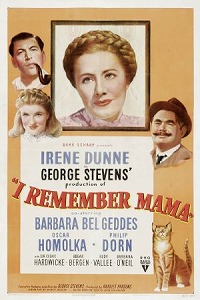
If you've never see I Remember Mama, you are missing a wonderful film. My pick for drama has several competitors (mainly A Tree Grows in Brooklyn, Johnny Belinda and The Enchanted Cottage), but for this week, I'm going with Irene Dunne in one of her last films. As the titular Mama, Dunne is perfect as Marta Hansen. Sure, Mama at time seems without fault, but it's hard to care or even notice as Dunne is so unbelievingly convincing as this warm and loving wife and mother. Narrated by the family's oldest daughter, Katrin (played beautifully by Barbara Bel Geddes), the story is a series of incidents in the life of the Hansen family over a number of years, which makes it perfect desert island viewing. Each "story" can be watched as part of the whole progression of the film, or as an independent short story. Especially poignant is an incident that revolves around the illness of the youngest daughter, Dagmar (June Hedin), and the inability of Mama to see her ailing child after surgery (hospital rules forbid any visitors for 24 hours post surgery. Wow, have things changed with time!) Dunne's heartbreak and guilt (she'd promised the child she would be there when she woke) in this segment reaches out from the screen and tears your heart. Ultimately, it is the strength of the family and the care that the immigrant mother and father show to their children as they try to avoid "go[ing] to the bank" that you will remember.
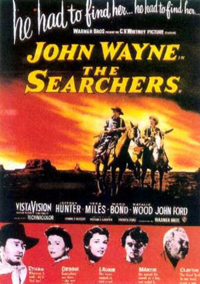
There are some really great westerns, and I have to admit that I had trouble deciding on just one. It came down to two: The Searchers and Westward the Women (add to the mix, a friend suggested Shane and The Big Country. Yes, my friends make my life harder). Ultimately, I chose The Searchers since it is again one of those movies I fall into each time I see it. John Wayne is exceptional as Ethan Edwards, a man driven to almost insanity by his hatred of Native Americans. When Ethan's niece, Debbie, is captured by a group of Indians who murdered the rest of her family, Ethan and Martin Pawley, a young man of mixed heritage who was raised by Debbie's parents, go on a quest to recover Debbie from her captors. But as the years pass and Debbie goes from childhood to young adulthood, it becomes clear to Martin that he must continue on the journey, no matter the cost. For, if he abandons it, Ethan will surely murder the young woman he now sees as a squaw. The story is intense, with Wayne creating a character that is impossible to like, but with whom the viewer feels a bond. Also notable are Jeffrey Hunter as Martin and Ward Bond as the Reverend Clayton, both characters that act as counterpoint to Wayne's driven loner. Finally, there are the magnificent vistas of Monument Valley, which director John Ford uses to tell his tale. It's a film with so many layers that, with each viewing, you'll see something new.
There are a number of comedies, especially romantic comedies which come to mind when asked to pick a desert-island selection: Victoria, Victoria, The Major and the Minor, Roman Holiday are just the tip of the iceberg. But I decided to select Bachelor Mother, starring Ginger Rogers as Polly Parrish, the temporary employee of Merlin and Son Department Store. When her job is about to come to an end, Polly goes out on her lunch break to find another job. She sees a woman abandoning a baby at a foundling home. Fearful the baby will roll from the stoop, Polly rushes in - and is mistaken for the baby's mother by the staff. As a result, Polly finds herself saddled with a baby, as well as a suitor, in the form of David Merlin, the "and Son" of the department store. The film is funny and sweet, the baby is adorable, and our romantic couple have a great chemistry. But what I love about this film are the attitudes of everyone towards this seemingly unwed mother. Sure, we, the audience, know that Polly is a "good girl", but the other characters don't, and uniformly they treat her with kindness and compassion. I especially love Polly's landlady Mrs Weiss (played to perfection by Ferike Boros), who, rather than condemn the girl, goes and gets her adult son's baby things and becomes Polly's go-to baby sitter! In an era where unwed mothers didn't exist, or were punished (usually by death) at movie's end, Bachelor Mother gives us a picture of a society that embraces the mistakes of a young woman, and ends by creating a happy family, all without violating the Code.
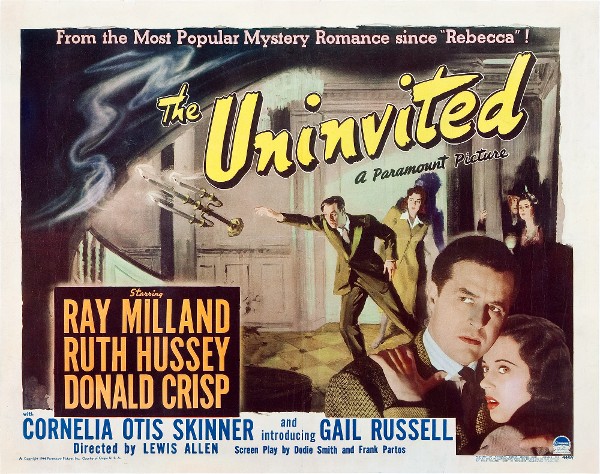
I'm not a huge horror fan, but I love suspenseful films. The Spiral Staircase is one film that I considered for this category, but really there was no contest in the ultimate winner: The Uninvited. It really does have everything - a phenomenal story, great cast, two ghosts, a really mysterious house, and a haunting musical score. (In an earlier blog entry, above, you'll find a link to a You-Tube video of the magnificent theme, Stella By Starlight). One of the problems with suspense films is that, once you know the answer, you don't always enjoy rewatching the film. ButThe Uninvited still is a pleasure even when you know what is coming. Much like Laura, it's the acting, and the relationships of the characters that keep you returning to this film. Ray Milland is exceptional as Rick, the new owner of Windwood House, as is Ruth Hussey as his sister Pam. But the person who steals the film from under everyone else is the ethereal Gail Russell, playing Stella Meredith, the object of Rick's love and the focus of the beings that haunt the house. The Uninvited is a movie that will make you believe in ghosts.
As I said, this is a list that could change at a moment's notice, and you'll notice that the list lacks a few films that one might expect to see on a desert island list. So, let's give a nod to To Kill a Mockingbird, Gone with the Wind, The Best Years of Our Lives,The Thin Man, Casablanca, just a few in a list of "essentials" that film fans love. These are wonderful; I own them, I would never give them up. I rewatch them regularly, but you all KNOW about these films. With my list, I hope I may have brought up a few films that might not have made your own "essentials" queue.
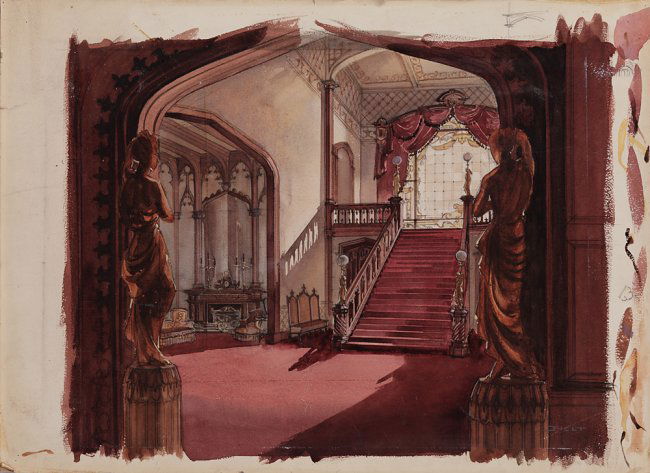
Though I've already posted on Gone with the Wind several times, I'm again going to discuss it, this time in relation to a interesting program held at AFI Silver (in partnership with Smithsonian Associates), which was part of a series entitled William Cameron Menzies: Inventing Production Design. James Curtis, the author of William Cameron Menzies: The Shape of Films to Come, spoke about Menzies contributions to filmmaking in general, and specifically about his impact on the film that would become Gone with the Wind. Using examples from Menzies' surviving art work (a sketchbook was miraculously saved from the attic of his home before the building was razed), Mr. Curtis discussed the contribution of Menzies' amazing eye in creating the look and feel of the film. Gone with the Wind was always going to be a Technicolor film; this gave Menzies the opportunity to use color in the telling of the story. Mr. Curtis pointed out the pastel hues of the early scenes - think of Scarlett entertaining her beaus on the steps of Tara, compared to the deep reds and oranges of the escape from Atlanta. The sketches tell the story of Menzies vision of the film.
Today, we see the term "production designer" on all films, but Menzies was the first person to have that title; in fact, it was created to describe his unique contribution to filmmaking. He won the first awarded Oscar in Art Design for his work in The Dove and Tempest (both in 1929) and was given a special Oscar for Production Design in 1939 for Gone with the Wind. Of course, there WAS no Production Design award at that point - the Oscar in that category was only renamed (from Art Direction) in 2012. In 2016, the Art Director's Guild instituted an award named after William Cameron Menzies. The first awardee was Robert Osborne, "for his work in championing classic motion pictures." Menzies would eventually go on to try his hand at film direction - Things to Come (1936) and Invaders from Mars (1953) are the two that are most highly regarded. But his credits in this area cannot surpass his credits in production design. With films like Kings Row (1942), Our Town (1940) and Made for Each Other (1939), he created a vocabulary of images.
Barbara Stanwyck's final role on the big screen was in a William Castle horror/suspense film entitled The Night Walker (1964). Its major claim to fame (besides being Stanwyck's last go at movies) was that it reunited her with her former co-star - and former husband -Robert Taylor. Stanwyck plays Irene Trent. Married, unhappily to jealous tyrant Howard Trent (Hayden Rorke), Irene's sleep is plagued by dreams of a fantasy lover (Lloyd Bochner). When Howard is killed in a freak accident in his laboratory, Irene's not heartbroken, and happily leaves their damaged home in the hope of escaping from the stressful dreams. But the dreams begin to escalate in intensity; terrified she is going mad, Irene goes to her husband's attorney,Barry Morland (Robert Taylor) for help. On some levels, one wonders what would prompt Ms. Stanwyck to appear in this rather ludicrous story. Though hired first, she ends up billed under her ex-husband, Robert Taylor. According to this article in the Florence Times, from May 9, 1964, Stanwyck was willing to appear with her ex, if he and his wife (German actress Ursula Thiess) agreed. Taylor said it was fine with him, but when asked, the current Mrs. Taylor allegedly said "not necessarily."
While Stanwyck gets second billing, it is clearly her film. Even with an outlandish plot, special effects that are laughable, and an ending that makes you want to go "Huh?", Stanwyck is still excellent. In an age when older actresses were having to become laughingstocks in the Grand-Guignol style (think What Ever Happened to Baby Jane), Stanwyck is still elegant, and even regal. Her beauty was even more striking as she aged (my father - a huge fan - always said she got better looking every year), and at age 57 she looks like a youth when compared to much less well-preserved (and 4 years younger) Robert Taylor. (The book Barbara Stanwyck: Miracle Woman by Dan Callahan also comments on the physical differences between the stars. Be aware - there are spoilers).
Interestingly, Joan Crawford is alleged to have been William Castle's first choice for Irene. She declined, perhaps because she was at that point committed to Hush, Hush Sweet Charlotte, a role that was ultimately given to Olivia de Havilland when Crawford became ill (or, perhaps just couldn't stand the thought of working againwith her rival, Bette Davis).
Possibly the biggest problem with the story is the lack of continuity. Howard Trent is horribly jealous. Why? He has a laboratory in the attic. What is he doing there? Irene owns a beauty salon, which she owned before she met Howard. Why did they marry? Why is Howard blind? The questions go on and on, but we get no answers. We're supposed to wonder why Irene is having these odd dreams, but given her rather strange marriage, it's no wonder that she is dreaming of a handsome man who adores her. And if you listen carefully, you actually can figure out WHY "The Dream" is someone who actually exists. It's quite probable that Irene met him at some point.
It was very pleasant to see Hayden Rorke in a film role - he actually had a very lengthy film career in character parts before he became so very familiar to us all as the much put-upon Dr. Bellows on I Dream of Jeannie. While this was not his last film role, he primarily did television after this movie. He'd started film acting in 1943; prior to that, he'd appeared on Broadway in 6 plays (including The Philadelphia Story, with Katharine Hepburn - he played Mac, the night watchman). He continued working until 1985, and died in 1987, age 76. He was survived by his partner, Justus Addiss. Also in the cast, in tiny parts, are Jess Barker (who we saw in Good Luck, Mr. Yates) and Rochelle Hudson (probably best known as Shirley Temple's older sister in Curly Top). Blink, and you'll miss Ms. Hudson as Hilda, the manager of Irene's beauty shop. Barker at least gets a few minutes screen time as Mr. Malone, the inspector of the damaged house, at the beginning of the film.A shame really, that they didn't get more to do.
As Bosley Crowther in his New York Times review states, "the whole thing would not be worth reporting if it didn't have Barbara Stanwyck in the role of the somnambulistic sufferer and Robert Taylor as her husband's lawyer who tries to help." Small wonder that Ms. Stanwyck eschewed further big screen roles in favor of television. Her next role would see her in the part of the inimitable Victoria Barkley, with star billing as
MISS Barbara Stanwyck for the four-year run of The Big Valley. That role would earn her four Emmy nominations, and two wins. She also would win another Emmy in 1983 for her performance as Mary Carson in The Thorn Birds. (Obviously, the Emmy voters were a lot smarter than the Oscar voters!) We'll leave you with this trailer from the film.
In the second year of her film career, Kay Francis appeared in 10 films. For the Defense (1930) features her in the third of the 6 films in which she appeared with William Powell. Powell plays attorney William B. Foster, a successful, albeit often unethical attorney who will do almost anything to get his client freed. He loves actress Irene Manners (Ms. Francis), but is unwilling to marry her - he's not the marrying kind, and is perfectly satisfied with their current relationship. She, however, is ready for marriage, and is being wooed by Jack Defoe (Scott Kolk), who is eager to wed her. Irene is ambivalent - she loves Bill, but the relationship is going nowhere; Jack loves her, but she she has no strong feelings about him. Sensing her indecision, Jack drinks too much; Irene insists on driving him home. On their trip, Jack again tries to embrace her; as a result, she inadvertently swerves, hitting and killing a man in the road. Jack insists that she leave the scene; he takes the blame for the accident, and ends up on trial for manslaughter - with Bill as his defense attorney. This was Kay Francis' first real chance at a leading role; she seems at ease and quite natural in the part. Though not given the wardrobe that would later enhance most of her films, her costumes are not shabby, thanks to the excellent (and uncredited) work of Travis Banton. Even her hairdo is different here; she wears it extremely short, and slicked back (you can see it below). It's very severe, but is also becoming. As the only woman in the cast (even the jury members are all men), Ms. Francis stands out, and makes the most of what could have been a fairly small role.
The character of William Foster is based on a real life character - William J. Fallon, "The Great Mouthpiece", who
defended, among other, Nicky Arnstein (Fanny Brice's husband) and Arnold Rothstein (the model for Meyer Wolfsheim in The Great Gatsby). Of the 120 defendants accused of murder that Fallon defended, none was convicted. This article from The New York Press goes into detail on the life and times of the notorious Bill Fallon. In 1932, Warren
William would play another character, loosely based on Fallon in The Mouthpiece; the character of Billy Flynn is certainly a direct descendant of the lawyers patterned after Fallon. William Powell is quite good as Foster. Just two years from silent films, Powell knows how to use the camera both with speech - and without it. The sound cameras in 1930 were very limited and director John Cromwell does a lot to compensate for the problems, such as using rear screen projection to give the feeling of a busy city street (This TCM article goes into more detail on some of the techniques used to give the film movement). Especially impressive is a scene of Powell, late in the film, walking down a long corridor. There isn't a sound, but Powell and Cromwell make the walk seem like forever. (Check out this review of the film on Pre-code.com for more on the film's impressive use of silence.)
Powell's career began on Vaudeville and Broadway. He appeared in 4 Broadway plays (as William H. Powell - his name was William Horatio Powell) between 1918 and 1922, when he left New York for Hollywood. He worked steadily during the silent period - his greatest success being in Emil Janning's The Last Command. With his prior stage experience and wonderful speaking voice,he was ready for his first talkie in 1928, when he starred in Interference. But it was The Canary Murder Case the following year that really solidified his position in films. Originally conceived of as a silent, the film was reworked, and Powell cast (for the first of 5 appearances) as detective Philo Vance. The year after his final appearance as Vance, Powell was cast in the part for which he is best remembered - Nick Charles in The Thin Man (1934). He had just recently (in Manhattan Melodrama) appeared with co-star Myra Loy; their chemistry resulted in 14 films together. Though his marriage to Carole Lombard only lasted two years, they remained friends and in fact appeared in My Man Godfrey (1936) three years after their divorce. Shortly after the death of his fiance, Jean Harlow, Powell was diagnosed with cancer. After a two-year battle, the disease went into remission and Powell resumed his career. He worked steadily until his retirement in 1955, immediately after his appearance in Mr. Roberts. Married to actress Diana Lewis for 44 years, he died 30 years after his retirement, at age 91.
We'll close with this scene of Bill and Irene at a night club. We'll be leaving the pre-code period for a Barbara Stanwyck film from the 1960s.
Last week, we watched Kay Francis appear as a pre-code physician in Mary Stevens, M.D. This week, we viewedDr. Monica (1934), released the next year, but in many ways, a much more restricted film. While technically a pre-code film (Dr. Monica was released June 21, 1934 - the code didn't officially start being enforced until July 1st), for all intents and purposes, this film is forced to abide by some aspects of the Production code, not the least of which is the punishment of a woman who has carried on an affair with a married man. Dr. Monica Braden (Ms. Francis) is a successful obstetrician, married to writer John Braden (Warren William). The only thing that seems to mar the happiness of their marriage is Monica's inability to have a child. Or so it seems to Monica - unbeknownst to her, John has been carrying on an affair with aviatrix Mary Hathaway (Jean Muir). When John leaves for Europe, he and Mary call a halt to their relationship; what he doesn't know - and won't discover - is that Mary is pregnant.
Though the character of Mary is ultimately punished for her mistake (not so the erring husband), many aspects of the film fall into the pre-code conventions. There is the out-of-wedlock pregnancy, a brief discussion of abortion, and finally, our female leads. The film presents us with three women, all of whom are career women - our heroine, a successful physician; Mary, though wealthy, a trained flyer with her own plane; and Anna Littlefield (Verree Teasdale), a gifted architect. Several sources, including this TCM article note that Joseph Breen, the head of the Production Code Administration, despised this film as being about "a lesbian, a nymphomanic and a prostitute." We figured that Anna was the lesbian, given that she isn't married, doesn't have a man in her life, and has a successful career, and that Mary was the prostitute (though she certainly wasn't doing it for money. She has far more money that John will ever have. Monica is the major breadwinner in that family). But we weren't clear on who the nymphomanic was - Monica? Because she wants a child? We are at a loss, and we're not suggesting a seance to ask Breen what on earth he was thinking!
The New York Times review was far more sympathetic to the film, with positive reviews for the three ladies, especially Jean Muir, and even some kind words for Warren Williams (in what they truthfully call a "thankless role).
We were especially impressed with Verree Teasdale's performance - she gives the character of Anna a gravitas that is essential for the person who serves as Monica's moral compass. She is Monica's confidant, but she is also the one that makes certain Monica ultimately fulfills her duties as a physician, even when outside circumstances make her unwilling to act ethically.
Ms. Teasdale began her career on Broadway, appearing in 13 plays between 1924 and 1932. She started in films, in 1929, appearing in Syncopation that year. In her 30 films, she was primarily the second lead or nasty society wife; she also played Hippolyta in the 1935 A Midsummer Night's Dream. That same year, she married actor Adolphe Menjou - they had one child. Though they did not appear in films together, in the 1940's and 1950s, they hosted a radio show. She and Menjou remained together until his death in 1963. She died in 1987, at the age of 83.
According to the AFI Catalog, the Hollywood Reporter stated that Barbara Stanwyck and Joel McCrea were considered for the leads, casting that would have resulted in a very different movie. Stanwyck would finally get to play a doctor in the 1940s (You Belong to Me, 1941); Ms. Francis would play a physician once more, in 1939s gangster film, King of the Underworld, giving her the record, as far as I can find, of an actress playing a doctor. We'll end today's posting with a trailer from the film.
As I've mentioned before in this blog, I have a personal fondness for films about women doctors, so I was very pleased that the film my group selected for this week is Mary Stevens, M.D. (1933). Kay Francis is Mary Stevens. We meet her as she and her best friend, Don Andrews (Lyle Talbot) conclude their internships and open an office together,with Mary's devoted friend - and nurse Glenda (Glenda Farrell) in tow. It's rough going at first - Mary, as a woman, finds it hard to recruit patients. But, just as things start to improve, Don decides that he'll be better off married to Lois Rising (Thelma Todd), the daughter of a powerful politician. And, while Mary now has a thriving practice, she loves Don and he is now, seemingly, out of reach. The pre-code elements in this film are fairly simple: Don and Mary have an adulterous relationship, and Mary has a baby out of wedlock. There's even a brief hint at abortion (Mary refuses to "do something" about her pregnancy, since she'd recently advised a patient to "go through with the thing" and now she is "going to live up to [her] own advice!" My fellow blogger at Pre-code.com also provides a nice overview of the film (though be warned - there are spoilers). But Mary's integrity as a physician and as a human being are never in question. She is a good, dedicated doctor, who just happens to fall in love with a very wrong man.
We loved Kay Francis as Mary Stevens. Sure, she's got nicer clothing than any struggling physician should have. Regardless, she presents a picture of a woman who is competent and who KNOWS she is competent. Despite her love for Don, she won't brook medical sloppiness, and when she realizes that his drinking is destroying his ability as a doctor, she breaks all ties with him. Lyle Talbot also does a good job in portraying someone with real ethical issues. Talbot has the ability to switch from likeable to reprehensible with very little effort, a real asset with Don. And he needs to do it in such a way that the audience will root for him when Mary and he meet years later. We talked about Mr. Talbot at length in our review of A Lost Lady. He is equally good here, but in a very different part.
Poor Glenda Farrell gets very little to do here, except be supportive to Kay. She is seldom out of her nurse's uniform, and doesn't even have a last name. But she makes the most with what she is given, making Nurse Glenda memorable. With 116 film and television credits, Glenda Farrell's career extended from an uncredited role in 1928 to 1970. She excelled at comedy, and could do zany and/or dumb characters with her eyes closed. Frequently paired with Joan Blondell (they would do 9 films together), Ms. Farrell really broke out when she first appeared as intrepid reporter Torchy Blane in Smart Blonde (1937). She would play the part 6 more times Lola Lane played Torchy once in 1938's Torchy Blane in Panama when Warner Brothers decided they wanted a new Torchy - it didn't work out, and Ms. Farrell appeared again in the role. Jane Wyman would conclude the film series with Torchy Blane...Playing with Dynamite (1939) when Ms. Farrell left Warners to head back to New York and Broadway. Between 1929 and 1970, Ms. Farrell appeared in 12 Broadway plays, including Forty Carats (her part went to Binnie Barnes in the film version), as well as appearances in many television shows. While appearing in the Broadway play Separate Rooms (1941), Ms. Farrell met Dr. Henry Ross (he was treating her sprained ankle at the time). They married, and were together until her death of lung cancer in 1971.
Another actress with a minuscule part is Thelma Todd, who only has a few scenes as Don Andrews' wife Lois. We see her briefly prior to their marriage, then again when Lois' father forbids her from divorcing him. Todd had started her career in silent films, but talkies gave her the opportunity to show off her comedic talents, often teamed with ZaSu Pitts in a series of short films about two hapless women (patterned after Laurel and Hardy) named Thelma and ZaSu (surprise!). But Todd is perhaps known because of her mysterious death at age 29; she was found in her car, dead, in what the coroner called a suicide from carbon monoxide poisoning. The truth behind her death has been debated for decades. Did she die at her own hand, or was she the victim of a murder? In 2012, William Donati published The Life and Death of Thelma Todd, which revisited the investigation.
Two major incidents happen towards the end of the film that bear some mention. Dr. Stevens is called in to treat a child with infantile paralysis. She needs a serum. Really? Infantile paralysis - or polio - was not treatable in the 1930s, and the only "serum" currently available are the polio vaccines, discovered by Jonas Salk and by Albert Sabin in the 1950s. The other incident revolves around Mary's depression at the end of the film. As Don tries to bring her back to herself, it is her career that he uses as a motivator, not their pending marriage. That, combined with a final scene that is described in this TCM article are, for me, the most interesting aspects of this film on the role of women in medicine.
This New York Times review points out the excellent work of Una O'Connor in her small part as the mother of two sick children. All in all, it's a positive review, and we agree and highly recommend it. We leave you with a trailer.
Next week, we'll look at another Kay Francis film in which she portrays a doctor.
We return to the pre-code era for Blonde Crazy (1931). James Cagney stars as Bert Harris, a bootlegger and would-be con man who has an eye for the ladies and his sights set on the big con. When Ann Roberts (Joan Blondell) arrives at the hotel where Bert works as a bellhop looking for a job, Bert helps arrange that she get it - assuming there will be a little quid pro quo in the romance department. He quickly discovers that Ann is no pushover (which only makes Bert like her more). He convinces her in joining him on a con - convince hotel guest (and lecher) Rupert Johnson (Guy Kibbee) to go out with Ann, and pony up some cash when a scandal is threatened. Audience reaction to this film (within our group) was mixed. Most of us enjoyed it, while one member did not care for the various con jobs that interspersed the story. But we uniformly enjoyed the combination of Cagney and Blondell. They are marvelous individually and sizzling as a couple. Cagney sparkles as the vainglorious Bert, and when he gets his comeuppance, his reactions are spot on. Similarly, Blondell is well able to convey the ambivalence that Ann feels, a basically honest person driven to duplicity in the world of Depression America. Mae Marsh (according to the AFI Catalog) was the original casting choice for Ann. Joan Blondell had already been in 14 films and shorts when she received star billing in Blonde Crazy. Prior to this film, she appeared as the second banana in films like Night Nurse, Illicit, and Big Business Girl. She'd even appeared with Cagney in Sinner's Holiday (1930) and The Public Enemy (1931). She would continue to be a lead at Warner Brothers throughout the 1930s, finally leaving to become an independent in 1939. She continued to work in film until the end of the 1940s. As film work dried up for the actress (who was now in her 40s), she moved to television, where she worked (including the occasional film role) until her death at age 73 in 1979. Married three times (all of which ended in divorce), the ones best knows were to Dick Powell - which ended when Powell became involved with the younger June Allyson, and to Mike Todd (Blondell divorced him after he spent all her savings with his lavish lifestyle).
This was not Ray Milland's (Joe Reynolds) first role in films. He'd started in silent films, mostly in small parts, as Raymond Milland (his birth name was actually
Reginald Alfred John Truscott-Jones), a name he would use in many of his films during the 1930s. It really wasn't until 1940 that he began to get starring roles - The Doctor Takes a Wife, which we've already discussed, was one of those leading roles. Four years later, he would appear in one of his best roles - the haunted Rod in The Uninvited. The following year, he would win the Oscar as Best Actor for his portrayal of an alcoholic at the end of his ropes in The Lost Weekend (his competition included Gregory Peck for The Keys of the Kingdom and Gene Kelly for Anchors Away). In this film, he gets to run the gamut - and does it well. His Joe Reynolds seems a loving, good man - the opposite of Cagney's Bert. Ultimately, we discover that Joe is a dishonest cad, and Milland does a good job of making the transition, as well as making him an interesting foil for Bert. Married for 54 years to Muriel Weber, Milland worked in both film and television until 1985; he died of cancer the following year. His 1976 autobiography, Wide-Eyed in Babylon gave an amusing view of his years as a Hollywood leading man.
Also in the cast are Louis Calhern as Dapper Dan Barker and Noel Francis as Helen. Ms. Francis' career was relatively brief - she appeared in 45 films between 1929 and 1937, many of the uncredited appearances. Mr. Calhern, however, had a much longer career. He started in the silent era (in 1921), and continued working, primarily as the wealthy businessman or nasty conniver (as he is here). He was the dying sybarite in The Man in a Cloakand the oily businessman waiting for the world to discover the death of his rival in Executive Suite. In his final film, he was as the deliciously lechy Uncle Willie in High Society. He died that same year, 1956, while on location in Tokyo for the comedy The Teahouse of the August Moon.
With multiple characters in the film getting away with all kinds of crooked activities, a scene with the lovely Ms. Blondell in a bathtub (and Mr. Cagney trying to get in for a gander), and another where Bert invites a more-than-willing young lady up to an empty hotel room, it's clear why this is easily placed as a pre-code film. My fellow blogger at Pre-code.com notes in his review that the film has "everything lascivious about Depression-era film making and moralizing in one convenient package." And despite a wishy-washy New York Times review, according to this TCM article, it did rather well at the box office. The reason? James Cagney - just listen to him say "HON-eeey" a time or two and you'll be won over as well. We'll close with this trailer (with the film's original title, Larceny Lane); you'll get an idea of just how Cagney will captivate you. And, as the trailer says, together, Cagney and Blondell "are dynamite".
The Ten Commandments (1956) was featured as this month's Fathom Events screening for TCM Presents, celebrating the 60th Anniversary of the film's release. Starring Charlton Heston as Moses, the film also features its director, Cecil B. DeMille, the narrative voice of the movie. At the time of its release, The Ten Commandments was the most expensive film ever produced (costing over $13 million), as well as being DeMille's most successful film. It was also DeMille's final film. He would die three years later, at the age of 77. This screening showed the film as it was originally released, with an
overture, end music and introduction by the director (as well as a 10 minute intermission. With a running time of 220 minutes, that break was welcome) In his introduction, DeMille
informs us that, as much of Moses' early life is not discussed in The Holy Scriptures (as the titles call The Bible),
the film goes to the works of Josephus and Philo to fill in the missing
period. (You can see that introduction just below). The film is reverent in its treatment of the story, and DeMille really wants the audience to understand that care that was taken in creating an accurate telling of the story of Moses.
Charlton Heston is perfect in the role of Moses - and it's hard to envision anyone else in the part (When DeMille did it as a silent film, in 1923, the part of Moses was played by Theodore Roberts, an actor who appeared in 23 films for DeMille, but did not transition to talkies). According to the AFI Catalog notes some sources claim that William Boyd ("Hopalong" Cassidy) had been DeMille's first choice for the part, though DeMille's autobiography stated otherwise. It's been said that Heston's resemblance to the Michaelangelo Moses was the impetus for his selection. You can judge for yourself from the images below.
Charlton Heston had already worked with DeMille - in the circus epic, The Greatest Show on Earth (1952), for which DeMille won the Best Picture Oscar (beating High Noon and The Quiet Man). The Ten Commandments really pushed Heston into the star category, a status thatBen Hur would solidify when he won the Best Actor Oscar three years later. Heston's magnificent speaking voice gives the character of Moses great power (though, it should be noted that the Moses of the Bible was not a good speaker, and asked God to allow his brother Aaron to do the speaking for him) and served him well in his lengthy and varied career. Though best knows as the star of epics like this one, he worked in science fiction (SoylentGreen, Planet of the Apes), westerns (The Big Country), comedies (Wayne's World) and even Shakespeare (Julius Caesar, Hamlet, Antony and Cleopatra - the latter of which he adapted for the screen and directed). In the 1980's, Heston segued into episodic television, as the star of the Dynasty spinoff, The Colbys (which briefly co-starred Barbara Stanwyck). He was married to his wife, Lydia Clark for 44 years; they had two children, Fraser and Holly. (Frasermade his screen debut (and only on screen appearance) in The Ten Commandments, age 3 months, as the
baby Moses. Fraser was cast en utero, several months before the
sequences were scheduled to be shot.) When Charlton Heston discovered in 2002 that he was suffering from Alzheimer's Disease, he retired. He died in 2008.
With an unbelievably large and impressive cast: Yul Brynner as Rameses II, Yvonne De Carlo as Moses' wife, Sephora, Debra Paget as Lilia, John Derek as Joshua, Sir Cedric Hardwicke as Sethi, Nina Foch as Bithiah, Martha Scott as Yochabel, Judith Anderson as Memnet, it is hard to pick just a few to discuss. We particularly enjoyed Vincent Price as the oily and lecherous Baka, The Master Builder. He made a fine contrast to Edward G. Robinson as his equally lecherous, but far more sinister successor, Dathan. Anne Baxter, as Nefretiri, however, was a huge disappointment. Baxter can be a powerful actress, but uncontrolled, she can overact to the rafters. This was one of the latter performances. In one scene, where she is supposedly seducing Moses, she turns AWAY from him, eyes wide and smoldering, and instead tries to seduce the camera. Interestingly, she was not DeMille's first choice for the part - he had in fact considered Audrey Hepburn, but decided her bust was too small for the wardrobe he envisioned for Nefretiri. This Huffington Post article has some further tidbits of information.
According to this TCM article, Yul Brynner got the part of Ramses between acts of The King and I, and Yvonne de Carlo was hired based on her appearance Sombero. DeMille was screening it to see Nina Foch; he ended up casting both women based on the 1953 film. The special effects in the film are of varying quality. Let's not forget, this is the pre-Industrial Light and Magic era, so special effects look clunky to modern eyes. Of course, the most famous (and best) effect in the film is the parting of the Red Sea, a complicated process that involved lots of water, reversing of a filmed flood, and a great deal of post processing. This article provides more detail on the processes used. Less successful is the use of animation for the burning bush, and for the writing of the tablets of the 10 commandments. It unfortunately looks animated - and bad animation at that. DeMille should have talked to Walt Disney before he tried it!
An interesting historical
note concern's DeMille's efforts at publicity for the film, including the "donation" of Ten Commandment stone plaques to government buildings across the United States (this NPR report discusses the civil liberties issues involved in the display of these religious items on government facilities). The repercussions of this publicity stunt continued for over 50 years.
I'll leave you with the trailer for this film. All caveats aside, it's an impressive film that got a well-deserved big screen showing. Perhaps one day, it will be shown in double feature with DeMille's 1923 silent version of the story (it would be a VERY long double feature!)