Four Jills in a Jeep (1944), based on a book by Carole Landis, tells the true story of the Ms. Landis, Kay Francis, Martha Raye and Mitzi Mayfair, as they venture from the safe confines of Los Angeles (where all four were deeply involved inthe war efforts) to entertain the troops in the war zone - first in England and then in North Africa. Along the way, Carole and Mitzi find romance - and Martha dodges a smitten Sgt Eddie (Phil Silvers). By and large, this is a true story - the four women, spent nearly four months abroadlto entertain the troops in the middle of the danger zone (see this AFI Catalog article). Carole Landis did meet a flyer (Army Air Force Captain Thomas Wallace) on the tour, and married him in 1943 (they divorced in 1945). The film presents an interesting picture of the war effort from the point of view of those who decided that staying home was not the best service to the troops. It's an enjoyable film, with great music, and an array of talent from 20th Century Fox studio - Alice Faye, Betty Grable, Carmen Miranda, George Jessel, Jimmy Dorsey and his Orchestra, and even Dick Haymes, playing Lt. Dick Ryan (in his first credited screen appearance. Of course, he is a singer!). You can see from the advertisement below that these guests get more prominent billing than our four stars.
Though other wartime revues, such as Hollywood Canteen and Thank Your Lucky Stars (both from Warner Brothers) did well, this film did not, and received an unfavorable review from the New York Times. Released in 1944 (in April, before the D-Day
invasion), audiences (now in the war for over 2 years) were likely
dejected by the seeming lack of progress. But it must surely have been welcomed by the soldiers who were not able to see the Four Jills on their tour. Of course, the film was shot entirely on the studio lot, resulting in the women riding Central Asian (two-hump, or Bactrian) camels in North Africa (the home of the Dromedary, or one-hump camel). And though the ladies always look immaculate, the film does capture the flavor of what they had to deal with. Especially impressive is a scene in which the women perform using only cigarette lighters when the power goes out during a bombing raid.
We sometimes forget what a lovely singing voice Martha Raye had. This film, luckily, gives her the opportunity to show it off. Sure, it's a novelty number, in which she gets to clown as well. Had Ms Raye had the looks of a Carole Landis, it is likely she would have had starring roles in big musicals. However, that was not to be. The film's producer, Darryl F. Zanuck, was apparently not a fan; he commented to director William A. Seiter, "Martha Raye usually talks too fast and too loud. Try
to make her play Martha-Raye-off-stage and not
Martha-Raye-on-the-screen, if possible."
Ms Rayecontinued her work abroad after the four month tour. She was famous for going where the troops were, no matter whether it was 2 men or 2000. She traveled with the USO during the Second World War, the Korean Conflict, and the Vietnam War. She was given the honorary rank of Colonel Maggie. In later years, she would receive the Jean Hersholt Humanitarian Award, and the Presidential Medal of Freedom for her work with the troops. She also appeared in numerous films - though apparently she was only happy with her work in Chaplin's Monsieur Verdoux. When the age of television arrived, she began to work in TV; she also appeared on the Broadway stage - notably in Hello, Dolly and No, No, Nanette. Her personal life was not a happy one - she married seven times, all but the last ending in divorce. Her relationship with her daughter, Melodye Condos, became fraught when Ms. Condos sought to control her mother's money following Ms. Raye's stroke in 1991. Ms. Raye died of pneumonia, age 78, in 1994, the result of the stroke and serious circulation problems. This is a cute movie, though not great literature. Then again, it's not supposed to be. It certainly is worth a look as a glimpse into the lives of those who went abroad to entertain the troops. Plus, it's one of Alice Faye's last film roles (until she reemerged from her self-imposed exile in 1962), and one of Kay Francis' final roles as well. We'll leave you with this scene that was deleted from the final picture, with Ms. Mayfair, Ms. Landis, and Ms. Raye dancing and singing for the troops.
Robert Montgomery stars as Lieutenant Wally O'Brien in War Nurse (1930). The film opens at the outbreak of the First World War. American women from all parts of the country and all walks of life daydream about becoming a war nurse. Each has their own reason, and their own view of the mission. The film follows the lives of Barbara (Babs) Whitney (June Walker), Joy Meadows (Anita Page), Cushie (ZaSu Pitts), Rosalie "Brooklyn" Parker (Marie Prevost), and Marian "Kansas" (Helen Jerome Eddy) as the women venture to France to nurse the wounded. Though Mr. Montgomery is given top billing, this film really is about the nurses - all of them. Sure, Babs is our "heroine", but each of the women has an interesting backstory and a distinct personality. We grow to like all of them, and to admire their dedication to an awful and dangerous job. The men in the story are the window dressing; the women are its heart. Some movies are eternal, and it doesn't really matter when they are filmed. Some are time capsules of their era. In a sense, War Nurse is both. This film looks back 12 years to "the War to end all wars," yet we know what the characters and filmmakers do not. That, in a scant 8 years, the world will be at war again. And though the technology may change, the effects of war and the work of the nurse do not. We can empathize with the characters because their struggle represents the struggle of all nurses in a war zone.
Based on the book 1930 book War Nurse: The True Story of a Woman Who Lived, Loved and Suffered on the Western Front (AFI Catalog), this is an excellent and compelling story. We only had one minor complaint with the film, the levity that was
inserted into the script felt forced and flat. Not that one wants the film to be oppressing,
but often the wisecracking just didn't belong. It sometimes seemed to
interrupt the flow of the action, and we were eager for the story to continue.
June Walker, in the role of Babs, is just wonderful. Her scenes with Mr. Montgomery have a real feeling of truth. We were especially impressed by the scene in which Wally visits her in her small flat. Their interplay is excellent, and you come out of the scene sympathizing with both of them for different reasons. Ms. Walker had a long career, in both television and theatre. In 1926 (after making one short silent and one silent feature), she married writer/actor Geoffrey Kerr. They had one child, actor John Kerr. The marriage lasted until 1942, after which Ms. Walker made a few movies, but primarily appeared in television, working until 1960. She also had a long career
on Broadway, beginning in 1919, and working until 1958. She appeared in 34 plays
including Gentlemen Prefer Blondes (1926, as Lorelei Lee), Waterloo Bridge (1930, as Myrna), and The Middle of the Night (1956). Ms. Walker died in 1966. Hedda Hopper is appealing in the small part of Matron Townsend, an
experienced, no-nonsense nurse, who looks over both the male patients and her
nurses (see this TCM article).
Robert Ames as Robin Neil is also good. Ames died the year after this
film was released. A severe alcoholic, Ames was trying to recover, but
it is suspected that his sudden withdrawal from alcohol resulted in his
death (which was attributed to delirium tremens).
We were especially intrigued with ZaSu Pitts as Cushie (her work in the film is briefly noted in this New York Times review). With her sad face and voice, Ms. Pitts sound career was frequently in comedies. In the early 30s, she was often partnered with Thelma Todd, in what has often been referred to as Hal Roach's feminine version of Laurel and Hardy (like Stan and Ollie, Thelma and ZaSu also used their real names in these films). During the silent era, Ms. Pitts received much deserved praise for her work in Greed (1921); in the sound era, a film to not miss is her performance in Ruggles of Red Gap (1935). She worked steadily, easily moving into television in the 1940s (she was a regular on The Gale Storm Show - also known as Oh, Susanna); her last film was released after her death from cancer in 1963: It's a Mad, Mad, Mad, Mad World. Ms. Pitts was also an author: she penned a book Candy Hits by ZaSu Pitts, which was published just after her death. Her unusual name was a combination of her two birth names EliZA SUsan (pronounced "Zay-soo"). Though a precode film, the characters of Joy and Robin are both punished for their sins (for more on the plot, and an interesting discussion, visit this Pre-code.com review). For a modern audience, the lack of background music and special effects (a bombing sequence is very clearly backscreen projection), can be surprising. Regardless, you are still seeing a grim picture of the war, without viewing a lot of blood and gore.
We'll leave you with this clip from the film. We highly recommend it.
In His Brother's Wife (1936), Dr. Chris Claybourne (Robert Taylor) is about to go on a several year research project to the South American jungle, in search of the cause spotted fever. But Chris, a very undedicated young man, intends to spend his last two weeks in New York drinking and gambling. While at the gambling hall of the rather shady "Fish-Eye" (Joseph Calleia), Chris loses a $5,000 (which he doesn't have), and meets model Rita Wilson (Barbara Stanwyck). The meeting is fortuitous - a smitten Chris spends the two weeks with Rita; by the end of it, he has resolved to resign from the research project and marry Rita. But there is still the $5,000 debt to deal with. When Chris asks his brother, Dr. Thomas Clabourne, Jr. (John Eldredge) for help, Tom's agrees, but at a price - drop Rita, who Tom sees as a gold-digger, and go on the expedition, or deal with the debt himself. Chris agrees to the terms, leaving a heartbroken and angry Rita vowing revenge on the Claybourne family. In some ways, the biggest problem with this film is the script's portrayal of Chris Claybourne, whose switch from debauched playboy to dedicated researcher seems almost too abrupt. Sure, the deterioration of his relationship with Rita plays a part in the character's change, as does seeing colleagues die in South America. But, he also goes from heartsick juvenile to bitter old man with the flip of a switch. As a result, it's really hard to get a handle on Chris. The prior year, Taylor had become very much a matinee idol in Magnificent Obsession and one wonders if the writers were trying to capitalize on the popularity of that film, by making Chris similar to Robert Merrick. In this New York Times review, the popularity of Mr. Taylor (following his success in Magnificent Obsession) figures heavily in the commentary. At one point, (according to the AFI Catalog), Jean Harlow and Clark Gable were being considered for the lead roles in this film; later, it was reported that the cast included Harlow and Franchot Tone. However, it was already public knowledge that Stanwyck and Taylor were dating (see this TCM article for more about the film); assumedly, that contributed greatly to casting Stanwyck rather than Harlow. Harlow in the role of Rita would have been very different, as Stanwyck gives Rita an elegance and strength that makes her attractive and likeable. Given Rita's actions later in the film, it could be hard to retain sympathy for her, but Stanwyck has the skill to make Rita much more sinned against than sinning.
Another handicap is John Eldredge as Thomas Claybourne, Jr. Simply put, he's a blackmailer, a liar, and a weakling. Surely, one doesn't sympathize much with Chris' proclivity for gambling and then writing bad checks. But Tom's carping about the lack of money available when he is standing in a house that could house 30 people rather than 3 seems just reprehensible. And, on top of that, to then elope with the woman his brother wanted to marry - a woman he all but called a whore, is just despicable. One wonders why Chris doesn't deck him when he returns from South America.
Joh Eldredge never seemed to get beyond second banana status, and given his performance here, it's understandable. The scenes in which he tells his brother about his passion for Rita are over-the-top and rather insincere. He had a respectable film career; then moved into television in his later years.In fact, he worked up until his death of a heart attack in 1961. Growing up, I remember him clearly as a frequent Superman villain in The Adventures of Superman.
The costuming is good - Stanwyck has some nice outfits, but by and large, the actors look like they've been dipped in Clorox in the jungle scenes - everyone in white, and not a stain to be seen. And we, as mentioned, had some problems with the set used as the Claybourne home. It makes it awfully hard to believe there are any financial constraints within the family. Jean Hersholt as Professor Pop Fahrenheim, Chris' supervisor and mentor on the expedition, is very good, as usual. He is able to provide an amount of gravitas to that role, without making him pious. However, Samuel S. Hinds as Dr. Thomas Claybourne, Sr. is totally wasted. He has, perhaps two scenes, and does little except worry about Tom, Jr.
Some amount of the film concentrates on the aspect of heroic medicine, which is very reminiscent of Arrowsmith.
Of course, in 1936, vaccines were a relatively new concept, and there is a convention in films of this era that the noble physicians (Pop and Thomas, Sr. - who is pouring all his money back into his hospital) are willing to sacrifice their very lives to save mankind. Chris' father wants Chris to
become that kind of physician. That Chris is eager to risk himself to prove the efficacy of his vaccine shows the growth of the character, and that he has indeed become ennobled by his work in the tropics. In this day and age of controlled clinical trials, and IRBs (institutional review boards that verify that studies are both necessary and will minimize harm), this method of medical research seems outlandish. But take a look at this brief article on Joseph Goldberger - it was the way of the world at that time. We will leave you with this trailer from the film. Next time, we'll be looking at an early movie about the medical profession.
This is My Affair (1937) marked the second teaming of Barbara Stanywck and Robert Taylor. Set during the presidential term of William McKinley, Taylor plays Navy Lt. Richard L. Perry, who is asked by President William McKinley (Frank Conroy) to go deep undercover to investigate the "Mr. Big" behind a series of bank robberies. Only the President will know that Perry is really working for the government, as McKinley is convinced that the key player is high in his own administration. Perry starts by investigating Batiste Duryea (Brian Donlevy) and his cohort Jock Ramsay (Victor McLaglen). To get close to them, he begins seeing Batiste's sister, Lil (Barbara Stanwyck), but quickly finds that he has feelings for the young lady. As a result, he begins to regret his mission. Will he stick it out? Or will history itself cause his downfall? The story of Richard Perry and Lil Duryea is, of course, fictional, albeit set during actual events. It doesn't take a scholar to realize about five minutes into the film that Perry is getting himself into really hot water by taking on a secret assignment from McKinley, who is not long for this world. Since our first glimpse of his successor, Teddy Roosevelt (Sidney Blackmer) presents us with a man who appears to be a buffoon, a lot of head shaking can occur before the story really begins. But the real problem is that the movie can't decide what it wants to be - romance? espionage story? historical piece? musical? The film never really decides, and as a result we have a bit of a mishmash.
That our co-stars were romantically involved at the time is perhaps the main reason for this mess. According to this article from the AFI Catalog, Darryl Zanuck (who wrote the short story on which the screenplay is most likely based under the pseudonym of Melville Crossman), wanted to capitalize on the highly publicized relationship. So, what might have been a decent espionage story became muddled with the romance between Richard and Lil. Plus, when you have a star of the caliber of Barbara Stanwyck, you want her to shine. As a result actors like Brian Donlevy and Victor McLaghlen get shortchanged, as their (more important) storyline, gets abridged to almost nothing. A waste of two fine talents, and not a great use of the Ms. Stanwyck, either.
It's really Robert Taylor's movie, though he doesn't have much of a script to work with. As a result, his performance is somewhat lackluster, and there is suprisingly not much chemistry between him and Ms. Stanwyck. There's a lot more chemistry in both The Night Walker and His Brother's Wife, so it is certainly not THEM.
Taylor had met Stanwyck after her divorce from Frank Fay, in 1935, about a year before they filmedHis Brother's Wife (1936) (see A Life of Barbara Stanwyck: Steel-True 1907-1940)
She was a bit older, and certainly had more experience in the film industry, and what began as a mentorship morphed into marriage in 1939 (a marriage that was somewhat forced on her. That they were living together became public when Photoplay magazine outed them - along with Gable and Lombard, and Chaplin and Goddard - resulting in MGM encouraging to formalize the union). They were together until 1952. Separated by the war (Taylor served United States Naval Air Corps as a flight instructor) and then by work, the marriage suffered. When Stanwyck discovered that Taylor was involved with a starlet, she asked for a divorce. Later, Taylor married actress Ursula Thiess (they had two children). He died of lung cancer in 1969.
It's hard to discuss Taylor without talking about his involvement in the Hollywood Blacklist. Suffice it to say, when subpoenaed by HUAC, he appeared and testified. He considered the proceedings to be a circus, but when asked for names, he supplied two. (You can read a transcript of his testimony or see an excerpt.) Did he have a choice? Perhaps. But, to quote Dalton Trumbo, who was no stranger to the evils of the blacklist: "The blacklist was a time of evil...no one on either side who survived it came through untouched by evil...[Looking] back on this time...it will do no good to search for villains or heroes or saints or devils because there were none; there were only victims."
The cast is chock full of wonderful actors, most of who are wasted. Brian Donlevy makes the most of the little screentime he has, but Victor McLagen is seems completely out of place - he hams up most of his scenes, making a character who should be menacing rather stupid. Why an actor of his caliber was placed in this really inferior part is a mystery. Sidney Blackmer is almost unrecognizable as Roosevelt, but he does get an opportunity to grow the character. He makes Roosevelt very broad (but Roosevelt was a man who lived life large), but he also shows him to be no fool, and very tenacious. By the end of the film, he is almost likeable (as much as any other character in the piece!)
According to this TCM article, Stanwyck, who started her career on the Broadway stage (she appeared in the Broadway musical Tattle Tales in 1933, with her then husband Frank Fay), was quite nervous about singing in the film - and asked that Taylor not be on the set while she sang. Stanwyck has a deep, not unpleasant voice, but these "musical numbers" are really more of a distraction, and
add little to the story.
All in all, not one of Ms. Stanwyck's best efforts. We will circle back to her first film with Robert Taylor next time.
Barbara Stanwyck and Henry Fonda team up for the first time in The Mad Miss Manton (1938), a delightful screwball comedy. Stanwyck is Melsa Manton, a wealthy society girl, and a member of the Park Avenue Pranksters, a group of nine young ladies with too much time on their hands, who inevitably end up getting into hot water. After a late night of partying, Melsa takes her little dog out for a walk. She spies an acquaintance, Ronnie Belden run from an empty building. Curious, Melsa wanders inside and finds a dead body. She races to a phone, calls the police, and returns to the house. But when Lieutenant Mike Brent (Sam Levene) arrives, the body has disappeared, and he's convinced that Melsa is having a joke at his expense. The next day, newpaper editor Peter Ames (Henry Fonda) prints an article condemning Melsa. Incensed, Melsa and her merry band decide that they will find the missing body and solve the mystery of the murder. This is a hysterical romp, it's delightful and enjoyable - a little candy confection of a movie. Instead male bonding movie, we have a dynamic young woman and her Scoobies. It's not great literature, but it is silly and funny and totally relaxing. Watching Stanwyck is a screwball heiress is great fun; nicest of all is that, while Melsa is a bit of flake, she's a SMART flake. She's brave, and she's always in control One realizes quickly that her lunacy is based on boredom - give her something to do, and she takes it on and runs with it.
Henry Fonda, in his first of three films with Stanwyck, was allegedly not thrilled with the part of Peter Ames. He particularly did not like the scene in which the Park Avenue Pranksters overpower him, and tie him to a bed. On loan from Walter Wanger, Fonda was furious during the shoot, and ignored everyone as much as possible (see this TCM article). Luckily, his dissatisfaction with the picture did not sour him on performing with Ms. Stanwyck, or we would not have the magnificent The Lady Eve! Regardless of his annoyance, Mr. Fonda turns in a good performance, in a role in which he is clearly a very second banana. Another performance that really stands out (not surprisingly) is that of Hattie McDaniel as Melsa's maid, Hilda. As is to be expected. her part is small, but she makes the most of what she has. According to Hattie: The Life of Hattie McDaniel by Carlton Jackson, some audience members had a problem with Hilda tossing a vase of water in Peter's face (on Melsa's orders). We personally, thought it was a hoot (she did use "distilled water") Ms. McDaniel can do with a raised eyebrow what other actors cannot do with their entire body. Her retorts to Melsa are brief and pointed (Melsa: "Miss Beverly is our guest.". Hilda: "I didn't ask her"), but there is an affection between the two that is undeniable.
The film opened at
Radio City Music Hall, which speaks to a film from which the studio
expected a great deal of interest. The costumes by Edward Stevenson are
quite lovely, especially considering that he is having to gown nine
girls in stunning clothing. Interestingly, in 1944, when Dick Powell walks past a movie marquee in Murder, My Sweet (1944), this is the film being shown.
The screenplay was based on an unpublished novel by Wilson Collison. The role of Melsa was also considered for Katharine Hepburn and Irene Dunne; Stanwyck took the part to fulfill requirements in her non-exclusive RKO contract (AFI catalog). She became ill during production, but despite her having to stay home for a week's recuperation, her director, Leigh Jason, said of her: "I've worked with perhaps eight or nine hundred actors and actresses. Barbara Stanwyck is the nicest."
We will leave you with the scene in which Peter and Melsa meet at the newspaper office, after his article comes out. Next time, more Stanwyck, but with another actor with whom she appeared in multiple films.
Kay Francis returned to Warner Brothers in 1942 for Always in My Heart. Kay plays Marjorie Scott, the mother of Victoria (Gloria Warren) and Martin (Frankie Thomas). They live in a small coastal town of Santa Rita, California with their housekeeper Angie (Una O'Connor) and her little granddaughter Booley (Diana (Patti) Hale). Marjorie (or Mudge, as her children call her) also has a suitor, Philip Ames (Sidney Blackmer), who is not above bribing Victoria and Marty to help him convince Marjorie to marry him. But, unbeknownst to the children and Philip, Marjorie's heart lies elsewhere - with her husband, MacKenzie Scott (Walter Huston), who's been in prison for over ten years. We really wanted to like this film, but in the long run, it was pretty hard to do so. It's a waste of the wonderful Kay and Walter Huston (who we previously saw together in Storm at Daybreak). The film doesn't really know what it wants to be: comedy? drama? musical? It does know that it wants to find the next Deanna Durbin in Gloria Warren. As you can see from the ad below, even though Ms. Francis and Mr. Huston are the stars, it is Ms. Warren on whom the ad focuses. This was the first of her five films (between 1942 and 1947), and she is, quite frankly, not well served. To be sure, she has a magnificent operatic voice, but this film gives her nothing with which to shine. Even the title song (more on that later) is done in a way that just makes it a bore. Add a peripatetic plot, and you have a bit of a mess.
This New York Timesreview comments that "Miss Warren is . . .a bit mature for her reported fifteen years" and she does appear much older than 15. Butshe was actually 16 when the film was released. Obviously, her mature singing voice doesn't help one believe that she is only 15, but a mature voice never hurt Deanna Durbin. What Ms. Warren lacked, it seems, were scripts. The
films she made are not remembered, and while she is pleasant enough, the public just didn't didn't take to her. The director also places emphasis on the operatic quality of her voice, during a period of time when The Big Bands were soaring in popularity. The one popular song she is given, Always in My Heart, is arranged with a very operatic style and probably didn't help much. The song was nominated for an Oscar (it lost to White Christmas. What wouldn't lose to White Christmas?) Later, it was covered by, among others, Dean Martin.
According to this TCM article, Kay Francis appeared in the film at Walter Huston's suggestion. This was their fourth film together. They do work well (especially considering they aren't given a whole lot of screen time, nor much to work with when they are on screen). The film minimizes so many issues surrounding the adults - they are reluctant to tell us why Mac is in jail (we don't find out til the last 1/2 hour). And why are there no pictures of him around the home? Sure, the children think he is dead, but no photographs to remember him by? And the kids never ask? It's an odd piece of writing. Mr. Huston, however, does get to sing. He had previously appeared in the musical Knickerbocher Holiday (1938-1939) on Broadway, and had a pleasant singing voice and style (see this AFI Catalog article for more information).
This was also the screen debut of Diana (Patti) Hale, who had almost as brief a career as Ms. Warren. She was in five films, her last being Thunderhead - Son of Flicka (she had also appeared in the same part in 1943's My Friend Flicka) in 1945. She returned to television in 1954 in an episode of Meet Corliss Archer, and then left the business. Sidney Blackmer gets the thankless job of playing Philip, a bore and a stereotype. Philip is a jerk, who uses his money to get around his beau's children. He's a bit of a bully, and you spend most of the movie waiting for him to twirl a non-existent mustache as he ships the children far away from their beloved Mudge. An excellent actor, with a remarkable speaking voice, Mr. Blackmer began his career in the silent era (in 1914) and continued acting in film and television until 1971. See him as Seth Lord in High Society (1956) or This is My Affair (1937) as Teddy Roosevelt. We'll leave you with this scene of Gloria Warren singing. Sorry we can't be more enthusiastic about the film, but do enjoy her lovely voice.
We continue our investigation of the view of women in the medical professions with the biography of Sister Kenny (1946). Elizabeth Kenny (Rosalind Russell) returns from nursing school to her parent's home in Brisbane, Australia, where she begins a career as a bush nurse. It was a career urged on her by her mentor Dr. Aeneas McDonnell (Alexander Knox) and she finds satisfaction in work, though she intends to continue only until her fiance, Kevin Connors (Dean Jagger) returns from the military. Called to the bedside of a seriously ill child, she cables the symptoms to Dr. McDonnell, who responds with a horrible diagnosis - infantile paralysis (polio) and instructions to "treat the symptoms" as no other remedies exist. Elizabeth does so, and the child fully recovers from the devastating illness - as do five other children likewise afflicted - much to the shock of Dr. McDonnell. He determines that Elizabeth's treatment must be shared, but when Dr. Charles Brack (Philip Merivale), a leading orthopedist, ridicules and mocks her, Elizabeth determines to begin treating children with her method, regardless of the opinion of the "medical men" who despise her.
While the basic facts presented about Sister Kenny are accurate, by all accounts the story of her "great love," Kevin Connors, was fictitious. Given all she had to go through to get her work taken seriously, it seems silly that Hollywood felt, that as a woman, she had to give up a man in order for her sacrifice to be truly important. But, putting that aside, this is a sensitive and well-acted enactment of work that possibly helped in the efforts to wipe out polio.
Let's spend a moment talking about infantile paralysis.
When this film was released, it was only 17 months since the death of
one of polio's most famous victims - Franklin Delano Roosevelt. Though
many Americans were unaware that the disease had left the President in a
wheelchair (in the 1930s and 1940s, reporters were willing to help
conceal the President's condition), most realized he had been afflicted
with the disease years earlier. Polio, generally a disease of the
summer months, affected everyone, regardless of race, creed, income and age, (children were the primary targets; Roosevelt was 39 when he
contracted it in 1921), and there was no way to prevent it. It wasn't
until the Salk and Sabin vaccines of the 1950s that polio could be prevented. The result: a disease that is virtually unknown in the
U.S. today. (I taught a class to junior high school students on doing
medical/health research, and I would always ask them about polio. Most
had never heard of it.) For more information on polio, visit the PBS Whatever Happened to Polio? and this New York Timesarticle on polio treatment.
An FYI - both Alan Alda and Martin Sheen, who contracted polio as
children, credit the Kenny Method as the reason they can walk today.
Rosalind
Russel is magnificent as Kenny, a role that was a labor of love for her. She became friends with Sister Kenny because of her work with The League for Crippled Children. Russell's youngster, Lance, was unable to walk, and on a visit to Russell's home, Kenny noted a spastic muscle. Lance was admitted to the Kenny Institute in Minneapolis, and left able to walk (TCM article). Sister Kenny was pleased at Rosalind Russell's involvement in the film, and Russell was eager to tell her story. Though the film did not do well financially, it did earn Russell an Oscar nomination (she lost to Olivia de Havilland in To Each His Own). Russell would say of Kenny: " If she hadn't
gone stamping through the world, stirring people up, we'd have been a
whole lot longer getting the Salk vaccine" (Naomi Rogers. Polio Wars: Sister Kenny and the Golden Age of American Medicine, 2013). One more thing to note: Elizabeth Kenny was not a member of a religious order. In the UK and in Australia, "Sister" is a title given to a nurse manager. It's a term that may disappear, according to this article in The Telegraph.
An interesting bit of trivia: in a brief hospital scene in
the film, Ellen Corby appears as a scrubwoman. The performance is
uncredited (but listed in the IMDB). Years later, when Ms. Corby appeared as Grandma Walton on The
Waltons, the Kenny Method is used to treat Olivia Walton (Michael Learned) in the first season episode "An Easter Story".
If there is one downside to the film, it is the fact that there are really no grey areas - Elizabeth Kenny is "good" and right, the most of doctors, like Brack are "bad" and wrong. But as this biography of Elizabeth Kenny points out, two years after she established her first clinic in Townsville, more Kenny clinics opened in Brisbane. While the more conservative medical community did not support her, there were physicians who did, and much earlier than we are led to believe in the film. That "deliberate manufacture of emotional blacks and whites" is the main criticism of this New York Timesreview.
But, to our minds, what the Times saw as a major failing, we see as a quibble. As the story of a notable woman, who dedicated her life to a cause she saw as important, we found this an excellent and moving film. It makes you want to learn more about Sister Kenny and about the cause she was espousing. As time has progressed, her therapeutic methods became the norm; thankfully, in the U.S., her clinics are no longer needed for the treatment of polio victims. Today, the Kenny Clinic still exists, as the Courage Kenny Rehabilitation Institute, treating people with injuries and disabilities.
We'll leave you with a scene from the film, in which Sister Kenny faces down Dr. Brack.
I rarely discuss recent films in this venue, but quite frankly (despite some of the discussion I've seen about banning films after 1960 from TCM) 30 years ago is not all that recent. So I'm going to look at Labyrinth (1986), which had a Fathom Events celebration for its 30th Anniversary. I will confess right now, I'd not seen the film before, and am not really familiar with David Bowie (The Goblin King). My husband, however, assured me I would enjoy it, and indeed I did. The plot is straight out of Joseph Campbell, involving a hero's (in this case, heroine's) quest, which is also a journey to maturity. Sarah, a teen with a vivid imagination, spends her days imaging a fantasy world in which she confronts The Goblin King. It's her real world that to her mind is a horror. She has to deal with her stepmother (Shelley Thompson) and a new baby brother, Toby (Toby Froud), who seemingly never stops crying (it doesn't help that Sarah is either yelling at him or ignoring him). In anger, she curses little Toby: may he taken away by The Goblin King, an action she quickly repents her actions. But it is too late - the Goblin King appears, informing her that she has 16 hours to traverse the labyrinth that surrounds The Goblin King's castle, or Toby will be turned into a goblin forever.
I love the Muppets, but was unsure how I would react to these very un-Muppet characters. However, as he does with the Muppets, director Jim Henson gives us a cadre of characters that we can relate to, even if they aren't "real". They work within the concept of the epic nature of the story and provide an accessibility for both adults and children. The other plus is the interaction of both Ms. Connelly and Mr. Bowie with the puppets. They make you believe that these other characters are real. We are all familiar with Ms. Connelly's work as an adult - especially her Academy Award winning performance in A Beautiful Mind (2002). Her talent is already evident here: both in her ease with the puppet characters, as well as her scenes with Mr. Bowie. She's 15 years old, to his 38. But both are able to create a chemistry that is ageless (and also not icky). Especially in the dream scene where they dance together, the pair are fascinating to watch.
Mr. Bowie's death earlier this year makes it impossible to not stop to say a few more words about his performance. Again, I was not really familiar with him, either as an actor or singer - certainly, I'd heard of him, could identify a photo of him, and knew that much of his film work had been favorably received. But I'd not seen any of it, and thought the hype about him might be just that. I was wrong. He is remarkable here, giving The Goblin King a sexiness and appeal that are undeniable. He needs to be scary and attractive at the same time, and he does that very successfully. I'm hoping now to locate a few more of his films. In the meantime, I'm going to recommend this New York Timesarticle that appeared shortly after his death. As is often the case with Fathom Events, there was a preliminary film that discussed the history of Labyrinth. Included was a section on the Center for Puppetry Arts in Atlanta, GA, which is now the home of the puppets from this movie. The Henson Family, who had kept the puppets after Jim Henson's untimely death in 1990, donated the puppets to the Center, where they are being restored and displayed for the film's anniversary. It was sad to learn that, in order to preserve them, the puppets are no longer usable as performance tools, but nice to know that they will have a home where generations can view them in the context of the film. I'm going to close with this trailer from Labyrinth. I heartily recommend the film for the next time you want a bit of fantasy in your life.
My fascination with in women in medicine extends to way nurses are portrayed in classic cinema. So, this week, our group watched the 1939 film Four Girls in White. The film follows four young women who enter a three year nursing program, each for her own reasons: Gertie Robbins (Una Merkel) wants a job which will give her three (or more) meals a day; Mary Forbes (Mary Howard) wants to be a district nurse so she can better support her small daughter; Patricia Page (Ann Rutherford) is there because her sister, Norma (Florence Rice) has entered the program. And Norma? Norma's decided the hospital is the route to a rich husband. This is an interesting film, which combines humor, drama, engaging characters, and a good script. It's a story which provides a (somewhat glorified) view of nursing education, as well as a nice bunch of stories - some romantic, some comic, some tragic. But it really is never boring and is often surprising. It does a excellent job introducing us to our lead character - realizing she and her sister will be late for their school orientation, Norma puts in a phony call for an ambulance, then begs a ride to the school from the answering physician, Stephen Melford (Alan Marshal). No fool, Dr. Melford quickly figures out their ruse and exacts a punishment (he could, of course, turn her and her sister into the police, but that's never discussed). Norma, of course, is smitten, primarily because he is a young, handsome, and unmarried physician. We were especially impressed with Alan Marshall's portrayal of Dr.
Melford. The movie presents him as another physician of the Hollywood hero mode: a doctor who wants to work in the hospital at lower pay because there he treats people
who truly need him, takes ambulance
duty because a colleague needed assistance, and is a
researcher trying to better mankind It could be a tricky role,
because Melford is so innately "good", but Marshall gives him a sense of humor;
Melford's discussions with Norma concerning his career choices are
sincere without being saccharine. At one point, according to this AFI Catalog article, Gene Raymond was set for the role. We think Marshall was a much better choice.
An engaging actor, Marshall appeared in 24 films between 1936 and 1959 (he died in 1961, at the age of 51). An Australian citizen, he was unable to join the US Military during World War II, and acquiesced to his wife's request that he not attempt to return to Australia to enlist (quite frankly, it would have been very dangerous just to travel TO Australia). Instead, he did numerous bond tours, receiving the The United States Treasury Award for his work. By 1944, he pulled back from film work - he had always disliked Hollywood, and his film work and bond tours had exhausted him. He would return to films and to television in the 1950s, and worked steadily - often with friends like Vincent Price (in The House on Haunted Hill). For more information on Mr. Marshall, visit thiswebpage that is dedicated to him. He also worked onstage - his final role was in play of Sextette, starring Mae West. He was appearing in Chicago in that play(along with his son, Kit), when he suffered a heart attack. We liked Florence Rice in the role of Norma. This TCM article
is rather critical of her (as well as Ann Harding - who has nothing to do with this movie. We like Ann
Harding), but we feel unfairly so. One isn't supposed to really LIKE
Norma - she's an opportunist, and the
audience is never clear if her interest in Melford is because he is a
doctor, with a potential for wealth, or because she really has a regard
for him. Rice is not afraid to play her as selfish and a bit
unpleasant. Her only saving grace is her loving relationship with her
sister (it seems evident that the girls are alone in the world. No other family is mentioned) - that is what gives one hope that her character will eventually
grow up. We were intrigued with the use of a statue of Florence Nightingale in
the story. It serves as a barometer for Norma's growth as a person - she complains to it when her selfishness is the most egregious; it also signals her reform later in the film. It's an interesting way to heroize the character of The Nurse. Ms. Rice had a decent career, mostly in second leads. She was still working fairly steadily when she retired in 1943. She married her third husband, Fred Butler in 1946, a marriage that would last until her death in 1974.
One character in the film is a bit of a mystery. Mary Forbes, who has been forced to put her child into a foster home (on a farm), while she completes the three year nursing program in the city. Though it is never stated outright, there are hints that Mary is an unwed mother. She never mentions a husband, never says she is widowed, but she is clearly the sole support of the child. And the character is, as is often the case for unwed mothers during the "Code" period, punished for her "sins". It's an interesting plot point, that we suspect would have been evident to the contemporary audience. A number of interesting character actors appear in the film, notably Jessie Ralph as the nursing instructor, Miss Tobias, Sara Haden as Miss Bennett, Kent Taylor as millionaire Robert Maitland, and Buddy Ebsen as orderly Express. The relationship between Ebsen and Una Merkel provide most of the humor to the film (some of it on the silly side). We will leave you with this clip from the film. As fans of the Cherry Ames books, we found the film an enjoyable look at the start of a career.
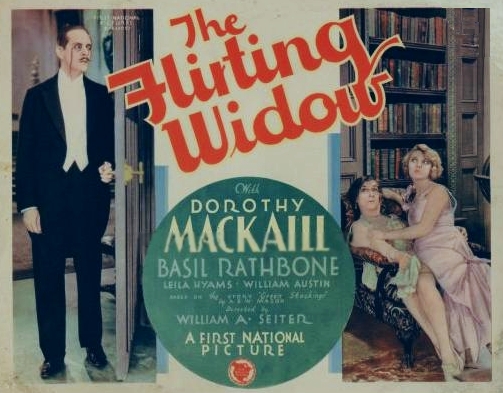
Celia Faraday (Dorothy Mackaill) has had it. She's 26 and unmarried, and her younger sister Evelyn (Leila Hyams) is trying to set her up with a marriage to the idiotic Raleigh Raleigh (William Austin). It seems their father Sir William Farady (Claude Gillingwater) will not permit Evelyn to marry until Celia is safely in wedded bliss. Celia had already been forced to be the green stocking when her other younger sister married, and Sir William will not see it happen again - it's too embarrassing (for him). Celia, on the other hand, could care less; she's not all that interested in marriage and doesn't care if her sisters want to have husbands. So, she makes up a fiance who's been shipped to India. But, when her sister steals and mails one of Celia's fake letters to her "beloved" Colonel John "Wabbles" Smith, the letter is delivered to the very puzzled Colonel John S. Smith (Basil Rathbone) in India, who determines to meet his unknown "lover". Thus begins The Flirting Widow (1930)
The beauty of this slight little film is the interplay between Basil Rathbone and Dorothy Mackaill. Until he arrives at her doorstep, the film is rather banal, but once they begin to interact, the chemistry is palpable. As always, Dorothy Mackaill is wonderful in the film; the addition of Rathbone gives her someone whom she can really bounce off. Added to that, he is quite dashing and amusing as the bemused fiance of a woman he's never actually met.
For a precode film, this one is rather tame. My colleague at Pre-code.com points out a scene in which a watch gets dropped down Celia's front (with the very interested Colonel Smith watching her retrieve it. You can see a photo of the scene on his website, above). There is also the character of Raleigh Raleigh - though not stated outright, the film hints that he is gay. Aunt Ida's drunk scene also might give later censors a bit of a shudder (this is, after all, still the era of prohibition. Sure, it's set in England, but when would that stop a censor?) But by and large, this is a subdued precode film, which just skirts around the borders of naughtiness.
We did find the character of Celia to be very interesting. She
has an almost masculine way about her when we first meet her - a severe slicked back hairstyle, a tie and sweater; but later, once she's not being harassed to marry, her clothing and hair are soft and more traditionally feminine. Much like the film Devotion, which we earlier discussed (and would be released the following year), this is a woman who is rather abused by a family that considers her to be more of a servant than a daughter or sister. But Celia is released from her servitude by her declaration of an engagement. Only as the appendage of a man (even a fictitious one) is she permitted the independence she craves.
In their review of the film, the New York Times also commented on the slight nature of the film. However, they too agreed that the chemistry between Rathbone and Mackaill was outstanding. Though not an earthshattering film, it's a pleasant enough way to spend 72 minutes, if only to see Dorothy Mackaill with an actor who is her equal.
 Four Jills in a Jeep (1944), based on a book by Carole Landis, tells the true story of the Ms. Landis, Kay Francis, Martha Raye and Mitzi Mayfair, as they venture from the safe confines of Los Angeles (where all four were deeply involved in the war efforts) to entertain the troops in the war zone - first in England and then in North Africa. Along the way, Carole and Mitzi find romance - and Martha dodges a smitten Sgt Eddie (Phil Silvers).