When Jennifer Stewart (Lucy Marlow) arrives at the home of her cousin, Eva Phillips (Joan Crawford), she discovers a mess of unhappiness. Eva's sister-in-law, Carol Lee (Betsy Palmer) despises Eva and is loathe to tell her about Carol Lee's engagement to Judson Prentis (John Ireland); Eva's husband, Avery is rarely sober, Eva's son Ted (Tim Hovey) has constant nightmares. Jennifer, however, is immediately enchanted with the affectionate Eva, and becomes her acolyte and defender. Little does she know Eva is not the woman she images; she is, in fact, the heartless Queen Bee (1955). We always enjoy Joan Crawford, and seeing her play the witch is generally a pleasure. But Queen Bee really taxes that pleasure button. Based on a novel by Edna Lee, the film is melodrama at its worst. The plot has holes in it a mile wide, and the characters are superficial, and annoying. Even Ms. Crawford suffers from the inconsistencies in a character that could have been a companion to Harriet Craig. Eva is uptight, controlling, and jealous, just like Harriet, but she is Harriet on steroids. Unlike Harriet, she is contradictory. On the one hand, she emotionally tortures her family endlessly. One the other hand, she falls into an inconsolable depression when a person she has just tormented beyond endurance dies. Once she recovers, she's back on the torture trail. She is, to quote Winston Churchill, "a riddle, wrapped in a mystery, inside an enigma." But she's not the only character that makes you throw up your hands
in despair. Let's look at her husband, Avery. When we meet Avery, he
snarls at Jennifer about the scar on his face. His family, even the
sister that loves him, calls him "Beauty" as a nickname! The scar and
the nickname are brought up the once, and then dropped. We know he got
the scar in an auto accident, but it is a throwaway reference. He's a
raging alcoholic (allegedly because he is married to Eva); he also is
fairly spineless. Even with the health and well-being of his children
are at stake, he is terrified of confronting his wife.
Which makes us question why Jennifer would fall in love with him. She despises him on first meeting, but within a hair's breath is madly in love (and for no good reason. The man is constantly inebriated and is verbally abusive to boot). But quite frankly, there's not much to like about Jennifer either. An orphan, she has come to the Phillips' home because Eva, who has been supporting Jennifer in Chicago, has invited her. Jennifer has had a good education, thanks to the financial munificence of the Phillips', but she doesn't seem to have made any effort to support herself by getting a job. At first enamored of Eva, she ultimately discovers her to be a monster. But still Jennifer stays.Why? Her affection for the children? This great love for Avery? Again, the film gives you no legitimate reason for her actions. In its review of the film, the New York Times talks about Ms. Marlow "gawk[ing] and quak[ing]." I hate to agree with Bosley Crowther, but he's right on this one.
As if all this is not enough, the film throws in the abusive Miss
Breen (Katherine Anderson), the stereotypical evil nanny (the character Bette Davis would play in The Nanny).
The character arrives when Eva suffers her nervous breakdown, then
stays on to emotionally and physically torment the children. Miss Breen
serves a point - she provides Eva with a source of blackmail at the end
of the film, but quite frankly, Eva could have gotten her blackmail
information without Miss Breen's annoying presence. All Miss Breen
contributes is to make Avery, in his one moment of rebellion, again look
like a weakling.
It is nice to see Fay Wray (Sue McKinnon) in the film, even if it is
only for about 5 minutes. But, the presence of her character is, again, rather
pointless (she's a rather dotty lady who was emotionally damaged when
Eva stole Avery from her. She doesn't know how lucky she was!)
According to this TCM article,
Ms. Wray announced her return to film (she had retired when she married
Robert Riskin, to care for her child from her prior marriage and to her
two children with Mr. Riskin) after her husband's death in 1955. Ms.
Crawford not only sent her a note saying "Welcome...we need you", she
arranged for her to be cast in the part of Sue. It's a thankless role,
but Ms. Wray is excellent in this little snippet. While not her first
post-retirement role, it was certainly not her last. She would continue
to act in both film and television until her final retirement in 1980.
She would marry again, in 1971; she and Dr. Sanford Rothenberg were
together until his death in 1991; Ms. Wray died in 2004, aged 96. Oh, yes, and then there is the supernatural element of young Ted, and his dreams of a horrific car crash, which, by the conclusion of the film, we discover has a supernatural element to it (the abusive nanny wasn't enough of a leap into the macabre). This AFI Catalog entry notes that the film received Oscar nominations for black and white cinematography and for costume design (it lost to The Rose Tattoo and I'll Cry Tomorrow, respectively). The film also changed the ending of the book, possibly to provide what they considered a happy ending. But nothing is all that happy about this film, and it did Ms. Crawford no good service. So, unless you hunger for the complete Crawford, avoid this one. We'll leave you with this clip in which Ms. Crawford is matchmaking for Ms. Marlow:
The fishing town of Monterey, California is the setting of Clash by Night (1952), a film noir that features Barbara Stanwyck as Mae Doyle. Mae's been living in New York, the mistress of a wealthy married man. Though they were deeply in love, he was unable to divorce, and when he died, the small settlement he left her was taken back by her lover's family. Broke and depressed, May returns to her childhood home, now occupied by her brother Joe (Keith Andes). Mae's beauty and strength of character attracts a gentle fisherman Jerry D'Amato (Paul Douglas), as well as his friend, the cynical and callous Earl Pfeiffer (Robert Ryan). Though frightened of marriage, Mae decides that Jerry might be her salvation, even though she is dangerously attracted to Earl. Clash by Night is very intense film, and as such, it is hard to actually LIKE it. We have characters we can understand, but many of whom are terribly hard to admire. Stanwyck's Mae Doyle is at the top of the list. She was born in Monterey, but left because she hated it there. Now she's back, but she still hates the place. Why does she return? Wasn't there somewhere else she could go? And strong as she is, was it so impossible to stick it out in New York City, where it seemed she was happy? Stanwyck, in a sense, creates a character that is a cypher. We never really know Mae, a woman who wants to be happy, but can't seem to find real contentment. Her marriage to Jerry seems an act of desperation. And though she loves her child, her sorrow and pain after her daughter's birth hint at the least of post-partum depression- or perhaps we are just looking for an excuse for her misery.
Jerry, as played by Paul Douglas is a sympathetic character, but also a weak, and sometimes pathetic,man. His love for Mae is genuine. He is a good and loving father to their daughter, Gloria, but he is manipulated by everyone. Earl, who is supposedly his friend, ridicules him. His Uncle Vince (J. Carrol Naish) uses him as a source of money, and as a tool for vengeance on Mae (Uncle Vince's predilection for pornographic poster art, and his constant "requests" for money put Mae in the position of asking her husband to get Vince out of the house. You can't blame her for that). And Mae, who cares for him but has no love for him, consents to marry him - with his knowledge that there is no love - in order to have a caretaker and provider. So, while you feel for Jerry, it's difficult to like him, he is such a patsy.
Robert
Ryan, who played the part of Joe (Mae's brother) in the original
Broadway cast of the play, was the only cast member to appear in the
movie (the play featured Tallulah Bankhead as Mae and Lee J. Cobb as
Jerry). Ryan, as Earl, gives us a portrait of a man who is a lost
soul. Too intelligent for his job as a movie projectionist but too
unambitious to do anything else, Earl spends his life drinking too much
and ridiculing everyone and everything around him. Mae, who is
initially repulsed by Earl's negativity, finally responds both to his
sexuality and to his intellect. But in the final analysis, Earl is not
someone who can even take care of himself, much less a wife and child.
Should Mae leave with him, we wondered how long it would be before he
abandoned her and the child for which he has no regard or affection.
Perhaps the most attractive characters in the story are Joe and Peggy
(Marilyn Monroe). Peggy deeply loves Joe - and he loves her - but she
is no victim. Their love ultimately is one of equals, and will succeed
because of their commitment to one another. Ms. Monroe was really
breaking through in this small, but pivotal role. And while her
relationship with Stanwyck was cordial, the seeds of her later problems
had already begun. According to this TCM article,
director Fritz Lang was frustrated by her lateness and inability to
remember her lines. Stanwyck, however, never lost her cool, and would
do repeated takes when Monroe forgot her lines. Ultimately, Stanwyck
would comment, after Monroe's death that Monroe "drove Bob Ryan, Paul
Douglas, and myself out of our minds." However, "she didn't do it
viciously, and there was a sort of magic about her which we all
recognized at once."
The film, not surprisingly, changed a great deal of the play (by Clifford Odets). The setting is changed from Depression-era Staten Island, New York (which, of course, makes Mae's return far less drastic). And the endings of the play and film are far different (no spoilers, should you want more information take a look at this article in the AFI Catalog). Joan Crawford, Jeff Chandler, and Mala Powers were considered at one point for the parts of Mae, Earl and Peggy, all interesting choices. Regardless, without Stanwyck's powerful and layered performance, this film would likely have fallen apart (this New York Timesreview comments on the strength of the performances in a film that they don't necessarily think holds together).
As we've said before, any Stanwyck movie is worth a look, and this certainly is, not only for her, but also for strong performances from Robert Ryan and Paul Douglas. And the opportunity to see Marilyn Monroe before she became a love goddess is a treat. We will leave you with this clip from the film, in which Mae returns to her brother's home, and meets the woman he wants to marry.
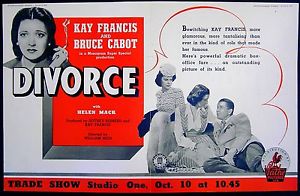
The "horror" of Divorce (1945) is the topic of this film, which stars Kay Francis as Dianne Carter, a four-time divorcee who has just shed her latest husband, gaining both her freedom and a pot of money. Following the divorce, Dianne decides to return to her home town for a brief visit. When she arrives, she reconnects with her former boyfriend, Bob Phillips (Bruce Cabot), now a real estate professional, happily married to Martha (Helen Mack) and the father of two sons. But happiness is a relative term; once Dianne sets her cap for Bob, the marriage is doomed, and Martha has little recourse but to seek a divorce and try to start her life over. Kay Francis starred in and produced this, the first of three pictures with Monograph Studios. Her contract with Warner Brothers was over, as was her work during World War II, and it seems that the idea of having more control over her films held some attraction (TCM article). Like the film, Allotment Wives, this picture uses a growing social issue to attract an audience. As the War ended, the number of divorces began to grow dramatically (see this article from the Washington Post), probably a result of the hasty marriages made during the war. Regardless of the actual reasons for the rapid increase, the film looks at divorce as an evil, with the character of Dianne as a predatory homewrecker. And while the plot is a bit simplistic, and some of the characters not entirely fleshed out, it does a decent job of setting a tone.
Though low budget, the film does recruit some strong actors, most notably Ms. Francis, whose performance gives a depth to the character of Dianne. The other excellent performance is that of Helen Mack. Her Martha is not a whimpering wife - Ms. Mack gives her a strength and pride that is not usual for the "loving wife" that she is being asked to play. Within the context of the divorce, she juxtaposes nicely with Dianne, who has built her finances with the settlements from her multiple marriages. Martha, on the other hand, refuses all monies from her husband, even child support - If Bob can not be an actual support for their children, she will work and support them both emotionally and financially. Her refusal to depend upon him both empowers her, and emasculates him.
Bruce Cabot, on the other hand, is a football, passed back and forth between the two women (interestingly symbolized by a football game early in the film, whichMartha attempts with her two boys). Cabot's Bob is almost passive - first guided by his wife, then abruptly manipulated by his former girlfriend. That passivity makes it easy to understand why Dianne would even want him. He's quite a talented real-estate agent - Dianne sees both money and control in any relationship with him. According to the AFI catalog, Cabot was not the first choice for the role - it was originally earmarked for Paul Kelly (who would appear with Ms. Francis later that year in Allotment Wives).
The presence of Jerome Cowan, playing lawyer Jim Driscoll, is another added pleasure. We recently saw Mr. Cowan as the lecherous neighbor in My Reputation; his part here is not all that much bigger, but considerably more sympathetic. A character actor who brings veritas to any role that he plays, Mr. Cowan appeared on Broadway beginning in 1923, and would continue appearing on stage until 1959 (his final stage appearance was in Say, Darling). His work on Broadway led to his casting in Beloved Enemy (1936), starring Brian Aherne and Merle Oberon (Mr. Cowan took on the role of the villain of the piece). He worked continuously from then on - probably his most noted performance is that of Miles Archer in The Maltese Falcon (1941), but he was also excellent as one of Bette Davis' suitors in Mr. Skeffington (1944) and as the harried district attorney Thomas Mara in Miracle on 34th Street (1947). As the age of television began, he deftly moved into the medium, appearing as a guest star in such shows as The Twilight Zone, Perry Mason, and Bonanza. His final appearance was on an episode of Alias Smith and Jones in 1971. He died in January of 1972, survived by his two children and his wife of 43 year, Helen Dodge.
One other appearance worth noting is that of Larry Olsen, as Michael Phillips, the older of the two boys so devastated by their parents divorce. Mr. Olsen had a decent career as a child actor, but is bet remembered today as the older brother of Susan Olsen (of Brady Bunch fame). We will return again with another film from one of our favorite actresses.
Joan Gordon (Barbara Stanwyck) has hopes of a better life - a torch singer in a New York City speakeasy, she is engaged to the wealthy Don Leslie (Hardie Albright), much to the regret of her lover, Eddie Fields (Lyle Talbot). Alas, the engagement is quickly broken; when Don discovers her past relationship with Eddie, he dumps her, and Joan, who is not willing to resume her affair with Eddie runs away to Montreal. Eddie, however, is determined bring her back. His men find out she is working there; when she realizes that another confrontation is at hand, she bribes her maid, Emily (Leila Bennett) to let Joan serve as Emily's replacement - as a mail order bride in North Dakota. There, she meets James Gilson (George Brent), a taciturn farmer with little knowledge of women or of conversation in general. The result: a horror of a wedding night, and a married couple who are at odds with one another. Thus begins The Purchase Price (1932).
This film pointed out to us the benefits of rewatching a movie together after a long gap. We originally discussed The Purchase Price back in 2009, shortly after the film came out on DVD via the Forbidden Hollywood collection. For all of us, it was our first time viewing the film (You can see that post here). As we were discussing the film, we referred back to our earlier comments, and discovered that much of what we originally said had changed, most especially our reactions to the two male leads, Jim and Eddie. We initially found the character of Jim to be a bit creepy; his almost violent attack of Joan on their wedding night was most off-putting, and it resulted in our really disliking him from that point forward. But on closer examination, we began to like him a bit more. He has the potential to be a great husband, but his uncommunicative behavior and his total lack of grace is still a bit disconcerting. He hasn't got a clue on how to behave with a woman, for one thing. Sure, he advertised for a bride, but manhandling a strange woman almost immediately in no way to win affection. But, when Joan reacts and hits him, he does NOT hit back or force himself on her further. He leaves the room and does not come back uninvited. He even suggests that they begin divorce proceedings so she can get on with her life. Ultimately, Jim's character grows and changes, to try to become a better man for her.
Eddie, on the other hand, will not take no for an answer. Essentially, he is a stalker, constantly pursuing Joan, even when she's told him that the life he offers is not the one that she wants. He's married, and cannot marry her. He does seem to love her, in his own way, and ultimately proves helpful to her, but his ego seems to be such that he cannot let her quietly exit his life. We also wondered if Joan is, for Eddie, the only decent person in his life, and the only person who provides him with the appearance of class, another reason why he might not wish to just find another woman - he knows he'll never find anyone as good. The town in North Dakota, as portrayed here, seems more like hillbilly country than the northern U.S. But where so many of the male characters that live here (like Bull McDowell, as portrayed by David Landau - a letch if ever there was one) are distasteful, the few women we see are rather nice, especially Mrs. Tipton (Adele Watson) and her daughter Sarah (Anne Shirley). Joan visits them when she discovers that Mrs. Tipton has had her new baby alone (except for the presence of her very young - and very frightened daughter). Ms. Shirley - uncredited here, had been working in films since the age of four (under the name Dawn O'Day). She was 14 when she appeared in The Purchase Price (and had previously played Ms. Stanwyck as a child in So Big, released the same year, and, as I was recently reminded, would later play Ms. Stanwyck's daughter in Stella Dallas) She is quite sweet in this very small part, and is worth looking for.
Don, the man that dumps Joan, is only in one scene, but it is a terrific one. Director William Wellman takes full advantage of sound to portray the sorrow and hypocrisy of the event. As Don scolds and rejects Joan for being involved with a bootlegger (a bootlegger he utilizes), the hotel lobby in which they sit becomes silent - the nosy inhabitants of the hotel all hush to listen to their conversation. Even the street outside is silent. But, as Don exits in a huff and Joan sits there in abject misery, conversations begin again, and a garbage truck drives up the block. It's an impressively done moment. Stanwyck again does her own stunts, most notably in the fire scene at the end of the film, resulting in some minor injuries. Her relationship with her director was very friendly, and Mr. Wellman is quoted as saying "On
one of Miss Stanwyck's interviews she mentioned me as one of her
favorite directors and ended with 'I love that man.' Needless to say I
was very proud and had a lump in my throat which does not happen to me
very often. Barbara Stanwyck -- 'I love that girl.'" (see this TCM article) Naturally, the New York Times review did not like the film (we seem to say that a lot), but in this case, we think the reviewer is quite wrong. This is a good film, with strong performances from Stanwyck, of course, and also from George Brent and Lyle Talbot. We will leave you with this clip in which Ms. Stanwyck herself sings:
Almost immediately, The Moonlighter (1953) defines its title - a moonlighter is a cattle rustler who works by moonight - a skill, no doubt, since it is hard to rope what you can't see. Wes Anderson (Fred MacMurray) has been arrested for said offense, and the local townfolk are looking forward to a hanging. Ranch owner Alex Prince (Morris Ankrum) and his strawboss (Jack Elam) decide to take the law into their own hands; they break into the jail, and hang the man in cell three. Only, unbeknownst to them, it's the wrong man. The resulting celebration gives Wes and his cellmates the opportunity to beat it out of town. Wes spends a few months revenging himself on the murderers, then returns to his home town - to his mother (Myra Marsh), brother Tom (William Ching), and to Rela (Barbara Stanwyck), the love of his life, who is now engaged to brother Tom. Needless to say, Wes is not a happy man. So, when his friend Cole Gardner (Ward Bond) shows up, he decides the life of crime really is the one for him. It's great to see Barbara Stanwyck and Fred MacMurray back together again. This was the third of their four films together (we've already discussed Remember the Night (1940), Double Indemnity (1944), and There's Always Tomorrow (1956)). Their chemistry together remains excellent, and Mr. MacMurray was vocal in his affection for his co-star. This TCM article quotes Mr. MacMurray: "I was lucky enough to make four pictures with Barbara. In the first I turned her in, in the second I killed her, in the third I left her for another woman, and in the fourth I pushed her over a waterfall. The one thing all these pictures had in common was that I fell in love with Barbara Stanwyck -- and I did, too!" But this film doesn't really do that chemistry a whole lot of justice.
First off, we don't even see Ms. Stanwyck until nearly half-way into the film. Secondly, the film doesn't feel like a full unit - it feels like a bunch of little plots all loosely linked together. The beginning, wherein Wes is almost lynched, seems to be a short piece that has nothing to do with the later plot of Wes robbing a bank. Plus, much of it makes no sense - why does the upstanding Tom decide to become a thief (especially when he knows Rela despises Tom for his larcenous ways)? Why does Wes resort to bank robbery, when he is so good with cattle (well, we think he is. We never really see him stealing any cattle. We do see him roping a few men, and he is quite good at that)? And WHY do three bank robbers make absolutely no attempt to hide who they are from their victims? It's bank robbery by the Keystone Kops! There is another major problem with this film, and I shudder to say it - the leads are ALL too old for the parts. MacMurray is 45; Stanwyck is 46, and William Ching is 40. The male characters act like teenagers - totally unable to cope with real life, and rebelling like mad. It's bad enough that one man in his 40s is so immature, but TWO? While Stanwyck is the right age for both MacMurray and Ching (and I applaud director Roy Rowland and producer Joseph Bernhart for selecting a mature woman to act alongside these two actors), Rela isjust too smart and too mature to get involved with these total losers. There was discussion at one point of having Jennifer Jones and Alan Ladd or Kirk Douglas star (AFI Catalog). Though somewhat younger, they still would have been wrong.
For some reason, though filmed in black and white, the film was shot in 3-D (naturally, we saw a 2-D television version). And though it clocks in at 77 minutes, it has an intermission! In this New York Timesreview, the reviewer is just as confused as the utility of the 3-D process in the film: it "merely pulls a few cliffs, trees and modest panoramas into clearer focus". They could have done as much with without making the audience wear funny glasses.
So, while we wish we could recommend this one, we really can't. For Stanwyck fans, give it a go (because she is great. She is always great. Ultimately any Stanwyck film is worth seeing at least once), but put it low on the list. Next week, we'll revisit a Stanwyck pre-code film that we originally discussed several years ago.
We'll leave you with a short clip of Mr. MacMurray in danger:
It's 1942. Jessica Drummond (Barbara Stanwyck) has just buried her husband Paul, who died after a long illness. He has left her financially secure - enough money to live comfortably and send their two sons, Kim (Scotty Beckett) and Keith (Bobby Cooper) to the boarding school Paul attended in his youth. But with widowhood, Jessica finds that life in her suburban town is much different than she expected. She is hounded by her mother, Mary Kimball (Lucile Watson) about proper behavior and finding a new husband (preferably Frank Everett (Warner Anderson) the family lawyer), is pursued by George Van Orman (Jerome Cowan), a would-be philanderer, and she finds she now that she is no longer part of a couple, she has no no real company except her maid, Anna (Esther Dale). So, when her friends Ginna (Eve Arden) and Cary Abbott (John Ridgely) invite her on a skiing tip, she desperately accepts. It is there that she meets Major Scott Landis (George Brent), an officer awaiting permanent assignment abroad. The two are quickly attracted to one another, but while Scott seems more interested in a fling, Jessica has commitment on her mind. Will the two be able to cross the abyss to create a lasting relationship? Thus begins My Reputation (1946). Our entire group was very impressed with this film. Yes, it has some of the tropes of a woman's film - the letchy married man, who thinks widows are fair game; the overbearing mother; the gossipy neighbors; the man who is "not the marrying kind" - but in many cases, the film upsets some of those tropes. As a result, you watch with engagement. It's not always apparent where the film is going to go next. As always, Stanwyck is magnificent in a part that requires a lot of character growth (this TCM article is especially enthusiastic about her contributions to the film). While it can be hard to imagine her as someone mother-pecked, she does it successfully. Her frustration with her mother, and her initial inability to adapt to the world without her husband are not only convincing, they are spot-on. We like her for her maternal instincts - to let her boys go away to school, as they and their father wanted. But we ache for her loneliness, and her desire to just ask them to stay with her, if only for a little while.
The boys at first might seem a bit selfish. But it is evident that Keith, the older of the two boys, is sensitive to the proprieties and to his mother's needs.
He tries to guide his younger brother, Kim. But for Kim, the loss of his father has not yet hit home. The action of the film opens the day after the funeral. We know that Paul's death was far from sudden (we later find out he was in tremendous pain - assumedly cancer). We can assume that not only were the boys aware that their father was dying, but that for several days, they've had to be on best behavior, and put up with adult funeral behavior (how many "I'm so sorry for your loss" can a child take?) Though they love their mother, and want to be with her, they also want to break out. The early desire to attend a baseball game not only allows them to become free of the funeral responsibilities, it provides a means to memorialize their father, who always took them to the game. And Jessica understands and tries to allow them to begin the process of life over again. There's no surprise when George is revealed to be a cad, or when or
when Riette (Leona Maricle) is shown to be a harpy. But, one is
surprised when Mrs. Kimble turns out to be right about the town and the proprieties of mourning. We want Jessica to be
the one who is correct, but ultimately, it is her mother who has her
finger on the pulse of the community. A little calculation
demonstrated that Jessica was a bit younger than her youngest son when
Mr. Kimble died (her mother has been a widow for 25 years), and Mrs.
Kimble has had to cope with life alone since then. She wants her
daughter to remarry (with her approval, of course), and she is a
stickler for the conventions of mourning. That she still wears black
seems excessive; but Mrs. Kimble understands the responsibilities of
being a widow raising children alone, and she wants more for her
daughter. We root for Jessica to find independence; but the film shows
us that it comes with a price.
George Brent treads a careful path with the character of Scott. It would have been easy to make him either heroic or caddish - Brent makes sure he is neither. As a man who never imagined himself within a family, he needs to grow and mature. Though released in 1946, the film is carefully situated in the early years of the Second World War. Scott is well aware that he will be going to fight. His reluctance to take on the burden of a wife and family (that could be left alone) is understandable, as is his desire to spend time with Jessica, even if it means she will be away from her children. But it also marks his innate selfishness, a trait that needs to change if he is to ever be a part of Jessica's life. This was Mr. Brent's final film with Warner Brothers (AFI Catalog); the same year, he would portray Professor Warren in RKO's The Spiral Staircase. We wish there had been more of Eve Arden, who is a delight in everything she does. Every moment with her is a gift - she plays Ginna as wry and amusing, but supportive to Jessica, and to her husband, with whom she has an easy-going and loving relationship. With a career that began in 1937, and continued until 1987 (she died three years later, age 82), Ms. Arden spent much of her career playing the best friend (Mildred Pierce, for example), who knows the world WAY too well. She segued from radio into television with Our Miss Brooks, where she got to play the lead as the smart and assertive Connie Brooks, a high-school English teacher (she also played Connie in the movie of the same name). Married twice, with three children, Ms. Arden survived her husband of 32 years. Her final appearance on television, in Falcon Crest, was with her dear friend, Jane Wyman.
The film features excellent performances by a
number of child actors, notably Scott Beckett and Bobby Cooper, who play
the Drummond brothers as good kids who are trying to cope with a new
way of living. Janice Wilson, who we last saw in The Strange Love of Martha Ivers
plays Penny Boardman, a neighbor who is very attracted to Keith, and
Ann E. Todd plays Gretchen van Orman, the daughter of the rather nasty
Riette and George. Bosley Crowther, in his New York Times review, is being very cranky, we think, when he says the film is "much ado about nothing—or practically nothing." We disagree and suggest you give it a viewing. This trailer will give you a taste.
Allotment Wives (1945
aka Woman in the Case) opens with an announcement that the film is based on an actual wartime problem - women who would marry soldiers solely for the purposes of collecting their allotment checks. Colonel Pete Martin (Paul Kelly) is assigned the task of finding the women who are perpetrating this fraud. His investigation leads him to a service canteen, organized by Mrs. Sheila Seymour (Kay Francis), a wealthy society woman, who, unbeknownst to Pete, is the head of an organization that recruits young women to gull soldiers into marriage - often taking on three or four "husbands". She is assisted by Whitey Colton (Otto Kruger), her friend and confidant. Sheila, a strong woman who has a firm control on her operation,, has a weakness - her daughter Connie Seymour (Teala Loring), who Sheila has carefully stashed away in a boarding school, primarily to keep her away from "the business". Or so Sheila thinks. In truth, Connie is out on the town, spending her days finding men and drinking. Sheila also has another problem - Gladys Smith (Gertrude Michael), who knew Sheila when both were in reform school, and wants payment to keep quiet about it.
Let's start by saying, this is not a great movie. Unlike my colleague at Kay Francis on Film, this is not a film we would consider essential Kay Francis viewing. Were it not for the fact that it was her last appearance on the silver screen, we doubt it would be remembered at all. It's not that Ms. Francis isn't good, she is. But she doesn't have a whole lot to work with. Made at the Poverty Row Monograph Studios and originally titledAllotment Wives, Inc. (AFI catalog), filmed in 10 days, and with a script that required Ms. Francis (who was also a producer) to do some major editing, the inferior production values tend to diminish the viewer experience. The New York Times wasn't impressed either - their short review was not laudatory.
The benefit, however, at working in Poverty Row was that the censors didn't seem to care as much about what got through (see this TCM article). There's quite a bit of risque plot - not the least of which is the idea of one woman being married to several men. There's the relationship between Whitey and Sheila - it seems very apparent that they are lovers. And finally, the fact that a woman could unquestioningly lead this group of men. Even when Sheila is compromised, there is no question that she is still in charge.
Pete Martin, as played by Paul Kelly, really comes across as a passive character. It's only by chance that he discovers that Sheila is the ringleader (and he knows about the marriage ring because he's told where to go. There's no great detecting on his part). He never even finds the secret back room in the beauty parlor (we all loved that hidden room). Mr. Kelly is overpowered by the strong performances of Ms. Francis and Mr. Kruger. You end up rooting for them, not for him.
Paul Kelly had a fairly lengthy career, despite the fact that it was interrupted by his death in 1956, at the age of 57, and a 25 month stint in San Quentin for manslaughter. Kelly had an extensive career in silent films when a fight with Ray Raymond (both men were drunk) in 1927 over Kelly's affair with Raymond's wife (Dorothy Mackaye) resulted in Raymond's death from a brain hemorrhage. (See our review of Ladies They Talk About for more on the story). When he was released from prison, Kelly resumed his career, now appearing in talkies - often as a heavy. He also returned to a career on Broadway (he had appeared in 13 plays before his incarceration), appearing in 9 productions from 1930 through 1950. He was nominated for a Tony for his appearance in Command Decision (in the role Clark Gable would assume in the film version), and appeared in the role that would earn Bing Crosby a best actor nomination for the film version of The Country Girl. After Mackaye's death in 1940 (in an automobile accident), Kelly remarried. He worked in film, stage, and television until his death of a heart attack.
Otto
Kruger is very good in the film, and plays the character of Whitey as a gentleman, not a thug. With a name like Whitey, one expects a low-life, but Kruger gives us a man of sophistication and class, which makes the character more appealing than perhaps he should be. At the very least, it helps us to understand the relationship between Whitey and Sheila.
Mr. Kruger began his career on the Broadway stage; from 1915 to 1949, he appeared in 32 plays, including the part of Waldo Lydecker in Laura. Beginning in 1915, he appeared in a few silents, but his career on film bloomed with talkies, which is not hard to understand, given his lovely speaking voice. He primarily played heavies (as in Saboteur (1942). But on occasion, he got to play a secondary role as a nice guy - Chained (1934), in which he is Joan Crawford's kindly - but older - husband and Cover Girl (1944) where he plays Rita Hayworth's enamored - but older - suitor. By 1949, he had started to appear on television (he also had a fairly substantive career on radio) and would continue working between film and TV until his retirement in 1964. Married in 1919 to Susan MacManamy (they had one daugher, Ottilie), they were together until his death at age 89 in 1974.
So, while not a totally awful film, its not great. And while Ms. Francis tries her best to give a performance worthy of her talent, she's really not got enough to work with. If you want to cover her oeuvre, by all means, give it a try. Otherwise, stick to Confession (to see her suffer) or In Name Only (if you want to see her sink her teeth into a really great villain role). We'll have more Kay in the future, but next time, join us for a Barbara Stanwyck film.
In The Woman in Red (1935), Shelby Barrett (Barbara Stanwyck) works as a horse trainer and competitive rider. Currently in the employ of the wealthy Nico Nicholas (Genevieve Tobin), Shelby finds her life becoming complicated when she attracts the attention of Johnny Wyatt (Gene Raymond) and Eugene Fairchild (John Eldredge). Johnny, the son of an upper class (but cash poor) family, sponges off of rich friends (like Nico) and plays polo. Gene, on the other hand, is a self-made man who rides his own horses in competition, and gracefully loses to Shelby. Both men are smitten with her, but ultimately, Shelby chooses the more difficult life, falling in love with Johnny. The pair have to deal with unemployment, family ridicule, Nico's jealousy, and Gene's continuing interest in Shelby. Perhaps the most interesting aspect of the film is the portrayal of the lead male characters. One expects a rivalry between Johnny and Gene, as well as resentment of the very capable Shelby. But surprisingly, there is little of that. Both men revel in Shelby's intelligence and independence. And, because the film does not live up to those negative expectations, the viewer is drawn in. The film is a constant surprise. The poster art (above) is notable for giving a totally wrong view of the character of Shelby. There is no red dress like the one pictured above. The title comes from a red COAT that Shelby wears while on a boating trip. The poster portrays Shelby as a temptress, but that's not the way Stanwyck plays her. Her Shelby is businesswoman, and is passionate about her chosen career and her friends. Though the film was not really all that well received (see this New York Timesreview), you cannot find any fault with Ms. Stanwyck's portrayal. She never
phones in her performance and is able to give any part she plays gravitas. Given that, following a riding accident she was afraid of horses, she looks remarkably comfortable in the riding sequences (A Life of Barbara Stanwyck: Steel-True 1907-1940).
John Eldredge plays a very different character than the one we saw in His Brother's Wife, and he is quite good and likeable. He's not a wimp here. He's a strong, intelligent and not easily cowed man.
Genevieve Tobin also gets a very different role than the one she played in Snowed Under. Quite frankly, her Nico is a piece of work - wealthy, spoiled, nasty, and vindictive. A gossip of the first order, she is determined to undermine the relationship of Shelby and Johnny by whatever means available. Ms. Tobin gives Nico an unattractive edge - a spoiled brat with too much money and too much time on her hands. Genevieve Tobin made a few films during the silent era (notably as Little Eva in a short of Uncle Tom's Cabin in 1910 - she was 11 years old), but primarily she was working on Broadway, appearing in 12 plays from 1912 to 1930). With the advent of sound, she found some success, mostly as second leads. But, in 1938, she retired, having recently married director William Keighley. They were married until his death in 1984; Ms. Tobin died at the age of 95 in 1995. Dorothy Tree played the pivotal role of Olga Goodyear; she has one major scene in which she is completely inebriated. She too got her start on Broadway (she appeared in 6 plays between 1927 and 1936); her introduction in sound films was as one of Dracula's brides in the 1931 Dracula (she appeared in both the English and Spanish versions of the film). She mostly appeared in small roles (for example, Martha Rockne in Knute Rockne, All American). She married screenwriter Michael Uris, had one child, and continued working in films until 1951, when she and her husband were blacklisted. Using her married name, she started a new career as a speech, voice, and acting coach. She also wrote on the topic - her last book was published in 1979. Her husband died in 1967; Ms Tree lived to the age of 85 (she died in 1992).
The film was based on a novel, North Shore, but Jack Warner didn't like the title. After several suggestions, The Woman in Red was selected. It had been purchased as a starring vehicle for Bette Davis, but was turned over to Ms. Stanwyck (see this TCM article). Both Joel McCray and Robert
Young were considered for the part of Johnny, and Ricardo Cortez for the first choice for Gene (AFI Catalog). With this film, Ms. Stanwyck ended her contract with Warner Brothers. She would never sign another long-term contract with a studio again (perhaps the reason she never won a competitive Academy Award!). We'll leave you with this trailer. Perhaps it is not the best film in the Stanwyck catalog, but it is worth a look. We'll return soon.
In Man Wanted (1932), Kay Francis plays Lois Ames, a successful publisher who has taken over her late father's company. As she toils by day, her husband, Fred (Kenneth Thomson) plays polo and essentially lives off her earnings. When Lois' secretary (Elizabeth Patterson) quits in a huff, Thomas Sheridan (David Manners), a salesman, offers to step in temporarily. Tom, however, proves to be efficient and capable; as a result, Lois advances him within the company. But complications ensue when Tom finds himself falling in love with Lois, much to the annoyance of Tom's fiance, Ruth Holman (Una Merkel). Take your mind back to movies of the 1930s and 1940s. Think of the women in these movies - by and large, they are subservient to men in some way; those that are not sacrifice their autonomy by the end of the movie, or are punished in some way. Not this one. As my colleague at Precode.com, says, this is a movie where "our heroine [is] not punished for being devoted to her job, and she’s damned good at it." And it is rather amazing to watch. Kay Francis' Lois is tough, smart, and fair. She loves her work, and enjoys working with people who also enjoy their jobs. Her relationship with Tom Sheridan grows BECAUSE they are so good at what they do, and are so committed to it. It IS hard to believe that Lois could really be in love with Fred. He's such a lazy and lackadaisical man. He does nothing except play polo, and doesn't seem to mind doing nothing - he's perfectly satisfied with living off Lois' money. He's also perfectly satisfied with cheating on her with Ann Le Maire (Claire Dodd). One particularly interesting scene focuses on Lois' discovery of Fred's relationship - she tosses a hotel room key at him, letting him know she is aware of his infidelity. Ms. Francis is magnificent in her quiet disgust. This was Ms. Francis' first film for Warner Brothers (see this AFI Catalog article), and she does an excellent job.
David Manners gives a the character of Tom real force and dignity. The film is careful to position Tom so he is Lois' equal in everything but job title. He is as smart and as ambitious as she is. His love for her is also dignified. When he believes that any pursuit of Lois would be rejected - she has openly affirmed her love for her husband - he begins to bow out of her life as quietly as possible. There are no scenes, no impassioned pleas for her affection. His only indignity, perhaps, is in settling for the very annoying Ruth. Una Merkel does a good job of making you want to throttle Ruth, if only to get her to shut up. Mr. Manners began his film career in 1929; within a year, he appeared as the romantic lead in the 1930 version of Kismet. We've already seen him in two other films: Torch Singer (1933) and The Miracle Woman (1931). Regardless of his quick advancement in Hollywood, by 1936 he left for Broadway (where he appeared in three plays) and to pursue other interests, such as painting and writing. He would eventually settle in California, with his life-partner, Bill Mercer (they were together until Mercer's death in 1978). Mr. Manners died in 1998, at the age of 98.
Elizabeth
Patterson has a small role as Lois' first secretary, Miss Harper. In one scene, we see her literally lounging at a desk, with her feet up. When Lois tells her they will be remaining in the office to complete some work, Miss Harper refuses, and then asks should she return in the morning. Essentially, she quits a well paying job. Given that the film was released in the middle of the Depression, we wondered if a woman with steady employment would really quit, or refuse to work late, knowing it will be the end of her job (and whether audiences would accept her choice)? Regardless, Elizabeth Patterson is, as always, excellent as the secretary with attitude. Ms. Patterson worked in film and in television from 1926 to 1961. She also appeared on Broadway in 26 plays (between 1913-1954), and was appeared frequently in the television series I Love Lucy. Ms. Patterson never married, and died at the age of 91 of pneumonia. Of course, Ms. Francis has magnificent clothing - but much of it is tailored for a working woman (but still exquisite). Her gowns were credited to Earl Luick. And Lois' beautiful office was designed by Anton Grot. We'll leave you with the trailer to the film. You will also see Andy Devine in the role of Tom's friend Andy Doyle. Join us again next week.