The very married Martin Cortland (Robert Benchley) has his eye on chorus girl Sheila Winthrop (Rita Hayworth); he's decided to entice her into his bed with a diamond bracelet. Sheila is having none of it and refuses the gift. That evening, Julia Cortland (Frieda Inescort) finds the bracelet in her husband's pocket (engraved "To Sheila") she informs her husband that she is sick of his philandering and has instituting divorce proceedings. To prevent this (as Martin's finances are all in Julia's name), Martin claims that the bracelet was a gift from his choreographer Robert Curtis (Fred Astaire) to Sheila as an engagement present, which drives Robert into the army. Today, we'll be discussing You'll Never Get Rich (1941) As with You Were Never Lovelier, You'll Never Get Rich is more about the dancing than the plot, and thank heaven the dance numbers are so spectacular, or no one would ever watch this film. Fred Astaire and Rita Hayworth have exceptional rapport in all their interactions, but it's not always enough to make up for a rather ridiculous and very padded script. Much of the humor is supposed to come from Robert Benchley. In total honesty, none of us are fans - by and large, he is an annoyance; in this film, his annoyance factor is redoubled. Why Robert would even associate with this man is beyond comprehension. Martin is a liar and a cheat; he is constantly unfaithful and downright nasty to his wife; and verges on sexually abuse in his pursuit of women. We didn't understand why Julia would stay with him, but she has the excuse of a marriage contract. Robert does not seem to have any tie to Martin. You would think he would run for the hills.
When he does run, it's not from Martin, but from Sheila (Martin has told Julia and Sheila that Robert is in love with Sheila and wants to marry her). He ends up in the Army. Fred Astaire makes a most unlikely soldier. Never mind the fact that he is underweight (in one of the somewhat humorous incidents, he puts a five pound weight in his hat so he passes the physical), he's also too old to be in the draft. Once in the service - which he worked so hard to achieve - he is constantly disobedient. He even puts on an officer's uniform - a court martial offense that the film treats as a lark. Released on September 25, 1941, just before the outbreak of the Second World War, the Army that
Robert enters is a peacetime one (the draft had been reinstated in
1940). In a scant 42 days, these funny soldiers will be going off to
possibly die in Europe and in the Pacific. In retrospect, the prospects
for these men is not particularly comical. it's unlikely this film would have passed muster after December 7th.
Add Osa Massen (Sonya) and Cliff Nazarro (Swivel Tongue) to Mr. Benchley and you have a trio of actors you would rather were somewhere else. Mr. Nazarro's line of double-talk rapidly gets wearing, and as we mentioned when we discussed Honeymoon for Three, Ms. Massen isn't the world's greatest actress. (I'll acknowledge that she had some good moments - she's pretty good in A Woman's Face, but the part is blessedly small, and she's supposed to be annoying in that film).
Frieda Inescort is a plus, but she's seen so rarely - and always with Benchley - that she is wasted. Ms. Inescort started her acting career on Broadway in 1922, after working in England as a journalist and a private secretary. Over the course of her career (between 1922 and 1948), she would appear in 20 plays, including When Ladies Meet (in the part that would go to Myrna Loy in 1933 and Joan Crawford in 1941). Her film career began in 1935; she'd primarily play wives and "other women", like her role as Caroline Bingley in Pride and Prejudice (1940). She also began appearing on television in the 1950s, with roles in The Loretta Young Show, December Bride, and Bourbon Street Beat. Married for 35 years to Ben Ray Redman, she survived him by 15 years, dying of multiple sclerosis in 1976 at the age of 74. Rita Hayworth's singing is again dubbed, this time by Martha Tilton who has an unbilled part in the film (AFI Catalog). Fred Astaire dances while in jail with Chico Hamilton and the Delta Rhythm Boys in a brig that is apparently not segregated! (TCM article).
Originally called He's My Uncle, the title of the film comes from the 1917 song "You're in the Army Now," though the song is not used in the film. Then again, the songs that we have were written by Cole Porter - who received an Oscar nomination for "Since I Kissed My Baby Goodbye" (also nominated was the score by Morris Stoloff). New York Times review was relatively positive. Though the script was called listless, the reviewer felt that Ms. Hayworth's and Mr. Astaire's dancing more than made up for it. The film, in fact, opened at Radio City Music Hall, a quite prestigious venue, and was profitable enough that You Were Never Lovelier was quickly put into production. We suggest that you watch the film for the dancing, and fast-forward though some of the plot. Here areFred and Rita dancing to "So Near and Yet So Far":
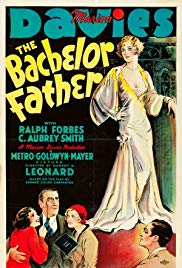
Sir Basil Winterton (C.Aubrey Smith) is The Bachelor Father (1931); though never married, he has managed to father three children with three different women. Now getting on in years and not in the best of health, he asks his lawyer John Ashley (Ralph Forbes) to locate the now-grown children: Geoffrey Trent (Ray Milland), Maria Credaro (Nena Quartaro), and Antoinette Flagg (Marion Davies), so that he can finally have a relationship with them. But, will they want a relationship with him? Marion Davies is thoroughly delightful as Tony (don't DARE to call her Antoinette!), a vibrant and winning young lady who is eager to discover a new family, but unwilling to compromised herself to do so. The audience knows early on that Tony is not actually the daughter of Sir Basil (she had a half-sister, also named Antoinette, who died before Tony's birth). The script - and Ms. Davies - make it transparent that Tony is not there for wealth, she's there simply to meet her father - and if she doesn't like him, she's leaving!! Marion Davies is an engaging actress who really should be seen more often. Though she was concerned about the move to talkies, she should not have been. Ignore the stories that she is the model for the untalented second Mrs. Kane in Citizen Kane - she's not. In his introduction to The Times We Had by Marion Davies, Mr Welles said: "Marion Davies was one of the most delightfully accomplished comediennes
in the whole history of the screen. She would have been a star if
Hearst had never happened. She was also a delightful and very
considerable person." (WellesNet) With all the stories about William Randolph Hearst being the model for Charles Foster Kane, it's often forgotten that Citizen Kane is a work of fiction. It is true that Hearst wanted her to succeed as a dramatic actress, but Ms. Davies far preferred comedy. Her comedic timing was impeccable, and while I'm sure she is an excellent dramatic actress, her gift really was in comedy, as is evidenced in this film (which she also produced).
There are many Marion Davies stories - this one is rather nice. After Cecil Beaton commented that she was one of the six most beautiful women in Hollywood, he was invited to photograph her. When she arrived, she was wearing a high-neck dress. He had hoped to photograph her with bare shoulders - so she cut up the dress to give him the picture he wanted (TCM article).
C. Aubrey Smith is delightful as the curmudgeony Sir Basil. Mr. Smith was reprising his role from the 1928 Broadway play. Even though this was a pre-code film, there were still issues (that were apparently disregarded) concerning the subject of the film. The Hays Office wanted the title of the film changed and no reference to the Broadway play, so that Sir Basil was not a bachelor, but multiply-divorced. As it was, because it was clear that the children were illegitimate, several countries and U.S. states changed the dialogue to muddy the children's status. As you can see by the advertisement below, the studio ignored the order. (AFI catalog).
This was Ray Milland's ninth film role, and while its not a big one, he does make an impression as Geoffrey, who despite his mother's antipathy (probably well-deserved) to Sir Basil, wants to form a relationship with his father. Mr. Milland worked for years, often as second lead, until he won an Oscar for The Lost Weekend (1945). But he had already done some really choice parts, including Gary Cooper's youngest brother in Beau Geste (1939), Ginger Roger's benefactor in The Major and the Minor (1942), and the musician who's house is haunted in The Uninvited (1944). Mr. Milland would act and direct until just before his death in 1986. He was survived by his wife of 54 years and two children.
Ralph Forbes doesn't have an awful lot to do - he's mainly there as a love interest for Tony (honestly, the butler, Larkin (played marvelously by Halliwell Hobbes) is more interesting than Mr. Forbes. Mr. Forbes had a substantial film career, that extended from silents to the television era; he also appeared in 14 Broadway plays between 1924 and 1950. He was briefly married to Ruth Chatterton and to Heather Angel. He died in 1951, at the age of 46.
A French version of the story, entitled Le père célibataire and starring Lili Damita, was released the same year as this version. Though successful upon release, the subject matter made sure it was not available for viewing after the Code was enforced. If you get a chance to see it, please do - we think you will enjoy it, and perhaps fall a little in love with Marion Davies.
Jerry Mulligan (Gene Kelly) is An American in Paris (1951). An ex-GI with ambitions to become a painter, Jerry remained in Paris after the war, and now lives hand-to-mouth, but relatively happily, in his adopted homeland. Well-liked by his neighbors, his closest friend is composer Adam Cook (Oscar Levant); otherwise he's a fairly solitary man, focused on creating a body of work. But in a 24 hour period, his world is upended - he meets Milo Roberts (Nina Foch), a wealthy woman who aspires to be his patron (and perhaps more) and Lise Bourvier (Leslie Caron) who Jerry loves on first sight. Of course, there is an additional wrinkle - Lise is engaged to Adam's friend Henri Baurel (Georges Guetary). The Baltimore Symphony Orchestra provided the music in this screening of the film, and the ballet sequence that is the highlight of the movie was even more spectacular with Gershwin's tone poem for orchestra danced to a live orchestra. While the spoken dialogue was a trifle muddy at times, all of the music (and the songs) were exquisite in this screening (You can hear the Detroit Symphony Orchestra play this magnificent piece here). Directed by Vincente Minnelli and choreographed by Gene Kelly (with an assist from Carol Haney), An American in Paris (1951) is a daring film. The closing ballet is over 17 minutes long; from the time it starts until the picture ends, there is NO dialogue - spoken or sung. The number was also quite expensive to film - nearly a half a million dollars (TCM article), but Louis B. Mayer was willing to do it (the success of The Red Shoes (1948) helped convince him)
One number that doesn't get talked about often is the "By Strauss" number, featuring Mr. Guetary, Mr. Kelly, Mr. Levant and Mary Young, the flower seller who dances with Mr. Kelly. Ms. Young was 72 when she appeared in the film, and she is lovely as she waltzes with Mr. Kelly. A stage performer (she first appeared on Broadway - in a musical - in 1899), she started her film career in 1937, primarily playing small roles - often uncredited - as older women. She worked in film and on television until 1968. She died in 1971 at the age of 1971. This was Leslie Caron's first film. Vera-Ellen, Cyd Charisse, Sally Forrest, Jeanine Charrat, and Odile Versois were all considered for the role, but both Gene Kelly and Vincente Minnelli wanted a "fresh" face for the part. Mr. Kelly had seen Ms. Caron perform with the Roland Petit ballet company (AFI catalog); Mr. Kelly's widow later said that only Ms. Caron and Ms. Versois were tested (Los Angeles Times), but it has often been reported that Ms. Charisse had dropped out of consideration for the part because of her pregnancy (The Spectator). Though I'm not always a fan of Ms. Caron, she is excellent as Lise, giving the part a gravity that it requires.
One thinks of this picture as Gene Kelly's, but Fred Astaire was also considered - regardless, this is Mr. Kelly's part without question. His athleticism gives the character a strength that is essential for this man who has fought a war, remained in a foreign country, and thrown all his resources on a career that may or may not pan out. Fred Astaire would later dance with Leslie Caron in Daddy Long-Legs (1955), but the chemistry just wasn't there. The pairing of Kelly and Caron is magical.
Maurice Chevalier was at one point in the running for Henri (however, his possible collaboration with the Nazis during World War II finalized that casting). Though Georges Guetary was too young and too good-looking for the character as originally conceived, the film doesn't emphasize the age difference between Lise and Henri as being the obstacle to their happiness - that she has found her perfect match in Jerry is the issue.
A number of familiar faces pop up in unbilled appearances - John Eldredge and Anna Q Nilssen are unbilled as Jack and Kay Jansen, as is Hayden Rorke as Tommy Baldwin (Mr. Rorke would become a television favorite as Dr. Bellows on I Dream of Jeannie). Take a good look at the Third Year Girl who criticizes Jerry's work - that's Noel Neill who would appear as the second Lois Lane in The Adventures of Superman TV series.
An American in Paris was nominated for 8 Oscars - it won six : Picture, Writing, Art/Set Direction, Costume Design, and Scoring (Director Minnelli and Film editor Adrienne Fazan were nominated). It was added to the National Film Registry in 1993, is #9 on the AFI's Greatest Musicals of All Time and #65 in the original 100 Years, 100 Films lists. It is truly a remarkable film. Here's the trailer to introduce you to these splendid dance number:
Larry Hall (James Stewart) has a vision for ice shows - he sees them as extravaganzas, that tell stories through ice dancing and music. He has hired Mary McKay (Joan Crawford), a singer with no skating expertise to participate in his show, but is finding it hard to get jobs. No one wants anything more than skaters doing tricks. But Mary and Larry are in love, and when Mary realizes she is part of the problem, she separates herself from the ice show by talking her way into a film contract. But there is another issue - Mary and Larry have to hide their marriage. Her contract will only allow her to marry with the studio's permission. In celebration of James Stewart Day (August 7th) during the 2019 Summer Under the Stars festival on TCM (and as part of the Summer Under The Stars Blogathon), we'll be discussing Ice Follies of 1939 (1939). Louis B. Mayer wanted a skating picture to compete with those of 20th Century Fox's Sonja Henie (Musicals in Film: A Guide to the Genre by Thomas S. Hischak), but was unable to find a skating star of Ms. Henie's caliber. So, he took two of his biggest stars, and threw them headfirst into an ice skating extravaganza. There was, of course, a big issue - neither Joan Crawford nor James Stewart could skate.The solution was avoid showing them on skates - except in the advertisements (see below) - and just talk about them skating.
Given the cast, one would assume that this film from Hollywood's Golden Year would be exceptional. Unfortunately, it's not. The script is so mediocre that it is impossible for the actors to work successfully within it. There are some fun bits (like the running joke about Ms. Crawford's poor skating and a scene in which a doorman calls out the arrival of cars to a variety of MGM stars - great publicity for the studio!!), but by and large, the screenplay is routine, and doesn't capitalize on the skills of the actors.
Why they even bothered to have Lew Ayres as Larry's best friend, Eddie Burgess is one issue. He is such a good and engaging actor, and they give him precious little to do. As Larry's best friend, you would think he would serve as a sounding board for Larry when troubles begin, but the character is shipped out the minute problems begin. He reappears when things are looking up for Larry, and the only function he serves is as a sort of Yes Man for Larry's plan. By having Mr. Ayres in the part, you expect more, and are disappointed when he is gone. Joan Crawford was likely never supposed to skate, but she was supposed to sing. She recorded three songs for the production, but all were cut (AFI Catalog), and when she does sing, her voice is dubbed. Ms. Crawford would later state that the reason for the cuts were Jeannette MacDonald's jealousy of Ms. Crawford's vocal talents (TCM article). The very idea is idiotic; we've heard Ms. Crawford sing (Dancing Lady (1933)), and she's no coloratura.
One shock is the design of Ms. Crawford's appearance in the film (see above) - her hair is darkened and parted in the middle; her makeup is more elaborate. Given how protective Ms. Crawford was of her appearance, it's a surprise she would have consented to this new look! Ms. Crawford was not happy with the production, so MGM gave her a juicier part that same year - Crystal Allen in The Women.
Lewis Stone's Douglas Tolliver Jr. - the head of Monarch Studio - is the image that Louis B. Mayer wanted the public to believe was him, but, of course is not. Tolliver hires Mary because she says she doesn't want to be an actress (after she forces her way into his office, allegedly to collect $20 for damage caused by his chauffeur to Eddie's car). He's sweet, supportive, and a genuinely nice man. Ah, would that life imitated art!
Lionel Stander is also present as producer Mort Hodges. Like Tolliver, he is a good guy, and Mr. Stander plays him as the one person who believes in Larry's dream. Mr. Stander was about to have problems with HUAC (in 1940) that would continue on until he was blacklisted in 1951 (You can read his bold stand before the committee: The McCarthy Hearings by Philip Brooks). He eventually settled in Italy, where he appeared in spaghetti westerns like Once Upon a Time in the West (1968). When the TV series It Takes a Thief was filming in Italy, Robert Wagner asked Mr. Stander to appear in an episode of the show. This would lead to Mr. Stander's casting as Max, the man-of-all-work to the Harts in Hart to Hart. Mr. Stander died in 1994, aged 86, of lung cancer.
Which brings us to our Star of the Day, James Stewart. Like Ms. Crawford, he was unimpressed with the script. He plays Larry as a decent guy, who's trying to be supportive of his wife's carer - even to the point of cooking and cleaning as she supports them financially. But without anyone to bounce off, the character flounders, and it's hard for the audience to get to know him. There's precious little chemistry between him and Ms. Crawford, but he gives as good a performance as he can, given the limits of the script. He too would see better days that same year - he would appear in both Destry Rides Again and Mr. Smith Goes to Washington, and be nominated for the Best Actor Oscar for the latter performance.
The New York Timesreview by Frank S. Nugent was negative ("Far be it from us to rap one of Mr. Rapf's more glittering productions;
what we mildly object to is the fact that the glitter does not extend to
the dialogue,"); the New York Herald Tribune said Ms. Crawford "should avoid this type of film in future, where she has to buck poor material, a group of specialists and Metro's own lavishness" (Skating on Air: The Broadcast History of an Olympic Marquee Sport by Kelli Lawrence). All in all, The Follies were a folly, but it did give Mr. Stewart the opportunities that would advance his career greatly (leading to his Oscar win for The Philadelphia Story the following year.
Anna Rose (Betsy Drake) is happily married to George "Poppy" Rose (Cary Grant). The couple have three children: Tim (Malcolm Cassell), Trot (Gay Gordon), and Teenie (George Winslow). They also have an assortment of pets - abandoned creatures that Anna adopts, as Anna feels deeply for any creature living without love. So, when she visits a local orphan asylum and discovers the number of older children unable to find loving homes, she decides there is always Room for One More (1952). Ms. Drake and Mr. Grant had been married for three years when they appeared in this, their second of two films together. Their rapport is obvious and works towards the film's appeal. Mr. Grant is appropriately flustered as the husband working to make ends meet for a continually growing family. He also brings to the part an intelligence and concern for his family, that in lesser hands would have resulted in the stereotypical stupid father. Poppy is never that, nor is he unwilling to take on the additional mouths. He is cautious in the face of Anna's open generosity, and the counterpoint works beautifully. Betsy Drake makes Anna a free spirit; she lets her heart lead, in the assumption that all will be well. But we quickly learn she is savvy enough to know that financially they are strapped with the extra mouths, and that her job - and that of her husband - is to provide love and care to their adopted charges. Thus, the two additions to the Rose home are not adopted - they need funding from the state to make sure that ALL the children are equally cared for.
We know pretty quickly that Anna is a soft touch. Miss Kenyon (Lurene Tuttle), the head of the local orphanage sees to that. Though Anna is hesitant about taking on a child, Miss Kenyon arrives at the door of the Rose home with a very troubled girl, Jane (Iris Mann). The film pulls no punches in detailing the abuse this 13 year old child has faced, from her parents and from other caretakers. We know that she has been starved at one point, as we see her hoarding food in anticipation of being ejected from the Rose home. And when we meet the next of Miss Kenyon's children to enter the Rose family, we actually see the abuse that Jimmy-John (Clifford Tatum Jr.) has been suffering at the hands of one of his teachers.
All of the child actors are good, but George Winslow (Teenie) in his film debut, steals the show. With his distinct voice (he was nicknamed "Foghorn), he'd first appeared on the radio show Art Linkletter's People are Funny. (AFI Catalog). He would appear in two films with Cary Grant and two with Marilyn Monroe (Monkey Business (1952) which featured both of them, and Gentlemen Prefer Blondes (1953) with Ms. Monroe). Mr. Winslow retired from films at the age of twelve (when asked, he said he never much liked acting); served in the Navy and worked for the Postal Service. He never married; he died of cardiac arrest at the age of 69 in 2015. This New York Timesobituary has more information about his life and career.
Based on the book of the same name by Anna Perrot Rose (for more on the book, see Josephine's Reader Advisory ), the film did well at the box office. Both Variety and New York Timesreview by Bosley Crowther gave the film a thumb's up (though Mr. Crowther was annoyed at the "running gag" concerning "the manner in which the children interfere with the cuddling of pa and ma". In fairness, he does admit to a certain priggishness.) The Lux Radio Theatre aired a version of the story in May of 1952, with Cary
Grant and Phyllis Thaxter. In 1962, the story was the subject of a short-lived television series, starring Andrew Duggan and Peggy McKay (TCM article). Cary Grant has a way with children in his films that is exceptional - having five of them only gives him more opportunity to interact. I'll end with the opening of the film and a suggestion that you try it one day when you need a smile.
Norah Larkin (Anne Baxter) is deeply in love with her fiance, George, a soldier serving in Korea. After a long silence, she receives a letter from him; she decides to save it so that she can open it on her birthday evening. Sitting alone in her apartment, a glass of champagne in her hand, she reads the letter to discover George has met someone else and is breaking his engagement to Norah. The telephone rings; a devastated Norah answers it. The caller, Harry Prebble (Raymond Burr) assumes Nora is her roommate, Crystal Carpenter (Ann Sothern). Harry, an artist who has been working in her office, invites Noar to dinner at The Blue Gardenia (1953) and hangs up. Norah decides she will keep the date, with shocking results.
Welcome to the world of Film Noir and our contribution to The Noirathon, a chance visit other blogs and read about some of the amazing - and oft ignored - films noir. Our contribution is a well-paced film with just the right number of twists and very little fluff - The Blue Gardenia, a thoroughly enjoyable and engaging mystery. It has an excellent cast, with strong performances from Raymond Burr, Anne Baxter, and Ann Sothern. Director Fritz Lang and cinematographer Nicholas Musuraca create an almost claustrophobic atmosphere, with much of the film shot indoors or at night (TCM article).
Allegedly, Margaret Sullavan had originally been approached for the role that went to Anne Baxter (Wikipedia). Ms. Baxter is convincing as a woman plagued by guilt for a crime that she doesn't remember committing. Her scenes with roommates Jeff Donnell (Sally Ellis) and especially Ann Sothern, add to our understanding of the character. Equally engaging are her interactions with Raymond Burr - she suffered a torn ligament in their fight scene (AFI Catalog) and the intensity of their battle translates to the screen. Ms. Baxter had already won an Oscar for her performance as Sophie in The Razor's Edge (1947), and been nominated for her role as Eve Harrington in All About Eve (1950). Though she moved to Australia for four years, following her second marriage to Randolph Galt (The Washington Post), she continued to work in film, television, and on Broadway until her death in 1986. [She wrote about her time in Australia in Intermission: A True Story.]
Prior to Perry Mason, Raymond Burr was best known as a villain, and he doesn't disappoint in this film. Harry Prebble is a serial rapist, pure and simple. He could be just a stock bad guy, but Mr. Burr manages to make him interesting. You don't, by any means, root for him. However, you grasp why women might succumb to his date requests, despite his reputation as a Lothario. Partly, it's his work as an artist; with many men aware in Korea, his competition is also diminished. But, it's mostly Mr. Burr's skill as an actor, talents he would get to really demonstrate on television. Like Ms. Baxter, Mr. Burr also worked up until his death, primarily in a series of Perry Mason movies that were hugely popular - and reunited him with his good friend, Barbara Hale. He'd spend much of his off-screen time raising orchids, one of which is named after Ms. Hale, with his life-partner, Robert Benevides. He died of liver cancer in 1993.
Ann Sothern is an actress who rarely missteps, and she is in top form in this film. She wisecracks, she teases, but she is a support to her friend in a time of need. It's rather a shame that she is so often a supporting player, rather than the lead, but it's also true that Crystal gets the best lines in the script, like " Honey, if a girl killed every man who got fresh with her, how much of the male population do you think there’d be left?" We were not as intrigued with Richard Conte as reporter Casey Mayo. It's not all that interesting a part, and unfortunately, Mr. Conte doesn't make it more compelling. Casey is supposed to be a powerful, popular journalist, but Mr. Conte not very dynamic. He also should be more comfortable with the police, as represented by George Reeves (Captain Sam Haynes). We wondered what would have happened if Mr. Conte and Mr. Reeves switched parts - quite frankly, Mr. Reeves is a lot sexier and stronger. As an aside, Ruth Storey, who plays Harry's former victim, Rose, was Mr. Conte's wife at this time.
The lovely title song is performed by the unforgettable Nat "King" Cole. As is often the case with African-American performers in films of the period, Mr. Cole is removed from the action - playing the piano in the Blue Gardenia nightclub. The only "interaction" he has with the cast is with Celia Lovsky (May, the blind flower vendor), who approaches the piano to place a flower on it. In venues that objected, the scene could have been eliminated. But the song could not, as it turns out to be integral to the storyline. Whether he was physically visible or not, Mr. Cole is felt throughout the film. In his interview with Fritz Lang in Who the Devil Made It: Conversations with ...
Peter Bogdanovich called the film "a particularly venomous picture of
American life" Lang replied that "it was the first picture after the
McCarthy business, and I had to shoot it in twenty day. Maybe that's
what made me so venomous." [Lang was never called before the committee,
but he did have difficulty getting work as a result of HUAC's
investigations (Continental Strangers: German Exile Cinema, 1933-1951 by Gerd Gemünden)]. I'm not sure that I would call the story "venomous" but in the era of #metoo, it is a sad reminder that women have long been victimized by men, whether it is the Harry Prebbles, Casey Mayos, or Georges of the world.
Based on the short story The Gardenia by Vera Caspary (it was re-titled to capitalize on the Black Dahlia mystery of 1947),the story was reprised on the Lux Radio Theatre in November 1954, this time starring Dana Andrews and Ruth Roman. Bosley Crowther didn't like the film in his New York Timesreview, calling it "routine melodrama. He also tries to ruin the film by revealing the ending, so be warned if you choose to read the review. We heartily recommend The Blue Gardenia for your viewing pleasure. We'll end with this trailer, featuring Nat "King" Cole:
His eldest daughter now married, Edwardo Acuna (Adolphe Menjou) requires - per family tradition - that his next daughter, Maria (Rita Hayworth) will be the next to wed. Maria, however, is in no hurry to tie the knot, much to the consternation of her younger, engaged sisters, Cecy (Leslie Brooks) and Lita (Adele Mara). To tempt her towards marriage, Edwardo devises a plan - he sends her love letters and orchids every day, intending that she'll pick out some local man (of whom Edwardo approves, of course) as the wooer. But when dancer Robert Davis (Fred Astaire) is unintentionally asked to deliver the day's orchids, Maria sees him and decides HE is the suitor - and she is pleased. Her father however is not. This week we're discussing You Were Never Lovelier (1942). This is by no means a great film; as a story, it's in fact, rather lame. The plot is silly, and at times feels like the authors were trying to stretch it out to full movie length. But this is not a movie that you watch for the story - when the plot starts, you wait for the next dance routine, because they are well worth the wait. It's been said that Fred Astaire praised Rita Hayworth as "the first natural dancer he had worked with since his sister, Adele, had retired" and his favorite screen dancing partner (Puttin' On the Ritz: Fred Astaire and the Fine Art of Panache: A Biography by Peter Levinson). Mr. Astaire was an admirer of Ms. Hayworth's father, the dancer Eduardo Cansino, but had concerns that Ms. Hayworth - at 5"7' - would be too tall a partner for him (he was 5"9') when she put on her heels (TCM article). She was also 20 years his junior. However, once they began dancing, he was convinced. She's amazing in beautiful numbers like "I'm Old-Fashioned" and novelty routines like "The Shorty George." As was usually the case, she was not permitted to do her own singing; Nan Wynn provided the vocals as she had done on other Hayworth films (Being Rita Hayworth: Labor, Identity, and Hollywood Stardomby Adrienne L. McLean). This was their second - and last - film together (the other was You'll Never Get Rich).
It's apparent that Adolphe Menjou's character is supposed to be funny, but after awhile, he is just an idiot. It's no reflection on the actor - he does what he can with the part he is given, but he's not been given all that much with which to work. His attempt to convince his daughter to marry by sending her orchids and love letters is rather creepy (it might not have been in 1942, but it is now). When his wife, Delfina (Barbara Brown) begins to suspect that he is carrying on an affair with her best friend (Isobel Elsom as Maria Castro), it's all too much. Plus, no one is dancing in these scenes.
Gus Schilling (Fernando) was a burlesque performer who came to the attention of Orson Welles, and essentially became part of his film stock company. He would ultimately appear in five of Mr. Welles films (Citizen Kane, The Magnificent Ambersons, The Lady from Shanghai, Macbeth and Touch of Evil). Mr. Schilling is amusing as Acuna's abused secretary, but he doesn't have a whole lot to do except be exasperated. Similarly, the noted Latin band leader, Xavier Cugat (playing himself) has a relatively minor part - he functions as a means of getting Robert introduced to the Acuna family. Throughout his film career, Mr. Cugat would generally play himself, or an unnamed band leader. Married five times, most notably to Abbe Lane (who was one of his band singers) and to Charo (who also appeared with the band. Charo is a classically trained flamenco guitarist. Another guitarist who worked for the Cugat band was Desi Arnez), Mr. Cugat died in 1990, at the age of 90.
By the 1940s, with the War in Europe already started, Franklin Roosevelt
was aware that the U.S. would probably be drawn into it. He was
determined that the U.S.'s neighbors in South America not support the
Axis nations, so he began a goodwill campaign that would eventually
involve filmmakers like Walt Disney and Orson Welles. Latin American
films became quite popular, as did performers such as Carmen Miranda.
It's likely that this films setting reflects some of that interest. The original working titles of the film, Carnival in Rio and The Gay Senorita (AFI Catalog), emphasize the Latin American influences.
The New York Timesreview by Bosley Crowther found the film worth watching for the musical numbers, and we agree. With gowns by Irene, and choreography by Fred Astaire (and Nicanor Molinare, both of whom were uncredited), watch this for the dancing and for delightful songs like "Dearly Beloved", with music by Johnny Mercer and lyrics by Jerome Kern (the song was nominated for an Oscar). We will end with the dancing scene that we promised: "I'm Old-Fashioned" (by Mercer and Kern). Skip the plot, listen to the music and watch some really impressive dance routines by two masters.
Con man Sherwood Nash (William Powell) decides to forgo financial scams in favor of fashion scams when he meets would-be designer Lynn Mason (Bette Davis). Using Lynn's talent for sketching and eye for successful dresses, Nash "borrows" dresses en route from Paris to New York design houses, and sells cheap copies ("designed" by Lynn) to low-end competitors. He then convinces the New York designers to send him to Paris to do the same for them - get the Fashions of 1934 (1934) to them at a lower price. Part of the AFI Silver Theatre's Library of Congress Film Preservation Showcase. Fashions of 1934 was projected with a newly restored 35mm print of this film. Like it's sister film, In Caliente, Fashions of 1934 is an excuse for elaborate musical numbers as well as stunning dresses exhibited in various fashion shows. If you've seen The Women, you are familiar with this kind of scene - lovely, period dresses, but the kind no member of the film audience would probably ever be able to afford. However, add a little Busby Berkeley magic, and you've got production numbers that you will long remember. The biggest number involves human harps - yes, you read that right. The image below will give you just an idea of the piece. The trailer will show you another - lovely ladies with feather fans that are used to create gorgeous shapes. There's no way these routines would ever be on a stage at a fashion show, but I doubt anyone really cared.
William Powell is delightfully suave as the con man extraordinaire "Sherry" Nash. The part is reminiscent of the role he played in Jewel Robbery (1932). Even though he's unabashedly dishonest, the audience roots for him - he's just charming. He also has quite a good rapport with his two female co-stars, Bette Davis and Verree Teasdale (Grand Duchess Alix/Mabel McGuire), two very different actresses with extremely different acting styles. With Mr. Powell there, you don't notice a change of tone.
Not surprisingly, Bette Davis was not thrilled to be in this picture. She wanted meatier parts, and this certainly was not what she was looking for. She stated that she was "all done up like a third-rate imitation of the MGM glamour queens. That isn't me. I'll never be a clothes horse or romantic symbol." (TCM article). Regardless of her discomfort with the part, she acquits herself well (though she is much better looking as a brunette). As for her desire for better parts, she would get her wish later that year, when she FINALLY was given permission to play Mildred in Of Human Bondage (1934) (The Lonely Life: An Autobiography by Bette Davis). Verree Teasdale is amusing as Hoboken native and faux countess Alix. Ms. Teasdale started on Broadway, ultimately performing in 13 plays between 1924 and 1932; she appeared in her first film in 1929, and worked fairly steadily until 1941; thereafter, she did some radio work, often with her husband, Adolphe Menjou. Their marriage lasted from 1935 until his death in 1963 (they had one child). Ms. Teasdale died in 1987 at the age of 83.
In a part reminiscent of his character in One-Way Passage (1932),Frank McHugh plays Snap, a photographer - and con man/thief - who is Sherry's right-hand man. Mr. McHugh makes the most of what he's got, though the part is mostly comedic. It must be mentioned that, as intriguing as his little cane camera is, it's odd that he has to constantly hold it up to his eye to get pictures - resulting in the "secret camera" being not very secret. There is an emphasis on this particular gimmick, and our reaction was that you'd have to be particularly stupid to not figure out what he is doing. Several other character parts are worth mentioning - Hugh Herbert (Joe Ward) is actually not annoying in this film. Reginald Owen (Oscar Baroque) and Henry O'Neill (Duryea) as part of the fashion industries in Paris and New York (respectively) are frankly as dishonest as Sherry and his crew. Arthur Treacher makes a brief appearance as - what else - a butler.
Originally titled King of Fashion (AFI Catalog), this is a pleasant film with some lovely Berkeley numbers. Certainly, it is reminiscent of other films released around the same time, but with William Powell delivering the dialogue, you barely notice that it's typical. I'll leave you with a trailer from the film (and a preview of one of the amazing dance routines.
Magazine editor Larry MacArthur (Pat O'Brien) is in way over his head. He's somehow become engaged to golddigger Clara (Glenda Farrell), he's frequently drunk, and he is making up theatre reviews because he's too drunk to remember what he saw (if he even sobered up enough to the show). His associate editor and friend, Harold Brandon (Edward Everett Horton) decides the only recourse is to pack Larry up while he's drunk, and take him on a month's vacation to Agua Caliente, Mexico. While In Caliente (1935), Larry become smitten with Rita Gomez (Dolores Del Rio), a dancer of whom Larry (while intoxicated) gave a blistering review in the magazine. The AFI Silver Theatre recently hosted the Library of Congress Film Preservation Showcase. In Caliente featured a newly restored 35mm print of this film. The print was gloriously beautiful, and looked as it must have done in 1935 upon release. With numbers by Busby Berkeley, this rarely seen film was a lot of fun to watch. The plot is really a hook on which to hang some musical performances, like this number by the Dancing De Marcos (Sally and Tony, who actually didn't marry until 1944), and a performance by Ms. Del Rio. The film introduced the song "The Lady in Red", as well as featured a previously released song "She's a Latin from Manhattan". There's even a brief comic bit from Judy Canova.
Ms. Del Rio is good as the love interest. It's hard to understand why she would fall for Larry - he's drunk much of the time and he's also insulted her in print by calling her "a bag of bones." But, the story must prevail, and love him she does. After her strong work in the silent era, Ms. Del Rio was finding it hard to get good parts (even when she got the lead a few years earlier in Flying Down to Rio, she was eclipsed by that dynamic dancing duo, Astaire and Rogers); she returned to Mexico in the 1940s (TCM article).
Glenda Farrell has a bit more to work with as Clara, even though it is a relatively small part. Since it's evident that Clara wants a settlement, and Larry's drunken escapades will help her get her money, Ms. Farrell can play broadly; as always, Ms. Farrell is entertaining.
Edward Everett Horton made a career playing dolts. Harold is actually a lot smarter than many of the characters Mr. Horton gets to play. He's smart enough to get his friend away from New York in an attempt to quell his great thirst, but his protective instincts don't seem to work well for himself. He ends up in agua caliente himself because of his desire to help his friend.
Leo Carrillo as Jose Gomez, Rita's uncle and manager is entertaining as the con man who uses his position to cheat anyone who will play cards (or anything else) with him. He's got a lot more screen time than Ms. Farrell, but like her, he plays the part broadly to good comic effect.
Originally titled just Caliente (AFI Catalog), the film at one point was supposed to feature Rita Cansino (Rita Hayworth) in one of the numbers; she was eliminated from the final cut. This is not a film that is in any way deep, but it was a lot of fun. We'll leave you with a trailer from the film.
 The very married Martin Cortland (Robert Benchley) has his eye on chorus girl Sheila Winthrop (Rita Hayworth); he's decided to entice her into his bed with a diamond bracelet. Sheila is having none of it and refuses the gift. That evening, Julia Cortland (Frieda Inescort) finds the bracelet in her husband's pocket (engraved "To Sheila") she informs her husband that she is sick of his philandering and has instituting divorce proceedings. To prevent this (as Martin's finances are all in Julia's name), Martin claims that the bracelet was a gift from his choreographer Robert Curtis (Fred Astaire) to Sheila as an engagement present, which drives Robert into the army. Today, we'll be discussing You'll Never Get Rich (1941)