When Lily Bishop (Barbara Stanwyck) is accused of cheating at cards and ejected from town, California (1947) bound Michael Fabian (Barry Fitzgerald) invites her to join him on his trip west, despite the objections of the other train members, and its leader, Jonathan Trumbo (Ray Milland). News of the discovery of gold at Sutter's Mill disrupts the train, as Lily and most of the train break off to rush to the scene. Trumbo arrives at Pharaoh City to find Lily has opened a saloon and is working with Pharaoh Coffin (George Coulouris), a former slave trader and a man with ambitions of becoming the Emperor of California. Barbara Stanwyck in a Western - seems like it should be a perfect combination. Unfortunately, with California, other factors get in the way of making this a worthy venue for Ms. Stanwyck. First and foremost is the script - it's a hodge-podge of themes that don't ever come together effectively. First we have a gambling lady escaping to a new land, with a group of pilgrims seeking a new home. Next, it's an hysterical mob careening to the gold rush territory. Tnen, it's our gambling lady trying to run a saloon, and finally, it's a battle for statehood. Huh? All these points come across as separate story lines; there's no cohesion among them, which makes the story disjointed and unappealing. Even the fight scenes seem awkward.
Ms. Stanwyck is also working with an unfinished role: the character of Lily is not really fleshed out. We get a modicum of backstory (her father was a gambler), but then out of nowhere, Lily really wants to get married, and she's seemingly willing to take the first man who proposes, whether worthy of her or not. Add in the fact that there is no chemistry at all between Ms. Stanwyck and either Mr. Milland or Mr. Coulouris. Quite frankly, we thought Lily would have been better off with Barry Fitzgerald. Lily was originally earmarked for Betty Hutton (AFI catalog) but she declined to go on a honeymoon with her first husband. The remnants of Ms. Hutton probably remain the in singing numbers Ms. Stanwyck performs (with vocals by Kay St.Germaine).
Ray Milland was also the second choice; Alan Ladd had been assigned by Paramount, but he was in a salary dispute, so Mr. Milland was give the part. It's a thankless character - a trail boss, who (it turns out) is an army deserter. He's not very appealing, he's downright nasty to Lily. It defies even the idea of "meet cute" that he would be her love interest. Mr. Milland is a good actor, but he needs a character to work with, and he doesn't have one in this picture.
Another actor who was considered for casting was Victor McLaglen as
Pharoh Coffin (may I add, that who came up with THAT name??). George
Coulouris does the best he can, but Coffin is a villain with not one
redeeming quality. That Lily would even consider marrying this truly
despicable man is a head shake - he's got money, but no personality and
not a whit of kindness.
Anthony Quinn (Don Luis Rivera y Hernandez) has about two scenes. It was a role that deserved more development; because of the lack of distinction, when he's gone, you forget about him (which is not the point).
The only actor who manages to give his part distinction is Barry Fitzgerald. Michael Fabian is a good man: you like him and Mr. Fitzgerald's portrayal of him from the beginning. Though he unavoidably gets caught up in the script confusion, generally speaking, Michael's actions make the most sense of anyone in the story.
What the film does have is beauty - this is a lush technicolor film. Director John Farrow and director of photography Ray Rennahan use the background to good effect, presenting exquisite vistas of the California country-side (an early montage is an especially lovely piece of work). Edith Head's magnificent costumes for Ms. Stanwyck are breathtaking. And the necklace that Ms. Stanwyck wears in the picture below was a family heirloom that Mr. Farrow provided for use in the picture. It's amethyst, and has a matching tiara that Ms. Stanwyck also wears in the film.
The Lux Radio Theatre did a version of the film in January of 1950 with Ray Milland, Lizbeth Scott. and Raymond Burr. We were rather intrigued with the idea of Mr. Burr as Coffin - it seemed he might have brought a bit more sinister appeal to the part.
We were stunned to read a positive review of the film from Bosley Crowther of the New York Times, who said that California "glitters with a quite beguiling gleam" Unfortunately, we can't agree. If you are looking for a Barbara Stanwyck western, try Trooper Hook instead. In the meantime, here's a trailer from California:
Miguel (Anthony Gonzalez) lives in Mexico with his large family, shoemakers all. He is especially fond of his great-grandmother, Coco (2017), who was abandoned by her father when she was a small child. Coco's mother, Mamá Imelda (Alanna Ubach) raised her family to despise music, as it was his career as a guitarist that took her husband away from the family. Miguel, however, desperately wants to be a musician, like his idol Ernesto de la Cruz (Benjamin Bratt), but his Abuelita (Renee Victor) will have none of it. So, on El Día de Muertos, Miguel attempts to enter a local talent contest - but first he needs to find a guitar.
This post is part of the Hollywood’s Hispanic Heritage Blogathon hosted by Once Upon a Screen. We were treated to a live orchestral performance to this lovely film, with the National Symphony Orchestra at Wolf Trap playing the score by Michael Giacchino. The film is a delight, winning the Oscar for Best Animated Film in 2018, as well as the award for Best Song for "Remember Me" by Kristen Anderson-Lopez and Robert Lopez. One of the questions that arise from the movie on first viewing is the title - why is it named after the very elderly Coco, and not Miguel, who is the focus of the film. Well, you have to watch the movie to get that answer, but it is a moving reveal. The relationship between Miguel and his great-great-grandmother is a close one. He enjoys being with Grandma Coco - though he is bemused that she is unable to remember his name - but as she is the only one who really listens to him (or so he believes), Miguel feels great affection for her.
The rest of the family, represented by Abuelita, the matriarch of the family, find Miguel to be a bit of a handful. Abuelita upholds her mother Imelda's edict against music, which becomes the crux of Miguel's problem. He feels a call to music, and is a talented guitarist. In this family who loathes music, how is it possible that he could possibly be one of them. His answer - he is the great-great-grandson of his idol, Ernesto de la Cruz.
Thrown by a fluke into the land of the dead, Miguel's family on the other side try to send him home, but with Mamá Imelda's proviso that Miguel will give up music. Miguel attempts to thwart her by finding de la Cruz, and getting HIS blessing to go home. Enter Héctor (Gael García Bernal), an impoverished musician who has all but been forgotten by his family. Héctor agrees to help Miguel to de la Cruz if Miguel will put his photo on an ofrenda so he will not be consigned to oblivion. Mr. Bernal brings just the right amount of sadness to the part to make Héctor sympathetic.
Benjamin Bratt is excellent as de la Cruz, a scoundrel if ever there was one. He voices the part with equal amounts of vanity and arrogance. At the same time, he makes the character intriguing - until we find out more about his past. Be on the listen for Edward James Olmos as Chicharrón (this article in Gizmodo features an interview with Mr. Olmos on his characterization). He's quite wonderful, and will break your heart.
The reviews of this film were quite positive - Roger Ebert called it "a sprightly story;" The New York Times was a bit less enthusiastic, but still enjoyed the film; the Hollywood Reporter called it "one of Disney-Pixar's most engaging efforts." The power of a live orchestra providing background to an excellent movie is something that cannot be emphasized too much. If you have the chance to see one of these film and concert combos, please consider going. I'm going to leave you with a trailer to Coco.
As Harry Potter (Daniel Radcliffe) is about to enter his fourth year at Hogwarts, he is invited by the Weasley family to attend the Quidditch World Cup. The festivities are interrupted by the appearance of the Dark Mark and an attack on the attendees by a group of Death Eaters. This event signals that Harry's fourth year at Hogwarts is very much about a drastic change in his life and safety. This week, we're going to talk about Harry Potter and the Goblet of Fire (2005) Patrick Doyle's beautiful score was front and center as the National Symphony Orchestra at Wolf Trap played the music behind the film. It is truly impressive how much more intense the film is when a live orchestra is enhancing the film (much the way silent movies had a live accompanist). Wold Trap is a large venue, but we had an enthusiastic audience, who really became immersed in the film. We know from the film's very beginning that this is a different film from the first three. The Dursley's are not present, and we enter the film on Harry's nightmare - he sees Voldemort (Ralph Fiennes), Peter Pettigrew (Timothy Spall), and an unidentified man (David Tennant) kill an old caretaker. The dark tone of Harry's dream colors the rest of the film, as Hogwarts too becomes a nightmare world for young Harry - not just because he is forced into the TriWizard Tournament, but also because he is starting to notice girls, especially Cho Chang (Katie Leung).
We are used to Ron, Hermione, and Harry being a united front against the forces of evil, but their relationships are strained as they begin to mature. Harry and Ron Weasley (Rupert Grint) have their first major fight - Ronald is convinced that Harry entered the TriWizard Tournament in secret. Ronald and Hermione Granger (Emma Watson) also fall out when Ron unfairly assumes that Hermione couldn't possibly get a date the Yule Ball. His fury at Hermione (along with the fact that she is attending with one of his personal heroes) ultimately brings Hermione to tears.
One of the delights in seeing this film with a real audience is their reactions to the actors who became part of the franchise. This is especially true for Alan Rickman (Severus Snape), whose appearance on screen always results in long cheers. In spite of his somber attitude, Snape is a favorite of mine. Those of us who have read the full series of books (and seen all the films. Multiple times.) appreciate his dedication to the children's safety as well as the pain that it causes him. Of all the instructors, I believe the Professor Snape is the one person with whom we can all identify.
I recall, while reading this book, breaking into tears on the subway as I came to an event late in the story. The horror that we witness with Harry is unexpected, and author J.K. Rowling knows how to make you feel Harry's pain and shock. If you've never read these books, or seen the films, do seek them out.
We plan on attending more of these concert performances, for Harry Potter as well as for Disney (tune in for another animated film with a symphony score). In the meantime, I'll leave you with this trailer from the film.
Mary Herries (Aline MacMahon) is a wealthy woman with an impressive art collection, and a desire to live in solitude. She has family and friends who visit occasionally, but is quite happy being on her own. She is also a Kind Lady (1935) and finds it hard to resist helping those in need. When street artist Henry Abbott (Basil Rathbone) appears at her doorstep with a sob story, she invites him in for some hot tea and a sandwich, gives him some money, and a warm coat for his wife. It's not long before Abbott reappears, this time with wife Ada (Justine Chase) in tow, and wheedles his way back into the house. But is he as innocuous as he puts on? This is a suspenseful yarn that reminded us of the equally chilling My Name is Julia Ross. Both films focus on a strong female lead being preyed upon by strangers - attempting to mold the heroine to their desires. The story is unsettling - though it's not in any way gory, it's a tale that keeps you on the edge of your seat fearing for the safety of Mary Herries. With Aline MacMahon heading the cast, you know you can't go wrong. She's playing a woman much older than her years - when the play opened on Broadway in 1935, it starred Grace George as Mary. Ms.George was 56 at the time (Ms.George would also play the part on Broadway in a 1940 revival); Ms. McMahon is 20 years younger when she took the part of a woman we know is well into her 50s. Ms. MacMahon brings a determination to the part that makes the audience root for her. Sure, she is a softie, but she's not a weakling. She stands up to Abbott on multiple occasions, and never stops trying to get out of his clutches. For an excellent biography of Ms. MacMahon, visit this Filmstruck post.
Which brings us to Basil Rathbone, an actor who can make even the most heinous villain appealing. Watching Mr. Rathbone play the part (which on Broadway was performed by Henry Daniell, another able malefactor) is like watching a spider spin his web - you want to run, but you can't take your eyes from him. One scene towards the middle of the film is impressive - The Doctor (Murray Kinnell, playing a character who makes Abbott look like a saint) informs him of an "accident." Rathbone's reaction spells out his disgust at the event and his realization that all their plans have changed, and become far more deadly. Rose (Ms. Herries maid) as ably portrayed by Nola Luxford, is a woman who has seen her mistress's sympathies go to people she finds undeserving before. Her distrust of Abbott is evident from the moment she meets him, and Ms. Luxford makes her the only one in the house with the nerve to go to Mary with her concerns. When the film was remade in 1951, the part of Rose would go to Doris Lloyd, who plays Mary's sister Lucy Weston in this version (TCM article).
Frank Albertson (Peter Santard) again gets to play the good guy, as Mary's nephew-in-law-to-be (he is about to marry her niece, Phyllis (Mary Carlisle)). The immediate affection that Mary and Peter have for each other is important to the plot. It's not just that she offers to give the couple one of her prized art works as a wedding gift. Peter is genuinely concerned at Mary's silence and it is his tenacity that brings the film to a satisfactory ending. As previously mentioned, the film returned to Broadway in 1940; appearing in the part of Ada was Dorothy McGuire in one of her earliest stage roles. The 1951 film remake starred Ethel Barrymore and Maurice Evans as Mary and Abbott. The story also made its way to television on two occasions: Ford Theatre (December 1949) starred Fay Bainter and Joseph Schildkraut; and Broadway Television Theatre featured Sylvia Sidney (November 1953) (AFI catalog). This is an excellent film - certainly worth your viewing. We hope at some point to catch (and discuss) the Ethel Barrymore remake. In the meantime, please consider seeking this one out.
John Shadwell (John Boles) and Vergie Winters (Ann Harding) were planning to marry, but Vergie's father (Edward Van Sloan) told John that Vergie is instead marrying Hugo McQueen (Creighton Chaney). In pain, John marries Laura Shadwell (Helen Vinson) on the rebound. But Jim Winters had been paid $10,000 to tell the lie, and trick John into the marriage with Laura. Unable to divorce his wife, John visits Vergie on a regular basis, while his political star begins to rise. Our film this week is The Life of Vergie Winters (1934). Based on Louis Bromfield's short story (AFI catalog), this film is similar to the stories that are told in Forbidden (1932) and Back Street (1932) - a couple whose true love is thwarted by circumstance, but stay together despite the rules of society. And while this is not an original plot, Ann Harding makes Vergie so likable that you don't really care that you know the story. You keep watching just to see her.
There are class issues regarding Vergie's potential marriage to John which assist the Shadwells' lies; and Laura is eager to marry a man with political possibilities. Vergie, however, is seemingly well regarded (initially) by the community. A milliner with a popular store, her wealthy clientele are friendly with her (albeit only during business hours). When her secret life becomes more public, she loses her society shoppers, but inherits a new customer base, represented by Pearl Turner (Cecil Cunningham), a local madam. Rich or poor, Vergie displays an easy relationship with her customers.
The film also has an interesting "innovation" not a part of the previously mentioned movies. The Life of Vergie Winters uses narratage (New York Timesreview); the inner monologues of the townpeople at the opening of the film (the film actually begins with John's death and Vergie's imprisonment) serve as a kind of Greek chorus, preparing the audience for the story that is about to unfold. The technique was very reminiscent of the inner monologue in Strange Interlude (1932) and is interesting, if a bit stylized.
Frank Albertson (Ranny Truesdale) is the kind of man every woman wants to marry. His love for Joan Shadwell (Betty Furness) is deep; when the couple discover Joan is adopted, Joan suggests they break the engagement, since her background is so nebulous. Ranny complies - he demands his ring back; then asks for her hand and places the ring back on her finger. No further discussion of the subject is required (much to the disgust of Laura Shadwell). Ranny is a true gentleman, and Mr. Albertson gives him a warmth that makes him very engaging.
Helen Vinson, on the other hand, plays Laura as a opportunistic witch. She has no regard for John; she wants the prestige that his political possibilities will provide and nothing more. It's pretty apparent that the marriage is eventually one of convenience; it's also clear that she has no use for the child that she has taken into her home (the end of the film - without giving much away - substantiates that). Ms. Vinson's career was primarily playing the "other woman." She started on Broadway, appearing in four plays between 1927 and 1932, then went to Hollywood, where she would make 40 films, including Jewel Robbery (1932), I Am a Fugitive from a Chain Gang (1932), and In Name Only (1939). Her final film was The Thin Man Goes Home (1945). Married for the third time to Donald Hardenbrook the following year, she left film at her husband's request. They were married until his death in 1976; Ms. Vinson died in 1999 at the age of 92.
One of the most
appealing people in the film is that of Joan. We first see her as a
girl of about 11 (played by Bonita Granville). She's an engaging child,
kind to Vergie (who she has been told to avoid). The interaction between
Ms. Harding and Ms. Granville is touching. The character does not alter
as she ages - Betty Furness is lovely as a woman who has somehow stayed
a good and loving person, despite being raised by a viper.
There are a few other actors who should be mentioned - Lon Chaney, Jr. (still listed as Creighton Chaney - his true given name) has a few scenes as Hugo McQueen, the man Vergie's father says she is marrying. Donald Crisp is the villain of the piece as Mike Davey, a local pub owner who despises John. Sara Haden is Winnie Belle, the woman who has set her cap on Vergie's despicable father. Ben Alexander, who would later gain fame as the first of Jack Webb's partners in Dragnet, appears as Laura's brother Barry. And Walter Brennan has a brief scene as a rumor-spreading drunk.
The New York Times review by Mordaunt Hall was indifferent; the film was "important" enough that it opened at Radio City Music Hall. It probably will come as no surprise that the film landed on the Catholic Church's Condemned List, which also helped it to do well at the box office (TCM article). But, with a release date of June 14, 1934, it's at the end of the pre-code era - the new regulations took effect on July 1st, and would effectively have made this film impossible to release in its current state. So, while it is not the most original of plots, it is handled well, and it's always a pleasure to see Ann Harding at her peak. We enjoyed it, and think you will as well.
A dead body is discovered on a pier in New Orleans; the victim shot twice, making his death a clear-cut case of murder. But the medical examiner notices something odd, and calls in Public Health officer Dr. Clinton Reed (Richard Widmark). Reed determines the coroner's fears were justified - the victim Kochak (Lewis Charles) was suffering from pneumonic plague, and would have died within 24 hours - as will anyone he contaminated. Reed and Police Captain Warren (Paul Douglas) need to find the murderers before anyone else dies and there is a Panic in the Streets (1950).
This is a taut noir drama that doesn't waste any of its running time. With a strong cast, the film will keep you engaged til the very last moment. Richard Widmark is excellent as the Public Health Service officer who finds himself battling the clock - and the local police captain - I his attempt to locate men who are potentially carrying a virulent - and fatal - disease. He wasn't the first choice for the part - Dana Andrews was originally tagged for the role. As good as Mr. Widmark is - and he is good - the film's power is intensified by a riveting performance by Jack Palance (here credited as Walter Jack Palance) as Blackie, the gangster who murdered Kolchak. Mr. Palance emanates an air of danger, yet we see him interacting with the local community on a friendly basis. It's clear from his performance that Blackie can turn on a dime, and woe to the person who crosses him. Even the advertising poster (above) has Blackie as the dominant image - though Mr. Palance’s name does not even appear on the ad. This was Mr. Palance's first screen appearance (AFI Catalog) - he'd already done two television shows - and he makes an impressive debut. He would continue in television and films until 2004, winning an Academy Award for Supporting Actor for his performance in City Slickers (1991) (you can view his amusing acceptance speech here. He was 73 years old at the time).
It's always good to see Barbara Bel Geddes (Nancy Reed) in anything, and we wished she had more screen time (though, frankly, the film is not about her). Nancy provides a sounding board for Clinton; she allows him to vent his frustrations both about his job - which he clearly loves - and about the current investigation. (Linda Darnell was the person first cast as Nancy). We were impressed by the mature dialogue between the husband and wife (a couple discussing their choices regarding the expansion of their family), and by the equality in the marriage. The screenplay was based on a story by Edward and Edna Anhalt; we wondered if Ms. Bel Geddes dialogue was written by Ms. Anhalt, because Nancy sounds like a woman - not a man talking with a woman's voice (the Anhalt's won the 1950 Oscar for best story). Paul Douglas acts as Mr. Widmark's foil, a police detective who initially resents being posted on what he sees as an impossible - and seemingly ridiculous quest to find a murderer who might have a disease. It's not until he sees the effects of the plague - and begins to understand Dr. Reed's determination to stop its progress - that he becomes a true partner in the search for Blackie and his cohorts. Mr. Douglas is always a strong presence in any film, and does not disappoint here.
There are a two secondary players that are worth noting. Tommy Rettig of Lassie fame plays the Reed's son, Tommy. It's a small part, but instrumental in showing the family side of Clinton Reed. His genuine love and interest in his son provide insight into his belief in his family. In his second film role, Zero Mostel plays Fitch, one of Blackie's minions. The character is a rather repulsive little man, and honestly fades into the background. In his autobiography, Elia Kazan: A Life, Mr. Kazan claimed that he employed Mr. Mostel in spite of his being blacklisted. It didn't help - by 1952 Mr. Mostel was blacklisted completely and didn't work on television or film until 1959 (of course, Mr. Kazan would later name names, ensuring the safety of his own career (Los Angeles Times)). Mr. Mostel returned to New York and the theatre, and would eventually win three Tony Awards).
One character is not listed in the credits - Cleaver, the mortuary attendant who discovers the disease. It's a small role, but we were impressed by the professionalism of the man. IMDB says that the part is a cameo by director Kazan, but he really looks nothing like Kazan - this actor is a much bigger, and frankly, better looking man. I'd love to find out who played the part.
The City of New Orleans is also a character in the film, but it's not the New Orleans of Edna Ferber or Frances Parkington Keyes. This is a city of immigrants and of poverty. We see the docks and the underworld; none of the historic beauty of the French Quarter is visible in this film (TCM article).
The story was redone as a Lux Radio Theatre in March 1951, with Richard Widmark and Paul Douglas reprising their roles. The New York Timesreview was mostly positive, calling it "a generally gripping entertainment." We believe it's a film that will keep you watching til the very end. Here's a trailer to whet your appetite:
The very married Martin Cortland (Robert Benchley) has his eye on chorus girl Sheila Winthrop (Rita Hayworth); he's decided to entice her into his bed with a diamond bracelet. Sheila is having none of it and refuses the gift. That evening, Julia Cortland (Frieda Inescort) finds the bracelet in her husband's pocket (engraved "To Sheila") she informs her husband that she is sick of his philandering and has instituting divorce proceedings. To prevent this (as Martin's finances are all in Julia's name), Martin claims that the bracelet was a gift from his choreographer Robert Curtis (Fred Astaire) to Sheila as an engagement present, which drives Robert into the army. Today, we'll be discussing You'll Never Get Rich (1941) As with You Were Never Lovelier, You'll Never Get Rich is more about the dancing than the plot, and thank heaven the dance numbers are so spectacular, or no one would ever watch this film. Fred Astaire and Rita Hayworth have exceptional rapport in all their interactions, but it's not always enough to make up for a rather ridiculous and very padded script. Much of the humor is supposed to come from Robert Benchley. In total honesty, none of us are fans - by and large, he is an annoyance; in this film, his annoyance factor is redoubled. Why Robert would even associate with this man is beyond comprehension. Martin is a liar and a cheat; he is constantly unfaithful and downright nasty to his wife; and verges on sexually abuse in his pursuit of women. We didn't understand why Julia would stay with him, but she has the excuse of a marriage contract. Robert does not seem to have any tie to Martin. You would think he would run for the hills.
When he does run, it's not from Martin, but from Sheila (Martin has told Julia and Sheila that Robert is in love with Sheila and wants to marry her). He ends up in the Army. Fred Astaire makes a most unlikely soldier. Never mind the fact that he is underweight (in one of the somewhat humorous incidents, he puts a five pound weight in his hat so he passes the physical), he's also too old to be in the draft. Once in the service - which he worked so hard to achieve - he is constantly disobedient. He even puts on an officer's uniform - a court martial offense that the film treats as a lark. Released on September 25, 1941, just before the outbreak of the Second World War, the Army that
Robert enters is a peacetime one (the draft had been reinstated in
1940). In a scant 42 days, these funny soldiers will be going off to
possibly die in Europe and in the Pacific. In retrospect, the prospects
for these men is not particularly comical. it's unlikely this film would have passed muster after December 7th.
Add Osa Massen (Sonya) and Cliff Nazarro (Swivel Tongue) to Mr. Benchley and you have a trio of actors you would rather were somewhere else. Mr. Nazarro's line of double-talk rapidly gets wearing, and as we mentioned when we discussed Honeymoon for Three, Ms. Massen isn't the world's greatest actress. (I'll acknowledge that she had some good moments - she's pretty good in A Woman's Face, but the part is blessedly small, and she's supposed to be annoying in that film).
Frieda Inescort is a plus, but she's seen so rarely - and always with Benchley - that she is wasted. Ms. Inescort started her acting career on Broadway in 1922, after working in England as a journalist and a private secretary. Over the course of her career (between 1922 and 1948), she would appear in 20 plays, including When Ladies Meet (in the part that would go to Myrna Loy in 1933 and Joan Crawford in 1941). Her film career began in 1935; she'd primarily play wives and "other women", like her role as Caroline Bingley in Pride and Prejudice (1940). She also began appearing on television in the 1950s, with roles in The Loretta Young Show, December Bride, and Bourbon Street Beat. Married for 35 years to Ben Ray Redman, she survived him by 15 years, dying of multiple sclerosis in 1976 at the age of 74. Rita Hayworth's singing is again dubbed, this time by Martha Tilton who has an unbilled part in the film (AFI Catalog). Fred Astaire dances while in jail with Chico Hamilton and the Delta Rhythm Boys in a brig that is apparently not segregated! (TCM article).
Originally called He's My Uncle, the title of the film comes from the 1917 song "You're in the Army Now," though the song is not used in the film. Then again, the songs that we have were written by Cole Porter - who received an Oscar nomination for "Since I Kissed My Baby Goodbye" (also nominated was the score by Morris Stoloff). New York Times review was relatively positive. Though the script was called listless, the reviewer felt that Ms. Hayworth's and Mr. Astaire's dancing more than made up for it. The film, in fact, opened at Radio City Music Hall, a quite prestigious venue, and was profitable enough that You Were Never Lovelier was quickly put into production. We suggest that you watch the film for the dancing, and fast-forward though some of the plot. Here areFred and Rita dancing to "So Near and Yet So Far":
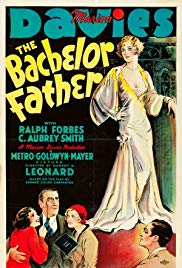
Sir Basil Winterton (C.Aubrey Smith) is The Bachelor Father (1931); though never married, he has managed to father three children with three different women. Now getting on in years and not in the best of health, he asks his lawyer John Ashley (Ralph Forbes) to locate the now-grown children: Geoffrey Trent (Ray Milland), Maria Credaro (Nena Quartaro), and Antoinette Flagg (Marion Davies), so that he can finally have a relationship with them. But, will they want a relationship with him? Marion Davies is thoroughly delightful as Tony (don't DARE to call her Antoinette!), a vibrant and winning young lady who is eager to discover a new family, but unwilling to compromised herself to do so. The audience knows early on that Tony is not actually the daughter of Sir Basil (she had a half-sister, also named Antoinette, who died before Tony's birth). The script - and Ms. Davies - make it transparent that Tony is not there for wealth, she's there simply to meet her father - and if she doesn't like him, she's leaving!! Marion Davies is an engaging actress who really should be seen more often. Though she was concerned about the move to talkies, she should not have been. Ignore the stories that she is the model for the untalented second Mrs. Kane in Citizen Kane - she's not. In his introduction to The Times We Had by Marion Davies, Mr Welles said: "Marion Davies was one of the most delightfully accomplished comediennes
in the whole history of the screen. She would have been a star if
Hearst had never happened. She was also a delightful and very
considerable person." (WellesNet) With all the stories about William Randolph Hearst being the model for Charles Foster Kane, it's often forgotten that Citizen Kane is a work of fiction. It is true that Hearst wanted her to succeed as a dramatic actress, but Ms. Davies far preferred comedy. Her comedic timing was impeccable, and while I'm sure she is an excellent dramatic actress, her gift really was in comedy, as is evidenced in this film (which she also produced).
There are many Marion Davies stories - this one is rather nice. After Cecil Beaton commented that she was one of the six most beautiful women in Hollywood, he was invited to photograph her. When she arrived, she was wearing a high-neck dress. He had hoped to photograph her with bare shoulders - so she cut up the dress to give him the picture he wanted (TCM article).
C. Aubrey Smith is delightful as the curmudgeony Sir Basil. Mr. Smith was reprising his role from the 1928 Broadway play. Even though this was a pre-code film, there were still issues (that were apparently disregarded) concerning the subject of the film. The Hays Office wanted the title of the film changed and no reference to the Broadway play, so that Sir Basil was not a bachelor, but multiply-divorced. As it was, because it was clear that the children were illegitimate, several countries and U.S. states changed the dialogue to muddy the children's status. As you can see by the advertisement below, the studio ignored the order. (AFI catalog).
This was Ray Milland's ninth film role, and while its not a big one, he does make an impression as Geoffrey, who despite his mother's antipathy (probably well-deserved) to Sir Basil, wants to form a relationship with his father. Mr. Milland worked for years, often as second lead, until he won an Oscar for The Lost Weekend (1945). But he had already done some really choice parts, including Gary Cooper's youngest brother in Beau Geste (1939), Ginger Roger's benefactor in The Major and the Minor (1942), and the musician who's house is haunted in The Uninvited (1944). Mr. Milland would act and direct until just before his death in 1986. He was survived by his wife of 54 years and two children.
Ralph Forbes doesn't have an awful lot to do - he's mainly there as a love interest for Tony (honestly, the butler, Larkin (played marvelously by Halliwell Hobbes) is more interesting than Mr. Forbes. Mr. Forbes had a substantial film career, that extended from silents to the television era; he also appeared in 14 Broadway plays between 1924 and 1950. He was briefly married to Ruth Chatterton and to Heather Angel. He died in 1951, at the age of 46.
A French version of the story, entitled Le père célibataire and starring Lili Damita, was released the same year as this version. Though successful upon release, the subject matter made sure it was not available for viewing after the Code was enforced. If you get a chance to see it, please do - we think you will enjoy it, and perhaps fall a little in love with Marion Davies.
Jerry Mulligan (Gene Kelly) is An American in Paris (1951). An ex-GI with ambitions to become a painter, Jerry remained in Paris after the war, and now lives hand-to-mouth, but relatively happily, in his adopted homeland. Well-liked by his neighbors, his closest friend is composer Adam Cook (Oscar Levant); otherwise he's a fairly solitary man, focused on creating a body of work. But in a 24 hour period, his world is upended - he meets Milo Roberts (Nina Foch), a wealthy woman who aspires to be his patron (and perhaps more) and Lise Bourvier (Leslie Caron) who Jerry loves on first sight. Of course, there is an additional wrinkle - Lise is engaged to Adam's friend Henri Baurel (Georges Guetary). The Baltimore Symphony Orchestra provided the music in this screening of the film, and the ballet sequence that is the highlight of the movie was even more spectacular with Gershwin's tone poem for orchestra danced to a live orchestra. While the spoken dialogue was a trifle muddy at times, all of the music (and the songs) were exquisite in this screening (You can hear the Detroit Symphony Orchestra play this magnificent piece here). Directed by Vincente Minnelli and choreographed by Gene Kelly (with an assist from Carol Haney), An American in Paris (1951) is a daring film. The closing ballet is over 17 minutes long; from the time it starts until the picture ends, there is NO dialogue - spoken or sung. The number was also quite expensive to film - nearly a half a million dollars (TCM article), but Louis B. Mayer was willing to do it (the success of The Red Shoes (1948) helped convince him)
One number that doesn't get talked about often is the "By Strauss" number, featuring Mr. Guetary, Mr. Kelly, Mr. Levant and Mary Young, the flower seller who dances with Mr. Kelly. Ms. Young was 72 when she appeared in the film, and she is lovely as she waltzes with Mr. Kelly. A stage performer (she first appeared on Broadway - in a musical - in 1899), she started her film career in 1937, primarily playing small roles - often uncredited - as older women. She worked in film and on television until 1968. She died in 1971 at the age of 1971. This was Leslie Caron's first film. Vera-Ellen, Cyd Charisse, Sally Forrest, Jeanine Charrat, and Odile Versois were all considered for the role, but both Gene Kelly and Vincente Minnelli wanted a "fresh" face for the part. Mr. Kelly had seen Ms. Caron perform with the Roland Petit ballet company (AFI catalog); Mr. Kelly's widow later said that only Ms. Caron and Ms. Versois were tested (Los Angeles Times), but it has often been reported that Ms. Charisse had dropped out of consideration for the part because of her pregnancy (The Spectator). Though I'm not always a fan of Ms. Caron, she is excellent as Lise, giving the part a gravity that it requires.
One thinks of this picture as Gene Kelly's, but Fred Astaire was also considered - regardless, this is Mr. Kelly's part without question. His athleticism gives the character a strength that is essential for this man who has fought a war, remained in a foreign country, and thrown all his resources on a career that may or may not pan out. Fred Astaire would later dance with Leslie Caron in Daddy Long-Legs (1955), but the chemistry just wasn't there. The pairing of Kelly and Caron is magical.
Maurice Chevalier was at one point in the running for Henri (however, his possible collaboration with the Nazis during World War II finalized that casting). Though Georges Guetary was too young and too good-looking for the character as originally conceived, the film doesn't emphasize the age difference between Lise and Henri as being the obstacle to their happiness - that she has found her perfect match in Jerry is the issue.
A number of familiar faces pop up in unbilled appearances - John Eldredge and Anna Q Nilssen are unbilled as Jack and Kay Jansen, as is Hayden Rorke as Tommy Baldwin (Mr. Rorke would become a television favorite as Dr. Bellows on I Dream of Jeannie). Take a good look at the Third Year Girl who criticizes Jerry's work - that's Noel Neill who would appear as the second Lois Lane in The Adventures of Superman TV series.
An American in Paris was nominated for 8 Oscars - it won six : Picture, Writing, Art/Set Direction, Costume Design, and Scoring (Director Minnelli and Film editor Adrienne Fazan were nominated). It was added to the National Film Registry in 1993, is #9 on the AFI's Greatest Musicals of All Time and #65 in the original 100 Years, 100 Films lists. It is truly a remarkable film. Here's the trailer to introduce you to these splendid dance number:
Larry Hall (James Stewart) has a vision for ice shows - he sees them as extravaganzas, that tell stories through ice dancing and music. He has hired Mary McKay (Joan Crawford), a singer with no skating expertise to participate in his show, but is finding it hard to get jobs. No one wants anything more than skaters doing tricks. But Mary and Larry are in love, and when Mary realizes she is part of the problem, she separates herself from the ice show by talking her way into a film contract. But there is another issue - Mary and Larry have to hide their marriage. Her contract will only allow her to marry with the studio's permission. In celebration of James Stewart Day (August 7th) during the 2019 Summer Under the Stars festival on TCM (and as part of the Summer Under The Stars Blogathon), we'll be discussing Ice Follies of 1939 (1939). Louis B. Mayer wanted a skating picture to compete with those of 20th Century Fox's Sonja Henie (Musicals in Film: A Guide to the Genre by Thomas S. Hischak), but was unable to find a skating star of Ms. Henie's caliber. So, he took two of his biggest stars, and threw them headfirst into an ice skating extravaganza. There was, of course, a big issue - neither Joan Crawford nor James Stewart could skate.The solution was avoid showing them on skates - except in the advertisements (see below) - and just talk about them skating.
Given the cast, one would assume that this film from Hollywood's Golden Year would be exceptional. Unfortunately, it's not. The script is so mediocre that it is impossible for the actors to work successfully within it. There are some fun bits (like the running joke about Ms. Crawford's poor skating and a scene in which a doorman calls out the arrival of cars to a variety of MGM stars - great publicity for the studio!!), but by and large, the screenplay is routine, and doesn't capitalize on the skills of the actors.
Why they even bothered to have Lew Ayres as Larry's best friend, Eddie Burgess is one issue. He is such a good and engaging actor, and they give him precious little to do. As Larry's best friend, you would think he would serve as a sounding board for Larry when troubles begin, but the character is shipped out the minute problems begin. He reappears when things are looking up for Larry, and the only function he serves is as a sort of Yes Man for Larry's plan. By having Mr. Ayres in the part, you expect more, and are disappointed when he is gone. Joan Crawford was likely never supposed to skate, but she was supposed to sing. She recorded three songs for the production, but all were cut (AFI Catalog), and when she does sing, her voice is dubbed. Ms. Crawford would later state that the reason for the cuts were Jeannette MacDonald's jealousy of Ms. Crawford's vocal talents (TCM article). The very idea is idiotic; we've heard Ms. Crawford sing (Dancing Lady (1933)), and she's no coloratura.
One shock is the design of Ms. Crawford's appearance in the film (see above) - her hair is darkened and parted in the middle; her makeup is more elaborate. Given how protective Ms. Crawford was of her appearance, it's a surprise she would have consented to this new look! Ms. Crawford was not happy with the production, so MGM gave her a juicier part that same year - Crystal Allen in The Women.
Lewis Stone's Douglas Tolliver Jr. - the head of Monarch Studio - is the image that Louis B. Mayer wanted the public to believe was him, but, of course is not. Tolliver hires Mary because she says she doesn't want to be an actress (after she forces her way into his office, allegedly to collect $20 for damage caused by his chauffeur to Eddie's car). He's sweet, supportive, and a genuinely nice man. Ah, would that life imitated art!
Lionel Stander is also present as producer Mort Hodges. Like Tolliver, he is a good guy, and Mr. Stander plays him as the one person who believes in Larry's dream. Mr. Stander was about to have problems with HUAC (in 1940) that would continue on until he was blacklisted in 1951 (You can read his bold stand before the committee: The McCarthy Hearings by Philip Brooks). He eventually settled in Italy, where he appeared in spaghetti westerns like Once Upon a Time in the West (1968). When the TV series It Takes a Thief was filming in Italy, Robert Wagner asked Mr. Stander to appear in an episode of the show. This would lead to Mr. Stander's casting as Max, the man-of-all-work to the Harts in Hart to Hart. Mr. Stander died in 1994, aged 86, of lung cancer.
Which brings us to our Star of the Day, James Stewart. Like Ms. Crawford, he was unimpressed with the script. He plays Larry as a decent guy, who's trying to be supportive of his wife's carer - even to the point of cooking and cleaning as she supports them financially. But without anyone to bounce off, the character flounders, and it's hard for the audience to get to know him. There's precious little chemistry between him and Ms. Crawford, but he gives as good a performance as he can, given the limits of the script. He too would see better days that same year - he would appear in both Destry Rides Again and Mr. Smith Goes to Washington, and be nominated for the Best Actor Oscar for the latter performance.
The New York Timesreview by Frank S. Nugent was negative ("Far be it from us to rap one of Mr. Rapf's more glittering productions;
what we mildly object to is the fact that the glitter does not extend to
the dialogue,"); the New York Herald Tribune said Ms. Crawford "should avoid this type of film in future, where she has to buck poor material, a group of specialists and Metro's own lavishness" (Skating on Air: The Broadcast History of an Olympic Marquee Sport by Kelli Lawrence). All in all, The Follies were a folly, but it did give Mr. Stewart the opportunities that would advance his career greatly (leading to his Oscar win for The Philadelphia Story the following year.