On the New England shore is a cottage which the locals believe is haunted. To Laura Pennington (Dorothy McGuire), a pennyless waif who is described by young Danny Hillgrove (Alec Englander) as homely, it is The Enchanted Cottage (1945). Laura is thrilled when she is asked to work there as a maid by the owner, Abigail Minnett (Mildred Natwick), a reclusive widow. Before Mrs. Minnett settled in the house, it was rented to honeymoon couples; Oliver Bradford (Robert Young) discovers the house and convinces Mrs. Minnett to allow him and his bride-to-be, Beatrice Alexander (Hillary Brooke), to honeymoon there. But their visit is delayed by the start of World War II, and when he does arrive, Oliver comes alone - a shell of a man, disfigured in a wartime accident. Told in flashback by Laura and Oliver's mutual friend, composer John Hillgrove (Herbert Marshall), we know from the beginning that Oliver and Laura are a couple. We also know that they are well-liked in their community. What the story brings is the long road they must travel to feel themselves worthy to be with other people. One particularly telling scene in the story of Laura's yearning for love occurs at a Canteen dance. Filled with airmen, Laura is ignored by everyone; men start to approach her, but when they see her, they turn back or avert their gaze. It's a heartbreaking moment, and one with which every young woman can identify. Because of this, Laura retreats back to the cottage where she hides with Mrs. Minnett, who herself bears scars that have caused her to secrete herself within the safe precepts of the house.
What the film is NOT is sensational (one wonders what film the designer of the poster above was watching when he created the tag line!) This is a sensitive and moving film, based on a play by Sir Arthur Wing Pinero. The play was written in 1922 as a morale booster for soldiers who were disfigured during the First World War (TCM article). That it would be redone as the Second World War ended is not surprising - sadly, it still had a tale to tell to GIs returning from Europe and the Pacific (a similar story is told by Homer Price in The Best Years of Our Lives (1946).
Robert Young is excellent as an exuberant young man plunged into depression by his family's reactions to his injuries. The revulsion displayed by Violet Price (Spring Byington), Frederick Price (Richard Gaines) - Oliver's mother and stepfather - and Beatrice all combine to drive Oliver to consider suicide. Mr. Young shows us the hatred that he has for his family, for himself, and for the world that robbed him of his secure vision of the future. Joseph Cotton was briefly considered for the part of Oliver (he'd previously played battle-scarred vets in I'll Be Seeing You (1944) and Love Letters (1945)) (AFI catalog). Mr. Cotton would surely have been excellent, but it is hard to imagine anyone but Mr. Young in the part.
It's hard to make Dorothy McGuire plain. She is an exquisite woman, with a radiance that make her pretty face even more beautiful. In prior productions of the piece, Laura was given a real physical defect - buck teeth, a crooked nose, a limp - but this film makes Laura homely with a bad hairdo, no makeup, and dull lighting. As Bosley Crowther points out in his (unfavorable) New York Times review, "a girl of moderate features (and fair intelligence) can make herself look very sweet." But herein Mr. Crowther misses the point that Ms. McGuire fully understands. Laura is homely because she feels that she is homely and undeserving of love. Ms. McGuire enacts a woman who has grown to fear the world; she's been told so many times that she is plain that she feels it is hopeless to even try to be appealing. It's a masterful stroke - one that makes the viewer identify with Laura even more. Like Mr. Young, Ms. McGuire was not the first choice for the part - both Ginger Rogers and Teresa Wright were considered.
Herbert Marshall as the pianist blinded in the last war is superb as the man who slowly leads Oliver back to the land of the living. And Mildred Natwick - it's impossible for her to ever make a wrong turn. Her love for Laura, her sympathy for Oliver, and her belief that they can have for each other the love that she lost when her husband died is moving beyond imagining. Hillary Brooke is also convincing in her major scene - asked by Oliver's mother to try to get him to come home, she does so reluctantly. Her horror at the changes in him are matched only by her disgust with herself for this reaction to the man that she believed she loved. Also worth noting is the brief appearance by Josephine Whittell as the thoughtless Canteen manager who forces the delicate Laura onto the dance floor with the cruel and uncaring soldiers. Ms. Whittell's career extended from 1917 to 1948. Many of her appearances were uncredited and unnamed (like this part). She also appeared in several Broadway plays between 1911 and 1926 (including No, No Nanette). She died in 1961, three years after her final film appearance in The Buccaneer.
As we mentioned before, The New York Times was dismissive of the film (Mr. Crowther also thought that simple plastic surgery could heal what is obviously severe neurological damage that causes Oliver's face to droop on one side, and his arm to be unusable); Variety, however was complimentary. In 2014, this film was Robert Osborne's pick for his evening of films, and was one of Whoopi Goldberg's picks when she was guest programmer in 2007. The film did get one Academy Award nomination - the score by Roy Webb was nominated (but lost to Miklos Rozsa's Spellbound). This is the second film version of the play - the first was in 1924, with Richard Barthelmess and May McAvoy as Oliver and Laura; in 2016, it was filmed again, this time Paul D. Masterson and Sarah Navratil in the leads (the war in this case is in Iraq). Robert Young and Dorothy McGuire reprised their roles in the Lux Radio Theatre edition of the story in September of 1945. Academy Award Theatre did a radioplay in December 1946, with Peter Lawford, Joan Loring, and Herbert Marshall. September of 1953 saw a General Electric Theatre version with Joan Fontaine and Dan O'Herlihy; and in September of 1955, Lux Video Theatre presented the story, with Teresa Wright, Dan O'Herlihy, and Sara Haden. It was even spoofed by Carol Burnett in her version entitled The Enchanted Hovel. We'll leave you with the film's trailer and a hearty recommendation to view this lovely movie:
John Parrish (Glenn Ford), a former captain in the Union Army, has spent three years in the West, recovering from his wartime injuries. Engaged to Caroline Vail (May Wynn), Parrish has decided to sell his ranch and return east at Caroline’s urging. The only potential buyer is Lew Wilkison (Edward G. Robinson), the owner of Anchor, a huge estate. It's no surprise when Wilkison underbids for Parrish's ranch. But Parrish is infuriated and a new war is set in motion when Cole Wilkison (Brian Keith), Wade Matlock (Richard Jaeckel), and The Violent Men (1955) murder John's ranch hand Bud Hinkleman (Bill Phipps) to "convince" Parrish to take the offer. This is an adequate western, with a stellar, though not well-used cast. Glenn Ford is fine as a man who seems condemned to using violence, even though he yearns for a life of peace. His interactions with Edward G. Robinson are good (though short and on the technical side). Also convincing are his scenes with Dianne Foster as Judith Wilkison, the daughter of Lew and Martha (Barbara Stanwyck). Mr. Ford is quoted as saying this was one of his favorite films - primarily because he got to work with Ms. Stanwyck and Mr. Robinson (Glenn Ford: A Life by Peter Ford).
What we missed were strong exchanges between Ms. Stanwyck and Mr. Ford or Mr. Robinson. Ms. Stanwyck's key scenes are with Brian Keith, an actor we all admire, but who is given precious little with which to work. Cole Wilkison is a villain - he's out for money and for sex; if he is able to hurt or kill someone while getting it, all the better. But his motivations are one-dimensional. As a result, the dialogue between these two fine actors is mere speechifying. It's a waste of talented performers who can give so much more. In Peter Ford's book, he says that he believed his father had fallen for Ms. Stanwyck. That alone makes you wish for just one scene in which she and Mr. Ford really talked.
In his book Barbara Stanwyck: The Miracle Woman, author Dan Callahan says: "whenever Stanwyck has blond hair in a movie...get out
of the way, buster, there's going to be a lot of trouble" and he is certainly correct in this instance. Martha is, without a doubt, one of the most unscrupulous characters Ms. Stanwyck has ever done. I'm sure you are thinking - "wait, what about Phyllis Dietrichson? Martha can't be worse than her!" But Indeed Martha is worse, because there is no depth to the character. Ms. Stanwyck tries, but she doesn't have the tools, in the form of a script, which allow Martha to have some substance. Ms. Stanwyck has one really good scene, in which she and Edward G. Robinson are trying to escape a burning house. It's only a moment, there is no real dialogue, but it is proof that when you have two dynamic actors, the results are electric.
Lew Wilkison has managed to distance himself from the current violence; Edward G. Robinson's portrayal is of a man who wants the power, but feels himself emasculated by the injury that limited his ability to walk. His daughter, Judith, as portrayed by Dianne Foster is far different than either of her parents. Initially unlikable, Judith becomes the only truly good character in the film. She has one goal, and it is not that of either of her parents. There is, however, a bond between father and daughter that is certainly not evident with her mother. Lew shows a concern for his child; Martha would rather just send her away. Ms. Foster had a brief film career; between 1953 and 1958, she was in 11 films (including The Kentuckian (1955) and The Last Hurrah (1958)). Beginning in 1959, she mostly appeared on television, guesting in shows such as The Wild, Wild West, Hawaiian Eye, Ben Casey, and Perry Mason. She's been married three times; her last marriage to Dr. Harold Rowe was in 1960 - the couple were together until his death in 1999. Ms. Foster has three children and lives in California, where she is a painter.
Based on the novel Smoky Valley by Donald Hamilton (AFI Catalog), the film does not appear to have been well received; Though it is a beautifully filmed movie, done in Technicolor and Cinemascope, the New York Times review by Bosley Crowther said: "If, at the end, it leaves you feeling you've seen just another horse-opera...it's no wonder, for that's what it is." The New York Herald-Tribune called the two leads "Little Caesar in buckskin" and "Lady Macbeth of the plains" (TCM article). It's not that it's a bad movie, it's just not a good one. With such a good cast, it's worth a single viewing (but if you have to choose a Stanwyck western, go for Trooper Hook). Here's a trailer from the film:
Marsha Meredith (Rosalind Russell) has been nominated for a federal judgeship. Standing in her way is her recent divorce from Peter Webb (Bob Cummings), an acrimonious affair that is frowned upon by the Senate committee investigating her. To make matters worse, Peter is interfering in the proceedings; Peter wants Marsha back. But Marsha - and her Grandfather (Harry Davenport) - want him out of her life. Marsha suspects him of having an affair with Ginger Simmons (Marie McDonald) who Peter - a lawyer - claims is a witness; Grandpa just doesn't like him. Our film is Tell it to the Judge (1949). We are all admirers of the wonderful Rosalind Russell, and were looking forward to this film. We were, unfortunately, quite wrong - it's awful on many levels. Primarily, it's really hard to view in 2019 - the antics of Peter Webb in his quest to get his wife back are horrific. Why any woman would want to marry him is really beyond our ken. Ms. Russell does her level best to make some sense of Marsha, but it's quite impossible, and by the end of the film, you wonder why she would involve herself with such a bunch of schlemiels. Jeanine Basinger calls Marsha one of the "nightmare career women" Ms. Russell played during the 1940s (A Woman's View: How Hollywood Spoke to Women, 1930-1960) - Ms. Russell recalled at least 23 such parts (TCM article). Which brings us to Robert Cummings - I've mentioned before that most of my group are not fans (see our entry on him in For Heaven's Sake). He's even worse in Tell It to the Judge. He doesn't bother to act - he mugs, he overdoes everything, he's shrill. The character is abusive and stupid, constantly putting Marsha into situations designed to do her bodily injury. Even a scene as simple as Cleo (the badly used Louise Beavers) trying to get a ton of luggage out of the room points out his callousness. Certainly, a lot of it is the script, but Mr. Cummings brings nothing to the part. We wondered if a more competent and appealing actor (Cary Grant) might have had a more positive effect on the film - it would certainly be an uphill battle.
Harry Davenport is an actor we always enjoy, but not here. Gramps is a bully in a different direction. HE'S decided Marsha should be a federal judge, and it is implied that he has helped manipulate the divorce because he sees Peter as a hindrance. With the exception of a scene in the middle of the film where he attempts to shanghai Peter, Mr. Davenport has precious little to do. It's a waste of a wonderful actor. Marie MacDonald's character is in genuine danger from gangsters, but the film plays this down to rev up the "other woman" angle. She's not at all interested in Peter (a woman of sense), but she is afraid for her life, and he's the only person in a position to help her. By trivializing her danger the film again demonstrates that Peter is a jackass who cares for no one but himself.
When we meet Alexander Darvac (Gig Young), we initially think he might be a better match for Marsha. But as the film progresses, we realize he is just as bad - if not worse - than Peter. It's clear that Mr. Young has no clue who this fellow is; basically he's just another abusive male in this woman's life. With a screenplay - originally titled My Next Husband (AFI catalog) - that has random scenes that are way too long and characters that are cruel manipulators, we have to agree with Bernard F. Dick when he calls the film "low farce jacked up a few notches to screwball without the accompanying wit" (Forever Mame: The Life of Rosalind Russell). Unless you are a Rosalind Russell complete-ist, this is one to avoid.
When the ancestral home of the de Canterville's is sequestered for use by the U.S. Army, the heiress, Lady Jessica de Canterville (Margaret O'Brien) meets an American decendent of the family Cuffy Williams (Robert Young). They also meet the resident ghost, Sir Simon de Canterville (Charles Laughton) who was condemned to walk the halls of the house until a descendant performs an act of bravery. Could Cuffy be the one to free The Canterville Ghost (1944)?
As part of the 10th Anniversary celebration for the Classic Movie Blog Association, we're featuring film-related anniversaries. Now 75 years old, The Canterville Ghost is also part of the memorials for the Second World War and D-Day (it was released in August, just two months after the invasion).
Let's begin by mentioning that the screenplay, adapted from an Oscar Wilde short story of the same name, has only marginal similarity to its inspiration. This is very much a World War II tale - there is no need for a descendant to perform an act of bravery for Sir Simon in Wilde's version. For one thing, Sir Simon's crime in Wilde's story is far more deserving of his horrible fate - in an unjustified fit of jealousy, he murders his innocent wife. In the film version, Sir Simon runs away from an opponent in a duel - even Sir Simon's adversary thinks his punishment horrific. Because the victim of his crime in the Wilde novella was a woman, Sir Simon must be saved by a woman: "you must weep for me for my sins, because I have no tears, and pray with
me for my soul, because I have no faith, and then, if you have always
been sweet, and good, and gentle, the Angel of Death will have mercy on
me." (The Canterville Ghost by Oscar Wilde). The idea of courage under fire was deemed more meaningful in the midst of the war.
As we saw inJourney for Margaret (1942), the chemistry between Margaret O'Brien and Robert Young is outstanding. He's also faced with the unenviable task of playing a coward as his country (and the viewers of the film) face an horrific war. It cannot have been easy to play a man who begins the film running from danger, but Mr. Young takes on the task. He makes Cuffy even more the hero, because the audience is aware that he is truly afraid. (Mr. Young remained in Hollywood during World War II. He participated in war bond rallies and worked with the local civil defense.)
Equally enjoyable are the scenes between Charles Laughton and Ms. O'Brien. He was "enchanted" by Ms. O'Brien (TCM article) and their affection shows. It's been said that Mr. Laughton wanted children, however his wife, Elsa Lanchester, was either not willing or unable to have children (she admitted to at least two abortions). Mr. Laughton was allegedly quite receptive to interactions with youngsters - in fact, his only work as a director, The Night of the Hunter (1955), focused on two children. We were especially takien with the dancing sequence in which a young soldier asks Lady Jessica to dance. As the child is unfamiliar with swing dancing, the soldier does all the steps for her. Ms. O'Brien really gets into the routine - even when she is unable to do something, she turns control over to her partner. It's a lot of fun to watch.
The film also demonstrates the skills of a number of excellent character performers: Una O'Connor (Mrs. Umney) is good as Lady Jessica's nanny. William Gargan (Sargent Benson) has just the right amount of military demeanor for a man who has literally just seen a ghost. Peter Lawford (Anthony de Canterville) dons a blonde wig that we suspect he stole from June Allyson to play Sir Simon's brother. Reginald Owen (Lord Canterville) is autocratic as a man who values courage over the life of his son. The film was originally to be directed by Norman McLeod, but Charles Laughton was concerned with Mr. McLeod prior experiences with broad comedy (he was the director on two Marx Brothers and one W.C. Fields films), and requested that he be replaced. Jules Dassin stepped in, and he and Mr. Laughton got on swimmingly. As this was one of Mr. Dassin's earliest feature films, Mr. Laughton provided advice in private, which the director found helpful.
There have been numerous adaptions of The Canterville Ghost. An early television broadcast (September 1949) starred Wendy Barrie and Edward Ashley. The following year, Robert Montgomery Presents Your Lucky Strike Theatre (November 1950) had a version with Cecil Parker and Margaret O'Brien. In April of 1951, the Du Mont network aired a show with Lois Hall and Reginald Sheffield. May 1953 saw Ziv TV show the story with John Qualen and Connie Marshall. It was made into a musical in November of 1966 - again on television - with Michael Redgrave, Douglas Fairbanks, Jr. and Peter Noone (of Herman's Hermits fame), John Gielgud and Andrea Marcovicci were in a 1986 television film, and Patrick Steward and Neve Campbell tackled the parts in 1996. (AFI catalog). A Film Commentarticle from 2018 calls this version "the strangest one of all," but we agree with them that it is "definitely charming." Here's a trailer:
This post is part of The Anniversary Blogathon hosted by The Classic Movie Blog Association - celebrating it's 10th Year. Happy anniversary, fellow members! Please visit the website to read the other posts that are part of this celebration.
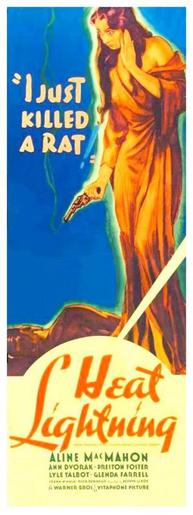
Sisters Myra (Ann Dvorak) and Olga (Aline MacMahon) run a gas station/diner/motel deep in the desert of the American Southwest. Isolated from the rest of the world (except for the customers who are always heading somewhere else), Olga is protective of her younger sister. She forbids her from socializing with men, especially Steve Laird (Theodore Newton), much to Myrna's fury. Olga's life is disrupted by the arrival of George (Preston Foster), a man who was once Olga's lover. Our film this week is Heat Lightning (1934). Aline MacMahon is always remarkable, and this film is no exception. When we meet Olga, her face is closed. She interacts with strangers on a business level only. She is not unfriendly, but distant and cautious. With the arrival of George (who Olga - and only Olga - calls Jerry), Ms. MacMahon changes her whole demeanor. The suspicion begins to slowly melt into affection, and finally into the hope for a resumption of their earlier relationship. Some of this is accomplished with costuming, as Olga literally lets down her lush hair (George had commented on the beauty of her thick, long hair), but most accomplished with Ms. MacMahon's eyes and posture. This was the first picture in which she received star billing, and she makes the most of it. Ann Dvorak's part is relatively small, but the last scenes in which she appears are very strong and truly heartbreaking. Myra's early rebellion and the results that revolt make it appear that the sisters will end up very much alike. The emptiness in Ms. Dvorak's face tell us the future of Myra far better than words could.
We're not used to seeing Lyle Talbot (Jeff) play a weakling, but he does here. By the end, he develops a small amount of backbone, but primarily he is under the thumb of the domineering - and nasty - George. We previously discussed his impressive film career when we viewed A Lost Lady, but this was a new side to a decidedly versatile, and underrated, actor. Frank McHugh (Frank) is also playing a somewhat different part from his usual sidekick roles. He's a chauffeur to Mrs. Feathers Tifton (Glenda Farrell) and Mrs. Tinkle Ashton-Ashley (Ruth Donnelly), two new divorcees, on their way home (with LOTS of expensive jewelry) from Reno. Surprisingly, Mr. McHugh is also the current object of both their affections! Mr. McHugh is amusing and effective with relatively little screen time. But seeing him as an object of lust does take some getting used to. As is often the case, Glenda Farrell doesn't get enough to do, though her interplay with Ruth Donnelly is especially fun. They are a good combination; in the end, Ms. Donnelly gets the better lines and the stronger part.
The script is intriguing, in that the backstory is supplied in tiny spoonfuls - you get just enough to understand Olga, and no more. It's script writing by insinuation, and is effective. You keep watching the movie to find out more, as you are given just a tad more information about Olga's life in the city. While several of the characters seem extraneous - the girls who arrive with "Popsy" (Harry C. Bradley), for example - it's evident by the end of the story that each of these visitors is telling us more about Olga and her decision to live in the desert. As you can see, it's an amazing group of character actors - Jane Darwell also appears in the opening scene as Gladys, wife to henpecked husband Herbert (Edgar Kennedy), a couple motoring through the desert with a really unreliable jalopy. It's another humorous interlude, but fascinating as well - Olga is a skilled mechanic, better than most men - even in the precode era, it's not usual to see a woman who is skilled at a trade.
The story was based on the play, Heat Lightning which was on Broadway for a month in 1933. and starred Jean Dixon as Olga. In 1941, there was remake (of course, drastically altered. The remake was, after all, well within the code) as Highway West (1941) (AFI catalog). Reviewer Mordaunt Hall of the New York Times was not enthusiastic about the film in his review, but did like Ms. MacMahon, saying "she gives a believable performance the rôle is not well suited to her". We disagree; there is not a part written which Ms. MacMahon cannot in some way make suit herself.
Released in March of 1934 (just 4 months before the Code began to be strongly enforced), the picture has not been widely circulated since then, as it was on the Legion of Decency's Banned List (TCM article). We think that it's a shame it - and its star - are not better known, and really recommend a viewing. Here's a trailer to get you started:
When Lily Bishop (Barbara Stanwyck) is accused of cheating at cards and ejected from town, California (1947) bound Michael Fabian (Barry Fitzgerald) invites her to join him on his trip west, despite the objections of the other train members, and its leader, Jonathan Trumbo (Ray Milland). News of the discovery of gold at Sutter's Mill disrupts the train, as Lily and most of the train break off to rush to the scene. Trumbo arrives at Pharaoh City to find Lily has opened a saloon and is working with Pharaoh Coffin (George Coulouris), a former slave trader and a man with ambitions of becoming the Emperor of California. Barbara Stanwyck in a Western - seems like it should be a perfect combination. Unfortunately, with California, other factors get in the way of making this a worthy venue for Ms. Stanwyck. First and foremost is the script - it's a hodge-podge of themes that don't ever come together effectively. First we have a gambling lady escaping to a new land, with a group of pilgrims seeking a new home. Next, it's an hysterical mob careening to the gold rush territory. Tnen, it's our gambling lady trying to run a saloon, and finally, it's a battle for statehood. Huh? All these points come across as separate story lines; there's no cohesion among them, which makes the story disjointed and unappealing. Even the fight scenes seem awkward.
Ms. Stanwyck is also working with an unfinished role: the character of Lily is not really fleshed out. We get a modicum of backstory (her father was a gambler), but then out of nowhere, Lily really wants to get married, and she's seemingly willing to take the first man who proposes, whether worthy of her or not. Add in the fact that there is no chemistry at all between Ms. Stanwyck and either Mr. Milland or Mr. Coulouris. Quite frankly, we thought Lily would have been better off with Barry Fitzgerald. Lily was originally earmarked for Betty Hutton (AFI catalog) but she declined to go on a honeymoon with her first husband. The remnants of Ms. Hutton probably remain the in singing numbers Ms. Stanwyck performs (with vocals by Kay St.Germaine).
Ray Milland was also the second choice; Alan Ladd had been assigned by Paramount, but he was in a salary dispute, so Mr. Milland was give the part. It's a thankless character - a trail boss, who (it turns out) is an army deserter. He's not very appealing, he's downright nasty to Lily. It defies even the idea of "meet cute" that he would be her love interest. Mr. Milland is a good actor, but he needs a character to work with, and he doesn't have one in this picture.
Another actor who was considered for casting was Victor McLaglen as
Pharoh Coffin (may I add, that who came up with THAT name??). George
Coulouris does the best he can, but Coffin is a villain with not one
redeeming quality. That Lily would even consider marrying this truly
despicable man is a head shake - he's got money, but no personality and
not a whit of kindness.
Anthony Quinn (Don Luis Rivera y Hernandez) has about two scenes. It was a role that deserved more development; because of the lack of distinction, when he's gone, you forget about him (which is not the point).
The only actor who manages to give his part distinction is Barry Fitzgerald. Michael Fabian is a good man: you like him and Mr. Fitzgerald's portrayal of him from the beginning. Though he unavoidably gets caught up in the script confusion, generally speaking, Michael's actions make the most sense of anyone in the story.
What the film does have is beauty - this is a lush technicolor film. Director John Farrow and director of photography Ray Rennahan use the background to good effect, presenting exquisite vistas of the California country-side (an early montage is an especially lovely piece of work). Edith Head's magnificent costumes for Ms. Stanwyck are breathtaking. And the necklace that Ms. Stanwyck wears in the picture below was a family heirloom that Mr. Farrow provided for use in the picture. It's amethyst, and has a matching tiara that Ms. Stanwyck also wears in the film.
The Lux Radio Theatre did a version of the film in January of 1950 with Ray Milland, Lizbeth Scott. and Raymond Burr. We were rather intrigued with the idea of Mr. Burr as Coffin - it seemed he might have brought a bit more sinister appeal to the part.
We were stunned to read a positive review of the film from Bosley Crowther of the New York Times, who said that California "glitters with a quite beguiling gleam" Unfortunately, we can't agree. If you are looking for a Barbara Stanwyck western, try Trooper Hook instead. In the meantime, here's a trailer from California:
Miguel (Anthony Gonzalez) lives in Mexico with his large family, shoemakers all. He is especially fond of his great-grandmother, Coco (2017), who was abandoned by her father when she was a small child. Coco's mother, Mamá Imelda (Alanna Ubach) raised her family to despise music, as it was his career as a guitarist that took her husband away from the family. Miguel, however, desperately wants to be a musician, like his idol Ernesto de la Cruz (Benjamin Bratt), but his Abuelita (Renee Victor) will have none of it. So, on El Día de Muertos, Miguel attempts to enter a local talent contest - but first he needs to find a guitar.
This post is part of the Hollywood’s Hispanic Heritage Blogathon hosted by Once Upon a Screen. We were treated to a live orchestral performance to this lovely film, with the National Symphony Orchestra at Wolf Trap playing the score by Michael Giacchino. The film is a delight, winning the Oscar for Best Animated Film in 2018, as well as the award for Best Song for "Remember Me" by Kristen Anderson-Lopez and Robert Lopez. One of the questions that arise from the movie on first viewing is the title - why is it named after the very elderly Coco, and not Miguel, who is the focus of the film. Well, you have to watch the movie to get that answer, but it is a moving reveal. The relationship between Miguel and his great-great-grandmother is a close one. He enjoys being with Grandma Coco - though he is bemused that she is unable to remember his name - but as she is the only one who really listens to him (or so he believes), Miguel feels great affection for her.
The rest of the family, represented by Abuelita, the matriarch of the family, find Miguel to be a bit of a handful. Abuelita upholds her mother Imelda's edict against music, which becomes the crux of Miguel's problem. He feels a call to music, and is a talented guitarist. In this family who loathes music, how is it possible that he could possibly be one of them. His answer - he is the great-great-grandson of his idol, Ernesto de la Cruz.
Thrown by a fluke into the land of the dead, Miguel's family on the other side try to send him home, but with Mamá Imelda's proviso that Miguel will give up music. Miguel attempts to thwart her by finding de la Cruz, and getting HIS blessing to go home. Enter Héctor (Gael García Bernal), an impoverished musician who has all but been forgotten by his family. Héctor agrees to help Miguel to de la Cruz if Miguel will put his photo on an ofrenda so he will not be consigned to oblivion. Mr. Bernal brings just the right amount of sadness to the part to make Héctor sympathetic.
Benjamin Bratt is excellent as de la Cruz, a scoundrel if ever there was one. He voices the part with equal amounts of vanity and arrogance. At the same time, he makes the character intriguing - until we find out more about his past. Be on the listen for Edward James Olmos as Chicharrón (this article in Gizmodo features an interview with Mr. Olmos on his characterization). He's quite wonderful, and will break your heart.
The reviews of this film were quite positive - Roger Ebert called it "a sprightly story;" The New York Times was a bit less enthusiastic, but still enjoyed the film; the Hollywood Reporter called it "one of Disney-Pixar's most engaging efforts." The power of a live orchestra providing background to an excellent movie is something that cannot be emphasized too much. If you have the chance to see one of these film and concert combos, please consider going. I'm going to leave you with a trailer to Coco.
As Harry Potter (Daniel Radcliffe) is about to enter his fourth year at Hogwarts, he is invited by the Weasley family to attend the Quidditch World Cup. The festivities are interrupted by the appearance of the Dark Mark and an attack on the attendees by a group of Death Eaters. This event signals that Harry's fourth year at Hogwarts is very much about a drastic change in his life and safety. This week, we're going to talk about Harry Potter and the Goblet of Fire (2005) Patrick Doyle's beautiful score was front and center as the National Symphony Orchestra at Wolf Trap played the music behind the film. It is truly impressive how much more intense the film is when a live orchestra is enhancing the film (much the way silent movies had a live accompanist). Wold Trap is a large venue, but we had an enthusiastic audience, who really became immersed in the film. We know from the film's very beginning that this is a different film from the first three. The Dursley's are not present, and we enter the film on Harry's nightmare - he sees Voldemort (Ralph Fiennes), Peter Pettigrew (Timothy Spall), and an unidentified man (David Tennant) kill an old caretaker. The dark tone of Harry's dream colors the rest of the film, as Hogwarts too becomes a nightmare world for young Harry - not just because he is forced into the TriWizard Tournament, but also because he is starting to notice girls, especially Cho Chang (Katie Leung).
We are used to Ron, Hermione, and Harry being a united front against the forces of evil, but their relationships are strained as they begin to mature. Harry and Ron Weasley (Rupert Grint) have their first major fight - Ronald is convinced that Harry entered the TriWizard Tournament in secret. Ronald and Hermione Granger (Emma Watson) also fall out when Ron unfairly assumes that Hermione couldn't possibly get a date the Yule Ball. His fury at Hermione (along with the fact that she is attending with one of his personal heroes) ultimately brings Hermione to tears.
One of the delights in seeing this film with a real audience is their reactions to the actors who became part of the franchise. This is especially true for Alan Rickman (Severus Snape), whose appearance on screen always results in long cheers. In spite of his somber attitude, Snape is a favorite of mine. Those of us who have read the full series of books (and seen all the films. Multiple times.) appreciate his dedication to the children's safety as well as the pain that it causes him. Of all the instructors, I believe the Professor Snape is the one person with whom we can all identify.
I recall, while reading this book, breaking into tears on the subway as I came to an event late in the story. The horror that we witness with Harry is unexpected, and author J.K. Rowling knows how to make you feel Harry's pain and shock. If you've never read these books, or seen the films, do seek them out.
We plan on attending more of these concert performances, for Harry Potter as well as for Disney (tune in for another animated film with a symphony score). In the meantime, I'll leave you with this trailer from the film.
Mary Herries (Aline MacMahon) is a wealthy woman with an impressive art collection, and a desire to live in solitude. She has family and friends who visit occasionally, but is quite happy being on her own. She is also a Kind Lady (1935) and finds it hard to resist helping those in need. When street artist Henry Abbott (Basil Rathbone) appears at her doorstep with a sob story, she invites him in for some hot tea and a sandwich, gives him some money, and a warm coat for his wife. It's not long before Abbott reappears, this time with wife Ada (Justine Chase) in tow, and wheedles his way back into the house. But is he as innocuous as he puts on? This is a suspenseful yarn that reminded us of the equally chilling My Name is Julia Ross. Both films focus on a strong female lead being preyed upon by strangers - attempting to mold the heroine to their desires. The story is unsettling - though it's not in any way gory, it's a tale that keeps you on the edge of your seat fearing for the safety of Mary Herries. With Aline MacMahon heading the cast, you know you can't go wrong. She's playing a woman much older than her years - when the play opened on Broadway in 1935, it starred Grace George as Mary. Ms.George was 56 at the time (Ms.George would also play the part on Broadway in a 1940 revival); Ms. McMahon is 20 years younger when she took the part of a woman we know is well into her 50s. Ms. MacMahon brings a determination to the part that makes the audience root for her. Sure, she is a softie, but she's not a weakling. She stands up to Abbott on multiple occasions, and never stops trying to get out of his clutches. For an excellent biography of Ms. MacMahon, visit this Filmstruck post.
Which brings us to Basil Rathbone, an actor who can make even the most heinous villain appealing. Watching Mr. Rathbone play the part (which on Broadway was performed by Henry Daniell, another able malefactor) is like watching a spider spin his web - you want to run, but you can't take your eyes from him. One scene towards the middle of the film is impressive - The Doctor (Murray Kinnell, playing a character who makes Abbott look like a saint) informs him of an "accident." Rathbone's reaction spells out his disgust at the event and his realization that all their plans have changed, and become far more deadly. Rose (Ms. Herries maid) as ably portrayed by Nola Luxford, is a woman who has seen her mistress's sympathies go to people she finds undeserving before. Her distrust of Abbott is evident from the moment she meets him, and Ms. Luxford makes her the only one in the house with the nerve to go to Mary with her concerns. When the film was remade in 1951, the part of Rose would go to Doris Lloyd, who plays Mary's sister Lucy Weston in this version (TCM article).
Frank Albertson (Peter Santard) again gets to play the good guy, as Mary's nephew-in-law-to-be (he is about to marry her niece, Phyllis (Mary Carlisle)). The immediate affection that Mary and Peter have for each other is important to the plot. It's not just that she offers to give the couple one of her prized art works as a wedding gift. Peter is genuinely concerned at Mary's silence and it is his tenacity that brings the film to a satisfactory ending. As previously mentioned, the film returned to Broadway in 1940; appearing in the part of Ada was Dorothy McGuire in one of her earliest stage roles. The 1951 film remake starred Ethel Barrymore and Maurice Evans as Mary and Abbott. The story also made its way to television on two occasions: Ford Theatre (December 1949) starred Fay Bainter and Joseph Schildkraut; and Broadway Television Theatre featured Sylvia Sidney (November 1953) (AFI catalog). This is an excellent film - certainly worth your viewing. We hope at some point to catch (and discuss) the Ethel Barrymore remake. In the meantime, please consider seeking this one out.
John Shadwell (John Boles) and Vergie Winters (Ann Harding) were planning to marry, but Vergie's father (Edward Van Sloan) told John that Vergie is instead marrying Hugo McQueen (Creighton Chaney). In pain, John marries Laura Shadwell (Helen Vinson) on the rebound. But Jim Winters had been paid $10,000 to tell the lie, and trick John into the marriage with Laura. Unable to divorce his wife, John visits Vergie on a regular basis, while his political star begins to rise. Our film this week is The Life of Vergie Winters (1934). Based on Louis Bromfield's short story (AFI catalog), this film is similar to the stories that are told in Forbidden (1932) and Back Street (1932) - a couple whose true love is thwarted by circumstance, but stay together despite the rules of society. And while this is not an original plot, Ann Harding makes Vergie so likable that you don't really care that you know the story. You keep watching just to see her.
There are class issues regarding Vergie's potential marriage to John which assist the Shadwells' lies; and Laura is eager to marry a man with political possibilities. Vergie, however, is seemingly well regarded (initially) by the community. A milliner with a popular store, her wealthy clientele are friendly with her (albeit only during business hours). When her secret life becomes more public, she loses her society shoppers, but inherits a new customer base, represented by Pearl Turner (Cecil Cunningham), a local madam. Rich or poor, Vergie displays an easy relationship with her customers.
The film also has an interesting "innovation" not a part of the previously mentioned movies. The Life of Vergie Winters uses narratage (New York Timesreview); the inner monologues of the townpeople at the opening of the film (the film actually begins with John's death and Vergie's imprisonment) serve as a kind of Greek chorus, preparing the audience for the story that is about to unfold. The technique was very reminiscent of the inner monologue in Strange Interlude (1932) and is interesting, if a bit stylized.
Frank Albertson (Ranny Truesdale) is the kind of man every woman wants to marry. His love for Joan Shadwell (Betty Furness) is deep; when the couple discover Joan is adopted, Joan suggests they break the engagement, since her background is so nebulous. Ranny complies - he demands his ring back; then asks for her hand and places the ring back on her finger. No further discussion of the subject is required (much to the disgust of Laura Shadwell). Ranny is a true gentleman, and Mr. Albertson gives him a warmth that makes him very engaging.
Helen Vinson, on the other hand, plays Laura as a opportunistic witch. She has no regard for John; she wants the prestige that his political possibilities will provide and nothing more. It's pretty apparent that the marriage is eventually one of convenience; it's also clear that she has no use for the child that she has taken into her home (the end of the film - without giving much away - substantiates that). Ms. Vinson's career was primarily playing the "other woman." She started on Broadway, appearing in four plays between 1927 and 1932, then went to Hollywood, where she would make 40 films, including Jewel Robbery (1932), I Am a Fugitive from a Chain Gang (1932), and In Name Only (1939). Her final film was The Thin Man Goes Home (1945). Married for the third time to Donald Hardenbrook the following year, she left film at her husband's request. They were married until his death in 1976; Ms. Vinson died in 1999 at the age of 92.
One of the most
appealing people in the film is that of Joan. We first see her as a
girl of about 11 (played by Bonita Granville). She's an engaging child,
kind to Vergie (who she has been told to avoid). The interaction between
Ms. Harding and Ms. Granville is touching. The character does not alter
as she ages - Betty Furness is lovely as a woman who has somehow stayed
a good and loving person, despite being raised by a viper.
There are a few other actors who should be mentioned - Lon Chaney, Jr. (still listed as Creighton Chaney - his true given name) has a few scenes as Hugo McQueen, the man Vergie's father says she is marrying. Donald Crisp is the villain of the piece as Mike Davey, a local pub owner who despises John. Sara Haden is Winnie Belle, the woman who has set her cap on Vergie's despicable father. Ben Alexander, who would later gain fame as the first of Jack Webb's partners in Dragnet, appears as Laura's brother Barry. And Walter Brennan has a brief scene as a rumor-spreading drunk.
The New York Times review by Mordaunt Hall was indifferent; the film was "important" enough that it opened at Radio City Music Hall. It probably will come as no surprise that the film landed on the Catholic Church's Condemned List, which also helped it to do well at the box office (TCM article). But, with a release date of June 14, 1934, it's at the end of the pre-code era - the new regulations took effect on July 1st, and would effectively have made this film impossible to release in its current state. So, while it is not the most original of plots, it is handled well, and it's always a pleasure to see Ann Harding at her peak. We enjoyed it, and think you will as well.