Monday, February 24, 2020

Gig is a Cop

Johnny Kelly (Gig Young)  works as a cop in Chicago, the City That Never Sleeps (1953). His father Sgt. John Kelly, Sr. (Otto Hulett ) is a police officer as well, and Johnny joined the force at his father's urging. But Johnny is sick of it; he feels underpaid and over-worked. His mother-in-law demeans his low earnings - his wife, Kathy (Paula Raymond) earns more than he does. Johnny has also become enamored of Sally "Angel Face" Connors (Mala Powers), a nightclub performer who is willing to become his lover IF he leaves town with her. So, when Penrod Biddel (Edward Arnold) offers Johnny a large sum of money to set up Hayes Stewart (William Talman), Johnny is tempted, but declines, as Biddel expects him to do it while on duty. In spite of his unwillingness to become involved with Biddel and Stewart, circumstances force him back into the case.  

This was another Noir City DC offering with which I was unfamiliar. I'll deal with the one negative issue of the story first - the attitude that Kathy Kelly is somehow an unsupportive wife because she gets a decent salary is annoying in this day and age. When she tells her father-in-law that she's going to stay home and live on Johnny's salary, there were groans in the audience. Putting that aside, the film is engaging, and keeps you guessing throughout - there are a lot of twists to the intricate plot.
 
Eddie Muller has called this one of the top 25 noir films (TCM article); it's an unusual film in that it told in a documentary style, with a little bit of the supernatural thrown in. The narrative voice of Joe Chicago (Chill Wills), Johnny's partner for this one, fateful day, gives the film an eerie, out of this world effect. 

Edward Arnold is good as the wealthy man with a young wife he adores - Lydia, played with her usual air of disdain by the wonderful Marie Windsor. They are, not surprisingly, an unlikely couple, so it's no surprised when we discover that Lydia is having an affair with Hayes Steward.  With his rumbling voice and bigger-than-life demeanor, Mr. Arnold brings a touch of menace to Biddel.

Until he was cast as Hamilton Burger on Perry Mason, William Talman seemed to have a career in which he was always a psychotic villain. Hayes Stewart is no exception to this assumption. He's a despicable individual - he's been working for Biddel as a henchman, doing the dirty jobs that Biddel is unwilling to do himself. Now that Biddel has found Hayes to be too big for his britches and wants him taken down a peg, we get to watch the two men turn on one another. Mr. Talman makes his character frightening.
Mala Powers is an actress who never gets the respect she deserves. She's wonderful as Angel Face, a woman who's dissatisfied with her life, and is determined to change it. Her relationships with the two men in her life - Johnny and Gregg Warren (Wally Cassell) are complicated, and Ms. Powers is able to show the complex feelings she has for these two very different men. As her attitudes change, Ms.Powers creates a character who is not fickle, but torn between love and the need to live a better life.

This was Tom Poston's first billed appearance (AFI catalog) - he only appears for a few minutes, but it was fun to see this familiar face as a police officer working with John Kelly, Sr. Though Mr. Poston did do many films, it was television that saw his best work, most notably as George Utley on Newhart
Gig Young is the key player in this film, and he is powerful as the conflicted policeman. You have to sympathize with Johnny, and Mr. Young does a good job in making you understand that Johnny is basically a decent man. The scenes in which he listens to the carping voice of his mother-in-law, followed by an offer from Biddel to do some work while on the job, set up the discords within this man who wants to do his job, but is tired of being considered second-rate because of it.

Some of the background shots were filmed in Chicago; the lighting and the cinematography by John L. Russell is properly atmospheric; the action of the film is set in one night. The director, John H. Auer, had an extensive career, primarily in low-budget movies, and accentuates the seedy nature of the City and of Johnny's job.
The New York Times review was lackluster when it was released, but the film's reputation has grown through the years. Martin Scorcese has called it one of his favorite films, (WBEZ radio) and assisted in efforts to get it restored and re-released.

I'll leave you with a clip from the film:

Monday, February 17, 2020

Cary Knits

A woman walks on a pier, her eyes fixed on the sea.  The waterfront guard, fearful that she is a potential suicide, is about to confront her when he is stopped by a sailor.  The sailor, Hard Swede (Charles Bickford) proceeds to tell her story. Our film for tonight is Mr. Lucky (1943).

Cary Grant is magnificent as the somewhat shady Joe Adams. He walks a fine line in making Joe (who'll use the name Joe Bascopolous throughout the film) both suspect and likeable. Classified as 1-A by the Draft Board, Joe gambles for, and wins the identity of the dying Bascopolous, as well as the gambling ship Fortuna from his former partner, Zepp (Paul Stewart), an equally devious character who's quite willing to cheat to get what he want. Joe then sets about finding some suckers to rent the ship. He focuses on a War Relief charity, run by Dorothy Bryant (Laraine Day). She's suspicious of his motives, but is eventually won over by his charm and seeming dedication to the war efforts. 

We, the audience, know that Joe is up to no good, but with Cary Grant in charge, it's easy to understand Dorothy's change of heart. And, as he gets to know her, we learn more about his life - Joe has not had it easy, and he's determined that nothing, not even war (it's not his war, he tells us) will alter his path. His growing affection for Dorothy is displayed by a tie she gives him as a gift - watch as he refuses to remove it (she tied it on for him).
Laraine Day is a good match for Mr. Grant - she's smart and determines. One doesn't feel that she is an easy mark, which makes her changing relationship with him all the more convincing.  Both Ruth Warwick and Anna Lee tested for the part (and Mr. Grant's new wife Barbara Hutton wanted to play Dorothy as well. Mr. Grant nixed that idea. (TCM article)), Ms. Day, however is ideal casting. The scene in which she uses the Australian (or Cockney) rhyming slang that Joe taught her to warn him away is beautifully done.

There are a number of wonderful actors in supporting parts. Charles Bickford's part is small but pivotal (we wish we'd seen more of him). Gladys Cooper (Mrs. Steadman) finally gets to play a good person - she is lovely as Dorothy's colleague in the charity. She, too, is intrigued by Joe; she's also immensely supportive of Dorothy when the going gets tough. Alan Carney (The Crunk) is amusing as Joe's henchman, and Paul Stewart is properly intimidating as Joe's enemy (when Mr. Stewart plays evil, he is most convincing). 

We had a bit of a problem with Mr. Bryant, as played by Henry Stephenson. Mr. Stephenson is  prim as Dorothy's grandfather, but he also has a loving relationship with his granddaughter. Is is hard to imagine him calling the police when it is sure to get Dorothy arrested.
As a knitter, I'm terrifically intrigued with Cary Grant learning to knit for the cause (you can see him in his early efforts here). And though the film gets chuckles out of men learning to knit, they also show him and The Crunk appreciating the craft after they learn it. Joe's admiration for a hand-knit tea cosy ("nice work") is endearing  Dorothy also points out that many men in England who are unable to serve in the military are learning to knit so they can provide warm clothing for the troops. If you would like to learn more about knitting in World War II, visit Knitting for Victory. Efforts still continue for today's veterans at the National World War II Museum (Knit Your Bit).
Based on Milton Holmes' story "Bundles for Freedom," which appeared in Cosmopolitan, the original ending of the story was far different that the one we see (AFI catalog), and it is for the best. Cary Grant asked RKO to purchase the film rights for him, and they obliged. Mr. Holmes and Adrian Scott were credited with the screenplay (Radical Innocence: A Critical Study of the Hollywood Ten by Bernard F. Dick).

Mr. Lucky opened at Radio City Music Hall and received a positive New York Times review - they called it "is a picture of many moods, and they are all handled expertly by Director H. C. Potter." Ms. Day and Mr. Grant reprised their roles for Lux Radio Theatre in October 1943. In 1959, a television series, loosely based on the film, premiered with John Vivyan (as Mr. Lucky) and Ross Martin.

If you've never seen this film, you are in for a treat. Here is the trailer:

Monday, February 10, 2020

Little Girl Lost

Five-year old Carolyn Crawford (Gwendolyn Laster) loves flowers. On her way to school one morning, she wanders into a field in search of some blossoms, and plunges into The Well (1951). Her mother, Martha (Maidie Norman) becomes concerned when Carolyn does not return home from school; she calls the local sheriff Ben Kellog (Richard Rober), who begins searching for the child. Some local people saw little Carolyn talking to a stranger, Claude Packard (Harry Morgan), and are convinced the man kidnapped her. Adding to the problem - Carolyn is African-American, Claude is white.

This film was part of the Noir City DC at AFI Silver. Our presentation featured an introduction by film historian Foster Hirsch.

Dr. Hirsch acknowledged that The Well is not really a film noir, though it has noir moments (A recent Facebook video by Eddie Muller also discusses the film's noir potential). Rather, The Well is two films in a brief 86 minutes. The first section focuses on how gossip and here-say in the small town results in an upsurge in racism and race riot, as the  citizens of the town - white and black - become incensed at what they see as injustices surrounding  little Carolyn's disappearance. The fury is so intense that Sam Packard (Barry Kelly), one of the chief instigators of the riot (it's his nephew who has been arrested) forgets why all the trouble started in the first place!  The second section of the film shows us the the town reuniting as they race the clock to rescue Carolyn before her fall is fatal.
This is clearly a B film, using actors most of us only see in supporting roles.  Maidie Norman, who spent her career playing maids, finally gets a role she can sink her teeth into as the distraught mother who only wants to find her little girl. Ms. Norman was born in Georgia but raised in Ohio (Profiles of Ohio Women, 1803-2003 by Jacqueline Jones Royster). She received a Master's Degree in drama from Columbia University in 1937; that same year, she married her first husband (they were together until his death). In 1946, she started performing on radio; the following year, she made her first film The Peanut Man (a film about George Washington Carver). It was difficult to find roles that truly used her talents - more often than not, she played domestics. However, she refused to speak in what she called "old-slavery time talk" (Jet Magazine obituary).  She went to television to find more challenging roles; she also became an instructor in drama at UCLA, where she introduced a course on Black Theatre history.  She died in 1998, at the age of 85, of lung cancer.
Harry Morgan, is - as always, excellent as the suspected kidnapper.  Claude is in town for a few hours, and attempts to visit his uncle. He's a kind man; he sees the child staring at some violets in a flower shop window, and buys them for her. That simple act of kindness opens up a maelstrom of trouble for him. Mr. Morgan began his career on Broadway (using his birth name, Harry Bratsburg); between 1937 and 1941, he appeared in 8 plays. In 1933, he appeared in a small role in The Kennel Murder Case; his screen career really started in 1942 in To the Shores of Tripoli (using the name Henry Morgan; he'd later be listed as Henry "Harry" Morgan. Around 1962, he was billed as Harry). Always a supporting player, he played a variety of "types" - good guy and villain alike. Radio and television, however, moved him into more prominent roles, such as Bill Gannon in Dragnet. But, the best was yet to come - after playing a psychotic general in M*A*S*H, he was offered the role of Colonel Sherman T. Potter, the new commander of the 4077th. He eventually was awarded an Emmy for the part. He married twice (the second marriage was after the death of his wife Ellen - they were together for 45 years). He died in 2011 at the age of 96.
The story was loosely based on the story of Kathy Ficus, a three-year old who fell into a pipe in an abandoned oil field (AFI catalog).The film received two Oscar nominations,  for screenplay and editing. This is not a great film, by any means, but (as Foster Hirsch said in his introduction), it's an important film.  If you can find a copy, we heartily recommend a viewing.  We'll leave you with a trailer:

Monday, February 3, 2020

Aldo is on the Run


James Vanning (Aldo Ray) goes into a Los Angeles bar for a drink, where he is approached by Marie Gardner (Anne Bancroft). She's got a problem - she was meeting a girlfriend for a drink and walked off without her wallet; would Jim loan her a small amount of money to pay for the drink she purchased? Jim agrees to help her; they strike up a conversation and decide to dine together. When they leave the restaurant, Jim is kidnapped by two criminals, John (Brian Keith) and Red (Rudy Bond), who plan to torture him for the location of something. We're going to discuss Nightfall (1957).

When I attend Noir City DC, I  try to select some films I've never seen before - sometimes ones I've never even heard of. This picture fell into the latter category. I openly confess to not being a particular fan of Aldo Ray, but after seeing this film, my opinion of his acting abilities has soared upward. Mr. Ray is both engaging and sympathetic as a man on the run both from the gangsters that want him to reveal the location of stolen funds, and from the police who believe he has committed a murder.

This was by no means Anne Bancroft's first appearance - she'd started in television, and made her big screen debut with Marilyn Monroe and Richard Widmark in Don't Bother to Knock (1952). She makes a lovely addition to Nightfall, appearing as a mannequin (modeling gowns created by fashion director Winifred Waring (AFI catalog)) at a local couture house, who becomes romantically involved with Jim.  In a sense, as is pointed out in this TCM article, the character is somewhat unnecessary to the story line, but she is so very engaging that you really don't notice. 


Brian Keith plays a truly despicable villain, though he's not nearly as bad as his murderous colleague, played with appropriate madness by Rudy Bond. Mr. Keith's calm delivery emphasizes how truly heinous John is. He commits murder with the ease of putting on a jacket. There is no guilt or emotion - it is just a task that he must perform.

It's always a pleasure to see Frank Albertson, here playing Dr. Edward Gurston, Jim's (or Art Rayburn; James Vanning is a pseudonym) best friend and camping partner. It's a small part, but he is, as always, enjoyable.Though he is only present for a few scenes, his character is crucial to the actions that follow, and his presence is felt through out the film.


Early in the film, we are introduced to Ben Fraser (James Gregory) and his wife, Laura (Jocelyn Brando). Their relationship is lovely - their marriage is obviously strong, and they are not afraid to tease one another about his job. James Gregory presents a man who is good at his job, and is also scrupulously honest. Though the authorities suspect Jim of robbery and murder, Ben has his doubts, based only on observation and a brief conversation between the two men. Ben's trust in Jim becomes a key factor as the plot thickens.

James Gregory started his acting career in New York (he was born in the Bronx and raised in New Rochelle) in the Broadway production of Key Largo. He would appear in 14 Broadway productions during his lifetime. After a three-year Navy stint, he did more theatre and radio - his distinctive, gravelly voice made him a natural. His first film role was as a police officer in The Naked City (1948); he's probably best remembered for his role as Senator Iselin in The Manchurian Candidate (1962). He found a home guest starring in television series, including Star Trek, The Big ValleyHawaii Five-O, and Barney Miller, where he had a recurring part as Inspector Frank Luger. He retired in 1986, and lived with his wife of 58 years until his death at the age of 90 in 2002.
Director Jacques Tourneur  was no stranger to film noir - he'd already directed Out of the Past (1947), perhaps the penultimate film noir. Since then, attitudes towards television had changed, and the filmmakers, who had originally ignored it, realized the TV was another venue for their films after the screen time was over. However, noir's grey-shaded cinematography did not show up well on 1950s b&w televisions. The films looked muddy. So, Mr. Tourneur brought in cinematographer Burnett Guffey to create a look that would show more clearly on early TV sets (PaleyFest). This included moving the film from Los Angeles, where it opened, to the mountains of Wyoming. The result - the film becomes truly black and white - with the stark, white mountains and snow-covered fields, contrasting with the  dark trees and water. It's a beautiful piece of work.

The New York Times review was dismissive, though the reviewer complimented the actors on a job well done (he's particularly impressed with Brian Keith and James Gregory - I agree).  The evaluation of the film has changed in recent years, as is evidenced by this Huffington Post article, calling it "work of striking juxtapositions and tones that by picture end, come off like an unforgettably disarming person — you’re charmed, discombobulated, even slightly disturbed, and you’re not sure what to make of it all. You just know you like it, no matter how bizarre it all ends up."

I heartily recommend you look for this film - I think you will enjoy it. In the meantime, here is a trailer:

Monday, January 27, 2020

Joan Has Her Portrait Hung

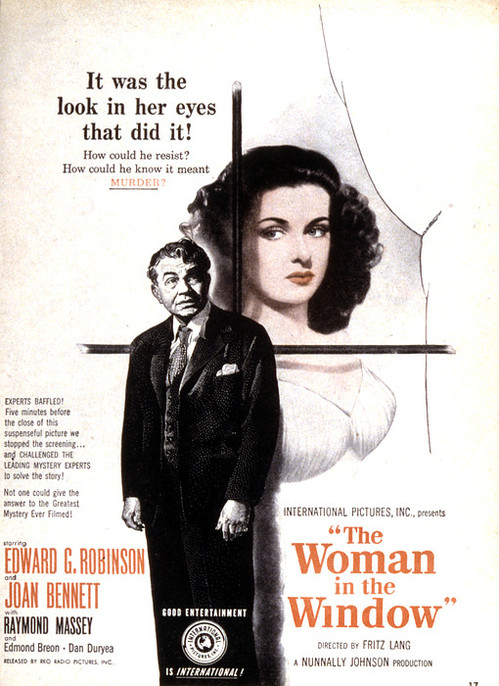
Professor Richard Wanley (Edward G. Robinson), an instructor of psychology at Gotham University, has just sent his family on an extended trip to Maine. He spends the evening with his friends, Dr. Barkstane (Edmond Breon) and New York District Attorney Frank Lalor (Raymond Massey).  Several hours - and drinks - later, Richard exits the club and pauses to admire The Woman in the Window (1944), a portrait in the gallery next to his club. He's stunned to realize that, standing next to him is THE woman (Joan Bennett), who after some conversation, invites him to her apartment. His response to her query will change his life forever.

At the 2019 Noir City DC, we were treated to an introduction to this film by film historian Foster Hirsch. The film, he said, was about submerged desires, and what happens when these desires bubble to the top. Certainly, there is a sexual aspect to the interactions between Alice and Professor Wanley (at least, on his part!). But I disagreed that this was the result of a loveless or sexless marriage. We see Professor Wanley seeing his wife (Dorothy Peterson) and children (Robert Blake and Carol Cameron). He gives his wife a warm departing kiss; we later see him writing to her, and starting the letter "My Dearest Darling". This is certainly a long-time marriage, but he clearly still loves his wife, and very much misses his family.

Seeing Edward G. Robinson in anything is a treat, but he really outdoes himself in this film.  The juxtaposition between the nebbishy professor and the calculating criminologist is fascinating to watch. This was Mr. Robinson’s first film with Joan Bennett, and the chemistry between them is perfect - so good, in fact that the two would be reunited the following year for the impressive Scarlet Street.  Given Mr. Robinson's career of playing vicious murderers, it is intriguing to see him as a victim - though one who has a real crime on his hands.
Merle Oberon was at one point considered for the role of Alice (AFI catalog), but it is hard to picture anyone but Joan Bennett in the role. She is so enormously sexy that it's easy to picture the three clubmen (Dr. Barkstane, Frank Lalor, and Professor Wanley) discussing their dream girl based merely on a picture in the window of an art gallery.  With her dark hair (a change she made in 1938, which opened a new range of films for her), deep voice, and her seductive tones, she is a siren, wooing men to their doom. Her interactions with both Mr. Robinson and Mr. Duryea are letter-perfect. It's no wonder that Hollywood wanted this dream team to be reunited the following year.

Ms. Bennett, her husband, Walter Wanger, and Fritz Lang were the producers on the film; this opened up new opportunities to director Lang, whose vision for film had being circumscribed by producers like Darryl F. Zanuck. (TCM article)  The film's ending was Lang's idea; producer and screenwriter Nunnally Johnson wanted a different ending, but he was overruled.
Dan Duryea  (Heidt) is appropriately smarmy as the bodyguard hired by his company to tail Claude Mazard (Arthur Loft) - a wealthy man who has a reputation for losing his short temper and getting into fights.  While we initially think Heidt will be easily fooled by the Professor and Alice, we find he is by no means stupid, though he is avaricious and vengeful. Mr. Duryea spent the greater part of his career playing the villain, but he's never boring. His scenes with Ms. Bennett sizzle with tension.
The film's initial title was Off Guard. It received a single Oscar nomination for Score (Hugo Friedhofer and Arthur Lange)., losing to  Miklós Rózsa's Spellbound. Ms. Bennet, Mr. Robinson, and Mr. Duryea reunited to perform a Lux Radio Theatre version in June of 1945.

If you've never seen Woman in the Window, do get hold of a copy. It's a real treat.  I'll leave with the trailer:

Wednesday, January 22, 2020

William Gets Married


Candace Goodwin (Frances Dee) is in love with Michael Stewart (William Holden), but Mike is reluctant to propose to her - Candy's family is well-off, and Mike is a simple working man. When Candy's father Pierce Goodwin (Grant Mitchell) announces that, should Mike marry Candy, he'll cut off her funds, Mike proposes, and Candy announces her intention to live on a budget.  But, it's a lot harder than the inexperienced Candy thinks. Our film this week is Meet the Stewarts (1942), and is part of the The Wedding Bells Blogathon, hosted by Hometowns to Hollywood.

This is a pleasant film that, unfortunately, goes off the rails a few times. It starts as a sweet look at a newly married couple facing financial woes, but then degenerates into unnecessary slapstick. Jeanine Basinger in her book I Do and I Don't: A History of Marriage in the Movies points out how difficult it is to write an entire movie about a marriage - most films lead us TO the marriage, and then stop (happily ever after). It's much harder to show day-to-day life and make it interesting. Meet the Stewarts is able to do that for awhile, then seems to feel it needs something else to keep the plot moving. We didn't think It was necessary. 

Frances Dee is quite engaging as Candy. She's ill prepared for life as a struggling wife - she's never cooked, or cleaned, or kept a budget, but she is determined to learn. Ms. Dee creates a no-nonsense woman who believes she can do anything she puts her mind to. She can, but it takes time, and her husband is not really convinced that she can learn the skills of a homemaker. Their arguments become diatribes about money - with Mike looking the worse for their encounters.
Frances Dee started her career as an extra in 1929. She worked regularly, rising to more important parts. In 1933, while filming The Silver Cord, she fell in love with its star, Joel McCrea. They married that October, eventually having 3 children. They were together until Mr. McCrea's death in 1990 (on their wedding anniversary).  Ms. Dee died in 2004, at the age of 90. 

William Holden is a good partner for Ms. Dee in Meet the Stewarts. Despite his anxiety over money, you like Mike, but Mr. Holden plays the role so it is clear that Candy is making appropriate decisions and trying to learn how to be a wife with not a whole lot of money. Ms. Dee was just returning to work after a maternity leave, and was having problems adjusting to the work schedule. The film's director, Alfred E. Green decided to fire her, but Mr. Holden went to Harry Cohn and interceded. Ms. Dee remained in the film (William Holden: A Biography by Michelangelo Capua). William Holden enlisted in the Army Air Force; Columbia was able to get a dispensation so he could finish the film before entering the service, (AFI Catalog) and the film opened in May, 1942.
We looked forward to seeing Margaret Hamilton (Willametta) in the cast, but were very disappointed when she finally arrived on screen. She's supposed to be funny as an inept maid, but she is just annoying. Her incompetence is intolerable, and we kept wondering why someone didn't fire her on the spot (and dock her for breaking the glassware). Anne Revere (Geraldine Stewart) was a breath of fresh air as Mike's older sister. You think that you won't like her, but she turns out to be a good woman looking out for both her brother and her new sister-in-law.

Based on the short story Something Borrowed by Elizabeth Dunn, there are things to many like about this little film - Candy and her efforts to make the marriage work is one of the major attractions. When she goes back to work to pay a debt that she inadvertently incurred, she is admirable, and the film does not try to make it feel like she is in some way emasculating her husband by working for the money. Yes, the film gets silly at times, but in the long run, we all enjoyed it for what it was - a light, rather breezy entertainment (with some scenes we'd like to excise), as well as a look at two young people starting a new life as a married couple.

This post is part of The Wedding Bells Blogathon, hosted by Hometowns to Hollywood. Please visit the blogathon website to view the other posts in the series. 


Monday, January 20, 2020

Edward Sees Himself

The Whole Town's Talking (1935) about gangster "Killer" Manion (Edward G. Robinson), who just broken out of jail in search of stoolie "Slugs" Martin (Edward Brophy). With Manion's picture all over the front page of every newspaper in town, Arthur Ferguson Jones (Edward G. Robinson) is in a pickle - the mild-mannered clerk is a dead-ringer for Manion. How can the police catch Manion and not keep arresting Jones? Well, a pass issued by the Chief of Police seems like a good solution, but when that information hits the papers as well (thanks to Reporter Healy (Wallace Ford), Manion develops his own plan.

Mr. Robinson is quite impressive in the dual roles. Using him is an interesting and effective casting decision; it toys with the audience's familiarity with him in his gangster roles, by throwing another characterization into the mix.  Mr. Robinson doesn't rely on makeup or vocal changes to differentiate the characters - he uses his posture and his face. The audience always knows which character is which because of his skill in demarcating one man from the other. Clearly the star of the film - and the romantic lead - his performance also shows the skills that would make him a magnificent - and powerful - character actor as he aged. 

Following his success in Little Caesar (1931), it appeared that Edward G. Robinson was doomed to a career of gangster roles. So, when Columbia pictures wanted to borrow him for The Whole Town's Talking, he initially balked (TCM article). Under suspension and pressed for cash, Mr. Robinson eventually agreed to take the part. The film was so well received that there were rumors he would be nominated for an Oscar. However, Jack Warner used his influence to block the nomination - he didn't want a Warner star nominated for another studio's film (Little Caesar: A Biography of Edward G. Robinson by Alan L. Gansberg).
Jean Arthur is appropriately sassy as Wilhemina "Bill" Clark, the woman of Arthur’s dreams. He secretly writes poems to her, addressing them to Cymbeline; poems which she mocks (not knowing Arthur is the author). When she realizes that Arthur is a double of Manion, she becomes fascinated with the timid clerk. And while Bill finds Arthur's bachelor apartment exactly as she suspected (even to “a canary bird”), she has mellowed enough to find this endearing. We were especially amused by Bill’s discussions with the police, as she yells “Manion” to every crime about which they inquire. This film was something new for Ms. Arthur and contributed to her future in films like Mr. Smith Goes to Washington (1939) and Mr. Deeds Goes to Town (1936) (Women in the Films of John Ford by David Meuel).
It's surprising to realize that the film was directed by John Ford. One doesn't often think of him in relation to films of this type, but he had directed contemporary American stories before (John Ford: The Man and His Films by Tag Gallagher). In his autobiography, Edward G. Robinson had nothing but praise for Mr. Ford. The pair bring a gentle comedy to the film - Arthur is amusing, but never mocked.

A quick tip of the hat to the always amusing Donald Meek as Hoyt, the first person to confuse Arthur with Manion  - his efforts to claim the reward for finding Manion are really funny (it's not a surprise that he's having a problem getting the money, since he keeps turning in the wrong person). 

We do wish the police were a little less stupid - the idea of giving Arthur a note, and then letting a reporter put that in the newspaper is so tantamountly idiotic that you can only shake your head at this plot device. Regardless, this is a very small complaint in an otherwise enjoyable picture.
When it opened at Radio City Music Hall, The Whole Town's Talking received a glowing review from Andre Sennwald at the New York Times. This was the first of Mr. Robinson's films to open at Radio City and was a huge success for the studio (Little Caesar: A Biography of Edward G. Robinson by Alan L. Gansberg). 

The story was adapted from a novel by William R. Burnett, the author of Little Caesar (which would certainly help explain Mr. Robinson's initial reaction to the role). Working titles were Jail Breaker and Passport to Fame (AFI catalog).  In February 1941, Jeff Corey took on the story for the Lux Radio Theatre.

This is a fun film, and one we wholeheartedly encourage you to view.  We'll leave you with a clip from the opening of the film:

Monday, January 13, 2020

Joan Bakes

There's been a murder. Monte Beragon (Zachary Scott), the second husband of Mildred Pierce (1945) is dead, and the prime suspect is Mildred's (Joan Crawford) ex-husband, Bert (Bruce Bennett). As Mildred relates the story of her life with Bert, Monte, and her children, we realize there are several suspects to the crime, including Bert's former partner Wally Fay (Jack Carson) and the Pierce's oldest daughter, Veda (Ann Blyth).

Our group discussed Mildred Pierce back in 2011;  we decided it was time for a re-watch.  The first reaction to the film this time was remembering how much we all despised Veda Pierce.  Ann Blyth plays her part with such supreme self-obsession that it's hard to find anything good about Veda. Even when she is telling her doting mother how much she loves her, Ms. Blyth has a look in her eyes that displays her manipulative behavior.  It's a remarkable performance, and one which Ms. Blyth does not couch by trying to make the audience like her (Shirley Temple was considered for the part - Director Michael Curtiz was not sympathetic).   Ms. Blyth did an interview at the TCM Film Festival (you can see her discussion of this film begins beginning at 5:14).
Jack Carson  was, at one point, considered for the role of Monte Beragon (AFI catalog). It's hard to imagine him as a loafer - Wally Fay is constantly in motion, always looking for a deal, always on the make for one woman or another. Zachary Scott, on the other hand seems tailor-made for the passive Monte, a man who's never lifted a finger to do anything besides play polo and take other people's money.  The casting of Mr. Scott is an easy choice - it's helpful that he looks rather caddish, and since we know from the start that Monte is the victim, the audience can just wait to find out what he did that resulted in his murder (Zachary Scott: Hollywood's Sophisticated Cad by Ronald L. Davis).
Zachary Scott was born in Austin, TX; he left his home town at age 19 - he dropped out of college and worked on a freighter bound for London, where he worked in repertory theatre for nearly two years. Once back in Texas, he continued to appear on the stage; there, he was noticed by Alfred Lunt. Small parts on Broadway followed (he appeared in 6 Broadway productions throughout his career), which led to a contract from Warner Brothers. He never really evolved much beyond supporting roles in films like Shadow on the Wall (1950) and Flamingo Road (1949); his major starring role was in The Southerner (1945). By the 1950s, he was moving to television like many of his colleagues. Married twice (he had a child with each wife), he died in 1965 at the age of 51 of a brain tumor. 
If there is one person who comes close to stealing the film from Joan Crawford, it's Eve Arden (Ida Corwin). Besides bringing some humor to this melodramatic story, she the voice of truth She has what is perhaps the best line in the film (certainly the best comment on Veda): "Personally, Veda's convinced me that alligators have the right idea. They eat their young."  Ms. Arden received her only Oscar nomination (with Ann Blyth) in the Supporting Actress category (they both lost to Anne Revere in National Velvet).  She would later say that she never expected the part to bring her a nomination (TCM articles). 

Though it was nominated for 6 Oscars, the only winner that night was Joan Crawford, who wasn't even the first choice for the role - Michael Curtiz wanted Barbara Stanwyck. Ms Crawford wasn't at the ceremony, however. Fearing she would not win (see Ann Blyth's TCM tribute to Joan Crawford), Ms. Crawford took to her bed and called in sick. However, when she was notified that she had indeed won the award, she invited the press into her bedroom, where she prettily sat in her sickbed with the Oscar in her hand. 
 

The story was remade as a television miniseries in 2011 starring Kate Winslet.  With more time (five one-hour episodes), and no production code to deal with, the miniseries is closer in plot to James M. Cain's original book.  Carol Burnett did one of her memorable spoofs, "Mildred Fierce" (shoulder pads and all!). The film was added to the National Film Registry in 1996.

If you've never seen this production, treat yourself and find a copy - it's one of Ms. Crawford's finest performances (allegedly, her favorite role), and a film noir par excellence. Here's a trailer to whet your appetite.

Monday, January 6, 2020

Bette is a Librarian

Librarian Alicia Hull (Bette Davis) finds herself in a Storm Center (1956) when she is asked to remove a book, The Communist Dream, from the Kenport Public Library. Torn between her desire to get a new children's wing for the library, and her belief in free access to books, Alicia has to decide what is best for her library and for the community in general.

While one member of our group found the film hard to sit through - specifically the parts that involved young Freddie Slater (Kevin Coughlin) and his meltdown - all members of the group agreed this is an important film, and deserves to be seen and discussed more frequently.

The character of Freddie is included to create one specific scene towards the end of the film. While we salute the imagery that the writers and director were inserting, Freddie is a frustrating character who lessens the impact of the film. The child is badly damaged, primarily by his tentative relationship with a bigoted, unintelligent, and obnoxious father. George Slater (Joe Mantell) bullies his child because the kid is too smart, and wants a boy who will do what he sees as manly things, like play baseball. Mother Laura (Sallie Brophy) encourages Freddie's intellectual growth (she is a talented pianist), but she is undercut by her husband, and weak enough to put up with his nonsense. Why she would marry this neanderthal is beyond our understanding, and is a weakness in the story.
Kevin Coughlin is over-the-top as Freddie; according to this TCM article, director Daniel Taradash was not comfortable directing a child (this was, in fact, Mr. Taradash's only directing credit). Coughlin's mother horrified both Ms. Davis and Mr. Taradash when she pinched her son until he cried, so as to elicit tears for the camera. This was Mr. Coughlin's first film role; he would later play Billy in The Defiant Ones (1958). Most of his career, however, was on television. He died in 1976, at the age of 30, hit by car speeding by his home in Malibu.

Bette Davis was not the first (nor the second) choice for Mrs. Hull (AFI catalog). Originally, the part was intended as a comeback for Mary Pickford, however Ms. Pickford bowed out, ostensibly because the film was not being shot in color. It is believed, however, that she was pressured to withdraw from the picture by Hedda Hopper who was infuriated by the anti-McCarthy sentiments of the movie.  Ms. Hopper's influence may have also had the same effect on Barbara Stanwyck, Irene Dunne, and Loretta Young. Ms. Davis, however, is magnificent as Alicia. She gives Alicia both the strength of character and vulnerability needed to play a woman who is being crucified by the town she loves, simply for being true to her duties as a librarian.
Brian Keith plays councilman Paul Duncan as an innocuous man who is even more dangerous because he seems so personable. Engaged to the librarian Martha Lockridge (Kim Hunter), he uses her collegiality with Alicia to find information that he can use against Mrs. Hull in a smear campaign. Though only one character makes mention of their complicity, it's clear to the viewer that Martha is not averse to the benefits that come from Alicia's dismissal.  There are strong performances as well from other actors in the cast, including Paul Kelly as sympathetic judge Robert Ellerbe, Edward Platt as the Reverend Wilson, Joseph Kearns as Mr. Morrisey, and Kathryn Grant as Hazel.
The story was based on an actual event (though the reason for the firing was altered). Ruth Brown was a librarian in Oklahoma, who was active in local civil rights organizations. In 1950, she was fired from her job ostensibly for being a communist - the actual reason was her involvement in desegregation activities. (The Dismissal of Miss Ruth Brown: Civil Rights, Censorship, and the American Library by Louise S. Robbins ). 

Daniel Taradash and Elick Moll, the screenwriters, were familiar with the case and saw Storm Center as "a dangerous picture about dangerous ideas." Original titles for the film were: The Library, This Time Tomorrow, and Circle of Fire, but none of them were felt to be strong enough.  The American Library Association, which had supported Ms. Brown through her fight in Oklahoma, hosted an advance screening, during which a letter from Bette Davis was read, saying she hoped she had "reflected accurately their dedicated service and had made communities more aware of the role of librarians"  (Louise Robbins. Fighting McCarthyism through Film: A Library Censorship Case Becomes a "Storm Center". Journal of Education for Library and Information Science Fall, 1998. 39(4) 291-311).

Not surprisingly, there were censorship issues with the film. The Catholic Church's Legion of Decency came up with a whole new category just for this film (The Catholic Crusade Against the Movies, 1940-1975 by Gregory D Black; Transforming the Screen, 1950-1959 by Peter Lev), stating that "the highly propagandistic nature of this controversial film (book-burning, anti-communism, civil liberties) offers a warped and strongly emotional solution to a complex problem of American life."


The New York Times review by Bosley Crowther was reluctantly negative, but Mr. Crowther pointed out:  "This is too bad, because the purpose and courage of the men who made this film not only are to be commended but also deserve concrete rewards. They have opened a subject that is touchy and urgent in contemporary life. It should be presented so adroitly that it would fascinate and move people deeply.Furthermore, they have got from Bette Davis a fearless and forceful performance as the middle-aged widowed librarian who stands by her principles. Miss Davis makes the prim but stalwart lady human and credible."  
While this is not be best picture ever made, it is a significant film, one that is still worth watching. Unfortunately, we still have to deal with communities banning books (American Library Association list of Banned Books) and individuals deprived of their liberties because of the beliefs, place of birth, religion or skin tone.  As a librarian myself, I wanted to stand up and cheer at the end of Storm Center.

We'll leave you with a trailer from the film: