Monday, July 27, 2020

Kay Loves a Thief

The Amateur Cracksman has struck again, and the police are baffled. Despite his success as a thief, A. J. Raffles  (Ronald Colman) is giving up his life of crime for Gwen (Kay Francis), the woman he loves. But that is before he discovers his best friend, Bunny (Bramwell Fletcher) is deeply in debt. To save his friend, Raffles (1930) decides to pull one more job - steal the diamond necklace belonging to Lady Melrose (Alison Skipworth).

This was a fun, enjoyable movie. It's very much like the 1939 remake, if a bit more static in places (this is 1930, after all. Sound is still an infant).  Regardless, the film's creative team tries to insert some movement and action to the proceedings, which does help to make the film seem less talky.

Ronald Colman is the perfect choice for A. J. Raffles. He's charming, debonair, well spoken, and someone you can imagine scaling walls - all the things that are needed to make the audience root for him. His relationship with Bunny is just the icing on the cake - Raffles is a loyal friend.  Bunny may not deserve him - he's in debt because of gambling - but this loyalty makes Raffles even more attractive. There was no question as to who would play Raffles in this version. Mr. Colman had proved so successful with Bulldog Drummond the previous year that Sam Goldwyn rushed this film into production (TCM article).
We wanted more Kay Francis.  Gwen disappears for much of the film (as Raffles cases the premises to steal Lady Melrose's jewels), then returns towards the end.  One thing that her absence accomplishes is to make sure that it takes some time before she realizes that her fiance is actually a robber. Had she been around, we might be shaking our head at how stupid she is for not realizing his hobby (shades of Lois Lane not recognizing Superman when he is wearing glasses!) Once we see her later in the film, Gwen is pretty quick to catch onto Raffles' objective, so it was sadly expedient to not have her around for a bit.
The clever, witty script caused the original director, Harry d'Abbadie D'Arrast, to push for a comedic style. It was deemed to be too fast by producer Goldwyn for Ronald Colman - Mr. Goldwyn saw Mr. Colman as less a comic than a wit, and changed directors; though neither Mr. D'Arrast nor his successor, George Fitzmaurice was listed in the credits (AFI Catalog). By casting actors like Ms. Francis and David Torrence (Inspector McKenzie), both of whom prove to have excellent repartee with Ms. Colman, the film is smart rather than silly.

With excellent reviews, like this New York Times review which said that Mr. Colman "does well  by the part" and Ms. Francis "is also excellent," the film turned a tidy profit (The Women of Warner Brothers: The Lives and Careers of 15 Leading Ladies by Daniel Bubbeo). It isn't surprising that it would be remade in nine years with David Niven in the lead. Both films are enjoyable and well worth a viewing.

Monday, July 20, 2020

Joan Visits Germany

Art critic Carol Cabot Hoffman (Joan Bennett) is taking an extended vacation with her husband of eight years, Eric Hoffman (Francis Lederer).  Eric's father, Heinrich (Otto Kruger) needs help selling the family business, and the couple and their seven year old son, Ricky (Johnny Russell) are going to Germany to mix business with pleasure. But, when they arrive, Carol begins to wonder if The Man I Married (1940) is the same person with whom she is now living.

Joan Bennett is excellent as the wife who gradually realizes that her husband is not only having an affair with his childhood friend, Freda Heinkel (Anna Sten), but is also becoming a fervent Nazi. For the 21st Century viewer, the latter is the most hateful. But like the 1940 audience, Carol is initially less concerned about Eric's political leanings. She serves as the eyes of the audience, slowly learning about the evils of the Nazi party, primarily through her friendship with American newsman Kenneth Delane (Lloyd Nolan). It's a frightening revelation for all concerned, as Carol learns of unjust imprisonments, torture, and murder.

As the husband who is seduced into the Nazi party, Francis Lederer is impressive. It would be easy to go over the top with the part, but he doesn't fall into that trap. When Eric and Carol attend a Nazi rally, his fervor becomes apparent. Mr. Lederer does it with a Nazi salute - it's an effective and terrifying moment. George Saunders was originally considered for the role, but he was involved with another film, and was unavailable. (AFI catalog)
Francis Lederer was born in Austria. After stage and silent film work in Germany, he went to London to appear in the play Volpone. Another London production (Autumn Crocus) and a transfer of the play to Broadway (he would appear in four Broadway plays during his career) brought him to America.  As he had no desire to return to Germany - Mr. Lederer was Jewish - he stayed and became a U.S. citizen in 1939. He worked in Hollywood (in both films and television) from 1934 until 1971. His third marriage lasted for nearly 60 years, until his death in 2000 at the age of 100. The home that he helped to design is a protected Los Angeles monument (and is now a wine tasting room).
A number of supporting actors add noteworthy performances to the movie.  Lloyd Nolan only gets a little screen time, but is excellent as the reporter who tries to help Carol locate a missing academic for his brother, Dr. Hugo Gerhardt (Ludwig Stossel). Mr. Nolan serves as the audience's tour guide to Nazi Germany He has little regard for the Hitler regime; by 1940, it's not likely that the audience knew his time in Germany was about to come to an end.

Otto Kruger has a small, but effective part as Eric’s elderly father. He provides the necessary moral compass to the film - a man who lives in Germany, but is not sucked in the the reactionary politics of the Third Reich.
Anna Sten does a decent job with Freda - it's never easy to play a fanatic. If there is any problem with the character, it's that she never seems to be in love with Eric. Her seduction is intended to bring him into the party. Eric is merely another convert for the party.  

Finally, the always remarkable Maria Ouspenskaya has the small role of Frau Gerhardt, the widow of the academic Carol was asked to seek out. Ms. Ouspenskaya has only one scene in the film, but with her quiet dignity, it is not a moment you are likely to forget.

The movie was based on a short story, "Swastika" by Oscar Schisgall. Producer Darryl F. Zanuck changed some names, ostensibly to make them sound less Jewish, but using "Jude" instead of "Jew" didn't hide a whole lot. (The Moguls and the Dictators:Hollywood and the Coming of World War II by David Welky). This TCM article cites it as "one of the first aggressively anti-Nazi films made in the wake of the Invasion of Poland in September 1939."
The press for the film was good as is shown in this review from Variety.  The New York Times review by Bosley Crowther was absolutely glowing: "If we are bound to have a succession of anti-Nazi propaganda pictures...let's hope that they all may be as restrained in their emotions, as frank and factual in their reports and as generally entertaining cinematically as Twentieth Century-Fox's The Man I Married,...."  

Pressure from the German government had resulted in a name change (from I Married a Nazi); the studio underplayed the plot of the film, and didn't distribute it widely. As a result, the film is not as well known as it should be.  You may not have heard of this film before, but we suggest you seek it out. It's worth your time.

Friday, July 17, 2020

Barbara is Shopworn

Her father's sudden death forces Kitty Lane (Barbara Stanwyck) to take a job in a hamburger joint in the city.  One of her customers is David Livingston (Regis Toomey), a medical student. He and Kitty gradually fall in love, but David's snooty mother, Helen Livingston (Clara Blandick) has other plans for her son than a Shopworn (1932) girl.

This post is part of The Queen of Sass: The Barbara Stanwyck Blogathon hosted by Pale Writer. 

Shopworn is a mixed bag. On the one hand, you have a dynamic performance by Barbara Stanwyck, but other elements of the film fall into the banal.  Perhaps the key culprit is the final film itself. There are huge gaps (probably the result of censorship) (TCM article), that make the movie feel helter skelter. In the latter section of the film, we are told that six years have elapsed - it takes a while to find this out - and in the meantime, we are wondering why the sweet Kitty suddenly seems to be such a notorious woman. With almost no transitions between the major sections of the film, one finds oneself bemused by the changes. Regardless, Ms. Stanwyck makes the change easily to accept, and the audience accepts the change because of her skill. Lila Lee was initially considered for Kitty (AFI Catalog); Ms. Stanwyck evidently was sorry the part was not given to Ms. Lee. It probably didn't help that her marriage to comedian Frank Fay was starting to disintegrate. (A Life of Barbara Stanwyck: Steel-True, 1907-1940 by Victoria Wilson).
The casting of Regis Toomey as Kitty's love interest is another problem. Mr. Toomey is fine as a character actor; he also was a good fit for television. He is a more intimate actor, which makes him ideal for the small screen, but opposite a dynamo like Barbara Stanwyck, he seems insignificant and unworthy of her attention. You spend most of the movie wondering what Kitty could possibly see in this momma's boy. Only when he finally stands up to Judge Forbes (Oscar Apfel) do we finally have any regard for David, but it is perhaps too little too late.

Our villains in the piece are David's nightmare of a mother, and her strongman, Judge Forbes. Given this is a pre-code film, no punishment is meted out. In the long run, we longed for the Judge to get his just deserts. There's no question Helen is a horror, but Forbes is a man of the law, and he misuses his position horribly. He's a despicable man, and the only comeuppance his gets is pitifully inadequate. A lurid trial, and the image of him being disbarred would have been a nice conclusion (but that is probably another movie).
ZaSu Pitts is adorable as Kitty's aunt and best friend, Dot. It's a small, but memorable role, and we looked forward to seeing her reappear on the screen. Her polar opposite is Clara Blandick, who creates the ultimate monster mother in Helen Livingston. It's the women who dominate in this film; but the only woman we really care about is Ms. Stanwyck's Kitty.
While the reviews for the film were not great - Variety called it "the clumsiest kind of literary hoke..." (A Life of Barbara Stanwyck, 1907-1940: Steel-True by Victoria Wilson) and Mordaunt Hall of the New York Times said "It is beyond the powers of such capable players as Barbara Stanwyck, Regis Toomey, Clara Blandick and Zassu Pitts (sic) to make their actions in this film convincing or even mildly interesting" - in the long run, the film did well at the box office (Starring Miss Barbara Stanwyck by Ella Smith). If you are a Stanwyck completest, you should watch it for her performance. 

We'll leave you with a scene in which Kitty shows her strength of character:


Be sure to visit the other posts that celebrate the Magnificent Missy at Pale Writer's The Queen of Sass: The Barbara Stanwyck Blogathon
 

Monday, July 13, 2020

Jinx Inherits a Million

Chorus girl Gloria Carroll (Jinx Falkenburg) discovers she's been left one million dollars by Herbert J. Dinwiddie, an older man with whom she had become friends. Not surprisingly, all heck breaks loose. Her boss, Ned McLane (Don Beddoe) wants her to produce a new revue; the criminals from whom Mr. Dinwiddie stole the money want it back, and the gentleman's two sisters, Annabelle (Elizabeth Patterson) and Hettie (Adele Rowland) want a piece of the action. This week, our film is Lucky Legs (1942).

A pleasant little B movie with an adequate cast (and one outstanding performance), Lucky Legs is a short (64 minutes) film with a little bit of music, several lovely young ladies, and a plot that has been done before but still manages to be amusing. The lead role is filled by Jinx Falkenburg, an unassuming actress who is reasonably pleasant as the heiress. One rather likes her portrayal of Gloria, a common-sense kind of woman who gets swept up the mania surrounding her surprise inheritance.
Ms. Falkenburg started as a model, and was the first "Miss Rheingold" in New York (Rheingold was a local beer). While her success as an actress was fleeting (she never made it beyond B pictures, though she had a cameo appearance in Cover Girl and spent a good deal of the war doing USO shows), her career after films was impressive.  In 1945, she married journalist John "Tex" McCrary. The following year, they launched a radio show Hi Jinx, followed by The Tex and Jinx Show which is credited with being the forerunner of the radio talk show. (You can hear an episode, featuring guest  star Nancy Walker here).  They branched out into television as well, with At Home and The Tex and Jinx Show.  Though the McCrary's never divorced, they did separate in 1980; however they remained close friends. Ms. Falkenburg died in 2003 (one month after her husband's death) in the hospital that she and Tex had helped to found. This opinion piece by William Safire on Jinx's career as a talk radio pioneer was published shortly after her death.
The real star of the film is the delightful Elizabeth Patterson. She sparkles as the mystery loving, Annabelle.  She's funny and upbeat, and the viewer looks forward to her scenes.  An actress with extensive credits on Broadway (26 plays between 1913 and 1954), Ms. Patterson appeared in over 100 films, including Colonel Effingham's Raid (1946) and Remember the Night (1940). She's also remembered for her role as Mrs. Tumbull on I Love Lucy. Ms. Patterson died at the age of 91, in 1966.

It's believed that the story for Lucky Legs was based on a real incident, in which millionaire William Guggenheim  willed a million dollars to four showgirls. And though the film was shot between April and October of 1942, it's notable that not one mention of World War II is made.  (AFI catalog). Regardless, it's a cute film; it might not be first on your list, but it's good fun for a night in which you want a smile.

Monday, July 6, 2020

Rita Fascinates Orson

Told in flashback, our story begins as seaman Michael O'Hara (Orson Welles) is wandering the streets of New York City and happens upon a mugging. He rescues the victim (Rita Hayworth) from her attackers and returns her safely to her hotel. The next day, he is approached by Arthur Bannister (Everett Sloane), a noted defense attorney, and is asked to accept a position on Bannister's yacht. The Lady from Shanghai (1948), it seems, is his wife, Elsa. Against his better judgement, Michael accepts the job so he can get closer to the tantalizing Elsa.

The reaction to the rather odd movie was mixed. One person said, having seen it, she would not choose to view it again. It can be cumbersome viewing it. The film feels like pieces are missing, and the viewer can get lost in the convoluted plot. This is not a surprise, since director Orson Welles planned a much longer movie that was cut drastically by Columbia (TCM article). The sections that were removed were destroyed at some point, so hopes for a director's cut are likely futile. Peter Bogdanovich in his commentary on the film, is eager to shift any blame for the film's defects away from Orson Welles and onto other parties, including Rita Hayworth. Mr. Welles' history as a director and producer demonstrate that he certainly is responsible for much of the film's problems.
Welles' opening narration sets the audience up to wonder at just what exactly Elsa Bannister is up to. Rita Hayworth does not disappoint as a seemingly demure, but somewhat shady character. Her voice, her mannerisms, her eyes all signal the duplicity of Elsa. The notorious hair cut and dye job which so irked Harry Cohn also help her to create this very cunning lady.  It's been said that she asked her then-husband Welles for the part - he wanted then unknown actress Barbara Laage, (Orson Welles: The Rise and Fall of an American Genius by Charles Higham) while Ida Lupino was also under consideration at one point (AFI Catalog). Though their marriage was crumbling when she agreed to take on the part of Elsa, she may have been trying to patch up the union, or at the very least assist Welles in providing child support for their daughter, Rebecca.  Sadly, the marriage still ended in November 1947, just around the time filming ended, exacerbated by Mr. Welles infidelities (Orson Welles: A Biography by Barbara Leaming). (AMC Filmsite). At the same time, a New Yorker DVD of the Week notes that Welles' many close-ups of Mr. Hayworth are loving in their attention to her.
Glenn Anders is appropriately creepy and revolting as George Grisby. He is well matched by Everett Sloane as the sly lawyer and husband. According to Mr. Bogdanovich, Mr. Welles decided to put him on crutches because he didn't like Mr. Sloane's walk. The effect of the crutches and the odd gait that Mr. Sloane affects is disquieting.

The film was shot on location in New York, San Francisco, and Acapulco, though one of the early scenes in New York really looks like a poorly designed set (other scenes are clearly of New York). The yacht scenes were filmed aboard Errol Flynn's boat, the Zaca, and it has been said that Mr. Flynn actually appeared in the film, though no one is sure exactly where he appears (Paula's Cinema Club).
Loosely based on the novel  If I Die Before I Wake by Sherwood King. Welles offered to direct it if Harry Cohen would give him $50,000 so his musical production of Around the World (with music by Cole Porter) could open (the production had run out of funds just before opening night, and they need to pay for the costumes) The rights to the book were owned by William Castle, who was an associate producer on the movie. It went through a number of titles before release including Black Irish If I Die Before I Wake, and Take This Woman.

The reviews at the time of release were poor, as is evidenced by this New York Times review by Bosley Crowther, who said that Mr. Welles "has a strange way of marring his films with sloppiness which he seems to assume that his dazzling exhibitions of skill will camouflage." As the years progressed, the regard for the film increased, as evidenced by this Irish Times discussion from 2014 and J. Hoberman's discussion of the film in the New York Times on its blu ray release. The Lady from Shanghai was added to the National Film Registry in 2018

This is an essential film - in a recent Noir Alley, Eddie Muller called it "a cinematic bombshell" and "the most daring, sinister, alluring, and combustible... mess ever released by a major studio."  You may love it or hate it, but it's one that should be seen. We'll leave you with this trailer: 

Monday, June 29, 2020

Howard, King of the Beggars

The Poet (Howard Keel) has come to the Baghdad marketplace to sell his poems. Discouraged by the lack of business, he sits to contemplate his situation and is given money. He has inadvertently taken residence in the place of Hajj the beggar. Not one to let a good opportunity pass him by, The Poet claims to be a relative of Hajj (who has gone to Mecca), and proceeds to set up shop and solicit alms. However, when he is kidnapped by the thief Jawan (Jay C. Flippen) and ordered to reverse Hajj's curse. The Poet discovers that everything in life is a matter of Kismet (1955).

Back in 2016, we viewed the non-musical Ronald Colman version of Kismet (1944). Also filmed in color, that version was a delightful fairy tale, with strong performances from Mr. Colman and Marlene Dietrich.  The musical version is much the same story, but it's hard to compare it to the earlier rendition, precisely because it is a musical. The addition of the lush score changes the whole dynamic of the film, making it a very different experience.

Howard Keel is excellent as The Poet. He's actually too young for the part - he is only nine years older than his "daughter," Ann Blyth (Marsinah). But he is so engaging and appealing you really don't care. If we had one complaint, it was that he doesn't get to sing the most exquisite song from the production, "Stranger in Paradise". That pleasure goes to Vic Damone (Caliph), who has a pleasant voice, but nowhere near the richness of Mr. Keel's bass-baritone. Mr. Keel was second choice for the part - Ezio Pinza was the original selection of Arthur Freed (TCM article).
After working in public relations, Howard Keel was hired as the understudy for John Raitt in Carousel - he would appear in the role while Mr. Raitt was on vacation. (PBS) He next became the replacement for Alfred Drake in Oklahoma! (Mr. Drake was the original Poet in Kismet). Mr. Keel would eventually appear in 6 Broadway plays. His breakout film role was as Frank Butler in Annie Get Your Gun (1948), but his ultimate singing partner was Kathryn Grayson - they co-starred in Show Boat (1951) and Kiss Me, Kate (1953). After leaving MGM (following Kismet), he continued to appear on film and television; then in 1981, he became a regular on the television show Dallas as Clayton Farlow, Miss Ellie's second husband. He would continue with Dallas for the next 10 years; the show had the added benefit of introducing him to a new audience, and invigorating his singing career (though he never actually sang on the show!). Mr. Keel died in 2004, at the age of 85. (Guardian obituary)
Also outstanding is Dolores Grey; she makes Lalume into a sultry seductress, and her musical routines are memorable. It was surprising to learn that she was upset by the daylight shoot of the film, fearing it would show up flaws in her complexion (A Hundred or More Hidden Things: The Life and Films of Vincente Minnelli by Mark Griffin). She need not have worried, She looks awesome.  Cyd Charisse was under consideration for the role (AFI catalog) and while she certainly had the dancing ability (let's face it, she could outdance anyone!), her singing was not at Ms. Gray's level.

Ann Blyth has a beautiful singing voice, and she is an excellent actress, but the part of Marsinah is so terribly small, she feels almost wasted. She does get to sing the lovely "Baubles, Bangles, and Beads" and supports Vic Damone in "Stranger in Paradise".  She's at her best with Howard Keel - he gives her someone to bounce off. She's less engaged with Vic Damone, which is not her fault. He's stiff and flat when he is not singing, it's as though he thinks he making a record album. It probably didn't help that director Vincente Minnelli, usually an actor's best support, was downright unpleasant to Mr. Damone during the shoot. This was not a film Mr. Minnelli wanted to make; as a result, he went quickly, sometimes to the detriment of his actors (That Was Entertainment: The Golden Age of the MGM Musical by Bernard F. Dick). 
There are some interesting supporting parts worth a mention - Monty Woolley as Omar the merchant, who starts The Poet on his long, strange journey (this was his last film appearance). Sebastian Cabot as the Wazir, a wicked man plotting to line his own pockets at the expense of his Caliph. Mike Mazurki appears in the small role of a policeman. Jack Elam (Hasan-Ben), Jamie Farr (Orange Merchant), Ted de Corsia (Policeman), and Barrie Chase (Harem Dancer) also appear - some in parts that if you blink, you will miss them (but worth looking for!)

While being able to view the film on demand in your own home is wonderful, this Cinemascope production does lose some of its impact when shown on a small screen. One of our members commented that so much was going on, it was hard to concentrate on it as she watched on her computer monitor. It's a film that begs for a big screen revival.
Kismet had many lives, most of them as a straight play (see our post on the Ronald Colman film, linked above). The musical opened on Broadway in 1953, with Alfred Drake as The Poet,  Doretta Morrow as Marsinah, and Richard Kiley as Caliph (Neile Adams as a Dancer). It ran for 583 performances.

The New York Times review of the film by Bosley Crowther was lukewarm. It paled by comparison to the stage version, but did receive positive review for Mr. Keel and Ms. Gray, and for the  music. It had a Christmas release at Radio City Music Hall, but lost money for MGM.

Kismet is not a bad film - it could have been better, but is well worth seeing for Mr. Keel, Ms. Grey, and Ms. Blyth.  We'll leave you with a trailer:

Monday, June 22, 2020

Marilyn Joins the Chorus

May (Adele Jergens) and Peggy Martin (Marilyn Monroe) are Ladies of the Chorus (1949) in a burlesque theatre. When the star of the current show resigns, May is asked to take the lead role, but instead sends out daughter Peggy. An instant hit with the audience, Peggy also is has an unknown admirer who sends orchids to her every day. After a few weeks, Peggy's curiosity gets the better of her, and she decides to find out the identity of her mystery man.  She also finds love - and complications.

Nowadays, this film is remembered as a Marilyn Monroe film - her first "starring" role, in fact.  But when it was released (as you can see in the poster to the left), the "star" was actually Adele Jergens, and Ms. Monroe was given second billing. All that changed once Ms. Monroe became a phenomenon.  The title credits of the film were altered - Marilyn Monroe was listed above the title, and poster art featured her picture, not that of Ms. Jergens (as you can see below).  In 1949, this was a B picture that didn't rate big stars, and Ms. Monroe was certainly NOT a big star.  This was her first - and only - movie at Columbia Pictures (more on that later). But Ms. Monroe is used to good advantage in the pictures, and she is engaging as the ingenue.
The casting of the film is interesting - there is only nine years between the mother and daughter (Ms. Jergens was only 31). The studio makeup people put a little grey in her hair to make the alleged age difference more convincing. Regardless, the two worked well together and were quite friendly, with Ms. Jergens becoming very protective of her younger co-star (TCM article). Their easy rapport is evident in the film and adds to the audience's enjoyment.

Adele Jergens worked as a model, a chorus girl, a Rockette at Radio City Music Hall, and a performer and understudy for Gypsy Rose Lee in the Broadway review Star and Garter. When Ms. Lee was ill, Ms. Jergens was able to step in, which led to a contract with Columbia. While there, she appeared primarily B movies (The Guardian). The year this film was released, she met her future husband (they were together for 40 years, until his death), Glenn Langan on the set of Treasure of Monte Cristo. After the birth of her son, she returned to work, primarily television, retiring from performing in 1956. She died of pneumonia at the age of 84, a year after her only son died of a brain tumor.
This was Marilyn Monroe's only Columbia film. It's been said that Harry Cohn propositioned her, and Ms. Monroe declined. Cohn, not noted for being a beneficent boss, cancelled her contract (Marilyn Monroe: Her Films, Her Life by Michelle Vogel). The rest, as they say, is history. Of course, once she became known, Columbia capitalized on her appearance in the film and changed the billing (as previously mentioned) (AFI catalog). This, by the way, is not the breathy Marilyn of later pictures - she's not yet the sexpot into which she would be molded.
The film really belongs to the women in the cast, including Nana Bryant as Adele Carroll, our hero's mother. Without giving too much away, her performance is a majro reason that this movie is a fun ride. Her actions take what could have been a really trite weeper and turn it into a delightful romance. 

We do have a couple of male performers. Rand Brooks (Randy Carroll), best remembered today as Charles Hamilton (Scarlett's first husband in Gone with the Wind) is fine as the enamored society gent. He is very convincing in his big scene with May (asking for Peggy's hand in marriage).  Eddie Garr (Billy Mackay) only has a few scenes as the man in love with May.  Mr. Garr is probably best remembered today for being the father of actress Teri Garr.
There is one fairly inane scene in which Dave and Alan Barry play decorators Ripple and Ripple Jr.  It wants to be a burlesque routine, but it really is just silly. Otherwise, this is an enjoyable film, and a chance to see Marilyn Monroe as you will never see her again.  

We'll leave you with with scene of Ms. M singing:

Monday, June 15, 2020

Vincent's House is Haunted

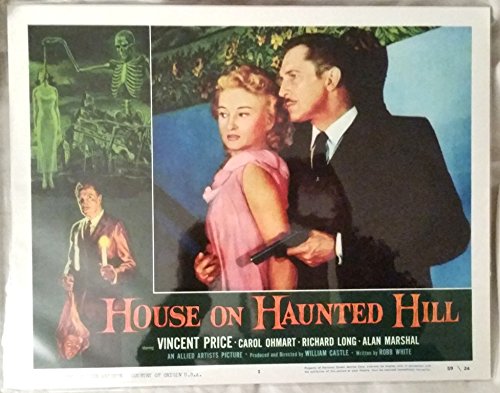
Millionaire Frederick Loren (Vincent Price) is having a haunted house part for his wife, Annabelle (Carol Ohmart). He has invited five strangers to the House on Haunted Hill (1959), with the understanding that he will pay them each $10,000 for spending a night. Once the doors are locked at midnight, they cannot leave until 8am. The "guests" - pilot Lance Schroeder (Richard Long), psychiatrist Dr. David Trent (Alan Marshal), office worker Nora Manning (Carol Craig), columnist Ruth Bridges (Julie Mitchum), and the house's actual owner Watson Pritchard (Elisha Cook) all need the money. But can they survive the night?

If you like short, campy movies with special effects so low budget that you can see the wires, this is the film for you. The inimitable William Castle directed and produced the production which goes, as always, for the shock value. A believer in promotion, Mr. Castle felt it "should be an integral part of the entire movie going experience." (Showmanship: The Cinema of William Castle by Joe Jordan). He would design gimmicks for his films, like vibrating motors attached to some seats for the thriller, The Tingler (1959) or voting on the main character's fate in Mr. Sardonicus (1961). The House on Haunted Hill, too, had its gimmick, which we'll discuss later on.
Without Vincent Price, this movie would be nothing. He gives it cache - he plays the role with his tongue firmly implanted into his cheek. As a result, the audience can sit back and enjoy the proceedings, understanding that taking ANY of it seriously would be a drastic mistake. Mr. Price had just lost a role in a Western film - he was judged too tall to play opposite the new star, Alan Ladd. Mr. Castle offered Mr. Price the lead in The House on Haunted Hill, which was in development. In exchange, Mr. Castle gave him a piece of the movie, which ended up netting Mr. Price a new painting for his extensive collection, and a new career as the king of the horror film (The Price of Fear: The Film Career of Vincent Price, In His Own Words by Joel Eisner).

Vincent Price was very much a Renaissance man. He began his acting career in London with The Mercury Players, after having worked as a teacher and studied fine arts. By 1936, he was working on Broadway, playing Prince Albert to Helen Hayes' Victoria Regina. He would appear in 11 Broadway productions, including the Mercury Theatre production of  Heartbreak House, starring Orson Welles (1938),  Angel Street (1944), and Richard III, playing the Duke of Buckingham to Jose Ferrer's Richard (1953). He'd moved to Hollywood by 1938, with a co-starring role with Constance Bennett in Service de Luxe.  While he played good guys on some occasions, it seems he was destined to specialize in villains or weaklings, like Nicholas Van Ryn in Dragonwyck (1946) and Shelby Carpenter in Laura (1944). He moved easily from film to radio to television (where he appeared as one of my favorite villains in "The Foxes and Hounds" episode of The Man from U.N.C.L.E). A highly regarded art collector, Mr. Price donated works from his collection to form the basis for The Vincent Price Art Museum, so that students at East Los Angeles College would have access to a teaching collection. He also wrote several books on gourmet cooking with his second wife, Mary Grant.  His final on-screen film role was in Edward Scissorhands (1990), but he contributed his vocal talents to a number of films, and even to the music video Thriller. Mr. Price died of emphysema in 1993 at the age of 82.
I was unimpressed with Carol Ohmart when I saw her in The Scarlet Hour; the group opinion was not any different. She's an expressionless actress, who thinks making a moue with her mouth is the epitome of fine acting. It's not. In 1955, James Bacon called her a "female Brando" for her "savage realism" (Chicago Daily Herald, 3 July 1955).  One wonders how much Paramount paid him for that compliment. 

Carol Craig gets to scream a lot during the film. The one character who is truly terrified by what is going on, Nora has the brains of a pea. She goes wandering off behind curtains and into empty rooms. Why someone that frightened would be wandering this revolting house alone is beyond us.
Though she doesn't have a lot to do (except for some Lady Macbeth hand cleaning), Julie Mitchum is worth noting as Robert Mitchum's sister.  We also enjoyed Richard Long as the "hero" of the piece. He's effectively stalwart, with not a lot of screen time. And let's not forget Elisha Cook, who keeps warning the audience about the dangers of the house and the ghosts. He's a puzzling character, who remains a question even as the film ends.

The exterior of the house is a Frank Lloyd Wright home - Ennis House, in the Los Feliz neighborhood of Los Angeles (The house was also used as Spike and Drusilla's residence in Buffy, the Vampire Slayer). (Los Angeles Conservancy) The inside is studio created - it's an upscale albeit rather dirty haunted house, though you might find a head in your luggage.
Always the showman, William Castle devised a special gimmick for this film. Called "Emergo," it involved a glow-in-the dark skeleton appearing over the audience's head at a pivotal point in the movie (TCM article). According to Joel Eisner, the first time he tried this trick was at a private screening for major producers. The skeleton was operated from a fishing reel in the projectionist's group, which worked at first. Unfortunately, the line snapped, and fell on the assembled producers.  Mr. Castle had to redesign the skeleton, so that, if it fell in a real theatre, it was light enough to not hurt any audience members!.

The New York Times review  by Howard Thompson, called the film "a stale spook concoction. " However, in a review of a 1999 remake, Lawrence Van Gelder said the new film was "a sorry reincarnation of the 1950s William Castle horror film". That rendition starred Geoffrey Rush in the Vincent Price part (AFI catalog). Today, Mr. Price's version is considered a cult classic.

We'll leave you with a trailer: 

Monday, June 8, 2020

Ginger Won't Marry

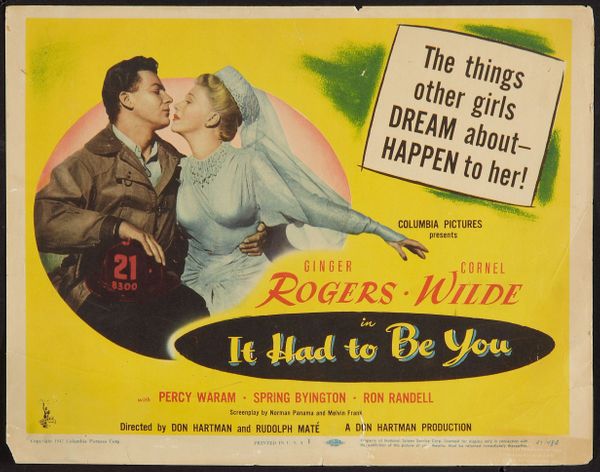
Victoria Stafford (Ginger Rogers) has had three trips to the altar, all unsuccessful - she bolts the minute she is asked to say "I Do". She's about to take a fourth trip, this time to Oliver H.P. Harrington (Ron Randall).  However, fearing another botched ceremony, his father (Thurston Hall) suggests a cooling off period before the vows are exchanged. After a month in her sculpting studio, far from her family and fiance, Vicki decides she will marry Oliver. But when she arrives in New York City, she finds an American Indian (Cornell Wilde) in her upper berth, saying It Had to be You (1947).
 
This is a remarkably silly movie, with few redeeming values; with a cast headed by Ginger Rogers and Cornell Wilde, one expects better. Unfortunately, the script is weak (and at this point in history, rather offensive), and the acting is overdone.

When Ginger Rogers did Tom, Dick, and Harry (1941), she presented the character with a high-pitched voice; she would do something similar when she appeared in The Major and the Minor (1942). The little-girl voice was perfect (albeit a tad over-young) for the allegedly 12-year old Susu Applegate. She does it again here, and all it accomplishes is to let us know Vicki is a moron. She shouldn't be - she's a talented sculptress with confidence in her abilities. Her inability to commit to a man, except to someone she met when she was 10 is odd. But Ms. Rogers makes her into a nincompoop, who vibrates through the picture with no apparent focus, leaving the audience with no focal point as well. Ms. Rogers allegedly liked the role (TCM article), though one wonders why.
Cornel Wilde is usually an enjoyable actor, but he is out of his element in this movie. When he plays the native-garbed George McKesson, he is goggled-eyed and ridiculous - if his eyes got any wider, they would pop out of their sockets.  When enacting fireman Johnny Blaine, he is the exact opposite - almost flat in his portrayal of a man allegedly in love.

Spring Byington only gets to flutter helplessly as Vicki's mother Mrs. Stafford.  The events whirl around her and she is incapable of understanding ANYTHING about her daughter. It's a real shame to waste her in this piece of nonsense.
If there is one thing that is extraordinary about the film, it is the costuming. Jean Louis designs four spectacularly gorgeous wedding gowns, as well as dresses and suits for Ms. Rogers that would make any woman proud to wear them. 

In her book A Woman's View: How Hollywood Spoke to Women 1930-1960, Jeannine Basinger comments on the wedding dresses as means of demonstrating Victoria's emotions prior to each of her weddings. Yet, in each marriage, she bolts. Ms. Bassinger believes that the film is "a case of the audience having it all. They get to ogle three gorgeous wedding gowns for the price of one. They get to see three wimpy grooms rejected. And Ginger Rogers is still intact for further plot development, free and easy and not saddled with a dreary marriage." For a film aimed at a female audience, the story may have been aimed at the many unhappily married women among them.
In April 1948, Lucille Ball and Cornell Wilde starred in a Screen Guild Theater radio version of the story (AFI Catalog).  A January 1950 Screen Directors' Playhouse show starred Joan Fontaine (subbing for an ill Ginger Rogers).

Bosley Crowther's New York Times review was scathing - he said that even his 8 year old son didn't like it. Unfortunately, we are forced to agree with him. It's not the worst film ever made, but it is a Ginger Rogers low point.  If you are a completest of Ms. Rogers work, or in the mood to see great costumes, then see it (but have a remote in hand to fast forward through some of the silliness).

Monday, June 1, 2020

Police Inspector Ralph

Gloria Gale (Shirley Grey), a spoiled socialite, is bored. When she meets Dan Terrence (Charles Sabin), a crook who works for gang leader  Mike Russo (J. Carrol Naish), she agrees to be his wheel-person during a jewel theft. Once the crime is committed and the police, led by Inspector Steve Trent (Ralph Bellamy) hone in on her, Gloria, the Girl in Danger (1934), has second thoughts about the adventurous life.

The fourth (in a series of four) movies (released between 1933 and 1934) that featured Ralph Bellamy as Inspector Trent, the movie really should be named "The Girl is an Airhead." The film's major problem is that from the start, one cannot believe that Gloria could be stupid enough to get involved in a life of crime merely because she is jaded.  We're not talking about a bit of shoplifting, or hanging out in a casino. We're talking breaking and entering and grand theft.  Dan Terrence is also armed, so had someone entered the room he was pilfering, he'd have had no qualms about shooting the unsuspecting intruder. It doesn't seem like any amount of ennue would entice a woman with a brain in her head to set herself up for 5 to 10 years in prison.
If the plot is a little lacking, the movie does have some bright spots. Ralph Bellamy is always a pleasure to watch, and it's nice for a change to see him in the lead, and not playing a put-upon dolt.  He's clearly comfortable as Trent, and his laconic attitude works well for this precise character.

Mr. Bellamy was born in Chicago; by 1919, he'd left home (he was 15) to work in theatrical road shows. Ultimately, he made his way to New York, started his own theatre company, and began getting work on Broadway, where he worked off and on from 1929 to 1959. He originated roles such as Grant Matthews in State of the Union (which would star Spencer Tracy in the film version), Michael Frame in Tomorrow the World (Fredric March in the film), Detective McLeod in Detective Story (Kirk Douglas n the movie), and what is perhaps his finest performance FDR in Sunrise at Campobello, a role he finally got to play himself when the film was made. He received a Tony Award for that performance. He spent a lot of his long career playing put-up second bananas, like the character of Daniel Leeson in The Awful Truth (1937), which got him his only Oscar nomination. Married and divorced three times, his 1945 (4th) marriage to Alice Murphy lasted until the end of his life in 1991 at the age of 97. He worked until nearly the end - his last role was Richard Gere's industrial nemesis in Pretty Woman (1990)
Another plus to the film is seeing early work by Ward Bond (Wynkoski), J. Carroll Naish, and Vincent Sherman (Willie Tolini) - here in an acting role! This was, in fact, Mr. Sherman's last role in front of the screen. He worked as a screenwriter, as a dialogue director, and finally as a director in films such as Old Acquaintance (1943), Mr. Skeffington (1944), and Harriet Craig (1950).

Originally titled, By Persons Unknown (AFI catalog), this is a so-so film with some engaging actors and a slapped-together script. It's blessedly short (57 minutes), with a pre-code ending that will have you shaking your head. Personally, I think Gloria Gale needs a time-out.