Monday, November 30, 2020

Ben Directs Silent Movies

Hugo (2011) (Asa Butterfield), is an orphan who lives in the clock tower at the Paris train station. There, he steals enough food to live, and tries to rebuild a broken automaton - a mechanical man Hugo's father (Jude Law) was working on when he died in a fire. But life takes a  turn when Hugo's pilfering is discovered by the toy-maker Georges Méliès (Ben Kingsley), who confiscates Hugo's notebook - his only hope of getting the mechanical man to work.

This week, we decided to view a recent film, but one that salutes the classic film era. Hugo is very much about the history of - as well as the love for - silent movies. Director Martin Scorsese was introduced to the book when he read it to his daughter - it was one of her favorite books (The  Christian Post). Best known for films like Raging Bull and Taxi Driver, this was Mr. Scorsese's first film to get a PG rating since The Age of Innocence (1993). Hugo has the feel of a fairy story - it could easily start with "once upon a time..." This was also an opportunity for Mr. Scorsese to create a film that discussed one of his favorite topics - the preservation of our cinema history (TCM article). He even appears in a cameo, as a photographer.

The heart of the film is Hugo Cabret; as portrayed by Asa Butterfield, he is a lonely boy who has seen nothing but the painful side of life since the death of his father. Hugo's Uncle Claude (Ray Winstone) is a drunk; he pulls the young boy from school, to work with him to maintain the railway station clock. The one advantage is that the task gives Hugo a place to hide and the tools (and a few more skills) to repair his beloved mechanical man. Uncle Claude's disappearance means little to Hugo, except that he must be even more careful to not be detected by the Station Inspector (Sasha Baron Cohen), a bitter man who will consign Hugo to an orphan asylum should he ever be discovered.

We are not fans of Sacha Baron Cohen, but he is fine as a man who has seen service in World War I, and lost a leg as a result. The Station Inspector is a bitter man; he yearns for affection, but can give none. He's very much in love with Lisette (Emily Mortimer), the flower seller, but is unable to tell her because of his self-pity.  In many ways, the Station Inspector mirrors the resentment that affects Georges as well.   

Ben Kingsley is outstanding as the angry Georges. Forced to support himself, his wife Jeanne (Helen McCrory) and his adopted daughter Isabelle (Chloë Grace Moretz) by working as a toy-maker, he has lost his life's work and his legacy because of the War. Like the Station Inspector, he too is defeated by life. Hugo's pilfering of his spare parts is just one more insult to his already deflated life view.

The relationship between Hugo and Isabelle is probably the best part of the film. She is a girl in love with books; he is boy entranced by movies. He's lost his love of books due to the death of his father; she's never seen a movie. They introduce each other to their fantasy world; as a result, they are able to make reality a better place. It's in those worlds that the audience is inaugurated into the universe of the silent film. Hugo mentions his love for the book Robin Hood and for actor Douglas Fairbanks - and it was Fairbanks who played Robin Hood in 1922.  The pair go to the movies and see Harold Lloyd's Safety Last (1923) - Hugo ends up hanging off a clock tower, much like in that film's most famous scene.  We see posters outside the movie theatre to Chaplin and Keaton coming attractions. We are introduced to the early films of the Lumière brothers, and finally, we see A Trip to the Moon - the magnificent film of Georges - and Jeanne - Méliès.
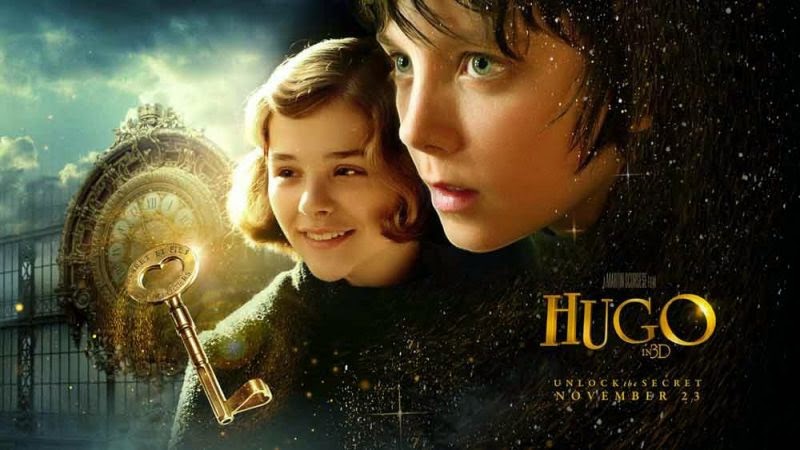
Based on the book The Invention of Hugo Cabret by Brian Selznick, this is a visually stunning film from beginning to end - even in 2-D (the film was released in 3-D) on a television set, it still a breathtaking movie.  It won five Academy Awards, for Production Design, Sound Mixing, Visual Effects, Cinematography, Sound Editing, and nominated for six more - for Director, Editing, Score, Screenplay, and Costume Design, and Picture. Interestingly, it lost the best picture Oscar to The Artist, a silent movie. 

The New York Times review by Manohla Dargis was glowing, as were  Roger Ebert  and The Guardian. Because of the costs of the film and the marketing, it sadly lost money on release. We highly recommend this film to lovers of classic film - it's a delight not to be missed. We'll leave you with the trailer:

Monday, November 23, 2020

John Fought for Spain

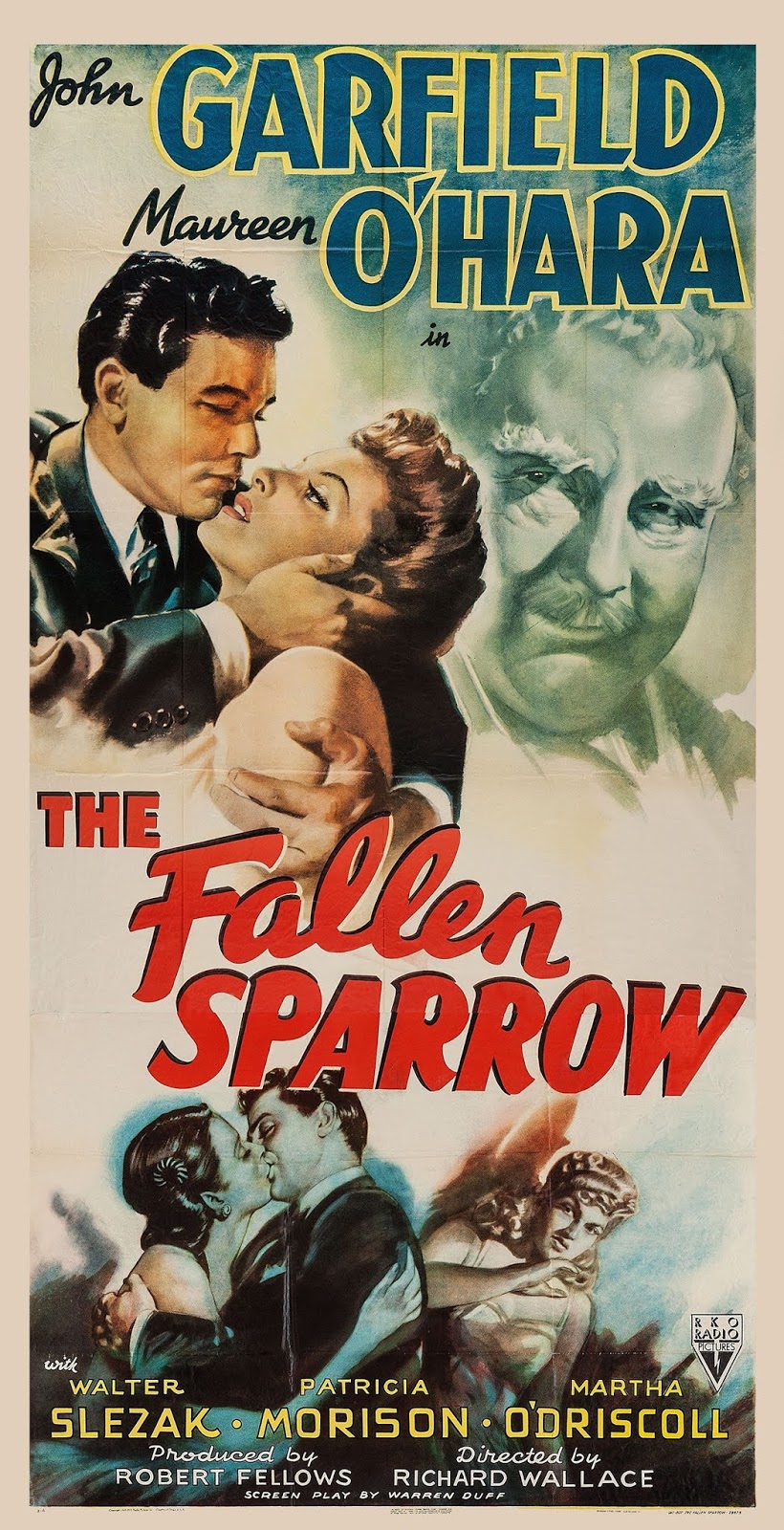
Following his escape from a Spanish POW camp, John "Kit" McKitrick (John Garfield) has been hospitalized in the US. While there, he discovers his best friend police lieutenant Louis Lepetino has died, allegedly the victim of an accidental fall from the window of a New York City high-rise. Kit is convinced that his possession of a war standard is the cause of Louie's death - and will also bring about his death next.  Our film this week is The Fallen Sparrow (1943). 

John Garfield is perfect as a man teetering on the edge of sanity. Yes, Kit has been hospitalized for what we would now call post-traumatic stress disorder, and has been discharged, but the death of his friend has summoned back all the demons he'd hoped to put behind him. Mr. Garfield brings a vulnerability to the character that does not detract from his strength of purpose. Given that Kit is in nearly every scene in the film, it's important that the audience identify with and support him; Mr. Garfield makes him a character you take to your heart. He wasn't the first choice for the part - RKO originally wanted James Cagney, but he turned it down (he'd been under some scrutiny because of his support for Loyalist Spain); Cary Grant, Randolph Scott, and George Brent also said no. (TCM article). Mr. Garfield, himself a supporter of Loyalist Spain, very much wanted the part and campaigned to get it. (John Garfield: The Illustrated Career in Films and Stage by Patrick J. McGrath).Stage by Patrick J. McGrath). Warner Brothers got the rights to remake Of Human Bondage from RKO in exchange for Mr. Garfield's services in this film (AFI catalog).

Maureen O'Hara (Toni Donne) takes on an unusual role - that of a possible Nazi spy. Toni is rather a cypher - you want to like her, you know that Kit wants to believe her, but in the final analysis, neither the audience nor Kit trusts her.  She's good in the part, because she is able to keep the audience on edge as to her intentions throughout the film; why she is working for the enemy is a question that hovers over the viewer.

While Ms. O'Hara keeps the audience guessing in an atypical role, Walter Slezak (Dr. Skass) does not. You know from the instant you see him that he is the villain. Sure, Mr. Slezak's early career was spent playing villains, but it's more than that. He fairly oozes evil - Dr. Skass' first conversation with Kit is a discussion of the beauty of water torture. We're told that Skass is a researcher - it's pretty apparent that he's the head of the spy ring, and no amount of screen subterfuge will convince you otherwise. If we had one regret in this film, it was that we would have appreciated a little more mystery surrounding the identity of the spy leader. 

We particularly enjoyed Martha O'Driscoll (Whitney Hamilton) as one of Kit's close friends. She is sweet and appealing as the one of the few people in Kit's life who is sincere. We especially enjoyed Kit's nickname for her - Imp. It seemed to happily sum up her personality and their friendship. 

Another character to watch is Inspector Tobin (John Miljan). Unlike too many police roles in movies, this is a character to observe carefully. There is more going on than meets the eye, and Mr. Miljan plays the part with an attention to detail.

The film's score was nominated for an Oscar (It lost to The Song of Bernadette).  While the New York Times review by Theodore Strauss (T.S.), was not keen initially on the film's story, Mr. Strauss' regard for Mr. Garfield's performance won him over: "by virtue of a taut performance by John Garfield in the central role, and the singular skill with which director Richard Wallace has highlighted the significant climaxes, The Fallen Sparrow emerges as one of the uncommon and provocatively handled melodramas of recent months." It would become one of RKO's high grossing films for 1944 (Variety) The story would appear as a Lux Radio Theatre broadcast on 14 Feb 1944, co-starring Robert Young,  Maureen O'Hara, and Walter Slezak. 

This is a movie worth seeing if for no other reason than to watch Mr. Garfield in action, but it has much more than that. We highly recommend it. In the meantime, here is a trailer:


Monday, November 16, 2020

Bette's Negative Prognosis

Judith Traherne (Bette Davis) is suffering from frequent and disabling headaches. At the urging of her best friend, Ann King (Geraldine Fitzgerald) and her family doctor, Dr. Parsons (Henry Travers), she sees neurosurgeon Dr. Frederick Steele (George Brent). He diagnoses a glioma, and brain surgery. Will the results be a Dark Victory (1939)?

Bette Davis won an Oscar in for Jezebel (1938); her performance here is also Oscar-worthy. Of course, next to the juggernaut Gone With the Wind, it was not in the cards for her to win again, but she did receive a well-deserved nomination for the doomed Judith Traherne. In an era in which Elisabeth Kubler-Ross's stages of grief were unknown, Ms. Davis portrays Judith's reactions: first to her supposed cure, and then to the realization that, at age 23, she only has a few more months of life. Like Julie Marsden in Jezebel, Judith is alone in the world, but there the similarities end. Judith is very much alone in the world - her beloved father died of alcoholism and her mother has abandoned her to play in Europe. To make up for her lack of family, Judith surrounds herself with friends. And while she may burn the candle a bit at both ends, we soon realize that her devotion to her friends (and theirs to her) is real and lasting. Ms. Davis was not the first choice for the film. It had originally been considered for purchase by MGM for Greta Garbo; when she was not interested, Merle Oberon, Carole Lombard, and Janet Gaynor were considered. Eventually, Ms. Davis convinced Hal Wallis to purchase it for her. (AFI catalog).
Her dearest friend is played by Geraldine Fitzgerald in her first American film. The character of Ann was created for the film, and having her is an asset to the plot.  Ann acts as a buffer for Judith, while giving Ms. Davis someone tangible to bounce off. Since Ann is the first person to discover Judith's fate, it is HER grieving that we concentrate on. When Judith ultimately finds out her diagnosis, the audience is ready to empathize with her, having already experienced the initial shock with Ann. Without Ann, the audience would have no outlet for their grief. 

George Brent is the picture of professionalism as Dr. Steele.  He's strong when he needs to be, but you believe in his frustration with his career - the high death rate for his patients have worn him out. He still wants to practice medicine, but needs a respite from the daily grind of death. In our age of informed consent, it is appalling that holds back the facts from his patient, but this was standard practice before Kubler-Ross.
Mr. Brent was not the first choice for the film - both Fredric March and Spencer Tracy were early choices (Edmund Goulding's Dark Victory: Hollywood's Genius Bad Boy by Matthew Kennedy ). Mr. Brent's interplay with Ms. Davis is delightful - they spar, but you can see the affection growing between them. The couple would appear in 11 films together during their careers; prior to this film, both were married. But, on this set, both were unattached - Mr. Brent had recently divorced Ruth Chatterton and Ms. Davis was finalizing her divorce from Harmon Nelson. The result was a romance that lasted several years, though Mr. Brent was unwilling to marry, fearing they could not have a long-lasting relationship. Ms. Davis would later say "Of the men I didn't marry, the dearest was George Brent" (TCM article).

The commentary that accompanied my DVD of the film immediately launched into a diatribe against Humphrey Bogart as horse trainer Michael O'Leary - miscast, a leading man shoved into a supporting part, etc. Except, Bogart was only starting to take on leading roles (like the gangster in King of the Underworld). His portrayal of Michael gives the film a character who is an equal to Judith. He works well with Davis, and their good-humored, toe-to-toe arguments about her horse are a breath of fresh air.  He also brings a masculinity to the part that is important later in the movie. You can understand Judith's overtures to Michael when her life has literally fallen away from her.  His response is appropriate, and paves the way for Judith's eventual healing process.
Ronald Reagan (Alec Hamin), on the other hand, is pretty much invisible in the film. He's there (Alec spends most of the movie drunk), but we found you don't pay much attention to him.  Director Edmund Goulding wanted to make more of the part, and asked Mr. Reagan to play the part as a gay man - Mr. Goulding wanted to make it clear there was no possible relationship between Judith and Alec.  Unsurprisingly, Mr. Reagan refused. (Dark Victory: The Life of Bette Davis by Ed Sikov).

The film was based on a Broadway play ran for six weeks, with Tallulah Bankhead starring as Judith.  It premiered on the radio in 1938, when Barbara Stanwyck and Melvyn Douglas starred in a Lux Radio Theatre version. In 1939 Ms. Davis and Spencer Tracy starred in another Lux episode. The story was remade on film in 1963's Stolen Hours and starred Susan Hayward and Michael Craig. In 1976, NBC broadcast a television version starring Elizabeth Montgomery and Anthony Hopkins.
Frank S. Nugent review in the New York Times when the film opened at Radio City Music Hall was glowing, especially in his praise of Bette Davis:"Miss Davis is superb. More than that, she is enchanted and enchanting." The film received three Oscar nominations, for Picture, Actress, and Original Score (Max Steiner). It is #32 on AFI's 100 Years...100 Passions

This is a fantastic film, and one you should go out of your way to view. We'll leave you with a trailer from the movie.

Monday, November 9, 2020

Farley is on the Run

Following their escape from jail, Arthur “Bowie” Bowers (Farley Granger), Elmo “Chickamaw” Mobley (Howard Da Silva), and Henry “T-Dub” Mansfield (Jay C. Flippen) arrive at the home of Chickamaw’s brother (Will Wright) and niece, Katherine “Keechie” Mobley (Cathy O’Donnell). As the days go by, Keechie and Bowie gradually fall in love. But there is a catch - the escapees pull a job that results in the death of a guard. Any hope Bowie has of getting a lawyer to prove his innocence on his original crime is now gone. The lovers hit the road in an attempt to avoid the police. Today we’ll be discussing They Live By Night (1949).

An excellent cast makes this noir romance a classic must-see.  While you might shake your head at some plot points (like, why don't Bowie and Keechie head as fast as they can to Mexico?), the love story mixes well with the crime elements.

This was Farley Granger's first film after returning from service during World War II. He bring a pathos to Bowie that keeps the audience interested in him. He often seems too naive and trusting, but the viewer needs to keep in mind that he's been in jail since he was 16 years old. As Eddie Muller points out in his commentary on the DVD, both he and Keechie are virgins when they marry; their mutual innocence is imperative for our appreciation of the characters.  Mr. Granger would later count this among his three favorite films (Include Me Out: My Life from Goldwyn to Broadway by Farley Granger & Robert Calhoun). 
Cathy O'Donnell is equally good as Keechie. She's tough, yet innocent. Though not educated, she has the common sense that Bowie lacks, and her strength of character keeps the couple hopeful for their future. (Ms. O'Donnell actually worked in a gas station for two weeks in order to look natural in the film (AFI Catalog)). The relationship between the two actors is lovely - in fact, there were discussions that they should be paired on a regular basis. A complication to that plan arose when Ms. O'Donnell married Robert Wyler, the brother of director William Wyler. When William left Samuel Goldwyn's employ, Goldwyn insisted that Ms. O'Donnell divorce her husband. When she refused, Goldwyn cancelled her contract (More Magnificent Mountain Movies by W. Lee Cozad). Mr. and Mrs. Wyler were married from 1948 until her death from cancer in 1970.

Bowie's two accomplices are ably played by Howard Da Silva and Jay C. Flippen. Mr. Da Silva bring menace to the hot-tempered Chickamaw, a part that was coveted by Robert Mitchum. (Mr. Mitchum was eliminated from consideration, as his recent film successes made him too important for what was seen as a minor part. This TCM article says that Mr. Mitchum was being considered for Bowie, but Eddie Muller's DVD commentary and this Medium article confirm that it was Chickamaw that intrigued Mr. Mitchum). Mr. Flippen's T-Dub at first seems a reasonable, calm man, set in contrast to the volatile Chickamaw. But, we eventually learn beneath the surface is a cold nature that will stop at nothing to get what he wants. Mr. Flippen is scary as he flips from sympathy to menace.
Ian Wolfe (Hawkins) gives a well acted performance to interesting character - a man who runs a quickie marriage chapel.  Mr. Muller, in his commentary noted that the film was careful not to label Hawkins a Justice of the Peace. The PCA objected to the man being a legal official.  Hawkins has strange morals, that by the end of the film make you almost sympathetic to him. Mr. Wolfe was in two other Nicholas Ray's films: Rebel Without a Cause (1955) and On Dangerous Ground (1952).

In the middle of production, RKO was bought by Howard Hughes, who had no use for the film. Not being one to release a movie he didn't personally like, Mr. Hughes shelved it for several years. Eventually, it was given a limited released in England; the reviews there were so favorable that RKO finally released in the U.S.

The film was based on the novel Thieves Like Us by Edward Anderson; working film titles included Your Red Wagon and The Twisted Road. The Production Code Administration originally thought the book was unfilmable; it took a great deal of work to adapt the script so that the PCA would approve it. (Lonely Places, Dangerous Ground: Nicholas Ray in American Cinema edited by Steve Rybin & Will Scheibel).

The New York Times review by Bosley Crowther was moderately positive, though very complimentary of the actors, especially Ian Wolfe who he called "disturbingly shifty." Today, it is on Eddie Muller's list of the Top 24 Noir Films (at #14). We highly recommend this excellent film, and leave you with this trailer:

Monday, November 2, 2020

Teacher Bette

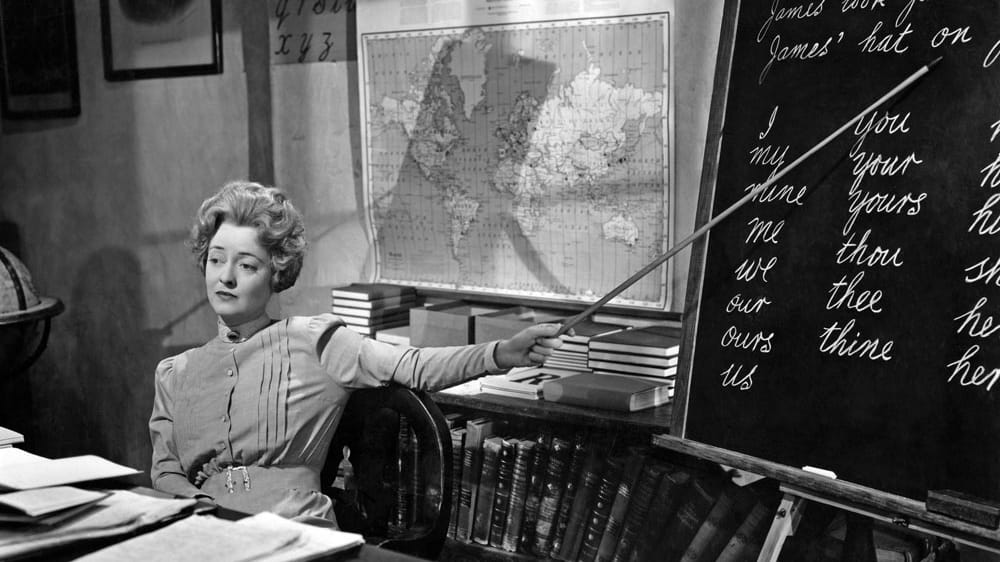
The Welsh mining town of Glansarno is in a tizzy - the new owner of one of the larger estates is arriving that day. They are shocked to discover that LC Moffat, M.A. is a woman - Lily Cristobel Moffat (Bette Davis), an educated woman who intends to use her inheritance to start a school for the local children. She enlists the services of Mr. Jones (Rhys Williams) and Miss Ronberry (Mildred Dunnock) to act as instructors in her free school but despite the high levels of illiteracy in the town, she finds herself in a battle with Sir Trevorby, the local Squire (Nigel Bruce) and pub owner Will Davis (Arthur Shields), both of whom see the school as a threat to their livelihoods.  Our film this week is The Corn is Green (1945).

Bette Davis shines as the tough-as-nails Miss Moffat in this retelling of the Broadway play.  Loosely based on the life of  playwright Emlyn Williams, the Broadway production starred Ethel Barrymore as the independent educator. Ms. Davis was only 36 when she took on the part - and would later say that she was perhaps a bit too young (Ms. Barrymore was 61 when she appeared in the play, and Miss Moffat was supposed to be in her 50s) - but Bette Davis was not averse to looking older for the film (TCM article). She brings grit and, when required, warmth to this single-minded woman.
The film introduced Joan Lorring (Bessie Watty) to the screen. Bessie is an avaricious, nasty piece of work, though with her mother, it's not hard to imagine WHY Bessie is the manipulator that she is. She especially loathes Miss Moffat (who she sees as the reason for everything that is wrong with her life), and goes out of her way to strike out at her nemesis.  Originally, Bette Davis wanted Ida Lupino for the role of Bessy Watty (Dark Victory: The Life of Bette Davis by Ed Sikov), but she was not available.  Angela Lansbury, Betty Field, and Andrea King were all tested - Ms. Davis selected Ms. Lorring, who got an Oscar nomination in the supporting actress category, and who called Ms. Davis one of her "teachers". 

Though Richard Waring (who played Morgan Evans on stage) was director Irving Rapper's first choice, Mr. Waring's military service prevented him from being cast. John Dall, like Ms. Lorring, was introduced for this film. He's convincing as Morgan, who goes from flippant to bitter to ambitious, and all done with great conviction. His scenes with Ms. Davis are especially strong - he would credit her with assisting in his performance - in his close up scenes, Ms. Davis stood "behind the camera, facing me, giving the scene the same acting as if she were before the camera."
Several wonderful actors repeated their Broadway roles. Mildred Dunnock who doesn't know how to give a bad performance, reprised Miss Ronberry; Rhys Williams as the minister Mr. Jones and Sara Pugh (Gwyneth Hughes) are also excellent (AFI Catalog),. Nigel Bruce, however, was new to the cast and is at his fubsy best as the rather clueless Squire.  Also added to the film cast was Arthur Shields, who makes a menacing publican. 

Also repeating her Broadway role was Rosalind Ivan (Mrs. Watty). Mrs. Watty is both funny and dismaying simultaneously. Her utter disregard for her daughter makes the viewer want to cringe - then again, with a daughter like Bessie, it's hard to argue with Mrs. Watty's attitude.  Ms. Ivan was over 60 when she played Mrs. Watty, yet you believe her as Bessie's mother - her face, while not that of a beauty, is also not old.  Because she frequently played women who were not very likeable, she acquired the nickname "Ivan the Terrible" (Accustomed to Her Face: Thirty-Five Character Actresses of Golden Age Hollywood by Axel Nissen). Ms. Ivan would continue in films for another nine years after The Corn is Green,  including Johnny Belinda (1948) and Scarlet Street (1945). After appearances in a couple of television shows, she retired.
One interesting aspect of the film (which is set in 1898) is that part of Miss Moffat's mission is to teach English to the locals. As was done in Ireland and Scotland, use of the native language was banned in place of English. Though it did not always prevent the locals from using the language, its use in the courts or even in places of business was illegal (Historic UK). As time progressed, Welsh began to die out; there were fears that it would no longer have any native speakers. However, in recent years, the number of native speakers has risen, and there is now hope the spoken language will continue to live (BBC).

As mentioned, the film was based on the 1940 Broadway play by Emlyn Williams with Ethel Barrymore as Miss Moffat. There were three other productions of the play: 1943 (with Miss Barrymore); 1950 (Eva La Gallienne); 1983 (Cicely Tyson). There was also an unsuccessful attempt of a musical (starring Bette Davis in the title role and Dorian Harewood as Morgan Evans) - Miss Moffat - that never made it to Broadway.  Helen Hayes took on the lead in the December 1947 Theater Guild of the Air radio production.  Lux Radio Theatre presented the story twice - with Olivia de Havilland and Richard Basehart as the teacher and student, in June of 1950 and again with Claudette Colbert and Cameron Mitchell in May of 1954. The story also made it to television in 1979, with Katharine Hepburn as Miss Moffat.
While Bosley Crowther enjoyed Bette Davis' performance in the film, his review in The New York Times was not complimentary of the director nor of the film overall, saying "this humble, human story is not as intimate and moving on the screen as it was on the stage." But, Mr. Crowther spends a lot of copy comparing the film to Ms. Barrymore's stage performance - a performance that (unfortunately) that the rest of us will never be privileged to see.

We all enjoyed the film thoroughly, and heartily recommend it for your enjoyment.  We'll leave you with a trailer:

Monday, October 26, 2020

Faye is in Danger

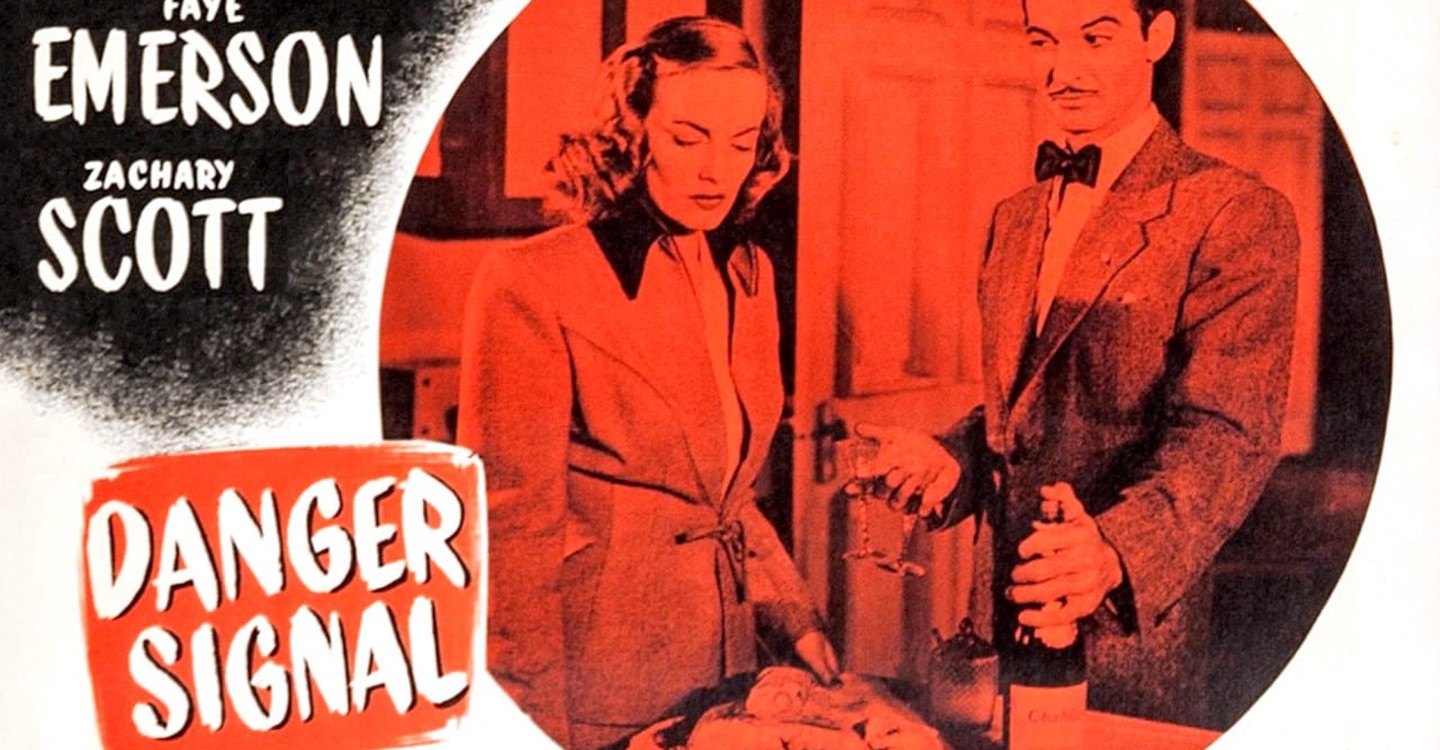
Ronnie Marsh (Zachary Scott) is a fast talking, fascinating man, who manages to convince Hilda Fenchurch (Faye Emerson) to rent him a room in the home she shares with her mother (Mary Servoss). Ronnie recently beat a hasty retreat from another town, where he was almost found with the dead body of Alice Turner. Ronnie rapidly decides that Hilda and her home offer a nice way for him to live comfortably, and he successfully woos her. But he changes his mind about his target when Hilda's younger sister Anne (Mona Freeman) returns home - Anne, you see has a substantial inheritance. Watch for the Danger Signal (1945)!
 
With Zachary Scott (who interestingly is not given top billing) in this film, you are in for a wild ride. He's perfect as an amoral seducer who is also probably a murderer. He has just the right amount of appeal that you understand why Hilda would fall for him, as well as the ability to make the audience cringe as you realize what an absolute heel he is.  Mr. Scott has an odd smile, and he has a way of turning it from endearing to menacing at the drop of a hat. The audience keeps watching because you're never sure what he will do next.

This film was released the same year as Mildred Pierce, in which Mr. Scott plays another remarkable scoundrel.  Though the characters have been compared to each other (Zachary Scott: Hollywood's Sophisticated Cad by Ronald L. Davis), these really are very different roles. You never fear Monty Beragon - he's lazy and, relatively speaking, harmless. Ronnie, on the other hand is a snake - he hypnotizes his victims, and then bites. 
Faye Emerson is equally appealing as Hilda. You have to like her if you are to appreciate the film - you need to worry about her, and wonder just what she is capable of doing to preserve her family. She's fascinated by Ronnie from their first meeting; her poise and obvious intelligence help to convince the audience of Ronnie's power over women. It's one thing when her mother and sister succumb to his charms. It's quite another when Hilda falls.

Ms. Emerson moved to California as a small child; in 1941, she landed a Warner Brother's contract after appearing in local stage productions.  She had small parts in a number of a movies, like Air Force (1943) and Destination Toyko (1943), but B movies - like Lady Gangster
(1942) - were her forte. Her first marriage disintegrated primarily because of her career; in  1943, she met Elliot Roosevelt, the son of the President. They married during the filming of this movie (which was one of a number of delays caused by their relationship), but the marriage only lasted until 1950. During the marriage, she left her Warner Brothers' contract, planning to spend the time with her husband. When she decided to return to work, she went first to Broadway (appearing in The Play's the Thing (1948) - she would ultimately appear in 5 Broadway plays) and to television, where she hosted The Faye Emerson Show. She would later work with her third husband, Skitch Henderson and become a regular on game shows and talk shows (Women Pioneers in Television: Biographies of Fifteen Industry Leaders by Cary O'Dell). Ms. Emerson retired in 1963; she died in 1983 at the age of 65.
Ann Blyth was originally slated for the role of Anne, but a back injury caused her to drop out (AFI catalog). Mona Freedman does a good job in a thankless role; Anne makes a good contrast to Hilda - she's silly, feckless, and uncaring. It's hard to like or care about Anne - she has little regard for the rest of her family and seems to get pleasure out of hurting her sister. In contrast, Rosemary DeCamp is excellent and convincing as psychiatrist Dr. Jane Silla - the voice of reason and experience in the film. The character is a tip of the hat to the novel’s author, Phyllis Bottome, who was a student of psychologist Alfred Adler (Eddie Muller intro). Ms. DeCamp would later state this was her favorite film role (TCM article).

Dick (Richard) Erdman, who has a small amount of screen time as Anne's would-be love interest, Bunkie, died last year at the of 93, after a career in films and television that lasted from 1944 until 2017.  Bruce Bennett (Dr. Andrew Lang) is banal as Hilda's boss - a research physician working in botulism. Appearing opposite Zachary Scott again (he was Bert Pierce in Mildred Pierce), Mr. Bennett fades into the background - he's not really a dynamic personality, and placed in contrast to Mr. Scott, well, there simply is no comparison.

Thomas M. Pryor's (TMP) review in the New York Times was lukewarm, however, the film showed a profit at the box office.   There's only one problem - it's the ending, which takes a very bizarre turn that can make you feel a like you have a slight case of whiplash. Regardless, you will spend the film engaged with the characters and the story.  We'll leave you with the trailer:

Wednesday, October 21, 2020

Yankee Doodle Jimmy

From the stage of I’d Rather Be Right, George M. Cohan (James Cagney), famed actor and the composer/lyricist of Yankee Doodle Dandy (1942), is summoned to Washington DC to meet President Roosevelt. At the President’s request, Cohan recounts the story of his life.

This post is part of the Politics on Film Blogathon, hosted by the Classic Movie Blog Association.
 
James Cagney gives the performance of a lifetime as Cohan. Though the role was offered to Fred Astaire (Mr. Astaire said no - he felt he was wrong to portray Cohan; he was right), and finally was given to Mr. Cagney, who was eager to play the part (TCM article). Mr. Cagney had always considered himself a hoofer - his first job in the theatre was dancing in the chorus (Library of Congress biography) - and he was eager to get away from the gangsters to which his career had been relegated. He'd also on occasion been accused of being a communist (his activities in the Screen Actors Guild were part of the issue), and playing Cohan showed him as the ultimate American patriot.

Mr. Cagney was a perfectionist, and demanded long rehearsals to perfect his dancing.  He was coached by Johnny Boyle, a vaudevillian who was highly regarded as an Irish-American tap dancer. At the same time, he was not averse to improvisation - when he first meets Mary Cohan (Joan Leslie), Mr. Cagney improvised most of his "business." The stair dance at the conclusion of the film was also spur of the moment. The dancing style, however was very reminiscent of Cohan's style (you can see some brief clips of Mr. Cohan dancing in this video). His dynamic dancing makes the film - when he is on screen you cannot take your eyes off him.  He's no singer, but as Joan Leslie pointed out "Jim doesn't sing, because he doesn't sing worth a darn. He'd talk it, and every now and again, he'd hit a note...but he had some much energy and such a presence that it doesn't seem like he couldn't sing." (Michael Curtiz: A Life in Film by Alan K. Rode).

Joan Leslie is a strong counterpart to Mr. Cagney. She gives Mary just the right amount of naivete in the beginning, and slowing moves the character into a knowing and supportive partner. Ms. Leslie had an excellent singing voice, and could dance a bit; she follows Mr. Cagney's lead, as he improvises some of their scenes together, she responds easily.  Ms. Leslie is playing a primarily fictional character.  George M. Cohan was married twice - to Ethel Levey and Agnes Nolan. When he agreed to the film biography, he stipulated that he didn't want either of his wives discussed. Warner Brothers decided to create an amalgam of the two women and give her a different name, thus abiding by Cohan's requirement and still having him be married - as well as provide a motivation for the song "Mary's A Grand Old Name."

Yankee Doodle Dandy is very much a Cagney family affair. James Cagney's brother, William, served as the producer, and sister Jeanne Cagney appears as Josie Cohan. The easy relationship between the brother and sister, combined with the talents of Rosemary DeCamp (Nellie Cohan) and Walter Huston (Jerry Cohan) make for a strong family unit. Ms. DeCamp was actually 11 years younger than Mr. Cagney. Her autobiography comments on the difficulties she and Ms. Cagney had learning the complex dance routines (Tigers in My Lap by Rosemary DeCamp).
Walter Huston, however, had a theatre background - he'd worked in Vaudeville, and among his fourteen Broadway credits was the musical Knickerbocker Holiday. He has what is perhaps the most moving scene in the film - the death of Jerry Cohan. According to Rudy Behmer (in his commentary on the DVD), Michael Curtiz broke down sobbing as he watched Cagney perform. He ruined at least one take and can be heard in the background of the film if you listen carefully.

The film also features strong performances by Richard Whorf (Sam H. Harris) and Irene Manning (Fay Templeton). George Tobias (Dietz) appears as a would-be theatrical impresario. And S.Z. "Cuddles" Sakall (Schwab) has one scene as the man who stages Cohan and Harris first production. Though the scene is fine, Mr. Cagney was initially upset that Mr. Sakall was mugging through the filming - he asked Mr. Curtiz to tone Sakall down. Much of his work ended up on the cutting room floor.
Obviously, a lot of the history is incorrect - the frame story in particular is not anywhere the actual story.  World War II broke out while Yankee Doodle Dandy was being filmed (Ms. DeCamp related the company huddled around a radio on the set, listening to Franklin Roosevelt deliver his address to Congress). I’d Rather Be Right, however,  ran from November 1937 to July 1938. And Roosevelt gave Cohan the Congressional Gold Medal (NOT, as stated in the film, the Congressional Medal of Honor - the Medal of Honor is a military award) in May of 1940.  It had been awarded in June of 1936, but Cohan (a Democrat), disliked unions and though an early Roosevelt supporter was not fond of Roosevelt's pro-union stance. The photo below (from the Library of Congress), shows George M. Cohan receiving the Gold Metal from the President. Mr. Cohan died in November of 1942, a few months after the film was released (AFI Catalog).

Bosley Crowther's review in the New York Times was glowing: "as warm and delightful a musical picture as has hit the screen in years, a corking good entertainment and as affectionate, if not as accurate, a film biography as has ever—yes, ever—been made." A Roger Ebert review from 1998 was also complimentary.  The film received three Academy Awards (for Actor - Mr. Cagney, Sound Recording, and Scoring of a Musical). It was also nominated for five awards: Picture, Supporting Actor - Walter Huston, Director, Original Screenplay, and Film Editing).  In 1993, it was added to the National Film Registry. It is #18 on AFI's list of musicals, #100 on the original 100 Years, 100 Movies, and #98 on the 10th Anniversary list.

If you'd like to read more about this exceptional picture, take a look at "‘A Great American Service’: George M. Cohan, the Stage, and the Nation in Yankee Doodle Dandy" by  Elizabeth Titrington Craft from The Oxford Handbook of Musical Theatre Screen Adaptations Edited by Dominic McHugh Oxford Handbook Online and this American Heritage article. If you've never seen Yankee Doodle Dandy, treat yourself and get hold of a copy. In the meantime, here is the trailer:

This post is part of the Classic Movie Blog Association Blogathon, Politics on Film. Please visit the website to read some of the other wonderful posts.


Monday, October 19, 2020

Is Bill a Murderer?

Sailor Alex Winkler (Bill Williams) finds a large sum of money in his pocket. He tells dance-hall hostess June Goffe (Susan Hayward) that he must have taken it from Edna Bartelli (Lola Lane) after she got him drunk. They return to her apartment to return the money, and find her dead. June agrees to help Alex locate the murderer before Alex's Deadline at Dawn (1946).

At first glance, this appears to be another "we only have six hours to find the murderer movie," but the plot has more twists and turns than a pretzel, making it an interesting ride.  It gets a bit long-winded at times - there is perhaps a twist too many and the ending seems to come from nowhere, but this is an enjoyable picture that will keep you watching.

Susan Hayward creates an interesting character in June. She's just on the border of jaded - tough, but still possessing enough faith in humanity that she is willing to come to the aid of this naive sailor. June hovers on the edge of acceptance - she wants to believe in Alex, but her experiences in the Big City have left her cynical. The audience spends the movie waiting for her to abandon Alex and is relieved when she doesn't. Ms. Hayward is a good choice for the part — her strength makes it acceptable as June takes on the more traditionally masculine role, while Williams is the "damsel" in distress. The film marks Ms. Hayward's return to the screen after giving birth to twin boys (AFI catalog).
Though Alex, as played by Bill Williams, is likeable, he can also seem dull and repetitive. Thankfully, as the film progresses, he becomes less childlike and more responsible. Mr. Williams is able to grow Alex - the film open with him recovering from the mickey that Edna gave him. As the movie goes on, we are aware that Alex's head is clearing, and while he is still a babe in the woods compared to June, he's far more intelligent than the early scenes led us to believe. Mr. Williams, who married Barbara Hale the year this film was released, maintained a friendship with Susan Hayward after the film - which apparently was not an easy task for a woman as guarded as she was (TCM article). 

Paul Lukas (Gus Hoffman) rounds out the stars of the film as a cab driver who befriends the pair. Mr. Lukas makes Gus a cypher - why he would want to help the couple is mysterious, but, like June, he appears to believe sincerely in Alex's innocence and goes to drastic lengths to clear him of a potential murder charge. Gus gets the opportunity to orate on the more philosophical elements of the film that were inserted into the script by Clifford Odets.
There are a number of outstanding character performances, headed by Lola Lane as the thieving Edna. The opening sequence of the film (you can watch it below), shows a deep close up of her face, with a fly dancing around her - is she dead, you wonder. Her appearance in the film is brief, but pivotal. Ms. Lane is always a pleasure and sadly often under-utilized - she never got the screen time offered to sister Priscilla.

Marvin Miller (Sleepy Parsons), who would later gain fame as Michael Anthony in the TV show The Millionaire, is excellent as Edna's compatriot, a blind pianist. Osa Massen (Helen Robinson) is also convincing as a woman who is somehow tied into the crime. Jerome Cowan (Lester Brady) has a brief appearance as another suspect.  The one character we could have done without was the creepy Edward Honig (played by Steven Geray). He was a bit too icky as a dance hall patron pursuing June, and didn’t seem relevant to the story.

The story was reprized by the Lux Radio Theatre in May 1946 with Mr. Lukas, Mr. Williams and Joan Blondell in the lead roles. The movie received a lukewarm review by Bosley Crowther in the New York Times. And while we agreed with the Times that the ending came out of nowhere, a lot of things that throughout the film made no sense do coalesce.  We will mention that that a couple of us needed to rewatch the ending to grasp all that was going on.

If not everything makes sense in the film, one can assume, like Eddie Muller says in his introduction to the film, that it is "a dream." We'll leave you with that opening scene,  which starts the twisty road.

Monday, October 12, 2020

Robert is in the Park

After a glorious six-day honeymoon in the Plaza Hotel, newlyweds Paul (Robert Redford) and Corie Bratter (Jane Fonda) settle down to married life in a fifth-floor walk-up apartment in New York City's Washington Square.  Dealing with the vagaries of life in the City (that we love!), Corie and Paul face broken windows, a bedroom that is actually a closet, plumbing that works backwards, a bathroom without a bathtub, and an upstairs neighbor who uses their bedroom window to get into his attic apartment.  Let's all go Barefoot in the Park (1967).

This was not the first time we'd seen this movie, though most had seen it many years ago. From my perspective, this has always been a movie I enjoyed. However, watching it with a more critical eye brought to all our attentions many issues with the film that we found, at the very least, to be annoying. Most of our irritation focused on Corie Bratter.

Corie is, by and large, a nitwit. She's gone from her mother's home to her husband's home. We've no indication that she has ever worked or even gone to college. We know her mother, Ethel Banks (Mildred Natwick) is a financially secure widow, living in New Jersey. Mrs. Banks has the money to send Corie costly - and frivolous - gifts from Bergdoff-Goodman (one of NYC's more expensive department stores). Corie has never wanted for anything. Nor it seems, has she ever been asked to use her brain. She sits around her new apartment all day; she's so bored that, at 5pm, she stands at the bus stop waiting for her husband to come home. And she has no concept of what is required to get ahead in the working world.  One wants to shake her periodically.
This is not Jane Fonda's fault - she is doing what the character was written to do.  If anyone is to blame for Corie, it is playwright Neil Simon, who really doesn't know much about women.  If you are familiar with his later film, The Goodbye Girl (1977), we have a similar ditzy woman. Paula McFadden could be seen as what could happen to Corie if Paul left her with a small child.  Mr. Simon writes about a woman whose only skill (and ambition in life) is to redecorate her apartment. At least Corie sticks to a budget. 

The role on Broadway had been played by Elizabeth Ashley, and Ms. Fonda was by no means the first choice.  Among the many actresses considered were Geraldine Chaplin, Elizabeth Hartman, Susan Saint James, Faye Dunaway, Yvette Mimieux, Sandra Dee, Suzanne Pleshette, Samantha Eggar, and Marlo Thomas (AFI Catalog). Though she is the focus of the story, Corie is the weakest character in the film, when viewed with 21st Century eyes.
Robert Redford reprises his role from the Broadway play.  He had to think long and hard before he took on the film - he didn't particularly like Paul, feeling the character was too uptight (TCM article). However, we found Paul to be likeable. Sure, he's not really open to new foods and he gripes a bit too much about the six flights of stairs to his apartment (he counts the stoop!), but he is also a responsible grown up. He's trying to build a law career and support his wife, while she spends all her time trying to get him to play, discouraging him from going to work, preventing him from preparing for a case, and keeping him out til 2am on a work night.  He is more sinned against than sinning. 

By far, the most interesting and enjoyable characters in the story are Ethel Banks and Victor Velasco (Charles Boyer). Ms. Natwick was reprising her role from the play, and received an Oscar nomination as best supporting actress. She's wonderfully delightful as a middle-aged matron tossed into the maelstrom that her daughter and Victor Velasco create. Despite their chaos, she tries to become part of the festivities, even though everything that they suggest (a ride on the Staten Island Ferry in the dead of winter, food that must be "popped" rather than nibbled, a selection of unfamiliar alcoholic beverages) are way out of her comfort zone. You can't help but love Ethel.
Charles Boyer serves as an excellent foil for Ms. Natwick. The older couple are very much like Corie and Paul - one irresponsible, and the other perhaps a tad too responsible.  Mr. Boyer brings a joie de vivre to the part to which the audience easily responds. Taking on the role that Kurt Kaszner had originated on stage, Mr. Boyer been working in films, both in America and in France, since the 1920s. His first English-language picture was 1931's The Magnificent Lie. He would become one of Hollywood's most popular leading men when he appeared with Marlene Dietrich in The Garden of Allah (1935). He worked on Broadway and on radio, had a career on television, working with partners Dick Powell and David Niven on Four Star Playhouse. He continued working in film and television well into the 1970s.  His only child died in 1965; following his wife's (of 44 years) death from cancer in 1978, Mr. Boyer committed suicide at the age of 78.  
Another cast member from the play is Herbert Edelman (later billed as Herb Edelman - you may remember him as Bea Arthur's husband, Stan on The Golden Girls), playing Harry Pepper, the telephone man. New characters in the film include Mabel Anderson as Aunt Harriet (she has one scene) and Fritz Feld as the owner of the peculiar Albanian restaurant on Staten Island. 

The story has been redone several times. Broadway saw a new production in 2006, with Jill Clayburgh as Ethel, Tony Roberts as Victor, and Amanda Peet as Corie. It was made into a 1970 TV series with Scoey and Tracy Reed as the Bratters. In1982, a TV movie (based on a stage play) was aired, starring Richard Thomas and Bess Armstrong as the newlyweds.

When the film opened at New York City's Radio City Music Hall, the New York Times review was not complimentary, calling it a "carelessly knocked-together film". While the story hasn't aged well, it is still worth seeing, if only to see Mildred Natwick and Charles Boyer working together. We'll leave you with a trailer from the movie. 

<
<

Thursday, October 8, 2020

Bette is Marked

Gangster Johnny Vanning (Eduardo Ciannelli) has purchased the Club Intime, forcing hostesses Mary Dwight Strauber (Bette Davis), Gabby Marvin (Lola Lane), Emmy Lou Egan (Isabel Jewell),  Estelle Porter (Mayo Methot), and Rosalind Marquis (Florrie Liggett) to work for him. Mary is well aware of the hazards of being in Johnny's employ - he murdered a hostess in another of his clubs - but she figures if she does her job and keeps her distance, all will be well.  But things go awry when her younger sister Betty Strauber (Jane Bryan) arrives for a visit on the same day that Mary is arrested for the murder of club client Ralph Krawfurd (Damian O'Flynn), an out-of-town visitor who stiffed Johnny. Our film this week is Marked Woman (1937). 


Jack Warner read the newspapers regularly - he considered them a source for stories for his studio. The reports on the arrest and prosecution of Charles "Lucky" Luciano by New York Attorney General Thomas E. Dewey piqued his interest. The charge was compulsory prostitution, and several prostitutes were convinced to testify against Luciano, despite the danger implicit in such an action (Marked Women: Prostitutes and Prostitution in the Cinema by Russell Campbell). While the movie denies its relationship "to any person living or dead," Mr. Warner had clearly ordered a story based on this famous trial. (DVD Documentary: Marked Woman: Ripped from the Headlines)

Bette Davis had just returned to Warner's after losing a court battle against the studio (TCM article). However, she came back to a strong role in an excellent film.  Ms. Davis as Mary Dwight is the lynch pin in the story - she is strong, intelligent, determined, but she is also a woman with a human side. Her love for her sister is the most important part of who she is, and Ms. Davis gives a performance that clicks on all levels.  She was determined to make Mary believable. For her appearance in a later scene (after Mary is beaten for her refusal to cow-tow to Vanning), Ms. Davis went to her own doctor to get properly bandaged and "damaged" for the hospital scene, as she thought the Warner's makeup department made her look as though she was wearing "a cream puff of gauze" (Dark Victory: The Life of Bette Davis by Ed Sikov). When she returned (and a horrified guard called the office to report that Ms. Davis had been in a horrible accident), Warner and producer Hal Wallis agreed to her makeup, as long as she removed the broken nose she was sporting! 

In 1937, Humphrey Bogart was not known for playing heroes. He came close in The Great O'Malley, playing a family man who is sent to jail by a by-the-book cop. But he'd also appeared as a white supremacist in Black Legion and as gangsters in Dead End, Kid Galahad, and San Quentin that same year. Here, Bogart takes on the mantle of Thomas Dewey, playing a crusading district attorney. He's excellent throughout the film, but is especially wonderful in a scene where he has to deliver some bad news to Ms. Davis

It was on the set of this film that Mr. Bogart met Mayo Methot (who gives a touching performance as Estelle); both were married at the time, but that didn't stop them from beginning a relationship. They married they following year, but the marriage was notorious for its violence. (Hollywood's Hard-Luck Ladies: 23 Actresses Who Suffered Early Deaths, Accidents, Missteps, Illness and Tragedies by Laura Wagner)  Nicknamed "The Battling Bogarts," they drank deeply and often, usually resulting in violent arguments - his nickname for her was "Sluggy". (Architectural Digest, 2016). As time wore on, Mr. Bogart came to fear and pity Ms. Methot; when he met young actress Lauren Bacall in 1944, he finally asked for a divorce. Suffering from alcoholism and depression, Ms. Methot eventually moved to her home town of Portland, Oregon, when she died in 1951. Mr. Bogart sent flowers to her gravesite until his own death (Portland Monthly, 2011)

The film is enhanced by the talents of number of magnificent character actors working at Warner Brothers. Allen Jenkins (Louie), always a delight, has a brief moment as a dress salesman. John Litel (Gordon) is convincing as Johnny Vanning's lawyer. Ben Welden is frightening as Vanning's henchman Charlie. After a substantial career playing small parts in film, Mr. Welden would move onto television, where he again took on character roles - including appearances in 8 episodes of The Adventures of Superman.  Eduardo Ciannelli is effective as the menacing Vanning. Casting Mr. Ciannelli also emphasizes the fact that Vanning is supposed to be Luciano. Sure, "Johnny Vanning" isn't an Italian name, but using the very Italian Ciannelli in the part eliminates any doubt of who Vanning is supposed to be.

The ladies who work as the club hostesses are also excellent. We've touched on Ms. Methot, but it is worth mentioning the efforts of Lola Lane and Isabel Jewell. Neither actress ever gets the attention they deserve - Ms. Jewell always turns in memorable performances, that you forget are her because she so inhabits the character, as she does here. 

Jane Bryan is also good in her small, but pivotal role. Ms. Bryan started her career at the Hollywood Theatre Workshop. A contract with Warner Brothers and support from Bette Davis led her to make 18 pictures (four with Ms. Davis) between 1936 and 1940 (She's featured in this Life article, when she appeared in The Old Maid). In 1939, Ms. Bryan retired from films after she married head of Rexall Drugs, Justin Dart (The Independent, 2009). The couple were married for 45 years and had three children (until Mr. Dart's death in 1984). Ms. Bryan worked as a governor of the Los Angeles Natural History Museum and advocated for the arts. She died, age 90, in 2009.

Originally titled The Men Behind  (AFI catalog), the film got a good review from Frank S. Nugent in the New York Times ("a dramatically concise script, a shrewd director, and an extremely capable supporting cast") Life similarly praised the film in this article from April 19, 1937. This is an excellent and compelling drama, well worth your time. We'll leave you with this trailer: