Fay Carter (Kay Francis) was born in a trunk. She's spent her life acting and touring the country; first with her actor/father, later on her own. She is determined to build a career on Broadway, but the only parts she are offered are tours. A chance meeting with Peter Snowden (Ian Hunter) may change all that. Peter yearns to produce a Broadway play, and he may have just found the actress to help him succeed. Our film this week is Secrets of an Actress (1938). We really enjoyed this film. It's compact (a mere 70 minutes) with excellent acting, a bit of drama, and a dash of comedy for Ms. Francis (who, as we mentioned in our review of The Cocoanuts is quite a good comedienne). If we had any complaint at all is that we would have liked the film to be a bit longer. A little more backstory, especially for Carla (Gloria Dickson) and Dick Orr (George Brent), as well as for Fay would have been welcome. Ms. Francis, though, has a choice part. She gets to be the straight woman for Isabel Jeans (as the frequently inebriated Marian Plantagenet), be lovelorn with George Brent, and assertive with Ian Hunter. Fay is one of her richer characters - well drawn by the writers, a strong, talented woman who is interesting and attractive to both the audience and to her leading men. It's quite easy to see why both Peter and Dick are drawn to her. She has pizzazz! (For an excellent overview of Ms. Francis, both in this film, and through her career, see this TCM article).
Gloria Dickson as the villainess is also quite good. When Ms. Dickson is on the screen, you cannot take your eyes off her. Her delivery is sharp, and her demeanor has just the right touch of self-assured nastiness. We were not familiar with Ms. Dickson, who made a total of 23 pictures between 1937 and 1944. We'd seen her before as Dolly in Lady of Burlesque (1943), but she frankly didn't make an impression. Unfortunately, she died at the age of 28 when a fire (caused by a cigarette setting fire to a sofa) engulfed her house.
Isabel Jeans as the hard-drinking Marian became rather wearing after a few scenes. The character's drinking could have been toned down a bit, which would have made her much more appealing. Her binges don't add a lot to the film; it's hard to understand what the writers were thinking. Regardless, the relationship between Marian and Fay is well done - they come across as really good friends; we did wonder how long Fay will be able to tolerate Marian in her cups. In the end, we would have preferred less of Marian and more of Ian Hunter and George Brent. There did seem to be one continuity issue. Early in the film, we see Dick ask Carla for a divorce (before he meets Fay). But later, when questioned why he has never asked for a divorce, he says there is no point. We wondered if the censors insisted that the earlier scene be included to emphasize that a physical marriage no longer existed between the couple. It did bother us that Dick didn't tell Fay that he was married - Mr. Brent plays him as an upstanding guy. By hiding the marriage, the audience loses sympathy for him.
The film had two working titles before release: Lovely Lady and The Woman Habit (AFI catalog). It has gorgeous sets by Anton Grot and exquisite gowns by Orry-Kelly. While Warner's was already starting to (undeservedly) sour on Ms. Francis, they do provide her with a lovely setting for the film. The Complete Kay Francis Career Record: All Film, Stage, Radio and Television by Lynn Kear, John Rossman call the film "uneven."
While this is a fair evaluation, this is still a film worth a viewing. Here is a trailer to whet your appetite.
Writer Tom Garrett (Dana Andrews) attends an execution with his future father-in-law, crusading newspaper editor Austin Spencer (Sidney Blackmer). Spencer has been advocating for the repeal of the death penalty, because of his belief that circumstantial evidence is being used to convict people unjustly. He and Tom come up with an idea - they will concoct evidence against Tom regarding the recent murder of a hooch dancer named Patti Grey. Once Tom is convicted and sentenced, Spencer will come forward with the information that will show it was a setup, and that the conviction could not have been Beyond a Reasonable Doubt (1956). I try very hard to avoid spoilers in the films we discuss; quite frankly, this is a hard one. The main reason being that the film seems to be going along on a traditional plain. You are sure you know where it is going and how it will end. And then everything hits the fan, and you are gobsmacked to find you were completely wrong. Our group went into this film knowing very little about it, and we were glad; the beauty of the film is in the surprise towards the end.
Dana Andrews is excellent as the writer who is attempting to bring down a District Attorney (Philip Bourneuf as Roy Thompson). He's treading a fine line in the film, and he does it beautifully. You would never believe that he was in the midst of an alcoholic crises that resulted in his arriving at the studio late with immense hangovers and after automobile accidents (Hollywood Enigma: Dana Andrews by Carl Rollyson). It would take awhile, but Mr. Andrews was able to control his illness by the late 1960s. In 1972, he became a spokesman for the National Council on Alcoholism and Drug Dependence and was able to say he had not had a drink in four years (New York Times).
We were not as impressed with Joan Fontaine (Susan Spencer). Susan is a decidedly unappealing character - she's spoiled, she's unemotional; Ms. Fontaine seems stiff and uncomfortable in the role. One never feels any love between her and Tom. When she reads a newspaper article that shows him slumming with exotic dancer Sally Moore (Barbara Nichols), Susan is offended that Tom has publicly embarrassed her. She seems far less concerned that he is sleeping with another woman. Ms. Fontaine holds the character distant from everyone, and Susan is uninterested in anything that requires thinking. With a father as intelligent as Austin Spencer, one expects a daughter more like Polly Fulton in B.F.'s Daughter. What Ms. Fontaine gives us is an enigma who cares for nothing.
While one is never sure of the motives of Roy Thompson, Jonathan Wilson (Shepperd Strudwick) and Bob Hale (Arthur Franz) are portrayed as lawyers who are honorable. The discussions between Hale and Thompson in particular, are fascinating, and display Bob's ethics in contrast with Roy's ambitions. This was director Fritz Lang's final film in America (TCM article). In fact, film editor Gene Fowler, Jr. put the film together with Lang's instructions - the director had already left the country. The director of M (1931) and Fury (1936) would make three more films in Germany; after which he essentially retired. Upon retirement, he returned to Los Angeles, where he died in 1976, at the age of 85.
Before Bert Friedlob acquired the script, Ida Lupino had intended it as a vehicle for herself, Howard Duff and Joseph Cotton (AFI Catalog). Unfortunately, the film didn't do well on release and received mixed reviews. Variety called it a "melodrama [that] never really jells." The New York Timesreview by Bosley Crowther, however, praised the "forceful" Mr. Andrews and said that "this a fairly intriguing and brain-teasing mystery film."
In recent years, the film has been discussed in a more positive light, as is demonstrated by these articles in Cineast and The Guardian. It was remade in 2009 with Michael Douglas as the prosecutor. We'll leave you with a trailer from the film. Try to avoid spoilers before you view this movie. You'll appreciate the surprise.
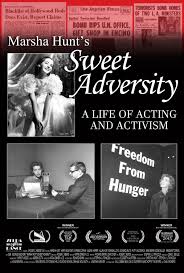
On a recent trip to New York City, I was able to catch a screening of a documentary. Marsha Hunt's Sweet Adversity (2015) was directed by Roger C. Memos, and is a tribute to Ms. Hunt (who turned 101 October 2018) both as an actress and an activist. With interviews of colleagues, friends, and admirers, this film is a must-see for classic film aficionados, as well as individuals who work to make the world a better place. Marsha Hunt was born in Chicago in 1917, and her family moved to New York City when she was a small child. After graduating from high school (Horace Mann in the Bronx), she had decided to pursue an acting career (Her family wanted her to attend college, but she felt it was a waste of time - she couldn't take any theatre courses until she was in her third year). Ms. Hunt started as a model; by 1935 she had signed an acting contract with Paramount Studios, where she was immediately cast in romantic lead roles. She grew bored with those kinds of parts, and asked Paramount for more character-driven stories. Paramount was not sympathetic; by 1938 she was no longer with the studio. She later signed with MGM, where among other roles, she appeared as Mary in Pride and Prejudice (1940).
Ms. Hunt discussed her disillusioning experience in auditioning for the role of Melanie Hamilton in Gone with the Wind (1939). Assured by David O. Selznick that he had "found his Melanie" after her audition, the following day the trades announced the casting of Olivia de Havilland. She also talked about her favorite part, the film that is often called the first movie to speak of the Holocaust, None Shall Escape (1944). Ms. Hunt recently discussed the film at the 2018 TCM Film Festival. When the writers who would eventually be tagged the Unfriendly Ten were summoned to appear before Congress, Ms Hunt was part of the contingent - The Committee for the First Amendment - that traveled to Washington DC to stand in solidarity with them. As a result (and despite years of war-related work during World War II), Ms. Hunt was eventually blacklisted. During this period, she began appearing on Broadway, ultimately appearing in six plays between 1948 and 1967. She also began working as an activist - first as a protege of Eleanor Roosevelt in support of the United Nations. Even today, at age 101, she continues to advocate in causes centered around homelessness, mental health, and hunger.
I felt privileged to be able to see this excellent film. Mr. Memos is still working to get venues to show it, and it should be seen, along with Ms. Hunt's wonderful films. We've discussed her in our comments on Lost Angel and Blossoms in the Dust, and hope to view more of her work. If you know of a venue that would be able to view the documentary, do contact Mr. Memos. A review of the film is available in the Los Angeles Times. Should you be able to catch a screening, please go - you're in store for a wonderful and enlightening experience.
Senator Sam Foley has died suddenly, and the governor of his state, Hubert "Happy" Hopper (Guy Kibbee) is tasked with naming a successor. The Governor is ordered by local boss Jim Taylor (Edward Arnold) to name one of his flunkies, but the citizenry rebel at the appointment of this yes man. The Governor's children campaign for the appointment of local Boy Ranger leader Jefferson Smith (James Stewart), a naive young man who Mr. Taylor finally agrees is the perfect solution. With no political background, Smith will be easily led by Senator Joseph Paine (Claude Rains) to vote according to Taylor's wishes. And so, Mr. Smith Goes to Washington (1939). This outstanding film was included as this month's contribution to the TCM Presents series. Originally conceived as a follow-up to Mr. Deeds Goes to Town, the film changed titles and actors when Gary Cooper proved to be unavailable. (AFI Catalog) James Stewart brings the needed innocence and gravitas to the role in his second film with Frank Capra and Jean Arthur (they had worked together the previous year on You Can't Take it With You). One problem with Frank Capra films is that he doesn't always know how to end them. It's a big issue with Meet John Doe (1941); it's a smaller issue here. Mr. Capra does seem to back his character into a corner, and then create a deus ex machina to pull him out of his problem. However, in this film the director does set up hints that Claude Rains will be both the problem and the solution to that problem.
Mr. Rains is, of course, excellent as The Silver Knight, the senior senator from Smith's unnamed state. Best friends with Smith's father (a crusading newspaperman who was murdered after he wrote editorials against a mining syndicate), Paine has been in the pay of Jim Taylor for years. But Senator Paine remembers the ideals that brought him to law and to politics. As Mr. Rains looks at Smith, we see his yearning for the purity that he had when he worked with Smith senior. A favorite villain for Mr. Capra is Edward Arnold. Mr. Arnold is able to be both affable and menacing at the same time. He helps us to understand why a respectable man like Senator Paine would fall into his clutches. He also has looming presence that gives the viewer pause - we know he is capable of any dastardly act to get what he wants. A stage actor at the beginning: between 1919 and 1933, he appeared in 13 Broadway plays, Mr. Arnold started his film career during the silent era. With his booming voice (and wonderful laugh) he was a natural for talkies, and appeared as the leading man in such films as The Toast of New York (1937) (he was billed ABOVE Cary Grant) and Diamond Jim (1935). Listed on the notorious "Box Office Poison" list, Mr. Arnold segued into more character parts, like Anthony P. Kirby, Sr. (James Stewart's father) in Capra's You Can't Take it With You (1938). Though he identified as a conservative Republican (and even ran for Los Angeles County Supervisor - he lost), he served as President of Screen Actors Guild, and was vocal in his opposition to the blacklisting of his colleagues during the HUAC era. Married three times, and divorced twice (he had three children with his first wife), Mr. Arnold died of cerebral hemorrhage in 1956 at the age of 66. His turn as Olivia de Havilland's father in The Ambassador's Daughter was released just after his death.
Jean Arthur (Clarissa Saunders) is picture perfect as the tough as nails assistant, who is sick and tired of the dishonest nature of politics. She's seen Taylor's influence on his state for too long, and is convinced that Jeff Smith is either an idiot or a stooge. When she finds he is a man of ideals, she becomes his staunchest ally. She is ALSO the smartest person in the film. She knows the rules of the Senate by heart, she understands the workings of the government, and she knows the people who work on the Hill. It's hard to imagine anyone other than Ms. Arthur giving Saunders such range. The film is also blessed with a bevy of magnificent character actors: Thomas Mitchell (Diz Moore), Eugene Pallette (Chick McGann), Capra favorite Charles Lane (Nosey), Ruth Donnelly (Mrs. Emma Hopper), Astrid Allwyn (Susan Paine), and H. B. Warner (Senate majority leader). But leading this group are the always wonderful
Beulah Bondi (Ma Smith) and Harry Carey (President of the Senate).
Though their parts are small, you remember then. One only regrets that
they are not on the screen for longer. Ms. Bondi would end up playing James Stewart's mother a total of five times (TCM article). This was the third outing in that role.
The film proved to be quite popular, though initially it was reviled by many U.S. Senators and by the Washington Press Corps. (WAMU article). Senate Majority Leader Alben Barkley described the film as "silly and stupid," adding that it made the Senate look like "a bunch of crooks." (U.S. Senate article). The film was also banned in Germany and Italy (they didn't like the fact that the film was about a democratic government, even a government that was having problems); however it did well in England, France (prior to the German invasion) and in the United States. Despite the jabs at journalists, the New York Times review was glowing, calling it "is one of the best shows of the year. "
The American Academy of Motion Picture Arts and Sciences obviously agreed; it was nominated for 11 Academy Awards, including Picture, Actor (for James Stewart), Supporting Actor (for both Harry Carey and Claude Rains), Director, Art Direction, Film Editing, Film Scoring, Sound Recording, and Original story (for which it won it's only Oscar). But, in 1939 the competition was fierce, and the juggernaut called Gone with the Wind pretty much swept the awards (winning 9 of the 14 for which it was nominated). Among the other Picture nominees were Dark Victory, Goodbye, Mr. Chips, Ninotchka, Stagecoach, Wuthering Heights, and The Wizard of Oz!
Noir City DC was held in October 2018, and featured a number of fascinating films. Though I would have loved to have seen them all, having a job and other responsibilities precluded that. We were, however, able to see a double feature of two rarely shown films. The first was Destiny (1944), the story of Cliff Banks (Alan Curtis), an ex-con who has a penchant for getting himself involved with the wrong women. The second film was Flesh and Fantasy (1943), an anthology film - three stories that looked at superstition, dreams, and destiny. But more interesting than the films themselves was that fact that, at one point, they were to be one film. Eddie Muller, founder of the Film Noir Foundation (and the host of Noir Alley on TCM) introduced the films, and also hosted an impromptu discussion in the lobby of the AFI Silver Theatre on the intermission. He provided a fascinating look at the history of these two films, originally intended to be only one movie, with four separate, interrelated vignettes. Julien Duvivier had already been acknowledged as a great director, thanks to films like Pépé le Moko (1937), when World War II broke out. Like many of his compatriots, he left France to work in Hollywood, where he felt he would have more creative freedom (EuroChannel article). Mr. Duvivier was friendly with Charles Boyer and the two formed a production company. The result was Flesh and Fantasy, which would be distributed by Universal Studios. Only there was a problem. Universal executives thought the first vignette was too odd for their audience, and yanked it out of the film. Then, the following year, Universal decided release it with a frame built around the short (to make it feature length and "clarify" it). They called back actors Gloria Jean (Jane Broderick) and Alan Curtis, and over their protests, forced them to film this new, odd sequence. Mr. Duvivier refused to participate (ordering his name be removed from the picture), and Reginald Le Borg reluctantly assumed direction of the new section. The new film was Destiny (1944)
The difference in tone and texture between the two episodes is glaring. As Mr. Muller pointed out in his introduction, you know when Mr. Duvivier's sequence begins (and ends) without being told. His portion is dreamlike, but at the same time, intense and moody. Mr. Le Borg's portion is more matter-of-fact (it also doesn't help that the script he was given makes little-to-no sense. Cliff Banks is turned into an idiot in the frame story. I found the character more interesting as a monster). John Garfield had been the first choice for Cliff (when it was still part of Flesh and Fantasy).
Both Teresa Wright and Bonita Granville were considered for Ms. Jean's role (AFI Catalog).Gloria Jean was brought to Universal as a singing star in the mold of Deanna Durbin. She saw Flesh and Fantasy as a turning point in her career. Finally, she would be in a dramatic role (with almost no singing) with fine performers Like Edward G. Robinson and Barbara Stanwyck. But, when the studio pulled her segment from the film, she was devastated, and felt that this action prevented her from advancing in the film industry (The Hollywood Reporter, 2018). By then end of the 1940's, her film career was pretty much over. She did some television, but eventually worked as an executive secretary at Redken Laboratories; she retired from that job after 30 years with the company. She moved to Hawaii to live with her son, Angelo and daugher-in-law (Angelo died in 2017). A biography was published in 2005 (Gloria Jean: A Little Bit of Heaven by Scott and Jan MacGillivray). Ms. Jean died in August 2018 of heart failure and pneumonia. She was 92.
The three stories that make up Flesh and Fantasy were supposed to flow, one into the other. Despite the unnecessary interruptions of Robert Benchley (I'm not really a fan. He frequently just goes a bit too far in silliness for my taste), the vignettes do still waft from story to story. The first (sometimes called "Mardi Gras"), stars Betty Field as Henrietta, an embittered seamstress, who yearns for Michael (played by Robert Cummings), a law student who is unaware of the homely woman. It has a romantic tinge, and is reminiscent of The Enchanted Cottage (1945). Ms. Field does a good job with the part, and provides just the right touch of hope to a woman who has all but surrendered her life. Story two (often called "The Palmist") concerns Marshall Tyler (Edward G. Robinson), a businessman who is told by palm reader Septimus Podgers (Thomas Mitchell) that he will kill someone. Tyler becomes obsessed by the prophecy, and is plagued by voices encouraging to control the prediction by picking a victim now, so that he will not be accused of a crime. Mr. Robinson is a deft actor who portrays mania well (if you've never seen him in Scarlet Street (1945), give yourself a treat). He's ably supported by Mr. Mitchell (a superb character actor), along with Dame May Whitty (Lady Pamela Hardwick) and Anna Lee (Rowena). The final story features Charles Boyer as Paul Gaspar, a world-renowned high-wire performer who is having nightmares that see him falling from the wire as a lovely woman gasps in horror. While traveling back to America (and considering the future of his act), he meets Joan Stanley (Barbara Stanwyck), the woman whom he has seen in the dream. Romantic elements also infuse this story, and both Mr. Boyer and Ms. Stanwyck are excellent (and are excellent together). We also have Charles Winninger as King Lamarr, the sympathetic owner of the Paul's circus.
Originally titled For All We Know, Flesh and Fantasy also looked at actors Charles Laughton, Adolphe Menjou, Deanna Durbin and Greta Garbo as potential actors in the piece. (AFI catalog) All three stories in Flesh and Fantasy made it to radio: a Screen Guild Theatre radio broadcast on April 1945 starred Ella Rains and Charles Boyer in "The High-Wire Performer" episode; a July 1945 broadcast featured Edward G. Robinson and Vincent Price in "The Palmist" episode; and in September 1945 John Hodiak and Claire Trevor enacted the "Mardi Gras" Episode. Mr. Muller is hoping that one day, these films can be reassemble to finally show us the film Mr. Duvivier intended to release. In the meantime, I heartily suggest watching both films together, and let you mind wander over the possibilities. Here are trailers from both of the films:
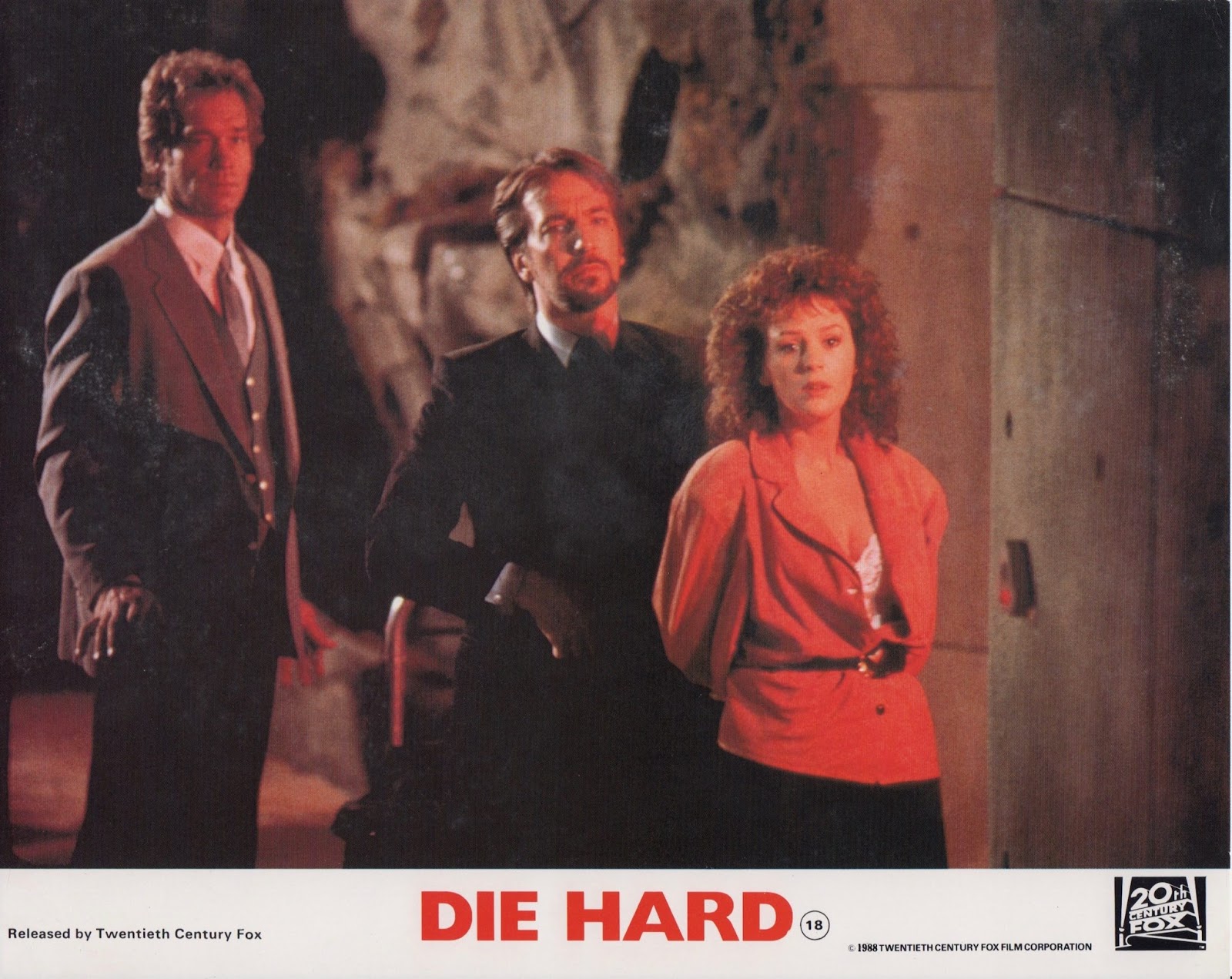
New York City police detective John McLane (Bruce Willis) arrives in Los Angeles for a visit with his estranged wife, Holly Gennaro (Bonnie Bedelia). Holly left NYC with the couple's two children when she was offered a prestigious job with the Nakatomi Corporation. John was completely unsupportive of her career move, resulting in a rift between them. He's in LA, hoping for a reconciliation, but is not in her office five minutes when he begins an argument about her job. The squabble only ceases because she is called out to speak at the company Christmas party. Raging at himself, John remains in her office cleaning up. It's only due to this that, when the party is invaded by a group of terrorists, led by Hans Gruber (Alan Rickman) John is able to escape, and begins a one-man war on the invaders, while trying to get help from the LA Police. Welcome to the 30th anniversary of Die Hard (1988), a TCM Fathom Event. Bruce Willis brings the proper level of non-hero to the role of McLane. John is literally making things up as he goes along, and Willis makes it clear that John is operating on a new level. He's no traditional action hero - he's scared, he gets hurt, he makes mistakes. He has one goal: to get himself and Holly out of the building alive. Interestingly, the part was originally intended for Frank Sinatra (Yahoo Entertainment) following his success in The Detective (1968). After Mr. Sinatra said no, the film was offered to Sylvester Stallone, Harrison Ford, Clint Eastwood, Paul Newman (ABC News), Richard Gere, Al Pacino, Arnold Schwarzenegger,
James Caan, and Burt Reynolds (Daily Mail). Bruce Willis was a TV actor; sure, his show Moonlighting, was a success, but it was primarily a comedy, he was not the titular star (Cybill Shepherd was) and Mr. Willis' first forays into films had not done well. But, by this time the producers were desperate, and (thankfully) decided to go with Mr. Willis.
Good as Mr. Willis is, he is nothing without his nemesis, the magnificent Alan Rickman. Mr. Rickman is the perfect foil to Willis. Gruber is unemotional - even as he murders in cold blood, he never blinks or shows any concern (for an excellent discussion of the character, see this New Yorker article: "The Unforgettable Villainy of Alan Rickman in Die Hard"). Hans Gruber is #46 on AFI's list of Greatest Villains, and deservedly so. Mr. Rickman gives the movie the gravitas that it requires to keep the audience on the edge of their seats. It was Mr. Rickman who decided that Gruber should be garbed in an expensive suit and tie, which succeeds in turning his character into even more of a monster. (this article from The Vulture comments on Mr. Rickman's stunt work in the film - he did the scary final fall himself). The part of Gruber was his breakout role, in a career that included such varied characters as Alexander Dane in Galaxy Quest (1999), John, the philandering husband in Love, Actually (2003), Jamie, the ghostly cellist in Truly, Madly, Deeply (1990) Colonel Brandon in Sense and Sensibility (1995), and, of course, Severus Snape in the Harry Potter films. I was lucky enough to see him perform Private Lives on Broadway in 2002. He was a thrilling actor, whom I miss.
I'm always pleased to see James Shigeta (Mr. Takagi) and he does not disappoint in his brief role. Mr. Takagi is a hero, who tries his best to protect his employees, even to sacrificing his own life. Since roles for Asian actors are always at a minimum, Mr. Shigeta's film career was limited. However, he appeared in a wide range of TV shows, and was always excellent. Two films of his to look out for are Bridge to the Sun (1961) and Flower Drum Song (1961). Born in Honolulu, he served in the Marines during the Korean Conflict. He began his performing career as a singer, ultimately working on film, television, and the theatre. He died at the age of 85 in 2014.
On release, the film received mixed reviews (AFI catalog) - this New York Timesreview is an example of one of the bad ones. It is, however a film that has aged well and become more widely admired in the ensuing years. Richard Brody, in an article from The New Yorker talks about having finally seen the film after 29 years (he enjoyed it, with reservations). It resulted in four sequels (none as good as the original), and was #25 in Entertainment Weekly's list of the "25 Greatest Action Films of All Time." And, in 2007, Bruce Willis donated the undershirt that McClane wore to the Smithsonian Institute's National Museum of American History.
Though Bruce Willis has stated that Die Hard is not a Christmas movie (article from The Washington Post), I would disagree - sure, there's lots of violence (but there is violence in Home Alone, and that seems to be widely accepted as a Christmas movie), but at its essence, Die Hard is about a family finding itself, and if that is not the spirit of Christmas, I don't know what is. Besides - there's a tree and Christmas music! We'll leave you with the trailer, and a message of good cheer this holiday season. Yippee-ki-yay!
Georgiana Summers (Kay Francis) overhears Bob McNear (George Brent) and Betty Summers (Genevieve Tobin) planning a rendezvous. It’s not long before Georgiana realizes that Betty is actually the current wife of Georgiana's ex-husband, Ralph Summers (Ralph Forbes). Georgiana devises a plan to get her revenge by trapping Betty in Georgiana’s country home where she is expecting a visit from Ralph. But plans go awry when jewel thieves Lawrence (John Eldridge) and Connie (Claire Dodd) also get trapped with them. Our film this time is The Goose and the Gander (1935). When we reviewed The Cocoanuts, we discussed Ms. Francis' excellent comic timing. This film substantiates that she is a brilliant comedienne. She's funny, and handles the quick dialogue and action with panache. This film even has a set of scenes in which jewelry is being carried from room to room (much like the scene with the Marx Brothers). And as before, Ms. Francis is deeply involved and a riot. Much of the humor in the film is devoted to Georgiana observing the shenanigans that are going on around her and reacting to them. It is truly a shame Ms. Francis didn't get to do more comedy. This is a movie that very much focuses on the ladies - the men are mere window dressing to propel the action. George Brent has a few scenes with Ms. Francis, but he is there to move the story; he's not really a strong character. Quite frankly, he doesn't need to be. The only complaint we had about the movie was the ending - which came from nowhere - but we didn't care. The resolution worked in the sense that it was funny, it gave the film a bit of a twist, and put our various characters where they needed to be. In The Women of Warner Brothers: The Lives and Careers of 15 Leading Ladies by Daniel Bubbeo, George Brent is heavily criticized as being a non-entity. Well, we beg to differ. He's a good actor (see him in something like The Great Lie, The Spiral Staircase, or The Purchase Price). Don't use this film as an example of his talents
While the advertising, as seen here, emphasizes the romantic aspects of the plot, it doesn't do justice to the mystery of the stolen jewels and how the thieves will get their comeuppance. The film is funny just dealing with the romances, but add in the jewels, and the arrival of Spencer Charters as Inspector Winkelsteinberger, and film soars. His interactions with Helen Lowell as Georgiana's Aunt Julia are hysterical. The police do get a bit dim, but under the circumstances, it's not hard to imagine that even Columbo would get confused.
We very much enjoyed Claire Dodd as the current Mrs. Summers. That she would want to venture off with another man is not surprising, given what a dolt her husband Ralph is (it's more surprising that Georgiana would want him back, even for revenge). Released in 1935, this film is firmly under the control of The Code. In spite of this, there's a lot innuendo, primarily between Ms. Dodd and Mr. Brent. The plot really goes into action when they are trapped in Georgiana's country home, posing as man and wife. We KNOW they are going off together for an evening of lust, but once in the house, the pair have to figure out a way to get Bob out the locked room (Georgiana's contribution to the confusion). Ms. Dodd protesting her purity is especially funny.
Just because it is a comedy, doesn't mean that Ms. Francis doesn't get some lovely costumes. Orry-Kelly does the dresses, with his usual flair; all of the actresses benefit from his expertise. The screenplay by Charles Kenyon (who had a long history with screenwriting, going back to the silent era) is crisp and entertaining. It's his story, as well as his screenplay; in a brief 65 minutes, this film includes a lot of plot. It's a wild
ride - and an enjoyable one. If you blink at the wrong time, you
might miss something. (TCM article)
We so often say that the New York Times review didn't like films but this time we get to quote a favorable review: "The narrative is so deviously complex that if you stop to light a cigarette or talk to your neighbor it requires five minutes to reorient yourself in its labyrinthine ways." We agree, and suggest this is a film that deserves multiple viewings. We'll leave you with the trailer.
Four college friends want to make it big in New York City. Catherine “Fiery” Furness (Janet Gaynor) is determined to be a writer. Chris Thring (Charles Farrell) plans on a law career. Mack McGowan (James Dunn) sees himself as a radio singer. And Madge Roundtree (Ginger Rogers) has visions of Broadway stardom. While they are the best of friends, there are complications: Fiery loves Chris, Chris loves Madge, Madge loves Mack, and Mack loves Fiery. Who will have a Change of Heart (1934)? It's always enjoyable to see an actor at the start of his or her career. Here we have Ginger Rogers in a film released only five months before she appeared as Fred Astaire's partner in Flying Down to Rio (if you recall, the duo were second bananas in that film). We also have a glimpse of Shirley Temple, in the dialog-free role of a little girl on an airplane - released just before Ms. Temple became America's darling in Little Miss Marker. The titular stars of the film are Janet Gaynor and Charles Farrell, who were appearing in their last of twelve films together (Ms. Gaynor was the first actress to win an Oscar. It was awarded for two films in 1927 - Sunrise: The Story of Two Humans and Seventh Heaven, the latter with Mr. Farrell). (AFI catalog) Ms. Gaynor is an always engaging actress, and she gives her character's nickname multiple meanings. Katherine says that she is called Fiery because of her red hair, but Gaynor makes a character who is strong and determined. She takes the hand that is dealt her with little complaint, and makes it work.
Though Ms. Gaynor, who had successfully made the transition from silent to sound films, had a career boost when she garnered raves in A Star is Born (1937), she decided to retire in 1938. She married costumer Adrian in 1939, and they had a child the following year. They remained together until his death in 1959. She returned to films briefly (Bernadine in 1957), as well as doing some television work beginning in 1953. But, by and large she painted, and traveled - often with her friend Mary Martin and Martin's husband. In 1982, a car accident killed one person (Mary Martin's manager Ben Washer) and injured Ms. Martin, Ms. Gaynor's second husband Paul Gregory, and Ms. Gaynor herself. Though Ms. Gaynor lived for another two years, she never fully recuperated from her injuries and died at the age of 77. James Dunn is quite good in the role of Mack. He plays him as a
self-assured young man, who is very much the leader of his friends. Mack is the ringleader - he
is the one who urges them all to journey with them to New York City. One
particularly fun scene involves him trying to con a mother and daughter
to adopt an infant. He's quite engaging.
We also very
much enjoyed Beryl Mercer (Harriet Hawkins). Ms. Mercer made a career
playing motherly types, and she does not disappoint here. She is sweet
and sympathetic, and her affection for Fiery makes the audience warm to
her instantly. That she seems to know (and care) that the young Mrs. Mockby (Drue
Leyton) needs to adopt the baby Harriet has in her care also makes her
appealing. We trust her unerring judgement in what is best for her babies, and for the parents who adopt them because of Ms. Mercer's sincerity.
We were NOT familiar with Ms. Leyton (she only made 10 films, one of
which was uncredited, and two Broadway plays), but her life story is far
more interesting than her career. In 1938, she retired and moved to
Paris to marry Jacques Terrane (also known as Jacques Tartière, a French
actor). She began working on Voice of America,
making herself quite unpopular with the Nazi's. With the outbreak of
the war in France, her husband joined the resistance, and was shot while working with the Free French in
Syria. With the Nazi entrance into Paris, Ms. Leyton was arrested, but managed to
escape. She joined the French resistance, and used her house in Barbizon
to smuggle (in total) 42 downed Allied airmen out of France. She wrote a
book about her experiences - The House Near Paris. She died in 1997 at the age of 93.
Which brings us to Ginger Rogers. We know from the beginning that Madge is not the good girl - she's blowing bubble gum at her college graduation (instead of looking beatific like Fiery). Even with that image, Ms. Rogers presents Madge as problematic. She is ambitious, and willing to do whatever it takes to get what she wants, but it's still hard to truly dislike her. You just want to give her a shake. As a result, by film's end, you are satisfied with the way it all resolves. The scenes of early New York City are always appealing to this group of natives. Change of Heart was surely filmed in Hollywood, but there is enough stock footage of NYC, circa 1934, to give us pleasure. While this is not a great film, it is enjoyable, primarily because of the two lead actresses. We'll leave you with this scene with Ginger, Janet, and the guys. You can also see Shirley Temple at the 1:08 mark (Don't blink. You'll miss her!)
Frances Mayes (Diane Lane) is a writer and book reviewer, who is supporting her would-be author husband. She THINKS she is happily married, and is devastated to learn that her husband has been carrying on an affair, is leaving her, AND is demanding alimony. He'll settle however - his lover wants Frances' house. With the sale of the house to the spouse-to-be, Frances is left with a nice sum of money and no place to live. Depressed and unable to write, Frances is consoled by her friend Patti (Sandra Oh), whose pregnancy has resulted in her and her partner Grace (Kate Walsh) giving Frances their tickets for a bus tour of Italy. While motoring through Cortona, Frances sees the villa Bramasole; she impulsively purchases it, and begins to rebuild her life Under the Tuscan Sun (2003). The reconstruction of Bramasole, which when purchased, is in the same wrecked condition as Frances, is the focus of the film. The house has ceilings that are falling in, pipes which no longer supply water, and a pile of junk that the prior owner was too fragile to discard. Frances sets out on a building project that, as she tears out walls, also helps her to dislodge the pain in her soul.
Frances
tells her friend, Mr. Martini (Vincenzo Ricotta), that she bought the
house because she wanted people to cook for, a house in which she could
have a wedding and a family. What Frances learns is that wishes can be
granted in different ways, and that, while the original desire is not answered, the response can be just as satisfying as the earlier aspiration. Ms. Ladd is magnificent at showing us the progression of
Frances' life and Frances' growing understanding of life's vagaries. Ms. Lane is supported by two wonderful actresses. Lindsay Duncan as Katherine, a free spirit who acted for Federico Fellini (or FeFe, as she calls him) has also made some life choices that have caused her unhappiness. Katherine is someone who lets life happen as she waits for her joys (symbolized by ladybugs) to appear. Similarly, Sandra Oh also is faced with the destruction of family when her partner decides that their longed-for child was not really what Grace wanted from life. Like Frances, Patti must rebuild her life as a single mom, turning to Frances as her extended family. Both actresses give memorable performances as influences on Frances' new life.
At times, it seems that Frances' and Patti's dreams of a happy family with a supportive partner, are impossible goals. But the subplot of the romance between Pawel (Pawel Szajda) and Chiara (Giulia Steigerwalt) gives us hope for the future, as does Mr. Martini, whose devotion to his wife and children show us our first positive male role. Frances imagines that Marcello (Raoul Bova) is the answer to her prayers. Mr. Bova makes him an appealing character. He's a man who respects Frances, as well as desiring her. Whether he actually loves her is problematic; Marcello is well aware that they've had little time to discover love, while Frances is lost in imagining a new life for herself with this relative stranger. Marcello's pragmatism works in the film. He tries to build a relationship, but is accepting of the fact that it may not come to fruition.
It's worth commenting on the beauty of this film - the cinematography (by Geoffrey Simpson) is exquisite; one yearns to visit Tuscany at the conclusion of the film. You get to go with Frances on her tour of Italy; her journeys during the repair of her house also bring us to Positano, a glorious seaside town that shimmers in the sunshine. You see Rome, via Marcello's high speed driving (Frances: "Do traffic lights mean anythng around here?" Marcello: "Sure. Green light - avanti, avanti. Yellow light - decoration." Frances: "What about red light?" Marcello: "Just a suggestion.'), and finally there is Cortona, Frances' new home. Sure, some of this is movie magic, but the scenery calls out for a visit.
The original memoir is quite different from the film; for one thing, Ms. Mayes was already in a relationship with the man who would become her second husband when she bought Bramasole (Encyclopedia of World Biography). Like the film, cooking is an important feature surrounding life at Bramasole (though the film doesn't give us the recipes that Ms. Mayes incorporates into her story). Regardless, this is a wonderful film, full of warmth and friendship. I'll leave you with a trailer: