Showing posts with label Alan Marshal. Show all posts

Monday, April 12, 2021

William and Myrna Investigate Again

It’s a year After the Thin Man (1936) investigation, and Nora (Myrna Loy) and Nick Charles (William Powell) return to their San Francisco home on New Year’s Eve, To Nick’s dismays a command visit by Nora’s aunt, Katherine Forrest (Jessie Ralph) awaits them. It seems that Nora’s cousin Selma Landis (Elissa Landi) has been abandoned by her husband Robert (Alan Marshal), and Selma is frantic.

If this film doesn't quite have the magic of the original film, it's pretty darn close (and if you'd not seen the first one, you wouldn't care there was something better). Mr. Powell and Mr. Loy remain in top form, and Mr. Powell is given another character to bounce off - this time in the person of Jessie Ralph's domineering Aunt Katherine.  Every time she calls him NICHO-LAAS, you fall down laughing. 

What begins as a simple case of marital neglect becomes a series of murders, with Selma Landis as the key suspect.  It's hard to sympathize with Selma - she's a doormat. Her husband is a boor, he's a serial philanderer, and she knows that he only married her for her money. When she begins begging him to return to her, one cringes. Selma has no gumption - she crawls to her husband and cowers from her aunt. Even her relationship with Nora - who really cares for her cousin - is that of a supplicant.  It doesn't help that Ms. Landi really overacts the part. 
That David Graham (James Stewart) would be passionately in love with Selma seems a stretch. The only time she seems to have rebelled against anyone is when she jilted David for Robert. But Mr. Stewart, who was starting to get lead parts (Born to Dance (1936) was released just before this film) is excellent in a very complex part.  According to Ms. Loy's biography, he was thrilled to be in the movie, and ran around the set telling everyone "There ought to be a law against any man who doesn't marry Myrna Loy!" (Myrna Loy: The Only Good Girl in Hollywood by Emily W. Leider). They had already appeared in the same film (though with no on-screen time) in Wife vs. Secretary that same year.

This was the first big role for Dorothy McNulty (Polly Byrnes), who would change her name to Penny Singleton in 1938 (AFI Catalog) and go on to fame in the Blondie series - all 28 films of it. She's good in the part - Polly's a tough woman, and serves as an interesting counterpoint to Selma the wimp. In the long run, I think we ended up liking Polly a lot more (even if she is a conniver!) 
Other supporting actors provide interesting performances. Joseph Calleia (Dancer) is properly menacing as the nightclub owner who is using Robert Landis for his own purposes. A short scene with Fingers (Harry Taylor), another of Nick's buddies, is very amusing. And finally, there is Sam Levene (Lieutenant Abrams), who takes on the part of the harried police officer.  Mr. Levene is excellent, and he and Mr. Powell have the rapport that is necessary to make the relationship between the detective and the investigator work.  

Asta gets a bigger part in this movie - he has a "wife" who is flirting with another dog, much to Asta's disgust. It's a cute bit, and was probably added because of the popularity of the animal from the prior film.

When Ms. Loy saw that she and Mr. Powell were being advertised as a screen team, she decided that receiving half the salary Mr. Powell was getting was not enough. So, she stood her ground and held out for an equal salary to Mr. Powell - and Louis B. Mayer gave it to her! (TCM article). And, if only for this film, Ms. Loy does seem to know how to knit.
The opening of the film makes of a big point of the fact that Nick and Nora are arriving in San Francisco on the Sunset Limited, a train that ran from New Orleans to San Francisco. Since, at the end of the first movie, the Charles' were on the train to San Francisco (and it is just after Christmas in that film), we know that the action in After the Thin Man is likely one year after the first movie.

The New York Times review by Frank S. Nugent was positive calling it "one of the most urbane comedies of the season". And indeed it is.  We'll leave you with the trailer:


Monday, June 15, 2020

Vincent's House is Haunted

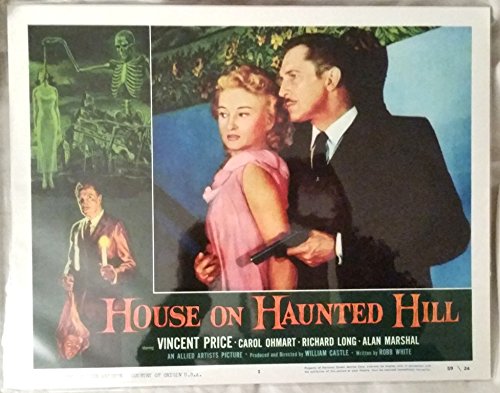
Millionaire Frederick Loren (Vincent Price) is having a haunted house part for his wife, Annabelle (Carol Ohmart). He has invited five strangers to the House on Haunted Hill (1959), with the understanding that he will pay them each $10,000 for spending a night. Once the doors are locked at midnight, they cannot leave until 8am. The "guests" - pilot Lance Schroeder (Richard Long), psychiatrist Dr. David Trent (Alan Marshal), office worker Nora Manning (Carol Craig), columnist Ruth Bridges (Julie Mitchum), and the house's actual owner Watson Pritchard (Elisha Cook) all need the money. But can they survive the night?

If you like short, campy movies with special effects so low budget that you can see the wires, this is the film for you. The inimitable William Castle directed and produced the production which goes, as always, for the shock value. A believer in promotion, Mr. Castle felt it "should be an integral part of the entire movie going experience." (Showmanship: The Cinema of William Castle by Joe Jordan). He would design gimmicks for his films, like vibrating motors attached to some seats for the thriller, The Tingler (1959) or voting on the main character's fate in Mr. Sardonicus (1961). The House on Haunted Hill, too, had its gimmick, which we'll discuss later on.
Without Vincent Price, this movie would be nothing. He gives it cache - he plays the role with his tongue firmly implanted into his cheek. As a result, the audience can sit back and enjoy the proceedings, understanding that taking ANY of it seriously would be a drastic mistake. Mr. Price had just lost a role in a Western film - he was judged too tall to play opposite the new star, Alan Ladd. Mr. Castle offered Mr. Price the lead in The House on Haunted Hill, which was in development. In exchange, Mr. Castle gave him a piece of the movie, which ended up netting Mr. Price a new painting for his extensive collection, and a new career as the king of the horror film (The Price of Fear: The Film Career of Vincent Price, In His Own Words by Joel Eisner).

Vincent Price was very much a Renaissance man. He began his acting career in London with The Mercury Players, after having worked as a teacher and studied fine arts. By 1936, he was working on Broadway, playing Prince Albert to Helen Hayes' Victoria Regina. He would appear in 11 Broadway productions, including the Mercury Theatre production of  Heartbreak House, starring Orson Welles (1938),  Angel Street (1944), and Richard III, playing the Duke of Buckingham to Jose Ferrer's Richard (1953). He'd moved to Hollywood by 1938, with a co-starring role with Constance Bennett in Service de Luxe.  While he played good guys on some occasions, it seems he was destined to specialize in villains or weaklings, like Nicholas Van Ryn in Dragonwyck (1946) and Shelby Carpenter in Laura (1944). He moved easily from film to radio to television (where he appeared as one of my favorite villains in "The Foxes and Hounds" episode of The Man from U.N.C.L.E). A highly regarded art collector, Mr. Price donated works from his collection to form the basis for The Vincent Price Art Museum, so that students at East Los Angeles College would have access to a teaching collection. He also wrote several books on gourmet cooking with his second wife, Mary Grant.  His final on-screen film role was in Edward Scissorhands (1990), but he contributed his vocal talents to a number of films, and even to the music video Thriller. Mr. Price died of emphysema in 1993 at the age of 82.
I was unimpressed with Carol Ohmart when I saw her in The Scarlet Hour; the group opinion was not any different. She's an expressionless actress, who thinks making a moue with her mouth is the epitome of fine acting. It's not. In 1955, James Bacon called her a "female Brando" for her "savage realism" (Chicago Daily Herald, 3 July 1955).  One wonders how much Paramount paid him for that compliment. 

Carol Craig gets to scream a lot during the film. The one character who is truly terrified by what is going on, Nora has the brains of a pea. She goes wandering off behind curtains and into empty rooms. Why someone that frightened would be wandering this revolting house alone is beyond us.
Though she doesn't have a lot to do (except for some Lady Macbeth hand cleaning), Julie Mitchum is worth noting as Robert Mitchum's sister.  We also enjoyed Richard Long as the "hero" of the piece. He's effectively stalwart, with not a lot of screen time. And let's not forget Elisha Cook, who keeps warning the audience about the dangers of the house and the ghosts. He's a puzzling character, who remains a question even as the film ends.

The exterior of the house is a Frank Lloyd Wright home - Ennis House, in the Los Feliz neighborhood of Los Angeles (The house was also used as Spike and Drusilla's residence in Buffy, the Vampire Slayer). (Los Angeles Conservancy) The inside is studio created - it's an upscale albeit rather dirty haunted house, though you might find a head in your luggage.
Always the showman, William Castle devised a special gimmick for this film. Called "Emergo," it involved a glow-in-the dark skeleton appearing over the audience's head at a pivotal point in the movie (TCM article). According to Joel Eisner, the first time he tried this trick was at a private screening for major producers. The skeleton was operated from a fishing reel in the projectionist's group, which worked at first. Unfortunately, the line snapped, and fell on the assembled producers.  Mr. Castle had to redesign the skeleton, so that, if it fell in a real theatre, it was light enough to not hurt any audience members!.

The New York Times review  by Howard Thompson, called the film "a stale spook concoction. " However, in a review of a 1999 remake, Lawrence Van Gelder said the new film was "a sorry reincarnation of the 1950s William Castle horror film". That rendition starred Geoffrey Rush in the Vincent Price part (AFI catalog). Today, Mr. Price's version is considered a cult classic.

We'll leave you with a trailer: 

Thursday, November 15, 2018

Kay Meets a Robber

Welcome to our contribution to the CMBA 2018 Fall Blogathon: Outlaws. As always, we'll begin with a short synopsis of the film.

Baroness Teri (Kay Francis) lives to shop. Her husband, Baron Franz von Hohenfels (Henry Kolker) indulges her with expensive jewels and clothing, but other than that he is completely inattentive. The Baroness' lovers also prove to be bores, so all that is left is looking for ever more expensive gems. When she visits a local store to buy yet another impressive ring, she finds herself in the middle of a Jewel Robbery (1932).

Though the plot is slight, this is a witty and engaging film. From the moment we meet Teri, we are intrigued. Ms. Francis creates a funny, wry character who is sexy and adorable. We first meet her in a bubble bath, where she is playing with the bubbles and the soap. When the soap goes flying from the tub, we experience a moment in which we believe she is really going to pop out of the bath. The film is pre-code with a vengeance! And while it is very dialogue driven, that's not really a bad thing, since the script is so sharp, you want to hear every word.
Sharing the screen with her in their their fifth (of seven) films together (TCM article) is the always-entertaining William Powell. The unnamed Robber is gentile and courteous. Like Teri, he too lives to shop - but he'd rather do it without money. Together, their repartee is engaging and quite suggestive (like I said, this is very much a pre-code film). 

Teri and the Robber participate in a subtle mating dance from the moment they meet. We, the audience, have the pleasure of watching them verbally duel. And with William Powell as the sparring partner, the audience is in store for a battle of wits. The Robber's sophistication and wealth are apparent. The dialogue slips from his mouth like pearls - each line is delivered in such as way as to leave no doubt as to The Robber's attitude towards Teri, as well as his other "victims." One wonders why he is still stealing, as his vault is full of valuable gems, which he seems in no rush to sell. We suspect theft is a game to him - a cat-and-mouse challenge between him and the police, and his quarry.
Initially, Mr. Powell was not interested in the film (TCM article). He'd just married Carole Lombard (his first marriage had ended in divorce) and was eager to spend time with his bride. Unfortunately, the marriage was over by 1933, though the two remained close friends until her death in 1942 (My Man Godfrey was filmed well after their divorce). He was engaged to Jean Harlow when she died in 1937; that same year, he was diagnosed with cancer. He temporarily retired from film, while he underwent radiation therapy. Within two years, his cancer was in remission. His only child had died in 1968 (suicide following a period of prolonged illness and depression; father and son had been quite close, and William's final letter was to his father). In 1940, he remarried Diana Lewis, a marriage which lasted until his death (from heart failure) in 1984 at the age of 91. He'd been retired since 1955 (Mister Roberts was his final film appearance) (William Powell: The Life and Films by Roger Bryant).
Helen Vinson as Teri's best friend, Marianne is also delightful.  The scenes between her and Ms. Francis are amusing.  Their discussion of the Baron, and his lack of skill in the bedroom are more than suggestive, as is Teri's admission that she is merely arm candy for her husband - candy for which he is eager to pay, with expensive clothing and jewelry.  

Also appearing briefly is  Alan Mowbray as Detective Fritz, providing the one real surprise in the movie. Though it should be mentioned that there is another surprise for modern audiences, unused to pre-code films - The Robber's use of a "funny" cigarette, that keeps reappearing in the films at inopportune times is quite enjoyable (and is clearly marijuana, which would, of course, be totally banned from movies when the Code was introduced). (Gestures of Love: Romancing Performance in Classical Hollywood Cinema by Steven Rybin).
Jewel Robbery was based on Ladislaus Fodor's play Ékszerrablás a Váci utcába, which was adapted by Bertram Bloch for Broadway as The Jewel Robbery. The film got mixed reviews (The Complete Kay Francis Career Record: All Film, Stage, Radio and Television Appearances by Lynn Kear and John Rossman and ), some praising Ms. Francis, some criticizing her (we're in the former camp. She's delightful). 

This is a truly entertaining film, and we highly recommend it. We'll leave you with a clip with Mr. Powell and Ms. Francis getting to know one another.

This post is part of the CMBA 2018 Fall Blogathon: Outlaws


Wednesday, September 21, 2016

Student Nurse Florence

My fascination with in women in medicine extends to way nurses are portrayed in classic cinema.  So, this week, our group watched the 1939 film Four Girls in White. The film follows four young women who enter a three year nursing program, each for her own reasons:  Gertie Robbins (Una Merkel) wants a job which will give her three (or more) meals a day; Mary Forbes (Mary Howard) wants to be a district nurse so she can better support her small daughter; Patricia Page (Ann Rutherford) is there because her sister, Norma (Florence Rice) has entered the program.  And Norma? Norma's decided the hospital is the route to a rich husband. 

This is an interesting film, which combines humor, drama, engaging characters, and a good script.  It's a story which provides a (somewhat glorified) view of nursing education, as well as a nice bunch of stories - some romantic, some comic, some tragic.  But it really is never boring and is often surprising.  It does a excellent job introducing us to our lead character - realizing she and her sister will be late for their school orientation, Norma puts in a phony call for an ambulance, then begs a ride to the school from the answering physician, Stephen Melford (Alan Marshal).  No fool, Dr. Melford quickly figures out their ruse and exacts a punishment (he could, of course, turn her and her sister into the police, but that's never discussed).  Norma, of course, is smitten, primarily because he is a young, handsome, and unmarried physician.

We were especially impressed with Alan Marshall's portrayal of Dr. Melford.  The movie presents him as another physician of the Hollywood hero mode: a doctor who wants to work in the hospital at lower pay because there he treats people who truly need him, takes ambulance duty because a colleague needed assistance, and is a researcher trying to better mankind   It could be a tricky role, because Melford is so innately "good", but Marshall gives him a sense of humor; Melford's discussions with Norma concerning his career choices are sincere without being saccharine. At one point, according to this AFI Catalog article, Gene Raymond was set for the role. We think Marshall was a much better choice. 

An engaging actor, Marshall appeared in 24 films between 1936 and 1959 (he died in 1961, at the age of 51).  An Australian citizen, he was unable to join the US Military during World War II, and acquiesced to his wife's request that he not attempt to return to Australia to enlist (quite frankly, it would have been very dangerous just to travel TO Australia).  Instead, he did numerous bond tours, receiving the The United States Treasury Award for his work.  By 1944, he pulled back from film work - he had always disliked Hollywood, and his film work and bond tours had exhausted him.  He would return to films and to television in the 1950s, and worked steadily - often with friends like Vincent Price (in The House on Haunted Hill).  For more information on Mr. Marshall, visit this webpage that is dedicated to him.  He also worked onstage - his final role was in play of Sextette, starring Mae West.  He was appearing in Chicago in that play (along with his son, Kit), when he suffered a heart attack.

We liked Florence Rice in the role of Norma.  This TCM article is rather critical of her (as well as Ann Harding - who has nothing to do with this movie. We like Ann Harding), but we feel unfairly so.   One isn't supposed to really LIKE Norma - she's an opportunist, and the audience is never clear if her interest in Melford is because he is a doctor, with a potential for wealth, or because she really has a regard for him.  Rice is not afraid to play her as selfish and a bit unpleasant.  Her only saving grace is her loving relationship with her sister (it seems evident that the girls are alone in the world. No other family is mentioned) - that is what gives one hope that her character will eventually grow up.  We were intrigued with the use of a statue of Florence Nightingale in the story.  It serves as a barometer for Norma's growth as a person - she complains to it when her selfishness is the most egregious; it also signals her reform later in the film. It's an interesting way to heroize the character of The Nurse.

Ms. Rice had a decent career, mostly in second leads.  She was still working fairly steadily when she retired in 1943.  She married her third husband, Fred Butler in 1946, a marriage that would last until her death in 1974. 
One character in the film is a bit of a mystery.  Mary Forbes, who has been forced to put her child into a foster  home (on a farm), while she completes the three year nursing program in the city.  Though it is never stated outright, there are hints that Mary is an unwed mother.  She never mentions a husband, never says she is widowed, but she is clearly the sole support of the child.  And the character is, as is often the case for unwed mothers during the "Code" period, punished for her "sins".  It's an interesting plot point, that we suspect would have been evident to the contemporary audience. 

A number of interesting character actors appear in the film, notably Jessie Ralph as the nursing instructor, Miss Tobias, Sara Haden as Miss Bennett,  Kent Taylor as millionaire Robert Maitland, and Buddy Ebsen as orderly Express.  The relationship between Ebsen and Una Merkel provide most of the humor to the film (some of it on the silly side). 

We will leave you with this clip from the film.  As fans of the Cherry Ames books, we found the film an enjoyable look at the start of a career.

Friday, March 28, 2014

Joan B. Leaves Home

Joan Bennett and Henry Fonda star in I Met My Love Again (1938).  We meet Julie Weir and Ives Towner while Ives is in school.  He and Julie are deeply in love and wish to marry, but Ives has been convinced by his mother (Dorothy Stickney) to delay the wedding until he is a success.  Two years later, the couple are still engaged, and Julie is frustrated by the delay.  Caught in a storm one night, she seeks refuge in the home of Michael Shaw (Alan  Marshall), and it is lust at first sight.  Julie and Michael elope and move to Paris.  Three years later, she has reason to regret her hasty marriage: Michael refuses to work, they are in debt, have a young daughter, and he is constantly partying.  Those parties prove his downfall - Michael is shot and killed while playing "duel" with another guest.  For the next seven years, Julie attempts to work as a fashion designer.  Finally, a letter from her Aunt William (Dame May Whitty) pulls her back to Vermont and to college professor Ives.

Joan Bennett is excellent in the role of Julie.  She has to literally grow up in front of you, starting as a naive 18 year old and morphing into the 30ish mother of a young child.  This is one of Bennett's last roles as a blonde.  The same year as this film, she reverted to her natural brunette color and never looked back.  She is stunning with dark hair, and her resemblance to sister Constance is minimized.  We have her husband Walter Wanger and Tay Garnett, the director of her film Trade Winds to thank for the change.  It also resulted in a change to her career, making her more appealing as a femme fatale in such films as Scarlet Street, The Woman in the Window and the recently discussed The Housekeeper's Daughter. 

Some really wonderful character performances are highlighted in the film.  First and foremost is Dame May Whitty as Aunt William, the aunt we all want to have in our family.  As is often the case, Dame May gets the best lines in the film.  When the obnoxious Mrs. Towner comes to find out why Julie is back, Aunt William finally loses her temper: "The next time you come for tea, I'll have rat poison in it".  And Stickney is really good as the mother from hell.  You wouldn't want to have the family that Ives has. They are all pieces of work, and the actors do a good job of demonstrating that.  Henry Fonda's role is somewhat weaker than we are used to from him, but like Bennett he does a good job in growing the character from youth to maturity.

Some of our group were not familiar with Alan Marshall, who plays the ne'er do well Michael.  Marshall had a long career, appearing in films and on television until  his death in 1959 of  a heart attack.  At the time, he was appearing on stage with Mae West in Sextette. Also in the cast is Louise Platt, whose most famous role was of Lucy in Stagecoach.  She left the screen for ten years (between 1942 and 1952), returning to do some television, including a year on the soap opera The Guiding Light.  Her only scene with Bennett (which comes at the end of the film) is a doozy.  Watch for it!

Next week, we'll be back with a film from the 1950s.


Monday, January 9, 2012

Interlude: Lydia

As several members of our group were missing, we held off on our next Carole Lombard movie and instead watched Lydia, a little gem from 1941.  Told in flashback, the movie is the story of Lydia Macmillan (Merle Oberon), who was a much sought after belle in her youth, who became an unmarried philanthropist.  At a party celebrating her good works, she meets one of her youthful romances, Dr. Michael Fitzpatrick (Joseph Cotton).  The son of her grandmother's butler, Michael had once had hopes of marrying Lydia, but, alas, it was not to be, because Lydia lost her heart to Richard Mason (Alan Marshal), a cad who seduced our heroine and then abandoned her.  Michael throws a party for Lydia, and invites her three romances: Mason, Frank Audry (Hans Yarah), a blind composer, and Bob Willard (George Reeves), a college football hero.  All are present, except for Mason, and the party of four begin to reminisce about the past.

Ms. Oberon is lovely as the youthful Lydia, but her makeup in the old-age scenes is rather odd (the men look SO much better; so much more realistic). We all enjoyed seeing George Reeves as the egotistical Bob (his drunk scene is quite funny), and of course, Joseph Cotton is always a pleasure to watch.  We really could not understand WHY Lydia would prefer Richard to Michael.  Michael is much more appealing; Alan Marshal is rather a non-entity compared to the much more dynamic Cotton. Also fun to watch (always) was Edna May Oliver as Granny. From the minute she shows up, Ms. Oliver is a delight.

Released in 1941, in many ways this film is shocking, in that it discusses a woman who has a two-week affair with a man who is probably married, yet her only punishment is to be single. Then again, one assumes in 1941, that was a fate worse than death for most women. But one can't help but thinking that Lydia made a huge mistake in abandoning Michael, no matter how profound her life was as a philanthropist (heck, Michael would have let her do both, even in 1941).

Next time, we promise another Carole Lombard movie!!