Showing posts with label John Garfield. Show all posts

Monday, February 1, 2021

John Hears a Bell - Twice

Frank Chambers (John Garfield) is awaiting execution on death row. He protests his innocence of the crime, and proceeds to tell his story, which begins when he arrives at the diner of Nick Smith (Cecil Kellaway). Frank accepts a job at Nick's urging, only to have his life become complicated by the presence of Nick's sultry young wife, Cora (Lana Turner). Our film this time is The Postman Always Rings Twice (1946).

This is a film that is regularly discussed as a touchstone for film noir, and with one very good reason. That's the star, John Garfield, who is perfect as Frank Chambers. Mr. Garfield has the laid-back and gritty sexiness that is required to make Frank convincing. Even when he is downright fresh to Cora, there is no doubt in your mind that she is falling for him. Why wouldn't you? Half the audience is falling in lust with him at the same moment.  Yet he was not the first (or even the second) choice for the part. It was originally offered to Joel McCrea (who said no) and Gregory Peck was also considered (TCM The Big Idea). We would have an extremely different film with either of those two remarkable (yet likely very wrong) actors in the leading role. Mr. Garfield almost had to pull out of the film. He was called up for the draft, and Cameron Mitchell was set to step in. However, Mr. Garfield's bad heart (which would cause his death in 1959, at the age of 39 (Los Angeles Times)) released him from active service in the military.

Lana Turner has never been better in any picture that she is here. From the moment her legs appear, garbed in snow white shorts, crop top, and turban (Cora is only seen in black once - when she is planning to kill Nick),  you're as hooked as Frank is. Her appearance justifies his intake of breath. She's a vision, but a tough one, and Ms. Turner plays every emotion that Cora experiences to perfection. It's hard not to compare her to Barbara Stanwyck in Double Indemnity, because of the similarities in plot. The two actresses, however, build different creations, primarily because their motivations are so very different.  Cora is far less calculating, and her emotions are all over the place; her desire to be with Frank versus her need for security are very much in conflict. As the film progresses, we begin to realize just why she married Nick, and the life she was attempting to escape.  James M. Cain was so impressed by her performance that he gave her an inscribed, leather-bound copy of the novel (TCM Behind the Camera). 

Cecil Kellaway is an interesting casting choice for Nick. It's mentioned that he's thrifty to the point of cheapness, but he's a warm, loving man who is good to Cora and kind to Frank. MGM was hoping to mollify the censors by making Frank a likeable fellow. He was in fact, such a nice man, that Lana Turner would later state that "I adored Cecil Kellaway...so much so that I hated having to help kill him on camera." (Movies TV Network article). But the screenwriters do make you sympathize with Cora just a bit when we discover what her fate will be if she stays with Nick; Mr. Kellaway brings a selfish determination to the scene that makes it all the more convincing.

We especially enjoyed the performances of the two lawyers in the action - district attorney Kyle Sackett (Leon Ames) and defense attorney Arthur Keats (Hume Cronyn). Both capable character actors, their interplay - they have a bit of a friendly rivalry going on - is a real asset the film. The viewer is not really sure which of the two is more opportunistic. Both are using the case to their own advantage, rather than in the pursuit of justice. Another interesting performance is that of Alan Reed (Ezra Liam Kennedy) as a private investigator. Mr. Reed is best remembered today as the voice of Fred Flintstone.


This was Audrey Totter's (Madge Gorland) first appearance in a film noir. Her part is small - a great deal of it was cut when the original occupation of the character - a lion tamer - aroused way too much ridicule during the film's preview (James M. Cain actually crawled out of the theatre in embarrassment) ( TCM article). 

The novel was written in 1934 and was thought to be unfilmable because of the sexual content, though Mr. Cain attempted a stage adaptation in 1936, which he hoped would get it filmed. Le Derniere Tournant (1939), a French adaptation, did not do well and was not released in the U.S.  A 1942 Italian film, Ossessione, was also never released in the United States because it violated Mr. Cain's copyright (AFI catalog).


The title of the film (and novel) was a subject of discussion - there are several tales about how it got it's name, but it was important for the film that the title be eventually explained (by Frank, at film's end). This list of trivia outlines those stories). 

The New York Times review by Bosley Crowther was positive: "it is, indeed, a sincere comprehension of an American tragedy." Other reviews are varied (TCM Critics Corner).  The radio show Hollywood Soundstage aired a version in January 1952 with Eleanor Parker and Richard Widmark. The film was remade in 1981 with Jack Nicholson and Jessica Lange.

This is a must-see film (don't bother with the remake - it's a pale copy), and we highly recommend it. In the meantime, we'll leave you with the trailer:


 

Monday, November 23, 2020

John Fought for Spain

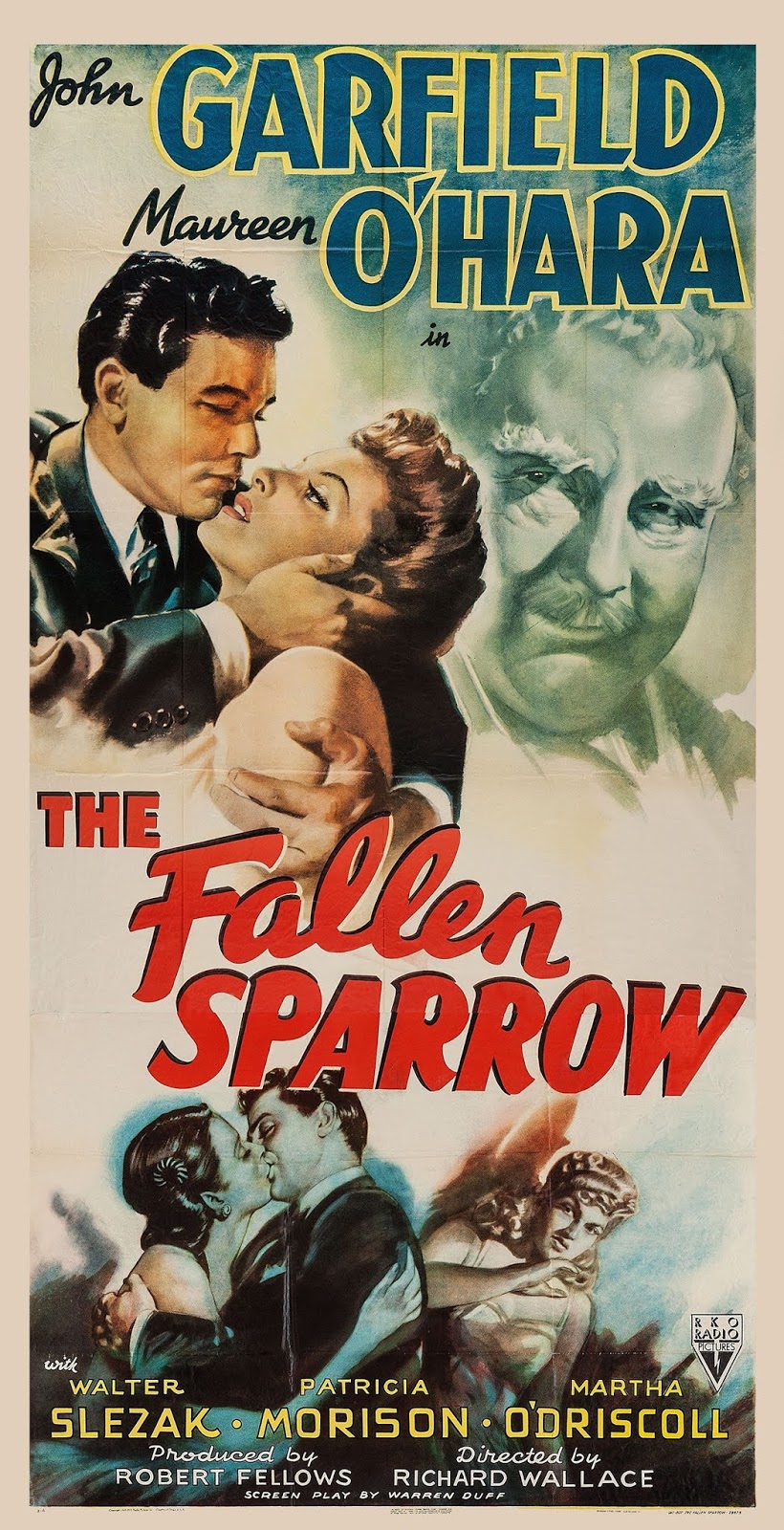
Following his escape from a Spanish POW camp, John "Kit" McKitrick (John Garfield) has been hospitalized in the US. While there, he discovers his best friend police lieutenant Louis Lepetino has died, allegedly the victim of an accidental fall from the window of a New York City high-rise. Kit is convinced that his possession of a war standard is the cause of Louie's death - and will also bring about his death next.  Our film this week is The Fallen Sparrow (1943). 

John Garfield is perfect as a man teetering on the edge of sanity. Yes, Kit has been hospitalized for what we would now call post-traumatic stress disorder, and has been discharged, but the death of his friend has summoned back all the demons he'd hoped to put behind him. Mr. Garfield brings a vulnerability to the character that does not detract from his strength of purpose. Given that Kit is in nearly every scene in the film, it's important that the audience identify with and support him; Mr. Garfield makes him a character you take to your heart. He wasn't the first choice for the part - RKO originally wanted James Cagney, but he turned it down (he'd been under some scrutiny because of his support for Loyalist Spain); Cary Grant, Randolph Scott, and George Brent also said no. (TCM article). Mr. Garfield, himself a supporter of Loyalist Spain, very much wanted the part and campaigned to get it. (John Garfield: The Illustrated Career in Films and Stage by Patrick J. McGrath).Stage by Patrick J. McGrath). Warner Brothers got the rights to remake Of Human Bondage from RKO in exchange for Mr. Garfield's services in this film (AFI catalog).

Maureen O'Hara (Toni Donne) takes on an unusual role - that of a possible Nazi spy. Toni is rather a cypher - you want to like her, you know that Kit wants to believe her, but in the final analysis, neither the audience nor Kit trusts her.  She's good in the part, because she is able to keep the audience on edge as to her intentions throughout the film; why she is working for the enemy is a question that hovers over the viewer.

While Ms. O'Hara keeps the audience guessing in an atypical role, Walter Slezak (Dr. Skass) does not. You know from the instant you see him that he is the villain. Sure, Mr. Slezak's early career was spent playing villains, but it's more than that. He fairly oozes evil - Dr. Skass' first conversation with Kit is a discussion of the beauty of water torture. We're told that Skass is a researcher - it's pretty apparent that he's the head of the spy ring, and no amount of screen subterfuge will convince you otherwise. If we had one regret in this film, it was that we would have appreciated a little more mystery surrounding the identity of the spy leader. 

We particularly enjoyed Martha O'Driscoll (Whitney Hamilton) as one of Kit's close friends. She is sweet and appealing as the one of the few people in Kit's life who is sincere. We especially enjoyed Kit's nickname for her - Imp. It seemed to happily sum up her personality and their friendship. 

Another character to watch is Inspector Tobin (John Miljan). Unlike too many police roles in movies, this is a character to observe carefully. There is more going on than meets the eye, and Mr. Miljan plays the part with an attention to detail.

The film's score was nominated for an Oscar (It lost to The Song of Bernadette).  While the New York Times review by Theodore Strauss (T.S.), was not keen initially on the film's story, Mr. Strauss' regard for Mr. Garfield's performance won him over: "by virtue of a taut performance by John Garfield in the central role, and the singular skill with which director Richard Wallace has highlighted the significant climaxes, The Fallen Sparrow emerges as one of the uncommon and provocatively handled melodramas of recent months." It would become one of RKO's high grossing films for 1944 (Variety) The story would appear as a Lux Radio Theatre broadcast on 14 Feb 1944, co-starring Robert Young,  Maureen O'Hara, and Walter Slezak. 

This is a movie worth seeing if for no other reason than to watch Mr. Garfield in action, but it has much more than that. We highly recommend it. In the meantime, here is a trailer:


Monday, September 30, 2013

Sisters in Love with the Same Man

When the AFI Silver opened in 1938, their premier film was Four Daughters.  As part of their anniversary festival, this was one of the three films we viewed. 

The Lemps are a musical family - father Adam (Claude Rains) is a conductor, instructor, and flutist; his daughters Thea (piano, played by Lola Lane), Ann (violin, played by Priscilla Lane), Emma (harp, played by Gail Page), and Kay (vocalist, played by Rosemary Lane) accompany him on classical recitals in their home; their audience is their Aunt Etta (May Robson).  Their home is a happy one, and the girls have a busy social life.  Emma has a beau, Ernest (Dick Foran), and Thea has just met someone (Frank McHugh as Ben Crowley).  Young Ann, however, has no interest in a beau; she has decided to be an "old maid", and live always with her beloved sister Emma.  But that is before Felix Dietz (Jeffrey Lynn), a young composer enters their lives.  In short order, all four girls are smitten with the young man.  He however, only has eyes for Ann.  And while it seems there will be a happy ending for Felix and Ann, the arrival of  Mickey Bordon (John Garfield), and Ann's realization that Emma loves Felix will have devastating results.   

From a novel by Fannie Hurst, Four Daughters is certainly a woman's picture in the traditional sense.  In some sense, the men (Felix, Ernest, Ben) are merely objects for the women to discuss.  But the character of Mickey, as portrayed by Garfield is far more than that.  Garfield's intensity (which he brought to all of his film roles), makes Mickey a force of nature that blows violently into the lives of all around him.  Mickey is both selfish and caring at the same time.  He loves Ann passionately, is able to see the pain of those around him (he and Aunt Etta are the only ones that realize how deeply Emma cares for Felix), but he is also willing to destroy the lives of Ann and Felix so he can have Ann. 

The Lane Sisters and Gail Page are flawless as the Lemp girls.  Their love for one another and for the family unit is true - watch the scene as the girls rummage through each other's closets to compile an appropriate date outfit.  Ann's decision to be with Mickey rather than Felix is as much about sparing Emma pain, as it is her need to bring some joy into Mickey's life.  We quickly realize that Ann DOES love Mickey - not in the way she does Felix; she feels an almost motherly responsibility for Mickey that she cannot escape. Ann's extreme youth is further demonstrated by her decisions.  She is unable to differentiate between love of a spouse and love of family.  Mickey should be family, but Ann can't quite see it.

The film resulted in two sequels, Four Wives and Four Mothers, as well as a companion film, Daughter's Courageous.  While neither is quite as powerful as the first film, the chemistry among the Lemp family is emphasized in this continuing series.  The impact of Garfield as a performer is highlighted in this clip.  Enjoy!


Wednesday, April 24, 2013

Interlude: WWII Erupts

On December 6, 1941, a group of B-17 Flying Fortress bombers leave San Francisco on a routine run to Hawaii.  As they arrive, they discover that Pearl Harbor and Hickam Field have been virtually destroyed by the Japanese attack of December 7th.  In that instant, the lives of the crew of the Mary Ann change as they attempt to get their plane first to Wake Island, then to the Philippines, to fight in the newly declared war in the Pacific.  This is Air Force, a Howard Hawks film from 1943. 

We had the opportunity to see this interesting film on a big screen at the AFI Silver Theatre, as part of a Howard Hawks retrospective.  Hawks, a member of the U.S. Army Air Service during the first World War, had already demonstrated his interest in aviation with his prior films, Ceiling Zero (1935) and Only Angels Have Wings (1939). Here, as the war rages on in Europe and Asia, with no end in sight, Hawks looks at an event that would have been very much in the memory of his audience.  The film is careful in sticking to the facts, with only a few liberties taken.  In fact, a group of Fortresses was en route to Hawaii just prior to the Pearl Harbor attack, and one of the ships was, in fact, the Mary Ann

My companion, who is quite familiar with the history of World War II, pointed out to me some of the liberties taken in the film.  For example, were a ship like the Mary Ann to be sent from Hawaii to the Philippines, it would have flown via Midway, not Wake Island. It's apparent that Hawks wants to reference the events that occurred on Wake Island, as it was attacked and captured by the Japanese (and perhaps tip his hat to the film Wake Island, that had been released the previous year). Towards the end of the film, we see the Mary Ann's crew involved in a battle - it appears to be the Battle of the Coral Sea, but that didn't happen until 5 months AFTER Pearl Harbor (not a few days as portrayed here).  And there is no way a B-17 could hover over a convoy of battleships to mark the way for oncoming planes. It just would not work!

You'll be treated to some fine performances here: a young John Garfield as tail gunner Joe Winocki; George Tobias as New Yorker and gunner Weinberg, Harry Carey - always wonderful - as crew chief Robbie White, Arthur Kennedy as Bombardier Tommy McMartin. and Gig Young as co-pilot Bill Williams.  We even have a cameo by Ann Doran as pilot Irish Quincannon (John Ridgely)'s wife.

Though I'm not usually a fan of war movies, this one was certainly worth seeing, and I hope to view it again. It had a sympathy for the men and an understanding of what they were facing that is not always apparent in World War II propaganda films.  Is it propaganda? Of course, but propaganda of the best kind.

For your enjoyment, the trailer from the film is below:


Our next Constance Bennett movie will be up in a few days.

Monday, January 24, 2011

Joan Supports the Arts

Joan Crawford followed her Oscar win with another excellent film, 1947's Humoresque, in which she plays socialite Helen Wright, an unhappy woman who becomes fascinated with a violinist (played by John Garfield).  Though Crawford gets top billing here, this movie is really about Garfield's Paul Boray, following him from boyhood (as played by Bobby - or later Robert - Blake), when he receives his first violin, through his relationship with Helen.  

Boray is a man obsessed by music and with his career.  Helen is a woman whose life has been one unhappiness after another. Her current (third) husband is a kind, but ineffectual man, for whom Helen has no respect and little affection.  We learn that her prior marriages were appreciably worse: "One was a crybaby and the other was a caveman" she tells Boray.  

Crawford's subtle skills as an actress are in evident here: when Boray attempts to touch her, Crawford cringes, harkening back to her former"caveman" husband  - and perhaps explaining why she remains married to current husband, Victor (Paul Cavanagh)), a weakling with no desire to do more than watch his wife from afar. Helen's nearsightedness (and reluctance to wear glasses) become of symbol of Helen's narrowed life vision - again, Crawford plays it carefully, using Helen's glasses as a sign of her attempts to really SEE Boray for who he is.

Certainly, this is an almost painful movie - Helen's misery and Boray's need for success give little room for happiness.  However, we do have some relief from the pain of these two people trying to develop a relationship against their own personalities and the dismay of both their families.  It is from Oscar Levant's Sid Jeffers.  Playing Garfield's closest friend since boyhood and his pianist, Levant's irreverence provides some humor to a film otherwise filled with unhappiness.  Sid also provides a moral compass, alerting the viewer (and the protagonists) to the dangers of this relationship with seems to cause nothing but pain.

Regardless, this is an excellent film, with sterling performances.  Watch Crawford's telephone monologue towards the end should you have any doubts. It is a piece of brilliance. And, the delicate portrayals of Paul's parents (played by J. Carrol Naish and Peggy Knudson) are also lovely. Papa's reluctance to waste money on a violin, counter-posed with his pride of his son, when the boy sees the birthday present he has yearned for are quite nicely played.

Before we leave for this week, here is a trailer from Humoresque:


Next week, we continue with Ms. Crawford's Warner Brother's years. Please join us.