Showing posts with label Kirk Douglas. Show all posts

Monday, January 18, 2021

Robert Meets a Shady Lady

Jeff Bailey (Robert Mitchum) owns a gas station in a small Connecticut town. He's in love with Ann Miller (Virginia Huston) and the two are discussing marriage.  But the arrival of Joe Stefanos (Paul Valentine) spells trouble for Jeff - he's been hiding out from Joe's boss, racketeer Whit Sterling (Kirk Douglas). Jeff - then named Jeff Markham - worked as a private investigator for Whit, and didn't finish up the operation to Whit's satisfaction. This week, we'll be discussing Out of the Past (1947).

Often cited as the penultimate film noir, Out of the Past is an excellent, albeit dense story, but with characters that completely hold your interest throughout. Frankly, it's a film that deserves several viewings, if only to puzzle out the sometimes confusing plot. Then again, Out of the Past is not really about the plot - it's about the multiple character relationships.  

Robert Mitchum has become so linked to this part, it's mind-boggling that he was not among the first considered for the role. Both Dick Powell and Humphrey Bogart were offered the lead part (Jacques Tourner: The Cinema of Nightfall by Chris Fujiwara) and Pat O'Brien and John Garfield were also in the running. Mitchum had been nominated for a Best Supporting Actor Oscar for his work in The Story of G.I. Joe two years previously, but he was still being relegated to supporting roles (like The Locket) when he was cast as Jeff. He works well with all of his co-stars, though it has been said that he and Kirk Douglas did not immediately hit it off, and there was a bit of jockeying for position (TCM Behind the Camera). Ultimately, the two found common ground; their different styles of acting compliment one another. This intro and outro to the film, featuring Eddie Muller and Chris Mitchum (Robert's son) is worth a viewing for more insights into the production.The part of Kathie Moffat was originally intended for Lizabeth Scott; after she dropped out, Jane Greer (Kathie Moffat) took on the devilish dame. Ms. Greer is remarkable as a woman who goes from good girl to bad girl in the wink of an eye.  In a TCM interview, Ms. Greer discussed director Jacques Tourneur's instructions to her on getting to the heart of the character - "impassive." Though only 23 when she filmed the picture, she is marvelous - seemingly sweet an innocent, her portrayal is more a praying mantis waiting to consume her mate. She would later say that she had an excellent relationship with Robert Mitchum, who took brotherly care of her, even adjusting her dress when he realized it wasn't filming properly (TCM articles).
 
Kirk Douglas, in his third film, is an excellent choice for Whit. Though Lex Barker was in the running for the part (AFI Catalog), Douglas brings both an apparently congenial, but ultimately menacing vibe to the role.  His obvious differences from Robert Mitchum just enhance the danger in his performance - when you first meet the character, the screen hums with the tension between the two men.
Rhonda Fleming (Meta Carson) has a small but memorable part as a secretary with ulterior motives. She's quite good in a relatively small part. This was, in fact, only her fifth credited role. Sadly, the lovely Ms. Fleming died at age 97 shortly after we viewed the film. You can see the TCM tribute video to her film work here.
 
Dickie Moore (The Kid), Jeff's deaf-mute assistant in the garage also gives a convincing performance. By the end of the film, we almost feel that The Kid has, in fact, been our narrator. It is he who gives the picture its ending, and he is instrumental in aiding Jeff as his life spins out of control. 
Based on the novel Build My Gallows High by Geoffrey Homes, the New York Times review by Bosley Crowther focused on the complexities of the plot.  And there are many, but as Mr. Crowther pointed out even then, the "challenge was worth a try." Since then, it has become very highly regarded - it was added to the Library of Congress National Film Registry in 1991, and is also on Eddie Muller's list of Top 25 Noir Films 

A 1975 remake using the novel's title fell through, but the film was remade in 1983 as Against All Odds, with Jane Greer and Paul Valentine in small roles. Robert Mitchum and Ms. Greer also guested on Saturday Night Live in a 1987 skit called "Out of Gas."  

If you are a fan of film noir, this is a picture that you must see. And, for film fans in general it is still "an essential". We'll leave you with the film's trailer:

Tuesday, May 2, 2017

Celeste Sends a Letter

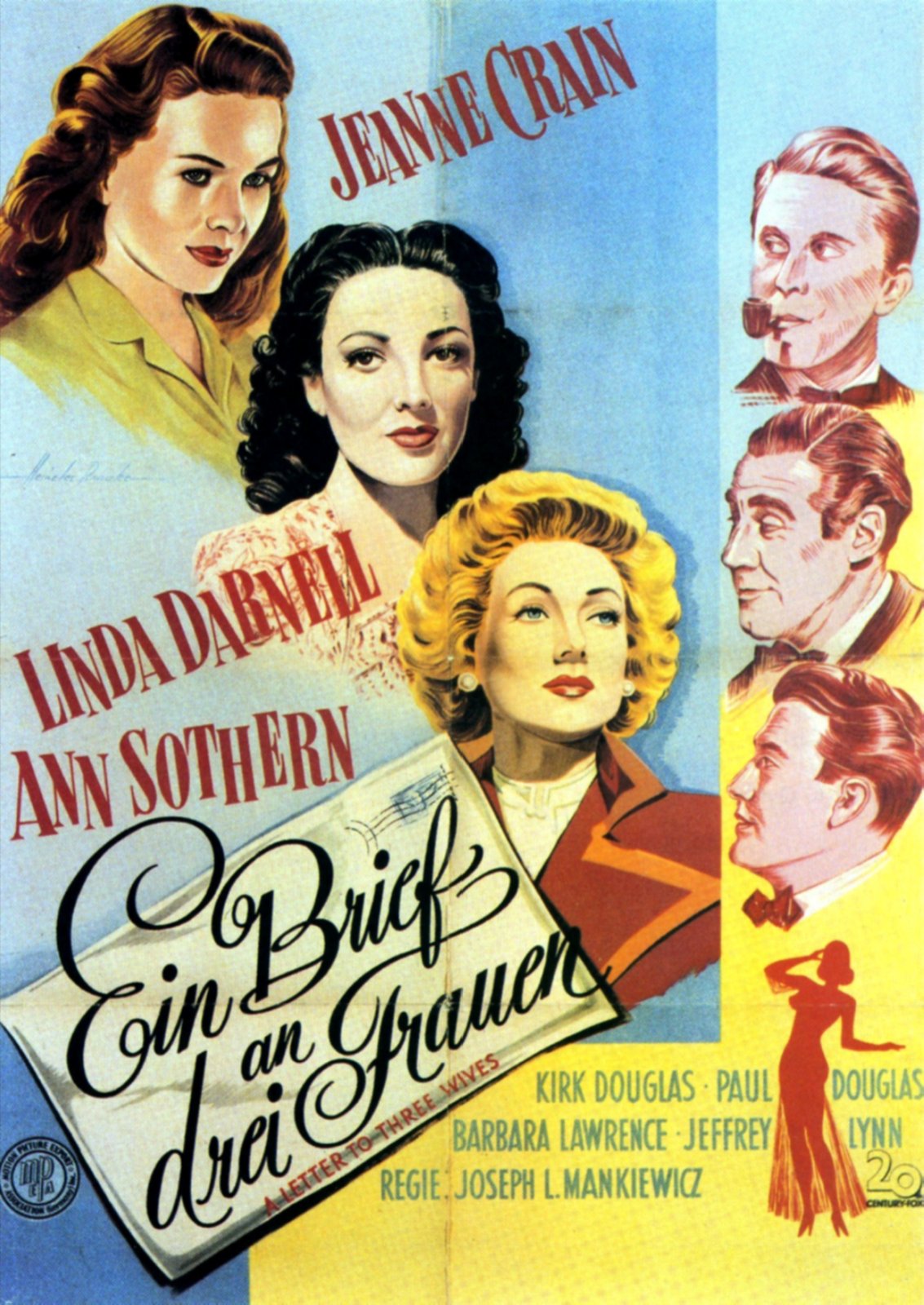
As Deborah Bishop (Jeanne Crain), Lora May Hollingsway (Linda Darnell), and Rita Phipps (Ann Sothern) are about to leave on a charity boat ride, a young man delivers A Letter to Three Wives (1949).  The letter informs them that their "friend", Addie Ross (voiced with just the right amount of venom by Celeste Holm) has left town - with one of their husbands.  Unable to leave the boat, the women spend the day worrying about their husbands and reviewing their marriages.

Based on A Letter to Fives Wives by John Klempner (the film eliminated two wives, which tightens it up), this is an exceptional film, especially given that it is really a series of vignettes.  The use of Addie's  narration as a glue to hold together this tale of three marriages in trouble is both inspired and entertaining.  That narration brings the tale to a different level, making the film a fully cohesive unit instead of a series of short stories.

Two of the stories especially stand out.  Rita and George Phipps  (Kirk Douglas) are a relatively happy couple, but Rita, a successful radio writer, is trying to have it all - career, husband, and children.  She's pretty good at doing it, but George is frustrated that he and their twins often take second place to the demands of her clients (ably represented by  Mr. (Hobart Cavanaugh) and Mrs. (Florence Bates) Manleigh).  Kirk Douglas plays George as an educated, reasonable and progressive man; he really doesn't mind that his wife works and that she out-earns him by quite a bit.  Her job and her impressive salary afford them all a good life, and enable him to pursue his career - an underpaid high school teacher - without guilt.  George loves his job and his wife.  He just wishes that she wasn't constantly afraid, and would occasional say no to her clients unreasonable demands.
In flashback, we see the courtship of Lora May Finney (Linda Darnell) and Porter Hollingsway (Paul Douglas).  Both are from the wrong side of the tracks (in Lora May's case, quite literally - she lives with her sister Georgianna (Barbara Lawrence) and mother, Ruth (Connie Gilchrist) on the edge of the train tracks).  But Porter, the owner of a successful department store, is now well-off, and enamored of Lora May's beauty.  But he is not interested in marriage; Porter's been married, and he didn't care for it. Plus, his ideal is Addie Ross - he keeps her picture on his piano, and talks about her "class," a quality he doesn't find in Lora May.

Linda Darnell is impressive as the tough talking Lora May.  The viewer is quick to realize that, despite her comments to the contrary, she loves Porter.  But she knows the only way to keep him is to play the game his way - Porter likes to fight, and Lora May is more than willing to oblige him to get what she wants.  To a point, of course.  When Porter shows up at her front door, honking his horn for her to come out, Lora May ignores it: "Anybody wants me can come in and get me, this ain't a drive-in." For more on the life of Ms. Darnell, please see our blog post on her work in The Mark of Zorro (1940).
The third story, the marriage of Deborah and Brad Bishop (Jeffrey Lynn) is possibly the weakest of the three.  It's not bad, its just that Deborah seems weak next to these two dynamic women. One sympathizes with her truly ugly dress, since we know she's not had time to procure a new one, but really, it is so hideous, it's hard to understand why even a simple farm girl would purchase it.  And WHY does Rita have to TELL her to cut off those ugly flowers? But it should be acknowledged that Deborah has left the farm, the WACs, and her past life for a new, more upscale environment with a husband she really doesn't know - the story of Brad and Deborah is a brief glimpse into the marriages that began because of the war.

Jeanne Crain began her film career at age 18, with a bit part in The Gang's All Here (1943).  Winner of the Miss Pan Pacific pageant, she attracted the attention of film scouts; by 1945, she was starring in State Fair and Leave Her to Heaven. She could sing, dance, ice skate, and she was a pretty good actress, but also in 1945 she married Paul Brinkman, and began having babies - seven in total.  She was pregnant during the filming of this movie, and may have lost the role of Eve in All About Eve due to one of her pregnancies. Regardless, her portfolio is quite impressive: I'm particularly fond of Cheaper by the Dozen (1950) and People Will Talk (1951)   Ms. Crain and her husband remained married until his death in 2003, but after a messy divorce proceeding (which was never completed), they lived apart.  She also lost two of her sons before she died in 2003 of a heart attack at age 78.
We've raved about Thelma Ritter (here playing Sadie Dugan) before, and she does not disappoint in this film.  Whether it is her interactions with her pal, Ruth Finney or her sass when she is working as a maid for Rita Phipps, Ms. Ritter is the queen of the bon mot. Take, for example, her response to Rita's request that she wear a uniform: "The cap's out. Makes me look like a lamb chop with pants on." or her answer to the Manleighs about their radio program: "You know what I like about your program? Even when I'm running the vacuum I can understand it."  At the same time, it is Sadie who cautions Ruth about her passion for her new refrigerator, when Ruth seemingly puts keeping it (in many respects, for Ruth, the refrigerator is a symbol of respectability) above her daughter's happiness: " You got to make up your mind whether you want your kids happy or your icebox paid up." 

A number of different actors were proposed for the film, including both Joan Crawford and Ida Lupino as the voice of Addie Ross (AFI catalog). Though the film was nominated for Best Picture, Screenplay, and Directing Oscars (winning the latter two), no acting nominations came its way. Interestingly, Jeanne Crain, Kirk Douglas, and Celeste Holm were all nominated for other film work that same year (none of them won, however).

 Contemporary critics received the film enthusiastically (see this New York Times review and this TCM article).  Since then, regard for the film has increased, as is evident by this New Yorker discussion, especially as a sophisticated examination of marriage.  As Jeanine Basinger notes in her book I Do and I Don't: A History of Marriage in the Movies, films that actually examine marriage itself are rare.  A Letter to Three Wives does this, and does it well.

Both Lux Radio Theatre (1950) and Screen Players Guild (1952) performed radio versions of the play.  Then, in 1985, the story made its way to television, with Ann Sothern appearing as Ruth Finney in a version which starred  Loni Anderson, Michele Lee, Stephanie Zimbalist as the three wives. 

We'll leave you with a trailer from the film - an introduction to the three wives.  

Wednesday, December 7, 2016

Barbara is Strange

On a rainy night, Sam Masterson (Darryl Hickman) meets Martha Smith (Janis Wilson) at the train yard in Iverstown, as they try to escape from the town and all it represents.  Orphaned Martha despises her guardian - her Aunt Ivers (Judith Anderson), the town's doyen and tyrant.  The feeling is mutual - Martha's father was a millhand in Miss Ivers mill; upon his death, Miss Ivers grudgingly adopted her sister's child, and forced her to take the name of Ivers, hoping to obliterate all evidence of his existence.  Escape, however, proves futile for Martha; with the police force on alert, Martha (and her beloved cat) are apprehended and returned to the not-so-tender mercies of her Aunt.  Undeterred, Martha attempts to escape again, but the consequences of the attempt are such that they will haunt Martha for the rest of her life.

Thus begins The Strange Love of Martha Ivers (1946), a film noir classic starring Barbara Stanwyck as the adult Martha, Van Heflin as the grown Sam, and Kirk Douglas (Walter O'Neill), appearing in his first film role. To say that this is an odd picture is not meant as an insult.  The film is complicated and dense. As this New York Times review says, it is a film where all the characters' "sordid deeds are neatly pulled together like so many pieces in a jigsaw puzzle."

Several impressive performances contribute to the film's appeal.  Barbara Stanwyck, of course, is outstanding as Martha.  She plays a woman who wants freedom, but who has spent her entire life in one prison or another.  Does Martha really love Sam, or does she love the freedom that he represents?   Does her warped nature come from the cruelty she faced from her Aunt, or from the blackmail of Walter and his father?  And is she ultimately responsible for the two deaths in the film, or should others take the blame?  Regardless of the answers, we know that Martha has spent her life trying to atone for what she sees as her sins, by trying to make Iverstown and the factory less of the hell that it was when her Aunt was alive.
For Lizabeth Scott as Antonia 'Toni' Maracek, this was only her second film role.  Her character serves as an interesting contrast to Martha, light where she is dark, common, where Martha appears high tone, but, like Martha, she too is a prisoner.  Though Toni's prison is a real one - convicted of a crime she denies committing, she is on probation, but constantly facing the specter of jail.

Lizabeth Scott had a long and complicated life, but a relatively abbreviated career.  With 31 film and TV credits (between 1945 and 1972), she is best remembered for this film, Dead Reckoning, and Too Late for Tears, all film noir classics.  Her looks and her voice are reminiscent of Lauren Bacall, but she didn't really have the versatility of Bacall.  She started her career in the New York theatre; she was Tallulah Bankhead's understudy in the part of Sabina The Skin of Our Teeth (much to Ms. Bankhead's disgust. For more discussion on this, see the Wikipedia article on Ms. Scott)  She did eventually get to play Sabina - when Gladys George became ill.  This performance brought her to the attention of Hal Wallis, the producer of our film. Wallis wanted to bill his find with her name above the title, but Barbara Stanwyck objected (Hal Wallis: Producer to the Stars by Bernard F. Dick).  It didn't help.  The virtually unknown Scott still got third billing above the title (it has been alleged that Scott and Wallis were having an affair, or at the very least that Wallis was infatuated with her). 
Scott's troubles began in the 1950s.  Confidential Magazine published an article accusing her of being lesbian.  She sued; the trial ended with a mistrial.  Add in her growing stage fright, and her career was virtually over.  She tried singing; the attempt went nowhere.  So, she segued over to televsion, where she had a relatively decent career.  She also returned to college (at USC).  She married twice - both lasted less than a year; she was linked romantically with Burt Lancaster, James Mason, Helmut Dantine, and Burt Bacharach, among others.  She died in 2015 of congestive heart failure.  She was 92.   To hear more about Ms Scott, try this interview that was done in 1996. 
Kirk Douglas is outstanding in this role, which would be an unusual one for him.  Walter is a weakling, dominated by both his father and Martha.  His guilt and feelings of hopelessness lead him into alcoholism.  In this TCM article, Douglas relays his method for creating a character like Walter:  "when you play a weak character, find a moment when he's strong, and if you're playing a strong character, find a moment when he's weak. I had a moment when I was at the desk - I stood up, grabbed Van Heflin by the shirt, and stared him in the eye. He was amazed at this sudden moment of strength, and it confused him. We shot it, and the director said, 'Very good.' Van Heflin said, 'Let's do it again.' The next time I grabbed him, he just looked down contemptuously at my hand. How smart of him - he took away the strength. Nothing wrong with that. As an actor, it was the right thing to do."  His work was not unnoticed - this AFI Catalog entry notes that Louella Parsons was particularly taken with this "wonder boy."
Several child actors appear in the beginning of the film.  We were particularly intrigued with the performance of Janis Wilson.  Ms. Wilson had a notably short career; between 1942 and 1948, she appeared in only seven films, after which she left show business.  But when you realize that those films include Watch on the Rhine and Now Voyager (along with this film), she  had an impressive resume.  She was 18 when she retired - always a difficult age for teen actors.  Interestingly, she met her future husband (they married in 1955) when she was 12 years old (on the set of Now Voyager.)  She died in 2003. 


It's not surprising that Stanwyck's dresses are spectacular.  Her favorite designer, Edith Head, created them.  Ms. Head would later say that Stanwyck's long waist usually resulted in her costumes being dowdy looking, but Head found ways to camouflage her waist.  As a result, Stanwyck would often request Head design for her (even in private life).  See this review of Barbara Stanwyck: Steel-True, 1907-1940 for a brief discussion of their relationship. 

We leave you with the trailer for this fascinating film.  And we send advance birthday wishes to Kirk Douglas, who will reach 100 on December 9th:

Thursday, December 1, 2016

Is Kirk Really Bad?

A few years ago, we discussed The Bad and the Beautiful (1952) (you can see our prior review here.  You'll also find a detailed description of the plot and characters there).  We decided to revisit the film, this time looking at it from a slightly different perspective - our discussion for this viewing focused on the character of Jonathan Shields, as wonderfully portrayed by Kirk Douglas.

So, the question is, is Jonathan Shields really bad?   We have three characters who are furious at him.  We looked at them in some detail.

Fred Amiel (Barry Sullivan) is angered when Jonathan passes him over for an experienced director on the film of Fred's script, The Far Away Mountain.  Is Fred justified in demonizing Jonathan?   When we first meet Fred, he is working as a professional mourner because he cannot sell a script.  Jonathan teams up with Fred and succeeds in getting them both jobs in Harry Pebbel's (Walter Pidgeon) studio.  Though Fred is not aggressive in blowing his own horn, Jonathan is. The final result, Fred becomes an Oscar-winning screenwriter and director, marries the woman of his dreams (to whom Jonathan proposes on Fred's behalf), and has a happy, stable family life. Does Jonathan backtrack on his promise to get Fred the acting gig? Sure.  Would Fred have gotten it, if Jonathan had pursued it further? Probably not.
Georgia Lorrison (Lana Turner) spends most of her time drinking and sleeping with men.  She perpetually mourns for her late father, a great actor, notable bon vivant, and drunkard.  Georgia however is notable for her beauty and for her inability to act.  Jonathan, who was friendly with her father, sees talent where no one else does, and goes out on a limb to hire her to star in his picture.  She inevitably breaks her promise to not drink and disappears on the first day of shooting.  Urged to replace her, Jonathan instead sobers her up, and keeps her in the production.  It's Georgia who envisions a great romance - Jonathan, a man plagued with his own demons, has no such idea.  However, he attempts to protect Georgia from his relationship with Lila (Elaine Stewart); it's Elaine who makes sure Georgia knows.  And Jonathan makes it clear he is furious at her callous revelation. Did he mislead her romantically? Probably.  Is he really out to hurt her? No.
James Lee Bartlow (Dick Powell), tempted to Hollywood by a hefty paycheck and by his wife Rosemary's Gloria Grahame) eagerness to sample the bright lights of the big city, signs a contract to write a screenplay of his book.  But Rosemary is a time suck.  We learn that it took him seven years to write his first book, primarily because of her interruptions.  To get the screenplay written, Jonathan asks his friend Victor "Gaucho" Ribera (Gilbert Roland) to squire Rosemary to the local hotspots to keep her distracted.  Though we hear only one half of a telephone conversation, it's clear Gaucho has more on his mind than squiring. Jonathan, however, is very clear in his response.  "I said 'squire', Gaucho".  He responds.  Is the fact that Rosemary and Gaucho choose to bring the relationship further than was requested Jonathan's fault? Not really, but perhaps he should have picked less of a Lothario as an escort.
The person who should resent Jonathan most is actually his biggest supporter.  Harry Pebbel becomes Jonathan's employee after Jonathan and Fred strike out on their own (assumedly, without his key writer and director, Harry cannot keep his B picture studio going).   Harry could see Jonathan (and Fred) as traitors, yet he is the one who forces our characters to look inward - to realize that their fame, awards, success all stem from what Jonathan did for them.  He does not defend, but points out truths (like the fact that Jonathan let Georgia out of her contract over Harry's protestations).  As such, Harry becomes the bellweather for our opinion of Jonathan, and he is hard to ignore.

It's hard to imagine anyone other than Kirk Douglas doing it.  He makes the character a real person - a combination of both the bad and the good. The nuances of Douglas' performance become more visible with each viewing of the film.  Since it's likely that Jonathan was loosely based on real people (see this AFI Catalog entry for some of possible candidates), it is important that Douglas create a real individual, not a caricature, which he does admirably.
When the film opened at the Radio City Music Hall in New York City, the New York Times review was not particularly enthusiastic.  Regardless of their opinion, the film won five Oscars, including Best Supporting Actress (Gloria Grahame) and Helen Rose for her splendid costume design (b&w film).  If you've not seen The Bad and the Beautiful in awhile, give yourself a treat and watch it again.  Now, we're not saying that Jonathan Shields is a prince among men, just that, on second viewing, you might find yourself rooting a bit for his comeback.

Tuesday, April 8, 2014

Everyone loathes Kirk

Perhaps the most interesting film to examine Hollywood is The Bad and the Beautiful (1952).  Kirk Douglas plays Jonathan Shields, a would-be studio executive, who is broke and has successfully alienated everyone who might possibly have assisted him in a comeback.  Jonathan is brilliant, he is inspirational, but he is also the biggest creep you could ever have the misfortune to meet.  As Harry Pebbel (Walter Pidgeon) asks former friends  Georgia Lorrison (Lana Turner), Fred Amiel (Barry Sullivan), and James Lee Bartlow (Dick Powell) to consider being part of Jonathan's next production, we are treated to three mini-movies, which reveal their particular relationships with Jonathan. 

Told in flashback, we already know that Jonathan has world has collapsed.  But what we don't know is why these three renowned people - an Oscar winning director, a highly praised leading lady, and a Pulitzer Prize winning author - despise Jonathan.  Slowly, we learn that Jonathan is completely obsessed with his own vision, and he will use his friends' strengths - and weaknesses - to get what he wants.  But we also discover that each of the three became who they are because of Jonathan.

Fred is a would-be director unable to get a job.  He is meek, unassuming, and almost passive.  Jonathan even takes the initiative to propose marriage to Fred's girl FOR Fred.  But once Jonathan steals Fred's pet project,  Fred learns to fight for what he wants.  He becomes a power in Hollywood, and a success in his personal life.
Georgia, the daughter of a famed Shakespearean actor - and noted drunk - is herself a drunk, who thinks nothing of sleeping around to amuse herself.  She is, by her own confession, a lousy actress, and she has no ambitions.  She both hates and idolizes her dead father, and has hidden herself away from even the possibility of success, until Jonathan enters her life.

James Lee is a college professor in Virginia, living quietly with his amorous wife Rosemary (Gloria Grahame).  It has taken him seven years to complete his first book, primarily because Rosemary won't let him work. This story is perhaps the most hard to deal with of the three.  In order to allow James Lee time to work, Jonathan involves Rosemary with film Lothario Victor 'Gaucho' Ribero (Gilbert Rowland), leading to both their deaths.  Left to himself, James Lee becomes a successful writer, but at what cost? Is the death of Rosemary worth the success he achieves?  Or, is love and companionship more important than success?
Director Vincente Minnelli carefully weaves in nods to real Hollywood in this fictional tale.  It's very apparent that the unseen George Lorrison (voiced by Louis Calhern) is modeled on John Barrymore; and that Georgia is loosely based on Diana Barrymore. Also, the filming of a horror film involving cat men is a nod to the 1942 film Cat People.  But also alluded to, according to this article from SUNY Albany are such notable filmmakers as David O. Selznick, Alfred Hitchcock, Josef von Sternberg, Erich von Stroheim, Val Lewton, and William Faulkner. TCM provides a great deal of information on this film, including the fact that Clark Gable was asked to play Jonathan (he turned it down).  Certainly, it would have been a very different role - Gable was much older (perhaps too old to play the younger Jonathan), and was also too likeable.  Is it possible to loathe Clark Gable?

This is a film with an amazing cast, both of leads and of extras.  Kirk Douglas is electrifying as Jonathan.  He conveys the small things as well as the big ones - his dislike, but love for his father; his admiration for Georgia's father; his fear of loving and being loved.  Barry Sullivan, an actor who is usually not high on my list, is excellent as well.  And Gloria Grahame as the modern day Scarlett O'Hara, Rosemary Bartlow, is stunning.  (Her line, "You have a dirty mind, James Lee, I'm happy to say" is priceless.)  Did Rosemary cheat on her husband? We'll never know, because Grahame paints such a beautiful, multidimensional portrait.  And watch for bit parts from people like Barbara Billingsley and Ned Glass.  This "Behind the Camera" from TCM discusses Glass' role in the film; Glass was a victim of the Hollywood Blacklist, and this film began his problems.

Finally, also from TCM, a look at the critical reception of the film in their Critic's Corner.  The film won five Oscars (from six nominations), as well as receiving accolades from the major critics. 

Before we go, a clip from the film in which Ned Glass as the costumer for "Doom of the Cat Men" demonstrates how NOT to dress a monster: