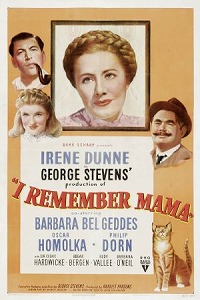
Katrin Hanson (Barbara Bel Geddes) reflects on her life with her Norwegian immigrant family in San Francisco. Her sisters, brother, father, aunts, uncle, and cousin are all recalled, but Katrin tells us, mostly, I Remember Mama (1948). When asked several years ago to list five movies I would have with me on a desert island, I Remember Mama was one of my choices. Our group had not watched it in recent memory (though all but one member had seen it before), and when the opportunity arose to view it, we were thrilled. No matter how many times you see this film, it is one of which you will never tire. I Remember Mama is a series of vignettes, all centered around the Hanson family. Mama Marta (Irene Dunne) and Papa Lars (Philip Dorn) came to the United States just after their marriage to join Marta's family - Uncle Chris Halvorsen (Oskar Homolka), and sisters Jenny (Hope Landin), Sigrid (Edith Evanson), and Trina (Ellen Corby). The children were all born in San Francisco - Nels (Steve Brown), Katrin, Christine (Peggy McIntyre), Dagmar (June Hedin), and Sigrid's son Arne (Tommy Ivo). The Hansons and Halvorsens are hard working people. They are not wealthy, but they are getting by, and Marta and Lars are working and saving so that their children can have a better life through education.
There are many memorable performances. But the film must anchor itself on Mama, and Irene Dunne does not disappoint. She was not the first choice for the role - Greta Garbo was approached (and said no), Katina Paxinou was also considered (the family would have been changed to Greeks), and Marlene Dietrich campaigned for the part (she was deemed too sexy) (AFI catalog). When Irene Dunne was asked, she said yes, on the condition that the director was selected from a list she provided. Luckily, George Stevens (his first film since he returned from Europe during World War II), who was already on the film was also on Ms. Dunne's list (TCM article). He guides her to a subtle, yet strong performance as the heart of this family. Perhaps the incident that most demonstrates Ms. Dunne's power is that of Dagmar's hospitalization. Ms. Dunne gives us a purposeful and wise woman who does what is needed to get to her ailing child.
Philip Dorn is a low-key actor who is used to good effect. He seems at first glance to be nothing compared to Mama, but he is clearly a partner in the marriage. He's a calming influence - he is observant, supportive, and acts when necessary. Watch him when he realizes his son has begun smoking, or when Katrin makes what is a very grown-up choice. It's Lars who is the leader in those situations.
His counterpoint is Uncle Chris. Oskar Homolka provides a brusk, noisy man who loves his family, but brooks no nonsense. His conversation with his nieces, who he discovers fear him, is a remarkable one. His care for his grand-nephew Arne is warm and understanding - the scene with young Tommy Ivo is handled beautifully. Uncle Chris is a man who likes to shock. Marta knows this - watch her attitude to Jessie Brown (Barbara O'Neill in another beautifully, subtle performance), which is why she is the only one of his nieces Uncle Chris can stand!
Barbara Bel Geddes has to age over a period of nearly 10 years and does it splendidly. When we first meet her, she is a grade school student; we see her through her teen years, as she advances in school and in maturity. One incident in particular shows her growth - as she and her mother travel by train to visit the ailing Uncle Chris, we see the girl staring out the window of the train, a sandwich in her hand, almost oblivious to the import of what is happening. But the narrative tells us what she, in retrospect, remembers of the event and the scenes that follow reveal the impact of her uncle's distress.
Ms. Bel Geddes started on stage, most notably as the original Maggie in Cat on a Hot Tin Roof. After well-received performances in six films (including Panic in the Streets), she was blacklisted. Eventually she was cast by Alfred Hitchcock in Vertigo; he included her in four episodes of his television show Alfred Hitchcock Presents, among them "Lamb to the Slaughter," perhaps the most wicked of all his teleplays. In 1978, she joined the cast of Dallas as Miss Ellie Southworth Ewing, the matriarch of the family; with the exception of a one-year break in which she was recovering from surgery, she played the part until 1990; at which point, she retired from acting. Married twice, with two daughters, she died of lung cancer in 2005.
The number of remarkable character performances in the film is astonishing. Edgar Bergen has a rare dramatic part as the shy undertaker Mr. Thorkelson, He's paired with Ellen Corby, equally shy and perhaps the sweetest of Mama's sisters. Sir Cedric Hardwicke uses his impressive speaking voice to bring dignity to Mama's boarder, Mr. Hyde, the man who brings literature to the family. Rudy Vallee, also in a dramatic role, is Doctor Johnson, physician who cares for Dagmar. And finally, the frequently underrated Florence Bates as Florence Dana Moorhead, a successful author and gastronomist, who meets Mama for "two glasses sherry."
Some portions of the movie were filmed in San Francisco, which adds to the verisimilitude of the story. When it opened at Radio City Music Hall in New York City, Bosley Crowther's New York Timesreview was glowing. It was also #24 on the list of top grossing films for 1948 (Variety). It was nominated for 5 Academy Awards: Irene Dunne for Actress (she lost to Jane Wyman in Johnny Belinda); Oscar Homolka for Supporting Actor (lost to Walter Huston in Treasure of the Sierra Madre); Barbara Bel Geddes and Ellen Corby for Supporting Actress (lost to Claire Trevor in Key Largo); and Nicholas Musuraca for Cinematography. Ellen Corby did win the Golden Globe for Supporting Actress.
The story was based on the novel Mama's Bank Account
by Kathryn Forbes, which became a Broadway play by John Van Druten. The
play starred Mady Christians and introduced Marlon Brando as Nels -
Oscar Homolka was the only cast member to appear in the film. Later, Irene Dunne, Oscar Homolka, and Barbara Bel Geddes reprized their roles for the Lux Radio Theatre production in August 1948. The story aired as a television series with Peggy Wood, which ran from 1949 to 1957. In June of 1961, British ITV did a television play with Stella Bonheur as Mama. There were also two musical versions. One, Mama, featuring Celeste Holm in the title role, but closed in 1972 before it reached Broadway. In 1979, it was made into a Broadway musical (with music by Richard Rogers) I Remember Mama with Liv Ullmann as Mama.
If you've never seen this film, please consider finding it. It is heartwarming, but in a good way. We'll leave you with this trailer:
A dead body is discovered on a pier in New Orleans; the victim shot twice, making his death a clear-cut case of murder. But the medical examiner notices something odd, and calls in Public Health officer Dr. Clinton Reed (Richard Widmark). Reed determines the coroner's fears were justified - the victim Kochak (Lewis Charles) was suffering from pneumonic plague, and would have died within 24 hours - as will anyone he contaminated. Reed and Police Captain Warren (Paul Douglas) need to find the murderers before anyone else dies and there is a Panic in the Streets (1950).
This is a taut noir drama that doesn't waste any of its running time. With a strong cast, the film will keep you engaged til the very last moment. Richard Widmark is excellent as the Public Health Service officer who finds himself battling the clock - and the local police captain - I his attempt to locate men who are potentially carrying a virulent - and fatal - disease. He wasn't the first choice for the part - Dana Andrews was originally tagged for the role. As good as Mr. Widmark is - and he is good - the film's power is intensified by a riveting performance by Jack Palance (here credited as Walter Jack Palance) as Blackie, the gangster who murdered Kolchak. Mr. Palance emanates an air of danger, yet we see him interacting with the local community on a friendly basis. It's clear from his performance that Blackie can turn on a dime, and woe to the person who crosses him. Even the advertising poster (above) has Blackie as the dominant image - though Mr. Palance’s name does not even appear on the ad. This was Mr. Palance's first screen appearance (AFI Catalog) - he'd already done two television shows - and he makes an impressive debut. He would continue in television and films until 2004, winning an Academy Award for Supporting Actor for his performance in City Slickers (1991) (you can view his amusing acceptance speech here. He was 73 years old at the time).
It's always good to see Barbara Bel Geddes (Nancy Reed) in anything, and we wished she had more screen time (though, frankly, the film is not about her). Nancy provides a sounding board for Clinton; she allows him to vent his frustrations both about his job - which he clearly loves - and about the current investigation. (Linda Darnell was the person first cast as Nancy). We were impressed by the mature dialogue between the husband and wife (a couple discussing their choices regarding the expansion of their family), and by the equality in the marriage. The screenplay was based on a story by Edward and Edna Anhalt; we wondered if Ms. Bel Geddes dialogue was written by Ms. Anhalt, because Nancy sounds like a woman - not a man talking with a woman's voice (the Anhalt's won the 1950 Oscar for best story). Paul Douglas acts as Mr. Widmark's foil, a police detective who initially resents being posted on what he sees as an impossible - and seemingly ridiculous quest to find a murderer who might have a disease. It's not until he sees the effects of the plague - and begins to understand Dr. Reed's determination to stop its progress - that he becomes a true partner in the search for Blackie and his cohorts. Mr. Douglas is always a strong presence in any film, and does not disappoint here.
There are a two secondary players that are worth noting. Tommy Rettig of Lassie fame plays the Reed's son, Tommy. It's a small part, but instrumental in showing the family side of Clinton Reed. His genuine love and interest in his son provide insight into his belief in his family. In his second film role, Zero Mostel plays Fitch, one of Blackie's minions. The character is a rather repulsive little man, and honestly fades into the background. In his autobiography, Elia Kazan: A Life, Mr. Kazan claimed that he employed Mr. Mostel in spite of his being blacklisted. It didn't help - by 1952 Mr. Mostel was blacklisted completely and didn't work on television or film until 1959 (of course, Mr. Kazan would later name names, ensuring the safety of his own career (Los Angeles Times)). Mr. Mostel returned to New York and the theatre, and would eventually win three Tony Awards).
One character is not listed in the credits - Cleaver, the mortuary attendant who discovers the disease. It's a small role, but we were impressed by the professionalism of the man. IMDB says that the part is a cameo by director Kazan, but he really looks nothing like Kazan - this actor is a much bigger, and frankly, better looking man. I'd love to find out who played the part.
The City of New Orleans is also a character in the film, but it's not the New Orleans of Edna Ferber or Frances Parkington Keyes. This is a city of immigrants and of poverty. We see the docks and the underworld; none of the historic beauty of the French Quarter is visible in this film (TCM article).
The story was redone as a Lux Radio Theatre in March 1951, with Richard Widmark and Paul Douglas reprising their roles. The New York Timesreview was mostly positive, calling it "a generally gripping entertainment." We believe it's a film that will keep you watching til the very end. Here's a trailer to whet your appetite:
In celebration of National Classic Movie Day, and as part of the Classic Film and TV Cafe's blogathon, I'm going to venture on choosing the five (!!) movies I want with me when I'm stuck on a desert island. For someone with over 1,000 DVDs in her library, this is no easy task, but I'm going to give it a try with the caveat that the five I pick today may not be the same five I pick tomorrow! I know that when forced to choose, I'm going to want to mix up the genres a bit, so I'm not watching the same kind of film over and over,. Let's start with a musical, and my selection here is without equivocation. Whenever Singin' in the Rain is on, I have to watch the whole thing. I start out saying "I'll just watch this scene", and the next thing I know, the movie is over and I've re-watched it again. I actually do that with a lot of movies, which is probably not a surprise to anyone reading this. Regardless, Singin' in the Rain is special. With great music, wonderful dancing (Donald O'Connor doing "Make 'em Laugh" is an especial favorite), and terrific actors (Jean Hagen as Lola Lamont - she is perfection!) it has everything. It also serves as an introduction to the beginning of talkies. It's a film to which I frequently refer people, especially when they are puzzled as to why films look like they do in 1929 and 1930. Plus, it's a film that you will finish with a smile on your face and a song in your heart.
If you've never see I Remember Mama, you are missing a wonderful film. My pick for drama has several competitors (mainly A Tree Grows in Brooklyn, Johnny Belinda and The Enchanted Cottage), but for this week, I'm going with Irene Dunne in one of her last films. As the titular Mama, Dunne is perfect as Marta Hansen. Sure, Mama at time seems without fault, but it's hard to care or even notice as Dunne is so unbelievingly convincing as this warm and loving wife and mother. Narrated by the family's oldest daughter, Katrin (played beautifully by Barbara Bel Geddes), the story is a series of incidents in the life of the Hansen family over a number of years, which makes it perfect desert island viewing. Each "story" can be watched as part of the whole progression of the film, or as an independent short story. Especially poignant is an incident that revolves around the illness of the youngest daughter, Dagmar (June Hedin), and the inability of Mama to see her ailing child after surgery (hospital rules forbid any visitors for 24 hours post surgery. Wow, have things changed with time!) Dunne's heartbreak and guilt (she'd promised the child she would be there when she woke) in this segment reaches out from the screen and tears your heart. Ultimately, it is the strength of the family and the care that the immigrant mother and father show to their children as they try to avoid "go[ing] to the bank" that you will remember.
There are some really great westerns, and I have to admit that I had trouble deciding on just one. It came down to two: The Searchers and Westward the Women (add to the mix, a friend suggested Shane and The Big Country. Yes, my friends make my life harder). Ultimately, I chose The Searchers since it is again one of those movies I fall into each time I see it. John Wayne is exceptional as Ethan Edwards, a man driven to almost insanity by his hatred of Native Americans. When Ethan's niece, Debbie, is captured by a group of Indians who murdered the rest of her family, Ethan and Martin Pawley, a young man of mixed heritage who was raised by Debbie's parents, go on a quest to recover Debbie from her captors. But as the years pass and Debbie goes from childhood to young adulthood, it becomes clear to Martin that he must continue on the journey, no matter the cost. For, if he abandons it, Ethan will surely murder the young woman he now sees as a squaw. The story is intense, with Wayne creating a character that is impossible to like, but with whom the viewer feels a bond. Also notable are Jeffrey Hunter as Martin and Ward Bond as the Reverend Clayton, both characters that act as counterpoint to Wayne's driven loner. Finally, there are the magnificent vistas of Monument Valley, which director John Ford uses to tell his tale. It's a film with so many layers that, with each viewing, you'll see something new.
There are a number of comedies, especially romantic comedies which come to mind when asked to pick a desert-island selection: Victoria, Victoria, The Major and the Minor, Roman Holiday are just the tip of the iceberg. But I decided to select Bachelor Mother, starring Ginger Rogers as Polly Parrish, the temporary employee of Merlin and Son Department Store. When her job is about to come to an end, Polly goes out on her lunch break to find another job. She sees a woman abandoning a baby at a foundling home. Fearful the baby will roll from the stoop, Polly rushes in - and is mistaken for the baby's mother by the staff. As a result, Polly finds herself saddled with a baby, as well as a suitor, in the form of David Merlin, the "and Son" of the department store. The film is funny and sweet, the baby is adorable, and our romantic couple have a great chemistry. But what I love about this film are the attitudes of everyone towards this seemingly unwed mother. Sure, we, the audience, know that Polly is a "good girl", but the other characters don't, and uniformly they treat her with kindness and compassion. I especially love Polly's landlady Mrs Weiss (played to perfection by Ferike Boros), who, rather than condemn the girl, goes and gets her adult son's baby things and becomes Polly's go-to baby sitter! In an era where unwed mothers didn't exist, or were punished (usually by death) at movie's end, Bachelor Mother gives us a picture of a society that embraces the mistakes of a young woman, and ends by creating a happy family, all without violating the Code.
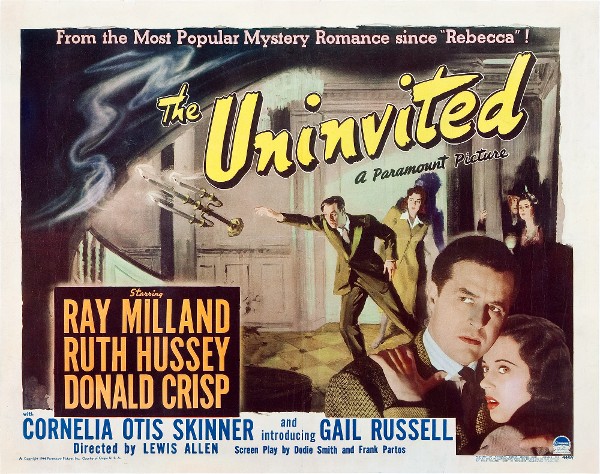
I'm not a huge horror fan, but I love suspenseful films. The Spiral Staircase is one film that I considered for this category, but really there was no contest in the ultimate winner: The Uninvited. It really does have everything - a phenomenal story, great cast, two ghosts, a really mysterious house, and a haunting musical score. (In an earlier blog entry, above, you'll find a link to a You-Tube video of the magnificent theme, Stella By Starlight). One of the problems with suspense films is that, once you know the answer, you don't always enjoy rewatching the film. ButThe Uninvited still is a pleasure even when you know what is coming. Much like Laura, it's the acting, and the relationships of the characters that keep you returning to this film. Ray Milland is exceptional as Rick, the new owner of Windwood House, as is Ruth Hussey as his sister Pam. But the person who steals the film from under everyone else is the ethereal Gail Russell, playing Stella Meredith, the object of Rick's love and the focus of the beings that haunt the house. The Uninvited is a movie that will make you believe in ghosts.
As I said, this is a list that could change at a moment's notice, and you'll notice that the list lacks a few films that one might expect to see on a desert island list. So, let's give a nod to To Kill a Mockingbird, Gone with the Wind, The Best Years of Our Lives,The Thin Man, Casablanca, just a few in a list of "essentials" that film fans love. These are wonderful; I own them, I would never give them up. I rewatch them regularly, but you all KNOW about these films. With my list, I hope I may have brought up a few films that might not have made your own "essentials" queue.