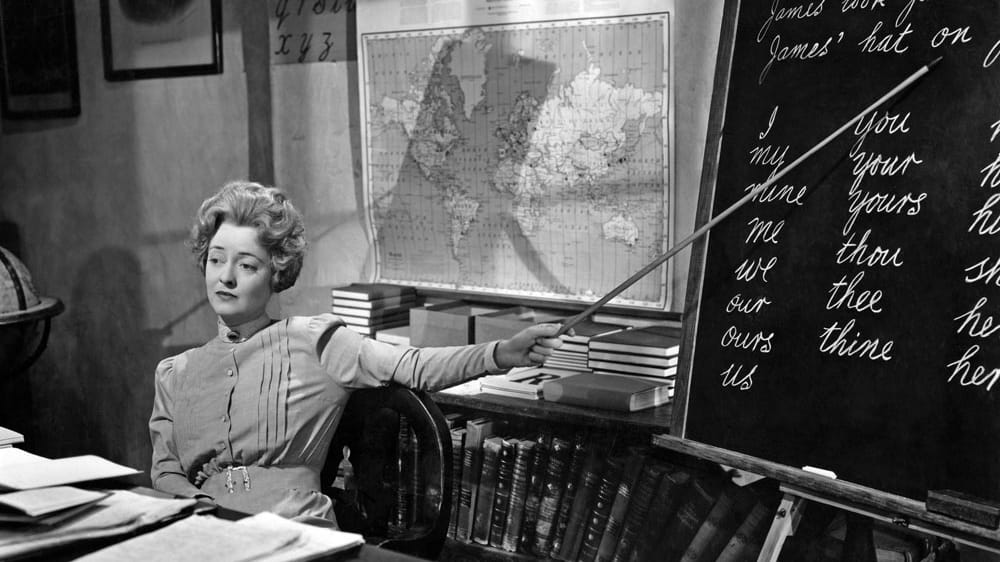
The Welsh mining town of Glansarno is in a tizzy - the new owner of one of the larger estates is arriving that day. They are shocked to discover that LC Moffat, M.A. is a woman - Lily Cristobel Moffat (Bette Davis), an educated woman who intends to use her inheritance to start a school for the local children. She enlists the services of Mr. Jones (Rhys Williams) and Miss Ronberry (Mildred Dunnock) to act as instructors in her free school but despite the high levels of illiteracy in the town, she finds herself in a battle with Sir Trevorby, the local Squire (Nigel Bruce) and pub owner Will Davis (Arthur Shields), both of whom see the school as a threat to their livelihoods. Our film this week is The Corn is Green (1945). Bette Davis shines as the tough-as-nails Miss Moffat in this retelling of the Broadway play. Loosely based on the life of playwright Emlyn Williams, the Broadway production starred Ethel Barrymore as the independent educator. Ms. Davis was only 36 when she took on the part - and would later say that she was perhaps a bit too young (Ms. Barrymore was 61 when she appeared in the play, and Miss Moffat was supposed to be in her 50s) - but Bette Davis was not averse to looking older for the film (TCM article). She brings grit and, when required, warmth to this single-minded woman.
The film introduced Joan Lorring (Bessie Watty) to the screen. Bessie is an avaricious, nasty piece of work, though with her mother, it's not hard to imagine WHY Bessie is the manipulator that she is. She especially loathes Miss Moffat (who she sees as the reason for everything that is wrong with her life), and goes out of her way to strike out at her nemesis. Originally, Bette Davis wanted Ida Lupino for the role of Bessy Watty (Dark Victory: The Life of Bette Davis by Ed Sikov), but she was not available. Angela Lansbury, Betty Field, and Andrea King were all tested - Ms. Davis selected Ms. Lorring, who got an Oscar nomination in the supporting actress category, and who called Ms. Davis one of her "teachers".
Though Richard Waring (who played Morgan Evans on stage) was director Irving Rapper's first choice, Mr. Waring's military service prevented him from being cast. John Dall, like Ms. Lorring, was introduced for this film. He's convincing as Morgan, who goes from flippant to bitter to ambitious, and all done with great conviction. His scenes with Ms. Davis are especially strong - he would credit her with assisting in his performance - in his close up scenes, Ms. Davis stood "behind the camera, facing me, giving the scene the same acting as if she were before the camera."
Several wonderful actors repeated their Broadway roles. Mildred Dunnock who doesn't know how to give a bad performance, reprised Miss Ronberry; Rhys Williams as the minister Mr. Jones and Sara Pugh (Gwyneth Hughes) are also excellent (AFI Catalog),. Nigel Bruce, however, was new to the cast and is at his fubsy best as
the rather clueless Squire. Also added to the film cast was Arthur
Shields, who makes a menacing publican.
Also repeating her Broadway role was Rosalind Ivan (Mrs. Watty). Mrs. Watty is both funny and dismaying simultaneously. Her utter disregard for her daughter makes the viewer want to cringe - then again, with a daughter like Bessie, it's hard to argue with Mrs. Watty's attitude. Ms. Ivan was over 60 when she played Mrs. Watty, yet you believe her as Bessie's mother - her face, while not that of a beauty, is also not old. Because she frequently played women who were not very likeable, she acquired the nickname "Ivan the Terrible" (Accustomed to Her Face: Thirty-Five Character Actresses of Golden Age Hollywood by Axel Nissen). Ms. Ivan would continue in films for another nine years after The Corn is Green, including Johnny Belinda (1948) and Scarlet Street (1945). After appearances in a couple of television shows, she retired.
One interesting aspect of the film (which is set in 1898) is that part of Miss Moffat's mission is to teach English to the locals. As was done in Ireland and Scotland, use of the native language was banned in place of English. Though it did not always prevent the locals from using the language, its use in the courts or even in places of business was illegal (Historic UK). As time progressed, Welsh began to die out; there were fears that it would no longer have any native speakers. However, in recent years, the number of native speakers has risen, and there is now hope the spoken language will continue to live (BBC).
As mentioned, the film was based on the 1940 Broadway play by Emlyn Williams with Ethel Barrymore as Miss Moffat. There were three other productions of the play: 1943 (with Miss Barrymore); 1950 (Eva La Gallienne); 1983 (Cicely Tyson). There was also an unsuccessful attempt of a musical (starring Bette Davis in the title role and Dorian Harewood as Morgan Evans) - Miss Moffat - that never made it to Broadway. Helen Hayes took on the lead in the December 1947 Theater Guild of the Air radio production. Lux Radio Theatre presented the story twice - with Olivia de Havilland and Richard Basehart as the teacher and student, in June of 1950 and again with Claudette Colbert and Cameron Mitchell in May of 1954. The story also made it to television in 1979, with Katharine Hepburn as Miss Moffat.
While Bosley Crowther enjoyed Bette Davis' performance in the film, his review in The New York Times was not complimentary of the director nor of the film overall, saying "this humble, human story is not as intimate and moving on the screen as it was on the stage." But, Mr. Crowther spends a lot of copy comparing the film to Ms. Barrymore's stage performance - a performance that (unfortunately) that the rest of us will never be privileged to see. We all enjoyed the film thoroughly, and heartily recommend it for your enjoyment. We'll leave you with a trailer:
On his return cruise to England, Francis, Lord Kelton (Frank Morgan) finds a woman asleep in his stateroom. Mrs. Fay Cheyney (Joan Crawford) has mistaken his cabin for hers. As she leaves, she meets Arthur, Lord Dilling (Robert Montgomery). Both men are intrigued with the attractive Mrs. Cheyney, and spend the trip vyng for her attentions. We turn our attentions this week to The Last of Mrs. Cheyney (1937)
It's hard to go wrong when you have the stellar cast of lead and character actors present in this movie. Joan Crawford is convincing, though she plays Fay with more seriousness than did Ms. Shearer in the 1929 version. Ms. Shearer very much had her tongue firmly in her cheek, whereas Ms. Crawford makes Fay more conflicted. The addition of a fairly nasty gang (Sara Haden (Anna), Melville Cooper (William), & Leonard Carey (Ames)) makes the stakes in this version a lot higher. Myrna Loy had originally been cast as Fay (TCM article), but Mrs. Crawford was so adamant in her refusal to play the lead in Parnell (she'd sworn off costume parts after The Gorgeous Hussy) that MGM decided to switch the actresses.
William Powell is splendid as Charles. Though his part is relatively small, he makes good use of the screen time provided. We speculated on the benefits of casting him as Lord Dilling - his chemistry with Ms. Crawford is better, and he has the charm and gravitas that we found a bit lacking in Robert Montgomery. Mr. Montgomery is not bad, he just doesn't have the savoir faire of either Mr. Rathbone or Mr. Powell. In comparison to these two gentlemen, Mr. Montgomery comes across as a touch callow. It's been said that Mr. Montgomery and Ms. Crawford were not particularly fond of one another, (Joan Crawford: The Essential Biography by Lawrence J. Quirk & William Schoell) which might be part of the problem. Truth to tell, had we not seen Mr. Rathbone, we might not have given Mr. Montgomery lower marks.
Frank Morgan is a vast improvement over Herbert Bunston. Now Lord Kelton, he is no where near as boring and pedantic as the original. He's a tad naive (just WHY is Fay in his room, wearing nothing but her undergarments??) and he is clearly older and less dashing than Lord Dilling. But, he's no buffoon, and one could see Fay agreeing to marry him. He's rather a nice man, he's quite wealthy, and he is clearly head over heels about her.
Nigel Bruce (Willie) is cast in a role in which he, like his friend Kelton, is somewhat innocent (he really doesn't know that Cousin John (Ralph Forbes) is NOT his wife Joan's (Colleen Clare) blood relation), but he's also a decent and not silly man. He doesn't do the fubsy Englishman that we are used to in his appearances as Dr. Watson; he is a too trusting soul, but a good friend with a sense of humor.
We also enjoyed Jessie Ralph as the Duchess of Ebley. This version gives the Duchess a bit of a past, which makes her even more attractive (and makes Fay's reluctance to rob her even more pointed). A Broadway actress with experience in silent films, she was 63 when she made her sound film debut in Child of Manhattan (1933). She had 50 sound film credits to her name (including such gems as Enchanted April (1935), David Copperfield (1935), and After the Thin Man (1936). Married once (and together until his death), she was forced to retire in 1941 after diabetes complications resulted in the amputation of her leg. She died three years later, age 73, of a heart attack. A few new scenes are added to the film - the opening scene with Lord Kelton, a late scene with Mr. Powell (obviously inserted to satisfy the Hays Office), and fund-raising auction scene, with little dolls of our lead character auctioned for charity. Here's a photo of Mr. Montgomery with the Crawford doll. We thought the dolls were absolutely adorable, and wondered if the actors got to keep them. The New York Timesreview by Frank Nugent was not exactly glowing, though he did express admiration for William Powell saying that "Mr. Powell is equally fascinating, either side of the pale." Following the release of this version, the Lux Radio Theatre aired a version with Miriam Hopkins, Walter Pidgeon, and Adolph Menjou in May of 1942. In 1953, Broadway Television Theatre broadcast an adaptation with Vicki Cummings in the lead (AFI catalog).
Each film has its own merits, and we liked both of them for different reasons. We always enjoy seeing William Powell; we liked the rapport between Shearer and Rathbone. With the changes in film technology between 1929 and 1937, the movies are different enough that it is entertaining to see them both. We'll leave you with a scene from the film:
The arrival of Lady Edwina Esketh (Myrna Loy) and her husband, Lord Albert (Nigel Bruce) in Ranchipur, India creates problems when Edwina becomes attracted to the heir to the throne, Major Rama Safti (Tyrone Power). Though warned to stay away from Dr. Safti by her former lover, Tom Ransome (George Brent), Edwina continues her pursuit, but has the misfortune for fall in love with the handsome doctor. However, everyone is threatened when The Rains Came (1939). The Rains Came feels like it should be longer than it is; so much happens, the characters grow so much, that you think it must be of epic length, but director Clarence Brown packs an awful lot into a running time of 103 minutes. Like so many of the movies from 1939, this is both an exceptional film and one that is not always remembered because it had so much competition the year of its release (how do you get noticed when you are up against Gone With the Wind, The Wizard of Oz, and Ninotchka?). It was nominated for six Academy Awards (winning in the newly created Special Effects category), but none of the marvelous cast were even nominated for their work. Let's start with Myrna Loy. She's cast against type (at least at this point in her career) as a harlot; there was some comment that she was not capable of playing the role (Myrna Loy: The Only Good Girl in Hollywood by Emily W. Leider). It's clear that Edwina lived with Tom Ransome before her marriage, and that she left him. It's also quite clear that marriage is no barrier to her bedding any man that intrigues her, and that Major Safti very much intrigues her. While Marlene Dietrich was considered for the part (TCM notes), Fox head Darryl Zanuck eventually borrowed Ms. Loy from MGM (in exchange for Tyrone Power's appearance in Marie Antoinette (1938)). Mr. Zanuck didn't make her life easy, however - Ms. Loy had been under contract to him and he'd let her go; he apparently resented her success at MGM, and was blatantly nasty to her (TCM article). She found support from director Brown, who told her "I think you're giving the best performance of your career." And she is (though she would later outpace herself in The Best Years of Our Lives). She takes a character who starts as a caricature of an avaricious woman, and as the story progresses matures her into a living, breathing person.
George Brent was also borrowed (from Warner Brothers) for the part that was originally intended for Ronald Colman (AFI catalog). Like Ms. Loy, Tom is a careless individual - the son of a noble (and with the possibility of eventually inheriting the title). He's lazing in India, supposedly painting a portrait of the Maharaja (H.B.Warner), but never getting it done. He's got a (well-deserved) reputation as a roué, and is finally being tested both by the tragedy that strikes Ranchipur, as well as the love that the young Fern Simon (Brenda Joyce) feels for him. Mr. Brent does a good job of turning Tom into a grown-up, and makes it an interesting process to watch. Tyrone Power is exceptional as Major Safti, a dedicated doctor who is next in line for the throne of Ranchipur. Both Charles Boyer and Ramon Novarro were considered for the part (Clarence Brown: Hollywood's Forgotten Master by Gwenda Young). That he is one of the most striking men on Earth doesn't hurt - when he is on screen, you can't take your eyes from him. In the hands of a lesser actor, Rama could be mere eye candy for Edwina to toy with; with a gifted actor like Mr. Power, we respond to him; he uses everything at his disposal to paint a picture of a man who is both attracted to and offended by this obvious - and careless - woman.
This is not just a film of stars. It is an ensemble with a host of gifted character actors. First and foremost is Maria Ouspenskaya (Maharani). An indomitable force, she too is hard to ignore on the screen. Playing a character who is a mix of Eastern and Western habits, she is a powerful woman who has both the strength and determination to lead her people. Born in Russia in 1876, Mme. Ouspenskaya acted with the Moscow Arts Theatre until 1922. While on a trip with the company to New York, she stayed behind, where she worked on Broadway (she ultimately would do 8 Broadway plays) and taught acting and ultimately founded (with Richard Boleslawski) the School of Dramatic Art. When money got tight, she moved to California and opened a dancing school. She also began appearing in films. She was nominated for the Oscar twice, for Dodsworth (1936, her first film), and for Love Affair (1939). She died as the result of a stroke, and a fire - the couch she was on caught fire from her cigarette.
Other notable cast members include Nigel Bruce as Lord Esketh, a totally reprehensible man, and an welcome change from the sweet, befuddled character he was usually forced to play; Jane Darwell as the common sense Aunt Phoebe, loathed by Mrs. Simon (Marjorie Rambeau as the snobby minister's wife), adored by Tom Ransome, and by her husband the Reverend Homer Smiley (Henry Travers as a good and loving man); Mary Nash as nurse Miss MacDaid, who despises Lady Esketh until she is forced to acknowledge her devotion to Rama and the injured of Ranchipur; and Joseph Schildkraut as Mr. Bannerjee, as Westernized India traumatized by the earthquake (and our question - what happened to Mr. Bannerjee??)
The weakest link in the film is probably Brenda Joyce as Fern Simon; she's not a compelling actress, and as a result the character is diminished by the strong performances around her. As a young girl who feels she is being choked by her parents, Ms. Joyce does project the necessary naivety required of Fern. Ms. Joyce worked primarily in B pictures; she succeeded Maureen O'Sullivan as Jane in the Tarzan series, working with Johnny Weissmuller and Lex Barker in that franchise. She retired in 1949 to raise her three children with husband Owen Ward (the marriage ended in divorce in 1960). She would later work in the Catholic Resettlement Office, assisting immigrants in their new country. She died in 2009 at the age of 92. According to this article, which looks at the film (and its remake) in comparison to Louis Bromfield's 1938 novel, the novel focused on the effects of the catastrophe on all levels of Indian life. A Photoplay magazine, however, published an article in which Mr. Bromfield commented on the 1939 version of the film. Not surprisingly, given the venue, Mr. Bromfield praised the film.
As previously mentioned, the film was remade in 1955 as The Rains of Ranchipur with Lana Turner and Richard Burton, with a much different ending. In March 1940, Lux Radio Theatre did a production, which featured George Brent, Kay Francis, and Don Ameche in the main roles. The New York Timesreview by Frank Nugent was not satisfied with the film, calling it "the merest skeleton of the Bromfield work, and that not too well reassembled." When the film was included in TCM's Summer Under the Stars day devoted to George Brent, TCM host Dave Karger provided some commentary on the movie and on Mr. Brent. Regardless of the review, this is a magnificent movie. Sure, it's a romance, but WHAT a romance! We wholeheartedly suggest you give it a viewing. In the meantime, here is the opening of film, with our introduction to Tom, Miss MacDaid, and Rama.
Paul Gallard (Ronald Colman) arrives at the Sports Club in Monte Carlo with an empty suitcase, and proceeds to win 5 million francs at the baccarat table. He departs with his winnings, telling the newspapers that gambling is a fool's game to which he will never return. Miffed, the casino administration begin to move heaven and earth to get The Man Who Broke the Bank at Monte Carlo (1935) to tempt him back to the tables, and hopefully, lose. Most of the action in the 71 minute film is at the very beginning and the end. In between, there is the feeling that the screenwriters were killing time until we could get to those final scenes. It's not that the film was dull - it really wasn't. But it was hard to know exactly where the movie wanted to go and what tone it wanted to strike. While this is not one of Ronald Colman's best roles, he is delightful as Paul (this was released the same year as Clive of India and A Tale of Two Cities - two powerhouse parts for him). He also has a very good rapport with Joan Bennett (Helen Berkeley) in their second film together - they had previously appeared together in Bulldog Drummond (1929). As in that film, it is clear that Mr. Colman is the star; unfortunately for Ms. Bennett, the part of Helen is not really well defined. As Ms. Bennett and Mr. Colman didn't work together after this, one wonders what would have happened had Ms. Bennett been given better written roles and a character able to go toe-to-toe with Mr. Colman.
Joan Bennett was born into an acting family. Her maternal grandparents were actors, as were her mother and father (her mother would eventually become a literary agent). Her sisters also were actors: Barbara and Constance Bennett. Joan appeared in two films (in 1916 and 1923), then was on Broadway (to which she would return in 1950, in Love Me Little) in Jarnegan (1928). After two uncredited film roles, she appeared as the ingenue in Bulldog Drummond. With her blonde hair (her natural color) and youthful face, she was perfect for roles like Amy in Little Women (1933). Her career path would change, however, when future husband Walter Wanger and director Tay Garnett convinced her to go brunette for the film Trade Winds (1938). After that, she was a natural for roles like Kitty in Scarlet Street (1945). Married four times, her career all but ended when her third husband, Walter Wanger, shot Joan's agent in a fit of jealousy. She'd continue her career with regional stage performances (including the national tour of Bell, Book and Candle as Gillian). (In contrast, Wanger's career was not affected after he served his four-month jail sentence.) Television would prove a reentry for Ms. Bennett - she won an Emmy nomination for her role as Elizabeth Collins Stoddard in Dark Shadows (1966-1971). In 1970, she published her autobiography The Bennett Playbill (written with Lois Kibbee), and continued to appear in TV movies. She died of a heart attack in 1990, at the age of 80. For more on Joan and sister Constance, see this article from the Bill Douglas Cinema Museum at the University of Exeter.
Two excellent, but sadly brief performances are turned in by Colin Clive (as Helen's nefarious brother Bertrand) and by Nigel Bruce (as Paul's valet, Ivan). Mr. Clive is deliciously nasty; it's a shame he has so few scenes. And Mr. Bruce gets most of the really good lines. He's really funny, and not at all the buffoon that he would play in his later career. Sylvia Sidney was originally considered for the role of Helen, and John Ford was to direct - an accident on his boat gave the director's chair to Stephen Roberts (AFI catalog). The film's title is taken from an 1890's music hall song, resulting in the studio being sued by the heirs of songwriter Fred
Gilbert, for
violation of their copyright; they eventually lost the suit. You can hear the song sung by music hall comedian
Charles Coborn in the video below - you'll notice the song has nothing at all to do with the plot of the movie. The song would actually be sung in several films, including The Magnificent Ambersons (1942), Lawrence of Arabia (1962) and Alien: Covenant (2017). (TCM article).
The New York Timesreviewer was not impressed with the film; they somewhat liked Ronald Colman, but were quite hard on Joan Bennett (really, she doesn't have a strong script. We thought they were being unfair). It wasn't until May, 1946 that a radio version aired on Hollywood Star Time, with Rex Harrison and Lurlene Tuttle as the leads. Perhaps the film is justifiably forgotten today, but it's worth seeing for Colman alone. He's always a treat.
As promised, we'll leave you with the song on which the title was based.
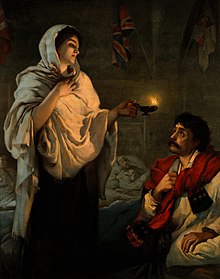
The early life of Florence Nightingale, as portrayed by Kay Francis, is the subject of The White Angel (1936). The film follows Nightingale's announcement of her intention to be a nurse, to her training at the Deaconess Institute in Kaiserwerth (Germany), to her work in Scutari during the Crimean War. In an era where nursing is a respected profession, it is important to emphasize the impact of Florence Nightingale in the creation OF the profession. Nightingale horrified her well-to-do family when she told them that she had a calling to become a nurse. The job that was nursing in England during this period involved hiring slatterns to primarily sit in hospitals and drink. Hospitals were NOT a place you wanted to be - they were filthy, and the "nurses" did little to help the situation. But Nightingale changed all that, first with her work in Scutari, and then with the books and reports she published after her return to England. This film, while rather loose in its faithfulness to the story of Nightingale's life, emphasizes the spirit of the adoration that was heaped upon Miss Nightingale during and after the War. It's interesting that The New York Times, though they liked Kay Francis, is disturbed the the "reverential tone" of the film. Yes, Ms. Francis does sometimes seem to be "striving to live up to Longfellow's 'Lady With the Lamp.'", but that is a hard image to lose. Below is a copy of the film's poster, alongside an 1891 painting. Tthe film mirrors the idolization of Ms. Nightingale that came down from the 1850s. As referenced in the film, Henry Wadsworth Longfellow did write Santa Filomena (1857) about Miss Nightingale. To a 21st century mind, this adoration can be off-putting, but it is well within the attitudes that prevailed during Miss Nightingale's life.
We do take exception to some of the a-historical elements in the film. The most egregious examples is the introduction of the character of Ella Stevens (Ara Gerald), a woman who comes from nowhere to act as a nurse supervisor in Scutari. Given all the tensions that are already present in the film, most notably with the character of Dr. Hunt (Donald Crisp), was it really necessary to import this inane woman as a foil to Florence? It adds nothing to the plot, and only serves to reiterate the importance of the rules that were established by Miss Nightingale at the start of her venture (and the audience is already well aware that she is correct in her judgements). What the screenplay DOESN'T do is to add a phony romantic subplot. Charles Cooper (Donald Woods) professes his love for Florence, but she has absolutely no interest in him. In his biography, Eminent Victorians (which the film credits as their key source), Lytton Strachey notes that at one point, Nightingale found someone she considered to be "a desirable young man", but whom she ultimately rejected in preference to "A profession, a trade, a necessary occupation, something to fill and employ all my faculties, I have always felt essential to me..." Woods fills that bill nicely; and Francis is excellent at displaying affection, but not romantic love.
It was interesting to see Donald Crisp fill the role of the overtly hostile Dr. Hunt. Crispshows much more of the imperious tone he would display in The Uninvited, but NONE of the affection and kindness. This was a Donald Crisp we were unused to, though with 170 film and television credits, Crisp has played just about everything. His film career began in the silent era (he played Ulysses S. Grant in Birth of a Nation); prior to that, he had served as a trooper in the Boer Wars. He studied with D.W. Griffith to become a director and during the silent and early sound eras, he directed 72 films. Ultimately, he found the work trying, and returned to acting exclusively. He appeared in some of the truly great films: Wuthering Heights (1939), How Green Was My Valley (for which he won the Academy Award as Best Supporting Actor of 1941), Lassie Come Home (1943), and National Velvet (1944). Married and divorced twice, Crisp worked until 1963 - his last role was as Grandfather Spencer in Spencer's Mountain. He died in 1974, at the age of 91. It's unusual for Kay Francis to not spend an entire film in eye-catching clothing, but her few lovely gowns are still designed by Orry-Kelly. Even with such an interesting subject, this movie still didn't do well at the box office (see this TCM article). As mentioned, it is not Ms. Francis' acting tht is the problem, but perhaps audiences so used to seeing her in melodramas were not prepared to watch her as an actual historical character.
This was not the first time Nightingale's life had been portrayed. During the silent era, Julia Swayne Gordon would portray her in The Victoria Cross (1912), and Elisabeth Risdon starred in Florence Nightingale (1915). After our film, the story would be attempted again - this time by the British in the 1951 film The Lady with the Lamp starring Anna Neagle. And, in 1985, a television movie with Jaclyn Smith was released. Though the 1951 film is probably the best of the bunch, we think this movie is worth your time, most especially for Ms. Francis' excellent performance. Here is a trailer to give you a taste:
A wealthy woman decides she has found religion in Susan and God (1940). Joan Crawford stars as Susan Trexel, the estranged wife of Barrie Trexel (Fredric March). Susan has been in England for several months, and as the action of the film opens, has returned to America, accompanied by her mentor, Lady Millicent Wigstaff (Constance Collier), the founder of Susan's new obsession. While Susan's friends are not amused by her ardent proselytizing, they like her a lot more than they like her husband, a drunk who can be rather unpleasant in his cups. They plot to keep the two apart as long as possible, to avoid the inevitable scene. But, when Barrie and Susan finally do meet up, they agree to reconciliation of sorts, primarily for the sake of their daughter, Blossom (Rita Quigley). Susan has one proviso - if Barrie takes another drink, she gets a divorce. We are big fans of Crawford, and she does not disappoint in the film. Susan's obsessive personality is very reminiscent of two portrayals that were years off - the over-the-top mother in Mildred Pierce and the maniacal homemaker in Harriet Craig. Crawford purposefully makes Susan annoying, with a patronizing voice and attitude that make you want to throttle her. The minute we meet her, we understand her friends' mixed reaction to her return - she's unable to do anything without making everyone else a party to her interest.
Crawford was stepping into some big shoes in this character - on Broadway (the play by Rachel Crothers opened in October of 1937), the role of Susan was played by Gertrude Lawrence. Added to that, MGM had purchased the play for Norma Shearer (who is reputed to have turned it down due to her reluctance to play the mother of a teenager), and later considered Greer Garson (who, the year before had played her breakthrough role in Goodbye, Mr. Chips) for the part (briefly noted in the AFI Catalog).
Frederic March, usually a very powerful actor, plays Barrie as a very weak man. The slightest pressure results in his again hitting the bottle. It's hard to understand what Barrie and Susan ever saw in one another, because they are so totally different and so unkind to one another. It sometimes feels that Barrie is still married to Susan so he has an excuse to drink. Without giving too much away, we were disappointed with the story line, which we felt really needed a lot of tweeking. The ending was too off-center, and felt as though it came out of nowhere. The screenwriter is Anita Loos, no stranger to comedy, or to satire, but the film doesn't really continue the satirical tone that allegedly made the play popular, though this TCM article maintains that some felt the film improved on the play. Without comparison, it's hard to say, but we felt that the satire was severely muted by the film's conclusion.
The film is rich, however, in supporting players: John Carroll in an exceedingly small part as Clyde Rochester, Nigel Bruce as 'Hutchie', Bruce Cabot as Michael, a very young Gloria De Haven as Enid, Blossom's rival for the affections of a boy and Rita Hayworth as Hutchie's young bride, Leonara. But the person who really shines is Ruth Hussey as Charlotte, probably the only decent human being among Susan's cadre of friends. Hussey is a longtime favorite - especially as Ray Milland's sister Pamela in The Uninvited (one of my personal favorite films, and perhaps the best ghost story ever put to film - we can argue between that and The Ghost and Mrs. Muir, but I digress). She really never seemed to get the lead parts (which is a shame) - the preceding year, she had appeared for what seemed an instant as the over-efficient Miss Watts in The Women. She started in films in 1937, had the lead in a few "B" movies like Bedside Manner (1945), and eventually moved over to television, where she appeared in shows like Marcus Welby, M.D. (which starred her H.M. Pulham, Esq. co-star Robert Young) and The Jimmy Stewart Show (featuring her love interest in The Philadelphia Story). Married for 60 years (and the mother of 3 children), she also performed on Broadway in the 1940s and 1950s (including the lead in State of the Union). She died in 2002, aged 93. While not the best of Crawford's film, Susan and God is rich in excellent performances. Here is a trailer to get you acquainted:
Play Girl (1941) features Kay Francis as Grace Herbert. Grace has spent most of her life living off men (her favorite gambit is the "breach of promise" lawsuit), and has been quite successful at it. However, now that she is no longer in the bloom of youth, she is finding it harder to live in the lifestyle to which she has become accustomed. She's in debt; forced to sell her most valuable piece of jewelry just to pay the rent, and finance a trip to new stomping grounds in Miami. Enter pretty Ellen Daly (Mildred Coles), a stenographer who Grace sees as a potential mentee - Grace will teach Ellen how make her living by romancing - and dumping - wealthy men.
En route to Miami, the car breaks down, and Tom Dice (James Ellison) stops to held. Ellen is immediately smitten, but Grace is not intrigued by the seemingly destitute young man, so she makes sure he and Ellen lose touch while she entices the vain Bill Vincent (Nigel Bruce) to become Ellen's sugar daddy. This is a well-paced and enjoyable film, primarily because of the excellent performances. Kay Francis creates an especially an attractive person in Grace - she seems to regard Ellen as a daughter, and in her own way, Grace is honest. Even when Ellen is not available, Grace regards Ellen's earnings as sacrosanct. We also have a good ingenue in Mildred Coles. She does a nice job of being innocent
without appearing stupid, and her hesitancy about what she is doing makes her more appealing. Coles had a very short career - only 26 films between 1939 and 1948, most of which were bit parts. She died in 1995; why she left films is not clear.
Two character actresses who just don't get enough press are also in this film. First, and foremost is Margaret Hamilton as Grace's loyal companion and maid, Josie is both confidante and adviser to Grace; she has been there through the good times, and will stick during the bad. And of course, she gets all the best lines! Katharine Alexander (Mrs. Dice), plays James Ellison's mother. There is a 12 years age difference between her and Ellison, but she doesn't look old enough to be his mother. Nevertheless, she is quite good in the part, playing a warm and likeable person. You don't see her for very long, but you remember her at the end. Alexander's film career went from 1930 to 1951. As movie roles became harder to come by, she went to the stage, ultimately playing Linda Loman in the 1949 London production of Death of a Salesman, got sterling reviews, then retired within two years.
The credit sequence, which features lovely shots of expensive jewelry, was fun, and really served as a taste of the film's theme. As always in Kay Francis' films, the costuming and scenery are great; though now she is at RKO, her contract at Warner's at an end. This article from TCM looks describes in some detail the problems that were facing Francis after she was included on the "Box Office Poison" list from 1938 (yes, that one). Though the men here are mere ornaments to the female characters, we did enjoy the "sauna" scene in which Bill and Van (G.P. Huntley) scheme to bring Grace down. By 1941 standards, this film is rather racy, and while not great, it's a fun 77 minute visit with Kay Francis.
We follow with another Joan Crawford movie from 1937; this time The Last of Mrs. Cheyney,
with Crawford as the title character, Fay Cheyney, Robert Montgomery as
Lord Arthur Dilling, and William Powell as Fay's butler Charles. Or IS Charles the butler? THAT is one of the questions in this delightful comedy. Fay meets Arthur when she accidentally
ends up in his stateroom on a trans-Atlantic trip.She becomes the
darling of his social circle, finally getting a treasured invitation to
the estate of Arthur's wealthy aunt, the Duchess of Ebley. But is everything on the up and up? And WHY is Charles so familiar to Arthur?
The
person who really shines in this film is the always wonderful William
Powell. It is hard to resist a film that has Mr. Powell in it.
Understated, attractive, dignified, compassionate - he is everything
one would want in a man. And his Charles, though suspicious, is always
good and kind to Kay. Also fun to watch is Frank Morgan as Kay's suitor
Lord Kelton, and Nigel Bruce as Willie, who WOULD be a suitor if he
weren't married. As with so many MGM movies, the magic is as much in
the supporting cast as in the stars.
The Last of Mrs. Cheyney
is based on a 1925 London and Broadway play, which starred Helen Hayes
as Fay in the New York cast. It also had 3 directors, the result of the
sudden death of the listed director, Richard Boleslawski.
Interestingly, the film was completed by Dorothy Arzner, the director of
our last film.
 The Welsh mining town of Glansarno is in a tizzy - the new owner of one of the larger estates is arriving that day. They are shocked to discover that LC Moffat, M.A. is a woman - Lily Cristobel Moffat (Bette Davis), an educated woman who intends to use her inheritance to start a school for the local children. She enlists the services of Mr. Jones (Rhys Williams) and Miss Ronberry (Mildred Dunnock) to act as instructors in her free school but despite the high levels of illiteracy in the town, she finds herself in a battle with Sir Trevorby, the local Squire (Nigel Bruce) and pub owner Will Davis (Arthur Shields), both of whom see the school as a threat to their livelihoods. Our film this week is The Corn is Green (1945).



_04.jpg)


