Showing posts with label Elsa Lanchester. Show all posts

Thursday, May 14, 2020

Tyrone's on Trial

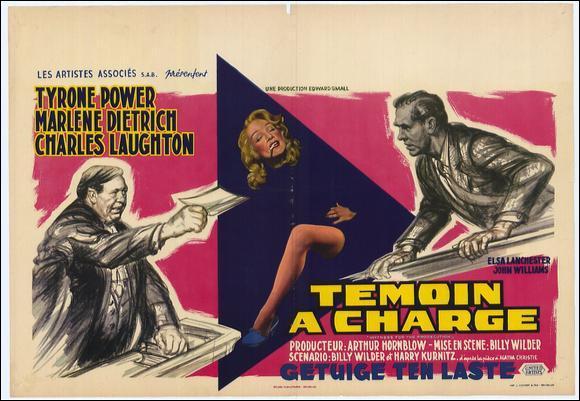
Ruta Lee, who appeared in the small role of Diana in Witness for the Prosecution (1957) spoke about her appearance in the film during the TCM Cruise.  Ms. Lee got the part when Arthur Hornblow, Jr. saw her at a Frank Sinatra night club appearance.  Hornblow approached her, and asked her to do a screen test; after which Marlene Dietrich (Christine Vole) insisted that her hair color be changed (so Ms. Lee became a brunette for the film).

Sir Wilfrid Robarts (Charles Laughton) has just returned home from hospital, with his nurse Miss Plimsoll (Elsa Lanchester) in tow, when he is approached by solicitor Mayhew (Henry Daniell) to possibly take on the defense of Leonard Vole (Tyrone Power) who is about to be arrested for the murder of Emily Jane French (Norma Varden), a wealthy widow who Vole had befriended.  Sir Wilfred finally agrees to take on the case (over the objections of Miss Plimsoll), as he is convinced of Vole's innocence, and the barrister he intended to recommend is not (John Williams as Brogan-Moore).  Complications ensue in the form of Vole's wife, Christine.  Is she really trying to help her husband, or is she using the murder as a means of getting rid of him for good?

I've seen this film dozens of times on television; I always appreciated the humor that floats through this very serious story.  But, seeing it with an audience really impressed upon me how FUNNY it really is - especially the interplay between Charles Laughton and (his wife in real life) Elsa Lanchester, who acts as straight woman for his bon mots.  For example, when Miss Plimsoll checks Sir Wilfred's thermos (to verify no brandy is present), he counters her with "If you were a woman, Miss Plimsoll, I would strike you."  And when she informs him that she was engaged to a lawyer but he died, he responds, "He certainly was a lucky lawyer." But the humor would not work if the audience didn't sense the affection between Laughton and Lanchester, and they easily give you the sense (even before the ending of the film) that these two are now a team.
Based on a short story by Agatha Christie, Witness for the Prosecution was adapted by Ms. Christie as a play which opened on the West End (London) in 1953. David Horne starred as Sir Wilfred and Derek Blomfield appeared as Leonard Vole.  When the play moved to Broadway, Francis L. Sullivan took on the role of Sir Wilfred, with Gene Lyons as Vole.  The character of Miss Plimsoll does not exist in the stage version.

Only one member of the Broadway cast reprised her role in the film - Una O'Connor as Janet McKenzie, housekeeper to the murder victim.  Born in Ireland in 1880, Ms. O'Connor started her career on the stage, in both Ireland and England.  In 1911, she appeared in her first Broadway play (The Playboy of the Western World), and by 1929, she was appearing in films, first in the UK and then in Hollywood.  She's perhaps best remembered as Maid Marian's lady-in-waiting, Bess in The Adventures of Robin Hood, and as Reginald Gardiner's housekeeper in Christmas in Connecticut.    But, even while doing films, she still managed to squeeze in the theatre - she appeared in 11 Broadway plays and 64 films, and ventured into television in the 1950s.  She was 77 when she appeared in this film, and when it wrapped, she retired.  She died two years later.
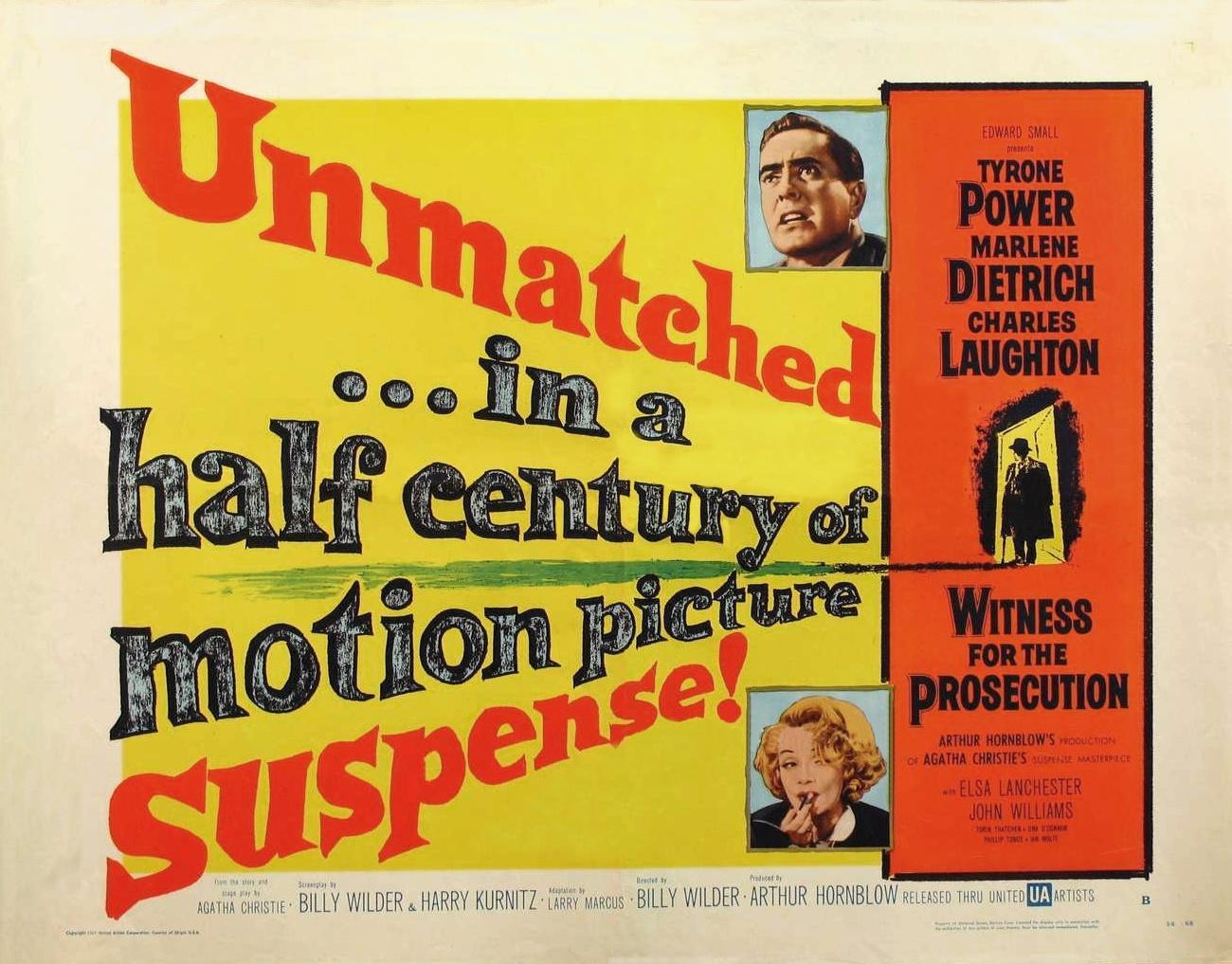
This was also Tyrone Power's final film appearance. According to these TCM articles, Power was not the first choice for Leonard Vole - William Holden was.  Also considered were Gene Kelly, Kirk Douglas, Glenn Ford, Jack Lemmon, and Roger Moore.  Power, who had at first turned down the role, finally accepted; with this role came the part of Solomon in Solomon and Sheba, which Power started shooting on September 15th, 1958.  But on November 15th, after shooting a dueling sequence, Power complained of arm and chest pain.  Despite being rushed to the hospital, he died of a massive heart attack.
Ava Gardner and Rita Hayworth were also considered for the role of Christine, and while Gardner very much wanted to do it, Billy Wilder wanted his friend Marlene Dietrich in the lead.  Without giving anything away (in case you've not seen it), it has often been said that Dietrich lost out on an Oscar nomination because of the secrecy about the film's ending. 

Finally, there is Charles Laughton.  Laughton was nominated for an Oscar for this role, but lost to Alec Guinness in The Bridge on the River Kwai.  Certainly, a notable performance, but my vote goes to Laughton.  A consummate actor, an impressive director (he directed once - the magnificent Night of the Hunter, and Robert Mitchum once claimed Laughton was his favorite director), Laughton won the Oscar once - for his role in The Private Life of Henry VIII (1934), and was nominated twice more - for this and for The Mutiny on the Bounty.  His performance here is layered and substantial.  He's funny, he's businesslike, he's subtle, he's passionate. All in all, his performance is special. 

These  notes from the AFI catalog go into some detail about the changes to the script, including, interestingly, the film's end.  The film got excellent reviews, as is evidenced by this New York Times review, and the AFI named it #6 in its list of Top 10 Courtroom Dramas.  All in all, this is an excellent film, only enhanced by being able to learn some of its history firsthand.

We'll close with this scene, in which Christine Vole is interviewed by Sir Wilfred: two actors at the top of their game.  Unlike her husband in an earlier scene, Christine takes no nonsense in her examination:


This posting is part of the Oscar Snubs Blogathon.

Monday, December 16, 2019

Ida and Her Sisters

Ellen Creed (Ida Lupino) works as a companion to Leonora Fiske (Isobel Elsom), a retired actress with savings that will keep her living comfortably for the rest of her life. Ellen works to support her two sisters, Emily (Elsa Lanchester) and Louisa (Edith Barrett) in London. The sisters, however, are somewhat odd in their habits, and their landlady has demanded that Ellen remove them from her boarding house immediately. In desperation, Ellen asks Miss Fiske if the sisters can visit with her at Miss Fiske's house for a short time. But when the short time extends to six months, Miss Fiske has had it.  Our film this week is Ladies in Retirement (1941)


A melodrama very much in the vein of Night Must Fall (1937), the film's power is driven primarily by the performance of Ida Lupino. Playing a woman who should be much older her 23 years  (TCM article). Ms. Lupino gives the character grit, and emphasizes that this is a woman who feels overwhelmed by circumstances. Clearly, Ellen is the breadwinner for the family. She's tried leaving her sisters on their own. She's exhausted her last chance of supporting them from afar - their landlady has threatened to have them institutionalized. Ellen's desperation is evident as she tries to keep Louisa and Emily with her. But the two women, one a temperamental hoarder and the other a grown child, are not controllable, even with Ellen there. Keeping them at Miss Fiske's abode is her last chance to protect them, but their continued antics make this impossible. Ms. Lupino would later list it as one of her favorite film roles (TCM Notes).
Louis Hayward (Albert Feather) was married to Ms. Lupino at the time this film was made. He's good as the shady Albert; he makes the character even likeable at times, though one is always suspicious of his motives.  Mr, Hayward started his career on the London stage, a protege of Noel Coward. In 1935, he did a Broadway play; this led to his first film role, The Flame Within (1935). He was cast as the first Simon Templar in The Saint in New York (1938), but is probably best remembered for his performance in The Man in the Iron Mask (1939). When World War II broke out in the U.S., he joined the Marines, commanding a photographic unit and eventually producing the Oscar winning short With the Marines at Tarawa (1944). He returned from the war severely depressed, which caused the breakup of his marriage to Ms. Lupino (Ida Lupino: A Biography by William Donati). He would marry twice more, the third producing his only child. His career continued, in both film and television until 1974. In 1985, he died of lung cancer (he'd smoked four packs a day for 50 years), at the age of 75.
Emily  and Louisa are well acted by Ms. Lanchester and Ms. Barrett - they give the characters just the right amount of insanity, so that, for awhile, you are able to sympathize with them and with Ellen. Rosalind Russell had expressed interest in playing one of the parts. Also in consideration for the sisters were Lillian Gish, Judith Anderson, Pauline Lord, Laurette Taylor and Helen Chandler (AFI Catalog). 

Evelyn Keyes does a reasonably good job as Lucy, the housemaid (in fairness, it's not a great part). She spends most of her scenes with Mr. Hayward, and he steals all the audience's attention. As I said, he's quite the rogue. 
  Based on a 1940 Broadway play (which ran for 151 performances) the screenplay was written by Garrett Fort and Reginald Denham, based on Mr. Denham's script with Edward Percy. The play starred Flora Robson as Ellen, Estelle Winwood as Louisa, and Isobel Elsom who reprises her role of Miss Fiske in this movie.

It's not surprising that the film received two  received two Oscar nominations - for Black & White Art  Direction (Lionel Banks and George Montgomery) and for Score (Morris Stoloff and Ernst Toch). Though we know that the film was shot on a backlot, the film gives the feeling of the moodiness of the moors, and is reminiscent of atmospheric Wuthering Heights. The score also makes interesting use of the music from The Mikado; of course, it is a comedy, but it is the story of Ko-Ko, a man forced to become the Lord High Executioner of Titipu. The film got other awards:  Isobel Elsom received the Best Acting nod from the National Board of Review (NBR); Ida Lupino received a joint Best Acting Award from NBR - for this film and for High Sierra.

New York Times review was positive calling Ladies in Retirement "painstakingly done, beautifully photographed and tautly played."  The story been redone several times. In September 1943, Lux Radio Theatre presented Brian Aherne and Louise Barrett.  Robert Montgomery Presents (1951) had Lillian Gish and Una O'Connor in a television broadcast. 1954 saw a version with Edith Barrett, Elsa Lanchester & Claire Trevor as part of the Lux Video Theatre. The film was remade as The Mad Room (1969) with Shelley Winters and Stella Stevens. 

While our group had some mixed feelings about the film (one member said she found it sometimes frustrating), the consensus was that it's certainly a film worth watching.  If you like melodramas, this one is for you.

Friday, November 20, 2015

Tyrone Finds the True Meaning of Life

This year's TCM Cruise presented a number of films with Tyrone Power (which is never a hardship for me); not surprisingly, I saw them all.  The third night of the cruise featured The Razor's Edge (1946), based on W. Somerset Maugham's novel, and introduced by Alex Trebek and Robert Osborne, both huge fans of this excellent rendition.  (For those of you who liked the Bill Murray remake, sorry - I didn't care for it, and neither did the evening's hosts).

The story focuses on Larry Darrell (Power), He has physically survived the First World War, but is tormented by the death of a friend, who died saving Larry's life on the eve of the armistice.  Why, Larry wonders, should he live, when this man is dead, and what can he do with his life to make up for that death?  Larry's fiance, Isabel Bradley (Gene Tierney) is sympathetic, and agrees that Larry should travel for a while, to try and find the answers to his questions.  But when, a year later, Larry is still determined to continue his quest, Isabel balks - she is not willing to live as an itinerant, with a husband who has no ambitions to anything but the life of a nomad.  So, they separate, only to be reunited years later, when both their lives - and the lives of their friends and relatives - have drastically changed.
This is a complex film, following the lives of a number of central characters over a period of nearly 15 years, all of whom are in some way related to Larry and Isabel.  The characters are real - with faults and flaws.  We admire Larry, but would find him impossible to live with.  We sympathize with Isabel, but gasp at her machinations.  It's a film of greys - there are almost no black and whites.

Elliot Templeton (Clifton Webb) is a prime example of a "grey" character.  Wealthy, selfish, and somewhat arrogant, Elliot is also generous and intrinsically good.  Late in the film, a priest characterizes Elliot as "a good man. His defects were on the surface, but he was generous of heart ...and kindly toward his fellow creatures."  That he is basically good is reflected in the fact that our narrator, Maugham (Herbert Marshall), actually likes Elliot (also calling him "kind and generous"), even though he feels that Elliot " has no friends, only acquaintances."  Elliot's wealth has allowed him to live his life in Europe, hobnobbing with the wealthy and noble, and to look with aghast at his much loved sister, Louisa (Lucile Watson), who has chosen to spend her life in the Midwest.  But, when his niece and nephew-in-law lose all their money in the Stock Market crash, it is Elliot who takes them in, and supports them and their children until they can get on their feet.  Webb paints a picture of a man whom you like in spite of yourself; he allows us to the see the inner Elliot.
Anne Baxter won her Academy Award for playing Sophie MacDonald, a loving wife and mother whose life is shattered after an automobile accident.  Other actresses were considered for the part (Susan Hayward, Betty Grable, Judy Garland, Anabel Shaw, Nancy Guild, and Bonita Granville, according to Ms. Baxter), but it is hard to imagine anyone else doing it.  The character of Sophie floats in and out of the story, as she does in the lives of the other characters.  Sophie's alcoholism becomes a major focus of the film, and it is Baxter's seering portrait of Sophie's problem that more than likely cinched the award for her.   While we sympathize with Sophie, Baxter is careful to make her unappealing in the latter half of the film - again, she is painted in grey tones.  And her alcoholism is not something that just appears because of the accident - early on, Sophie tells us that her husband Bob (Frank Latimore) doesn't like her to drink because of what it does to her.   Of course, Joseph Breen tried to get the alcoholism eliminated from the film - Darrel Zanuck refused to take it out, as essential to the story (for more on this and other casting issues see these AFI notes.)

Gene Tierney was not the first choice for Isabel.  Both Joan Fontaine and Olivia de Haviland were considered, as was Maureen O'Hara.  In her autobiography, 'Tis Herself, Ms O'Hara recalls that the deal was all but completedThere was one proviso, however: producer Darrell Zanuck told her to keep quiet about her casting.  She didn't - she told her friend Linda Darnell - who was in a relationship with Zanuck at that point, unbeknownst to Ms. O'Hara - and Zanuck fired her later that day for blabbing.  Regardless of the fact she was not the first choice, Ms. Tierney shines (she was nominated for an Oscar - losing to Joan Crawford in Mildred Pierce) as Isabel, and creates a character of dimension and layers.  As hideous as some of her actions are, even narrator Maugham cannot dislike her, nor in a sense can we do more than shake our heads at her selfishness.  According to this TCM article, Tyrone Power (newly back from his service in World War II), developed on crush on her.  She privately let him know that, though divorced from Oleg Cassini, she was seeing someone else - future president John Kennedy.  Though Tierney loved JFK deeply, it was not too be.  Kennedy was already looking towards his future in politics, and men married to divorcees just didn't get to be president in the 1940s.
Gray Maturin (John Payne) is the man who has loved Isabel for years, and who ends up married to her when Isabel is unwilling to wait for Larry.  It's interesting that his name is "Gray", because he is perhaps the only non-gray character in the film.  Gray is, in fact, the only really "good" person we meet.  He loves Isabel unquestioningly and he likes Larry, even though Larry is the competition.  It is Gray who has to interact with Sophie on the most critical day of her life - Payne gives us a man who is caring, but unable to do more than just sympathize.  Payne works hard to make Gray a complex, but not weak character;  he mostly succeeds, as we care about Gray and understand how deeply honorable he is. 

One other character of note is that of Miss Keith (played by Elsa Lanchester).  As the private secretary of the Princess Novemali, the part is tiny - at one point, we see her in the background of the action, but finally get to meet her at the film's end.  Like Gray, she is someone who is deeply good.  Though Lanchester only has this one brief scene with Tyrone Power, you will remember her.  Her Miss Keith is a woman of integrity in a world of mere surface.

In the discussion prior to the film, Robert Osborne cited one scene in the film that he thought one of the most beautiful on film.  You can see it below, as Isabel tries to seduce Larry, to keep him from going away again. A magnificent setting, and two of filmdom's most attractive people - this scene does shine.  

We'll be returning to more films from the festival in coming weeks (along with our regular conversations).