Showing posts with label Edgar Buchanan. Show all posts

Monday, May 3, 2021

Glenn is Framed

Michael Lambert (Glenn Ford) is a down-on-his-luck mining engineer. He agreed to drive a truck to get to a place where he can find a job, but is arrested for running the truck into another car. He’s bailed out by Paula Craig (Janis Carter), but doesn’t know why.  He is also doesn’t know he is about to be Framed (1947).

In the spirit of honesty, I'll start by mentioning that I'm not a fan of Glenn Ford.  He's done some good work (Gilda, primarily), but by and large I find him a one-dimensional actor, who does self-pity or anger, and not much more.  And I didn't find more than that in this film. In the final analysis, two members of our group liked the movie, and two didn't  The two that enjoyed it liked the story, though they said it could have been tighter.  

We know that Michael Lambert has managed to get to his destination to find a job as a mining engineer, but we know precious little more about him, except that he is an alcoholic. While the story doesn't tell us why he drinks so much, it works as a plot point - it makes it easier to set him up as a victim. 

We were also not impressed with Janis Carter. From her first second on film, we know that Paula is up to no good; it's apparent that Michael knows it too.  Yet, he still keeps hanging around her.  This is no The Postman Always Rings Twice, because there is no chemistry or connection between the characters.  It seems clear that they are not enamored of one another, nor are they trusting of one another.  Ms. Carter was cast in hopes of creating a new Gilda for Mr. Ford (TCM article). Sadly, it didn't work

Barry Sullivan (Stephen Price), however is good as the dishonest banker who's clearly using Paula to his own ends.  That there doesn't really seem to be much between them works in the movie's favor  - their relationship is a business deal, pure and simple, and Mr. Sullivan's distancing works for the film. 


Two minor characters are worth noting. Edgar Buchanan (Jeff Cunningham) plays a prospector who hires Michael as his mining engineer. It's the one clue we have that Michael is good at his job, because Jeff is a smart man, not the ditzy movie prospector we generally expect to see.  Karen Morley (Mrs. Price) has a nice scene as Barry Sullivan's neglected wife.  She does a lot with the character in very little screen time, and we were sorry not to see more of her.

The original title for the movie was They Walk Alone (AFI Catalog).  The New York Times review by A. H. Weiler (A.W.) was positive. It's got a decent story, and if you can overlook some of the casting issues, it's an interesting enough film to watch.  We'll leave you with a scene featuring our three leads:


Wednesday, July 15, 2015

Does Jean Love Cary or Ronald?

The members of our group have all seen Talk of the Town (1942) before, but it has been some time since we visited this fantastic movie, and decided it was time to reacquaint ourselves with this splendid cast of characters.  The film opens with the trial of Leopold Dilg (Cary Grant).  Dilg, an ardent activist, is accused of setting file to the Lochester Mills, and in the process, killing the night watchman Clyde Bracken (Tom Tyler).  The town is ripe for a lynching; in desperation, Leopold escapes from his cell, injuring his ankle in the process.  He arrives at the country home of Nora Shelley (Jean Arthur), a childhood friend.  Nora is in the midst of cleaning the house, which she is renting for the summer.  Though she is not eager to assist Leopold, his injured ankle and the town's angry attitude convince her to give him shelter, at least until she can contact his lawyer, Sam Yates (Edgar Buchanan).  However, a complication arises - Professor Michael Lightcap (Ronald Colman), a noted Harvard jurist, arrives a day early.  Nora has to scramble to not only keep Leopold hidden and but also keep herself in the house, to hide him from the reclusive professor.  And if that isn't a big enough problem, the following day, Professor Lightcap finds out he is being proposed for the Supreme Court, so any kind of scandal will endanger his appointment - and a murderer living in his house is not the kind of publicity he needs.

In his book Five Came Back: A Story of Hollywood and the Second World War, Mark Harris discusses the previews of the film.  It's widely known that Columbia decided to use audience previews to help them decide on the film's ending.  Two conclusions were shot: one with Cary Grant leaving with Jean Arthur; the other with Arthur selecting Ronald Colman.  That the film ends, thanks to audience reviews, with Grant is the result of those polls.  But what isn't as widely known is WHY the audience selected Grant.  According to Harris, the war-time audience (the film was released on August 20, 1942)  felt that Arthur should marry the man of draft age because "later on, the mature men will have [the women] all to themselves." (p. 167)  The idea that Nora would marry Leopold, see him off to war - and death - and ultimately end up with Michael (who is over 40 and therefore ineligible to serve)  is somewhat disturbing.  We wondered, had the survey been done a few years earlier, who would have won?  As much as our group adores Cary Grant, the consensus here was for the more stable, more mature, and more intelligent Michael Lightcap.  Leopold Dilg is just too much of a loose cannon (an unusual role for Mr. Grant) to appeal to our simpler tastes.  This TCM article goes into more detail on the tension between Colman and Grant, neither of whom was used to playing second fiddle to another actor, and on Colman's reluctance to appear in a Columbia film, due to his intense dislike of Harry Cohn (Stevens promised Colman that Cohn would never be on the set - and kept his word).
Director George Stevens was well-respected for romantic comedies, like The More the Merrier (for which he received his first Academy Award nomination as best picture) and Woman of the Year, as well as for dramatic romances like Alice Adams and Penny Serenade.  However, upon his return from World War II, where he was one of the first people into Dachau as the Allied forces entered Germany (his footage was used during the Nuremberg Trials), Stevens remade his career, never venturing into comedy again.  Instead, he chose films that, to his mind would "tell the truth and not pat us on the back" (Harris, p. 418).  The Diary of Anne Frank, Shane, Giant (Oscar-winning Director of 1956, and A Place in the Sun (Oscar-winning Director of 1951) are among his magnificent post-war efforts.   Steven would continue directing until 1970.  He died in 1975, aged 70.
There are some wonderful character actors in the film.  Edgar Buchanan, who had already worked with Grant and Stevens on Penny Serenade, appears as Sam Cade, Dilg's lawyer and an old school chum of Lightcap's. Glenda Farrell has a small part as Regina Bush, the rather crude and gabby girlfriend  of the "deceased" Clyde, and Lloyd Bridges has a brief appearance as Donald Forrester, Lochester's newspaper editor and reporter.  But the performance that stands out (and even rates a mention in this New York Times review) is that of Rex Ingram as Lightcap's valet, Tilney.  Though playing a servant, Tilney is a quiet, distinguished man.  More than just a valet, he serves as Lightcap's confidant and occasional adviser, for Tilney, unlike Lightcap, has seen something at the world.  He has even been married, albeit unsuccessfully.  Ingram had a relatively long career, beginning his film work in 1918's Tarzan of the Apes, and concluding with an appearance on The Bill Cosby Show in 1969.  A graduate of Northwestern University's medical school, he left for Hollywood, then for Broadway, where he appeared in 13 plays from 1934 to 1962.  He died in 1969, aged 73.

All in all, this is a film we highly recommend, and perhaps is close to being an essential.  We'll leave you with this video, to whet your appetite -  the first meeting between Professor Lightcap and Miss Shelley.

Monday, September 29, 2014

Jess DOESN'T Go to War


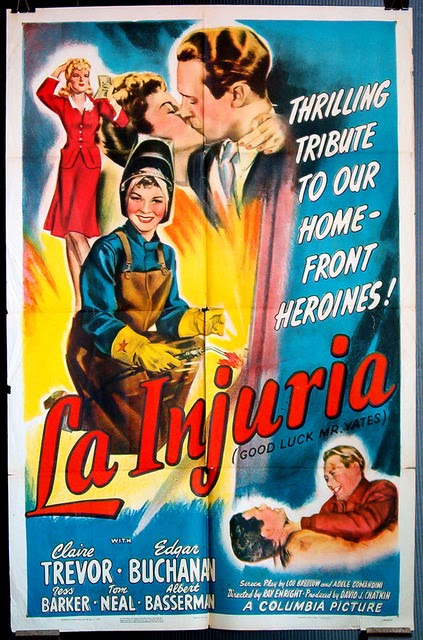
Our film for this week is a wartime B picture entitled Good Luck, Mr. Yates (1943),  It stars Jess Barker as the titular Oliver Yates, an instructor in a Carlyle Military Academyl who has been, much to his disgust, exempted from military service as an essential employee (why a grade school teacher would be exempt from the draft is beyond me).  Many of his students are hostile because he is not in the war, and Oliver is finally able to convince his boss that he must enlist.  Only problem is, he has a perforated eardrum and is listed as 4F.  Rather than return to the school, he gets a job at a shipbuilding facility, while he seeks treatment from German refugee Dr. Carl Hesser (Albert Basserman).  Dr. Hesser can cure him in a few weeks, and he'll be able to join the army.  Right...

To be upfront,  two of our viewers found the film amusing, two of us loathed it (and I was one of the loathers).  The film is all over the place, with no real focus, and much of it doesn't make a whole lot of sense.  With a panoply of European characters (our German doctor, the Greek landlord, the Russian dockyard workers), all there to remind us of what we are fighting for, it tries to demonstrate the wonderful melting pot that is the United States.  But all it succeeds in showing is that a mob is nasty no matter where you live.  

And then there is our local "Rosie the Riveter", Claire Trevor as Ruth Jones, daugher of Oliver's shipyard boss, "Jonesy" Jones (Edgar Buchanan playing the only really good man in this movie). How Ms. Trevor got mixed up in this turkey is beyond our ken.  She is such a good actress, and her success in Stagecoach is only a few years in the past.  Around this period, she was appearing in a number of film noir like Crossroads and Murder My Sweet, frequently not in a starring role.  Still, playing second fiddle to Jess Barker must have been a come down.
Jess Barker is banal as Oliver Yates, though one has to admit, he's not given a whole lot to work with.  He's an attractive enough man, reminiscent of Richard Denning.  But Barker had an abbreviated career, thanks to his own bad judgement.  He was married to Susan Hayward for 10 years, and when she asked for a divorce, Barker created quite the public row.  He insisted on a community property settlement (despite having signed a pre-nuptual agreement).  When he was refused money, he filed for full custody of the twin sons.  He lost that too.  Then, two years later, he was implicated in a paternity suit, and was ordered to pay support for his daughter (conceived, it turned out, while he was still married to Hayward).  He continued to act until 1977, but his reign as a potential leading man was long over.  

Another interesting aspect of this film is the marketing - it is (as you can see from the poster above), touted as a "thrilling tribute to our home-front heroines," with Claire Trevor getting top billing. Yet, there is very little about Ruth's war efforts.  For better or worse, this IS Yates story.

We have an appearance by Scotty Beckett as student Jimmy Dixon, and brief, uncredited appearances by Hugh Beaumont and John Hamilton.  What we DON'T have are two segments that were cut from the film.  Nan Wynn was supposed to sing as part of a lunchtime entertainment scene for the shipyard worker, but that was eliminated (here is a video of Ms. Wynn singing in Princess O'Rourke).  Also cut were the Three Stooges doing their "Niagara Falls" routine.  It seems the studio heads decided to save the routine and give it its own film: Gents Without Cents. Quite honestly, we considered THAT cut to be the one good thing about the film.

Next week, it back to the 1930s for a musical romance.  Hopefully, we'll have more positive things to say!

Monday, July 23, 2012

Jean is Impatient

Released the year before the end of World War II, The Impatient Years examines a topic in a comedic manner that, after the war would be looked at in a more serious vein.  Andy Anderson (Lee Bowman) is home on medical leave, returning to the home of his wife of one week (plus about 18 months).  He finds Janie (Jean Arthur), busy running her home, with her boarder (Henry Fairchild played by Phil Brown), her father (William Smith, played by the always wonderful Charles Coburn), and her not quite one-year old son! She exists on a very rigid schedule, one which her husband will not respect.  Within a day, the hastily wed couple are ready to divorce with equal speed, much to the disgust of Mr. Smith.  So, he recommends to the Judge (Edgar Buchanan) that he prevent the couple from divorcing until they can figure out WHY they married in the first place.

By 1946, The Best Years of Our Lives would look at the impact of the hasty wartime marriage on the returning vet. And while The Impatient Years certainly IS a comedy, there is a core of seriousness under the humor.  Both the Judge and Mr. Smith understand that the war is forcing decisions to be made to quickly.  They insist that our couple stop BEING impatient and try to rediscover their lost love for one another. 
It should be added that neither Andy nor Janie is totally in the wrong. He, back from combat, wants peace, wants to do what HE wants to do.  She, responsible for a house and small child, needs a schedule to get everything done.  Neither can understand the other's needs.  Neither even tries.  And thereby hangs the serious heart of the film.

Both Jean Arthur and Lee Bowman are excellent, and Charles Coburn, as always, shines as a loving father (who, in fact, is just meeting his son-in-law).  We also have comic performances from Charlie Grapwin (as a bellman) and Grant Mitchell (as a hotel clerk).  Sure, the film can be a tad silly, but at heart, it is a lovely story about two people who need fight their own way out of the War.