Sailor Alex Winkler (Bill Williams) finds a large sum of money in his pocket. He tells dance-hall hostess June Goffe (Susan Hayward) that he must have taken it from Edna Bartelli (Lola Lane)after she got him drunk. They return to her apartment to return the money, and find her dead. June agrees to help Alex locate the murderer before Alex's Deadline at Dawn (1946). At first glance, this appears to be another "we only have six hours to find the murderer movie," but the plot has more twists and turns than a pretzel, making it an interesting ride. It gets a bit long-winded at times - there is perhaps a twist too many and the ending seems to come from nowhere, but this is an enjoyable picture that will keep you watching. Susan Hayward creates an interesting character in June. She's just on the border of jaded - tough, but still possessing enough faith in humanity that she is willing to come to the aid of this naive sailor. June hovers on the edge of acceptance - she wants to believe in Alex, but her experiences in the Big City have left her cynical. The audience spends the movie waiting for her to abandon Alex and is relieved when she doesn't. Ms. Hayward is a good choice for the part — her strength makes it acceptable as June takes on the more traditionally masculine role, while Williams is the "damsel" in distress. The film marks Ms. Hayward's return to the screen after giving birth to twin boys (AFI catalog).
Though Alex, as played by Bill Williams, is likeable, he can also seem dull and repetitive. Thankfully, as the film progresses, he becomes less childlike and more responsible. Mr. Williams is able to grow Alex - the film open with him recovering from the mickey that Edna gave him. As the movie goes on, we are aware that Alex's head is clearing, and while he is still a babe in the woods compared to June, he's far more intelligent than the early scenes led us to believe. Mr. Williams, who married Barbara Hale the year this film was released, maintained a friendship with Susan Hayward after the film - which apparently was not an easy task for a woman as guarded as she was (TCM article).
Paul Lukas (Gus Hoffman) rounds out the stars of the film as a cab driver who befriends the pair. Mr. Lukas makes Gus a cypher - why he would want to help the couple is mysterious, but, like June, he appears to believe sincerely in Alex's innocence and goes to drastic lengths to clear him of a potential murder charge. Gus gets the opportunity to orate on the more philosophical elements of the film that were inserted into the script by Clifford Odets.
There are a number of outstanding character performances, headed by Lola Lane as the thieving Edna. The opening sequence of the film (you can watch it below), shows a deep close up of her face, with a fly dancing around her - is she dead, you wonder. Her appearance in the film is brief, but pivotal. Ms. Lane is always a pleasure and sadly often under-utilized - she never got the screen time offered to sister Priscilla.
Marvin Miller (Sleepy Parsons), who would later gain fame as Michael Anthony in the TV show The Millionaire, is excellent as Edna's compatriot, a blind pianist. Osa Massen (Helen Robinson) is also convincing as a woman who is somehow tied into the crime. Jerome Cowan (Lester Brady) has a brief appearance as another suspect. The one character we could have done without was the creepy Edward Honig (played by Steven Geray). He was a bit too icky as a dance hall patron pursuing June, and didn’t seem relevant to the story.
The story was reprized by the Lux Radio Theatre in May 1946 with Mr. Lukas, Mr. Williams and Joan Blondell in the lead roles. The movie received a lukewarm review by Bosley Crowther in the New York Times.
And while we agreed with the Times that the ending came out of nowhere, a lot of things that throughout the film made no sense do coalesce. We will mention that that a couple of us needed to rewatch the ending to grasp all that was going on.
If not everything makes sense in the film, one can
assume, like Eddie Muller says in his introduction to the film, that it is "a dream." We'll leave you with that opening scene, which starts the twisty road.
The very married Martin Cortland (Robert Benchley) has his eye on chorus girl Sheila Winthrop (Rita Hayworth); he's decided to entice her into his bed with a diamond bracelet. Sheila is having none of it and refuses the gift. That evening, Julia Cortland (Frieda Inescort) finds the bracelet in her husband's pocket (engraved "To Sheila") she informs her husband that she is sick of his philandering and has instituting divorce proceedings. To prevent this (as Martin's finances are all in Julia's name), Martin claims that the bracelet was a gift from his choreographer Robert Curtis (Fred Astaire) to Sheila as an engagement present, which drives Robert into the army. Today, we'll be discussing You'll Never Get Rich (1941) As with You Were Never Lovelier, You'll Never Get Rich is more about the dancing than the plot, and thank heaven the dance numbers are so spectacular, or no one would ever watch this film. Fred Astaire and Rita Hayworth have exceptional rapport in all their interactions, but it's not always enough to make up for a rather ridiculous and very padded script. Much of the humor is supposed to come from Robert Benchley. In total honesty, none of us are fans - by and large, he is an annoyance; in this film, his annoyance factor is redoubled. Why Robert would even associate with this man is beyond comprehension. Martin is a liar and a cheat; he is constantly unfaithful and downright nasty to his wife; and verges on sexually abuse in his pursuit of women. We didn't understand why Julia would stay with him, but she has the excuse of a marriage contract. Robert does not seem to have any tie to Martin. You would think he would run for the hills.
When he does run, it's not from Martin, but from Sheila (Martin has told Julia and Sheila that Robert is in love with Sheila and wants to marry her). He ends up in the Army. Fred Astaire makes a most unlikely soldier. Never mind the fact that he is underweight (in one of the somewhat humorous incidents, he puts a five pound weight in his hat so he passes the physical), he's also too old to be in the draft. Once in the service - which he worked so hard to achieve - he is constantly disobedient. He even puts on an officer's uniform - a court martial offense that the film treats as a lark. Released on September 25, 1941, just before the outbreak of the Second World War, the Army that
Robert enters is a peacetime one (the draft had been reinstated in
1940). In a scant 42 days, these funny soldiers will be going off to
possibly die in Europe and in the Pacific. In retrospect, the prospects
for these men is not particularly comical. it's unlikely this film would have passed muster after December 7th.
Add Osa Massen (Sonya) and Cliff Nazarro (Swivel Tongue) to Mr. Benchley and you have a trio of actors you would rather were somewhere else. Mr. Nazarro's line of double-talk rapidly gets wearing, and as we mentioned when we discussed Honeymoon for Three, Ms. Massen isn't the world's greatest actress. (I'll acknowledge that she had some good moments - she's pretty good in A Woman's Face, but the part is blessedly small, and she's supposed to be annoying in that film).
Frieda Inescort is a plus, but she's seen so rarely - and always with Benchley - that she is wasted. Ms. Inescort started her acting career on Broadway in 1922, after working in England as a journalist and a private secretary. Over the course of her career (between 1922 and 1948), she would appear in 20 plays, including When Ladies Meet (in the part that would go to Myrna Loy in 1933 and Joan Crawford in 1941). Her film career began in 1935; she'd primarily play wives and "other women", like her role as Caroline Bingley in Pride and Prejudice (1940). She also began appearing on television in the 1950s, with roles in The Loretta Young Show, December Bride, and Bourbon Street Beat. Married for 35 years to Ben Ray Redman, she survived him by 15 years, dying of multiple sclerosis in 1976 at the age of 74. Rita Hayworth's singing is again dubbed, this time by Martha Tilton who has an unbilled part in the film (AFI Catalog). Fred Astaire dances while in jail with Chico Hamilton and the Delta Rhythm Boys in a brig that is apparently not segregated! (TCM article).
Originally called He's My Uncle, the title of the film comes from the 1917 song "You're in the Army Now," though the song is not used in the film. Then again, the songs that we have were written by Cole Porter - who received an Oscar nomination for "Since I Kissed My Baby Goodbye" (also nominated was the score by Morris Stoloff). New York Times review was relatively positive. Though the script was called listless, the reviewer felt that Ms. Hayworth's and Mr. Astaire's dancing more than made up for it. The film, in fact, opened at Radio City Music Hall, a quite prestigious venue, and was profitable enough that You Were Never Lovelier was quickly put into production. We suggest that you watch the film for the dancing, and fast-forward though some of the plot. Here areFred and Rita dancing to "So Near and Yet So Far":
Author Kenneth Bixby (George Brent) is on a book tour with his secretary (and almost fiance) Ann Rogers (Ann Sheridan). Upon his arrival in Cleveland for a book signing, he receives flowers and a mysterious note from "Miriam," the fictional character in his latest book. The sender of the flowers turns out to be Ken's college girlfriend, Julie Wilson (Osa Massen), who's still fixated on him even though she is married to Harvey Wilson (Charles Ruggles). Our film this week is Honeymoon for Three (1941) With a script based on a relatively successful Broadway play, and an excellent cast, you would think Honeymoon for Three would be a good film. Unfortunately, you would be wrong. The script slides deeper and deeper into silliness, and after awhile, the audience just doesn't care any longer (and starts to look at their collective watches). It doesn't help that George Brent is miscast as the lothario Kenneth Bixby. Mr. Brent is just to stable to be convincing as a ne'er-do-well. And why on earth he would respond to a flibbertigibbet like Julie Wilson is beyond comprehension, especially when he has an attractive, intelligent woman like Ann Rogers sitting next to him.
We don't get to see enough of Ann Sheridan. Initially, there is a pleasant rapport between her and Mr. Brent (who would become her husband shortly after the filming ended. The marriage only lasted for a year). (TCM article) Ann is a calm breath of air next to the overblown Julie, and we DO get too much of Osa Massen. She's a delusional whirligig, with a mania that is just too much to take in. The viewer needs to understand why Bixby would even tolerate her, and the audience just can't. Jane Wyman, as Julie's almost sister-in-law, Elizabeth Clochessy is also wasted. Ms. Wyman was still playing small roles in 1941 - her real breakthrough as Orry Baxter (for which she was nominated for the Best Actress Oscar) in The Yearling wouldn't come for another five years. All she allowed to do in this film is dither, and look adoringly at her fiance Arthur Westlake (William T. Orr), who really isn't worth all that much adoration. Lee Patrick is equally ill-served as Mrs. Pettijohn, an idiotic woman with a penchance for naming her children after authors (Booth Tarkington Pettijohn???). The character provides a somewhat deus-ex-machina ending to the proceedings, but Ms. Patrick deserves better.
We did like Charles Ruggles who is the only part of the comedy to underplay his role. You feel sorry for Harvey - his wife is insane, and his brother is a bore - and Mr. Ruggles makes you rather like Harvey. Who can blame him for wanting to get Julie off his hands? Charles (or Charlie) Ruggles started his career on Broadway (in the 1914 production of Help Wanted), and was working in silent films by the following year. He easily made the transition to sound, often in those early years playing the romantic lead. As time progressed, he moved to character parts, including Egbert Flout in Ruggles of Red Gap (1935), Major Applegate in Bringing Up Baby (1938), and Grandfather Charles McKendrick in The Parent Trap (1961). A generation grew up with his voice - he was Aesop in the various Rocky and Bullwinkle shows. He worked frequently in both radio and television, while continuing to appear in films and on Broadway. He married his second wife (his first marriage only lasted two years) in 1942; they remained together until his death from cancer, age 70, in 1970.
Originally slated to have starred Olivia de Havilland and Fred MacMurray (AFI Catalog), the film was based on the play Goodbye Again, which opened on Broadway in 1932, starring Osgood Perkins (Anthony Perkins father) as Kenneth - and with a very young
James Stewart as The Chauffeur (in his second Broadway role). In 1933, it was made into a film, with
Warren William and Joan Blondell. In 1943, and 1956 (with Donald Cook, Patricia Barry, and Tom
Poston), the play was again produced on Broadway.
While critic Bosley Crowther is never a fan of Mr. Brent (his loss, quite frankly), we have to agree with him in his New York Timesreview Mr. Brent is just all wrong for this one. Then again, no one would have had a great deal of success with this tangled web of a script. Here's a trailer from the film.
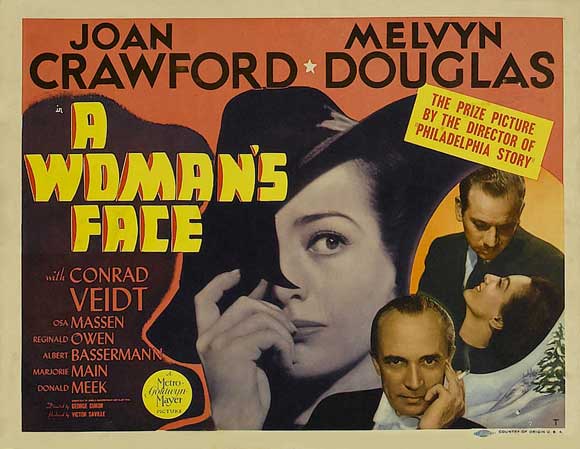
When we decided to view Joan Crawford's movies, A Woman's Face
(1941) was one of the movies I was most looking forward to seeing with
my friends. A totally underrated movie, with a beautiful, understated
performance by Ms. Crawford, I was sure everyone would love it. And they
did.
Joan plays Anna Holm, a young woman who works as a blackmailer,
and who was horribly scarred as a child. During one of her blackmail
missions, she encounters Dr. Gustav Segert
(Melvyn Douglas), a plastic surgeon with a remarkable record of
successes. Fascinated by Anna's scars, he offers to attempt a series of
surgeries that will possibly correct the damage. Anna consents; she
had recently met Torsten Barring (Conrad
Veidt), and hopes to be part of his life, scar-free. Unbeknownst to her,
Barring is far more interested in luring her into a murder plot, a murder that
would leave him the heir to millions.
Crawford
is just perfect in this role. Her acting is subtle; watch her
reactions to fire (Anna is terrified of fire), her mannerisms before
and after her surgery, and the restrained but definite reactions that
we see in her eyes as she reacts to a variety of frightening and
horrifying issues. Also magnificent is the always wonderful Conrad
Veidt. Veidt began his career in the silent cinema of his native
Germany, and generally played the hero. In the 1930s, he managed to
alienate the Nazis (he loathed Hitler and everything Hitler stood for),
and escape to England (where he became a citizen). Of course, his
career in American movies generally cast him as either a villain (as
here) or a Nazi (as in his most famous performance - Major Strasser in Casablanca).
While we know at the start that there is something a tad slimy about
Barring, we are able to watch Veidt construct a maniac before our eyes.
We watch as his insanity is more clearly and definitely revealed with
each passing scene.
Finally, we wanted to say a word about Richard Nichols as Lars-Erik. Nichols did not have a long career, but we've seen him in several films (most notably Kitty Foyle and All This and Heaven, Too).
Nichols has a rather childlike speech pattern that is hard to miss, but
he is SO much the little boy in this movie (and in everything he does),
that it is hard to remember he IS an actor. Witness Lars-Erik bouncing
around on a cable car, and then looking back to see if he will be
scolded for doing something so dangerous. So totally 5 year old boy!!
And with a sense of tension ably supplied by the astute direction of
George Cukor! We hope you will give this one a try. We think it is worth a viewing, especially if you've not seen it before. Here's a brief scene to give you a glimpse of the film: