Showing posts with label Van Heflin. Show all posts

Monday, November 12, 2018

Gramercy Park Barbara

Jessica (Barbara Stanwyck) and Brandon Bourne (James Mason) appear to be a successful, happily married couple. They dine weekly with Jessie's mother Nora Kernan (Gale Sondergaard), who shows deep affection for her son-in-law. They live in a lovely Gramercy Park apartment. But, there marriage was threatened some years ago when Brandon had an affair with Isabel Lorrison (Ava Gardner). Her departure helped repair their marriage; however, Isabel has just returned to New York, and she wants Bran back. Our film for this week is East Side, West Side (1949)

Before I begin discussing the film itself, I wanted to comment on the "East Side" setting. One of my favorite places in the world is Gramercy Park. For those of you not from NYC, Gramercy Park is a small region in Manhattan; it encompasses an area from 19th Street to 21st Street, and from Third Avenue to Park Avenue South. In its center is the actual Park, a private garden available only to residents. Centered in the Park is a statue to Edwin Booth; across the street is The Players' Club, which Mr. Booth founded in 1888. Among the inhabitants of the area were James Cagney (who lived at #34), Gregory Peck (you can see him walking in the Park in A Conversation with Gregory Peck), and Margaret Hamilton; John Garfield died in #3. The home in which the Bournes reside is #36 (right next door to James Cagney!) and was my personal dream apartment. Now, there is no way that Jessica can see the river, even from the top floor of the east face of the building (Stuyvesant Town would be in the way), but it's still an impressive residence.
It goes without saying that Ms. Stanwyck is impressive as Jessica. Though Jessie is quiet, Ms. Stanwyck makes sure she is not passive. Jessie is determined that her marriage will survive (her parents' marriage was tumultuous, and it had a toll on their daughter), but neither is she a doormat. She has made it clear to her husband that she won't tolerate his philandering any longer. Though she has suspicions at times, she is willing to trust to a point that he is keeping his word. Ms. Stanwyck makes her pain evident, but also shows us Jessica's strengths - especially when she finally confronts her chief nemesis, Isabel (for an interesting discussion of the scene, please visit this review by Jeanine Basinger in The New York Review of Books. It includes a review of  Ava Gardner: The Secret Conversations, by Peter Evans and Ava Gardner in which Ms. Gardner alleges an affair with Ms. Stanwyck's husband, Robert Taylor).
None of us are huge James Mason fans; though he is at his best when there is something a bit shady about the character. This film is no exception. Mr. Mason has no problem with making Bran distasteful and weak; the result however is that you know pretty quickly that he is not a fit husband for anyone, much less the caring Jessica. His interactions with Rosa Senta (Cyd Charisse, in a rare dramatic role) cut immediately to the chase. He flirts, she puts him down, saying "If I were your wife, I'd cut your heart out!" The audience totally understands her reaction; we don't even need to know that Isabel can summon him with a flick of her little finger to understand that he is spineless.
Conversely, Van Heflin as Mark Dwyer is excellent and immediately likeable. Sure, he falls for Jessica a bit too fast (but it is only an 108 minute film!) and he doesn't appreciate Rosa's affection for him, but he's a good man who has little use for Bran, and is upfront in his relations with the women in his life. Mr. Heflin, in his third appearance with Ms. Stanwyck (they had already appeared together in B.F.'s Daughter and The Strange Love of Martha Ivers) , shows an easy relationship with his co-star. There is an equality and regard in their relationship that (appropriately) is not present with Mr. Mason.

Part of the reason that Mr. Heflin's character is so attractive is the regard with which he is held by Rosa Senta. She's loved him since childhood, but she is also a woman with a regard for herself. She won't accept him as a second choice. His honesty towards her; her response to their conversations make both characters attractive.
Let's also acknowledge that the women in this film are remarkable for their solidarity. Sure, Isabel and Felice Backett (aka "The Amazon", played by Beverly Michaels) are heinous people, but the interactions that Jessie has with Helen Lee (Nancy Davis) and Rosa, and the love that Nora has for her daughter demonstrate that not every female discussion results in a catfight. These women are protective of Jessie. Ms. Davis, (in her first screen role; she was on the set of this film when she met her future husband, Ronald Reagan), says it best, when she decries the belief "that [women] aren't capable of affection for one another and honest friendship." Rosa, Nora, and Helen show the depth of female friendships. (TCM article)

Beverly Michaels was also appearing on the big screen for the first time. She was married to the film's producer Voldemar Vetluguin at the time (the marriage would end in 1952). She only appeared in 11 films (3 of them uncredited), but she's quite good in this small but memorable role. After her divorce, she married again, to screenwriter/director Russell Rouse. They were married for over 30 years, until his death, and had two children (their son Christopher is an editor). She died in 2007, at the age of 78, by which time she had become something of a cult figure as a noir-ish bad girl.
As is often the case, Mr. Mason and Ms. Stanwyck were not the first choices for the Bournes - Fred MacMurray and Claudette Colbert were the considered first. This would also be Gale Sondergaard's final film for 20 years - she and her husband Herbert Biberman were blacklisted; they moved to New York City where she was able to get work on Broadway. Finally, in 1969, she returned to the big and small screen (AFI catalog) with the film Slaves (directed by her husband) and the TV show It Takes a Thief.

We'll leave you with the trailer to this excellent film.

Monday, December 18, 2017

Robert is Eager

Johnny Eager (1941) (Robert Taylor), having served his time in prison, has been released on parole. He's working as a cabbie, and regularly visits his parole officer, Mr. Verne (Henry O'Neil), who firmly believes Johnny is on the straight and narrow. But Johnny has no intention of going straight, and uses his cousin Peg Fowler (Connie Gilchrist) and her daughter Matilda (Robin Raymond) as cover against discovery that's he's trying to open a dog track.  The venture is being held up, however, by D.A. John Benson Farrell (Edward Arnold). Johnny sees a way out when he meets Lisbeth Bard (Lana Turner), Farrell's much loved stepdaughter; her growing love for Johnny presents an opportunity to get the D.A. off Johnny's conniving back.

Johnny Eager is an engaging and entertaining film, primarily because of Robert Taylor's excellent portrayal.  He plays Johnny as a man on a journey to humanity.  At the beginning, Johnny is an actor, convincing one side that he is an upright citizen, and convincing the other that he is a heartless villain. The reality is somewhere in the middle, though Johnny himself considers he is the villain. Yet, early on, when he sends Garnet (Patricia Dane) away because he is not interested in her any longer, there is a kindness in his manner. Sure, he's setting her up for a fall, but he is genuinely trying to make it as painless as possible. He believes (and makes the audience believe) that he will return to Garnet once his fling with Lisabeth is over.  Taylor's genuineness makes him persuasive.
Van Heflin as Jeff Hartnett, Johnny's alcoholic best friend, won an Oscar for this portrayal. A decent actor, we still were not convinced that the performance was worthy of an Oscar. Still, in looking at the competition, which included William Bendix in Wake Island, Walter Huston in Yankee Doodle Dandy,  Frank Morgan in Tortilla Flat, and Henry Travers in Mrs. Miniver, we didn't strongly feel that there was a worthier performance among the nominees (though it was a mystery as to why Claude Rains wasn't nominated for Now, Voyager). Regardless, Mr. Heflin does a good job with a character who is hard to make engaging. Jeff is a weakling, and while his affection for Johnny is obvious, his willingness to tolerate Johnny's actions when he clearly believes them wrong, makes Jeff a character who is more despicable than the sociopathic Johnny. Mr. Heflin would later call this his favorite role (AFI catalog).
The film depends very much on the chemistry between Mr. Taylor and Ms. Turner (or TnT as they were called in the ad below). It certainly is there, but the idea of Ms. Turner's Lisabeth as a student social worker is a bit of a stretch.  According to this TCM article, the romance between the two stars was real (though Ms. Turner denied an actual affair). Mr. Taylor allegedly told his wife, Barbara Stanwyck that he was in love with Ms. Turner, but Ms. Turner broke up the relationship before an actual divorce took place.

We especially enjoyed a brief appearance by Glenda Farrell as Johnny's ex-girlfriend Mae Blythe. Now happily married, Mae comes to Johnny to request that Johnny use his influence to get her husband, a beat cop, a better assignment. We know what Mae does not, that it was Johnny who had her husband shipped to the boonies. Ms. Farrell takes the small role, and makes it quite memorable.
The New York Times review was positive; the Lux Radio Theatre would reprise the film in 1946, with Mr. Taylor and Mr. Heflin repeating their films, and Susan Peters subbing for Lana Turner.  We'll leave you with a scene featuring TnT together.

Wednesday, December 7, 2016

Barbara is Strange

On a rainy night, Sam Masterson (Darryl Hickman) meets Martha Smith (Janis Wilson) at the train yard in Iverstown, as they try to escape from the town and all it represents.  Orphaned Martha despises her guardian - her Aunt Ivers (Judith Anderson), the town's doyen and tyrant.  The feeling is mutual - Martha's father was a millhand in Miss Ivers mill; upon his death, Miss Ivers grudgingly adopted her sister's child, and forced her to take the name of Ivers, hoping to obliterate all evidence of his existence.  Escape, however, proves futile for Martha; with the police force on alert, Martha (and her beloved cat) are apprehended and returned to the not-so-tender mercies of her Aunt.  Undeterred, Martha attempts to escape again, but the consequences of the attempt are such that they will haunt Martha for the rest of her life.

Thus begins The Strange Love of Martha Ivers (1946), a film noir classic starring Barbara Stanwyck as the adult Martha, Van Heflin as the grown Sam, and Kirk Douglas (Walter O'Neill), appearing in his first film role. To say that this is an odd picture is not meant as an insult.  The film is complicated and dense. As this New York Times review says, it is a film where all the characters' "sordid deeds are neatly pulled together like so many pieces in a jigsaw puzzle."

Several impressive performances contribute to the film's appeal.  Barbara Stanwyck, of course, is outstanding as Martha.  She plays a woman who wants freedom, but who has spent her entire life in one prison or another.  Does Martha really love Sam, or does she love the freedom that he represents?   Does her warped nature come from the cruelty she faced from her Aunt, or from the blackmail of Walter and his father?  And is she ultimately responsible for the two deaths in the film, or should others take the blame?  Regardless of the answers, we know that Martha has spent her life trying to atone for what she sees as her sins, by trying to make Iverstown and the factory less of the hell that it was when her Aunt was alive.
For Lizabeth Scott as Antonia 'Toni' Maracek, this was only her second film role.  Her character serves as an interesting contrast to Martha, light where she is dark, common, where Martha appears high tone, but, like Martha, she too is a prisoner.  Though Toni's prison is a real one - convicted of a crime she denies committing, she is on probation, but constantly facing the specter of jail.

Lizabeth Scott had a long and complicated life, but a relatively abbreviated career.  With 31 film and TV credits (between 1945 and 1972), she is best remembered for this film, Dead Reckoning, and Too Late for Tears, all film noir classics.  Her looks and her voice are reminiscent of Lauren Bacall, but she didn't really have the versatility of Bacall.  She started her career in the New York theatre; she was Tallulah Bankhead's understudy in the part of Sabina The Skin of Our Teeth (much to Ms. Bankhead's disgust. For more discussion on this, see the Wikipedia article on Ms. Scott)  She did eventually get to play Sabina - when Gladys George became ill.  This performance brought her to the attention of Hal Wallis, the producer of our film. Wallis wanted to bill his find with her name above the title, but Barbara Stanwyck objected (Hal Wallis: Producer to the Stars by Bernard F. Dick).  It didn't help.  The virtually unknown Scott still got third billing above the title (it has been alleged that Scott and Wallis were having an affair, or at the very least that Wallis was infatuated with her). 
Scott's troubles began in the 1950s.  Confidential Magazine published an article accusing her of being lesbian.  She sued; the trial ended with a mistrial.  Add in her growing stage fright, and her career was virtually over.  She tried singing; the attempt went nowhere.  So, she segued over to televsion, where she had a relatively decent career.  She also returned to college (at USC).  She married twice - both lasted less than a year; she was linked romantically with Burt Lancaster, James Mason, Helmut Dantine, and Burt Bacharach, among others.  She died in 2015 of congestive heart failure.  She was 92.   To hear more about Ms Scott, try this interview that was done in 1996. 
Kirk Douglas is outstanding in this role, which would be an unusual one for him.  Walter is a weakling, dominated by both his father and Martha.  His guilt and feelings of hopelessness lead him into alcoholism.  In this TCM article, Douglas relays his method for creating a character like Walter:  "when you play a weak character, find a moment when he's strong, and if you're playing a strong character, find a moment when he's weak. I had a moment when I was at the desk - I stood up, grabbed Van Heflin by the shirt, and stared him in the eye. He was amazed at this sudden moment of strength, and it confused him. We shot it, and the director said, 'Very good.' Van Heflin said, 'Let's do it again.' The next time I grabbed him, he just looked down contemptuously at my hand. How smart of him - he took away the strength. Nothing wrong with that. As an actor, it was the right thing to do."  His work was not unnoticed - this AFI Catalog entry notes that Louella Parsons was particularly taken with this "wonder boy."
Several child actors appear in the beginning of the film.  We were particularly intrigued with the performance of Janis Wilson.  Ms. Wilson had a notably short career; between 1942 and 1948, she appeared in only seven films, after which she left show business.  But when you realize that those films include Watch on the Rhine and Now Voyager (along with this film), she  had an impressive resume.  She was 18 when she retired - always a difficult age for teen actors.  Interestingly, she met her future husband (they married in 1955) when she was 12 years old (on the set of Now Voyager.)  She died in 2003. 


It's not surprising that Stanwyck's dresses are spectacular.  Her favorite designer, Edith Head, created them.  Ms. Head would later say that Stanwyck's long waist usually resulted in her costumes being dowdy looking, but Head found ways to camouflage her waist.  As a result, Stanwyck would often request Head design for her (even in private life).  See this review of Barbara Stanwyck: Steel-True, 1907-1940 for a brief discussion of their relationship. 

We leave you with the trailer for this fascinating film.  And we send advance birthday wishes to Kirk Douglas, who will reach 100 on December 9th:

Tuesday, March 15, 2016

Barbara Marries a Radical

Following their dynamic introduction in The Strange Love of Martha Ivers (1946), Van Heflin and Barbara Stanwyck reunite in B.F.'s Daughter (1948).  When Polly Fulton (Barbara Stanwyck), the daughter of wealthy industrialist  Barton F. Fulton (Charles Coburn) meets Thomas W. Brett (Van Heflin) in a speakeasy, the sparks fly.  Polly is almost engaged to Robert S. Tasmin, III (Richard Hart), an up-and-coming young lawyer who refuses to consider marriage until he has a stable income.  Tom Brett is an economist, who is earning extra cash by lecturing, and who's books have decried B.F.'s capitalist methods.  Despite this, the two fall in love and marry.  But once Tom starts to become successful, his relationship with Polly - and with her beloved father - begins to deteriorate.

While not the best Barbara Stanwyck movie ever made, this is an interesting and well acted film.  Based on the novel by John P. Marquand (the author of H.M. Pulham, Esquire and the creator of Mr. Moto), the story centers on the relationship between Polly and Tom, and less on that of Polly and B.F., as the title implies.  (This TCM article points out that the novel was much more of a political satire than the movie could ever include).  The film establishes immediately the loving relationship between father and daughter; the tensions between B.F. and Tom are more fodder for the problems of the newlyweds than an issue for B.F. and Polly.
When you have an actress as strong as Stanwyck in the part (according to this AFI catalog entry, Katharine Hepburn was also considered for Polly), some things become much easier.  Polly's need for something to keep her involved in her husband's life radiates from Stanwyck.  When Tom no longer needs her to help manage his career, she throws her passion into creating a home worthy for him (or one that SHE sees as worthy of him!).  As the war starts, a brief glimpse of Polly in a uniform immediately telegraphs her involvement in the home front efforts.  Stanwyck makes Polly a woman of action, rather than a passive onlooker.

Polly's finances become a recurring issue throughout the film.  Bob won't wed her because he will not live off her money (actually, B.F.'s money).  Thought Tom initially says that her money makes no difference to him - B.F. can continue to supply her with an allowance, since Tom doesn't want Polly to feel she cannot live the life to which she is accustomed - Tom reneges once he a success.  The house she builds - with her money - becomes symbolic of what he sees as his dependence on her.  A lovely desk, with a typewriter that mechanically hides under the surface becomes an irritant that Tom can't get past.  Helfin's Tom is a bit of a disappointment, though it isn't Heflin's fault.  He often seems petulant and inconstant.  He demands that Polly need him, but when she does, he just isn't available.  As a result, the character is more annoying than appealing.
The character that was perhaps the most puzzling was Martin Delwyn Ainsley (Keenan Wynn), a reporter who never seems to get much of anything right.  We learn of him almost immediately, when B.F. listens to Ainsley criticizing B.F. for ostensibly bringing on the Great Depression (the film opens in 1932) .  Polly meets Ainsley through Tom - of course, they are friends - and Ainsley is complicit in Polly's campaign to secretly get Tom a lucrative lecture tour.  Though Polly has worked with Ainsley and welcomed  him to her home, Ainsley betrays her confidence, and further fractures her already fragile marriage.  Late in the film, a series of radio broadcasts show Ainsley's ineptitude as a commentator - his grand predictions continually prove to be wrong; Tom also says that Ainsley never gets anything right.  If that is the case, is Tom wrong as well, since he has always held Ainsley in such high regard?  It gives one pause.
We were all very impressed with the wonderful Margaret Lindsay as Polly's best friend, "Apples" Sandler.  "Apples" (she has no real first name) is a loyal friend, a loving wife, and a smart, practical human being.  She hasn't a mean or jealous bone in her body, and Lindsay plays her as a stalwart.  Her love for Bob is true and deep, though she has an awareness of his regard for her.  Ultimately, she is the one with the stable marriage, because she accepts Bob for who he is.  A wonderful actress, who worked steadily in the 1930s and 1940s, Lindsay is probably best remembered as Henry Fonda's Northern bride in Jezebel (1938).  She also appeared as Kay Francis' gambler-daughter in The House on 56th Street (1933) and as Olivia de Havilland's nasty aunt in Gold is Where You Find It (1938).  By the 1950s, Lindsay was finding film work harder to come by, so she segwayed into episodic television.  Never married, she had a partner, actress Mary McCarty.  Lindsay died in 1981, aged 70.
Repeating her role as Stanwyck's mother is Spring Byington (Gladys Fulton), again playing (as she had in Meet John Doe) a gentle soul the total opposite of her assertive daughter.  We get a brief glimpse of Marshall Thompson as a young sailor, and Barbara Laage (who would later appear in The Happy Road with Gene Kelly) is Eugenia Taris.

This New York Times review was not enamored of the film, and we did think that the ending felt abrupt and hastily slapped together.  That being said, it's a good movie, with some excellent acting, and definitely worth seeing.  We'll leave you with an early scene, with the Fulton family.

Thursday, April 10, 2014

Shane Comes Back

For those of you who read Entertainment Weekly, you might have had the pleasure recently to read an excerpt of Mark Harris' new book Five Came Back: A Story of Hollywood and the Second World War.  The book focuses on five directors: John Ford, Frank Capra, George Stevens, John Huston, and William Wyler, all of whom served in the military during WWII, and all of whom were involved in film-making within the armed services.  Their war experiences, not surprisingly, colored their post-war films, and this book looks in detail at their work during and after the war.   In conjunction with the book's release, AFI Silver featured a screening of the 1953 Shane, one of director George Steven's post-war films.  

Shane features an all-star cast: Alan Ladd as the title character, a gunfighter who is trying to escape his past; Van Heflin as Joe Starrett, Jean Arthur  as his wife Marian Starrett, and Brandon de Wilde as Joey Starrett, a family trying to create a home on the frontier; and Jack Palance (here listed as Walter Jack Palance) as Jack Wilson, the gunfighter who is trying to drive them off their land. It's a fairly simple film: the Starett family is trying to build a farm on the prairie, much to the disgust of Rufus Ryker (Emile Meyer) a cattleman who claims rights to the whole valley.  The lives of the Staretts and all the settlers have been made miserable as Ryker attempts to run them off.  Enter the loner, Shane, who attempts to restart his life by working for Joe as a handyman.  But given the environment, Shane soon finds that the only way he can help the family he has come to love is to return to his old occupation.
Interestingly, Ladd and Heflin were not the first choices for Shane and Joe.  Montgomery Clift and William Holden were the first choice of director Stevens for the roles of Shane and Starrett.  When they were unavailable, Stevens selected Ladd and Heflin who were under contract to Paramount. This article from TCM discusses some of the studio's attitudes towards the film.

Stevens was able to coax Jean Arthur (with whom he had worked on The More the Merrier) out of retirement for this, her final film role.  Ms. Arthur is quite wonderful as Marian, a strong woman who loves her husband, but who is also attracted to the stranger in their midst.  The scene in which she tries to decide what dress to wear - all but her wedding dress are work clothes - as Shane talks to Joey outside, is gently amusing and poignant.  

Shane is shot in Technicolor, and while it's not a widescreen film, it has an exquisite use of color and vistas.  The film emphasizes the size of the country through the use of widescreen shots.  This serves to elaborate on the greed of Ryker, who desires so much land in an area that is so vast it surely could hold a few more people.  Yet Ryker is given time to explain his need for the land.  In fact, all of the characters are allowed an opportunity to explain their feelings about the range dispute, leaving us, the audience, to decide who is in the right.
And there are quite a few characters: Elisha Cook, Jr., as Stonewall Torrey, a former Confederate soldier with a bad temper and a deep thirst; Ben Johnson as Chris Calloway, a ranch hand for Ryker who starts the film as Shane's adversary, but who ends as his friend; Edgar Buchanan as Fred Lewis, another of the settlers who fears the effects of Ryker's wrath.  We also have two familiar female faces in this group: Nancy Culp (Mrs. Howells) and Ellen Corby (Liz Torrey) have brief moments as settlers' wives.

Ultimately, though, Shane is a love story between a grown man and a little boy, and Brandon de Wilde as the hero-worshiping Joey turns in a wonderful performance.  There is a real rapport between him and Ladd, and their chemistry gives the film its strength.  Sadly, after a career in which he appeared in films such as The Member of the Wedding, All Fall Down, and Hud, de Wilde died in a traffic accident at the age of 30.

We leave you with a clip from Shane, in which the title character demonstrates the proper use of a revolver to young Joey.  One thing to notice is the loudness of the gunfire - director Stevens purposely made the gunshots extra loud: "a gun is a tool," Shane tells us.  But in a sense, it is a tool that destroys lives.


Friday, June 7, 2013

Kay Edits a Book

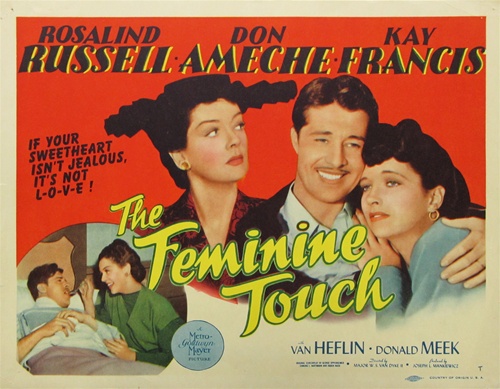
At its best, screwball comedy is a wonderful thing.  It is a manic, charming, delightful walk into the wacky world of a person who lives very much in an alternate universe.  The Feminine Touch (1941) does NOT fall into this category.  The film features Rosalind Russell as Julie Hathaway, the wife of  Prof. John Hathaway (Don Ameche), a college professor who despises jealousy as a worthless emotion, and who has decided to ditch his university job and write a book on the subject.  Enter Nellie Woods (Kay Francis), the editor for publisher Elliott Morgan (Van Heflin).  Elliott's not very involved in his business - Nellie does all the work in the publishing house, as her boss is too busy pursuing the high life and women.  Unfortunately, Nellie is also in love with Elliott, and sees this book as an opportunity to force Elliott into paying some attention to her.  Elliott, of course, is much more interested in wooing Julie.  Julie's problem is that while she is not the least bit interested in Van, she is dismayed that John doesn't care that another man is trying to seduce her.

While the film has some amusing moments, primarily it is just annoying.  We're presented with a number of characters who are just, quite frankly, stupid.  Nellie is the only one with any brains.  And Elliott, besides being an idiot, is a pest.  You spend most of the movie wanting to smack him.  It is amazing how long it takes him to realize that Julie is not  interested in anyone but her husband.  Plus, Heflin, usually such a disciplined actor, here is hugely overacting. He spends much of the movie distorting his face, to no real purpose. 
Russell and Ameche are similarly annoying.  She is overacting; he is just being smug.  Worse still, there is NO chemistry between the two of them.  Perhaps that's why this is their only film together.  Though, given that both are excellent actors when given a decent script, one would have liked to have seen them together in a more sympathetic venue.  With the writing talent (George Oppenheimer and Ogden Nash, specifically) and the producer (Joseph L. Mankiewicz) of the film also people's who work we admire, we were surprised that the script wasn't sharper. As it is, it just seems to go on forever.  Even the final scene seems gratuitous.

We did enjoy, as New Yorkers all, the scenes of New York City, specifically the depiction of the subways.  (We remember the old rattan seats and the overhead straps, which gave NYers the name "straphangers".  Actually, one of us - the short one - misses those straps!).  In spite of everything,  Kay Francis is really quite good.  As always, she gets great clothing - her hats, especially, are something to be seen.  We suspected the costumers wanted to look a bit avant garde and daring - they do succeed.  Her character, as we said, is the only one with a brain - she is running the company, and we suspect, will continue to run it.  Ms. Francis is the breath of fresh air in the middle of chaos.

We should note that, according to this article from TCM, The Feminine Touch was actually quite well received when it was released, so you may want to judge for yourself whether it is a hit or a miss.  To get you started, here is a trailer:  

Monday, January 31, 2011

Joan Enters the Asylum

After her wonderful role in Humoresque, Crawford got an equally interesting part in Warner Brother's Possessed.  Crawford plays private nurse Louise Howell, who has fallen passionately in love with David Sutton (Van Heflin).  David, as we grow to learn, is a total bounder - a "love 'em and leave 'em" cad who enjoys the chase, and is immediately bored once he wins his prey.  Bored now with Louise, he has informed her of his disinterest in commitment.  She however, has become obsessed with David, and is badly damaged by his rejection; damage that will eventually spiral her downwards into madness.

The opening scene of this picture is fascinating.  We see Crawford wandering alone down what is obviously Los Angeles city streets. First is the shock of actually seeing the city of Los Angeles (and not the WB back lot) in a picture.  Second is the surprise of seeing Crawford without a drop of makeup on her face! Actually, the beauty of her face is even more evident plain as it is.  She was a stunning woman, without the overdrawn lips and arched eyebrows!  And here, is that very scene:


The film begins after Louise has suffered a severe mental breakdown.  Her story is told in flashback, as her psychiatrist (Stanley Ridges) attempts to ferret out the reason for her illness.  
 
We found the character of David Sutton to be totally reprehensible.   It is hard to discuss, as I'm loathe to give away the ending of the picture for anyone who has not seen it (and we heartily suggest that you see it. You will not be disappointed), but David is not content with destroying Louise, he has another victim in his sights, and Louise is perhaps the only one who understands what he is about to do.  Van Heflin does an excellent job of making David loathsome, yet, we can still understand why women would be attracted to this snake-in-the-grass.  Raymond Massey's Dean Graham is also an interesting portrayal.  Graham, too, has been battered by life, but has an inate strength that will serve those around him well.

Most of the film is told from Louise's point-of-view. We are, after all, hearing her story as told to her doctor.  However, the POV work is fascinating, as we actually SEE her mind breaking down.  We see her hallucinations; as  a result, we are often not sure what is real and what is not.  Which makes for an even more interesting and intense story.  Crawford is wonderful in showing us the confusion in Louise; she makes us care about this woman and appreciate her pain.

Next time, more from Crawford's Warner Brother's years.