Showing posts with label George Cukor. Show all posts

Monday, July 19, 2021

Spencer Interviews Katharine

The sudden death of American war hero and businessman Robert Forrest throws the country into a tailspin. Steven O'Malley (Spencer Tracy), a journalist who recently returned from war-torn Europe, is one of Forrest's many admirers, and has decided to write a book about the great man.  He seeks the assistance of Forrest's wife, Christine (Katharine Hepburn); she initially tries to keep her distance, then consents to assist in the biography.  Steven, however, finds her reticence concerning as she attempts to be the Keeper of the Flame (1942).

As we enter the world of Keeper of the Flame, it seems we are being introduced to a mystery - who killed Robert Forrest? In a sense we are in the middle of a mystery, but it isn’t the one we think it is. The tension of the story is enhanced by the excellent performances throughout the film, ably led by the two leads. The chemistry between Tracy and Hepburn is apparent in the film, and is a contributor to the power of the movie  

Over the objections of screenwriter Donald Ogden Stewart, Ms. Hepburn insisted on changes to the script that strengthened the romance between Christine and Steven (TCM article). This sometimes gives the film a feeling of Rebecca-ish gloom, with the imposing Forrest estate as the stand-in for Manderley. It also gives more opportunity for Tracy and Hepburn to interact, which, frankly, is one of the main pleasures of the film.  One looks forward to seeing them spar.

Audrey Christie is excellent as Steven's friend and fellow reporter, Jane Harding.  The part is relatively small but memorable.  This was Ms. Christie's first film, and her casting was recommended by Katharine Hepburn (AFI Catalog).  Ms. Christie had been appearing on Broadway since 1933, and Ms. Hepburn and Ms. Christie would appear together in the 1942 production of Without Love (which Ms. Hepburn brought to the screen in 1945). Audrey Christie would continue on Broadway, film and television until 1982. She's probably most remembered today for her performance as Mrs. Loomis (Natalie Wood's mother) in Splendor in the Grass (1961). Married once, with one son, Ms. Christie died in 1989 (three years after her husband) of emphysema. 

We were not as impressed with Richard Whorf, Robert Forrest's personal secretary Clive Kerndon. Mr. Whorf plays the character as a fanatic, yet the information that we learn about him is that he is a tool of more powerful men.  That his fanaticism is telegraphed the minute we meet Kerndon is unfortunate; a gradual building of suspicion towards the character might have been more effective. As an aside, the same year he appeared in this film, he was also in Yankee Doodle Dandy as Sam Harris.

There are so many good performances in the film, it's hard to go into detail in this small space. But, mention should be made of Howard da Silva as Jason Rickards, Forrest's surly gatekeeper and fellow war veteran. Though we get no details about his life, we quickly realize that he is perhaps the person who knew Forrest the best. 

Margaret Wycherly has a small part as Forrest's insane mother. Stephen McNally (here listed as Horace) is fellow reporter Freddie Ridges, who has eyes for Jane Harding. Forrest Tucker plays Christine cousin Geoffrey Midford, who might be involved in Forrest's death. Darryl Hickman is guilt-ridden Jeb Rickards, who holds himself responsible for Forrest's death.  And we can't forget to mention Donald Meek as innkeeper Mr. Arbuthnot and Percy Kilbride as cabbie Orion Peabody. 

The production design is a very powerful element in the film. As we mentioned before, the house is almost oppressive in its elegance. The windowless stone fort that Forrest used as an office signals the sinister nature of his activities. The portrait of Forrest dominates the house, yet upon his death, no photos are included in the newspapers.  Our only image is a stylized painting of the great man.

Keeper of the Flame received an enthusiastic review by Bosley Crowther in New York Times, calling it "a courageous and timely drama which touches frankly upon a phase of American life that is most serious and pertinent today."  It opened at Radio City Music Hall, and was held over for several weeks, but ultimately it was not a top grosser for MGM (Variety), and is considered the least effective of the Tracy/Hepburn film. Perhaps the darkness was too much for people. 

In the final analysis, this is a good film that is discussing a still (sadly) timely issue. It may be a bit preachy at times, but tells its story well. Here's a trailer:


Monday, April 2, 2018

Ronald Goes Mad


Anthony John (Ronald Colman) is a highly regarded Broadway actor, and while there is no debate on his talent, attitudes towards him as a person differ drastically. Mr. John has a problem - he totally inhabits his current role. As his ex-wife, Brita (Signe Hasso) says "when he's doing something gay...it's wonderful to be with him, but when he gets going on one of those deep numbers... We were engaged during Oscar Wilde, broke it off during O'Neill, married during Kaufman and Hart, divorced during Chekov." Despite this, Tony's producer is encouraging him to tackle Othello, a part he longs to do, but which also terrifies him for its intensity of emotion. A Double Life (1947) is our film this week.

Ronald Colman won a well-deserved Oscar as best actor for his performance in this movie. (His competition was: John Garfield, Body And Soul; Gregory Peck, Gentleman's Agreement; William Powell Life With Father; Michael Redgrave, Mourning Becomes Electra) He was originally reluctant to play the part - the part was first intended for Laurence Olivier - but persuasion from director George Cukor and screenwriters Ruth Gordon and Garson Kanin convinced Mr. Colman to take on the role and the Shakespearean text that went with it. (TCM article). They were certainly right; Colman's experience on the stage stood him in good stead, and he is an impressive Othello. You would never guess he was uncomfortable with the text; his portrayal is crisp and magisterial.

Considered a film noir, A Double Life also has moments that call to mind the horror genre. The scenes of Tony's descent into madness could rival the Hammer films of the time, with the use of unseen voices echoing from Tony's weakened mind. And is it any wonder that Tony has become unhinged - by the middle of the film, we learn that he has appeared in the play for over two years - 300 performances, of 8 performances a week?  It's amazing he didn't lose it after a year of doing what is probably considered one of Shakespeare's most intense and demanding roles (today, most actors leave their show at the end of one year). We did wonder if part of the screenwriters were (on some levels) mocking The Method, in the form of an actor who too deeply submerges himself into the character he portrays.
Both Signe Hasso and Shelley Winters (as Pat Kroll) are very good in their parts, though in many regards, the characters are there to counterpoint one another. Ms. Hasso is the dutiful wife (yes, they are divorced, but it is clear that she still considers Tony to be her husband) and Ms. Winters is the local slut. Ms. Hasso is very good as a woman torn between her love for a man, and her fear of  his increasing instability and violence.

I have to admit to a certain bias against Ms. Winters, who I consider to be an over-actor of the first order (that being said, her predilection for over-emoting worked beautifully in A Patch of Blue (1965), probably her best performance). But she is good in this role; you do find yourself sympathizing with her in what would prove to be her breakthrough role (AFI Catalog). Director Cukor badly wanted her for the part; in order to relax her, he filmed a rehearsal without her knowledge and used that as her screen test.
There is one decidedly problematic character, and that is Bill Friend (Edmund O'Brien). Bill is the publicity agent for Tony, he also has a crush on Brita and cannot understand why she does not reciprocate his feelings. Later in the film (spoiler here), Bill works with a reporter to label a killing as "the kiss of death" murder as publicity for Tony's production of Othello. He KNOWS Tony will object, that Tony will find such publicity tacky and distasteful. Yet Bill is seemingly surprised when Tony blows his stack and fires Bill. Bill's immediate reaction - Tony is involved in the murder. As Bill tries to involve the police in his newly blossomed theory, he is asked if there is any ulterior motives to his belief. He says no, though Mr. O'Brien provides a slight reaction, demonstrating that Bill is quite aware that he has a definite bias against Tony. It's really hard at this point to have any sympathy for Bill; the irony of his last name is apparent.
A very young Betsy Blair makes an appearance as The Girl in the Wig Shop, a young woman eager for a stage career - so focused that she is willing to change anything about herself to get a job impersonating Pat Kroll. The Girl presents a counterpoint to Tony - he becomes the part without choice, while she willingly subsumes herself for a chance at fame.

Though not as widely known as it should be, A Double Life has come up in recent commentaries. For example,  the New York State Writers Association at SUNY provides this fascinating examination of the picture within the tradition of Film Noir. They note the moody atmosphere created by cinematographer Milton Krasner - as well as the horror roots of production studio Universal. And this L.A. Times article released in 2014 after the premiere of Birdman finds a remarkable similarity between the two films, as they concentrate on stage actors becoming immersed in their roles.
George Cukor and Ruth Gordon/Garson Kanin formed a partnership with this film - the first of seven collaborations, including Adam's Rib, Born Yesterday, and Pat and Mike. Mr. Colman was convinced to take on the role as one that would result in an Oscar - and George Cukor kept his promise, campaigning hard to get Mr. Colman the award. Mr. Colman would only make three more films after this, turning his attention to radio and then television in The Halls of Ivy, with his wife Benita Hume. The New York Times review was glowing in its praise, not only for the film, but for Mr. Colman, saying it was "the role of his lengthy career." Despite Mr. Colman's fears, the Times was impressed by his portrayal of Othello. 

This is a fascinating film, well worth your viewing. We'll leave you with this trailer.

Monday, March 12, 2018

Katharine's Getting Married


It's been two years since Tracy Samantha Lord Haven (Katharine Hepburn) divorced her husband, C.K. Dexter Haven (Cary Grant) and Tracy is about to remarry. Her fiance is George Kittredge (John Howard), an up-and-comer who is completely different from the wealthy Dexter. Tracy, however, is not happy. She seethes with resentment towards Dexter, and towards her father, Seth Lord (John Halliday), who has been cavorting with a dancer in New York City. So, when Dexter shows up the day before her wedding with two reporters from the scandal sheet "Spy Magazine" in tow, Tracy is ready to give Macaulay Connor (James Stewart) and Elizabeth Imbrie (Ruth Hussey) the ride of their lives.

TCM Presents for February was the delightful The Philadelphia Story (1940). Katharine Hepburn is perfection as the intolerant Tracy, a woman of strict principle who finds herself torn among 3 men on the eve of her wedding. She never misses a step as Tracy discovers the true meaning of love as her inhibitions fall away.

Katharine Hepburn came to Hollywood to star in A Bill of Divorcement (1932) with John Barrymore. Two years later, she won her first (of four) Oscars for Morning Glory.  But, by 1938, with her films not doing well, she bought out her contract, and departed from Hollywood (after she was included in a list of actors termed Box Office Poison), Ms. Hepburn returned to New York, where she appeared in the Broadway production of The Philadelphia Story, a play which had been written by Philip Barry with her in mind. The play was a huge hit (it ran for 417 performances in New York, then opened on National Tour). All the major studios wanted it, but there was a catch. With the help of her friend Howard Hughes, Ms. Hepburn had purchased the rights to the play. No film would be made without her in the lead, and without her approval of her leading men. MGM bit the bullet, and bought the film, hired Philip Barry to write the screenplay, and (with Ms. Hepburn's approval) hired Cary Grant to play Dexter (even with his high salary demands and insistence on top billing!) This Philadelphia Magazine article  has more behind-the-scenes information on the production. For more on Ms. Hepburn's fascinating life and career, check out her autobiography Me, and the authorized biography that was published just after her death, Kate Remembered by A Scott Berg.
James Stewart is equally good as the angry young man who disrupts Tracy's life, a part that Ms. Hepburn intended for Spencer Tracy (they had not yet met). Mr. Stewart brings both a swagger and sass to Macauley Connor. He begins by resenting Tracy and all she represents, but ends deeply infatuated with her. Mr. Stewart would win his only Best Actor Oscar for his work in this film. His scenes with all three of his co-stars crackle with energy.

Cary Grant, however, was NOT nominated for his role as Dexter. Why will always be a mystery to me. He is wonderful (as always) in a part that Ms. Hepburn intended for Clark Gable. She asked Mr. Grant to appear when Gable was unavailable, and he agreed - provided he got top billing and a salary of $137,000 (which was given to British War Relief) (TCM article). As with their three prior parings (Sylvia Scarlet (1935), Holiday (1938), and Bringing Up Baby(1938)), their interplay is dynamic. There is an ease in their conversations that make them all the more real. Mr. Grant is equally adept at sparring with Mr. Stewart. And his scenes with Virginia Weidler (as Tracy's younger sister Dinah Lord) are a pleasure to watch.
The other nominated actor in the film is the always excellent Ruth Hussey (best supporting actress). If you have never encountered Ms. Hussey, treat yourself with this film or with The Uninvited (1944). There is a world-weariness to Liz, but it has not eliminated her hope for a future with Mike. Ms. Hussey began her career in Providence, RI as a radio commentator.  She eventually moved to New York where she modeled, and found jobs with theatrical touring companies. That got her an MGM contract, where she appeared films such as The Women (1939), Another Thin Man (1939), and H.M. Pulham, Esq (1941). She also appeared on Broadway in State of the Union (in the role Katharine Hepburn would play on film), and Goodbye, My Fancy (Joan Crawford's movie outing). Ms. Hussey appeared on radio and television as well until her retirement in 1973. She was married for 60 years to talent agent Bob Longenecker until his death in 2002; the couple had three children. She died in 2005, following an appendectomy, at the age of 93.

Donald Ogden Stewart won an Oscar for adapted screenplay, and director George Cukor was nominated. The film is listed as #44 in the100 Years, 100 Movies, 10th Anniversary Edition (interestingly, the rating went up from the original list, where it appeared at #51). It's also #44 on the 100 Years, 100 Passions list. In 1995, it was added to the National Film Registry.

The Lux Radio Theatre adapted the film twice: in July, 1942, with the original cast, and in June, 1943 with Robert Taylor, Robert Young, and Loretta Young. (AFI catalog). It would be remade as the musical High Society in 1956, starring Gracy Kelly, Bing Crosby, Frank Sinatra, and Celeste Holm, with glorious music by Cole Porter.  The New York Times review was glowing when the film opened at Radio City Music Hall, and quite honestly, what's not to love. We'll leave you with the trailer to this outstanding film:

Sunday, April 7, 2013

Connie Marries the Elite

This week, we again join Constance Bennett in a precode film.  This one is Our Betters from 1933.  Connie is Lady Pearl Saunders Grayston.  We meet her as she has just married Lord Grayston (Alan Mowbray).  She is determined to be a good wife to him, though she is aware that their marriage was one of convenience - he needs her money to  support his lifestyle.  But Pearl finds almost immediately that her dreams of a life as a happy wife are naive.  Her husband has no intention of giving up his mistress.  

The film, taken from a play by W. Somerset Maugham,  produced by David O. Selznick, directed by George Cukor, and with music by Max Steiner is not a great one, but it is interesting.  Besides having some of the best behind-the-scenes talent in Hollywood, we have a fantastic performance by Bennett.  Her Pearl becomes a society hostess, but one who is jaded and cold. We also want to pay homage to the fantastic costuming of Hattie Carnegie - take a look at the stunning (and scandalous) black dress Ms. Bennett wears to a party - it's a knockout!

At one of her parties, we discover that she is planning to bring her sister, Bessie (Anita Louise) into the same lifestyle, by arranging her marriage to Lord Harry Bleane (Hugh Sinclair).  Though Bessie seems willing, it soon becomes clear that she really loves Fleming Harvey (Charles Starrett).  But everything begins to implode at a weekend outing to the Grayston estate, as we learn more about Pearl's rather seedy existence.  
 

Among the party guest are GIlbert Roland.  We enjoy him as an actor, but felt he was wasted here as the gigolo who pursues Pearl, but is involved with the wealthy Duchess Minnie.   We also discover that Pearl is essentially destitute, thanks to her husband's bad handling of her finances, so she is using her wiles to "borrow" money from Arthur Fenwick (Minor Watson).  

Much of our conversation focused on the bartering of American heiresses for English titles.  It is surprising that, in 1933 (this is a contemporary story), this was still going on.  We especially discussed the life of Consuelo Vanderbilt, who was literally imprisoned by her mother until she consented the Duke of Marlborough

Here is a clip from the film:

Sunday, March 31, 2013

Connie Becomes a Star

We'll be starting a number of Constance Bennett movies over the next few weeks.  The first is What Price Hollywood? (1932) in which Ms. Bennett plays would-be actress Mary Evans.  The film opens with an unseen woman looking through a magazine.  The ads show us just what the stars use to make themselves beautiful.  The woman who is looking at the magazine is using the stockings, and makeup that the ads recommend.  The camera pulls back to show a our heroine, who is living in a tiny apartment, with a Murphy bed.  No star she, just a simple waitress waiting for her big break.  

That night at work, she befriends director Max Carey (Lowell Sherman), a good man, but one with too large an affection for alcohol.  He reluctantly agrees to help Mary, but her stiffness and inexperience is evident; he decides to recast the role with someone else.  The next day, Mary convinces him to give her one more chance. And thus, America's Pal is born - Mary Evans becomes a star.

Certainly, this is so close to A Star is Born as to be the original source material for the 1937 Janet Gaynor film.  But, we understand from the TCM commentary, no credit was given by either this film, nor the Judy Garland film in 1954, to this lovely movie (the former was produced by David O. Selznick, and the latter was directed by George Cukor, the producer and director of this film).  For those of you familiar with the later films, take a look at this clip, which is very reminiscent of something that occurs in both of the later versions:


And a wonderful film it is!  Several scenes are especially worth mentioning.  The opening scene we described above is one.  Here is a clip from that, which contains a small tribute to the man who would become the King of Hollywood, Clark Gable:


Another, is the scene in which Mary, having been fired from her first acting job by Max, goes home and spends the night practicing her lines.  Ms. Bennett is just fabulous as she stubbornly attempts to master her craft. 

We should also tip our hat to the male lead for this film - Neil Hamilton, best known to a generation as Commissioner Gordon in the 1960's television show, Batman.  As children of the Batman generation, it was fun to see Mr. Hamilton in a totally different (and much younger) role.

Next week, another Connie Bennett film.

Monday, April 2, 2012

Garbo Coughs

1937's Camille, with Greta Garbo as the notorious Marguerite Gautier was the subject of our latest discussion.  Garbo, of course, is wonderful as the opportunistic courtesan who falls in love with the scion (Robert Taylor as Armand) of a well-to-do family.  While Marguerite resists the attentions of - and her feelings for - Armand, she finds herself desperately in love with him.  A summer alone with him convinces her that she can change to a simpler lifestyle, but the mores of the time interfere, and Marguerite is faced with a choice - stay with Armand, to his ruin, or leave him and break both their hearts.

Garbo is just remarkable here. Her silent era training is evident as she uses her face, her eyes and her body - rather than her voice, to show us Marguerite's physical deterioration.  She LOOKS sick - beautiful, but quite ill.  Yet she is not overstated or exaggerated.  She is the epitome of suffering, trying to summon her last ounce of strength to greet the man she chased away.

Also wonderful is Lionel Barrymore as Armand's father, Monsieur Duval.  Barrymore could play his character as a villain, but he does not.  Monsieur Duval is merely a loving father who dreads hurting a woman who seems to be very sweet, and very much in love with his son, but who will soon cause his downfall if they continue their relationship.  When one realizes that Barrymore is less than 2 years from being forced into a wheelchair for the rest of his life (he suffered from severe arthritis that prevented him from walking), one realizes that he is acting through his pain.

Robert Taylor, too, is excellent, with Armand's naivety shining from his youthful face.  Armand seems sometimes like a sex object - a lovely creature for Marguerite to adore.  Taylor fits that bill as well, but also is able to make you understand why Marguerite would give up everything to be with this lovely, gentle man.

This is a beautifully designed film as well, with magnificent costumes (by Adrian).  Our group had a bit of discussion on the tendency of some films to not quite get the hair style right for the period - which is NOT the case here.  The whole atmosphere of the film is perfection.  It is interesting to note that the silent version of the film is also available (on the DVD of Camille), with Rudolph Valentino as Armand and Nazimova as Marguerite.  It is certainly worth a look if only as a comparison to its magnificent remake.

Here is a trailer to the Garbo version:


Monday, December 13, 2010

Joan has Plastic Surgery

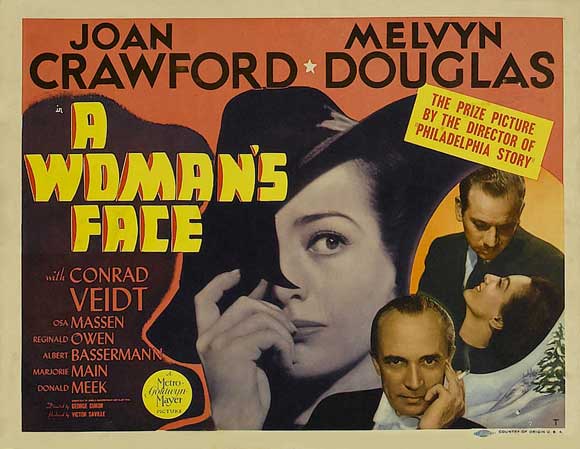
When we decided to view Joan Crawford's movies, A Woman's Face (1941) was one of the movies I was most looking forward to seeing with my friends. A totally underrated movie, with a beautiful, understated performance by Ms. Crawford, I was sure everyone would love it. And they did.  

Joan plays Anna Holm, a young woman who works as a blackmailer, and who was horribly scarred as a child.  During one of her blackmail missions, she encounters Dr. Gustav Segert (Melvyn Douglas), a plastic surgeon with a remarkable record of successes.  Fascinated by Anna's scars, he offers to attempt a series of surgeries that will possibly correct the damage.  Anna consents; she had recently met Torsten Barring (Conrad Veidt), and hopes to be part of his life, scar-free.  Unbeknownst to her, Barring is far more interested in luring her into a murder plot, a murder that would leave him the heir to millions.


Crawford is just perfect in this role.  Her acting is subtle; watch her reactions to fire (Anna is terrified of fire), her mannerisms before and after her surgery, and the restrained but definite reactions that we see in her eyes as she reacts to a variety of frightening and horrifying issues.  
 
Also magnificent is the always wonderful Conrad Veidt.  Veidt began his career in the silent cinema of his native Germany, and generally played the hero.  In the 1930s, he managed to alienate the Nazis (he loathed Hitler and everything Hitler stood for), and escape to England (where he became a citizen).  Of course, his career in American movies generally cast him as either a villain (as here) or a Nazi (as in his most famous performance - Major Strasser in Casablanca).  While we know at the start that there is something a tad slimy about Barring, we are able to watch Veidt construct a maniac before our eyes.  We watch as his insanity is more clearly and definitely revealed with each passing scene.

Finally, we wanted to say a word about Richard Nichols as Lars-Erik.  Nichols did not have a long career, but we've seen him in several films (most notably Kitty Foyle and All This and Heaven, Too).  Nichols has a rather childlike speech pattern that is hard to miss, but he is SO much the little boy in this movie (and in everything he does), that it is hard to remember he IS an actor.  Witness Lars-Erik bouncing around on a cable car, and then looking back to see if  he will be scolded for doing something so dangerous.  So totally 5 year old boy!! And with a sense of tension ably supplied by the astute direction of George Cukor!

We hope you will give this one a try. We think it is worth a viewing, especially if you've not seen it before.  Here's a brief scene to give you a glimpse of the film: