Showing posts with label Joan Blondell. Show all posts

Monday, October 1, 2018

George Finds a Body

Actress Mona Harrison (Adele Jergens) is expecting a package from costume designer Hector Rose. The package that arrives, C.O.D., which should have contained her Oscar ceremony dress, instead contains the body of Mr. Rose. Panicked, Mona calls reporter Joe Medford (George Brent), to make the body go away. But Joe has other ideas - after calling a photographer - and the police, Joe begins to investigate the murder, in hopes of a big scoop. But he has a slight problem in the form of Rosemary Durant (Joan Blondell), his competition on a rival newspaper. Our film this week is The Corpse Came C.O.D. (1947)

We have here yet another film that wants to be The Thin Man, but isn't.  George Brent and Joan Blondell just don't have the chemistry required to make that happen. Excellent actors both, they just don't gel the way Myrna Loy and William Powell do; their's is a unique chemistry that just is not found in this film. Ms. Blondell and Mr. Brent were better matched in Miss Pinkerton, though that was more her film (this is centered on Joe). Ms. Blondell was not the first choice for Rosemary - Veronica Lake was considered for the role. (AFI Catalog)

That being said, The Corpse Came C.O.D. is not a bad movie. It could stand some editing (it is 87 minutes long. It wouldn't have hurt had it lost about 7-10 minutes). A running gag in which Ms. Blondell ends up locked in a closet goes on for way too long, and much of the slapstick is really unnecessary. There are also a number of missing transitions; for example, early in the film, Joe confesses to a colleague his deep love for Mona, yet by the middle of the film, he's discussing marriage to Rosemary. There's almost a whiplash effect when he says it. He's like Romeo - in love with Fair Rosamund, and two seconds later, passionate about Juliet. But Romeo has an excuse - he's only 16!

All that aside, you have a pretty good mystery story. The  motives are well designed, and the murderer is a surprise, without being completely from left-field. The story is based on a novel by Jimmy Starr, who wrote three Joe Medford novels in total (Hardboiled in Hollywood By David E. Wilt). We wondered if the studio was looking for another series, and it just didn't pan out. If you can ignore some of the silliness, and just concentrate on the mystery, you've got a pretty good whodunit.
Jim Bannon, who plays Detective Mark Wilson was best known as a Western actor, particularly in the role of Red Ryder.  By the 1950s, he had transitioned to television, but didn't really find a good venue. So, in the 1960s, he moved to Arizona, where he worked as a radio announcer (his career prior to moving into acting) and as host of an afternoon TV show.  He was married for 12 years to Bea Benaderet (they divorced in 1950); the couple had two children, including Jack Bannon, who you may remember from Lou Grant. Mr. Bannon, senior died in 1984 of emphysema, at the age of 73.

The opening sequences of the film, with stock footage of Hollywood and images of the various gossip columnists of the day was very entertaining, as were the nightclub scenes. While this isn't a great film, it has some moments, and if you happen to run into it, it might be worth a bit of your time.


Monday, February 12, 2018

Dorothy's Brooklyn Family

The Nolan family is poor.  Father Johnny (James Dunn) is a singing waiter with a drinking problem, and more imagination than is practical. Mother Katie (Dorothy McGuire) works hard as their building's super to get a few pennies to support the family; while she loves her husband, she has become disillusioned by his dreaming. Son Neely (Ted Donaldson) is a good boy, who can't wait to finish school, while daughter Francie (Peggy Ann Garner) lives for learning - she yearns to be a writer, but is troubled by the increasing animosity between her mother and her adored father. Our film for this week is A Tree Grows in Brooklyn (1945)

Based on the novel by Betty Smith (which celebrated its 75th Anniversary in October of this year) the film is actually one "book" of the five that makes up the 1943 volume. The movie is also the directorial debut of Elia Kazan, and Mr. Kazan pulls no punches in showing the effects of poverty on this simple family. It would have been easy to gloss over the pain of their lives, but we're given an honest portrayal, thanks in no small part to the magnificent cast.

Let's start with James Dunn, who received an Oscar as Best Supporting Actor for his work in here. According to the TCM article, one of the reasons Dunn was cast was that he had a drinking problem. Kazan felt that having an actor " who probably had some experience with drink" made for a better performance. Dunn brings both dignity and pathos to the role - watch his face in the scene below as he suffers over the consequences of his inability to support his family. Then, compare that to his scene with Francie, as they imagine moving to a neighborhood where she can attend a better school. His love for his child shines from his eyes and you never doubt for a moment that you are seeing Johnny Nolan, not the actor. In the 1930s, Mr. Dunn had been used quite often - he was support to Shirley Temple in four of her films, but by the time he was cast in this film, he had difficulty getting roles, primarily because of his alcohol abuse. After winning the Oscar, he made a few more films, eventually transitioning to television. He died from complications of stomach surgery in 1967, at the age of 65.
It's hard to believe that Dorothy McGuire was not the first choice for Katie - the story was purchased with Alice Faye in mind for the role (and Gene Tierney auditioned for it as well) (AFI catalog). As a poor, uneducated woman who loves her children and husband, but has become stern and introverted as she tries to make ends meet, Ms. McGuire is magnificent. She has no trouble letting us become angry at Katie; at the same time, she allows us to see the young woman who fell in love with Johnny Nolan and his dreaming ways.

Aunt Sissy is arguably one of Joan Blondell's best roles. A brash and affectionate woman, Sissy has been married at least three times, but is not the slightest bit embarrassed by her life choices. Like her sister, Sissy is poor and illiterate (though it's never stated, we don't see Katie read, and she asks her children to read to her. Sissy and her mother also comment that they cannot read, so it seems likely that neither Katie nor Sissy received any education). Her marriages seem to have ended in part due to several miscarriages. But Ms. Blondell brings to Sissy the zest for life that Katie has lost. In his review of the 2016 TCM Film Festival, Scott Halloran reported on Ted Donaldson's appearance. Mr. Donaldson discussed his crush on Ms. Blondell, and the signed photo she gave to him at the film's conclusion - "From Joan 'I'm waiting for you' Blondell." Likely this was a rough shoot for Ms. Blondell, as she was in the middle of her divorce from Dick Powell. She was also upset that a scene, which showed Sissy working in a condom factory was cut from the film. Nevertheless, her performance is spot on, and you like Sissy - both in spite of and because of her cavalier attitude towards life.
As a librarian, I particularly love the scene in which Francie goes to the library. Attempting to read her way through the library, Francie is up to Robert Burton's The Anatomy of Melancholy. The librarian is horrified that this child is going to attempt such a difficult book. When she realizes that Francie will not be swayed, the librarian asks her to take, as well, When Knighthood Was in Flower (lest she get a headache thinking of the child "wrestling" her way through the book). You can view the scene here. Equally lovely is Francie's relationship with her teacher, Miss  McDonough (Ruth Nelson) who encourages Francie to consider writing as a career, but who also subtlety cautions her against pipe-dreaming (like her father!)

A trio of remarkable character performances also compliment the film. First, we have Lloyd Nolan as Officer McShane. He's excellent as a lonely police officer who envies the closeness of the Nolan family. James Gleason as McGarrity, the pub owner who cares deeply for Johnny Nolan and who endeavors to assist the family, is exceptional in a very small part. John Alexander as Sissy's exasperated husband, Steve Edwards is also notable. And watch for silent screen star Mae Marsh as one of the Tynmore sisters, and a young Nicholas Ray as a Bakery Clerk.
The heart of the movie is Peggy Ann Garner. As a child with an eager mind, and a heart torn by her parents' troubles, Ms. Garner imbues Francie with a spirit of hope. Her efforts in the film resulted in resulted in her receiving a Oscar in 1946 as outstanding child actor of the year.  Ms. Garner started her film career as Carole Lombard's daughter in In Name Only (1939). She was the young Jane Eyre (1943) and the child Nora in The Keys of the Kingdom (1944). As with so many child stars, she had trouble getting film roles as she aged, but worked in real estate to make ends meet between her television roles. She married three times, all ending in divorce, and had one child (Catherine Ann Salmi). Ms. Garner died of pancreatic cancer at the age of 52 in 1984.
A radio version of the play aired on Hollywood Star Time (with Mr. Dunn and Ms. Garner) in January of 1947, on Studio One in October 1947 (with Rosemary Rice and Frank Reddig), and again by Hallmark Playhouse in April of 1949 (with Mr. Dunn and Connie Marshall). In 1951, a musical version of the story opened on Broadway, with Shirley Booth as Aunt Sissy (Joan Blondell would take over the role for the National Tour). Finally, in 1974, the film was presented on television with Cliff Robertson, Diane Baker and James Olson.

Besides the awards to Mr. Dunn and Ms. Garner, A Tree Grows in Brooklyn was nominated for the Best Screenplay Oscar (it lost to The Lost Weekend) and was selected by the National Board of Review in 1945 as one of their 10 best films of the year.  The New York Times review was glowing. In 2010, the film was entered into the National Film Registry. It is a magnificent film, and one that you should visit at your earliest convenience.  We'll leave you with the Nolan family moving into their top floor apartment.

Tuesday, November 21, 2017

Clifton is an Angel

An unborn child (Gigi Perreau) receives assistance from two angels, Arthur (Edmund Gwenn) and Charles (Clifton Webb), when her chosen parents, Lydia (Joan Bennett) and Jeff Bolton (Robert Cummings) just can't seem to get around to conceiving her. For Heaven's Sake (1950) tells the story of Charles' transformation into a human, named Slim (and patterned after Gary Cooper), ostensibly to assist the child. But human temptations affect Charles in ways he did not expect.

We had mixed reactions to this film. Most of the group found it mildly amusing, whereas I found it annoying. My issues were script related: 1. The child chooses the parents? Really? 2. Having a child will save a bad marriage. 3. When a woman wants to have a baby, she shouldn't tell her husband, she should just get herself pregnant. He'll come around.  For Heaven's Sake was based on a play by Harry Segall, who had a thing about angels. He also wrote the play on which Here Comes Mr. Jordan was based (AFI catalog).

We all agreed, however, that the script was pretty slim (no pun intended). The saving grace of the movie, however, Clifton Webb. Mr. Webb goes along with the silliness of the conceit, and as a result gives an enjoyable performance. According to Sitting Pretty: The Life and Times of Clifton Webb by Clifton Webb and David L. Smith, Mr. Webb was intrigued with the script because he wasn't playing "Clifton Webb."  He was also really intrigued with Charles' portrayal of Slim - it amused him to imitate Gary Cooper, and he was also eager to utter lines that were so linked to film westerns. Mr. Webb shaved his mustache and cut his hair to enhance the Gary Cooper imitation - it was the only sound film in which he didn't have the mustache. According to this TCM article, Mr. Webb said that "I always have children in my pictures because, I'm certain, it's punishment for having lived so long as a bachelor."
Edmund Gwenn was also very good in the role of Arthur. As the stabilizing influence on the actions of the film, he's called upon to respond as Charles' human body begins to react to temptations. Of particular amusement was a scene in which Charles and Arthur set the scene for our little girl's conception. The look on Mr. Gwenn's face especially was something that told the audience what was going on in the bedroom above, yet there was nothing about which the censors could complain.

Gigi Perreau and Tommy Rettig (in the small part of Joe, another child waiting to be conceived) were quite good as well. Ms. Perreau is ALMOST able to make you understand why she has picked the Boltons for her parents. And Mr. Rettig is adorable as a little boy whose parents really long for his arrival, but are unable to financially support a baby.

Joan Blondell (as playwright Daphne Peters) and Joan Bennett, however, are just wasted in the film. Ms. Blondell has about two decent scenes, both of which involve her trying to seduce Charles. Ms. Bennett just gets to be petulant. That the film is not about the women is emphasized by the lack of definition given to their characters. Ms. Blondell was returning to the screen after a three year absence - she had just divorced producer Michael Todd.
Jeff Bolton, on the other hand, has plenty of screen time, and is a totally obnoxious character.  In the spirit of honesty, two of our group are NOT members of the Robert Cummings fan club, and this was not a film in which he engenders any affection.  A lot of it is the fault of the script -  we really need to understand why our little girl wants to be his daughter. Cummings plays him as so self-centered that one wants to yell to the child "RUN AWAY."  Mr. Cummings had a long career, starting in uncredited parts in 1933. His roles varied throughout his career between A- and B-list films; regardless, he appeared in several notable films. Two for Alfred Hitchcock show him at his best - Saboteur (1942) and Dial M for Murder (1954). He was also good as the reluctant prince consort in Princess O'Rourke (1943). After a career on both on the stage and on radio, by the 1950s, Mr. Cummings had made the successful transition to television, with The Bob Cummings Show, and later My Living Doll. Mr. Cummings was married five times, and had seven children (his son Tony is an actor). On the recommendations of colleagues, Mr. Cummings, an advocate of healthy living, became a patient of Dr. Max Jacobson (aka Dr. Feelgood), who succeeded in addicting Mr. Cummings to methamphetamines (he thought he was taking a vitamin mixture). This addiction and Parkinson's Disease affected his ability to get acting jobs. He died in 1990, age 80, of pneumonia and kidney failure in the Motion Picture & Television Country House and Hospital. (New York Times Obituary)

The TCM article listed above says that many of the reviews for the film were favorable, though the New York Times was not impressed. We'll leave you with the trailer for the film, to give you a taste.

Thursday, April 7, 2016

Joan's with Jimmy

We return to the pre-code era for Blonde Crazy (1931).  James Cagney stars as Bert Harris, a bootlegger and would-be con man who has an eye for the ladies and his sights set on the big con.  When Ann Roberts (Joan Blondell) arrives at the hotel where Bert works as a bellhop looking for a job, Bert helps arrange that she get it - assuming there will be a little quid pro quo in the romance department.  He quickly discovers that Ann is no pushover (which only makes Bert like her more).  He convinces her in joining him on a con - convince hotel guest (and lecher) Rupert Johnson (Guy Kibbee) to go out with Ann, and pony up some cash when a scandal is threatened.

Audience reaction  to this film (within our group) was mixed. Most of us enjoyed it, while one member did not care for the various con jobs that interspersed the story. But we uniformly enjoyed the combination of Cagney and Blondell. They are marvelous individually and sizzling as a couple.  Cagney sparkles as the vainglorious Bert, and when he gets his comeuppance, his reactions are spot on.  Similarly, Blondell is well able to convey the ambivalence that  Ann feels, a basically honest person driven to duplicity in the world of Depression America.  Mae Marsh (according to the AFI Catalog) was the original casting choice for Ann.

Joan Blondell had already been in 14 films and shorts when she received star billing in Blonde Crazy.  Prior to this film, she appeared as the second banana in films like Night Nurse, Illicit, and Big Business Girl.  She'd even appeared with Cagney in Sinner's Holiday (1930) and The Public Enemy (1931).  She would continue to be a lead at Warner Brothers throughout the 1930s, finally leaving to become an independent in 1939.  She continued to work in film until the end of the 1940s.  As film work dried up for the actress (who was now in her 40s), she moved to television, where she worked (including the occasional film role) until her death at age 73 in 1979.  Married three times (all of which ended in divorce), the ones best knows were to Dick Powell - which ended when Powell became involved with the younger June Allyson, and to Mike Todd (Blondell divorced him after he spent all her savings with his lavish lifestyle). 
This was not Ray Milland's (Joe Reynolds) first role in films.  He'd started in silent films, mostly in small parts, as Raymond Milland (his birth name was actually Reginald Alfred John Truscott-Jones), a name he would use in many of his films during the 1930s.  It really wasn't until 1940 that he began to get starring roles - The Doctor Takes a Wife, which we've already discussed, was one of those leading roles.  Four years later, he would appear in one of his best roles - the haunted Rod in The Uninvited. The following year, he would win the Oscar as Best Actor for his portrayal of an alcoholic at the end of his ropes in The Lost Weekend (his competition included Gregory Peck for The Keys of the Kingdom and Gene Kelly for Anchors Away).  In this film, he gets to run the gamut - and does it well.  His Joe Reynolds seems a loving, good man - the opposite of Cagney's Bert.  Ultimately, we discover that Joe is a dishonest cad, and Milland does a good job of making the transition, as well as making him an interesting foil for Bert.  Married for 54 years to Muriel Weber, Milland worked in both film and television until 1985; he died of cancer the following year.  His 1976 autobiography, Wide-Eyed in Babylon gave an amusing view of his years as a Hollywood leading man.
Also in the cast are Louis Calhern as Dapper Dan Barker and Noel Francis as Helen.  Ms. Francis' career was relatively brief - she appeared in 45 films between 1929 and 1937, many of the uncredited appearances.  Mr. Calhern, however, had a much longer career. He started in the silent era (in 1921), and continued working, primarily as the wealthy businessman or nasty conniver (as he is here).  He was the dying sybarite in The Man in a Cloak and  the oily businessman waiting for the world to discover the death of his rival in Executive Suite.  In his final film, he was as the deliciously lechy Uncle Willie in High Society.  He died that same year, 1956, while on location in Tokyo for the comedy The Teahouse of the August Moon.  

With multiple characters in the film getting away with all kinds of crooked activities, a scene with the lovely Ms. Blondell in a bathtub (and Mr. Cagney trying to get in for a gander), and another where Bert invites a more-than-willing young lady up to an empty hotel room, it's clear why this is easily placed as a pre-code film.  My fellow blogger at Pre-code.com notes in his review that the film has "everything lascivious about Depression-era film making and moralizing in one convenient package."  And despite a wishy-washy New York Times review, according to this TCM article, it did rather well at the box office.   The reason? James Cagney - just listen to him say "HON-eeey" a time or two and you'll be won over as well.

We'll close with this trailer (with the film's original title, Larceny Lane); you'll get an idea of just how Cagney will captivate you.  And, as the trailer says, together, Cagney and Blondell "are dynamite". 

Friday, August 21, 2015

William Joins the Bar

Lawyer Man (1933) stars William Powell as Anton "Tony" Adam, a Lower East Side lawyer who demonstrates a skill in oratory that lands him a partnership with a highbrow, uptown law firm.  His secretary, Olga Michaels (Joan Blondell), accompanies him on his journey to the top, only to discover that Tony, who had professed love for her in the past, is now far more intrigued with his partner's sister, Barbara Bentley (Helen Vinson).  He's also very interested in publicity and big payouts.  As a result, he accepts the breach of promise case of Virginia St. John (Claire Dodd) - against the advise of his partner Granville Bentley (Alan Dinehart) and Olga.   Then, Virginia's lover Dr. Gresham (Kenneth Thompson) uses his reconciliation with her to have Tony tried for unethical behavior, with significant repercussions to Tony's personal and professional life. 

This is a fast-paced film, sometimes too fast, as the transitions from each stage of Tony's life can feel rushed.  Another problem with the film is that, though it is a film about the law, there are no courtroom sequences, something that was commented on in this Variety review and by fellow blogger, Immortal Ephemera.  We keep being told what a superb lawyer Tony is, but we never get to see him in action.  Perhaps because of the pace of the film, Tony feels like two different people - first he is the noble lawyer of the poor, madly in love with his secretary (though with an eye for the ladies), then he is the avaricious social climber, far more interested in a wealthy, upper-class matron.  However, it also seems that, despite his desires for fame and fortune, Tony never loses his belief in the law - evidenced by the statue of blind justice that accompanies him from office to office.
William Powell was not, it seems, the first choice for the role of Tony.  According to this TCM article, a news item in Film Daily noted that Edward G. Robinson was once considered for the lead. Powell is, as always, very good as the womanizing Tony.  Perhaps the hardest thing he has to do is make us believe that he can pass up Joan Blondell for Helen Vinson (I mean, really - is there even a contest?), but Powell gives Tony just enough naivety that you can see him being captivated by the power and class that Barbara represents.  

We've already discussed several of the 60 films that feature Claire Dodd: Our Blushing Brides (as a Mannequin - her first screen part), This is the Night (as the real Chou-Chou), Ex-Lady (as Iris Van Hugh, the "other" woman), and Ann Carver's Profession (as Carole Rogers, the drunken singer). Her role in Lawyer Man is quite short - she really has only a few scenes, but she is memorable as the vengeful Virginia St. John.  Ms. Dodd worked from 1930 til 1942 in a variety of parts.  Perhaps her most famous turn was as Della Street in two Perry Mason films - The Case of the Curious Bride (1935) and The Case of the Velvet Claws (1936).  In the latter film, she has the didistinction of being the only Della Street to actually MARRY Perry Mason!  When she remarried in 1942 (she was 40) she retired from film.  She already had one child from her first marriage - in the next 7 years, she had four more with her second husband.  Claire and her husband remained together until her death from cancer in 1973.

Though her part is relatively small, Joan Blondell is perfect as Olga.  Deeply in love with Tony, she refuses to play second fiddle to his fly-by-night attitude towards women.  It's clear that Olga will stick with him as a secretary, but her sassy attitude reminds him (and us) that she will not be second in his love-life.  It's hard to image anyone but Blondell in this part.  She has the vivacity, the beauty, but above all, the strength to make Olga credible. 

While as a whole our group did not rate this movie particularly highly, my fellow blogger at  Pre-code.com  and Mordaunt Hall at the New York Times gave it much more praise. I suggest you take a look at their opinions for more insight into this film. Pre-code.com also supplies some interesting perceptions into why Lawyer Man is definitely a Pre-code film (with photos!).

We close with the film's trailer. Next time, another pre-code gem:

Tuesday, December 30, 2014

Joan B and her Two Sisters

We returned from the Christmas holiday week to discuss Three Girls About Town (1941), which stars Joan Blondell as Hope Banner and Binnie Barnes as sister Faith.  The girls work as hostesses in a convention hotel, and are pooling their funds to get their younger sister Charity (Janet Blair) through private school.  Of course, complications arise - first, Charity runs away from school and decides that Hope's boyfriend, reporter Tommy Hopkins (John Howard) is just perfect for her.  Then, to top it all off, the girls discover a corpse in one of the hotel rooms, and decide the best way to avoid a scandal at the hotel (and lose the business of a convention of morticians) is to get the body out of the hotel without anyone's knowledge.  A task that is much easier said than done.

The film has the feeling of the The Marx Brothers meet Weekend at Bernie's, with the dead body being toted all over the hotel, and passed off as a very tired man.  Though the plot is rather strained (you KNOW the body is going to end up in one of the morticians' display caskets), it has some amusing moments - a scene in which John Howard and our dead friend sit in on a poker game, and our "lucky stiff" (yes, that's what they said), keeps winning poker hands is actually very funny. Naturally, as long as he is winning, Tommy and friend can't leave; and try as he might to lose, Tommy just can't get the wrong cards.

Another amusing bit has Hope trying to rid herself of a persistent drunk, who is singing in the hallway outside the dead man's room.  To shoo him away, Hope tells him that there is "a singer is in the next room - Dick Powell".  Joan Blondell was married to Powell at this point, so the "in" joke would have been very obvious for the audience.  (The Blondell-Powell union lasted until 1945, when Powell left after falling in love with June Allyson).

Another bit of trivia - our trio of actresses were not originally considered for the parts of the Banner sisters:  the studio first wanted Constance Bennett, Joan Bennett and Virginia Bruce.  While it would have been amusing to see the Bennett sisters together, Virginia Bruce, who was already 30, would have been far too old (lovely as she was) to pass for the approximately 17 year old Charity.  Janet Blair, who was just 20 when the film was released, was far closer to Charity's age.  Blair certainly looks older than 17 in this, but Charity is purposely dressing up to look older.  It does work better to try to make Blair look older than it would have done to make Bruce look like a kid playing dress-up.  And while our heroines, Hope and Faith are accused by the local woman's group of being indecent, it's Charity who is actually a bit of slut.  One looks forward to Charity getting her comeuppance - she is truly an unethical brat.

Also seen in bit parts are Charles Lane as an undertaker, Una O'Connell as a scrubwoman, and a VERY young Lloyd Bridges (blink and you'll miss him) as a reporter.  We especially enjoyed seeing Bridges appear - he's quite handsome, and while you only get a glimpse of him, his voice is distinctive.

The film was directed by Leigh Jason.  We were familiar with one of his films - Dangerous Blondes, which we discussed in September, and we hope to be looking at some of his films with Barbara Stanwyck (The Mad Miss Manton and The Bride Walks Out) in the future.  Jason had a lengthy career, which extended from the silent era to 50's television.  He appears to have finally retired in 1961; he died in 1979, at age 74.

We'll return next week with a film with a more historical focus. We hope you will join us then.


Friday, November 28, 2014

Ms. Blondell's Sorta Engaged

We were in the mood for a comedy this week, so we selected Kansas City Princess (1934), starring Joan Blondell as Rosie Sturges and Glenda Farrell as her best friend, Marie Callahan.  Though technically this film was released after the Code was being enforced, it has a lot of the earmarks of a pre-code film.  For one thing, our two heroines are clearly on the make for rich husbands, at whatever cost, and they are usually up to hijinks that hint at  the risque.  The movie was filmed in the pre-code era, and originally set for a July release (making it on the borderline of Code enforcement), but Joan Blondell was pregnant (with son Norman S. Powell - the biological child of her first husband, George Barnes, but adopted son of second husband Dick Powell), so the studio opted to wait to release the film until October, after her child's birth.  This TCM article gives a quick overview of the film's history.

The plot is fairly simple.  Rosie is seeing petty gangster Dynamite Carson (Robert Armstrong), much to the disgust of Marie, who thinks Rosie can get a more wealthy husband.  Dynamite presents Rosie with an engagement ring, but Rosie isn't quite sure (thanks to Marie) that she WANTS to be married to Dynamite.  So, she goes out on a date with Jimmy the Dude (Gordon Westcott), who appears to be wealthy, but, it turns out, is an even more petty thief than Dynamite.  Jimmy proceeds to steal Rosie's engagement ring, which forces Rosie and Marie to skip town, rather than tell Dynamite how the ring was stolen.  The girls disguise themselves as Outdoor Girls of America (shades of The Major and the Minor!) to board the train, then manage to get two men to pay their boat fare to Paris, after they get "stranded" on the ship.  However, Dynamite is in hot pursuit, having discovered his ring in Jimmy's possession.

In one of the three films in which they appeared together, Glenda Farrell and Joan Blondell make a fun team.  Their chemistry is good, and both can talk at the speed of light - Farrell especially is adept at the rapid dialogue, as noted in the article above.  We were amused at the change in mores from the 1930s - our leads are manicurists, and have opted for that occupation because they are more likely to meet wealthy men (something that we are not as used to in the 21st century.  The nail salon has become the haven for women, and not even wealthy women).  We've noticed this before, primarily in Hands Across the Table, but it is still an interesting cultural phenomena.

Robert Armstrong's Dynamite is not the brightest bulb in the pack.  It never occurs to him that Jimmy stole the ring from Rosie (and he lets Jimmy keep it!).  He blithely assumes Rosie is engaged to him (he never really ASKS her to marry him - he just presents her with a ring, which he shoves on her finger).  The biggest flaw in the character is that he just isn't really all that scary; he's more stupid and obsessed and tenacious.  One rather think that the much smarter Rosie could deflect his interest without a great deal of effort, if she wanted to.
Before we go, a few words on two of the supporting players.  We have Hugh Herbert as Junior Ashcraft, a benign, albeit wealthy idiot who serves as a means to get Marie a wealthy husband.  At least Herbert wasn't clapping his hands all the time (as you can tell, I'm not a fan).  The other is Osgood Perkins as detective Marcel Duryea.  We had never seen Mr. Perkins before, so it was interesting to finally see the father of actor Anthony Perkins.  He's good here, though a bit slimy (but he is supposed to be offputting).  Perhaps we will get to see him again, though he had a very short film career - appearing in only 21 films before he died of a heart attack at age 37. 

We leave you with a scene from the film.  Gotta love the Pre-codes!
 

Wednesday, April 23, 2014

Joan B.'s on the Switchboard

I've Got Your Number (1934) is a film about the telephone: repairing them, using them, working with them.  It opens with a fascinating examination of the importance of the telephone in the 1930s - surely dated, but so enlightening.  In an age where we carry our phones with us, to see the phone being demonstrated as a new technology for both good and ill is a revelation.  As a native New Yorker, I also enjoyed the references to the old exchanges that, back in the day, told you the location of the phone (Nowadays, we carry our numbers with us, no matter where we live!)  

The story is a simple one.  Hotel switchboard operator Marie Lawson (Joan Blondell) inadvertently provides information to gangster Nicky (Gordon Westcott) that results in a financial loss for a guest.  Marie is forced to resign when telephone repair man Terry Reilly (Pat O'Brien) determines the security breech was human rather than machine.  Terry assists Marie in finding a new job.  Only problem is, Nicky is planning to use Marie's new position in a financial office to steal some some securities.  

The film is a tad silly, but it is amusing.  Terry and partner Johnny (Allen Jenkins) make telephone repair look like the most fun job in the world.  And while we have some really great actors, the script doesn't give them a whole lot of time to flesh out their characters.  Terry does a complete about-face when he meets Marie - going from roué to devoted suitor in about ten seconds,though O'Brien does a really good job at making the switch believable.  And Blondell's  Marie come across as very naive.  How can she not know that Nicky is a snake, especially after the incident at her first job?  She's awfully trusting of a man she doesn't seem to like all that much, yet she is obviously, from her banter with O'Brien, very careful of her appearance with men.
Wonderful supporting actors abound:  We've already mentioned Allen Jenkins, who is, as always, a hoot.  We also have Glenda Farrell as Bonnie, aka Madame Frances, a would-be psychic, who's not very good at it and Louise Beavers as her assistant.  And the always wonderful Eugene Pallette as Terry's often frustrated boss, Joe Flood gives a fantastic performance as a man who wants to throttle the devil-may-care Terry, but, when the chips are down, is the first one to come to his defense.  

We were not very familiar with Gordon Wescott.  He made 34 films between 1931 and 1935, but died at the age of 32 from injuries sustained while playing polo. Another interesting bit of trivia - the last scene shows Blondell in bed.  Well, she really WAS confined to her bed - she had just had emergency surgery, and the studio did the scene in Blondell's own bedroom!  The book, Joan Blondell: A Life Between Takes states that the emergency was actually the result of a botched abortion.

Released in January of 1934, this film just makes it into the pre-code era, and, as a result, it is quite risque - there is much double entendre.  And the scene in which Terry lounges on a couch with Bonnie really needs no explanations.

Orry-Kelly does the film's costumes, and Joan Blondell has some wonderful dresses that no switchboard operator could afford.   The dress with a fur collar is especially attractive. 

Before we go, here is a trailer from the film:

Monday, November 25, 2013

Barbara's Test Marriage

Back in January, our group watched Illicit, a fascinating precode with Barbara Stanwyck.   As part of the AFI tribute to Stanwyck, I was able to see it again, this time in a theatre.  As always, a big screen does make a difference in your viewing experience.

Stanwyck is Anne Vincent;  Anne is deeply in love with Dick Ives (James Rennie), but is terrified of marrying him.  Marriage, she believes, will destroy their love, just as it destroyed her parents' love for one another.  Though Dick is sure she is wrong, he is willing to continue their current arrangement (each has an apartment, but they visit overnight on a regular basis) until his father (Claude Gillingwater) reveals that their affair is the subject of gossip.  Anne agrees to marry, but within a couple of years, Anne is distressed to discover that her prediction has come true.  Dick is more concerned with being out with friends than with her.  And he has seemingly succumbed to the charms of his ex-girlfriend,  Margie True (Natalie Moorhead).  

The film is very careful to set up similar romantic situations for our hero and heroine.  Dick rejected Margie when he met Anne; Anne left Price Baines (Ricardo Cortez) for Dick.  Both exes are eager to win back their former love; but while Dick is easily led by Margie, Anne is not deceived at all by Price.  Try as he might, Price cannot get Anne to betray Dick, even after she knows that Dick has been seeing Margie.  In fact, Anne seems to find Price rather distasteful in his pursuit of her.  Stanwyck nearly cringes at his advances, and is quite prepared to throw him out of her home (and one suspects she could do it, too)  Both Margie and Price are vain, predatory individuals.  They don't so much love as seek to possess.  One can imagine that, once they win their battle, they will start seeking other prey.  Anne possibly is able to see this.  It takes Dick quite a long time to understand Margie.


Another couple (of sorts) is also thrown into the mix.  We have Charles Butterworth as the always inebriated Georgie, and his constant companion Helen "Duckie" Childers (Joan Blondell in a fairly small part). Where Georgie is a lush, "Duckie" (who does like to party) is sober, and is a good friend to Anne, while Georgie is busy gossiping about Anne and Dick.  Playing a society girl, Blondell still retains her brash appeal.  The good news is, she gets better clothing; the bad news is that she isn't on the screen often enough. 

This TCM article gives some picture of the critical reception of the film.  While some local censor boards banned the film, The New York Times was pleased with the story, giving the cast overall approval for their work. 

The film still has a great deal of appeal because it still seems so timely.  This trailer will give you a taste of this interesting movie:

Wednesday, July 17, 2013

Nurse Barbara

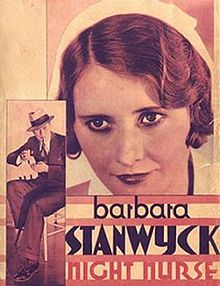
Several years ago, our group began our quest for pre-code films.  We viewed the wonderful Barbara Stanwyck in Night Nurse (1931) at that time.  Recently, I re-watched the film with a newer member of the group, and here share some of our thoughts. 

Stanwyck plays Lora Hart, a young woman who passionately wants to be a nurse.  We meet Lora as she applies for a position in a hospital nursing school.  However, Lora does not have a high school diploma - her mother's illness forced her to withdraw from school shortly before graduation - and the nursing matron will not accept her.   As she leaves the hospital, she literally runs into Dr. Bell (Charles Winninger) who, it turns out, is the hospital administrator.   Bell is quite taken with the attractive young woman, and decides to support her application.  Lora becomes friendly with her roommate, Nurse Maloney (Joan Blondell), and Mortie (Ben Lyon), a bootlegger whom she assists (after he is shot).  After graduation, she finds herself in a conundrum - her nursing oath demands that she obey the orders of the doctor in charge, but Lora quickly realizes that Doctor Ranger is in cahoots with Nick, the Chauffeur (Clark Gable) to murder two little children for their trust fund.

There is a lot of rowdy goings-on in this film.  We have our heroine in a state of undress several times (and Ms. Maloney joins her in one of these slip-teases once).  We have a bootlegger, who is not above asking his friends to take someone for a ride (we won't tell you who).  We have a dipsomaniac mother, a doctor who may be on drugs, and a murderous chauffeur.  And we possibly have an off-screen rape (see the TCM article for more on that).  Want to see more, here is a clip of Stanwyck in one of the slip scenes:


We also have some outstanding performances.  Joan Blondell as the gum-chewing Maloney is a hoot.  She's not really interested in nursing - it's just the only job that will pay you to go to school!  However, you like Maloney, who is quite good at her job, and a true friend.  It's Maloney who first recognizes that the children are being mistreated, and her concern is real.   

Clark Gable is very menacing as Nick - this was a breakthrough role for him, and it is  understandable.  Director William Wellman uses this up-and-coming star to good effect.  In the TCM article we previously referenced, there is a discussion of Stanwyck and Blondell's reaction to this new man on the block.  It's quite humorous. 

Finally, there is Stanwyck herself - her Lora truly wants to be a nurse. Watch the scene where the nurses take the Nightingale oath, and watch Stanwyck's eyes.  Her idealism radiates (as opposed to Maloney, who keeps cracking her gum!).  Also, watch her when she meets Dr. Bell, and later when she discusses him with Maloney.  How DID she explain her predicament to him? Lastly, there are her interactions with the children - her tenderness is moving.

Join us next time for another film - the first of two versions of the same story.


Thursday, March 28, 2013

Joan Joins the Fourth Estate

A murder in a small New York state town creates a firestorm for the locals, including the widow of the victim (Vivienne Osborne as Marcia Ferguson). a neighbor (Leon Ames, here listed as Leon Waycoff, as Judd Brooks) and a local reporter (Tom Brown as Bruce Foster).  In 1932's The Famous Ferguson Case, Joan Blondell is featured as one of the reporters that invades the town in search of sensation. 

On occasion, films from the thirties can feel a bit dated.  However, The Famous Ferguson Case is as timely as the paparazzi that stalk unwary celebrities.  The reporters that descent Cornwall like a plague of locusts are of the yellow variety - creating sensation when they don't find enough to feed their daily news reports; destroying lives in the name of "reporting the facts." Only one talks of the dangers of bad reporting, however no one listens (and quite frankly, he's not the strongest character you've ever met).

Blondell is interesting as the reporter who has seen the seamier side of her profession for all too long.  We are well aware that she has had an affair with Bob Parks (Kenneth Thompson), and she is just short of being appalled at his behavior in Cornwall, mostly because she is all too familiar with his modus apparendi.  Leon Ames is excellent as a man in the wrong place at the wrong time.  Watch for the scene where he finally gets to have HIS "say" in the proceedings.

We heartily recommend this one: an excellent film, with an enjoyable ending. Here's a trailer that might be of some interest.

Monday, March 18, 2013

Loretta Goes to Work

1931's Big Business Girl features Loretta Young as  Claire McIntyre, a woman just out of secretarial school.  She is in love with musician Johnny Saunders (Frank Albertson), but her debts from school force her to let him journey off alone to a lucrative gig, while she looks for work in New York City. After landing a job as a stenographer, she is able to get into see advertising executive Robert J. Clayton (Ricardo Cortez), who, impressed with her ad copy (and her looks) promotes her to copywriter.  Claire inadvertently overhears Clayton's assessment of her skills and appearance, and decides to use her wiles to further advance her career.  Re-enter Johnny, and sparks begin to fly, as Johnny is furious at Claire's dedication to her job, as well as Clayton's obvious interest in her sexually.
Looking back from the vantage of 2013, one could see Claire eventually suing Clayton for sexual harassment, but this is 1931, and neither his actions (nor her's) is at all bothersome.  We won't go into too much detail as to Johnny's reactions, because that would give away a big surprise that is revealed in the middle of the film.  But there is a lot of petulance on the side of Johnny (Frank Albertson is rather good at petulance.  Witness his Freddie Miller in Bachelor Mother) and sliminess on the part of Cortez (which we all know from many movies he too is very good at portraying).  And Loretta skirting the edge of being the slightest bit racy.  The fact that Claire is quite talented at her job (and is very careful to not lead Clayton on too far) makes her just barely moral.  But this is a pre-code film, so that titillation value is there.

There is also a nice surprise towards the end of the movie - an appearance by Joan Blondell.  Telling more than that would give away too much of the plot, but the she is a riot.  Here is a clip that will give you a taste of the movie (and of Ms. Blondell): 


While not a great movie, this is an interesting film that is worth seeing.  Just for Young and Cortez alone, it worth the just little over an hour of your time.

Monday, March 11, 2013

Gumshoe Joan, Take Two

Bill Reardon (Melvyn Douglas) is an unsuccessful PI.  With no clients, and loads of debts, he decides to go back to his job as an investigator for the District Attorney's office.  His wife, Sally (Joan Blondell) protests, so he jokingly gifts her with his office.  Next thing you know, a client, in the form of Lola Fraser (Mary Astor) appears. She hires Sally to find out if her husband is a cheat.  Only, within hours, Walter Fraser is dead.  Who dun it?

Thus begins the screwball There's Always a Woman (1938).  Our group had rather mixed reactions to it.  Developed as a response to The Thin Man, the big reaction was that Bill and Sally are no Nick and Nora.  The jokes tended to go on and on (sometimes way too long for some tastes).  And the over-the-top humor made the movie far less enjoyable.  

On the other hand, the film had great sets and costumes.  And some scenes were really funny.  Like a bit, late in the film, when Sally is being interrogated by the police, and is not in the least phased by the rhetoric.  Blondell could be very cute at times; other times, you wanted to give her a good spanking.  Here, we can share a little bit of the slapstick action (and it might give you a clue of why Sally is such a brat):

Finally, a couple of things to look out for: a young Rita Hayworth as the Bill's secretary (she's there for about one minute),l and Mary Astor appearing in a role very reminiscent of something a few years away - The Maltese Falcon.

Next time - another pre-code.

Monday, March 4, 2013

Gumshoe Joan, R.N.

A hospital nurse, bored with the day-to-day routine, is offered the opportunity to do private duty nursing. At last, she says, something different!  And so, our heroine, Miss Adams (Joan Blondell) ends up in the home of a young man who just committed suicide, taking care of his elderly, ailing, aunt (Elizabeth Patterson).  Only Detective Patten (George Brent) suspects murder, and having an agent in the house to observe the comings and goings of those potentially close to the victim would be a godsend. Thus, our heroine gets the adventure of her life becoming Miss Pinkerton (1932).

This is a fun, if somewhat convoluted movie.  The ending does kinda feel like the author wasn't QUITE sure how to end it, and a murder victim was culled from a number of choices. Regardless, it works.  And Joan Blondell is delightful as our detective/nurse.  She's smart, and brave (there's a bit of screaming, and at least one faint, but she does pretty well, given her naivety).  George Brent (without his mustache) is fun here; there's not enough of him, though. 

This is a film that requires a bit of attention, so if you watch it, don't leave the room.  You'll likely miss something.  It's fast paced.  And you really don't want to miss a moment of Joan Blondell.  She always got something amusing to say!  Just to get your ready, here is a brief trailer:


Monday, November 16, 2009

Precode Golddiggers

This week, we look at Gold Diggers of 1933, another Busby Berkeley musical. It looks at the Depression through the eyes of showgirls who are trying to survive as theatricals close under them.  Enter Brad Roberts (Dick Powell), a young man eager to break into show business as a songwriter.  He agrees to finance a show, as long as it features his music and stars his love, Polly Parker (Ruby Keeler). Brad is, it seems, quite wealthy, the younger son of a family that has agreed to his ambitions as long as he changes his name.  However, once his older brother Lawrence (played by William Warren) finds out that young Brad is planning on marrying a showgirl, mayhem ensues.  Carol's friend Polly (Joan Blondell) is mistaken by Lawrence for Carol, and Polly decides to play along.

During the musical numbers, Billy Barty is back, again as a child in the "Pettin' in the Park" number, oogling all the lovely ladies.  The number ends with the famous scene of him handing a can opener to Dick Powell, so he can cut the "protected" Ruby Keeler out of her tin armor.  But as racy as the number is, perhaps the interaction among Joan Blondell, William Warren, Aline MacMahon (as Trixie Lorraine, another showgirl) and Guy Kibbee ("Fanny", the object of Trixie's golddigging). The girls con expensive hats out of the men - retribution for their mission to break up Brad and Carol.  And let's not forget the lovely Fay (Ginger Rogers), whose last name is Fortune, and who, quite frankly, is looking for one.Of course, all comes right in then end - Brad get Carol, Polly gets Lawrence, and even Trixie get "Fanny".


We were surprised that, in this lighthearted romp, the number that ended the musical is "Remember My Forgotten Man". Its somber tone is in direct contrast to the rest of the movie, and that it ends the movie is a statement in and of itself. Coming out in the middle of the Depression, it reminds the audience of the environment to which they must return.  Here is that scene:

And so, next week we pick up with a more serious story.  Hope you'll visit with us again.