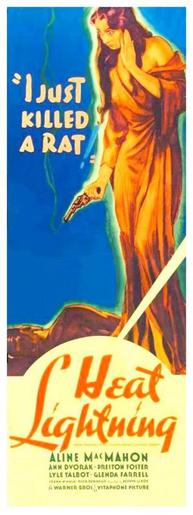
Sisters Myra (Ann Dvorak) and Olga (Aline MacMahon) run a gas station/diner/motel deep in the desert of the American Southwest. Isolated from the rest of the world (except for the customers who are always heading somewhere else), Olga is protective of her younger sister. She forbids her from socializing with men, especially Steve Laird (Theodore Newton), much to Myrna's fury. Olga's life is disrupted by the arrival of George (Preston Foster), a man who was once Olga's lover. Our film this week is Heat Lightning (1934). Aline MacMahon is always remarkable, and this film is no exception. When we meet Olga, her face is closed. She interacts with strangers on a business level only. She is not unfriendly, but distant and cautious. With the arrival of George (who Olga - and only Olga - calls Jerry), Ms. MacMahon changes her whole demeanor. The suspicion begins to slowly melt into affection, and finally into the hope for a resumption of their earlier relationship. Some of this is accomplished with costuming, as Olga literally lets down her lush hair (George had commented on the beauty of her thick, long hair), but most accomplished with Ms. MacMahon's eyes and posture. This was the first picture in which she received star billing, and she makes the most of it. Ann Dvorak's part is relatively small, but the last scenes in which she appears are very strong and truly heartbreaking. Myra's early rebellion and the results that revolt make it appear that the sisters will end up very much alike. The emptiness in Ms. Dvorak's face tell us the future of Myra far better than words could.
We're not used to seeing Lyle Talbot (Jeff) play a weakling, but he does here. By the end, he develops a small amount of backbone, but primarily he is under the thumb of the domineering - and nasty - George. We previously discussed his impressive film career when we viewed A Lost Lady, but this was a new side to a decidedly versatile, and underrated, actor. Frank McHugh (Frank) is also playing a somewhat different part from his usual sidekick roles. He's a chauffeur to Mrs. Feathers Tifton (Glenda Farrell) and Mrs. Tinkle Ashton-Ashley (Ruth Donnelly), two new divorcees, on their way home (with LOTS of expensive jewelry) from Reno. Surprisingly, Mr. McHugh is also the current object of both their affections! Mr. McHugh is amusing and effective with relatively little screen time. But seeing him as an object of lust does take some getting used to. As is often the case, Glenda Farrell doesn't get enough to do, though her interplay with Ruth Donnelly is especially fun. They are a good combination; in the end, Ms. Donnelly gets the better lines and the stronger part.
The script is intriguing, in that the backstory is supplied in tiny spoonfuls - you get just enough to understand Olga, and no more. It's script writing by insinuation, and is effective. You keep watching the movie to find out more, as you are given just a tad more information about Olga's life in the city. While several of the characters seem extraneous - the girls who arrive with "Popsy" (Harry C. Bradley), for example - it's evident by the end of the story that each of these visitors is telling us more about Olga and her decision to live in the desert. As you can see, it's an amazing group of character actors - Jane Darwell also appears in the opening scene as Gladys, wife to henpecked husband Herbert (Edgar Kennedy), a couple motoring through the desert with a really unreliable jalopy. It's another humorous interlude, but fascinating as well - Olga is a skilled mechanic, better than most men - even in the precode era, it's not usual to see a woman who is skilled at a trade.
The story was based on the play, Heat Lightning which was on Broadway for a month in 1933. and starred Jean Dixon as Olga. In 1941, there was remake (of course, drastically altered. The remake was, after all, well within the code) as Highway West (1941) (AFI catalog). Reviewer Mordaunt Hall of the New York Times was not enthusiastic about the film in his review, but did like Ms. MacMahon, saying "she gives a believable performance the rôle is not well suited to her". We disagree; there is not a part written which Ms. MacMahon cannot in some way make suit herself.
Released in March of 1934 (just 4 months before the Code began to be strongly enforced), the picture has not been widely circulated since then, as it was on the Legion of Decency's Banned List (TCM article). We think that it's a shame it - and its star - are not better known, and really recommend a viewing. Here's a trailer to get you started:
Having not been paid by her employer for four months, housekeeper extraordinaire Lizzie (Ruth Donnelly) quits her job and heads off to an employment agency. She meets Joan Smith (Margaret Lindsay), a young married woman who is searching for a maid. But with her limited income, Joan can't really afford a maid of Lizzie's qualifications. Lizzie, however, is intrigued by Joan and her son Bobby (Ronnie Crosby), and agrees to take a pay cut to work in the household. Lizzie has a plan to bring Joan and husband Jimmy (Warren Hull) up to her employer standards. This week, we're discussing Personal Maid's Secret (1935). Every once in a while you fall into a film you've never even heard of, and that provides low expectations. Personal Maid's Secret is one of them. Originally entitled Living Up to Lizzie, (AFI catalog), it is in fact a delightful little comedy. While the plot is pretty transparent, the acting is so good that you warm to the film almost immediately. Leading the cast (though she got fourth billing) is Ruth Donnelly. Her Lizzie is a practical sort - she leaves her current employment confident that she can secure another position immediately. While she is qualified for a much more well-paid position, she takes on the job with the Smiths because she has a good feeling about them - and because she feels she can help them. Finally Lizzie is a woman with a past - we know it from the start, and when we discover the truth about her, she becomes even more endearing (we wondered if perhaps the film was originally written before the code, as some of the early hints about Lizzie's past suggest a bit of hanky-panky).
Margaret Lindsay gets first billing and is engaging as the young wife trying to help her husband make his way in the world of business. Jimmy is an insurance salesman, and as such, needs contacts. Lizzie suggests to Joan that the best way for Jimmy to get ahead is for the Smith's to entertain. But to do that, they'll need to have a display of affluence. Using her pin money and some ingenuity, Joan is able to get the ball rolling. Ms. Lindsay plays the part with warmth - there is never a suggestion that Jimmy needs to succeed to make her life easier. Their marriage is a partnership, and his success is hers as well. It's not often that one gets to see Frank Albertson (Kent Fletcher) play a good guy, but he does here, and is quite appealing as Joan's inventor-brother. As with the other characters, there is no hint of grubbiness - Kent lives with his sister because it is expedient for both of them. He is working - and working to develop a new engine carburetor, which he hopes will increase gas mileage. When he becomes enamored of Diana Abercrombie (Anita Louise), you root for him to get the girl. Ms. Louise is lovely as the wealthy young lady whose life is about to change. And it's nice to see Arthur Treacher (Owen) - as always, playing Arthur Treacher!
One 21st Century problem with the film is the character of Bobby. Bobby is fascinated by "colored" people (in the 1930s, "colored" was a polite term. Think of the NAACP). The Smiths had a maid who was African-American at one point, and Bobby clearly adored her. So, he's decided that he wants a friend who is African-American. But what makes his constant queries interesting is that Bobby doesn't really see race - he asks the very white Palmers (Henry O'Neill and Lillian Kemble Cooper) if their son is colored. So, while his questions can be a bit unnerving, it's also an interesting comment on the ability of children to accept regardless of race. The song "You've Got to be Carefully Taught" comes to mind. Our villain, Warren Sherrill, is convincingly played by Gordon Elliott. If he seems familiar, you might know him from his later career as a Western actor and the role Red Ryder - Will Bill Elliott. Born on a ranch in Missouri, Mr. Elliott came by his Western expertise naturally. He became a horse breeder, and retired to a ranch in Nevada after his retirement. He died in 1965 at the age of 61.
Given that this was a B movie, the set design and costuming are outstanding. The Smith's home needs to reflect their life, and the work done by Carl Jules Weyl are an important part of the story. Orry-Kelly did the costume design, and, as always, it is impressive.
The film was not widely reviewed, but Variety gave it a very positive review (Wild Bill Elliott: A Complete Filmography by Gene Blottner), as did the Sydney Morning Herald, which complimented Ruth Donnelly for "the warmth with which she plays this part and the perfectlon of the portrait's detail," and said the film itself is" shrewd and humorous and the conversation is so natural that the spectator is able to forget the plot, which contains no surprises." There ARE a couple of slight surprises, though by and large it's a convention plot; but with such fine acting and such appealing characters, you won't care.
We'll leave you with a trailer and a suggestion that you seek this one out.
Senator Sam Foley has died suddenly, and the governor of his state, Hubert "Happy" Hopper (Guy Kibbee) is tasked with naming a successor. The Governor is ordered by local boss Jim Taylor (Edward Arnold) to name one of his flunkies, but the citizenry rebel at the appointment of this yes man. The Governor's children campaign for the appointment of local Boy Ranger leader Jefferson Smith (James Stewart), a naive young man who Mr. Taylor finally agrees is the perfect solution. With no political background, Smith will be easily led by Senator Joseph Paine (Claude Rains) to vote according to Taylor's wishes. And so, Mr. Smith Goes to Washington (1939). This outstanding film was included as this month's contribution to the TCM Presents series. Originally conceived as a follow-up to Mr. Deeds Goes to Town, the film changed titles and actors when Gary Cooper proved to be unavailable. (AFI Catalog) James Stewart brings the needed innocence and gravitas to the role in his second film with Frank Capra and Jean Arthur (they had worked together the previous year on You Can't Take it With You). One problem with Frank Capra films is that he doesn't always know how to end them. It's a big issue with Meet John Doe (1941); it's a smaller issue here. Mr. Capra does seem to back his character into a corner, and then create a deus ex machina to pull him out of his problem. However, in this film the director does set up hints that Claude Rains will be both the problem and the solution to that problem.
Mr. Rains is, of course, excellent as The Silver Knight, the senior senator from Smith's unnamed state. Best friends with Smith's father (a crusading newspaperman who was murdered after he wrote editorials against a mining syndicate), Paine has been in the pay of Jim Taylor for years. But Senator Paine remembers the ideals that brought him to law and to politics. As Mr. Rains looks at Smith, we see his yearning for the purity that he had when he worked with Smith senior. A favorite villain for Mr. Capra is Edward Arnold. Mr. Arnold is able to be both affable and menacing at the same time. He helps us to understand why a respectable man like Senator Paine would fall into his clutches. He also has looming presence that gives the viewer pause - we know he is capable of any dastardly act to get what he wants. A stage actor at the beginning: between 1919 and 1933, he appeared in 13 Broadway plays, Mr. Arnold started his film career during the silent era. With his booming voice (and wonderful laugh) he was a natural for talkies, and appeared as the leading man in such films as The Toast of New York (1937) (he was billed ABOVE Cary Grant) and Diamond Jim (1935). Listed on the notorious "Box Office Poison" list, Mr. Arnold segued into more character parts, like Anthony P. Kirby, Sr. (James Stewart's father) in Capra's You Can't Take it With You (1938). Though he identified as a conservative Republican (and even ran for Los Angeles County Supervisor - he lost), he served as President of Screen Actors Guild, and was vocal in his opposition to the blacklisting of his colleagues during the HUAC era. Married three times, and divorced twice (he had three children with his first wife), Mr. Arnold died of cerebral hemorrhage in 1956 at the age of 66. His turn as Olivia de Havilland's father in The Ambassador's Daughter was released just after his death.
Jean Arthur (Clarissa Saunders) is picture perfect as the tough as nails assistant, who is sick and tired of the dishonest nature of politics. She's seen Taylor's influence on his state for too long, and is convinced that Jeff Smith is either an idiot or a stooge. When she finds he is a man of ideals, she becomes his staunchest ally. She is ALSO the smartest person in the film. She knows the rules of the Senate by heart, she understands the workings of the government, and she knows the people who work on the Hill. It's hard to imagine anyone other than Ms. Arthur giving Saunders such range. The film is also blessed with a bevy of magnificent character actors: Thomas Mitchell (Diz Moore), Eugene Pallette (Chick McGann), Capra favorite Charles Lane (Nosey), Ruth Donnelly (Mrs. Emma Hopper), Astrid Allwyn (Susan Paine), and H. B. Warner (Senate majority leader). But leading this group are the always wonderful
Beulah Bondi (Ma Smith) and Harry Carey (President of the Senate).
Though their parts are small, you remember then. One only regrets that
they are not on the screen for longer. Ms. Bondi would end up playing James Stewart's mother a total of five times (TCM article). This was the third outing in that role.
The film proved to be quite popular, though initially it was reviled by many U.S. Senators and by the Washington Press Corps. (WAMU article). Senate Majority Leader Alben Barkley described the film as "silly and stupid," adding that it made the Senate look like "a bunch of crooks." (U.S. Senate article). The film was also banned in Germany and Italy (they didn't like the fact that the film was about a democratic government, even a government that was having problems); however it did well in England, France (prior to the German invasion) and in the United States. Despite the jabs at journalists, the New York Times review was glowing, calling it "is one of the best shows of the year. "
The American Academy of Motion Picture Arts and Sciences obviously agreed; it was nominated for 11 Academy Awards, including Picture, Actor (for James Stewart), Supporting Actor (for both Harry Carey and Claude Rains), Director, Art Direction, Film Editing, Film Scoring, Sound Recording, and Original story (for which it won it's only Oscar). But, in 1939 the competition was fierce, and the juggernaut called Gone with the Wind pretty much swept the awards (winning 9 of the 14 for which it was nominated). Among the other Picture nominees were Dark Victory, Goodbye, Mr. Chips, Ninotchka, Stagecoach, Wuthering Heights, and The Wizard of Oz!
It's 1909. Mary Archer (Barbara Stanwyck) nervously awaits the return of her cousin (and possible fiance) Jeff (Ralph Bellamy) from Germany. But Jeff's return changes both of their lives when Mary meets his friend, Hugo Wilbrandt (Otto Kruger). Hugo and Mary fall deeply in love, marry, and begin a family, consisting of their dachshund Cammie and their son Teddy (Ronnie Cosby). Hugo begins a successful career as a professor in Rossmore College, and becomes an American citizen. Their lives seemed blessed, until World War I erupts. From that point on, Hugo and Mary are shunned as the enemy, and their happy existence becomes a series of tragedies. Ever in My Heart (1933), a pre-code film, is almost relentlessly sad; there are parts of the film that are almost too much to bear. Since it begins as an almost lighthearted romance, the ultimate spiral downward makes for an even more intense viewer experience. Released by Warner Brothers studio, which also gave us suchsocially relevant films as I Am a Fugitive from a Chain Gang (1932, which looked at the American criminal justice system) and Heroes for Sale (1933, which dealt with the problems faced by World War I veterans); this film too is attempting to highlight injustice within the United States. The film, however, came out as Germany was electing a Nazi government, and beginning their persecution of the Jewish population (Victoria Wilson's A Life of Barbara Stanwyck: Steel-True, 1907-1940). As a result, it probably was not perhaps seen in the light which screenwriter
Bertram Millhauser had intended.
Barbara Stanwyck was not fond of this picture (TCM article)
or any of her films at Warner Brothers; she called them "a series of
parts that were much alike - women who were suffering and poor, and
living amid sloppy surroundings." That may be true, but she is dynamic
as a woman who watches her life crash in ruins about her. We have no
doubt of her sincerity when Mary refuses to leave her husband, despite their reduced
circumstances. When neighbors, who had been their friends begin to
reject them because of her husband's nationality, Stanwyck gives Mary a
quiet but determined dignity.
We were enchanted by Ronnie Cosby in the role of young Teddy. He is just delighful in the role of the affectionate child whose life becomes a tragedy. Mr. Cosby's career began with a small role in 1929's Madame X. He worked steadily through 1939, appearing in films such as Broadway Through a Keyhole (1933), Little Men (1934), and the 1937 remake of Madame X. His last appearance was in 1941's Birth of the Blues. He died in 2010, at the age of 82.
Ralph Bellamy is also excellent as Jeff, Mary's first
cousin and original intended. Jeff is carefully set up as a contrast to
Mary's brother, Sam (played with a certain amount of petulance and
jealousy by Frank Albertson). When Sam revolts against his
brother-in-law merely because he was born in Germany, it is Jeff who
tries to soothe the family. Though Jeff describes himself as
passionless, is always a true friend to both Mary and to his rival,
Otto. When Mary's family ignore her, it is Jeff who ultimately
convinces Grandma Archer (Laura Hope Crews) to take in the starving
couple. That Jeff is also a member of the very biased family is
sometimes hard to remember - he is much more like the very open-minded
Mary than the rest of the Archers. We understand why Mary at one point
was considering a marriage with Jeff. As is often the case, Ms. Stanwyck and Mr. Kruger were not the first choices for the Wilbrandts. Kay Francis and Paul Muni were originally considered (AFI Catalog). Not surprisingly, The New York Times reviewer was not enamored of the film, calling it "meaningless to this new generation" because it was not "news any more that the war propaganda which dramatized the Germans as baby murderers and wife beaters was prejudiced."
This comment by the Times in 1933 is quite ironic, given that Ever in My Heart is much more timely today than any of us might like to admit. Just days before we viewed the film, I heard this report from NPR story
concerning US residents, most of the Muslims, who are fleeing to Canada
- and to arrest - rather than staying the in U.S. This film is
testimony to the fact that these are not new prejudices, and that
despite this film's pleas for tolerance and understanding, history
keeps repeating itself, with the imprisonment of Japanese Americans during World War II, and today with a political agenda aimed at a particular religious group.
As
we publish this article, the news of Robert Osborne's death has just
been announced. It's with a heavy heart that we add our voices to those
that mourn this kind, wonderful and intelligent man. I had the privilege of meeting
him at a reception several years ago; he was gracious and welcoming.
But more than this, I will miss my nightly visit with him on television,
where he answered my need for more information, and provided a context and an appreciation for the films that I've always loved. I have
learned at the feet of a master; he will be greatly missed. We will leave you with this trailer and with a reminder that no one in the United States should be forced to state that "they let me be a citizen, but they won't let me be an American."
When waitress Mabel O'Dare (Marion Davies) loses her job thanks to Aloysius K. Reilly (Roscoe Karns), he gets the bright idea to introduce her to a Broadway producer. Mabel ends up with a job, only because the star has just quit. But there's a problem - Mabel can dance, a little, but not enough to lead a Broadway show. Her dreams of stardom are all but gone when Reilly decides to get some publicity for her by claiming a love affair between Mabel and up-and-coming boxer Larry Cain (Clark Gable). But again, there is a little problem - Larry and Mabel loathe one another. Thus begins Cain and Mabel (1936), a little froth of a comedy, with a few musical numbers thrown in. While it was fun to see Clark Gable in this very early role, and Marion Davies is a delightful performer, this was probably not the best movie either ever made. The musical routines were a bit tedious - they ended up changing the tone of the film. We know Mabel isn't a great dancer; all the routines do is emphasize that to no purpose. And though the film is a bit long, there are some delightful scenes. The early conversations between Reilly and Mabel are a hoot, and then there is the added presence of Allen Jenkins as Dodo, Larry's fight second. Any time Allen Jenkins is in a movie, you know you are going to have a good time.
We also have Ruth Donnelly as Aunt Mimi, who is also very
funny. It should be mentioned though that Mimi is a fairly despicable
person. She will go to any lengths to advance Mabel's career, because
it is keeping Aunt Mimi in the money. She has no worry that her actions might make Mabel
unhappy.
Another interesting appearance is that of Pert Kelton as Toddy, the
star whose departure makes way for Mabel. We've seen her in Bed of Roses, and as we mentioned then, later in her career as Shirley Jones' mother in The Music Man. Unfortunately, she doesn't get a whole lot to do here, which is a shame. Interestingly,
Dick Powell was originally slated to play Ronny Caudwell, Mabel's
co-star and almost boyfriend. However, the part went to
Robert Paige, because William Randolph Heart didn't like Dick Powell.
Hearst felt Powell was too attractive and that Davies liked him too
much. As I'm sure everyone is aware, Heart and Davies were longtime companions. An interesting bit of trivia - when Hearst was in financial trouble in the 1930s, it was Davies who came to his rescue. She was a very intelligent businesswoman, and used $1 million of her own money to bail him out (much of it invested in jewelry).
This TCM article also tells in some detail the story of how Clark Gable was cast as Larry. Davies did NOT want him in the part - she didn't think he was attractive enough to play Larry! She later changed her mind about him, but Gable never quite forgot the insult. All we have to say is HUH? Gable not attractive? On what planet? The film is a remake of the silent film The Great White Way, which was filmed by Hearst's company in 1924, which starred Anita Stewart. And while we can't whole-heartedly recommend this one, it has some nice moments. And then there is Gable. We close with the film's trailer:
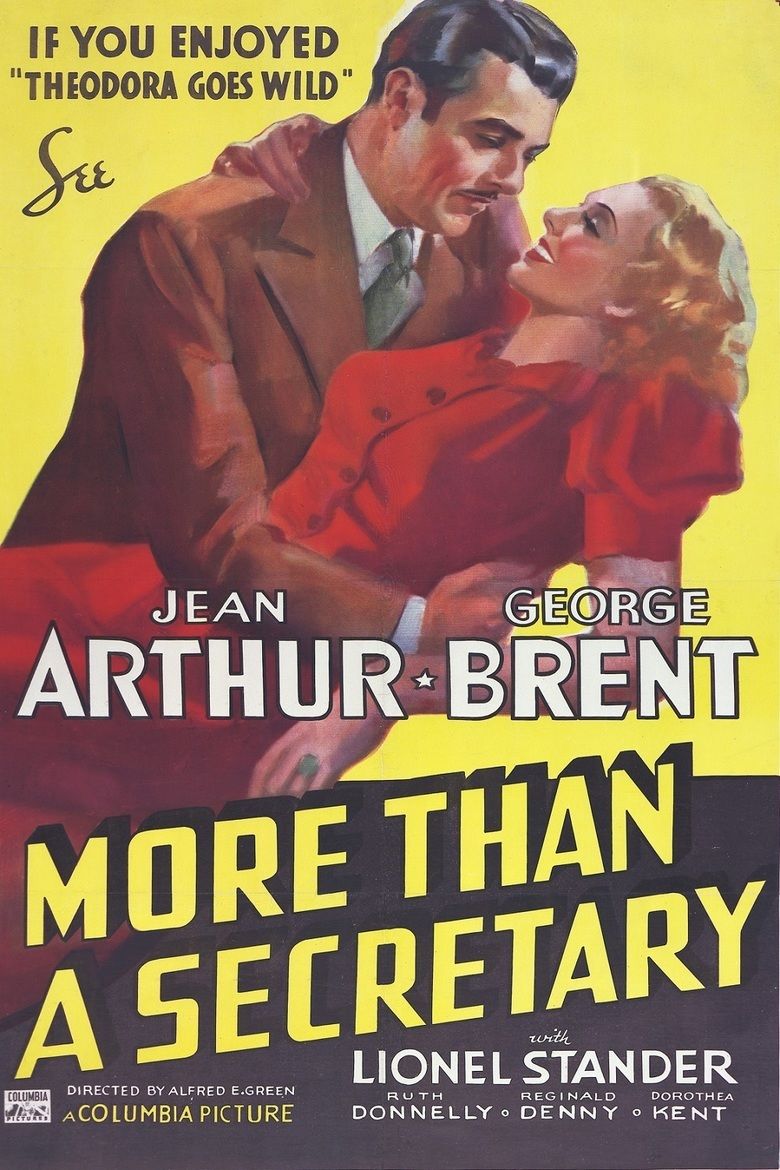
Carol Baldwin (Jean Arthur) and Helen Davis (Ruth Donnelly) run
a secretarial school. Unfortunately, most of their students seem to be
of the same caliber as their current student Maizie West (Dorothea
Kent) - no brains, but plenty of looks and a plan to make time with the
boss. Thus begins More Than a Secretary (1936), in which Jean Arthur
ends up working AS a secretary when the man who hired (and fired) one of
her students complains. The gentleman in question is publisher Fred
Gilbert (George Brent). His publication, "Body and Brains", is a
body-building magazine which regularly uses the face of an attractive
model on the body of the exceptionally well-built (and particularly
unattractive) Ernest (Lionel Stander). Of course, the magazine is NOT
doing well. It takes our Jean to put it on the right track. This
is a very cute movie, thanks to the interplay between Brent (who is
always wonderful) and Arthur (ditto). Her Carol, at the start, is
somewhat reminiscent of a character she will revisit in 1948 - Phoebe
Frost in A Foreign Affair. But she quickly discovers her outer
beauty, and becomes the perfect secretary. Beauty and brains in the
same office! Amazing! And Brent manages to make Fred a bit of a dweeb,
but still let you know why Carol is attracted to him. The scene where
he takes her out to a tofu dinner (!!!) is quite humorous.
It is
fun to see Lionel Stander as well. His Ernest longs for the day when
his face adorns his own body on the magazine - alas, it seems it is not
to be. Many of us remember Mr. Stander from Mr. Deeds Goes to Town and A Star is Born (as well as in Hart to Hart). It is sad that his career in this country was abbreviated during the 50s and 60s thanks to the McCarthy hearings.
A
few words are due, as well, for Dorothea Kent (as Maizie). She is a
hoot. You can't help but like the opportunistic creature! One
sympathizes with Carol's frustration, but I, for one, looked forward to
her return.
We'll close with the moment in which Carol finally loses it with Maizie. See you soon!
As we near the end of our Olivia de Havilland Festival, we have saved
the best for next to the last (we have one more to go after this one).
It's The Snake Pit - Olivia's Academy Award nominated performance as the tortured Virginia
Stuart Cunningham, whose mental collapse lands her in a mental
institution. This is truly a tour-d-force performance. What Ms. de
Havilland does with a brief glance, other actors could not do with their
entire bag of tricks. Watch her reactions change from ignorance to
disbelief to suspicion to anger in the briefest second - it is truly
magnificent. That Ms. de Havilland did not win the Oscar for 1948 is
due perhaps to the fact that her competition was fierce - she lost to
Jane Wyman in Johnny Belinda.
This
film is full of wonderful performances, and features some of the
premiere actresses of the day. Let's start with Celeste Holm and Betsy
Blair as Grace and Hester, the bookends to Virginia's confinement.
Holm's Grace cares for Virginia as she begins her confinement; as
Virginia heals, she becomes mentor to the disturbed Hester (Blair).
Other patients in the hospital are portrayed by Beulah Bondi, Ruth
Donnelly, Lee Patrick, and Isabel Jewell. Though their parts are small,
each adds to the atmosphere of the hospital in their own unique way.
Another interesting performance is that of Natalie Schafer as Virginia's
mother, certainly high on the list of dysfunctional parents! On
the distaff side, we have Leo Genn as Dr. Kik, Virginia's psychiatrist,
Mark Stevens as her husband Robert, and Leif Erickson as her one-time
boyfriend, Gordon. The men however, merely serve as window-dressing.
It is the women who rule this picture. It is their performances you will
remember.