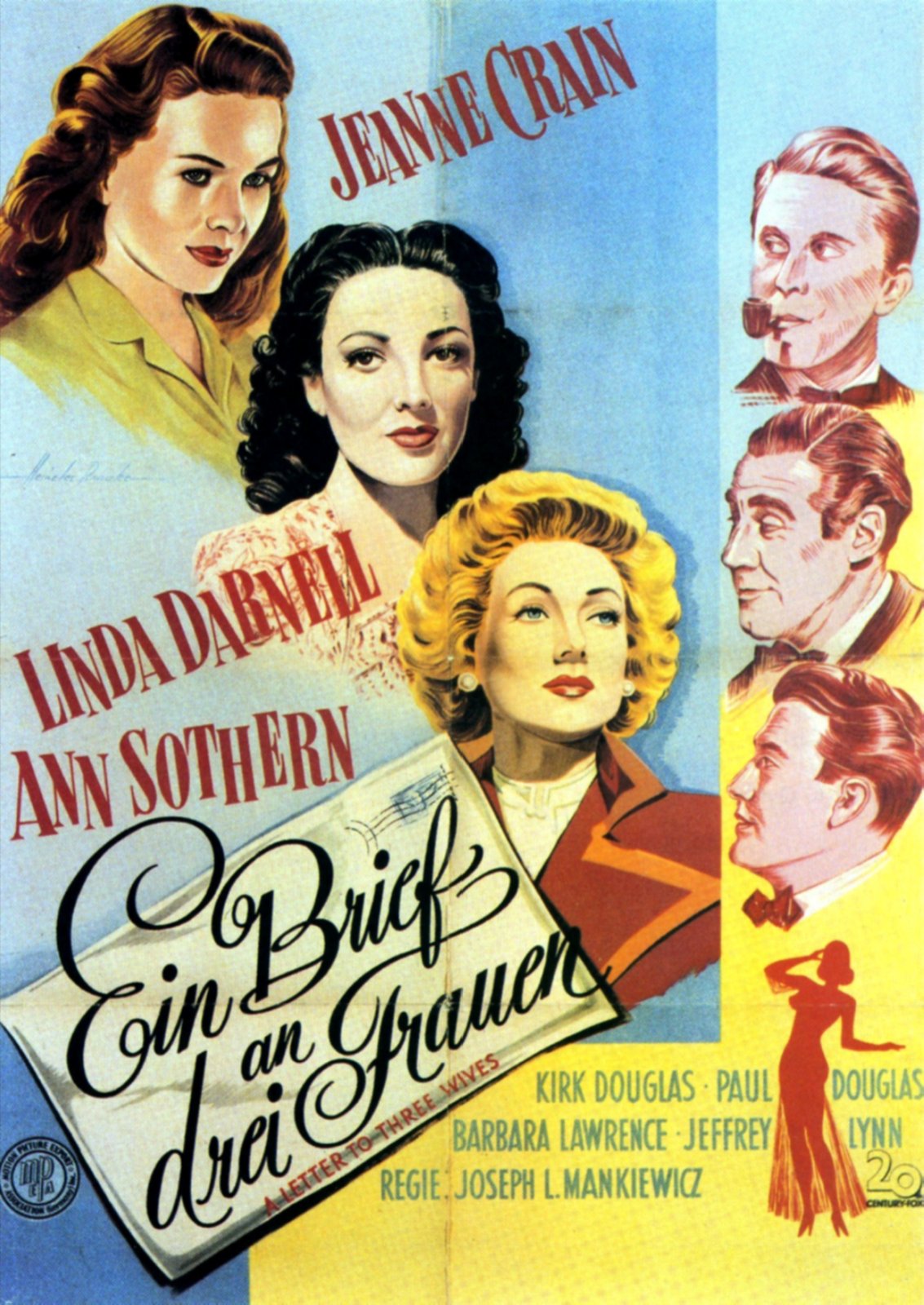
As Deborah Bishop (Jeanne Crain), Lora May Hollingsway (Linda Darnell), and Rita Phipps (Ann Sothern) are about to leave on a charity boat ride, a young man delivers A Letter to Three Wives (1949). The letter informs them that their "friend", Addie Ross (voiced with just the right amount of venom by Celeste Holm) has left town - with one of their husbands. Unable to leave the boat, the women spend the day worrying about their husbands and reviewing their marriages. Based on A Letter to Fives Wives by John Klempner (the film eliminated two wives, which tightens it up), this is an exceptional film, especially given that it is really a series of vignettes. The use of Addie's narration as a glue to hold together this tale of three marriages in trouble is both inspired and entertaining. That narration brings the tale to a different level, making the film a fully cohesive unit instead of a series of short stories. Two of the stories especially stand out. Rita and George Phipps (Kirk Douglas) are a relatively happy couple, but Rita, a successful radio writer, is trying to have it all - career, husband, and children. She's pretty good at doing it, but George is frustrated that he and their twins often take second place to the demands of her clients (ably represented by Mr. (Hobart Cavanaugh) and Mrs. (Florence Bates) Manleigh). Kirk Douglas plays George as an educated, reasonable and progressive man; he really doesn't mind that his wife works and that she out-earns him by quite a bit. Her job and her impressive salary afford them all a good life, and enable him to pursue his career - an underpaid high school teacher - without guilt. George loves his job and his wife. He just wishes that she wasn't constantly afraid, and would occasional say no to her clients unreasonable demands.
In flashback, we see the courtship of Lora May Finney (Linda Darnell) and Porter Hollingsway (Paul Douglas). Both are from the wrong side of the tracks (in Lora May's case, quite literally - she lives with her sister Georgianna (Barbara Lawrence) and mother, Ruth (Connie Gilchrist) on the edge of the train tracks). But Porter, the owner of a successful department store, is now well-off, and enamored of Lora May's beauty. But he is not interested in marriage; Porter's been married, and he didn't care for it. Plus, his ideal is Addie Ross - he keeps her picture on his piano, and talks about her "class," a quality he doesn't find in Lora May. Linda Darnell is impressive as the tough talking Lora May. The viewer is quick to realize that, despite her comments to the contrary, she loves Porter. But she knows the only way to keep him is to play the game his way - Porter likes to fight, and Lora May is more than willing to oblige him to get what she wants. To a point, of course. When Porter shows up at her front door, honking his horn for her to come out, Lora May ignores it: "Anybody wants me can come in and get me, this ain't a drive-in." For more on the life of Ms. Darnell, please see our blog post on her work in The Mark of Zorro (1940).
The third story, the marriage of Deborah and Brad Bishop (Jeffrey Lynn) is possibly the weakest of the three. It's not bad, its just that Deborah seems weak next to these two dynamic women. One sympathizes with her truly ugly dress, since we know she's not had time to procure a new one, but really, it is so hideous, it's hard to understand why even a simple farm girl would purchase it. And WHY does Rita have to TELL her to cut off those ugly flowers? But it should be acknowledged that Deborah has left the farm, the WACs, and her past life for a new, more upscale environment with a husband she really doesn't know - the story of Brad and Deborah is a brief glimpse into the marriages that began because of the war. Jeanne Crain began her film career at age 18, with a bit part in The Gang's All Here (1943). Winner of the Miss Pan Pacific pageant, she attracted the attention of film scouts; by 1945, she was starring in State Fair and Leave Her to Heaven. She could sing, dance, ice skate, and she was a pretty good actress, but also in 1945 she married Paul Brinkman, and began having babies - seven in total. She was pregnant during the filming of this movie, and may have lost the role of Eve in All About Eve due to one of her pregnancies. Regardless, her portfolio is quite impressive: I'm particularly fond of Cheaper by the Dozen (1950) and People Will Talk (1951) Ms. Crain and her husband remained married until his death in 2003, but after a messy divorce proceeding (which was never completed), they lived apart. She also lost two of her sons before she died in 2003 of a heart attack at age 78.
We've raved about Thelma Ritter (here playing Sadie Dugan) before, and she does not disappoint in this film. Whether it is her interactions with her pal, Ruth Finney or her sass when she is working as a maid for Rita Phipps, Ms. Ritter is the queen of the bon mot. Take, for example, her response to Rita's request that she wear a uniform: "The cap's out. Makes me look like a lamb chop with pants on." or her answer to the Manleighs about their radio program: "You know what I like about your program? Even when I'm running the vacuum I can understand it." At the same time, it is Sadie who cautions Ruth about her passion for her new refrigerator, when Ruth seemingly puts keeping it (in many respects, for Ruth, the refrigerator is a symbol of respectability) above her daughter's happiness: "
You got to make up your mind whether you want your kids happy or your icebox paid up." A number of different actors were proposed for the film, including both Joan Crawford and Ida Lupino as the voice of Addie Ross (AFI catalog). Though the film was nominated for Best Picture, Screenplay, and Directing Oscars (winning the latter two), no acting nominations came its way. Interestingly, Jeanne Crain, Kirk Douglas, and Celeste Holm were all nominated for other film work that same year (none of them won, however).
Contemporary critics received the film enthusiastically (see this New York Timesreview and this TCM article). Since then, regard for the film has increased, as is evident by this New Yorkerdiscussion, especially as a sophisticated examination of marriage. As Jeanine Basinger notes in her book I Do and I Don't: A History of Marriage in the Movies, films that actually examine marriage itself are rare. A Letter to Three Wives does this, and does it well.
Both Lux Radio Theatre (1950) and Screen Players Guild (1952) performed radio versions of the play. Then, in 1985, the story made its way to television, with Ann Sothern appearing as Ruth Finney in a version which starred Loni Anderson, Michele Lee, Stephanie Zimbalist as the three wives. We'll leave you with a trailer from the film - an introduction to the three wives.
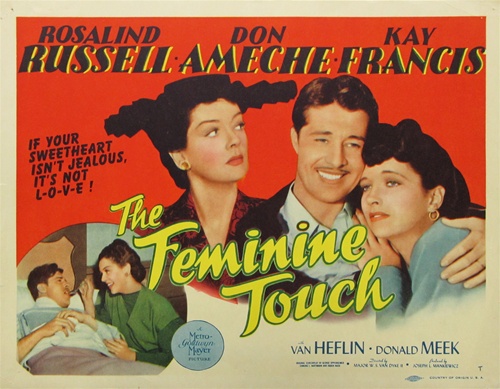
At its best, screwball comedy is a wonderful thing. It is a manic, charming, delightful walk into the wacky world of a person who lives very much in an alternate universe. The Feminine Touch (1941) does NOT fall into this category. The film features Rosalind Russell as Julie Hathaway, the wife of Prof. John Hathaway (Don Ameche), a college professor who despises jealousy as a worthless emotion, and who has decided to ditch his university job and write a book on the subject. Enter Nellie Woods (Kay Francis), the editor for publisher Elliott Morgan (Van Heflin). Elliott's not very involved in his business - Nellie does all the work in the publishing house, as her boss is too busy pursuing the high life and women. Unfortunately, Nellie is also in love with Elliott, and sees this book as an opportunity to force Elliott into paying some attention to her. Elliott, of course, is much more interested in wooing Julie. Julie's problem is that while she is not the least bit interested in Van, she is dismayed that John doesn't care that another man is trying to seduce her.
While the film has some amusing moments, primarily it is just annoying. We're presented with a number of characters who are just, quite frankly, stupid. Nellie is the only one with any brains. And Elliott, besides being an idiot, is a pest. You spend most of the movie wanting to smack him. It is amazing how long it takes him to realize that Julie is not interested in anyone but her husband. Plus, Heflin, usually such a disciplined actor, here is hugely overacting. He spends much of the movie distorting his face, to no real purpose.
Russell and Ameche are similarly annoying. She is overacting; he is just being smug. Worse still, there is NO chemistry between the two of them. Perhaps that's why this is their only film together. Though, given that both are excellent actors when given a decent script, one would have liked to have seen them together in a more sympathetic venue. With the writing talent (George Oppenheimer and Ogden Nash, specifically) and the producer (Joseph L. Mankiewicz) of the film also people's who work we admire, we were surprised that the script wasn't sharper. As it is, it just seems to go on forever. Even the final scene seems gratuitous.
We did enjoy, as New Yorkers all, the scenes of New York City, specifically the depiction of the subways. (We remember the old rattan seats and the overhead straps, which gave NYers the name "straphangers". Actually, one of us - the short one - misses those straps!). In spite of everything, Kay Francis is really quite good. As always, she gets great clothing - her hats, especially, are something to be seen. We suspected the costumers wanted to look a bit avant garde and daring - they do succeed. Her character, as we said, is the only one with a brain - she is running the company, and we suspect, will continue to run it. Ms. Francis is the breath of fresh air in the middle of chaos.
We should note that, according to this article from TCM, The Feminine Touch was actually quite well received when it was released, so you may want to judge for yourself whether it is a hit or a miss. To get you started, here is a trailer:
Based on a play which starred Tallulah Bankhead, Forsaking All Others
(1934) is an absolutely delightful film. With an exceptional cast,
which includes Ms. Crawford, Clark Gable, Robert Montgomery, Billie
Burke, and a brief appearance by Rosalind Russell; and a screenplay by
Joseph L. Mankiewicz, the viewer is given a delightful 84 minutes of
great acting and witty dialogue. Joan's Mary Clay is preparing for her
long-anticipated wedding to her childhood friend Dillon Todd (Robert
Montgomery). The day before her wedding, unsuspecting Jeff
Williams (Clark Gable) returns from Spain, with enough money to propose
to Mary, whom he has loved since they were children. His disappointment
is palpable when he discovers he is too late, but rather than burden the
ecstatic Mary, he agrees to give away the bride. Come the day of the
wedding, however, Mary learns that Dill has eloped with his former
paramour Connie Barnes (Frances Drake). Mary tries to
start over without Dill, but when he renews his pursuit of her, she
begins to succumb to his charms.
The script is just full of little bon mots, like
"I saw [a fan dance] with electric fans once, it was awful" that keep
you giggling through the movie, along with sight gags like Robert
Montgomery sound asleep in a lacy nightie. And you can't do better
than this cast. Gable is just commanding as Jeff. He conveys so much
by just LOOKING; all his hurt and love shine out of his eyes. And
Crawford was never more endearing. Even when she is about to mess up
her life totally by returning to Dill, you still adore her, and just
want her find her way to Jeff. Robert Montgomery, a versatile actor who
played everything from the love interest, lunatic, war hero, and second
banana, walks a very thin rope here. He manages to keep Dill appealing,
while you still want him to lose the girl. A hard job, but Montgomery
is more than up to the task.
Finally, a word about another
performance: that of Billie Burke as Mary's dear friend, Paula. One is
so used to seeing Ms. Burke as a ditz, that it is a pleasure to see her
play someone with some sense. Yes, Paula is still a bit of a nut, but
she is sensible and loving. Her regard for Mary know no limitation, and
she does everything in her power to protect this girl who is nearly her
own child.
This film is not shown enough. It should be shown more. Next time it is around, do see it.