Showing posts with label Claire Dodd. Show all posts

Friday, December 21, 2018

Kay Wants Revenge


Georgiana Summers (Kay Francis) overhears Bob McNear (George Brent) and Betty Summers (Genevieve Tobin) planning a rendezvous.  It’s not long before Georgiana realizes that Betty is actually the current wife of Georgiana's ex-husband, Ralph Summers (Ralph Forbes). Georgiana devises a plan to get her revenge by trapping Betty in Georgiana’s country home where she is expecting a visit from Ralph. But plans go awry when jewel thieves Lawrence (John Eldridge) and Connie (Claire Dodd) also get trapped with them. Our film this time is The Goose and the Gander (1935).

When we reviewed The Cocoanuts, we discussed Ms. Francis' excellent comic timing. This film substantiates that she is a brilliant comedienne.  She's funny, and handles the quick dialogue and action with panache. This film even has a set of scenes in which jewelry is being carried from room to room (much like the scene with the Marx Brothers). And as before, Ms. Francis is deeply involved and a riot. Much of the humor in the film is devoted to Georgiana observing the shenanigans that are going on around her and reacting to them. It is truly a shame Ms. Francis didn't get to do more comedy.

This is a movie that very much focuses on the ladies - the men are mere window dressing to propel the action. George Brent has a few scenes with Ms. Francis, but he is there to move the story; he's not really a strong character. Quite frankly, he doesn't need to be. The only complaint we had about the movie was the ending - which came from nowhere - but we didn't care. The resolution worked in the sense that it was funny, it gave the film a bit of a twist, and put our various characters where they needed to be.  In The Women of Warner Brothers: The Lives and Careers of 15 Leading Ladies by Daniel Bubbeo, George Brent is heavily criticized as being a non-entity.  Well, we beg to differ. He's a good actor (see him in something like The Great Lie, The Spiral Staircase, or The Purchase Price). Don't use this film as an example of his talents
While the advertising, as seen here, emphasizes the romantic aspects of the plot, it doesn't do justice to the mystery of the stolen jewels and how the thieves will get their comeuppance. The film is funny just dealing with the romances, but add in the jewels, and the arrival of Spencer Charters as Inspector Winkelsteinberger, and film soars. His interactions with Helen Lowell as Georgiana's Aunt Julia are hysterical. The police do get a bit dim, but under the circumstances, it's not hard to imagine that even Columbo would get confused.
We very much enjoyed Claire Dodd as the current Mrs. Summers. That she would want to venture off with another man is not surprising, given what a dolt her husband Ralph is (it's more surprising that Georgiana would want him back, even for revenge). Released in 1935, this film is firmly under the control of The Code. In spite of this, there's a lot innuendo, primarily between Ms. Dodd and Mr. Brent. The plot really goes into action when they are trapped in Georgiana's country home, posing as man and wife. We KNOW they are going off together for an evening of lust, but once in the house, the pair have to figure out a way to get Bob out the locked room (Georgiana's contribution to the confusion). Ms. Dodd protesting her purity is especially funny.
Just because it is a comedy, doesn't mean that Ms. Francis doesn't get some lovely costumes. Orry-Kelly does the dresses, with his usual flair; all of the actresses benefit from his expertise. The screenplay by Charles Kenyon (who had a long history with screenwriting, going back to the silent era) is crisp and entertaining. It's his story, as well as his screenplay; in a brief 65 minutes, this film includes a lot of plot. It's a wild ride - and an enjoyable one. If you blink at the wrong time, you might miss something. (TCM article)

We so often say that the New York Times review didn't like films but this time we get to quote a favorable review: "The narrative is so deviously complex that if you stop to light a cigarette or talk to your neighbor it requires five minutes to reorient yourself in its labyrinthine ways." We agree, and suggest this is a film that deserves multiple viewings.  We'll leave you with the trailer.

Tuesday, December 27, 2016

Kay Wants a Man

In Man Wanted (1932), Kay Francis plays Lois Ames, a successful publisher who has taken over her late father's company.  As she toils by day, her husband, Fred (Kenneth Thomson) plays polo and essentially lives off her earnings.  When Lois' secretary (Elizabeth Patterson) quits in a huff, Thomas Sheridan (David Manners), a salesman, offers to step in temporarily.  Tom, however, proves to be efficient and capable; as a result, Lois advances him within the company. But complications ensue when Tom finds himself falling in love with Lois, much to the annoyance of Tom's fiance, Ruth Holman (Una Merkel).

Take your mind back to movies of the 1930s and 1940s.  Think of the women in these movies - by and large, they are subservient to men in some way; those that are not sacrifice their autonomy by the end of the movie, or are punished in some way.  Not this one.  As my colleague at  Precode.com, says, this is a movie where "our heroine [is] not punished for being devoted to her job, and she’s damned good at it."  And it is rather amazing to watch.  Kay Francis' Lois is tough, smart, and fair.  She loves her work, and enjoys working with people who also enjoy their jobs.  Her relationship with Tom Sheridan grows BECAUSE they are so good at what they do, and are so committed to it.

It IS hard to believe that Lois could really be in love with Fred.  He's such a lazy and lackadaisical man.  He does nothing except play polo, and doesn't seem to mind doing nothing - he's perfectly satisfied with living off Lois' money.  He's also perfectly satisfied with cheating on her with Ann Le Maire (Claire Dodd).  One particularly interesting scene focuses on Lois' discovery of Fred's relationship - she tosses a hotel room key at him, letting him know she is aware of his infidelity.  Ms. Francis is magnificent in her quiet disgust.  This was Ms. Francis' first film for Warner Brothers (see this AFI Catalog article), and she does an excellent job.
David Manners gives a the character of Tom real force and dignity.  The film is careful to position Tom so he is Lois' equal in everything but job title.  He is as smart and as ambitious as she is.  His love for her is also dignified.  When he believes that any pursuit of Lois would be rejected - she has openly affirmed her love for her husband - he begins to bow out of her life as quietly as possible.  There are no scenes, no impassioned pleas for her affection.  His only indignity, perhaps, is in settling for the very annoying Ruth.  Una Merkel does a good job of making you want to throttle Ruth, if only to get her to shut up.

Mr. Manners began his film career in 1929; within a year, he appeared as the romantic lead in the 1930 version of Kismet.  We've already seen him in two other films: Torch Singer (1933) and The Miracle Woman (1931).  Regardless of his quick advancement in Hollywood, by 1936 he left for Broadway (where he appeared in three plays) and to pursue other interests, such as painting and writing.  He would eventually settle in California, with his life-partner, Bill Mercer (they were together until Mercer's death in 1978).  Mr. Manners died in 1998, at the age of 98.
Elizabeth Patterson has a small role as Lois' first secretary, Miss Harper.  In one scene, we see her literally lounging at a desk, with her feet up.  When Lois tells her they will be remaining in the office to complete some work,  Miss Harper refuses, and then asks should she return in the morning.  Essentially, she quits a well paying job.  Given that the film was released in the middle of the Depression, we wondered if a woman with steady employment would really quit, or refuse to work late, knowing it will be the end of her job (and whether audiences would accept her choice)?  Regardless, Elizabeth Patterson is, as always, excellent as the secretary with attitude.  Ms. Patterson worked in film and in television from 1926 to 1961.  She also appeared on Broadway in 26 plays (between 1913-1954), and was appeared frequently in the television series I Love Lucy.  Ms. Patterson never married, and died at the age of 91 of pneumonia.

Of course, Ms. Francis has magnificent clothing - but much of it is tailored for a working woman (but still exquisite).  Her gowns were credited to Earl Luick.  And Lois' beautiful office was designed by Anton Grot.

We'll leave you with the trailer to the film.  You will also see Andy Devine  in the role of Tom's friend Andy Doyle.  Join us again next week.

Monday, November 16, 2015

Barbara Gambles

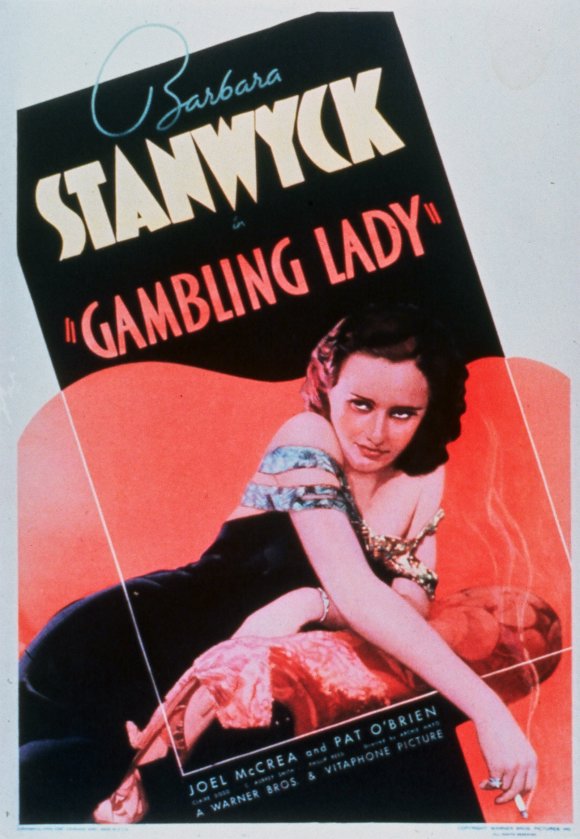
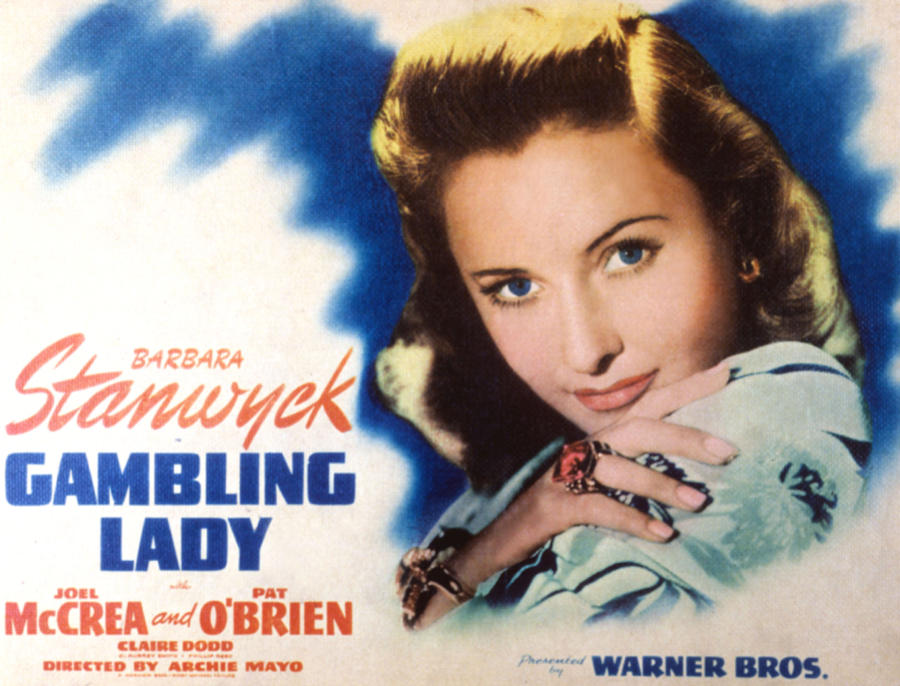
Gambling Lady (1934) is an engaging film, which stars Barbara Stanwyck as Jennifer "Lady" Lee.  When her father, Mike (Robert Barrat) kills himself in despair over his debts to a gambling syndicate, Lady seeks employment in the one occupation she knows - gambling.  Lady, like her father, is scrupulously honest, and takes a job with the syndicate on the proviso that they will run an honest game.  When she discovers they have lied to her (and have placed someone into the game who is systematically cheating), she resigns and begins working on her own.  While playing at a society party, she meets Garry Madison (Joel McCrea); they fall in love and he proposes marriage, to the concern of his father, Peter Madison (C. Aubrey Smith).  But Peter, a gambler himself who knew and admired Mike Lee, comes to realize that Lady's love for Gerry is true, and consents to the marriage.  However, the course of true love hits road bumps - the return of Garry's former girlfriend Sheila Aiken (Claire Dodd) and Garry's jealousy of Lady's friend Charlie Lang (Pat O'Brien).

This is a good, fast-moving film, with a lot of story packed into 66 minutes.  Stanwyck, as always, is excellent as Lady Lee, and her rapport with Joel McCrea (in their first of 6 films together) is evident. Particularly notable are two scenes: the first one has Lady playing cards with her rival Sheila, to Sheila's misfortune; the second immediately follows, and shows Garry and Lady frolicking in their bed as Garry tries to convince Lady to return Sheila's losses (this is, after all, a precode film). It's obvious in this second scene why Stanwyck and McCrea became a screen couple. When we viewed Banjo on My Knee several months ago (their second film together) we discussed their screen history.  For more information on McCrea himself, please visit our blog post on Rockabye.   The one criticism we have of his character in Gambling Lady is his jealousy towards Charlie - he should know his wife better.  She is the soul of honesty; how could he even THINK that she would cheat on him?
We like Pat O'Brien, but he is somewhat wasted in the film  - his screen time is small, and there are times when one wonders why Lady would pick Garry over Charlie (Garry can be quite petulant at times, while Charlie is always in Lady's corner).  But, O'Brien has the acting chops to stand toe to toe with Stanwyck, and that is important here - we HAVE to understand Lady's loyalty to Charlie, even though he doesn't always play an honest game.  And O'Brien has an inner integrity that makes his character almost admirable.


This is a film that is loaded with excellent character portrayals.  C. Aubrey Smith's Peter is one of them.  A man of honor, who loves his son and grows to love and even admire Lady, Smith gives us a memorable performance. A versatile actor, who could play sweet (as he does here) or vile (see No More Orchids for one of his more repugnant characters.)  Smith began his living as a professional cricketer, playing professionally from 1882-1890, and highly regarded as a bowler.  When he came to Hollywood, he continued to play, forming the Hollywood Cricket Club, with fellow actors David Niven, Laurence Olivier, Nigel Bruce, Leslie Howard, and Boris Karloff.  His acting career began in London - he, in fact, was the lead in The Prisoner of Zenda (returning to the story in the 1937 film version, in which he played the wise Colonel Zapt).  He worked in silent films in England, then ventured to Hollywood, where he became the unofficial head of the "Hollywood Raj," or British film colony.  In 1938 he was appointed a Commander in the Order of the British Empire, and was knighted in 1944.  Married to Isabelle Wood from 1896 until his death in 1948, Smith was an actor of note, appearing in such classics as The Four Feathers (1939), Wee Willie Winkie (1937), and Rebecca (1940).  His final film, Little Women (1949) was released after his death from pneumonia.


Claire Dodd is also quite entertaining as the evil Sheila Aiken; as mentioned above, her gambling scene with Stanwyck is one to see - two pros matching wits (Stanwyck wins, but Dodd gives her a run for her money).  We discussed her career in some detail when we saw her in Lawyer Man (1933).  This New York Times review was quite complementary - and justifiably so - of Ms. Dodd in the film.  Fellow blogger at Immortal Ephemera also singled out Ms. Dodd for praise.

As discussed in this TCM article, Stanwyck had some momentary trouble with director Archie Mayo when he tried to pinch her.  Not surprisingly, she handled the situation quickly and firmly (and he didn't do it to her again).

In 1949. Stanwyck would revisit the theme of gambling in The Lady Gambles, but the two films are in no way similar (the 1949 film is very much a social drama about gambling addiction).   We'll leave you with the trailer from Gambling Lady, and a hearty recommendation to give it a try: 

Friday, August 21, 2015

William Joins the Bar

Lawyer Man (1933) stars William Powell as Anton "Tony" Adam, a Lower East Side lawyer who demonstrates a skill in oratory that lands him a partnership with a highbrow, uptown law firm.  His secretary, Olga Michaels (Joan Blondell), accompanies him on his journey to the top, only to discover that Tony, who had professed love for her in the past, is now far more intrigued with his partner's sister, Barbara Bentley (Helen Vinson).  He's also very interested in publicity and big payouts.  As a result, he accepts the breach of promise case of Virginia St. John (Claire Dodd) - against the advise of his partner Granville Bentley (Alan Dinehart) and Olga.   Then, Virginia's lover Dr. Gresham (Kenneth Thompson) uses his reconciliation with her to have Tony tried for unethical behavior, with significant repercussions to Tony's personal and professional life. 

This is a fast-paced film, sometimes too fast, as the transitions from each stage of Tony's life can feel rushed.  Another problem with the film is that, though it is a film about the law, there are no courtroom sequences, something that was commented on in this Variety review and by fellow blogger, Immortal Ephemera.  We keep being told what a superb lawyer Tony is, but we never get to see him in action.  Perhaps because of the pace of the film, Tony feels like two different people - first he is the noble lawyer of the poor, madly in love with his secretary (though with an eye for the ladies), then he is the avaricious social climber, far more interested in a wealthy, upper-class matron.  However, it also seems that, despite his desires for fame and fortune, Tony never loses his belief in the law - evidenced by the statue of blind justice that accompanies him from office to office.
William Powell was not, it seems, the first choice for the role of Tony.  According to this TCM article, a news item in Film Daily noted that Edward G. Robinson was once considered for the lead. Powell is, as always, very good as the womanizing Tony.  Perhaps the hardest thing he has to do is make us believe that he can pass up Joan Blondell for Helen Vinson (I mean, really - is there even a contest?), but Powell gives Tony just enough naivety that you can see him being captivated by the power and class that Barbara represents.  

We've already discussed several of the 60 films that feature Claire Dodd: Our Blushing Brides (as a Mannequin - her first screen part), This is the Night (as the real Chou-Chou), Ex-Lady (as Iris Van Hugh, the "other" woman), and Ann Carver's Profession (as Carole Rogers, the drunken singer). Her role in Lawyer Man is quite short - she really has only a few scenes, but she is memorable as the vengeful Virginia St. John.  Ms. Dodd worked from 1930 til 1942 in a variety of parts.  Perhaps her most famous turn was as Della Street in two Perry Mason films - The Case of the Curious Bride (1935) and The Case of the Velvet Claws (1936).  In the latter film, she has the didistinction of being the only Della Street to actually MARRY Perry Mason!  When she remarried in 1942 (she was 40) she retired from film.  She already had one child from her first marriage - in the next 7 years, she had four more with her second husband.  Claire and her husband remained together until her death from cancer in 1973.

Though her part is relatively small, Joan Blondell is perfect as Olga.  Deeply in love with Tony, she refuses to play second fiddle to his fly-by-night attitude towards women.  It's clear that Olga will stick with him as a secretary, but her sassy attitude reminds him (and us) that she will not be second in his love-life.  It's hard to image anyone but Blondell in this part.  She has the vivacity, the beauty, but above all, the strength to make Olga credible. 

While as a whole our group did not rate this movie particularly highly, my fellow blogger at  Pre-code.com  and Mordaunt Hall at the New York Times gave it much more praise. I suggest you take a look at their opinions for more insight into this film. Pre-code.com also supplies some interesting perceptions into why Lawyer Man is definitely a Pre-code film (with photos!).

We close with the film's trailer. Next time, another pre-code gem:

Monday, November 3, 2014

Fay's a Lawyer

Sometimes watching a film so firmly set in its own time can be almost painful for a modern audience.  Such is the case with Ann Carver's Profession (1933).  Fay Wray plays Ann Carver, who has married her college sweetheart, "Lightning" Bill Graham (Gene Raymond) after both have worked their way through advance degrees - he as an architect, she as a lawyer.  Though Bill was a football hero in college, the real world places him into an architectural firm, where he gets to do the scutwork for very little money.  Ann has been unable to even find a job.  She's frustrated and Bill is eager to help her find a position.  So, when an evening arises in which he can sing his wife's praises to the head of a law firm, he does so, and Ann takes it from there, providing some advice that results in the firm's winning an important case.  Ann is on her way.

It's at this point that film becomes annoying.  There is no middle of the road for Ann.  As a successful lawyer she is selfish, rude, smug, and an all-around heel.  She becomes the stereotypical career woman - a man-eating viper who cares for nothing but her success.  SHE purchases a large house.  SHE hires many servants (why does a young married couple need a maid, cook, and butler anyway?) - Bill is not consulted.  After all, SHE controls the purse strings.  When she is forced away on business, Bill can't pay the staff - he has no access to HER funds.  All in all, he is humiliated in every way, and Ann, of course, is oblivious to his needs.  HER job comes first, especially since she is the big wage earner.

The biggest problem with the character of Ann is that she is so exaggerated. Her shift from frustrated housewife to power lawyer is dramatic and unrealistic.  This basically nice woman becomes a harridan for no real reason,other than absolute power corrupting absolutely.  It doesn't help that her rise to fame is so unrealistic - within a few weeks of being hired, she is a headline-making, major player in her law firm.   
Of course, this is a precode film, so we have a scene with Ann and Bill snuggling in their big double bed.  There is also Bill's "relationship" with Carole Rogers (Claire Dodd).  The consensus among our group was that there was a brief fling between the two;  however, Bill is ultimately disgusted with Carole's drunkenness and lewdness.  In spite of the affair, it's still hard to work up much sympathy for Ann.  She treats Bill as an appendage - someone to bring her to important work-related dinners - not as a husband.  Appearance is all that matters to her, and when Bill decides a career change will bring him more money, Ann is horrified - what will people think of HER with a "crooner" as a husband? 

We suspect not a lot of attention was paid to Ann Carver's Profession, as it was released the same year as another film starring Ms. Wray - King Kong.  She had already ventured into the land of horror that year (with The Vampire Bat and Mystery of the Wax Museum), but with the popularity of Kong, Ms. Wray became a staple in the genre, and was often called The Queen of Scream. 

Regardless, she had a long career - she appeared in films and on television as late as 1980.  Interestingly, she would marry the screenwriter for Ann Carver's Profession, Robert Riskin, in 1942.  They had two children and were together until his death in 1955.  Fay Wray died in 2004, at the age of 96.  

We'll close with a clip from the 1998 Oscars with Billy Crystal. A tribute to King Kong was part of the entertainment that evening, and Mr. Crystal surprised Fay Wray by introducing her from the audience.  

Oh, and Ruthelma Stevens was barely findable as a party guest.  A shame really...

Wednesday, July 9, 2014

Bette's Love Nest

In our continuing search for interesting pre-code films, we found Ex-Lady (1933) starring Bette Davis.  Ex-Lady is a remake of Illicit (1931), starring Barbara Stanwyck, which we discussed last year.  That the two were related was a nice surprise (thanks, Robert Osborne for the information).

Helen Bauer (Bette Davis) is in love with Don Peterson (Don Peterson); their affair is quite open, much to the disgust of Helen's father (Alphonse Ethier), who effectively disowns her.  Though Helen is convinced that marriage destroys love, Don convinces her that their marriage will work.  However, as Helen's reputation as a  commercial illustrator grows, and Don begins to have problems within their business, the couple's relationship begins to strain.  The intrusion of Nick Malvyn (Monroe Owsley) and Iris Van Hugh (Claire Dodd), former lovers of the Helen and Don, put more pressure on an already threatened marriage.

Davis' Helen is bright and ambitious.  She works for a living, and is good at what she does. Helen doesn't want children, she enjoys working, and she enjoys her freedoms.  Davis imbues Helen with an independence the pervades every scene.  As discussed in this TCM article, this was Davis' first headlining role. She would make her big breakthrough a year later in The Petrified Forest. 
Early in the film, we get a telling image of Helen's youth - a cold, authoritarian father and a passive, downtrodden mother (Bodil Rosing).  With that one scene, we begin to understand Helen's aversion to marriage, and her determination to not become the passive target of male domination.  It's also interesting that the parents are clearly immigrants, setting up a comparison between the Old and New World morals.  It also floats in a negative picture of European culture, in an era of increasing American isolationism. 

In contrast to Helen, Gene Raymond's Don is not exactly the brightest bulb in the pack.   He doesn't seem to know how to run a business - he and Helen go on vacation, but he doesn't leave proper instructions for his staff, and ends up losing accounts.  Helen, on the other hand, who works with Don, gains business, making Don petulant and resentful. 

We are increasingly impressed with Monroe Owsley.  He again plays a total rotter; he makes the character of Nick oily and rather revolting.  And even though this is a relatively short film (67 minutes), he manages to flesh out the character quite a bit. We discussed him at some detail when we looked at Ten Cents a Dance, and refer you there for more information on the brief career of this interesting actor.

In a New York Times review, we were presented with very negative comments on Davis' lingerie (the costuming was by Orry-Kelly) but positive remarks on the film's screenplay.  We rather liked the costuming and sets (by Jack Okey), and refer you to the scene below for a quick glimpse into the film.  Next week, we'll take a comparison look at Illicit