Showing posts with label Jerome Cowan. Show all posts

Monday, October 11, 2021

Bette Doesn't Age

Reknowned New York beauty Frances Beatrice "Fanny" Trellis (Bette Davis) is being pursued by most of the eligible bachelors in the City.  Fanny relishes the attention; even though she and her brother Trippy (Richard Waring) are deeply in debt. One evening, Mr. Skeffington (1944), Trippy's boss arrives to inform Fanny that Trippy has stolen $24,000 from his company.  Intrigued that Job Skeffington does not seem to respond like her other suitors, Fanny elopes with Job, alienating Trippy.

It's Interesting that the film is named Mr. Skeffington when Job disappears for most of the latter part of the film. As you can see from the Italian poster, they just changed the title to reflect the real focus of the film, the beguiling Fanny Skeffington. But the title change misses a point. Yes, the film is about Fanny, but it is Fanny as reflected by Job.  Even when he is gone, Job Skeffington is an influence on Fanny's life, much to her chagrin.

Bette Davis was not the first choice for the role of Fanny Skeffington - Katharine Cornell was originally approached; when she declined, Irene Dunne and Claudette Colbert also turned it down. Next up was Tallullah Bankhead; that deal was nixed by Hal Wallis (Dark Victory: The Life of Bette Davis by Ed Sikov), after which, Ms. Davis was approached. She was reluctant - she worried about the aging of the character, which originally had the story told in flashback (and Fanny going from old to  young and back again).  Adding to her anxiety, her husband, Arthur Farnsworth died just as production was to begin (TCM article),  Regardless of her fears, she is letter-perfect making it Fanny's charm that is the attraction, not her beauty.

The film, however, lives and dies on the character of Job Skeffington, and Claude Rains does not disappoint.  He is marvelous as a man floored by his love for a woman who is incapable of loving anyone but herself.  You might ask why such a sensible man would fall for such a woman, but Mr. Rains makes us appreciate his feelings, and his growing sorrow as he realizes that Fanny will never love him. Both James Stephenson (Mr. Stephenson died before production began) and Paul Henreid were considered for Job (AFI catalog).

Walter Abel (George Trellis) is also excellent as Fanny’s tolerant cousin.  A good man, who cares deeply for Fanny and Trippy, he also forms a bond with Job following Job’s marriage to Fanny.  George acts as a conscience for Fanny, reminding her when she is being more selfish than normal - not that she pays much attention!

There are some excellent performances by other members of the cast. Marjorie Riordan as the grown Fanny Rachel Trellis, who has lived in her mother's shadow all her life, is quite good as a daughter battling her dislike of her mother with her father's desire that she always treat her mother with affection. The trio of suitors played by John Alexander (Jim Conderley), Jerome Cowan  (Edward Morrison), and Peter Whitney (Chester Forbish) are delightfully ridiculous, with Jerome Cowan leading the pack in the last section of the film. 

New York Times review by Bosley Crowther was not enthusiastic. Regardless, the film did well at the box office.  It was adapted for the Lux Radio Theatre in October 1945 with Bette Davis and Paul Henreid as the two leads.

This is an excellent film, and while a tad long, well worth the time.  We'll leave you with a trailer:


Monday, June 14, 2021

Ann is Unfaithful

Christine Hunter (Ann Sheridan) returns home after a late party and is accosted on her front porch. She's forced into the house; we hear a scream and fighting. The next morning, her husband returns from a business trip to discover homicide detectives, a dead body, and his distraught wife. Our film this week is The Unfaithful (1947).

An exceptional cast and a tight script make this film thoroughly enjoyable. Led by the always excellent Ann Sheridan, the cast portray characters that feel like real people.  Ms. Sheridan plays Christine with an underlying insecurity that makes you believe she could be swayed by loneliness and grief. But her clear love for her husband, Bob (Zachary Scott) also makes us sympathize with her as her world begins to fall apart. The film reflects the aftermath of the war - an increasing divorce rate as couples who married quickly find that they are incompatible. Chris and Bob are not, but the misery brought about by wartime separation is really the crux of this movie.

Ms. Sheridan is ably supported by Lew Ayres (Larry Hannaford), an attorney who spends much of his time in the divorce court. Larry sees Chris and Bob as a model of marital happiness, so when the truth about Christine is revealed, he is as offended by her "crime" as her husband.  However, Mr. Ayres makes his character pull back mentally and apply some objectivity to the case, which also helps the audience to side with Chris.  

This was Mr. Ayres second film after returning from service during World War II.  He was derided before the war for declaring himself a conscientious objector. Though he refused to kill, he was was quite to serve as a non-combatant; he won three battle stars as a medic and chaplain's aide in the Pacific.  He returned to his film career, which must have seemed an impossibility at the start of the War - his studio (MGM) and the public were horrified at his unwillingness to kill the enemy - he continued working in films and television until two years before his death at age 88 (Washington Post obituary). 

Zachary Scott is frequently the villain in films, but not here. He's a loving husband who watches his life fall apart when his wife is assaulted.  Once he discovers Chris' indiscretion, Bob does come across as petulant. He is redeemed by his interactions with Eve Arden.

Eve Arden (Paula) steals the movie in her big scene with Zachary Scott. Paula, Bob's cousin, appears on the surface to be a completely thoughtless person - a gossip who rather dislikes her cousin-by-marriage and takes a certain amount of joy in putting Chris in her place. But when the chips are down, it is Paula who sees the truth in Chris' story, and is not going to let Bob get away with his judgemental attitude. It's a magnificent scene.

Normally, we enjoy Jerome Cowan (the Prosecuting Attorney), but he ends up being distracting more than convincing. We found that we sought out Larry Hannaford during the courtroom scenes. His quiet dignity made the courtroom scenes more believable.

The Unfaithful is loosely based on The Letter (1940); though much of script was unfinished when production started (TCM article). In his New York Times review, Thomas M. Prior (T.M.P.) was not impressed with the script, though he was full of praise for the three leads.

This is very much a film about forgiveness, and as Jeanine Basinger points out, the topic is unique in this post-war film (I Do and I Don't: A History of Marriage in the Movies). Clearly, the MPAA thought so as well, as they allowed a film about adultery to be shot, though with one proviso: "the MPAA agreed to allow this if the film clearly conveyed the message that divorce is undesirable" (AFI catalog). 

We really enjoyed this film and heartily recommend it. We'll leave you with the trailer:


Monday, January 11, 2021

Van Investigates

The murder of police officer Ed Monigan bring his colleague Mike Conovan (Van Johnson) to the Scene of the Crime (1949). Though the papers are accusing Monigan of being on the take, Mike does not believe Monigan was murdered because he was taking bribes. The investigation, however, is disturbing Mike's wife, Gloria (Arlene Dahl) - she's terrified her husband will end up like Monigan, and is doing everything in her power to convince Mike that there are other career options than the police force.

This was Van Johnson's first appearance in a noir-ish role, and he's good as the dedicated police officer. Conovan is the main focus of the film - it's all about his relationships with his wife, his fellow officers, the son of his deceased friend, and finally the criminals he has to deal with on a daily basis. If Mr. Johnson doesn't quite give us a tortured man, he does convey the conflicts that are plaguing Mike.

The more interesting character is Lili, played by Gloria DeHaven. We found ourselves comparing her (favorably) to Jane Greer in Out of the Past. Like Kathy, Lili is a character who is not all that she appears to be on the surface. She is seemingly an innocent, tossed by circumstances into a world of danger but as the film progresses, we learn much more about her apparent innocence. Ms. DeHaven does an excellent job in making you believe in the roller coaster that is Lili. 

Arlene Dahl has a much less appealing role. Gloria spends most of the film looking upset. She does have some very good scenes (especially one at the film's end), but the focus of the part is to make Conovan doubt his ability to perform his job. Ms. Dahl was not the first choice for Gloria - Donna Reed was originally cast in the part (AFI catalog).  In what could have been a thankless role, Ms. Dahl does make the audience like and sympathize with Gloria, which is important, otherwise Mike's dilemma is pointless.

Given that this is an MGM film (an unusual venture for them to take on a noir (TCM article)), the film is gifted with a number of excellent supporting players. Tom Drake, as the straight arrow cop - nicknamed C.C., is fine as the neophyte studying under Mike. Leon Ames (surprisingly, without a mustache!) is also good in the small part of Captain A. C. Forster, Mike's understanding chief. Donald Woods makes Bob Herkimer into a quite unlikable character -  a reporter who is after the story at all costs, and doesn't let a little thing like friendship get in his way. 

Two actors, however, dominate the supporting ranks. The first is John McIntire (Fred Piper), who is excellent as the veteran who is nearing the end of his career as an officer. He brings a sturdiness to the role that demonstrate why he has been one of Mike's mentors.  

The actor who steals the show is Norman Lloyd (Sleeper). A stoolie who works for Mike, Sleeper is extremely creepy. Mr. Lloyd makes no attempts to make Sleeper in any way attractive, yet as repulsive as he is, there is a sort of sick humor that makes you keep watching. A theatre actor, who worked on Broadway, with the Civic Repertory Theatre, with the Federal Theatre Project, and with the Mercury Theatre, he came to film-going public's attention as the title character in Alfred Hitchcock's Saboteur (1941). Throughout the 1940s and early 1950s, he had steady work as a character actor in films such as Spellbound (1945 - also for Mr. Hitchcock), The Green Years (1946), and Limelight (1952). But work disappeared when he was greylisted. Alfred Hitchcock came to the rescue with the offer of work as a director and assistant producer for Alfred Hitchcock Presents, over the objections of studio executives who felt that hiring Mr. Lloyd could be dangerous (The Hollywood Reporter).  He spoke about those years at the TCM Film Festival in 214. Mr. Lloyd really came back to the public's attention as an actor when he was cast as Dr. Daniel Auschlander in the show St. Elsewhere. Mr. Lloyd is retired now - he is 106 at the writing of this post, and speaks regularly with his friend, Ben Mankiewicz.

The New York Times review  by Bosley Crowther was lukewarm, though he enjoyed the performances of Mr. Lloyd, Ms. Dahl and Ms. DeHaven. We had one complaint about the film - it really could use a better title - one that actually conveys what the story is about. Other than that, we found this an enjoyable film and one worth seeing.  In the meantime, we'll end with the film's trailer:


Monday, October 19, 2020

Is Bill a Murderer?

Sailor Alex Winkler (Bill Williams) finds a large sum of money in his pocket. He tells dance-hall hostess June Goffe (Susan Hayward) that he must have taken it from Edna Bartelli (Lola Lane) after she got him drunk. They return to her apartment to return the money, and find her dead. June agrees to help Alex locate the murderer before Alex's Deadline at Dawn (1946).

At first glance, this appears to be another "we only have six hours to find the murderer movie," but the plot has more twists and turns than a pretzel, making it an interesting ride.  It gets a bit long-winded at times - there is perhaps a twist too many and the ending seems to come from nowhere, but this is an enjoyable picture that will keep you watching.

Susan Hayward creates an interesting character in June. She's just on the border of jaded - tough, but still possessing enough faith in humanity that she is willing to come to the aid of this naive sailor. June hovers on the edge of acceptance - she wants to believe in Alex, but her experiences in the Big City have left her cynical. The audience spends the movie waiting for her to abandon Alex and is relieved when she doesn't. Ms. Hayward is a good choice for the part — her strength makes it acceptable as June takes on the more traditionally masculine role, while Williams is the "damsel" in distress. The film marks Ms. Hayward's return to the screen after giving birth to twin boys (AFI catalog).
Though Alex, as played by Bill Williams, is likeable, he can also seem dull and repetitive. Thankfully, as the film progresses, he becomes less childlike and more responsible. Mr. Williams is able to grow Alex - the film open with him recovering from the mickey that Edna gave him. As the movie goes on, we are aware that Alex's head is clearing, and while he is still a babe in the woods compared to June, he's far more intelligent than the early scenes led us to believe. Mr. Williams, who married Barbara Hale the year this film was released, maintained a friendship with Susan Hayward after the film - which apparently was not an easy task for a woman as guarded as she was (TCM article). 

Paul Lukas (Gus Hoffman) rounds out the stars of the film as a cab driver who befriends the pair. Mr. Lukas makes Gus a cypher - why he would want to help the couple is mysterious, but, like June, he appears to believe sincerely in Alex's innocence and goes to drastic lengths to clear him of a potential murder charge. Gus gets the opportunity to orate on the more philosophical elements of the film that were inserted into the script by Clifford Odets.
There are a number of outstanding character performances, headed by Lola Lane as the thieving Edna. The opening sequence of the film (you can watch it below), shows a deep close up of her face, with a fly dancing around her - is she dead, you wonder. Her appearance in the film is brief, but pivotal. Ms. Lane is always a pleasure and sadly often under-utilized - she never got the screen time offered to sister Priscilla.

Marvin Miller (Sleepy Parsons), who would later gain fame as Michael Anthony in the TV show The Millionaire, is excellent as Edna's compatriot, a blind pianist. Osa Massen (Helen Robinson) is also convincing as a woman who is somehow tied into the crime. Jerome Cowan (Lester Brady) has a brief appearance as another suspect.  The one character we could have done without was the creepy Edward Honig (played by Steven Geray). He was a bit too icky as a dance hall patron pursuing June, and didn’t seem relevant to the story.

The story was reprized by the Lux Radio Theatre in May 1946 with Mr. Lukas, Mr. Williams and Joan Blondell in the lead roles. The movie received a lukewarm review by Bosley Crowther in the New York Times. And while we agreed with the Times that the ending came out of nowhere, a lot of things that throughout the film made no sense do coalesce.  We will mention that that a couple of us needed to rewatch the ending to grasp all that was going on.

If not everything makes sense in the film, one can assume, like Eddie Muller says in his introduction to the film, that it is "a dream." We'll leave you with that opening scene,  which starts the twisty road.

Tuesday, June 13, 2017

Dorothy is a Young Mother

Claudia and David (1946) picks up nearly four years after we left the Naughtons in Claudia.  Claudia (Dorothy McGuire) is very much involved in mothering her little son, Bobby (Anthony Sydes), with the assistance of Bertha (Elsa Janssen), who now serves both as nanny and housekeeper. While at a dinner party hosted by David's sister-in-law Julia (Gail Patrick), the Naughtons meet Elizabeth Van Doren (Mary Astor), a wealthy widow who wants to completely redesign the farm which she purchased some years before. David (Robert Young) is thrilled to be offered what he sees as a dream job, but Claudia becomes annoyed at the amount of time David is spending on the project, pulling him away from home for longer periods of time.

There was no difference in opinion on this one - the entire group enjoyed the film, and found the more mature Claudia very appealing.  Sure, we have an initial driving sequence where we discover that Claudia is a terrible driver, but other than that, you spend a lot of the movie rooting for Claudia (and conversely getting very aggravated at David for being a total jerk).  Dorothy McGuire gives us a Claudia who wants to be a good mom; we know that she learned from the best, and it is reflected in her attitude towards her child. Her irritation towards David is the result of his unjustified petulance. David is almost blase about his son's illness and is oblivious to Claudia's concerns when she suspects the little boy is ill. I found myself cheering when she told him off.
One scene in particular is very telling in demonstrating the growth of the character of Claudia. Confronted by Edith Dexter (Rose Hobart), the wife of neighbor Philip Dexter (John Sutton), who has been visiting Claudia and little Bobby (Philip had driven Claudia home the night before, when he realized her concern about her child's health), Claudia is able to ultimately disregard Edith's nastiness (Edith smacks Claudia across the face), and have a kind and moving heart-to-heart with the older woman. Claudia's gentleness of spirit shines through, and you can see her reflecting back the teachings of her mother.

It's always good to see Jerome Cowan (Brian O'Toole); and he is very good in the part of stage medium.  We did feel that Brian's telling Claudia that David is going to have an accident seemed a bit over-the-top for a man who is essentially a performer. It is perhaps that the screenwriter wanted Claudia to seem silly for believing him, but her naive belief in him isn't all that odd - he's summoned up memories of her late mother, and already convinced several of the other dinner-party attendees of his veracity. By the conclusion of the film, you do have to wonder if he really has ANY psychic powers.
This was Anthony Sydes first film; though his name was not immediately familiar, he had a respectable career as a child actor.   Most of us probably remember him as Thelma Ritter's son, Peter in Miracle on 34th Street (1947) or as Tony in Sitting Pretty (1948).  Born in 1941, he worked in films and television until he was 17 years old, after which, he joined the Army, serving two tours in Vietnam. His next career was as a professional auctioneer - he started an auction business and an auction college (to train new professionals in the field). His firm was still in business in 2015 when he died at age 74.  (For more information, see this obituary in The Hollywood Reporter).

For those of you who might wonder if the mustard bath that is used was actually a treatment of the time, it was. It was a long-time home remedy for fever.  By 1949, according to this Archives of Disease in Childhood article, it was considered by doctors, at any rate, as a way to keep parents busy until the doctor could arrive (back in the era of house calls!) -  much the way Philip sets Claudia doing tasks that will keep her occupied until the Doctor (Harry Davenport)'s arrival.

We also enjoyed John Sutton, who gave Philip a kindness that (for us) eliminated any thought of a pursuit of Claudia.  Sutton had a fascinating life - before becoming an actor, he worked as a tea plantation manager, a hunter, and a rancher; living in what is now Pakistan (where he was born), China, Malaya, and the Philippines. With over 103 film and television credits, he had an impressive career (usually as a villain or second lead) in such films as Jane Eyre (1944), Captain from Castile (1947), and The Three Musketeers (1948). He died of a heart attack in Cannes in 1963, age 54.
The New York Times review was fairly positive, though we think they were harder on Claudia then she deserves (and much kinder to David than HE deserved). There was a third Claudia film planned (AFI Catalog), but as Ms. McGuire and Mr. Young were never free at the same time, the picture never happened. Regardless, this is a nice conclusion to the series, and worth a visit.

Thursday, February 9, 2017

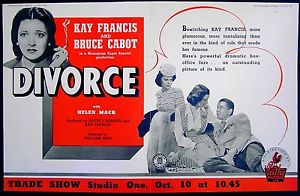
Kay is Divorced - a Lot

The "horror" of Divorce (1945) is the topic of this film, which stars Kay Francis as Dianne Carter, a four-time divorcee who has just shed her latest husband, gaining both her freedom and a pot of money.  Following the divorce, Dianne decides to return to her home town for a brief visit.  When she arrives, she reconnects with her former boyfriend, Bob Phillips (Bruce Cabot), now a real estate professional, happily married to Martha (Helen Mack) and the father of two sons.  But happiness is a relative term; once Dianne sets her cap for Bob, the marriage is doomed, and Martha has little recourse but to seek a divorce and try to start her life over.  

Kay Francis starred in and produced this, the first of three pictures with Monograph Studios.  Her contract with Warner Brothers was over, as was her work during World War II, and it seems that the idea of having more control over her films held some attraction (TCM article).  Like the film, Allotment Wives, this picture uses a growing social issue to attract an audience.  As the War ended, the number of divorces began to grow dramatically (see this article from the Washington Post), probably a result of the hasty marriages made during the war.  Regardless of the actual reasons for the rapid increase, the film looks at divorce as an evil, with the character of Dianne as a predatory homewrecker.  And while the plot is a bit simplistic, and some of the characters not entirely fleshed out, it does a decent job of setting a tone.
Though low budget, the film does recruit some strong actors, most notably Ms. Francis, whose performance gives a depth to the character of Dianne.  The other excellent performance is that of Helen Mack.  Her Martha is not a whimpering wife - Ms. Mack gives her a strength and pride that is not usual for the "loving wife" that she is being asked to play.  Within the context of the divorce, she juxtaposes nicely with Dianne, who has built her finances with the settlements from her multiple marriages.  Martha, on the other hand, refuses all monies from her husband, even child support - If Bob can not be an actual support for their children, she will work and support them both emotionally and financially. Her refusal to depend upon him both empowers her, and emasculates him.

Bruce Cabot, on the other hand, is a football, passed back and forth between the two women (interestingly symbolized by a football game early in the film, which Martha attempts with her two boys).  Cabot's Bob is almost passive - first guided by his wife, then abruptly manipulated by his former girlfriend.  That passivity makes it easy to understand why Dianne would even want him. He's quite a talented real-estate agent - Dianne sees both money and control in any relationship with him. According to the AFI catalog, Cabot was not the first choice for the role - it was originally earmarked for Paul Kelly (who would appear with Ms. Francis later that year in Allotment Wives). 
The presence of Jerome Cowan, playing lawyer Jim Driscoll, is another added pleasure.  We recently saw Mr. Cowan as the lecherous neighbor in My Reputation; his part here is not all that much bigger, but considerably more sympathetic.   A character actor who brings veritas to any role that he plays, Mr. Cowan appeared on Broadway beginning in 1923, and would continue appearing on stage until 1959 (his final stage appearance was in Say, Darling). His work on Broadway led to his casting in Beloved Enemy (1936), starring Brian Aherne and Merle Oberon (Mr. Cowan took on the role of the villain of the piece).  He worked continuously from then on - probably his most noted performance is that of Miles Archer in The Maltese Falcon (1941), but he was also excellent as one of Bette Davis' suitors in Mr. Skeffington (1944) and as the harried district attorney Thomas Mara in Miracle on 34th Street (1947). As the age of television began, he deftly moved into the medium, appearing as a guest star in such shows as The Twilight Zone, Perry Mason, and Bonanza.  His final appearance was on an episode of Alias Smith and Jones in 1971.  He died in January of 1972, survived by his two children and his wife of 43 year, Helen Dodge. 
One other appearance worth noting is that of Larry Olsen, as Michael Phillips, the older of the two boys so devastated by their parents divorce.  Mr. Olsen had a decent career as a child actor, but is bet remembered today as the older brother of Susan Olsen (of Brady Bunch fame). We will return again with another film from one of our favorite actresses. 

Monday, January 23, 2017

Barbara's Reputation

It's 1942.  Jessica Drummond (Barbara Stanwyck) has just buried her husband Paul, who died after a long illness.  He has left her financially secure - enough money to live comfortably and send their two sons, Kim (Scotty Beckett) and Keith (Bobby Cooper) to the boarding school Paul attended in his youth.  But with widowhood, Jessica finds that life in her suburban town is much different than she expected.  She is hounded by her mother, Mary Kimball (Lucile Watson) about proper behavior and finding a new husband (preferably Frank Everett (Warner Anderson) the family lawyer), is pursued by George Van Orman (Jerome Cowan), a would-be philanderer, and she finds she now that she is no longer part of a couple, she has no no real company except her maid, Anna (Esther Dale).  So, when her friends Ginna  (Eve Arden) and Cary Abbott (John Ridgely) invite her on a skiing tip, she desperately accepts.  It is there that she meets Major Scott Landis (George Brent), an officer awaiting permanent assignment abroad.  The two are quickly attracted to one another, but while Scott seems more interested in a fling, Jessica has commitment on  her mind.  Will the two be able to cross the abyss to create a lasting relationship? Thus begins My Reputation (1946).

Our entire group was very impressed with this film.  Yes, it has some of the tropes of a woman's film - the letchy married man, who thinks widows are fair game; the overbearing mother; the gossipy neighbors; the man who is "not the marrying kind" - but in many cases, the film upsets some of those tropes.  As a result, you watch with engagement.  It's not always apparent where the film is going to go next.

As always, Stanwyck is magnificent in a part that requires a lot of character growth (this TCM article is especially enthusiastic about her contributions to the film).  While it can be hard to imagine her as someone mother-pecked, she does it successfully.  Her frustration with her mother, and her initial inability to adapt to the world without her husband are not only convincing, they are spot-on.  We like her for her maternal instincts - to let her boys go away to school, as they and their father wanted.  But we ache for her loneliness, and her desire to just ask them to stay with her, if only for a little while.
The boys at first might seem a bit selfish.  But it is evident that Keith, the older of the two boys, is sensitive to the proprieties and to his mother's needs.  He tries to guide his younger brother, Kim.  But for Kim, the loss of his father has not yet hit home.  The action of the film opens the day after the funeral.  We know that Paul's death was far from sudden (we later find out he was in tremendous pain - assumedly cancer).  We can assume that not only were the boys aware that their father was dying, but that for several days, they've had to be on best behavior, and put up with adult funeral behavior (how many "I'm so sorry for your loss" can a child take?)   Though they love their mother, and want to be with her, they also want to break out.  The early desire to attend a baseball game not only allows them to become free of the funeral responsibilities, it provides a means to memorialize their father, who always took them to the game.  And Jessica understands and tries to allow them to begin the process of life over again.

There's no surprise when George is revealed to be a cad, or when or when Riette (Leona Maricle) is shown to be a harpy.  But, one is surprised when Mrs. Kimble turns out to be right about the town and the proprieties of mourning.  We want Jessica to be the one who is correct, but ultimately, it is her mother who has her finger on the pulse of the community.  A little calculation demonstrated that Jessica was a bit younger than her youngest son when Mr. Kimble died (her mother has been a widow for 25 years), and Mrs. Kimble has had to cope with life alone since then.  She wants her daughter to remarry (with her approval, of course), and she is a stickler for the conventions of mourning.  That she still wears black seems excessive; but Mrs. Kimble understands the responsibilities of being a widow raising children alone, and she wants more for her daughter.  We root for Jessica to find independence; but the film shows us that it comes with a price. 
George Brent treads a careful path with the character of Scott.  It would have been easy to make him either heroic or caddish - Brent makes sure he is neither.  As a man who never imagined himself within a family, he needs to grow and mature.  Though released in 1946, the film is carefully situated in the early years of the Second World War.  Scott is well aware that he will be going to fight.  His reluctance to take on the burden of a wife and family (that could be left alone) is understandable, as is his desire to spend time with Jessica, even if it means she will be away from her children.  But it also marks his innate selfishness, a trait that needs to change if he is to ever be a part of Jessica's life.   This was Mr. Brent's final film with Warner Brothers (AFI Catalog); the same year, he would portray Professor Warren in RKO's The Spiral Staircase.  

We wish there had been more of Eve Arden, who is a delight in everything she does.  Every moment with her is a gift - she plays Ginna as wry and amusing, but supportive to Jessica, and to her husband, with whom she has an easy-going and loving relationship.  With a career that began in 1937, and continued until 1987 (she died three years later, age 82), Ms. Arden spent much of her career playing the best friend (Mildred Pierce, for example), who knows the world WAY too well.  She segued from radio into television with Our Miss Brooks, where she got to play the lead as the smart and assertive Connie Brooks, a high-school English teacher (she also played Connie in the movie of the same name).  Married twice, with three children, Ms. Arden survived her husband of 32 years.  Her final appearance on television, in Falcon Crest, was with her dear friend, Jane Wyman.
The film features excellent performances by a number of child actors, notably Scott Beckett and Bobby Cooper, who play the Drummond brothers as good kids who are trying to cope with a new way of living. Janice Wilson, who we last saw in The Strange Love of Martha Ivers  plays Penny Boardman, a neighbor who is very attracted to Keith, and Ann E.  Todd plays Gretchen van Orman, the daughter of the rather nasty Riette and George.

Bosley Crowther, in his New York Times review, is being very cranky, we think, when he says the film is "much ado about nothing—or practically nothing."   We disagree and suggest you give it a viewing.  This trailer will give you a taste.