It’s a year After the Thin Man (1936) investigation, and Nora (Myrna Loy) and Nick Charles (William Powell) return to their San Francisco home on New Year’s Eve, To Nick’s dismays a command visit by Nora’s aunt, Katherine Forrest (Jessie Ralph) awaits them. It seems that Nora’s cousin Selma Landis (Elissa Landi) has been abandoned by her husband Robert (Alan Marshal), and Selma is frantic.
If this film doesn't quite have the magic of the original film, it's pretty darn close (and if you'd not seen the first one, you wouldn't care there was something better). Mr. Powell and Mr. Loy remain in top form, and Mr. Powell is given another character to bounce off - this time in the person of Jessie Ralph's domineering Aunt Katherine. Every time she calls him NICHO-LAAS, you fall down laughing.
What begins as a simple case of marital neglect becomes a series of murders, with Selma Landis as the key suspect. It's hard to sympathize with Selma - she's a doormat. Her husband is a boor, he's a serial philanderer, and she knows that he only married her for her money. When she begins begging him to return to her, one cringes. Selma has no gumption - she crawls to her husband and cowers from her aunt. Even her relationship with Nora - who really cares for her cousin - is that of a supplicant. It doesn't help that Ms. Landi really overacts the part.
That David Graham (James Stewart) would be passionately in love with Selma seems a stretch. The only time she seems to have rebelled against anyone is when she jilted David for Robert. But Mr. Stewart, who was starting to get lead parts (Born to Dance (1936) was released just before this film) is excellent in a very complex part. According to Ms. Loy's biography, he was thrilled to be in the movie, and ran around the set telling everyone "There ought to be a law against any man who doesn't marry Myrna Loy!" (Myrna Loy: The Only Good Girl in Hollywood by Emily W. Leider). They had already appeared in the same film (though with no on-screen time) in Wife vs. Secretary that same year.
This was the first big role for Dorothy McNulty (Polly Byrnes), who would change her name to Penny Singleton in 1938 (AFI Catalog) and go on to fame in the Blondie series - all 28 films of it. She's good in the part - Polly's a tough woman, and serves as an interesting counterpoint to Selma the wimp. In the long run, I think we ended up liking Polly a lot more (even if she is a conniver!)
Other supporting actors provide interesting performances. Joseph Calleia (Dancer) is properly menacing as the nightclub owner who is using Robert Landis for his own purposes. A short scene with Fingers (Harry Taylor), another of Nick's buddies, is very amusing. And finally, there is Sam Levene (Lieutenant Abrams), who takes on the part of the harried police officer. Mr. Levene is excellent, and he and Mr. Powell have the rapport that is necessary to make the relationship between the detective and the investigator work.
Asta gets a bigger part in this movie - he has a "wife" who is flirting with another dog, much to Asta's disgust. It's a cute bit, and was probably added because of the popularity of the animal from the prior film.
When Ms. Loy saw that she and Mr. Powell were being advertised as a screen team, she decided that receiving half the salary Mr. Powell was getting was not enough. So, she stood her ground and held out for an equal salary to Mr. Powell - and Louis B. Mayer gave it to her! (TCM article). And, if only for this film, Ms. Loy does seem to know how to knit.
The opening of the film makes of a big point of the fact that Nick and Nora are arriving in San Francisco on the Sunset Limited, a train that ran from New Orleans to San Francisco. Since, at the end of the first movie, the Charles' were on the train to San Francisco (and it is just after Christmas in that film), we know that the action in After the Thin Man is likely one year after the first movie.
The New York Timesreview by Frank S. Nugent was positive calling it "one of the most urbane comedies of the season". And indeed it is. We'll leave you with the trailer:
The disappearance of The Thin Man (1934), Clyde Wynant (Edward Ellis), and the suspicion that he is responsible for several murders, brings his friend, former police detective Nick Charles(William Powell) out of retirement. His wife, Nora (Myrna Loy) and their dog Asta come along to assist in the investigation.
The reasons this film is listed as an Essential (Jeremy Arnold The Essentials: 52 Must-See Movies and Why They Matter) are the two stars. The interactions between Ms. Loy and Mr. Powell are phenomenal. Their banter is clever and loving; it sparkles like the champagne they drink. It's easy to understand why the public thought them a happily married couple - they play the part so perfectly. As Jeanine Basinger said, "Loy and Powell know how...cooperate without losing individuality. They're Fred and Ginger OFF the dance floor" (I Do and I Don't: A History of Marriage in the Movies).
Ms. Loy had spent most of her career playing exotics. This role completely changed her image, and she would eventually do 14 films with Mr. Powell, six of which were part of The Thin Man series. She wasn't the first choice for the film - Louis B. Mayer wanted silent film star Laura LaPlante to play Nora, but director Woody Van Dyke, who had worked with her and Mr. Powell in Manhattan Melodrama (1934), insisted on Ms. Loy, and won the argument (TCM The Big Idea). She gives Nora an intelligence that, in lesser hands, would have made the character seem like a ditz.
Much of the credit for the success of the film goes to director Woody Van Dyke. He wanted the two actors to re-team, recognizing their easy relationship from his prior experience with them. He also encouraged his actors to be more spontaneous - when William Powell started shooting balloons off the Charles' Christmas tree with an air gun off-camera, Mr. Van Dyke just worked the routine in the the picture (TCM Behind the Camera).
Maureen O'Sullivan as Dorothy Wynant, the only appealing person in that family, didn't particularly like the film because her part was very small. She also disliked Mr. Van Dyke's fast shooting style - the film was completed in between 12 and 18 days (TCM The Essentials). Authors Albert Hackett & Frances Goodrich modified the character of Dorothy from the original Dashiell Hammett novel. Dorothy was far less appealing - "a rather silly, heavy-drinking girl" (Mystery Classics on Film: The Adaptation of 65 Novels and Stories by Ron Miller). This change works well, as it gives the audience someone who cares about the missing inventor with whom we can sympathize. Claude Wynant is not all that pleasant, and the rest of his family are distasteful. That we sympathize with Dorothy makes it more palatable that Nick would continue the investigation.
Thankfully, Nat Pendleton (Detective John Guild) gets to play a police officer who is good at his job. Sure, he's not brilliant like Nick, but he's smart enough to realize that he has the help of an outstanding detective, and he uses his colleague's skills with gratitude. We liked Detective Guild, and his easy relationship with Mr. Powell.
The film has the advantage of a number of excellent character performers. While all are pretty disagreeable characters, the actors give the right bite to their parts - Porter Hall as Lawyer MacCaulay, Minna Gombell as the unreliable former Mrs. Wynant (Mimi), and a very young Cesar Romero as her current husband, Chris Jorgenson.
William Henry, who Dorothy's odd brother Gilbert, would go on to have a long and varied career - the quintessential working actor. He appeared in films from 1925 until 1971 (in later years, often uncredited). In 1951, he added television to his credits, appearing in shows like Rawhide, Bonanza, and The Six Million Dollar Man (his final role). He died in 1982, at the age of 67.
While the ending is a bit convoluted - Mr. Powell complained that he was having trouble sorting out the complicated plot - the audience doesn't really care who did the murder, we are more interested in watching Nick figured it out. The popularity of the film, besides generating 5 more Thin Man films, also resulted is a spate of films that dealt with married sleuths like those found in There's Always a Woman (1938), Dangerous Blondes (1943), and A Night to Remember (1942). None of the copies were as good as the original.
The Thin Man received Academy Award nominations for Best Picture, Actor, Director,
and Adapted Screenplay. It also created a
craze for wire-hair terriers (though Myrna Loy said that Skippy, the dog who played Asta, bit her) (TCM The Thin Man).
The New York Timesreview by M.H. (Mordaunt Hall) called the film "an excellent combination of comedy and excitement," and other critics have also praised the film (TCM Critics Corner).
Mr. Powell and Ms. Loy recreated their roles for a Lux Radio Theatre broadcast on 8 Jun 1936. From 1957 to 1959, Peter
Lawford and Phyllis Kirk starred in a TV series, The Thin Man. It even generated a musical play called Nick and Nora, starring Barry Bostwick and Joanna Gleason, which opened on Broadway on 8 Dec 1991 (but closed on 15 Dec 1991) (AFI Catalog).
Jim (Cary Grant) and Muriel Blandings (Myrna Loy) are a happily married couple living in a three bedroom apartment with their two daughters, Joan (Sharyn Moffett) and Betsy (Connie Marshall), and their maid, Gussie (Louise Beavers). Jim is a successful ad man, making a nice salary, and while he loves his family, he yearns for a home with more room. When he stumbles upon an ad for a farmhouse in Connecticut, Mr. Blandings Builds His Dream House (1948).
If you’ve ever bought a house, redesigned your abode, or even picked out paint samples, this film is for you. The combination of Cary Grant, Myrna Loy, and Melvyn Douglas (Bill Cole) is a trio not to be missed. Add in a truly wonderfully supporting cast, and you have a VERY funny movie, which even today rings so true.
Cary Grant is delightful as a family man who is feeling the physical constraints of his crowded New York City apartment. It's very clear that the Blandings are well-off by contemporary standards. Jim makes a good salary, but there are limits, and Mr. Grant effectively pulls off the frustration of a man who is sinking his salary into a construction project that feels like a money pit. Some aspects of home buying have (thankfully) changed - no one today would dream of buying a home without a professional building inspection - but Jim's limitations as a home buyer add significantly to the humor in the film. Cary Grant and Myrna Loy did three films together (the other two are Wings in the Dark (1937) and The Bachelor and the Bobby-Soxer (1947)); this would be their final film together (TCM article).
Myrna Loy has long proved her talent for comedy, and her fine touch is demonstrated perfectly here. Her rapport with Mr. Grant is wonderful - an early scene, in which he brings her an early morning cup on coffee is a sweet comment on the intimacy of their marriage. As Jim hands her the cup, he lightly strokes the top of her head; she sleepily smiles. Later, as they try to perform their morning ablutions in their tiny bathroom, Jim gently pushes her head down so he can adjust the mirror on the medicine cabinet. It's those little touches that make this very much the story of a marriage. As Jeanine Basinger says, Ms. Loy "always remained relaxed, natural...There was an honesty to her, and a subtext that put her quietly in charge of everything." (I Do and I Don't: A History of Marriage in the Movies). One of my favorite scenes in the film is her selection of paint for the house. Think about the plethora of paint chips in the local paint store today!
The last member of the trio is the realist in their midst - Jim's best friend and lawyer, Bill Cole - who, it turns out, was also one of Muriel's beaux in college. Melvyn Douglas is wry (if somewhat frustrated) by Jim's impetuosity, and the contrast is wonderful. Their regard for one another is clear - even when Jim shows moments of jealousy, the audience knows it can't possibly last. Mr. Douglas had already appeared with Ms. Loy in Third Finger, Left Hand (1940), however they were close friends due to their mutual interest in liberal politics (TCM article).
Louise Beavers is terrific as Gussie, the one calm, practical member of the family. When all else is falling apart, Gussie keeps the home humming. Though her acting career was spent playing maids, she always brought warmth and dignity to the parts. She's best remembered today for films like Imitation of Life (1934), She Done Him Wrong (1933), and The Jackie Robinson Story (1950), and was one of three actresses to portray Beulah on television - the first television series to star an African-American actress. In her private life, she served as a board member for the Screen Actors' Guild (Hollywood Black: The Stars, The Films, The Filmakers by Donald Bogle). Her career is discussed in depth in African American Actresses: The Struggle for Visibility, 1900-1960 by Charlene Regester. Ms. Beavers died of a heart attack in 1962, at the age of 60.
The Blandings daughters are ably portrayed by Sharyn Moffett and Connie Marshall. Both girls stopped acting as they approached adulthood; Ms. Marshall died of cancer in 2001. Ms. Moffett and her husband are clergy in the Episcopal Church in Pennsylvania.
Other notable appearances in the film include Reginald Denny as Mr. Simms, the unflappable architect who keeps the Blandings house going; Ian Wolfe has one short scene as realtor Smith - a conniver if ever there was one. Lex Barker is a carpentry foreman in another brief speaking part. Jason Robards, Sr appears as John Retch, the contractor. But two actors stand out - Lurene Tuttle as Mary, Jim's loyal secretary (watch her as she waits for him to come up with an appropriate ad campaign for Wham!), and especially Harry Shannon as Mr. Tesander, who spends most of the movie looking for water. This exchange between Mr. Shannon and Mr. Grant and Mr. Douglas is priceless:
JIM: Water, Mr. Tesander.
TESANDER: Yep.
JIM: At six feet!
TESANDER: Yep.
JIM: And over there, just thirty-two yards away, you had to go down two hundred and twenty-seven feet to hit the
same water.
TESANDER: Yep.
JIM: How do you account for that, Mr. Tesander?
TESANDER: We-ll, way it seems to me, Mr. Blandings, over here the water's down around six feet and over there it's-- uh --
BILL AND TESANDER: down around two hundred and twenty-seven feet. (script).
The film was based on a book by Eric Hodkins and is a novelized account of a true story. Bosley Crowther's New York Times review was generally positive.
The story spawned an October 1949 Lux Radio Theatreproduction which starred Irene Dunne and Cary Grant, as well as a Screen Director's Playhouse production with Betsy Drake and Cary Grant in June of 1950 (AFI catalog). Mr. Grant and Ms. Drake also were the stars of the Mr. and Mrs Blandingsradio show in 1951.
New Yorkers all, we loved the introductory scenes of New York City, circa 1948. And we can certainly empathize with life in a NYC apartment. If you've never seen this movie, you'll find it a real treat (and if you have seen it, it's not a bad time to relax with the Blandings Family again). In the meantime, here's the trailer for a taste of what's to come:
The arrival of Lady Edwina Esketh (Myrna Loy) and her husband, Lord Albert (Nigel Bruce) in Ranchipur, India creates problems when Edwina becomes attracted to the heir to the throne, Major Rama Safti (Tyrone Power). Though warned to stay away from Dr. Safti by her former lover, Tom Ransome (George Brent), Edwina continues her pursuit, but has the misfortune for fall in love with the handsome doctor. However, everyone is threatened when The Rains Came (1939). The Rains Came feels like it should be longer than it is; so much happens, the characters grow so much, that you think it must be of epic length, but director Clarence Brown packs an awful lot into a running time of 103 minutes. Like so many of the movies from 1939, this is both an exceptional film and one that is not always remembered because it had so much competition the year of its release (how do you get noticed when you are up against Gone With the Wind, The Wizard of Oz, and Ninotchka?). It was nominated for six Academy Awards (winning in the newly created Special Effects category), but none of the marvelous cast were even nominated for their work. Let's start with Myrna Loy. She's cast against type (at least at this point in her career) as a harlot; there was some comment that she was not capable of playing the role (Myrna Loy: The Only Good Girl in Hollywood by Emily W. Leider). It's clear that Edwina lived with Tom Ransome before her marriage, and that she left him. It's also quite clear that marriage is no barrier to her bedding any man that intrigues her, and that Major Safti very much intrigues her. While Marlene Dietrich was considered for the part (TCM notes), Fox head Darryl Zanuck eventually borrowed Ms. Loy from MGM (in exchange for Tyrone Power's appearance in Marie Antoinette (1938)). Mr. Zanuck didn't make her life easy, however - Ms. Loy had been under contract to him and he'd let her go; he apparently resented her success at MGM, and was blatantly nasty to her (TCM article). She found support from director Brown, who told her "I think you're giving the best performance of your career." And she is (though she would later outpace herself in The Best Years of Our Lives). She takes a character who starts as a caricature of an avaricious woman, and as the story progresses matures her into a living, breathing person.
George Brent was also borrowed (from Warner Brothers) for the part that was originally intended for Ronald Colman (AFI catalog). Like Ms. Loy, Tom is a careless individual - the son of a noble (and with the possibility of eventually inheriting the title). He's lazing in India, supposedly painting a portrait of the Maharaja (H.B.Warner), but never getting it done. He's got a (well-deserved) reputation as a roué, and is finally being tested both by the tragedy that strikes Ranchipur, as well as the love that the young Fern Simon (Brenda Joyce) feels for him. Mr. Brent does a good job of turning Tom into a grown-up, and makes it an interesting process to watch. Tyrone Power is exceptional as Major Safti, a dedicated doctor who is next in line for the throne of Ranchipur. Both Charles Boyer and Ramon Novarro were considered for the part (Clarence Brown: Hollywood's Forgotten Master by Gwenda Young). That he is one of the most striking men on Earth doesn't hurt - when he is on screen, you can't take your eyes from him. In the hands of a lesser actor, Rama could be mere eye candy for Edwina to toy with; with a gifted actor like Mr. Power, we respond to him; he uses everything at his disposal to paint a picture of a man who is both attracted to and offended by this obvious - and careless - woman.
This is not just a film of stars. It is an ensemble with a host of gifted character actors. First and foremost is Maria Ouspenskaya (Maharani). An indomitable force, she too is hard to ignore on the screen. Playing a character who is a mix of Eastern and Western habits, she is a powerful woman who has both the strength and determination to lead her people. Born in Russia in 1876, Mme. Ouspenskaya acted with the Moscow Arts Theatre until 1922. While on a trip with the company to New York, she stayed behind, where she worked on Broadway (she ultimately would do 8 Broadway plays) and taught acting and ultimately founded (with Richard Boleslawski) the School of Dramatic Art. When money got tight, she moved to California and opened a dancing school. She also began appearing in films. She was nominated for the Oscar twice, for Dodsworth (1936, her first film), and for Love Affair (1939). She died as the result of a stroke, and a fire - the couch she was on caught fire from her cigarette.
Other notable cast members include Nigel Bruce as Lord Esketh, a totally reprehensible man, and an welcome change from the sweet, befuddled character he was usually forced to play; Jane Darwell as the common sense Aunt Phoebe, loathed by Mrs. Simon (Marjorie Rambeau as the snobby minister's wife), adored by Tom Ransome, and by her husband the Reverend Homer Smiley (Henry Travers as a good and loving man); Mary Nash as nurse Miss MacDaid, who despises Lady Esketh until she is forced to acknowledge her devotion to Rama and the injured of Ranchipur; and Joseph Schildkraut as Mr. Bannerjee, as Westernized India traumatized by the earthquake (and our question - what happened to Mr. Bannerjee??)
The weakest link in the film is probably Brenda Joyce as Fern Simon; she's not a compelling actress, and as a result the character is diminished by the strong performances around her. As a young girl who feels she is being choked by her parents, Ms. Joyce does project the necessary naivety required of Fern. Ms. Joyce worked primarily in B pictures; she succeeded Maureen O'Sullivan as Jane in the Tarzan series, working with Johnny Weissmuller and Lex Barker in that franchise. She retired in 1949 to raise her three children with husband Owen Ward (the marriage ended in divorce in 1960). She would later work in the Catholic Resettlement Office, assisting immigrants in their new country. She died in 2009 at the age of 92. According to this article, which looks at the film (and its remake) in comparison to Louis Bromfield's 1938 novel, the novel focused on the effects of the catastrophe on all levels of Indian life. A Photoplay magazine, however, published an article in which Mr. Bromfield commented on the 1939 version of the film. Not surprisingly, given the venue, Mr. Bromfield praised the film.
As previously mentioned, the film was remade in 1955 as The Rains of Ranchipur with Lana Turner and Richard Burton, with a much different ending. In March 1940, Lux Radio Theatre did a production, which featured George Brent, Kay Francis, and Don Ameche in the main roles. The New York Timesreview by Frank Nugent was not satisfied with the film, calling it "the merest skeleton of the Bromfield work, and that not too well reassembled." When the film was included in TCM's Summer Under the Stars day devoted to George Brent, TCM host Dave Karger provided some commentary on the movie and on Mr. Brent. Regardless of the review, this is a magnificent movie. Sure, it's a romance, but WHAT a romance! We wholeheartedly suggest you give it a viewing. In the meantime, here is the opening of film, with our introduction to Tom, Miss MacDaid, and Rama.
The war is over and three servicemen are on their way home. Sailor Homer Parrish (Harold Russell), bombadier Captain Fred Derry (Dana Andrews), and infantry Sergeant Al Stephenson (Frederic March) meet on the plane to Boone City. Each returns to family, but each has changed: Homer lost his hands when his ship was torpedoed; Fred saw his friend crash, and now has horrible nightmares, and Al is tormented by his memories of the men who didn't make it home. Are The Best Years of Our Lives (1946) behind them or still to come? In the first year of its existence (1989), the National Film Registry added The Best Years of Our Lives to its list of films of "enduring importance to American culture." And indeed it is. It is perhaps the best film of the post-war period, if not one of the best of all time. Directed by William Wyler after his return from the European Theatre of Operations, it was, in fact, his first film after spending over three years in bomber planes making documentaries for the U.S. Army Air Force. As a result of the noise in the planes, he lost his hearing, and was virtually deaf for several years. Wyler understood well the life facing disabled veterans. He therefore fashioned a movie (based on Time Magazine article "The Way Home," and a treatment by MacKinlay Kantor) that dealt with disability on a variety of levels. (For more on the film and it's creation, see this Film Preservation Board essay).
The most obvious examination of disability is the casting of double amputee Harold Russell as Homer. Unlike his character, Russell was injured in a training accident, and spent the war in the hospital. Mr. Russell was included in a training film Diary of a Sargeant (1944); when Wyler saw that film, he decided to change the character of Homer from a man suffering from severe spacticity. While clearly not an actor, Russell's gives a genuine performance; his scene, late in the film, with actress Cathy O'Donnell (as Homer's fiance, Wilma Cameron) is truly moving, giving real truth to the film.
Mr. Russell became the only actor to receive two Oscars for the same performance: he was awarded a competitive Oscar for Best Supporting Actor (the other nominees were: Charles Coburn in The Green Years, William Demarest in The Jolson Story, Claude Rains in Notorious, and Clifton Webb in The Razor's Edge), as well as a Special Oscar for "for bringing hope and courage to his fellow veterans." (TCM article). Years later, Mr. Russell sold one of the Oscars, in order to get funding for his wife's health care.
Fredric March won the Best Actor award that year, but Myrna Loyas his wife, Milly Stephenson didn't even get nominated! If anything is a travesty of the Oscars, it is the fact that she was NEVER nominated for Oscars for any of her wonderful performances. (The Academy did try to finally rectify the oversight in 1991 by awarding her an Honorary Oscar. You can see her acceptance here). Her performance as Milly is inspired. Watch her face as she realizes that Al is in the house. Then, see if you can refrain from tearing up as she explains to daughter Peggy (Teresa Wright, who was only 12 years younger than her on-screen mother) why even her "perfect" marriage has its challenges. Her quiet dignity, as she silently, but sympathetically, observes the changes in her husband are beyond stirring.
Dana Andrews (who also was not nominated for this picture) is excellent as a man returning to a wife he finds he no longer loves (Virginia Mayo as the rather despicable Marie Derry), and who is forced back into the same dead-end job he left to serve his country. Fred Derry is still suffering the effects of the war. He has vivid nightmares of the death of his friend, he feels ill-equipped to take on a more responsible job ("I just dropped bombs" is his response to any queries about his ability to prove experience based on his war service), and his wife only wants him to wear his uniform and party. It is in the company of Peggy Stephenson that he is able to find any comfort or understanding, but his marriage is a block that he can't get around. Mr. Andrews gives us a character that shows the most growth throughout the movie - he really does go from a boy to a man.
Though they only have a few scenes, Roman Bohnen and Gladys George as Fred's father and stepmother Pat and Hortense are magnificent. Their most powerful scene occurs towards the end of the film; the scene is a simple one - Pat is reading a document aloud to Hortense which explains the citation Fred received from the military. With just Mr. Bohnen's voice and Ms. George's eyes, we see the love and pain that they feel for their son. The war, we see, impacted more than those who fought. Equally effective is Hoagy Carmichael as Homer's uncle Butch Engle. Butch serves as the springboard to Homer's reentry into life - teaching him to "play" the piano, quietly encouraging him to open up to his parents and to Wilma, and perhaps more importantly, keeping him from slipping into alcohol as a refuge from his troubles. Another interesting casting note: Mr. Wyler used his 4 and 7 year old daughters in one of the drugstore scenes.
The film opened to enthusiastic reviews. The New York Times called it "this best film this year..." and Variety said it was "one of the best pictures of our lives." Since then, it has continued to be held in high regard, coming in at #37 in AFI's 100 Years, 100 Movies, 10th Edition (the same position as the original list) and at #11 in AFI's 100 Years, 100 Cheers. Richard Brody singled it out for a DVR alert in his New Yorkercommentary. It also was financially successful, earning over $11,300,000 in its first North American release. It was even re-released in 1953 to note the return of troops for Korean, to equally favorable reviews (AFI catalog). Yet, despite this, Mr. Wyler was called before the House UnAmerican Activities Committee - certain scenes were deemed Communist propaganda! If you have never seen The Best Years of Our Lives, we strongly urge you to get hold of a copy. It is worth your time. We'll leave you with the trailer from the film.
Magazine editor Margo Sherwood Merrick (Myrna Loy) is celebrating her first wedding anniversary alone. Or so her colleagues believe. The truth is, Margot is not married. Offered a promotion, Margot faked the marriage to discourage flirting by her boss Ralph Russell (William Halligan) and eventual firing at the instigation of his jealous wife (Marjorie Gatson). Her faux marriage also protects her from a number of unwanted suitors, including Philip Booth (Lee Bowman) and Hughie Wheeler (Sidney Blackmer). But when she meets artist Jeff Thompson (Melvyn Douglas), she begins to wonder about the benefits of that fictitious ring on her Third Finger, Left Hand (1940). When it's a Myrna Loy movie, you really WANT to enjoy it. She is always so wonderful. Add the engaging Melvyn Douglas to the mix, and you SHOULD have an delightful film. But good as they are, even these actors need a script, and Third Finger, Left Hand really doesn't have much of one. The initial idea is good - a woman who pretends marriage to deflect unwelcome male advances on the job (surely a timely plot!) - but at a certain point, the screenplay runs out of steam and the picture just gets stupid. For example, Margo has been carrying on this deception for a year, but she doesn't have a concrete description of her alleged husband, and each time she is asked, makes up a new (rather asinine) one. Her father (Raymond Walburn) and sister (Bonita Granville as Vicky) never asked to see a picture or to know what he is like? Margo should be smarter than that.
As a result, these two entertaining actors become irksome after a while, as they try to best and humiliate the other. If Margo is interested in Jeff, it's hard to imagine her as a simple housewife in Wapakinetta, Ohio. (We surmised that she will end up handling the business end of his art sales. He's really not all that good at it). Late in the film, the couple run into his neighbors from Wapakinetta, and Margo starts talking like a Brooklyn B-girl. Several members of the group were very distressed at her actions, though I myself found it fit revenge for his earlier behavior. Yet, there is so much plot between his actions and hers that it did, on many levels, seem out of place and inappropriate. It's as though the early chemistry between the two actors vanishes.
Not
that there is any particular chemistry with any of her other suitors.
Hughie, seen briefly, is a drunk, and Philip is boring. It's hard to
imagine the intelligent Margo with any of them. In the long run, she
would have been better off single.
There are several underused actors in the production, including Felix
Bressart (August Winkel) and Bonita Granville. It's a shame to waste
such talented people; when you see them in the cast, you expect them to
be integral to the plot. Regretfully, they were not. We thoroughly enjoyed the scenes with Ernest Whitman, as Pullman
conductor Sam. Viewed from a 21st Century perspective, Sam is a wonder. A
man eager to stimulate his mind, Sam has a law degree, which he pursued
to alleviate the sameness of his job. Sam, as a matter of fact, is a
far better lawyer than Philip, and proves an able adversary to Philip
when Jeff solicits his assistance. Sam is also African-American. Mr.
Whitman spent most of his career, not surprisingly, playing bathroom
attendants and African natives (The Road to Zanzibar). But he
also had a stage, radio, and a brief television career, appearing as
Bill Jackson in the radio and television versions of Beulah. He died in 1954, at the age of 61.
According to this TCM article, Ms. Loy and Mr. Douglas became lifelong friends. Their liberal politics and social activism united them. Ms. Loy supported Helen Gahagan Douglas when she ran for the U.S. Senate against Richard Nixon (Nixon accused Congresswoman Douglas of being a Communist. She was not, but it worked. He won the election. For more concerning the election, visit this New York Timesarticle.) Though reviews were not generally enthusiastic, this New York Timesreview was actually complimentary towards Ms. Loy and Mr. Douglas. The story was reused by the Lux Radio Theatre in September 1941 when they presented a radio version starring Martha Scott and Douglas Fairbanks, Jr. (AFI catalog). We'll leave you with the trailer from the film.
Reporter Jimmy Lee (Robert Montgomery) is deeply in love with novelist Mary Howard (Myrna Loy). But despite his numerous proposals, she refuses to marry him. Jimmy discovers that Mary has fallen in love with her married editor, Rogers Woodruf (Frank Morgan). Having read the novel on which Mary is currently working - in which she proposes that her heroine, in love with a married man, has a calm discussion with his wife, to talk about her desire to wed her lover - Jimmy knows what Mary has in mind. He decides the best course of action is to introduce Mary to Claire Woodruf (Ann Harding), without revealing to either of them their mutual relationship. When Ladies Meet (1933) will determine the future of both women's relationships. Though a pre-code film, this one is not really all that shocking. There's a lot of talk, but very little action. Mary has heretofore resisted Rogers' desire for a sexual relationship; just as she is about to give in, Jimmy blunders in and breaks up the rendezvous (certainly his intention!) We later discover from Clair that Rogers is a serial philanderer, and that Claire has turned a blind eye to it because she believes he really loves her. With the exception of some double-entendre blathering from Mary's friend Bridget Drake (Alice Brady), this is a pretty tame film.
That being said, this is an interesting and thoughtful movie, primarily because of the performances of Ann Harding and Myrna Loy. Ms. Harding presents a woman who is both dignified and understated. Even when confronted by betrayal, there is no hysteria, no over-emoting, just a quiet sorrow that is signified only with her eyes and her stance. Ms. Harding can break your heart with a glance.
Ms. Loy mirrors her in dignity playing a woman who is the ultimate idealist. When confronted with the realities of life, she too remains stoic. Her determination lets you know that her life will go on, and she will remake it. But we came away wondering how her new novel would end, with the author enlightened about the truths of life. We come to realize, thanks to the talents of these two excellent actresses, that Mary and Claire are very much alike in their attitudes and emotions. Interestingly, Ms. Loy became great friends with Robert Montgomery and Alice Brady on this production. Ann Harding remained distant from the "coterie of three." (TCM article)
Growing up with Frank Morgan as The Wizard does make it hard to see him as a romantic figure, especially one who is so deeply loved by these two remarkable women. It is certainly his skill as an actor that makes it obvious to the audience that Rogers is a cad. That he is so awfully unloving - more interested in the chase and in sex - becomes apparent later in the film. But Mr. Morgan does a good job in preparing you for this revelation.
Alice Brady seems to be present to provide the comic relief. Unfortunately, she becomes rapidly annoying. An Oscar-winning actress - she was nominated twice, and won for her role in In Old Chicago (1937) - in this film, it feels as though she is doing screwball comedy, while everyone else is
playing subtle humor and high drama. We felt that Bridget was too shallow a person, where the other characters are fully
developed. It felt as though Ms. Brady was
in a different movie. We wondered if a different actress in the part would have made a difference, and we may find out next week.
The film (based on Rachel Crothers' play, which was produced on Broadway in 1933) would be remade twice: once in 1941, with Joan Crawford, and again on 11 June 1952 as a ABC television presentation with Patricia Morison and Richard Carlson in the leads (AFI catalog). This film was nominated for the Best Art Direction Oscar, for Cedric Gibbons, whose sets are gorgeous (We were especially impressed with Mary's apartment). We'll leave you with this scene, featuring appearances by three of our leads. Next time, we'll be viewing the 1941 version.
Newlywed American Kit Preston (Doris Day) is wending her way home through a London "pea-souper". A voice in the night calls her by name, then threatens her life. Panicked, Kit runs home and tells her husband, Anthony (Rex Harrison). He reassures her that it is common London practice to try to spook people in a London fog. But the next evening, Kit receives a phone call from the same voice, again threatening to kill her by the end of the month. The police are summoned, but are suspicious that no one else heard the voice but Kit. Meanwhile, Kit becomes more and more terrified as the calls escalate - calls that no one hears but her. Our film this week is the mysterious Midnight Lace (1960). Our discussion started with a birthday toast to Ms. Day, who turned 95 on April 3rd. For several members of our group, this was the first time they had seen Ms. Day in anything but a musical comedy. And while her performance here is perhaps not as impressive as her work in Alfred Hitchcock's The Man Who Knew Too Much (1956), she is still excellent as the terrorized victim. According to the AFI Catalog, Ms. Day became truly hysterical (using as an inspiration for the scene a moment in her life when her first husband became abusive) and Ross Hunter had to shut down production in order to allow her to recover. If there is one problem with the film, it is that, in many respects, it has not aged well. Kit is so remarkably helpless. Sure, she's being stalked, and that is scary, but she does nothing to protect herself (she's wealthy - couldn't she hire a bodyguard?) She is aware that the police doubt her veracity, yet when her husband is finally in the house during one of the calls, she hangs up the phone before he can get on the extension (though why she doesn't just hand him the phone is another issue!) There are times when you want to shake her!
On the plus side, you have a real mystery, with a number of worthy suspects that keep you guessing throughout the film. We'll start with Roddy McDowall (who was odds on favorite among the newcomers to the film) as Malcolm Stanley, money-grubbing son of Kit's put-upon housekeeper, Nora (Doris Lloyd). He provides the character with just the right amount of sleaze and menace, and given that he really only has a couple of scenes, Malcolm is a character that stays in your mind as the action progresses. Mr. McDowall started his career as a child actor in the UK; in 1940, his family moved to the United States to escape the Blitz in England; by 1941, he was starring in John Ford's How Green was My Valley, and in 1943, he became the first owner of the collie America loved in Lassie, Come Home. Mr. McDowall worked steadily in Hollywood, in both film and on television; worked on Broadway (he was Mordred in the original cast of Camelot, and played Artie Strauss in Compulsion, the role assumed by Bradford Dillman in the 1959 film) and in regional theatre, making a reasonably seamless transition to adult roles. A highly regarded photographer, he worked for magazines such as Look and Life, as well as publishing several books in the field. He remained close friends with his Lassie co-star, Elizabeth Taylor, was also a dear friend of his Midnight Lace co-star, Myrna Loy (he called her "Fu" because of her early role in The Mask of Fu Manchu), and was known for his parties, in which he would screen classic films for his guests. Winner of both a Tony Award and an Emmy, Mr. McDowall died of lung cancer in 1998 at the age of 70.
Herbert Marshall has a few scenes as Charles Manning, another possible culprit. A deep-in-debt gambler, Charles COULD be trying to kill Kit to distract Tony. Marshall, unfortunately, has little to do in the film; mostly, he looks worried and distracted. It's always good to see him, but he really is underutilized in the part. John Gavin's Brian Younger at first seems like a nice guy, who is always in the right place at the right time, but then there are those mysterious phone calls from the local pub. What IS he up to? Gavin, an amazingly attractive man, is well cast here, though I would say his perfect part was as Trevor Graydon in Thoroughly Modern Millie (1967), in which he mocks his white-bread good looks. A reasonably successful actor, who appeared in Spartacus (as Julius Caesar) and Psycho (both 1960), Mr. Gavin would leave film and television work for a career as a diplomat (Ambassador to Mexico) during the Reagan administration. Currently retired after a successful business career, Mr. Gavin and his wife Constance Towers have been married for over 40 years.
Finally, there is a half-hearted attempt to make Kit's Aunt Bea Coleman (Myrna Loy) appear to perhaps be in cahoots to drive Kit crazy. But really, Myrna Loy? Her role as the reassuring voice that attempts to soothe the increasingly agitated Kit is very small, but she is a welcome presence in any film. A noted liberal, Ms. Loy related in her autobiography Myrna Loy: Being and Becoming that she cautioned conservative John Gavin about being seen with her - she stated that he must have been, since he "rode Reagan's coattails right into an ambassadorship."
The voice that plagues Kit is discussed in this TCM article, comparing it unfavorably to something that "now it sounds like a character on The Cartoon Network."
And while that is true, we did find the voice unnerving enough that, if
we received a call like that, we'd be calling the police
as well. Wacky, perhaps, but also unsettling.
Doris Day has 17 glorious outfits designed by Irene in the film. The decision by the group was that the one above, was our favorite (I'm a sucker for hats that match a dress!) The midnight lace of the title was a jet black lace pegnior, that was probably the most ordinary of the items of clothing Ms. Day wears. Several of the outfits are viewable on Google Images.
The film opened to moderate reviews (see this Bosley Crowther overview from the New York Times).
In New York City, it premiered in Radio City Music Hall (along with a
new stage show and The Rockettes), always a sign of a prestige film.
We'll leave you with this trailer from Midnight Lace.
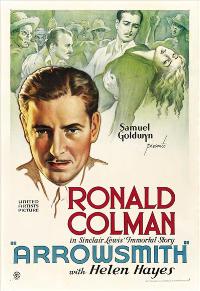
Ronald Colman plays a physician with an interest in research in Arrowsmith (1931). Dr. Martin Arrowsmith (Colman) knows from early in his career that he wants to do big things. He wants, he tells his mentor Dr. Max Gottleib (A.E. Anson) to cure cancer. But when he meets and falls in love with Leora Tozer (Helen Hayes), Arrowsmith decides to set up a clinical practice in a rural area, where he can make some money to support what he hopes will be a growing family. But research is in his blood, and he begins to work on a finding a cure for Black Leg Disease, a bovine infection that is decimating the area. His success leads to an offer to join the prestigious McGurk Institute in New York City, where, he hopes, he can begin to cure the ills of mankind. Based on the novel by Sinclair Lewis, Arrowsmith is a layered film, though drastically shortened from the novel. Helen Hayes, whose wonderful portrayal of Leora gives us a strong but insecure woman, alleged that director John Ford excised much of the script in order to shorten the production time - she claimed that as he had promised to not drink during the filming, he was in a hurry to finish the film (this TCM article outlines the story that is included in her autobiography, My Life in Three Acts. In John Ford: Hollywood's Old Master by Ronald L. Davis, the story is elaborated on to discuss in a bit more detail the affection that resulted between Hayes and Ford.)
In spite of Ford's alleged trimming of the plot, the film still retains a lot of depth and character development. Martin Arrowsmith is carefully played by Colman, and he makes the relationship between Martin and Leora especially poignant before and after her miscarriage. While Martin is always genuinely caring of her, once she loses their child and is told she will not be able to conceive again, his attentions shift more towards his work. Is Arrowsmith afraid of losing Leora, or does he have problems confronting a life without the family for which he sacrificed his early career? Having married a nurse, it would seem obvious that Leora would become a helpmeet in his research, but, with the exception of one scene, she does not. In fact, there are no women scientists in this film (it is the 1930s, after all), and often the female characters are given short shrift. But, regardless, the story and Colman's portrayal document a marriage that is loving, but tenuous at best. John Ford: The Man and His Films by Tag Gallagher looks briefly at the marriage of Martin and Leora (but be aware, there are spoilers here). In a brief role is Myrna Loy as Joyce Lanyon. In the novel, the character of Joyce was much more substantial, and figured heavily in the conclusion of the story. Though filmed in the pre-code era (see this commentary by my fellow blogger at Pre-code.com), this movie is remarkably tame. There is a hint of attraction between Joyce and Martin (is there an affair? It's not clear. In the book, there is some kissing, but nothing more), but the film does not dwell on any possible infidelity. Still several years away from her breakthrough role in The Thin Man, Ms Loy was still being cast as the vamp or the exotic, so it is not surprising her part is so suspicious. But even a brief appearance by Myrna Loy is welcome, and she does not disappoint. (For more information on the MPAA and the film, see this listing from the AFI Catalog).
In an even more brief appearance is Beulah Bondi as Leora's mother. She has all of one scene, and gets to say very little. Too bad, as Ms. Bondi is an asset to any film in which she appears. Born in 1889, she began her career at age 7 in her hometown of Valparaiso, Indiana (playing Little Lord Fauntleroy!) After receiving a master's degree in oratory at Valparaiso University, she began to get roles on Broadway (she would appear in 11 Broadway productions in her lifetime) in plays such as Street Scene and Rain (a part she would reprise in the screen version starring Joan Crawford). One of the first actresses to be nominated in the category of Best Supporting Actress (for her work in The Gorgeous Hussy) by AMPAS, she never won an Oscar (she was nominated one more time for Of Human Hearts). Interestingly, she played the same character three times, over a span of 18 years, appearing in On Borrowed Time in the 1939 film, the 1953 Broadway production, and a 1957 Hallmark Hall of Fame TV version. With 86 film and television credits (many of them named Granny or Mom), she is probably best remembered as James Stewart's loving mother in It's a Wonderful Life (though one of my favorite Beulah Bondi moments is her dance with Ginger Rogers in Vivacious Lady!). Her final role, in a career of 49 years, would be an Emmy Award winning performance in The Waltons. She died in 1981, at the age of 92. This TCM tribute to Beulah Bondi is well worth a viewing:
It is important to mention the presence of Dr. Oliver Marchand, as played by actor Clarence Brooks. Dr. Marchand is of African descent, and is treated by Drs. Arrowsmith and Sondelius (Richard Bennett) with respect and courtesy. Though a small part, it is a remarkable one, given the time period. Dr. Marchand is shown a competent doctor, concerned with in the health of his patients, with an understanding of Arrowsmith's need to check his research with a clinical trial. Marchand is willing to have his patients serve as test subjects, as it means many who would other die will survive. That a man of color in the 1930s was shown as a knowledgeable professional is something that should be noted. One interesting aspect of the film is the need for Dr, Arrowsmith to prove his theory on the plague vaccine with a clinical trial. The film gives us both a population who refuse to be "guinea pigs" (even though the serum may save some of their lives), and another population who willingly participates. But, like Dr. Ehrlich's Magic Bullet (1940), the clinical trial is shown as something that prevents patients from receiving medication that will save their lives. In the 21st Century, we have embraced the notion of the clinical trial, but in the era of heroic medicine, the clinical trial was seen as an unnecessary delay in delivering a cure.
We'll leave you with an early scene in the film in which Arrowsmith learns the joys of primary care medicine.