George Steele (Pat O'Brien) assaults a police officer trying to get into the Manhattan Museum, where George works. George is confused, and says he was in a train accident. But Lieutenant Cochrane (Wallace Ford) from the police detective unit assures him there have been no train accidents in over seven months. Is George about to Crack-Up (1946)?
Pat O'Brien gives a good performance as a war veteran who genuinely believes he was involved in a train wreck, but can't prove it. If there is one problem with his portrayal it is that Mr. O’Brien is obviously too old (he was 47 when the picture was released) for the part he is playing. That aside, you do believe him both as a man being driven to the edges of sanity, as well as an intellectual with a deep interest and knowledge of art history. Mr. O'Brien's did only one other film noir, but he makes the most of it in this outing (TCM article).
He's well matched with Claire Trevor (Terry Cordell), herself a veteran of films noir. She'd already done one notable noir - Murder, My Sweet (1944), and would win an Oscar for her performance in Key Largo (1948) two years after our film. It's a shame she doesn't have more screen time, but when she does appear, either working with Mr. O'Brien as his love interest, or with Herbert Marshall (Traybin), she takes command of the screen.
Though Herbert Marshall's part is small, he is used to good effect. You are never quite sure of the reliability of the character. Ray Collins (Dr. Lowell) is also in the same position. By keeping the characters ambiguous, the audience is kept engaged in the action.
One small oddity in the film comes at the beginning. During an art lecture given by George Steele to a group of museum donors, Steele compares an old Master to a modern painting (which bears a passing resemblance to Dali), and trashes the modern painting. He is interrupted by an angry man in the audience; the man speaks with a distinct foreign accent and is nearly hysterical in his passion for the modern piece. It's an odd insert into the movie. As Derek Sculthorpe points out in his book on Claire Trevor (Claire Trevor:The Life and Films of the Queen of Noir), the screenplay seems to be linking modern art to radicalism - an acknowledgement to the increasing Red scare?
Based on the story Madman's Holiday by Fredric Brown, the film was not well received; Bosley Crowther's New York Timesreview found him "overwhelmed by [the film's] inadequacies." Regardless, in December 1946 Lux Radio Theatre did a production with Pat O'Brien and Lynn Bari. (AFI catalog).
While this is by no means a perfect movie, it certainly is worth a viewing, if only to see this very good cast work together. We'll leave you with a trailer:
Newly married diplomat David Talbot (William Powell) is celebrating his three-month anniversary with his wife, Lucienne (Hedy Lamarr) when he receives a message, addressing him as Jean, and informing him that he needs to repay a million franc debt by tossing the money over a fence near a deserted farmhouse. Talbot decides to do so, but after advising the police that he is being blackmailed. At the trial, the accused claims that Talbot - who lost his memory after nearly dying in a train accident - is in actuality Jean Pelletier, a thief. Our film is Crossroads (1942), and is posted to celebrate William Powell's day on Summer Under the Stars.
It's always a pleasure to see a William Powell film, and this one is no exception. He brings gravitas to any part he plays, and ably fits the bill of a diplomat. Mr. Powell had played amnesia for laughs in I Love You Again (1940). Here, he brings sympathy to this man who has had to reconstruct his entire life following his near death accident. His relationship with Ms. Lamarr as his stalwart wife is convincing (though, as we'll discuss later, she is severely underutilized). He also is able to make the audience wonder throughout the film how much truth there is in the accusations leveled by his nemesis, Henri Sarrou.
It's a shame Hedy Lamarr has such a small amount of screen time. Her early scenes with Mr. Powell bring some humor to an otherwise serious film, and the conclusion of the film uses her to good effect. She would later work with him in The Heavenly Body (1944). Certainly, she does not have the chemistry with him that he had with actresses like Myrna Loy, but we believe in their romance.
Marlene Dietrich was offered the role of Michele Allaine, but turned it down (TCM article); regardless, Claire Trevor is convincing as David's alleged former lover, and really a better fit for the role. Ms. Trevor keeps the viewer wondering - especially interesting is a scene in which a locket with a surprising photograph is dangled before the eyes of David's wife - just enough out of range that she cannot see it, but close enough to cause David - and the audience - concern. It's Ms. Trevor's adept handling of the scene that makes the audience hold their breath as the action proceeds.
When you have Basil Rathbone (Henri Sarrou) in the cast, you know you are in for a good time. Sure, it's hard to believe in the early scenes that he really is David's rescuer (of course, we are right - he is not), but wow, he is suave and scary as the head of the blackmail ring. It is because of the interplay between Mr. Rathbone and Mr. Powell that you are never quite sure who to believe. They verbally duel, and they make it easy to believe the one or both is hiding more than they are revealing.
Margaret Wycherly (Mme. Pelletier) is excellent as an old lady, allegedly the mother of Jean Pelletier. Ms. Wycherly is a character actor who can turn on a dime - she can go from the sweet little old lady to the she-devil in the blink of an eye. She's probably best noted for her performance as Cody Jarrett's Ma in White Heat (1949). Two other actors of note in the film are Felix Bressart as Dr. Andre Tessier and Sig Ruman as his nemesis in court, Dr. Alex Dubroc. Their scenes together are well done, and Mr. Bressart is enjoyable as David's doctor, friend, and supporter.
Crossroads was based on the screenplay for a 1938 French film, Carrefour, and had several working titles during production: The Man Who Lost His Way , 'Til You Return and The Man from Martinique (AFI catalog). The New York Timesreview by Theodore Strauss (T.S.) was not enthusiastic - except for Mr. Powell, calling him "particularly, flawlessly urbane and crisp...an actor whose talent for
under-statement is perfectly adapted for a melodrama of this genre." The story was reprized with a Lux Radio Theatrebroadcast in March of 1943, with Lana Turner and Jean Pierre Aumont in the lead roles.
We enjoyed the film greatly, and recommend it for your viewing pleasure. In the meantime, here is a trailer:
Valerie Stanton (Rosalind Russell) a star of the theatre, has spent her career in light comedies, but she wants to try her hand at more serious plays. She’s been offered the lead in Hedda Gabler, and she's eager for the opportunity. But she is being thwarted by her manager, Gordon Dunning (Leon Ames) who has also been her lover. Dunning threatens to tell her fiance, Michael Morrell (Leo Genn) of her past. As they argue, he physically attacks her. In a panic, she strikes him with a trophy. With Dunning dead, Valerie is in faced with owning up to the event or trying to hide it. Our film is The Velvet Touch (1948)
Rosalind Russell leads an exceptional cast in this noir drama, which concerns itself with the impact of guilt on our lead character's life. Valerie is less afraid of getting caught than she is of living with her crime - if the death of Gordon Dunning can really be labeled a crime. Leon Ames plays Dunning as a cruel, careless bully. He's discarded his former lover Marian Webster (Claire Trevor) in favor of Valerie. He controls Valerie, as we can assume he did Marian. When Valerie seeks to end their relationship, he threatens her, not only with a revelation of their past to her new love, but also with death. When she hits him, there is a real sense of danger - it does appear he is about to strike out at her. It's because of Mr. Ames that we can sympathize with Valerie throughout the film.
The Velvet Touch was the first film made by Independent Artists, the production company formed by Ms. Russel and her husband Frederick Brisson (TCM article). Mr. Brisson first saw Ms. Russell when she appeared in The Women (1939). Immediately smitten with her, he later asked his friend, Cary Grant, who was filming His Girl Friday (1940) to introduce him to her. Mr. Grant did (he brought Mr. Brisson along on a date he had with Ms. Russell). The rest is history - the couple married in 1941, had a son, and were together until Ms. Russell's death of breast cancer in 1976. Rosalind Russell started her career on Broadway, so the setting of this film was not unfamiliar to her. In the 1950s, she returned to Broadway to make Wonderful Town and Auntie Mame - and starred in the film versions of both plays (and if you've never seen Auntie Mame, walk, don't run to get access to a copy). Before doing Wonderful Town, she appeared in the film My Sister Eileen (1942), upon which Wonderful Town was based. She won the Tony for Wonderful Town, and was nominated for Auntie Mame. Nominated 4 times for an Oscar, she received the Jean Hersholt Humanitarian Award in 1972
Claire Trevor gives us a characterization of a bitter, but weak, woman. It's almost unbelievable that she could have feelings for a heel like Dunning, but Marian is so dependent upon him for her self-image that she is lost by his abandonment and by his death. Ms. Trevor, an actress who spent her career in character parts, appeared in another movie the same year as this one - Key Largo, for which she was awarded the Oscar for Best Supporting Actress (Her competition that year was impressive: Agnes Moorehead in Johnny Belinda, Barbara Bel Geddes and Ellen Corby in I Remember Mama, and Jean Simmons in Hamlet.) This snippet from TCM features Ms. Trevor discussing her work on Key Largo - it's a fascinating story. The actor that really gives Ms. Russell someone to bounce off is Sydney Greenstreet, in his final film (he would continue his radio career for several more years). His Captain Danbury is a cuddly detective, whose warm familiarity hides an intelligent, observant man. How much he knows and when he knows it is always the question in this film. And though the audience sympathizes with Valerie, we like Danbury and almost want him to succeed.
It is worth mentioning that we have some familiar actors in supporting roles. Frank McHugh as stage manager Ernie Boyle is always amusing; Dan Tobin as Jeff Trent appears in a few scenes, and Lex Barker as young actor Paul Banton was just two years into his film career. We were excited to see Theresa Harris (Nancy) as Valerie's maid. Yes, she's a maid again, but Ms. Harris shines in everything she does, even with a role as minimally written as Nancy. The costumes by Travis Banton are wonderful - we were especially impressed by a cape decorated in gold (yes, it's a black and white movie, but we know gold when we see it!). If we have any complaint at all with the film it is the ridiculous title song, which must have been written for another film. Don't listen to it when you watch the film - it will make you NOT want to watch the film!
Ms. Russell and Mr. Greenstreet reprised their roles for the Lux Radio Theatrebroadcast in January 1949 (AFI catalog). As demonstrated by the poster above, in one Latin country, the film was released with the title Hedda Gabler (which must have confused some audience members)! Not surprisingly, Bosley Crowther in his New York Timesreview was dismissive: "a long and tortuous survey of Miss Russell's efforts to elude discovery
as the rather obvious murderess and get on with her promising career." We disagree - this is an enjoyable film that illustrates the impact of guilt on a good person. We'll leave you with the opening scene from the film, and a suggestion that you take a look at it.
When a rainstorm floods out a train trestle and strands her in the boom town New City, Texas, Lucy Gallant (1955) (played by Jane Wyman) realizes she can make her fortune by selling the nouveau riche clothing from New York and Paris. With the help of local banker Charlie Madden (William Demarest), the owner of the local brothel Lady "Mac" MacBeth Claire Treveor), and rancher Casey Cole (Charlton Heston), Lucy opens a store. But the success of the store creates a barrier between her and Casey - he wants a stay-at-home wife, and Lucy loves working. I try to not give away the ending of films as a rule, but as our major issue with Lucy Gallant was the ending, I'll have to do a bit of a spoiler. We had thoroughly enjoyed it up until the last scene, but the standard 1950s woman as "handmaiden to her man" routine was irritating. The character of Lucy Gallant is so attractive - she's smart, clever, imaginative, kind, and loyal - it's hard to see her giving up her dream because some man doesn't want his wife working. We found ourselves coming up with a five years later scenario in which Lucy was back running her beloved store. Based on a novella, The Life of Lucy Gallant by Margaret Cousins, this is an interesting portrait of the women in New City. The characters of Lucy, Molly Basserman (Thelma Ritter) and Mac are carefully drawn. All are strong characters, well able to take care of themselves (and often having to do so). The script is not so careful of the the men. Casey begins as gentleman-ly and rather attractive, but deteriorates into a petulant, chauvinistic caricature. Gus Basserman (Wallace Ford) may have found oil, but he remains a crude drunk, Jim Wardman (Tom Helmore) is your typical northern carpetbagger, and Charlie Madden is a weakling. In fact, the only reliable male here is Summertime (Joel Fluellen), who remains loyal to Lucy through every crisis, but as an African-American is relegated, per the mores of the time, to being the doorman at Gallant's.
Jeanine Basinger, in her book A Women's View: How Hollywood Spoke to Women 1930-1960
posits that the film equates Lucy's life in the
department store as a prison, where freedom is marriage and children. But I would suggest there is another subtext in the film, much more hidden, and possibly more critical of the role Lucy assumes at the film's conclusion. The biggest advocate for Lucy's marriage to Casey is Molly Basserman. At the beginning of the film, Molly runs a boarding house while her husband wildcats for oil. Later in the film, we see Gus Basserman drinking and whoring. Finally, Lucy discovers that Gus has purchased a very expensive fur coat for another woman, and it appears that Molly is blissfully unaware of her husband's infidelity. With this the only symbol of a "happy" marriage in the film, just WHAT is Lucy getting herself into?
In theirreview of the film, theNew York Times comments that Charlton Heston is "not believable" as Casey. We tend to agree. He plays the role as though pouting for the whole film. While at first, Casey seems like a gallant gentleman, after awhile he is merely annoying. He seems to have no regard for Lucy's happiness, and he is unable to compromise on anything. We expected that the character would grow, but he did not. Heston was allegedly dissatisfied with his performance - his mind was elsewhere. When Lucy Gallant wrapped, Heston flew off for his next role - in The Ten Commandments! The film is very much about fashion, and there are some lovely outfits (though most have a 1950s vibe, even though much of the action takes place before the second World War). We also get treated to a Vista Vision fashion show, emceed by the one and only Edith Head (who designed the dresses for the film). The film demonstrates that the growth of Gallant's mirrors the growth of the town of New City, and the dominance of the female clientele in the town. We see other stores begin to appear near Gallant's, including a high-end jewelry story. The women in the town dress better, and there is a decidedly more cosmopolitan air to New City by the conclusion of the film.
According to the AFI catalog, Joan Crawford was at first interested in the part of Lucy. The Hollywood Reporter had also announced that Jody McCrea (son of Joel and Frances Dee) and Julie Dorsey (daughter of Jimmy) were to have made their film debuts in Lucy Gallant; neither however made it to the final version of the film. We'll leave you with an early scene, in which Lucy meets some of the local ladies of New City:
The poster to the left says it all. Murder, My Sweet (1944), which was one of the films on the TCM Cruise, was a new beginning in the career of Dick Powell. He'd spent the 1930s as a juvenile crooner in such films as 42nd Street and Gold Diggers of 1933, but with this movie he changed the trajectory of his career. Powell was approaching his 40s, and a middle aged juvenile was a hard sell. By taking on the part of hard-nosed detective Philip Marlowe, Powell would become a film noir leading man.
A poolside midnight showing of Murder, My Sweet capped day four of the cruise. Eddie Muller of the Film Noir Foundation provided the introduction (Mr. Muller was also the host of the 2015 Summer of Darkness on TCM). Based on the book
Farewell, My Lovely by Raymond Chandler, the studio found it necessary to change the name, as audiences thought they were going into a musical comedy (the star was Dick Powell, after all). And, while it completely altered the career of star Powell, it also was the swan song for Anne Shirley, who retired at the end of the film. (For more on Ms. Shirley, see our recent post on Anne of Green Gables, as well as this TCM article).
Told in flashback by Marlowe, his eyes completely bandaged, the fairly complicated story begins with Detective Marlowe
alone in his office. A man arrives - Moose Malone (Mike Mazurki) matches his nickname - he is huge and not too bright, but he is in love, and his girlfriend, Velma Valento has disappeared while Moose was in prison. He wants Marlowe to find her. Then, Marlowe is approached to by Lindsay Marriott (Douglas Walton) help him pay ransom for stolen jewels. That doesn't go well, and at the drop, Marlowe catches a glimpse of a woman, who will also show up at his office when he gets back from the "drop". That woman is Ann Grayle (Anne Shirley), and the jewels were stolen from her stepmother. As the story unfolds, these seemingly unrelated events begin to merge into one big case, as Marlowe is knocked around, kidnapped, and drugged.
Released three years earlier than The Lady in the Lake, this film has a similar feel in the point-of-view references. Where The Lady in the Lake rarely lets you see leading man Robert Montgomery (we only see him in mirrors), Murder, My Sweet makes it clear that what we are seeing is Marlowe's story, with blurred effects and blackouts as he is injured or intoxicated. It's a very powerful effect, making the story more intense and engaging.
When the film was released, Dick Powell had just hit his 40th birthday, and he looked it. Type-cast as a musical comedy actor, Powell wanted to expand his roles. He bought his release from Warner Brothers, and signed a contract with RKO, on the proviso that his first role would be a dramatic one. This film ended Powell's career in musicals (though he would continue in occasional comedic roles, including The Reformer and the Redhead with his third wife, June Allyson. He'd also been married to Joan Blondell). Powell also began to branch out to work behind the scenes - as a producer on TV's Four Star Playhouse and The Dick Powell Theatre, and as a director of films such as Woman on the Run and The Conqueror. It was on this last film that Powell was most like exposed to the radiation that contributed in his death from lung cancer at age 58. Filmed in Utah, the crew members were onsite at the time of a nearby nuclear test. Susan Hayward, John Wayne, Ted de Corsia, Agnes Moorehead, and Pedro Armendáriz were also affected.
Let's not ignore the wonderful Claire Trevor as Mrs. Helen Grayle. Her languid delivery is perfect for a woman seemingly more interested in drinking than jewelry or intrigue. You KNOW she is up to something, but until the end, it's not really clear WHAT she is planning. Trevor was no stranger to Noir she'd already appeared in Crossroads (1942) when she was cast in our film - she has often been called the Queen of Film Noir, notably appearing in such renowned noirs as Born to Kill (1947) and Key Largo (1948), winning the Academy Award for Best Supporting Actress for the latter. Married three times, Trevor had one child, Charles, who was killed in a plane crash. That same year, her husband died of a brain tumor. For the most part, she stopped acting in the mid 1960s, but in 1982, she appeared in the movie Kiss Me Goodbye, and subsequently did several TV episodes. She died in April of 2000 at age 90.
The AFI database notes that Ann Dvorak was at one point considered for the role of Ann Grayle. The film would be remade under it's original title in 1975, with Robert Mitchum as Marlowe (it had already been made as a The Falcon Takes Over in 1942).
Trevor, Powell and Mike Mazurki would reprise their roles in a Lux Radio Theatre version, with June DuPrez voicing Ann. Even a year later in the radio play, host Irving Pitchel comments that "in answer to the proverb that a leopard cannot change its spots, we bring you tonight a gentleman who turns his back on many years of light and frothy roles by which he climbed to stardom and takes the part of a ruthless, hard-as-nails detective... He's Dick Powell...." Such was the impact of Powell's career change. As I go, I leave you with the trailer to Murder, My Sweet:
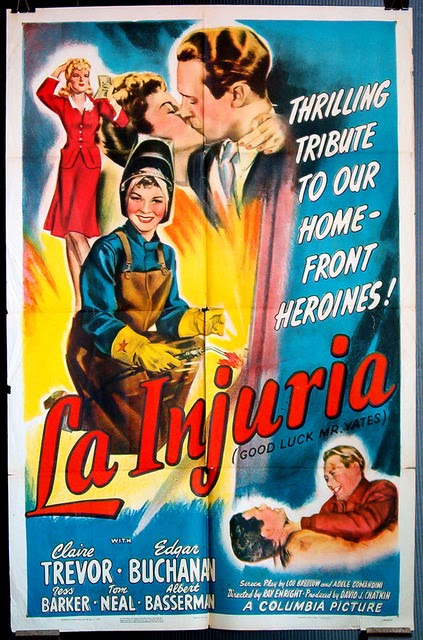
Our film for this week is a wartime B picture entitled Good Luck, Mr. Yates (1943), It stars Jess Barker as the titular Oliver Yates, an instructor in a Carlyle Military Academyl who has been, much to his disgust, exempted from military service as an essential employee (why a grade school teacher would be exempt from the draft is beyond me). Many of his students are hostile because he is not in the war, and Oliver is finally able to convince his boss that he must enlist. Only problem is, he has a perforated eardrum and is listed as 4F. Rather than return to the school, he gets a job at a shipbuilding facility, while he seeks treatment from German refugee Dr. Carl Hesser (Albert Basserman). Dr. Hesser can cure him in a few weeks, and he'll be able to join the army. Right...
To be upfront, two of our viewers found the film amusing, two of us loathed it (and I was one of the loathers). The film is all over the place, with no real focus, and much of it doesn't make a whole lot of sense. With a panoply of European characters (our German doctor, the Greek landlord, the Russian dockyard workers), all there to remind us of what we are fighting for, it tries to demonstrate the wonderful melting pot that is the United States. But all it succeeds in showing is that a mob is nasty no matter where you live.
And then there is our local "Rosie the Riveter", Claire Trevor as Ruth Jones, daugher of Oliver's shipyard boss, "Jonesy" Jones (Edgar Buchanan playing the only really good man in this movie). How Ms. Trevor got mixed up in this turkey is beyond our ken. She is such a good actress, and her success in Stagecoach is only a few years in the past. Around this period, she was appearing in a number of film noir like Crossroads and Murder My Sweet, frequently not in a starring role. Still, playing second fiddle to Jess Barker must have been a come down.
Jess Barker is banal as Oliver Yates, though one has to admit, he's not given a whole lot to work with. He's an attractive enough man, reminiscent of Richard Denning. But Barker had an abbreviated career, thanks to his own bad judgement. He was married to Susan Hayward for 10 years, and when she asked for a divorce, Barker created quite the public row. He insisted on a community property settlement (despite having signed a pre-nuptual agreement). When he was refused money, he filed for full custody of the twin sons. He lost that too. Then, two years later, he was implicated in a paternity suit, and was ordered to pay support for his daughter (conceived, it turned out, while he was still married to Hayward). He continued to act until 1977, but his reign as a potential leading man was long over. Another interesting aspect of this film is the marketing - it is (as you can see from the poster above), touted as a "thrilling tribute to our home-front heroines," with Claire Trevor getting top billing. Yet, there is very little about Ruth's war efforts. For better or worse, this IS Yates story.
We have an appearance by Scotty Beckett
as student Jimmy Dixon, and brief, uncredited appearances by Hugh Beaumont and John Hamilton. What we DON'T have are two segments that were cut from the film. Nan Wynn was supposed to sing as part of a lunchtime entertainment scene for the shipyard worker, but that was eliminated (here is a video of Ms. Wynn singing in Princess O'Rourke). Also cut were the Three Stooges doing their "Niagara Falls" routine. It seems the studio heads decided to save the routine and give it its own film: Gents Without Cents. Quite honestly, we considered THAT cut to be the one good thing about the film.
Next week, it back to the 1930s for a musical romance. Hopefully, we'll have more positive things to say!



FLjQ~~0_35.JPG)