Multi-millionaire John P. Merrick (Charles Coburn) is furious. Though he studiously keeps himself out of the limelight, a recent labor protest by the employees of a department store he owns have brought his name front and center. Determined to fire all of the people involved in the protest, he hires private detective Thomas Higgins (Robert Emmett Keane) to infiltrate the store and find the protesters. Mr. Higgins is unable to start immediately (his wife is about to have a baby), so Merrick fires him and uses the store credentials Higgins has acquired to become an employee in the store's shoe department. It's not long before he discovers that he really likes the store employees and despises the management. Our film this week is The Devil and Miss Jones (1941). The tone of this sweet and funny film is set at the opening credits, when we are introduced to the "devilish" Mr. Coburn and the angelic Ms. Arthur. While Ms. Arthur gets above-the-title billing, this film really belongs to Mr. Coburn, as it should. J.P. Merrick could be a bully and a bore, but not in Mr. Coburn's capable hands. He treads a fine line in being lovable, but still keeping you in suspense as to what he will do in the end. Though, as he becomes increasingly furious at the store managers and supervisors, you really want to give him a hug.
Charles Coburn came to the screen late in life - he was 60. He'd spent his career working in a touring company with his wife, Ivah Wills (they had 6 children). When Ivah died of congestive heart failure in 1937, Mr. Coburn moved his family to Los Angeles to try his hand at film acting. Between 1938 and his death in 1961, he appeared in more than 90 films and television shows. He received a Best Supporting Actor Oscar in 1944 for his work in The More the Merrier, and was nominated two other times - for his work in this film, and for The Green Years (1946). He was active in the Motion Picture Alliance for the Preservation of American Ideals (Hollywood Traitors: Blacklisted Screenwriters - Agents of Stalin, Allies of Hitler by Allan H. Ryskind), a group supporting the McCarthy hearings. Following a second marriage (he was 81 at the time), and the birth of a seventh child, he died of a heart attack at the age of 84. His papers are housed at the University of Georgia, Hargrett Rare Book and Manuscript Library.
Jean Arthur is delightful as Mary Jones. Though her romantic interest is Robert Cummings (Joe O'Brien), it is Mr. Coburn with whom she has the most scenes and the best chemistry. She would work with Mr. Coburn twice more: The More the Merrier (1943) and in The Impatient Years (1944) (TCM Article). The part of Mary Jones was specifically designed for Ms. Arthur - this film's producer was her husband Frank Ross. He had set up an independent production company and was eager to find a property that fit her talents better than the scripts she was being offered. Though Mr. Coburn's part is much stronger, Ms. Arthur refused rewrites that would have given her character more screen time. (Jean Arthur: A Biofilmography by Jerry Vermilyeand). She was fond enough of the part that she planned to do a remake of it in 1966, to be titled The Devil and Mr. Jones, with Ms. Arthur as the Devil; sadly, it didn't materialize.
Robert Cummings is good in a relatively small part. An early scene in the film has Joe cavorting with Mary on the beach at Coney Island. It's quite delightful to watch, and there is a naturalness to the performances. Mr. Cummings was not the first choice for the role - Jeffrey Lynn was originally considered. (AFI Catalog) Also in a small but important part is Spring Byington (Elizabeth Ellis). A gentle woman who just wants to find someone to love, she fixes her sights on Merrick when she thinks that he is indigent. One feels that Merrick has avoided any kind of entanglements because of his money. Ms. Byington makes Elizabeth into someone who cares nothing for money. She wants to find a man she can make happy, and Merrick is the right fit.
There are so many excellent character actors in the film it is hard to focus on just one or two. Edmund Gwenn is marvelous as the repugnant Hooper, one of the bosses who drive Merrick to distraction. S.Z. Sakall appears as George, Merrick's very tolerant butler, and is his usual warm self. William Demarest shows up in the small part of a detective, Regis Toomey is a police officer in Coney Island, and Florence Bates plays a professional shopper - all contribute greatly to the film.
The film, which opened in April at Radio City Music Hall, received an enthusiastic review from New York Times critic Bosley Crowther "Out of the sheerest gossamer the most captivating webs are sometimes spun". Unfortunately, it did not do well at the box offer (Author Jerry Vermilye speculates that the "unsubtle pro-union stance" was a factor"). In January 1942, there was a Lux Radio Theatre production which starred Lana Turner and Lionel Barrymore. The film was nominated for two Oscars: Norman Krasna for his original screenplay and Charles Coburn as Best Supporting Actor.
This is a movie that is not to be missed, especially if you are a Jean Arthur fan. We'll leave you with a clip, in which Charles Coburn meets Ms. Arthur:
The Whole Town's Talking (1935) about gangster "Killer" Manion (Edward G. Robinson), who just broken out of jail in search of stoolie "Slugs" Martin (Edward Brophy). With Manion's picture all over the front page of every newspaper in town, Arthur Ferguson Jones (Edward G. Robinson) is in a pickle - the mild-mannered clerk is a dead-ringer for Manion. How can the police catch Manion and not keep arresting Jones? Well, a pass issued by the Chief of Police seems like a good solution, but when that information hits the papers as well (thanks to Reporter Healy (Wallace Ford), Manion develops his own plan.
Mr. Robinson is quite impressive in the dual roles. Using him is an interesting and effective casting decision; it toys with the audience's familiarity with him in his gangster roles, by throwing another characterization into the mix. Mr. Robinson doesn't rely on makeup or vocal changes to differentiate the characters - he uses his posture and his face. The audience always knows which character is which because of his skill in demarcating one man from the other. Clearly the star of the film - and the romantic lead - his performance also shows the skills that would make him a magnificent - and powerful - character actor as he aged.
Following his success in Little Caesar
(1931), it appeared that Edward G. Robinson was doomed to a career of
gangster roles. So, when Columbia pictures wanted to borrow him for The Whole Town's Talking, he initially balked (TCM article).
Under suspension and pressed for cash, Mr. Robinson eventually agreed
to take the part. The film was so well received that there were rumors
he would be nominated for an Oscar. However, Jack Warner used his
influence to block the nomination - he didn't want a Warner star
nominated for another studio's film (Little Caesar: A Biography of Edward G. Robinson by Alan L. Gansberg).
Jean Arthur is appropriately sassy as Wilhemina "Bill" Clark, the woman of Arthur’s dreams. He secretly writes poems to her, addressing them to Cymbeline; poems which she mocks (not knowing Arthur is the author). When she realizes that Arthur is a double of Manion, she becomes fascinated with the timid clerk. And while Bill finds Arthur's bachelor apartment exactly as she suspected (even to “a canary bird”), she has mellowed enough to find this endearing. We were especially amused by Bill’s discussions with the police, as she yells “Manion” to every crime about which they inquire. This film was something new for Ms. Arthur and contributed to her future in films like Mr. Smith Goes to Washington (1939) and Mr. Deeds Goes to Town (1936) (Women in the Films of John Ford by David Meuel).
It's surprising to realize that the film was directed by John Ford. One doesn't often think of him in relation to films of this type, but he had directed contemporary American stories before (John Ford: The Man and His Films by Tag Gallagher). In his autobiography, Edward G. Robinson had nothing but praise for Mr. Ford. The pair bring a gentle comedy to the film - Arthur is amusing, but never mocked.
A quick tip of the hat to the always amusing Donald Meek as Hoyt, the first person to confuse Arthur with Manion - his efforts to claim the reward for finding Manion are really funny (it's not a surprise that he's having a problem getting the money, since he keeps turning in the wrong person). We do wish the police were a little less stupid - the idea of giving Arthur a note, and then letting a reporter put that in the newspaper is so tantamountly idiotic that you can only shake your head at this plot device. Regardless, this is a very small complaint in an otherwise enjoyable picture.
When it opened at Radio City Music Hall, The Whole Town's Talking received a glowing review from Andre Sennwald at the New York Times. This was the first of Mr. Robinson's films to open at Radio City and was a huge success for the studio (Little Caesar: A Biography of Edward G. Robinson by Alan L. Gansberg).
The story was adapted from a novel by William R. Burnett, the author of Little Caesar (which would certainly help explain Mr. Robinson's initial reaction to the role). Working titles were Jail Breaker and Passport to Fame (AFI catalog). In February 1941, Jeff Corey took on the story for the Lux Radio Theatre.
This is a fun film, and one we wholeheartedly encourage you to view. We'll leave you with a clip from the opening of the film:
Senator Sam Foley has died suddenly, and the governor of his state, Hubert "Happy" Hopper (Guy Kibbee) is tasked with naming a successor. The Governor is ordered by local boss Jim Taylor (Edward Arnold) to name one of his flunkies, but the citizenry rebel at the appointment of this yes man. The Governor's children campaign for the appointment of local Boy Ranger leader Jefferson Smith (James Stewart), a naive young man who Mr. Taylor finally agrees is the perfect solution. With no political background, Smith will be easily led by Senator Joseph Paine (Claude Rains) to vote according to Taylor's wishes. And so, Mr. Smith Goes to Washington (1939). This outstanding film was included as this month's contribution to the TCM Presents series. Originally conceived as a follow-up to Mr. Deeds Goes to Town, the film changed titles and actors when Gary Cooper proved to be unavailable. (AFI Catalog) James Stewart brings the needed innocence and gravitas to the role in his second film with Frank Capra and Jean Arthur (they had worked together the previous year on You Can't Take it With You). One problem with Frank Capra films is that he doesn't always know how to end them. It's a big issue with Meet John Doe (1941); it's a smaller issue here. Mr. Capra does seem to back his character into a corner, and then create a deus ex machina to pull him out of his problem. However, in this film the director does set up hints that Claude Rains will be both the problem and the solution to that problem.
Mr. Rains is, of course, excellent as The Silver Knight, the senior senator from Smith's unnamed state. Best friends with Smith's father (a crusading newspaperman who was murdered after he wrote editorials against a mining syndicate), Paine has been in the pay of Jim Taylor for years. But Senator Paine remembers the ideals that brought him to law and to politics. As Mr. Rains looks at Smith, we see his yearning for the purity that he had when he worked with Smith senior. A favorite villain for Mr. Capra is Edward Arnold. Mr. Arnold is able to be both affable and menacing at the same time. He helps us to understand why a respectable man like Senator Paine would fall into his clutches. He also has looming presence that gives the viewer pause - we know he is capable of any dastardly act to get what he wants. A stage actor at the beginning: between 1919 and 1933, he appeared in 13 Broadway plays, Mr. Arnold started his film career during the silent era. With his booming voice (and wonderful laugh) he was a natural for talkies, and appeared as the leading man in such films as The Toast of New York (1937) (he was billed ABOVE Cary Grant) and Diamond Jim (1935). Listed on the notorious "Box Office Poison" list, Mr. Arnold segued into more character parts, like Anthony P. Kirby, Sr. (James Stewart's father) in Capra's You Can't Take it With You (1938). Though he identified as a conservative Republican (and even ran for Los Angeles County Supervisor - he lost), he served as President of Screen Actors Guild, and was vocal in his opposition to the blacklisting of his colleagues during the HUAC era. Married three times, and divorced twice (he had three children with his first wife), Mr. Arnold died of cerebral hemorrhage in 1956 at the age of 66. His turn as Olivia de Havilland's father in The Ambassador's Daughter was released just after his death.
Jean Arthur (Clarissa Saunders) is picture perfect as the tough as nails assistant, who is sick and tired of the dishonest nature of politics. She's seen Taylor's influence on his state for too long, and is convinced that Jeff Smith is either an idiot or a stooge. When she finds he is a man of ideals, she becomes his staunchest ally. She is ALSO the smartest person in the film. She knows the rules of the Senate by heart, she understands the workings of the government, and she knows the people who work on the Hill. It's hard to imagine anyone other than Ms. Arthur giving Saunders such range. The film is also blessed with a bevy of magnificent character actors: Thomas Mitchell (Diz Moore), Eugene Pallette (Chick McGann), Capra favorite Charles Lane (Nosey), Ruth Donnelly (Mrs. Emma Hopper), Astrid Allwyn (Susan Paine), and H. B. Warner (Senate majority leader). But leading this group are the always wonderful
Beulah Bondi (Ma Smith) and Harry Carey (President of the Senate).
Though their parts are small, you remember then. One only regrets that
they are not on the screen for longer. Ms. Bondi would end up playing James Stewart's mother a total of five times (TCM article). This was the third outing in that role.
The film proved to be quite popular, though initially it was reviled by many U.S. Senators and by the Washington Press Corps. (WAMU article). Senate Majority Leader Alben Barkley described the film as "silly and stupid," adding that it made the Senate look like "a bunch of crooks." (U.S. Senate article). The film was also banned in Germany and Italy (they didn't like the fact that the film was about a democratic government, even a government that was having problems); however it did well in England, France (prior to the German invasion) and in the United States. Despite the jabs at journalists, the New York Times review was glowing, calling it "is one of the best shows of the year. "
The American Academy of Motion Picture Arts and Sciences obviously agreed; it was nominated for 11 Academy Awards, including Picture, Actor (for James Stewart), Supporting Actor (for both Harry Carey and Claude Rains), Director, Art Direction, Film Editing, Film Scoring, Sound Recording, and Original story (for which it won it's only Oscar). But, in 1939 the competition was fierce, and the juggernaut called Gone with the Wind pretty much swept the awards (winning 9 of the 14 for which it was nominated). Among the other Picture nominees were Dark Victory, Goodbye, Mr. Chips, Ninotchka, Stagecoach, Wuthering Heights, and The Wizard of Oz!
When Boyd Emerson (Joel McCrea) and his friend Frasier (Raymond Hatton) arrive in Kalvik, Alaska, their entry is greeted by open hostility. The Silver Horde (1930) concerns their efforts to open a salmon canning business in Kalvik, and the opposition they face from their chief competitor, Fred Marsh (Gavin Gordon). A remake of a 1920 silent film of the same name (AFI catalog), The Silver Horde is as much about the business of salmon fishing in Alaska as it is a romance. In a fairly detailed sequence, we are shown the details behind the salmon that arrived on the shelf of consumers from the moment the fish are caught until the can is sealed and labeled. And just to be sure that the viewer knows that this is a part of the film, we see both Joel McCrea and Raymond Hatton working on the assembly line. Salmon fishing (in this case, coho salmon) is a major industry in Alaska - school children are taught about the five kinds of salmon, it is that important - and this one episode emphasizes that. More to the point, the industrialization of the salmon fishing would have been an exotic and unique process to the general filmgoer; this segment proves both educational and a quick glimpse of the past of an important food industry. The film, by the way, was actually shot on location in Ketchikan, Alaska (TCM article).
This was the first teaming of Joel McCrea and Jean Arthur (they would do two more films together). However, Ms. Arthur is not the star here. Evelyn Brent (Cherry Malotte) is. Ms. Brent had long experience as a silent actress - she started in films in 1914. She's quite good in this film, playing a tough and knowing woman, who has made her money in Alaska working as a prostitute, and is now the owner of a successful copper mine. Ms. Brent worked steadily, well into the 1940s, though she did most of her later work in B films, or at Poverty Row studios. When she retired from acting in 1950, she became an agent (she would make one television appearance in 1960 - on an episode of Wagon Train). Married three times, she died of a heart attack in 1975 at the age of 75. Unfortunately, many of her silent films have been listed as lost. This was Joel McCrea's second major role and he was pretty much on an upward trajectory for the rest of his career. He's sincere and attractive as Boyd; he manages to keep your sympathy and interest even after he is verbally cruel to Cherry. Mr. McCrea was always an interesting actor AND an interesting man. While many actors who were not in the military played soldiers in movies, Joel McCrea refused to wear a uniform in any of his films. Unable to serve in the Armed Forces, he felt that for him to appear in uniform was disrespectful to those who were serving (TCM article). He loved westerns, and in his later years would only appear in them. After his retirement, he worked on his ranch, where he lived with his wife, Frances Dee (they had three children, and were ultimately married for 57 years) until his death at 84 in 1990.
Blanche Sweet, who plays Queenie, was a notable silent actress, but her career just didn't take off in sound films. She's quite sassy as Queenie, serving to tie up some plot loose ends and to give us a tiny glimpse into Cherry's past. This film, was in fact, her last until 1959 when she appeared in an uncredited role in The Five Pennies (she also did a few television appearances around this time). She continued to work in radio, and on stage. She had married Raymond Hackett in 1935; after his death, she moved on to a new part of her life - she worked on film preservation. She served on the Board of Directors of the National Board of
Review of Motion Pictures was a consultant to the
Department of Film of the Museum of Modern Art. (New York Timesobit). She also appeared in Before the Nickelodeon: The Early Cinema of Edwin S. Porter (1982). Ms. Sweet died of a stroke in 1986, at age 90. Her ashes were scattered in the Brooklyn Botanical Garden.
The New York Timesreview was not particularly complimentary in their evaluation of the film, though they were very enthusiastic about the work of Blanche Sweet. While not a great film, The Silver Horde really has a lot going for it, especially the opportunity to see two future stars before they got their starts. We'll leave you with this scene of Joel McCrea, looking rather hunky as he fights for his place in the community:
The members of our group have all seen Talk of the Town (1942) before, but it has been some time since we visited this fantastic movie, and decided it was time to reacquaint ourselves with this splendid cast of characters. The film opens with the trial of Leopold Dilg (Cary Grant). Dilg, an ardent activist, is accused of setting file to the Lochester Mills, and in the process, killing the night watchman Clyde Bracken (Tom Tyler). The town is ripe for a lynching; in desperation, Leopold escapes from his cell, injuring his ankle in the process. He arrives at the country home of Nora Shelley (Jean Arthur), a childhood friend. Nora is in the midst of cleaning the house, which she is renting for the summer. Though she is not eager to assist Leopold, his injured ankle and the town's angry attitude convince her to give him shelter, at least until she can contact his lawyer, Sam Yates (Edgar Buchanan). However, a complication arises - Professor Michael Lightcap (Ronald Colman), a noted Harvard jurist, arrives a day early. Nora has to scramble to not only keep Leopold hidden and but also keep herself in the house, to hide him from the reclusive professor. And if that isn't a big enough problem, the following day, Professor Lightcap finds out he is being proposed for the Supreme Court, so any kind of scandal will endanger his appointment - and a murderer living in his house is not the kind of publicity he needs. In his book Five Came Back: A Story of Hollywood and the Second World War, Mark Harris discusses the previews of the film. It's widely known that Columbia decided to use audience previews to help them decide on the film's ending. Two conclusions were shot: one with Cary Grant leaving with Jean Arthur; the other with Arthur selecting Ronald Colman. That the film ends, thanks to audience reviews, with Grant is the result of those polls. But what isn't as widely known is WHY the audience selected Grant. According to Harris, the war-time audience (the film was released on August 20, 1942) felt that Arthur should marry the man of draft age because "later on, the mature men will have [the women] all to themselves." (p. 167) The idea that Nora would marry Leopold, see him off to war - and death - and ultimately end up with Michael (who is over 40 and therefore ineligible to serve) is somewhat disturbing. We wondered, had the survey been done a few years earlier, who would have won? As much as our group adores Cary Grant, the consensus here was for the more stable, more mature, and more intelligent Michael Lightcap. Leopold Dilg is just too much of a loose cannon (an unusual role for Mr. Grant) to appeal to our simpler tastes. This TCM article goes into more detail on the tension between Colman and Grant, neither of whom was used to playing second fiddle to another actor, and on Colman's reluctance to appear in a Columbia film, due to his intense dislike of Harry Cohn (Stevens promised Colman that Cohn would never be on the set - and kept his word).
Director George Stevens was well-respected for romantic comedies, like The More the Merrier (for which he received his first Academy Award nomination as best picture)and Woman of the Year, as well as for dramatic romances like Alice Adams and Penny Serenade. However, upon his return from World War II, where he was one of the first people into Dachau as the Allied forces entered Germany (his footage was used during the Nuremberg Trials), Stevens remade his career, never venturing into comedy again. Instead, he chose films that, to his mind would "tell the truth and not pat us on the back" (Harris, p. 418). The Diary of Anne Frank, Shane, Giant (Oscar-winning Director of 1956, and A Place in the Sun (Oscar-winning Director of 1951) are among his magnificent post-war efforts. Steven would continue directing until 1970. He died in 1975, aged 70.
There are some wonderful character actors in the film. Edgar Buchanan, who had already worked with Grant and Stevens on Penny Serenade,
appears as Sam Cade, Dilg's lawyer and an old school chum of
Lightcap's. Glenda Farrell has a small part as Regina Bush, the rather
crude and gabby girlfriend of the "deceased" Clyde, and Lloyd Bridges
has a brief appearance as Donald Forrester, Lochester's newspaper editor and reporter. But the performance that stands out (and even rates a mention in this New York Timesreview)
is that of Rex Ingram as Lightcap's valet, Tilney. Though playing a
servant, Tilney is a quiet, distinguished man. More than just a valet,
he serves as Lightcap's confidant and occasional adviser, for Tilney,
unlike Lightcap, has seen something at the world. He has even been
married, albeit unsuccessfully. Ingram had a relatively long career,
beginning his film work in 1918's Tarzan of the Apes, and concluding with an appearance on The Bill Cosby Show
in 1969. A graduate of Northwestern University's medical school, he
left for Hollywood, then for Broadway, where he appeared in 13 plays
from 1934 to 1962. He died in 1969, aged 73.
All in all, this is a film we highly recommend, and perhaps is close to being an essential. We'll leave you with this video, to whet your appetite - the first meeting between Professor Lightcap and Miss Shelley.
For those of you who read Entertainment Weekly, you might have had the pleasure recently to read an excerpt of Mark Harris' new book Five Came Back: A Story of Hollywood and the Second World War. The book focuses on five directors: John Ford, Frank Capra, George Stevens, John Huston, and William Wyler, all of whom served in the military during WWII, and all of whom were involved in film-making within the armed services. Their war experiences, not surprisingly, colored their post-war films, and this book looks in detail at their work during and after the war. In conjunction with the book's release, AFI Silver featured a screening of the 1953 Shane, one of director George Steven's post-war films. Shane features an all-star cast: Alan Ladd as the title character, a gunfighter who is trying to escape his past; Van Heflin as Joe Starrett, Jean Arthur as his wife Marian Starrett, and Brandon de Wilde as Joey Starrett, a family trying to create a home on the frontier; and Jack Palance (here listed as Walter Jack Palance) as Jack Wilson, the gunfighter who is trying to drive them off their land. It's a fairly simple film: the Starett family is trying to build a farm on the prairie, much to the disgust of Rufus Ryker (Emile Meyer) a cattleman who claims rights to the whole valley. The lives of the Staretts and all the settlers have been made miserable as Ryker attempts to run them off. Enter the loner, Shane, who attempts to restart his life by working for Joe as a handyman. But given the environment, Shane soon finds that the only way he can help the family he has come to love is to return to his old occupation.
Interestingly, Ladd and Heflin were not the first choices for Shane and Joe. Montgomery Clift and William Holden were the first choice of director Stevens
for the roles of Shane and Starrett. When they were unavailable,
Stevens selected Ladd and Heflin who were under contract to Paramount. This article from TCM discusses some of the studio's attitudes towards the film.
Stevens was able to coax Jean Arthur (with whom he had worked on The More the Merrier) out of retirement for this, her final film role. Ms. Arthur is quite wonderful as Marian, a strong woman who loves her husband, but who is also attracted to the stranger in their midst. The scene in which she tries to decide what dress to wear - all but her wedding dress are work clothes - as Shane talks to Joey outside, is gently amusing and poignant.
Shane is shot in Technicolor, and while it's not a widescreen film, it has an exquisite use of color and vistas. The film emphasizes the size of the country through the use of widescreen shots. This serves to elaborate on the greed of Ryker, who desires so much land in an area that is so vast it surely could hold a few more people. Yet Ryker is given time to explain his need for the land. In fact, all of the characters are allowed an opportunity to explain their feelings about the range dispute, leaving us, the audience, to decide who is in the right.
And there are
quite a few characters: Elisha Cook, Jr., as Stonewall Torrey, a former
Confederate soldier with a bad temper and a deep thirst; Ben Johnson as
Chris Calloway, a ranch hand for Ryker who starts the film as Shane's
adversary, but who ends as his friend; Edgar Buchanan as Fred Lewis,
another of the settlers who fears the effects of Ryker's wrath. We also
have two familiar female faces in this group: Nancy Culp (Mrs. Howells)
and Ellen Corby (Liz Torrey) have brief moments as settlers' wives.
Ultimately,
though, Shane is a love story between a grown man and a little boy, and
Brandon de Wilde as the hero-worshiping Joey turns in a wonderful
performance. There is a real rapport between him and Ladd, and their
chemistry gives the film its strength. Sadly, after a career in
which he appeared in films such as The Member of the Wedding, All Fall Down, and Hud, de Wilde died in a traffic accident at the age of 30.
We leave you with a clip from Shane, in which the title character demonstrates the proper use of a revolver to young Joey. One thing to notice is the loudness of the gunfire - director Stevens purposely made the gunshots extra loud: "a gun is a tool," Shane tells us. But in a sense, it is a tool that destroys lives.
Released the year before the end of World War II, The Impatient Years
examines a topic in a comedic manner that, after the war would be
looked at in a more serious vein. Andy Anderson (Lee Bowman) is home on
medical leave, returning to the home of his wife of one week (plus
about 18 months). He finds Janie (Jean Arthur), busy running her home,
with her boarder (Henry Fairchild played by Phil Brown), her father
(William Smith, played by the always wonderful Charles Coburn), and her
not quite one-year old son! She exists on a very rigid schedule, one
which her husband will not respect. Within a day, the hastily wed
couple are ready to divorce with equal speed, much to the disgust of Mr.
Smith. So, he recommends to the Judge (Edgar Buchanan) that he prevent
the couple from divorcing until they can figure out WHY they married in
the first place.
By 1946, The Best Years of Our Lives would look at the impact of the hasty wartime marriage on the returning vet. And while The Impatient Years
certainly IS a comedy, there is a core of seriousness under the humor.
Both the Judge and Mr. Smith understand that the war is forcing
decisions to be made to quickly. They insist that our couple stop BEING
impatient and try to rediscover their lost love for one another.
It
should be added that neither Andy nor Janie is totally in the wrong.
He, back from combat, wants peace, wants to do what HE wants to do.
She, responsible for a house and small child, needs a schedule to get
everything done. Neither can understand the other's needs. Neither
even tries. And thereby hangs the serious heart of the film.
Both
Jean Arthur and Lee Bowman are excellent, and Charles Coburn, as
always, shines as a loving father (who, in fact, is just meeting his
son-in-law). We also have comic performances from Charlie Grapwin (as a
bellman) and Grant Mitchell (as a hotel clerk). Sure, the film can be a
tad silly, but at heart, it is a lovely story about two people who need
fight their own way out of the War.
Carol Baldwin (Jean Arthur) and Helen Davis (Ruth Donnelly) run
a secretarial school. Unfortunately, most of their students seem to be
of the same caliber as their current student Maizie West (Dorothea
Kent) - no brains, but plenty of looks and a plan to make time with the
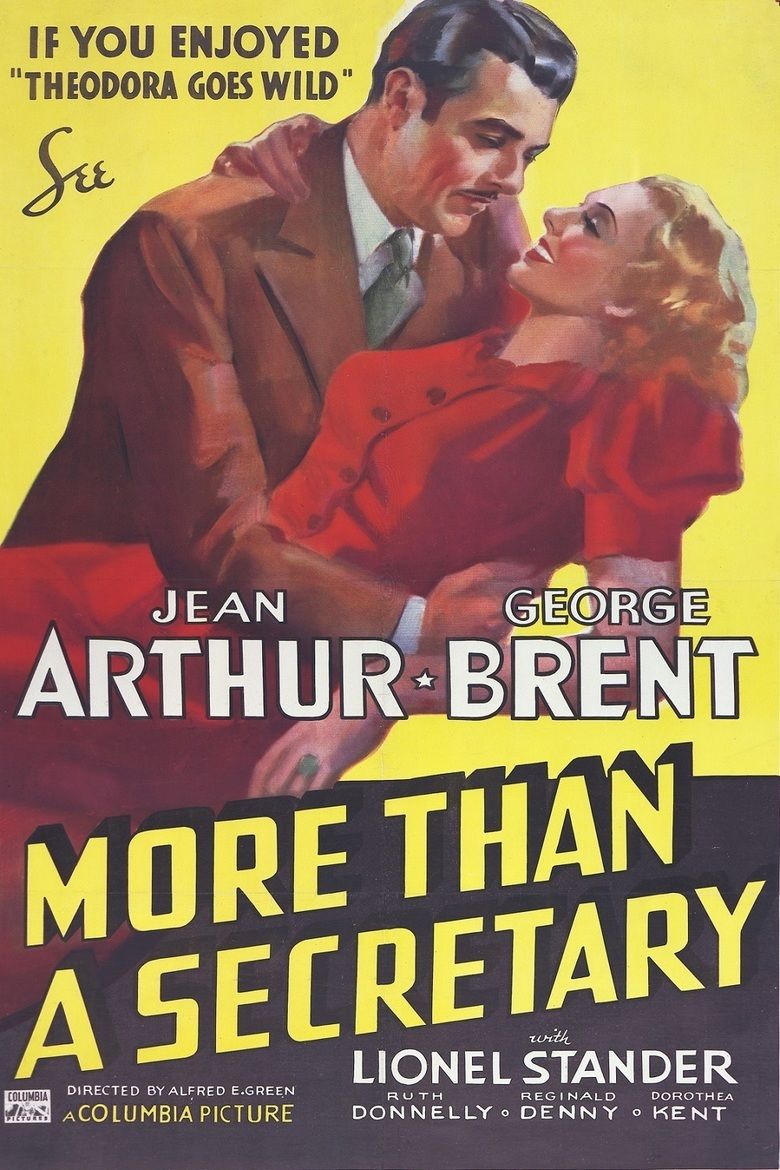
boss. Thus begins More Than a Secretary (1936), in which Jean Arthur
ends up working AS a secretary when the man who hired (and fired) one of
her students complains. The gentleman in question is publisher Fred
Gilbert (George Brent). His publication, "Body and Brains", is a
body-building magazine which regularly uses the face of an attractive
model on the body of the exceptionally well-built (and particularly
unattractive) Ernest (Lionel Stander). Of course, the magazine is NOT
doing well. It takes our Jean to put it on the right track. This
is a very cute movie, thanks to the interplay between Brent (who is
always wonderful) and Arthur (ditto). Her Carol, at the start, is
somewhat reminiscent of a character she will revisit in 1948 - Phoebe
Frost in A Foreign Affair. But she quickly discovers her outer
beauty, and becomes the perfect secretary. Beauty and brains in the
same office! Amazing! And Brent manages to make Fred a bit of a dweeb,
but still let you know why Carol is attracted to him. The scene where
he takes her out to a tofu dinner (!!!) is quite humorous.
It is
fun to see Lionel Stander as well. His Ernest longs for the day when
his face adorns his own body on the magazine - alas, it seems it is not
to be. Many of us remember Mr. Stander from Mr. Deeds Goes to Town and A Star is Born (as well as in Hart to Hart). It is sad that his career in this country was abbreviated during the 50s and 60s thanks to the McCarthy hearings.
A
few words are due, as well, for Dorothea Kent (as Maizie). She is a
hoot. You can't help but like the opportunistic creature! One
sympathizes with Carol's frustration, but I, for one, looked forward to
her return.
We'll close with the moment in which Carol finally loses it with Maizie. See you soon!
Tonight, we join the lovely Jean Arthur for the first in a series of films that feature her in the lead. Adventure in Manhattan (1936) has Jean starring as Claire
Peyton, and beyond that, there is little I can tell you, as there are
spoilers aplenty if I do. Joining Jean is Joel McCrea as George
Melville, a reporter noted for his unerring ability to predict crimes
before they happen. When a famous gem is stolen, George predicts the
next robbery, and surmises that the robberies are the work of Belaire, a thief long believed to be dead. By everyone, of course, except George.
It is interesting that this film is included on the Jean Arthur Comedy Collection,
as it is really hard to class it AS a comedy (unless you view comedy in
the more Elizabethan-theatrical vein). Our first encounter with Claire
is far from comedic, and very few of the incidents that occur will make
you laugh. Perhaps the only funny lines are at the end (and even then,
for those of us who had been carefully watching, they were much more
serious than we believed the authors actually intended.) This is
certainly a film that will keep you guessing til the very end, but I
would be interested to know if anyone else really believed this to be a
"comedy."
A lot of talent is involved in this
under-viewed movie. First, of course, is Ms. Arthur, who really is the
consumate actress. Joel McCrea, usually the boy-next-door, is
rather arrogant as George, and well he should be, because George DOES
think a lot of himself. We also have such excellent character actors as
Thomas Mitchell (as George's editor, Phil Bane) and Reginald Owen as Blackton Gregory. An interesting and gifted cast, in a very different, and at times puzzling movie.