Showing posts with label Marlene Dietrich. Show all posts

Thursday, May 14, 2020

Tyrone's on Trial

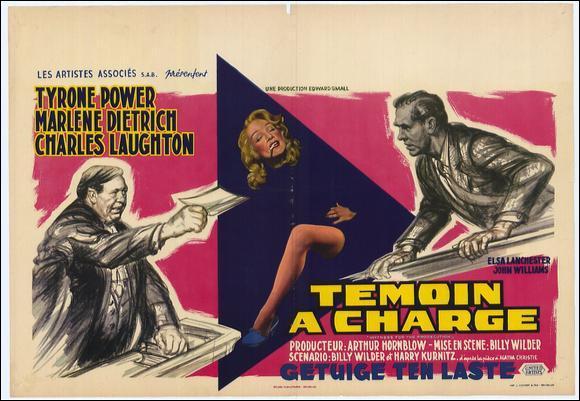
Ruta Lee, who appeared in the small role of Diana in Witness for the Prosecution (1957) spoke about her appearance in the film during the TCM Cruise.  Ms. Lee got the part when Arthur Hornblow, Jr. saw her at a Frank Sinatra night club appearance.  Hornblow approached her, and asked her to do a screen test; after which Marlene Dietrich (Christine Vole) insisted that her hair color be changed (so Ms. Lee became a brunette for the film).

Sir Wilfrid Robarts (Charles Laughton) has just returned home from hospital, with his nurse Miss Plimsoll (Elsa Lanchester) in tow, when he is approached by solicitor Mayhew (Henry Daniell) to possibly take on the defense of Leonard Vole (Tyrone Power) who is about to be arrested for the murder of Emily Jane French (Norma Varden), a wealthy widow who Vole had befriended.  Sir Wilfred finally agrees to take on the case (over the objections of Miss Plimsoll), as he is convinced of Vole's innocence, and the barrister he intended to recommend is not (John Williams as Brogan-Moore).  Complications ensue in the form of Vole's wife, Christine.  Is she really trying to help her husband, or is she using the murder as a means of getting rid of him for good?

I've seen this film dozens of times on television; I always appreciated the humor that floats through this very serious story.  But, seeing it with an audience really impressed upon me how FUNNY it really is - especially the interplay between Charles Laughton and (his wife in real life) Elsa Lanchester, who acts as straight woman for his bon mots.  For example, when Miss Plimsoll checks Sir Wilfred's thermos (to verify no brandy is present), he counters her with "If you were a woman, Miss Plimsoll, I would strike you."  And when she informs him that she was engaged to a lawyer but he died, he responds, "He certainly was a lucky lawyer." But the humor would not work if the audience didn't sense the affection between Laughton and Lanchester, and they easily give you the sense (even before the ending of the film) that these two are now a team.
Based on a short story by Agatha Christie, Witness for the Prosecution was adapted by Ms. Christie as a play which opened on the West End (London) in 1953. David Horne starred as Sir Wilfred and Derek Blomfield appeared as Leonard Vole.  When the play moved to Broadway, Francis L. Sullivan took on the role of Sir Wilfred, with Gene Lyons as Vole.  The character of Miss Plimsoll does not exist in the stage version.

Only one member of the Broadway cast reprised her role in the film - Una O'Connor as Janet McKenzie, housekeeper to the murder victim.  Born in Ireland in 1880, Ms. O'Connor started her career on the stage, in both Ireland and England.  In 1911, she appeared in her first Broadway play (The Playboy of the Western World), and by 1929, she was appearing in films, first in the UK and then in Hollywood.  She's perhaps best remembered as Maid Marian's lady-in-waiting, Bess in The Adventures of Robin Hood, and as Reginald Gardiner's housekeeper in Christmas in Connecticut.    But, even while doing films, she still managed to squeeze in the theatre - she appeared in 11 Broadway plays and 64 films, and ventured into television in the 1950s.  She was 77 when she appeared in this film, and when it wrapped, she retired.  She died two years later.
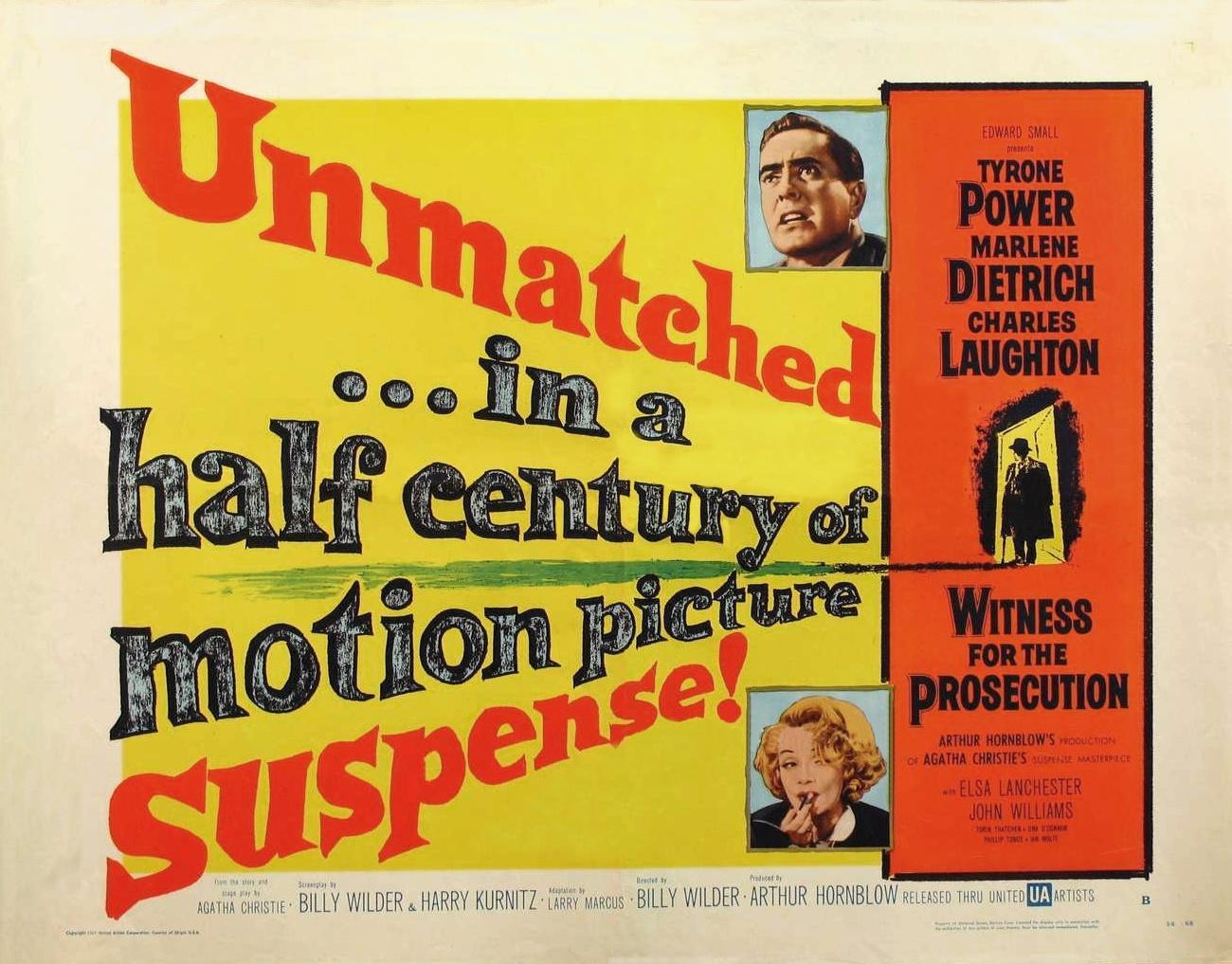
This was also Tyrone Power's final film appearance. According to these TCM articles, Power was not the first choice for Leonard Vole - William Holden was.  Also considered were Gene Kelly, Kirk Douglas, Glenn Ford, Jack Lemmon, and Roger Moore.  Power, who had at first turned down the role, finally accepted; with this role came the part of Solomon in Solomon and Sheba, which Power started shooting on September 15th, 1958.  But on November 15th, after shooting a dueling sequence, Power complained of arm and chest pain.  Despite being rushed to the hospital, he died of a massive heart attack.
Ava Gardner and Rita Hayworth were also considered for the role of Christine, and while Gardner very much wanted to do it, Billy Wilder wanted his friend Marlene Dietrich in the lead.  Without giving anything away (in case you've not seen it), it has often been said that Dietrich lost out on an Oscar nomination because of the secrecy about the film's ending. 

Finally, there is Charles Laughton.  Laughton was nominated for an Oscar for this role, but lost to Alec Guinness in The Bridge on the River Kwai.  Certainly, a notable performance, but my vote goes to Laughton.  A consummate actor, an impressive director (he directed once - the magnificent Night of the Hunter, and Robert Mitchum once claimed Laughton was his favorite director), Laughton won the Oscar once - for his role in The Private Life of Henry VIII (1934), and was nominated twice more - for this and for The Mutiny on the Bounty.  His performance here is layered and substantial.  He's funny, he's businesslike, he's subtle, he's passionate. All in all, his performance is special. 

These  notes from the AFI catalog go into some detail about the changes to the script, including, interestingly, the film's end.  The film got excellent reviews, as is evidenced by this New York Times review, and the AFI named it #6 in its list of Top 10 Courtroom Dramas.  All in all, this is an excellent film, only enhanced by being able to learn some of its history firsthand.

We'll close with this scene, in which Christine Vole is interviewed by Sir Wilfred: two actors at the top of their game.  Unlike her husband in an earlier scene, Christine takes no nonsense in her examination:


This posting is part of the Oscar Snubs Blogathon.

Monday, February 1, 2016

Ronald, King of the Beggars


Kismet (1944) is a fable.  It is the story of Hafiz (Ronald Colman), who calls himself the King of the Beggars.  Hafiz is always plotting - he hopes to find a good marriage for his much-beloved daughter, Marsinah (Joy Ann Page), while he is having a romantic liaison with the wealthy Jamilla (Marlene Dietrich).  What Hafiz doesn't know is that Marsinah has already found the love of her life, a young man who she believes is the son of the gardener for the royal palace, but who is actually the Caliph (James Craig) and that Jamilla is the courtesan of the Grand Vizier (Edward Arnold), who is plotting the Caliph's death.

As always, Ronald Colman is excellent as Hafiz, and the film, in fact, gives him an opportunity to show his range - for comedy, drama, romance and even a bit of farce.  His rapport with Marlene Dietrich is obvious; their interplay is really what makes the movie.  And while the script isn't exactly suspenseful - it is, after all, a fairy tale - it's fun getting there.  Colman, superb storyteller that he is, never lets us forget the fantasy aspects of the storyline, and revels in the experience.
It seems obvious that Colman is having a good time in this production;  Marlene Dietrich also seems to be enjoying the experience.  Always a striking actress, she is more so here, with costuming that emphasizes her fantastic legs and exotic beauty.  According to this TCM article, Dietrich was well aware that she was the decoration in the story, and went with the concept.  It was her only appearance in an MGM film (according to this AFI Catalog entry, they never found another film worthy of her). She had to wear 4 coats of gold paint on her legs, which were a horror to remove.  So, she would leave the paint on at the end of the day, and arrive at the Hollywood Canteen with golden legs!  Dietrich's devotion to the troops is the stuff of legend.  My father, an Army Corporal in the Engineers, often spoke of her with affection.  Her hatred of the Nazis was well known - though offered a carte blanch to return to Germany (She was Hitler's favorite actress), she not only refused the offer, but became an American citizen and spent most of the war entertaining the troops in areas in which she was in extreme danger of capture and execution. She spent so much time in the European Theater of Operations that Billy Wilder is said to have quipped that "she was on the front more than Eisenhower" (Some Like it Wilder, 2010).  As one of the actresses on the notorious 1938 "Box Office Poison" list (Glamour in the Golden Age: Movie Stars of the 1930s, 2011), Dietrich was having problems getting film roles around this time (she was 42 when production on the film began), but some of her best films were ahead of her:  A Foreign Affair (1948), Touch of Evil (1958, a small but meaty part), Judgement at Nuremberg (1961), and Witness for the Prosecution (1957).  As her film career petered out, Dietrich performed on stage and in cabarets, but following a fall onstage, she was forced into retirement.  In her later years, she refused to be photographed, preferring that her public remember her in her youth.  She died in 1992, at age 90.
Joy Ann Page, who here appears as Marsinah, is best remembered as the young bride in Casablanca. Her role in this film is minor - Marsinah gets little to do except be admired and lusted after.  Her career was short, and she really never got a part as memorable as the one in Casablanca again, despite the fact that she was stepdaughter of Jack L. Warner.  Warner, in his usual curmudgeonly way, refused to give her a contract at Warner's (she had auditioned for, and landed, the role in Casablanca without his knowledge.  Once she had it, he agreed to her being in the film, but it was with reluctance).  She had a total of 22 film and television credits, and ended her career in 1959 after appearing in The Swamp Fox for Walt Disney.  She married William Orr in 1945 (her stepfather actually hired Orr after their marriage, and advanced his career steadily).  The marriage ended in divorce in 1970.  She died in 2008, at the age of 83.
Edward Arnold plays the part of the Grand Vizier with great relish.  His strong voice and powerful laugh only serve to emphasize his evil intentions.  His scenes with Dietrich are especially wonderful - Jamilla is the only human being who actually intimidates him.  It's interesting that no one else seems to have been considered for this part.  William Powell was at one point talked about for the role of Hafiz, Richard Carlson tested for the role of the Caliph, and Vera Zorina, Virginia Bruce and Marilyn Maxwell all tested for Jamilla.  In hindsight, it is difficult to see anyone but Arnold in the role.

Kismet is a story that is a popular one in Hollywood.  Based on a Broadway play from 1912, it was filmed twice as a silent film - in 1914 and 1920.  In 1930, it was filmed with sound (and starred the actor who had done the 1920 silent version, Otis Skinner - the father of Cornelia Otis Skinner, of The Uninvited fame)After a successful Broadway musical version of the story opened in 1953, the story was again filmed, this time with Howard Keel and Ann Blyth singing the leads.  Finally, on 24 October 1967, Jose Ferrer appeared in a television special of the musical.

We'll leave you for this week with the trailer for the film - note the glorious technicolor (but Dietrich's golden legs are nowhere to be seen!  I guess you had to pay your admission to see them!)

Friday, February 14, 2014

Marlene Steals a Baby

Marlene Dietrich plays a stage actress who falls in love with a baby and runs off with him in The Lady is Willing (1942). Elizabeth 'Liza' Madden (Dietrich) is walking home from the theatre one evening when she happens upon an altercation.  A baby has been found abandoned in a building and the neighborhood is in a tizzy.  A police officer hands Liza the baby, and it is love at first sight.  So, since the baby has no parents to speak of, Liza simply takes him home, and begins the role of Mom.

Of course, Liza quickly discovers that it's not that easy for a single woman to adopt a baby, much less a woman who is up to her ears in debt.  You see, Liza has a lovely apartment, wonderful clothing, and lots of debts.  She has a tendency to financially support relatives and friends - or dead-beats, as her assistant, Buddy (Aline MacMahon), calls them.  So, Liza must marry, and marry fast or little Corey (David James) will be taken from her.  She approaches Dr. Corey McBain (Fred MacMurray) to take on the dad role (Yes, there is a reason for the fact that Dr. and baby have the same name).  In exchange, he can switch from his specialty of pediatrics to what he really loves, research.  Of course, it will be a marriage in name only, and of course, Corey and Liza will begin to want a more lasting relationship.

This is a cute film; while not great literature, it was fun to see Marlene Dietrich doing a comedy.  Being, Dietrich, she is still intense, but she also makes the character likeable, if not a trifle naive.  And while Liza is not the brightest bulb in the pack (for example, she has a lot of trouble understanding Mr. Micawber's basic rule for financial happiness: “Annual income twenty pounds, annual expenditure nineteen six, result happiness. Annual income twenty pounds, annual expenditure twenty pound ought and six, result misery."), she has a kind and loyal heart.  Naturally, she also has a magnificent apartment (thanks to production designer Lionel Banks) and spectacular gowns (by Irene). Amusingly, when she needs another apartment, she is easily able to get the one next door.  As New Yorkers, we found that quite funny (though, I have to admit, it was a lot easier to find housing in NYC in 1942 than it is today).

A bit of trivia about the clothing: In this TCM article, we learn that Dietrich injured her ankle very early in the production and was required to wear a cast.  She twisted her ankle attempting to protect the little David James, whom she was holding at the time.  Thus, for most of the film, she is wearing long evening gowns or slacks.  There is a brief glimpse of the magnificent Dietrich legs, but nothing more than that.  But it is a small price to pay to see some of the clothing she gets to model. This brief YouTube Video gives you a picture of the fall that caused the injury and the resulting cast:

 
Fred MacMurray is also very good as the pediatrician who dislikes children.  Corey McBain is initially hard to figure out.  He's cold and somewhat aloof, but once we meet his ex-wife, Frances (Arline Judge), and find out that his deeper ambition is to be a researcher, his alienation is much more understandable.  His soberness acts as a lovely contrast to Dietrich's exuberance.

But, for us, the standout performance in the film is Aline MacMahon.  She is always so good, sharp but affectionate.  Her regard for Liza is obvious, but not forced or phony. As usual, MacMahon gets some of the best lines in the film, and even without words, she is a riot (watch the clip from the film below to get a look her some of her excellent silent moments.

The film is filled with excellent character moments. Charles Lane as ambulance-chasing lawyer K. K. Miller is at his abrasive best.  Elizabeth Risdon as the child services worker Mrs. Cummings brings some interesting perspectives to what could be just an old-maid villain.  A married, working woman with children, Mrs. Cummings is a caring professional, who understands the yearning for a baby. We found it Interesting that she is "permitted" to work in an era when married women, especially were often banned from jobs. (Though released in 1942, The Lady is Willing was actually filmed in 1941, prior to U.S. involvement in World War II.)

The film also has some aspects that fly in the face of censorship.  When Lawyer Miller arrives with a couple who claim to be baby Corey's parents, Dr. McBain proposes a blood test to determine parentage.  Or, he queries, is the wife afraid that the test will prove her husband is not the father!  Liza's Broadway co-star, Victor, seems to be interested in her, but when McBain comments on Victor's bestowing a kiss on Liza, she remarks that "he kisses everyone".  Could Victor be gay?  We should add that we were impressed with Victor (Roger Clark), who proves to be a true friend to Liza in the end. 

The one drawback to the story was the sub-plot of McBain's ex-wife.  The storyline is contrived and the film would have been much stronger without her.  She felt like she stepped in from another movie; she never quite fit the picture we had of McBain, and her impact could have been compensated for in a more imaginative way. 

We refer you back to the TCM article listed above for a story about Dietrich making a play for MacMurray during the filming (he wasn't interested).  The article also contains a summary of a rather scathing review from The New York Times.  We felt that Mr. Crowther was not seeing the same film we were.   Variety, on the other hand, enjoyed it, as did our group.  We hope you have the opportunity to judge for yourself.