Lucy Chase Wayne (Kay Francis), the wife of Secretary of State Stephen Wayne (Preston Foster) is the granddaughter of a U.S. President. She has ambitions for her husband to achieve the same position. Lucy also wants to circumvent the efforts of Irene Hibbard (Verree Teasdale), the wife of Supreme Court Justice Carter Hibbard (Walter Connolly) to romance Senator Gordon Keane (Victor Jory). So, to tweak Irene's nose, she suggests to woman's club president Lavinia Mae Creevey (Louise Fazenda) that Carter would be an excellent presidential candidate, never dreaming it will interfere with her own desire to be the First Lady (1937).
Kay Francis doesn't often get the chance to do comedy, but she's a excellent comedienne, as we've seen in films like The Goose and the Gander, Jewel Robbery, and Cocoanuts. First Lady is in the category of the first two films - a romp, where Ms. Francis gets to figuratively wink at the goings-on in the political arena, circa 1937. This is a fictitious Washington - no mention is made of the current political administration, and there is certainly no President Chase in U.S. history. Regardless, the film is gently poking fun at the ways in which candidates for office are selected, and it looks like not much has changed in that regard. Though Lucy knows politics (she writes and/or edits her husband's speeches), she cannot run for office - it is a man's world; women can maneuver from behind the scenes, and be the "power behind the throne."
Most of the action focuses on the two female adversaries, Lucy and Irene. There has long been bad blood between the two, and Lucy now sees a way to embarrass Irene. The reasons for Lucy's ire are, not surprisingly petty - Irene stole Lucy's cook, and is also making a play for the man Stephen's niece Emmy Page (Anita Louise) loves. But, her plans backfire horribly, and Lucy has to concoct a new means of besting Irene.
Where Ms. Francis plays her part tongue-in-cheek, Verree Teasdale is downright serious. Ms. Teasdale's Irene is an avaricious woman, who wants power and men (though not necessarily in that order). As a result, the interplay between the two is spot-on, with each getting good lines, but with Ms. Francis coming off as the more sympathetic character. Without such a strong actress to play against, Lucy would seem ridiculous. Opposite Ms. Teasdale, she is delicious. It is worth noting that Irene's prior divorce does not seem to be an impediment to her husband seeking higher office.
The men in the film mainly serve as support to the the two women. Preston Foster does a good job in a part that could resemble a tree in the hands of a lesser actor. Victor Jory gets the rare opportunity to play the juvenile and romantic interest to both Emmy and Irene. Walter Connolly, however, steals every scene as the somewhat bumbling Supreme Court Justice who would rather listen to the radio than romance his bored wife. It's unfortunate that Anita Louise doesn't have more to do than look innocent, she's a good actress, but the part pales in comparison to the lead actresses. Louise Fazenda, however, as the annoying Mrs. Creevey is hilarious. The script has a lot of fun with her strict abstinence. Her inability to understand that she is drinking strong alcohol when she given a glass of absinthe - and keeps asking for more - is very funny.
Unfortunately, the film did not do well at the box office, and helped to begin Ms. Francis' slide from the top at Warner Brothers (TCM article). It may not be her best film, but we really enjoyed it and suggest you add it to your list.
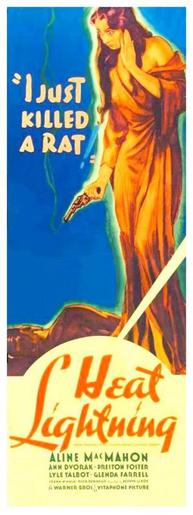
Sisters Myra (Ann Dvorak) and Olga (Aline MacMahon) run a gas station/diner/motel deep in the desert of the American Southwest. Isolated from the rest of the world (except for the customers who are always heading somewhere else), Olga is protective of her younger sister. She forbids her from socializing with men, especially Steve Laird (Theodore Newton), much to Myrna's fury. Olga's life is disrupted by the arrival of George (Preston Foster), a man who was once Olga's lover. Our film this week is Heat Lightning (1934). Aline MacMahon is always remarkable, and this film is no exception. When we meet Olga, her face is closed. She interacts with strangers on a business level only. She is not unfriendly, but distant and cautious. With the arrival of George (who Olga - and only Olga - calls Jerry), Ms. MacMahon changes her whole demeanor. The suspicion begins to slowly melt into affection, and finally into the hope for a resumption of their earlier relationship. Some of this is accomplished with costuming, as Olga literally lets down her lush hair (George had commented on the beauty of her thick, long hair), but most accomplished with Ms. MacMahon's eyes and posture. This was the first picture in which she received star billing, and she makes the most of it. Ann Dvorak's part is relatively small, but the last scenes in which she appears are very strong and truly heartbreaking. Myra's early rebellion and the results that revolt make it appear that the sisters will end up very much alike. The emptiness in Ms. Dvorak's face tell us the future of Myra far better than words could.
We're not used to seeing Lyle Talbot (Jeff) play a weakling, but he does here. By the end, he develops a small amount of backbone, but primarily he is under the thumb of the domineering - and nasty - George. We previously discussed his impressive film career when we viewed A Lost Lady, but this was a new side to a decidedly versatile, and underrated, actor. Frank McHugh (Frank) is also playing a somewhat different part from his usual sidekick roles. He's a chauffeur to Mrs. Feathers Tifton (Glenda Farrell) and Mrs. Tinkle Ashton-Ashley (Ruth Donnelly), two new divorcees, on their way home (with LOTS of expensive jewelry) from Reno. Surprisingly, Mr. McHugh is also the current object of both their affections! Mr. McHugh is amusing and effective with relatively little screen time. But seeing him as an object of lust does take some getting used to. As is often the case, Glenda Farrell doesn't get enough to do, though her interplay with Ruth Donnelly is especially fun. They are a good combination; in the end, Ms. Donnelly gets the better lines and the stronger part.
The script is intriguing, in that the backstory is supplied in tiny spoonfuls - you get just enough to understand Olga, and no more. It's script writing by insinuation, and is effective. You keep watching the movie to find out more, as you are given just a tad more information about Olga's life in the city. While several of the characters seem extraneous - the girls who arrive with "Popsy" (Harry C. Bradley), for example - it's evident by the end of the story that each of these visitors is telling us more about Olga and her decision to live in the desert. As you can see, it's an amazing group of character actors - Jane Darwell also appears in the opening scene as Gladys, wife to henpecked husband Herbert (Edgar Kennedy), a couple motoring through the desert with a really unreliable jalopy. It's another humorous interlude, but fascinating as well - Olga is a skilled mechanic, better than most men - even in the precode era, it's not usual to see a woman who is skilled at a trade.
The story was based on the play, Heat Lightning which was on Broadway for a month in 1933. and starred Jean Dixon as Olga. In 1941, there was remake (of course, drastically altered. The remake was, after all, well within the code) as Highway West (1941) (AFI catalog). Reviewer Mordaunt Hall of the New York Times was not enthusiastic about the film in his review, but did like Ms. MacMahon, saying "she gives a believable performance the rôle is not well suited to her". We disagree; there is not a part written which Ms. MacMahon cannot in some way make suit herself.
Released in March of 1934 (just 4 months before the Code began to be strongly enforced), the picture has not been widely circulated since then, as it was on the Legion of Decency's Banned List (TCM article). We think that it's a shame it - and its star - are not better known, and really recommend a viewing. Here's a trailer to get you started:
When Nan Tayor (Barbara Stanwyck) is arrested as an accessory to a bank robbery, childhood friend David Slade (Preston S. Foster) tries to come to her assistance. Slade believes her protestations of innocence - her father was once their town's deacon and was good to Slade. Slade is now a highly regarded attorney and evangelist and uses his influence to have Nan paroled to his charge. Moved by his trust in her, Nan confesses to him that she was complicit in the robbery, then is disgusted to realize that he will use her confession against her in court. Nan is sent to prison, after she confesses to the authorities, but she harbors a deep, abiding hatred for the man she considers as her betrayer. Nan has become one of the Ladies They Talk About (1933) In a December 2013 article in the New Yorker, Margaret Talbot listed this as one of her 10 favorite Stanwyck films. We found the film very enjoyable, but without the punch of say, Stella Dallas or Double Indemnity. Part of the problem is that Stanwyck's portrayal is so powerful, her leading man is unable to stand up to her force of will. Whenever Stanwyck is on the screen, you watch her - Foster's David Slade is a non-entity next to her, and it's hard to understand what she - or even Susie (Dorothy Burgess) - see in him. It's not altogether Foster's fault - really, the film's focus is on the prison scenes. The romance and warfare between Nan and David are secondary to the interaction of the ladies in prison.
Based on a play by Dorothy Mackaye and Carlton Miles entitled Women in Prison, (for more information on the play, visit the AFI Catalog) the prison scenes are allegedly based on Mackaye's actual experiences in jail. When her husband was killed in an altercation with Mackaye's lover, Paul Kelly, Mackaye was sentenced to one to three years (she served 10 months) in San Quentin for "attempting to conceal facts" (TCM article) in his death. [Actor Paul Kelly would serve 25 months for manslaughter; he and Mackaye married after his release from prison, and were together until her death in 1940. He continued to a successful stage, screen, and television career following his release]. However, any attempt Mackaye may have made in the play to portray living conditions in San Quentin were surely eliminated by the film. The
prison is so very nice and homey - it's more like a college dorm room. Though Warner Brothers
had a technical advisor who had served time at San Quentin (San Quentin
housed women until 1932, when Tehachapi was opened), they still prettied the prison up
substantially. The women have decorations in their rooms, record players they can run all hours of the night, and seem to have the run of each other's cells. Almost everyone seems to get along (except for a woman who is
clearly intended to be lesbian - she "likes to wrestle,' Nan is warned. You can see a picture of her at precode.com).
Lyle Talbot as Nan's partner-in-crime, Don is wasted in the film. He has so very little screen time - we would have expected him to visit her in prison, but that is given over to Lefty (Harold Huber), as the visits only start when Don also ends up in San Quentin. A shame, really, as Talbot is an engaging actor who has proved his ability to go toe-to-toe with strong women. Lillian Roth appears in the film as Nan's prison friend, Linda. Roth is best remembered today as the subject of the Susan Hayward film I'll Cry Tomorrow. In our film, Linda gets an opportunity to sing "If I Could Be with You" to a photo of Joe E. Brown (not our idea of a heartthrob, but under contract to Warner Brothers when they released this film. Then again, so were Jimmy Cagney and Douglas Fairbanks, Jr. Go figure!). A noted Broadway actress, Roth's addiction to alcohol derailed her career. Between 1929 and 1939, she appeared in 22 films and shorts, often playing herself. (Starting in 1955, she began to make sporadic appearances in television and films). She also had a substantial career as a concert and nightclub performer. Married (and divorced) five times, she ended up broke when her last husband absconded with all of her money. She died from a stroke in 1980, aged 69. If you are not familiar with Roth, below is a film of her singing to Mr. Brown!
The reviewer for the New York Times commented on the strength of the prison scene in Ladies They Talk About. He says the film "is effective when it is describing the behavior of the prisoners, the
variety of their misdemeanors, their positions in the social whirl
outside, their ingenuity in giving an intimate domestic touch to the
prison, and their frequently picturesque way of exhibiting pride,
jealousy, vanity and other untrammeled feminine emotions." The romance is less than secondary and is merely a method of giving us a "happily ever after" to the proceedings. We'll leave you with a trailer to the film. Next week, we'll take a look at another Stanwyck films from Ms. Talbot's list of 10 that we've not yet discussed.
Annie Oakley (1935) stars Barbara Stanwyck as the legendary sharpshooter Annie Oakley. The story is loosely based on Annie's early years in the entertainment industry, when she broke into the business by competing against a male rifleman, here named Toby Walker (Preston Foster). And while the film does get a lot of the information right, it takes many liberties with Ms. Oakley's life, not the least of which is that it changes the name of her partner and husband from Frank Butler. Nevertheless, it's an entertaining film, as long as you realize it is "FILM history".
Young Annie Oakley is the main support of her family - her mother and younger siblings. Annie is a crack shot; she hunts quail for an upscale Cincinnati hotel; as she able to hit the bird directly in the head, so no buckshot ruins the meat. When Toby Walker, the new attraction for the Buffalo Bill Wild West Show stays at the hotel, the hotel manager, Mr. MacIvor (Andy Clyde), suggests a shooting match between Walker and the person who is supplying him with his game. MacIvor, however believes his supplier is a man. Annie is able to match Toby shot for shot, but when her mother overhears a discussion that Annie's win might cost Toby his position with Bill Cody, she encourages Annie to lose the match. Annie, who finds Toby quite attractive, purposely misses her next shot. Regardless, her talent with a rifle is noted by Jeff Hogarth (Melvyn Douglas), who hires her for the Buffalo Bill Wild West Show. Soon, Annie is the star of the show, with Ned Buntline (Dick Elliott) hinting at a bitter rivalry between Annie and Toby (for publicity), while Toby secretly teaches Annie showmanship, and while Toby and Annie fall in love.
Barbara Stanwyck as Annie Oakley
The real Annie Oakley
Let's start with a look at the real Annie Oakley. She was born Phoebe Ann Moses in 1860, and following her father's death in 1866, she lived a life of privation. After being sent to a foster home (she would only identify the people as "the wolves"), she eventually returned to her mother; she began hunting and was able through her work to pay off the mortgage on her family's home. That same year (1875), she competed against Frank Butler in a Cincinnati challenge match, and won. Butler was instantly fascinated by her, and the following year, they wed. By 1882, she joined Frank's act - she was so popular that Frank became her manager and publicist, leaving the shooting to Annie. After a long career, both with the Wild West Show and on stage, Annie retired. The Butlers lived in retirement until her death in 1926. Frank died 18 days later. For an in-depth biography of the real Annie Oakley, as well as an analysis of Annie Oakley on Stage and Screen, visit: Annie Oakley (The American Experience).
What is really successful in this film is their ability to catch the romance between Annie and Toby. The audience and Annie never question that the couple are deeply in love. Surely, it plays fast and loose with the facts, but neither are demeaned. Annie is clearly Toby's equal, and even after he is told (by her) that she let him win, he is not intimidated by her, but respects her abilities. Stanwyck is especially vibrant in the role of Annie. She is sweet when she needs to be, but proud of her abilities and not one to hide her light. One scene especially shows Stanwyck at her best. Alone in her room, Annie longs for Toby, whom her colleagues believe has purposefully injured her hand. She knows the injury was accidental, but Toby has been fired by Bill Cody (Moroni Olsen), and Annie is unable to prevent it or even go to Toby. Her pain radiates from her; the scene is done in silence.
This was Stanwyck's first film at RKO. She had been appearing in films at Warner Brothers and was dissatisfied with the parts she was receiving their. She'd already ventured over to First National for The Woman in Red and to Edward Smalls (Reliance) for Red Comrade. Her next film, A Message to Garcia, would be at 20th Century Fox. In A Life of Barbara Stanwyck: Steel-True 1907-1940, Victoria Wilson stated that Stanwyck was "outside the protection of a single studio" (full quote at Rogerebert.com). Perhaps this is why she never won an Oscar. Regardless, it gave her the ability to control her own career to a degree that other actresses probably envied. For more detail on Stanwyck's move to RKO, see this TCM article.
We focused a bit of our discussion on the male leads. Melvyn
Douglas appears in a secondary role with Preston Foster in the lead. We wondered what the film would have been like had the roles been switched.
We've only seen a few films with Preston Foster, and in most of them he had a supporting role (for example, The Harvey Girls (1946) in which he plays the evil Sam Purvis to John Hodiak's heroic Ned Trent); he was briefly discussed when he appeared opposite Carole Lombard in Love Before Breakfast. Foster had a long
career, appearing in film and television til 1967. He had started on the Broadway stage, appearing in
five plays between 1929 and 1932. After that, he was Hollywood bound. He also had a career as a vocalist and songwriter, appearing in trio consisting of himself, his wife Sheila Darcy (to whom he was married from 1946 until his death in 1970) and guitarist Gene Leis. When Foster retired from acting, he took on the role of executive director of the El Camino Playhouse, where he wrote, directed and acted in plays (the Playhouse closed in 1966). Preston Foster died in 1970, at the age of 69.
Also in the small role of Vera Delmar is Pert Kelton, whose distinct speaking voice is instantly recognizable. We've mentioned her before in our discussions of Cain and Mabel and Bed of Roses (wherein she plays the hooker, Minnie) - in this film, she plays a character much closer to that of Minnie. Vera is a bit of a tramp; she's interested in Toby, and doesn't really care what she has to do to get him. Kelton makes the most of her short screen time to create a memorable characterization.
Pert Kelton had a very varied career. Her film career, in which she was generally the wisecracking buddy or a floozy, only lasted from 1929 to 1939. After that, she seems to have moved back to the East Coast, where she appeared in radio. In the 1950s, she appeared in short sketches the Cavalcade of Stars as Alice Norton - sketches that would give birth to the television show The Honeymooners. Kelton, however would not continue on to the series - her husband Ralph Bell had become embroiled in the McCarthy Era blacklist, which led to her being dropped from the show. She did continue in small roles on Cavalcade, and it has been suggested that Gleason attempted to keep her working for as long as he could. He, in fact, invited her to appear in The Color Honeymooners as Alice's mother (since, by that time Audrey Meadows had assumed the role of Alice). Ms. Kelton died in 1968 at the age of 61. Though many of the episodes from Cavalcade are lost, here is a short bit with her that survives:
We leave you this time with a short clip from Annie Oakley - the shooting contest between Annie and Toby. We'll be back soon with a discussion of a more recent film, as well as our evaluation of a Kay Francis film.
Our Carole Lombard focus this time is 1936's Love Before Breakfast. In the spirit of honesty, let's just start by getting it out in the open - we just DIDN'T
like this movie! Try as they might, this trio of excellent actors
(Carole Lombard, Preston Foster, Cesar Romero), could not make this mess
of a script into a cohesive whole. First off, the title - just WHERE
did they pick this title from? It made no sense, bore no relation to the
movie at all. Next, there is the relationship between Kay Colby (Carole
Lombard) and Scott Miller (Preston Foster). All they do is fight. And
fight to the point where it is ridiculous. I won't go into the ending
here, but just watch it. It makes no sense, and is just plain stupid.
Compare it to a similar ending in My Man Godfrey, where the ending is
handled brilliantly. Though it has been a long time since I've seen it
(and one of my viewing companions has not see it at all), we wondered if the screenwriters
were trying to recapture the screwball silliness of Twentiety Century. Regardless, it doesn't succeed.
Another
problem with the film is that it brings in elements, and then doesn't
use them. For example, very early in the film, Scott discovers that
Bill Wadsworth (Cesar Romero - here, for a change, not playing a Latin
lover or Indian houseman) is seeing another woman, though he is engaged
to Kay. So, to get rid of Bill, Scott ships Bill abroad (Bill works for
him), and tells Kay that he did it purposely, but NEVER tells her that
Bill is not faithful to her. WHY? Scott blabs everything else. Why not
that? And if he is not going to use the information, why do we need to
know it? It's dropped out there like some kind of time bomb, then turns
out to be a dud that never goes off.
And then there is Kay. She is stubborn beyond belief! Trapped in a small boat that is about to be
swamped by a storm, she refuses to come aboard Scott's large, warm, DRY
yacht. Bill (who has returned from his work abroad) is so drunk he can't stand up. The pair can't hide below decks
because it is already full of water. So, all they can do is sit on the
main deck, getting drenched and wait to be swept overboard. Could anyone
be that antagonistic towards someone that they would die for it?
So, not exactly one we can recommend. I'm sure we will find The Princess Comes Across much more enjoyable!


 The men in the film mainly serve as support to the the two women. Preston Foster does a good job in a part that could resemble a tree in the hands of a lesser actor. Victor Jory gets the rare opportunity to play the juvenile and romantic interest to both Emmy and Irene. Walter Connolly, however, steals every scene as the somewhat bumbling Supreme Court Justice who would rather listen to the radio than romance his bored wife.