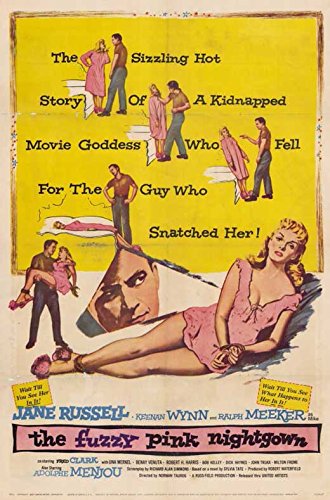
Laurel Stevens (Jane Russell) is a successful actress with a new film being released - The Kidnapped Bride. She's a tough negotiator, who is careful to protect her career and image, and who uses her power to make sure her studio also protects them. Having successfully brokered several concessions for the release of the picture, she leaves for the premiere, only to find that her driver is, in fact, a kidnapper. Driven to a beach-side bungalow and handed The Fuzzy Pink Nightgown (1957), Laurel tries to find a way out. It's unfortunate that this effort at filmmaking is not really successful. It has a decent premise, and a number of good actors, but nothing really gels. It's not that the movie is bad - it has some good moments and presentable performances, but in the long run, the film sinks because of a poorly designed script. Jane Russell does her best with what she's given. Laurel is a strong woman, who sees her career as the most important thing in her life. She's smart and she is determined, so it is hard to understand why she would fall for someone like Mike Valla (Ralph Meeker). He strikes her, and he has forcibly removed her from her home. Part of the problem is that the years have made some aspects of the film distasteful - Laurel is hit a several times; when she hits back, it's set up as being amusing. Quite honestly, there is nothing amusing about her predicament.
None of our group are particular fans of Ralph Meeker, and we didn't find that there was any chemistry between him and Ms. Russell. He's not bad, but he is much more convincing in menacing mode (like in Jeopardy) than in as the romantic lead. Ms. Russell very much wanted Dean Martin to appear as Mike, but director Norman Taurog selected Mr. Meeker after Ray Danton was released from the film (Flashes from Filmland, January 12, 1957 by Erskine Johnson) - it was decided that Mr. Danton looked much too young to be romancing Ms. Russell. The interactions between Laurel and Mike's best friend Dandy (Keenan Wynn) are far more engaging. There seems to be real affection between the two, and Dandy is a more likeable character than Mike. The son and grandson of actors (Ed Wynn and Frank Keenan, respectively), Mr. Wynn spent his film career as a second banana, with a body of work in some outstanding films: The Hucksters(1947), B.F.'s Daughter (1948), Annie Get Your Gun (1950), and Dr. Strangelove (1964) are just a few examples. He'd started on Broadway (he appeared in 9 plays between 1935 and 1943); worked in radio, and eventually segued into television - he took over the role of Digger Barnes in Dallas when David Wayne's other commitments forced him to leave the role. Mr. Wynn was married three times. His first marriage, to Evie Lynn Abbott ended in divorce (the next day Ms. Abbott married Mr. Wynn's best friend, Van Johnson. She would later state that she was forced to marry Mr. Johnson to protect Mr. Wynn's career (The Independent)). His third marriage to Sharley Hudson lasted from 1954 until his death of pancreatic cancer in 1986.
There are some other good character actors in the cast, who make the most of what screen-time they have. Fred Clark (Sgt. Ed McBride) is convincing as a police officer trying to make amends to Mike Valla for wrongly imprisoning him. Una Merkel (Bertha) gives a nice turn as Laurel's assistant, confidant, and best friend. Adolphe Menjou (Arthur Martin), however, is quite over-the-top as the studio head. Ms. Russell and her husband Bob Waterfield purchased the novel on which
the script is based for Russ-Field, their production company (AFI catalog). The novel by Sylvia Tate was based on the alleged kidnapping of actress Marie McDonald (TCM article). Though Ms. MacDonald was found battered on a desert road in California, police and her ex-husband Harry Karl (who would later marry Debbie Reynolds and ruin her financially) believed the kidnapping was faked to garner Ms. MacDonald some publicity (Pulp International). The truth of the story was never proved or disproved.
The New York Timesreview was dismissive, and we have to agree with it. Even at 87 minutes the film seems long. It's not a bad film, it just is a very mixed-up one. It seems like the writers wanted to write a romance, but then decided it should be a comedy - neither holds for very long. You wait for hi-jinx you never get; or for a real romance that never quite materializes. We'll leave you with this trailer:
The Stilwin family, Helen (Barbara Stanwyck), Doug (Barry Sullivan), and son Bobby (Lee Aaker) are in a deserted area of Mexico to enjoy a long anticipated camping expedition. But when an accident places Doug in Jeopardy (1953), it's up to Helen to find assistance before the rising tide drowns her husband. There is, however, a complication - an escaped murderer (Ralph Meeker as Lawson) is in the area, and will stop at nothing to get away.
The poster art for the film is rather peculiar. Yes, Helen does end up in jeopardy, but there are two people in real danger. The posters make it look as though the title of the film is A Woman in Jeopardy, when it is not. This, of course, does make the art a bit more lascivious, but it doesn't prepare the viewer for the real story. We were a little taken aback that Doug would bring his family to such a remote and really dangerous area, especially since they are in a country where none of them speak the language (Doug does have a modicum of Spanish). The conversations between Doug and Helen, however, remind us that this was an area in which Doug spent some happy times during the second World War, fishing with his army buddies. We can assume that, after facing combat, Doug found the isolation of this area attractive, and he remembers it colored by his other thoughts about his time in the service. Barry Sullivan is quite good as Doug - you may shake your head at his decision to take his family to such an odd vacation locale, but you cannot doubt his regard for his wife nor his love for his son. Sullivan's scenes with young Lee Aaker are especially moving; as Doug loses hope of Helen's timely return, he begins to carefully prepare the boy for his death. Sullivan does it tactfully, and without any self-pity. It's a picture of a good father wanting what is best for his boy.
Mr. Sullivan was particularly complementary about Ms. Stanwyck in the film, stating that "of the films I did with Miss Stanwyck only Jeopardy sticks in my mind as having any merit, but all three occasions (the others were The Maverick Queen and Forty Guns) cling to my memory as fun experiences." Part of the credit for the success of the film goes to director John Sturges, who enticed Ms. Stanwyck back from a one-year attempt at retirement. (TCM article) There was a great deal of discussion about Ralph Meeker, who presents an interesting and complicated character. Two of our members wondered if providing a backstory for Lawson would have been beneficial. What did he do? Why was he in Mexico? I'm convinced it would not have added anything. We know Lawson is a murderer. We see a dead man that he killed, and we see him shoot a police officer. That, for me, was enough. By the end (no spoilers on this one), we do have to look at Lawson as a human being rather than just a malevolent villain. Lawson is a complex individual who you won't like but will appreciate.
Lee Aaker, who is very good as Bobby, had a relatively short film and television career. He's probably best remembered today for his role as Corporal Rusty in The Adventures of Rin Tin Tin (1954-1959). Many of his film roles were uncredited (like A Lion is in the Streets (1953)), but he also had the role of Red Chief in "The Ransom of Red Chief" segment of O. Henry's Full House. When acting roles were not available to him any longer (as so frequently happens to child actors), he went into the production arena. He finally left Hollywood, settling in Mammoth Lakes, California.
Based on a radio play A Question of Time (AFI catalog), the film was expanded a bit, but is still relatively short - 69 minutes, which affords the film a lot of tension. Bosley Crowther of the New York Timeswas not impressed by the film; regardless it did well at the box office. In 1954, Ms. Stanwyck and Mr. Sullivan reprized their roles in a 48 minute broadcast. In a recent introduction on TCM's Noir Alley (to Stawyck's Crime of Passion), Eddie Muller called Ms. Stanwyck "greatest actress in the history of
motion pictures." He went on to say:
Not only did Ms. Stanwyck possess the greatest range of any
movie actress, being equally adept at screwball comedy and gut-wrenching drama,
she could easily lay claim to being the most essential actress in the development
of film noir. After all, dark crime thrillers were not really a movement until
Stanwyck created a sensation as the duplicitous
Phyllis Dietrickson in 1944’s Double Indemnity. At that time she was the
highest paid woman in the USA and the box office success of that film was the
single most critical factor in the rise of what would later be called film
noir. And she didn’t stop there; during
the 10 years following Double Indemnity, she could lay claim to the title The Queen of Film
Noir: The Strange Love of Martha Ivers, Sorry, Wrong Number, The Two Mrs. Carrolls, The File on Thelma
Jordan, No Man of Her Own, Witness to Murder,
as well as noir-stained dramas like The Lady Gambles, Clash by Night,
and Jeopardy. Stanwyck took a long Walk on the Wild Side. For years however,
few of those films were mentioned when experts talked about film noir. The
reason is simple. Film scholars were mostly men and they rarely felt a female
protagonist fit the mold they’d established for film noir. No one, man or woman, portrayed this angst
and agony better than Barbara Stanwyck.
Thank you, Mr. Muller for saying so eloquently what we've been attesting to in our own modest way about this most glorious of actresses. We'll leave you with this trailer for the film.