Showing posts with label Charles Laughton. Show all posts

Thursday, May 14, 2020

Tyrone's on Trial

Ruta Lee, who appeared in the small role of Diana in Witness for the Prosecution (1957) spoke about her appearance in the film during the TCM Cruise.  Ms. Lee got the part when Arthur Hornblow, Jr. saw her at a Frank Sinatra night club appearance.  Hornblow approached her, and asked her to do a screen test; after which Marlene Dietrich (Christine Vole) insisted that her hair color be changed (so Ms. Lee became a brunette for the film).

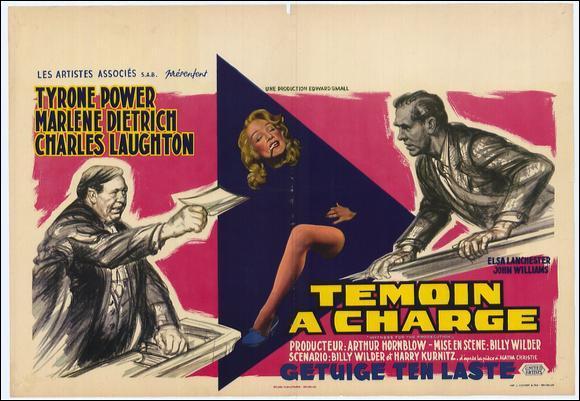
Sir Wilfrid Robarts (Charles Laughton) has just returned home from hospital, with his nurse Miss Plimsoll (Elsa Lanchester) in tow, when he is approached by solicitor Mayhew (Henry Daniell) to possibly take on the defense of Leonard Vole (Tyrone Power) who is about to be arrested for the murder of Emily Jane French (Norma Varden), a wealthy widow who Vole had befriended.  Sir Wilfred finally agrees to take on the case (over the objections of Miss Plimsoll), as he is convinced of Vole's innocence, and the barrister he intended to recommend is not (John Williams as Brogan-Moore).  Complications ensue in the form of Vole's wife, Christine.  Is she really trying to help her husband, or is she using the murder as a means of getting rid of him for good?

I've seen this film dozens of times on television; I always appreciated the humor that floats through this very serious story.  But, seeing it with an audience really impressed upon me how FUNNY it really is - especially the interplay between Charles Laughton and (his wife in real life) Elsa Lanchester, who acts as straight woman for his bon mots.  For example, when Miss Plimsoll checks Sir Wilfred's thermos (to verify no brandy is present), he counters her with "If you were a woman, Miss Plimsoll, I would strike you."  And when she informs him that she was engaged to a lawyer but he died, he responds, "He certainly was a lucky lawyer." But the humor would not work if the audience didn't sense the affection between Laughton and Lanchester, and they easily give you the sense (even before the ending of the film) that these two are now a team.
Based on a short story by Agatha Christie, Witness for the Prosecution was adapted by Ms. Christie as a play which opened on the West End (London) in 1953. David Horne starred as Sir Wilfred and Derek Blomfield appeared as Leonard Vole.  When the play moved to Broadway, Francis L. Sullivan took on the role of Sir Wilfred, with Gene Lyons as Vole.  The character of Miss Plimsoll does not exist in the stage version.

Only one member of the Broadway cast reprised her role in the film - Una O'Connor as Janet McKenzie, housekeeper to the murder victim.  Born in Ireland in 1880, Ms. O'Connor started her career on the stage, in both Ireland and England.  In 1911, she appeared in her first Broadway play (The Playboy of the Western World), and by 1929, she was appearing in films, first in the UK and then in Hollywood.  She's perhaps best remembered as Maid Marian's lady-in-waiting, Bess in The Adventures of Robin Hood, and as Reginald Gardiner's housekeeper in Christmas in Connecticut.    But, even while doing films, she still managed to squeeze in the theatre - she appeared in 11 Broadway plays and 64 films, and ventured into television in the 1950s.  She was 77 when she appeared in this film, and when it wrapped, she retired.  She died two years later.
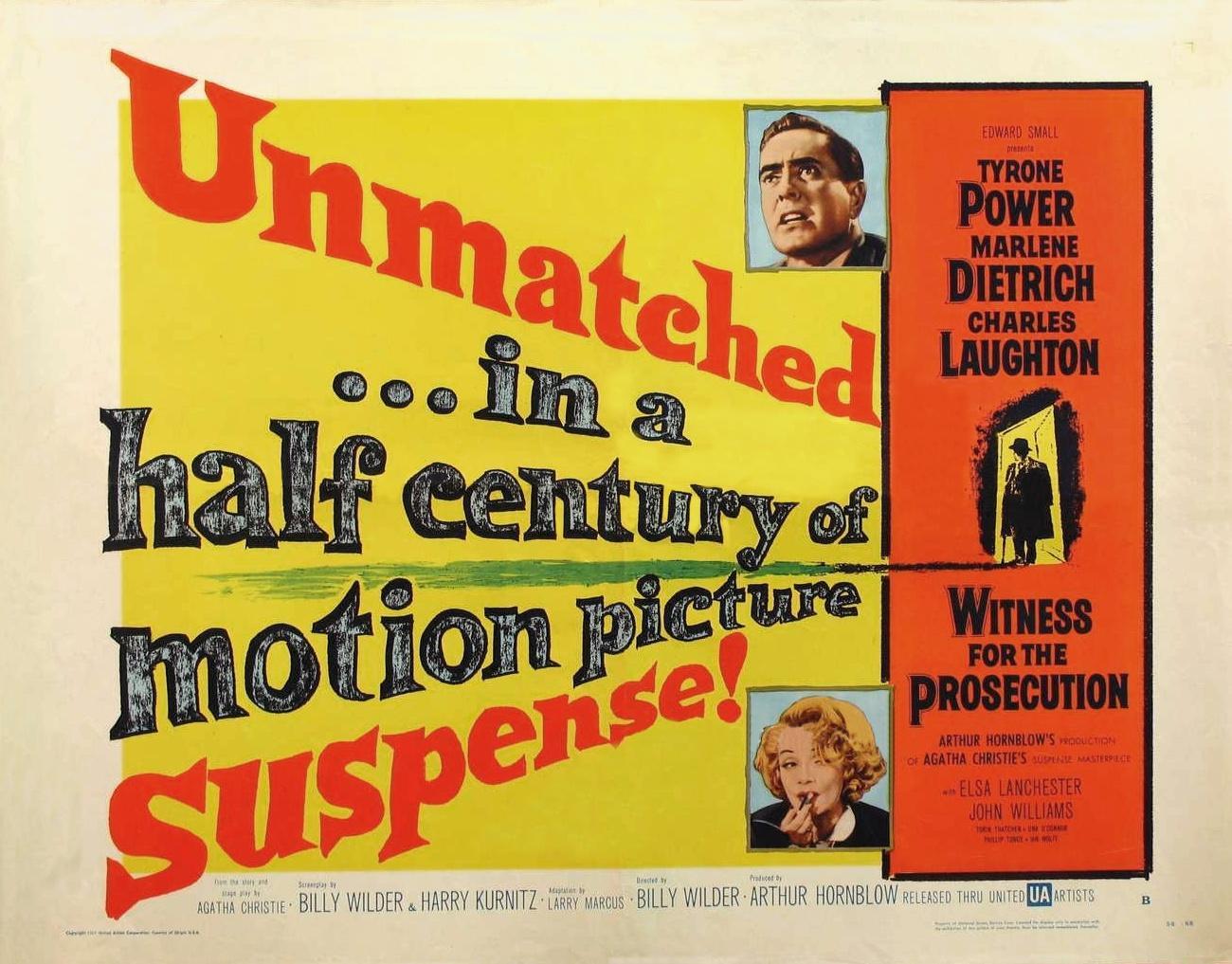
This was also Tyrone Power's final film appearance. According to these TCM articles, Power was not the first choice for Leonard Vole - William Holden was.  Also considered were Gene Kelly, Kirk Douglas, Glenn Ford, Jack Lemmon, and Roger Moore.  Power, who had at first turned down the role, finally accepted; with this role came the part of Solomon in Solomon and Sheba, which Power started shooting on September 15th, 1958.  But on November 15th, after shooting a dueling sequence, Power complained of arm and chest pain.  Despite being rushed to the hospital, he died of a massive heart attack.
Ava Gardner and Rita Hayworth were also considered for the role of Christine, and while Gardner very much wanted to do it, Billy Wilder wanted his friend Marlene Dietrich in the lead.  Without giving anything away (in case you've not seen it), it has often been said that Dietrich lost out on an Oscar nomination because of the secrecy about the film's ending. 

Finally, there is Charles Laughton.  Laughton was nominated for an Oscar for this role, but lost to Alec Guinness in The Bridge on the River Kwai.  Certainly, a notable performance, but my vote goes to Laughton.  A consummate actor, an impressive director (he directed once - the magnificent Night of the Hunter, and Robert Mitchum once claimed Laughton was his favorite director), Laughton won the Oscar once - for his role in The Private Life of Henry VIII (1934), and was nominated twice more - for this and for The Mutiny on the Bounty.  His performance here is layered and substantial.  He's funny, he's businesslike, he's subtle, he's passionate. All in all, his performance is special. 

These  notes from the AFI catalog go into some detail about the changes to the script, including, interestingly, the film's end.  The film got excellent reviews, as is evidenced by this New York Times review, and the AFI named it #6 in its list of Top 10 Courtroom Dramas.  All in all, this is an excellent film, only enhanced by being able to learn some of its history firsthand.

We'll close with this scene, in which Christine Vole is interviewed by Sir Wilfred: two actors at the top of their game.  Unlike her husband in an earlier scene, Christine takes no nonsense in her examination:


This posting is part of the Oscar Snubs Blogathon.

Wednesday, October 16, 2019

Robert Meets a Ghost


When the ancestral home of the de Canterville's is sequestered for use by the U.S. Army, the heiress, Lady Jessica de Canterville (Margaret O'Brien) meets an American decendent of the family Cuffy Williams (Robert Young). They also meet the resident ghost, Sir Simon de Canterville (Charles Laughton) who was condemned to walk the halls of the house until a descendant performs an act of bravery. Could Cuffy be the one to free The Canterville Ghost (1944)?

As part of the 10th Anniversary celebration for the Classic Movie Blog Association, we're featuring film-related anniversaries. Now 75 years old, The Canterville Ghost is also part of the memorials for the Second World War and D-Day (it was released in August, just two months after the invasion).

Let's begin by mentioning that the screenplay, adapted from an Oscar Wilde short story of the same name, has only marginal similarity to its inspiration. This is very much a World War II tale - there is no need for a descendant to perform an act of bravery for Sir Simon in Wilde's version. For one thing, Sir Simon's crime in Wilde's story is far more deserving of his horrible fate - in an unjustified fit of jealousy, he murders his innocent wife. In the film version, Sir Simon runs away from an opponent in a duel - even Sir Simon's adversary thinks his punishment horrific. Because the victim of his crime in the Wilde novella was a woman, Sir Simon must be saved by a woman: "you must weep for me for my sins, because I have no tears, and pray with me for my soul, because I have no faith, and then, if you have always been sweet, and good, and gentle, the Angel of Death will have mercy on me." (The Canterville Ghost by Oscar Wilde). The idea of courage under fire was deemed more meaningful in the midst of the war.
As we saw in Journey for Margaret (1942), the chemistry between Margaret O'Brien and Robert Young is outstanding. He's also faced with the unenviable task of playing a coward as his country (and the viewers of the film) face an horrific war. It cannot have been easy to play a man who begins the film running from danger, but Mr. Young takes on the task. He makes Cuffy even more the hero, because the audience is aware that he is truly afraid. (Mr. Young remained in Hollywood during World War II. He participated in war bond rallies and worked with the local civil defense.)

Equally enjoyable are the scenes between Charles Laughton and Ms. O'Brien. He was "enchanted" by Ms. O'Brien (TCM article) and their affection shows. It's been said that Mr. Laughton wanted children, however his wife, Elsa Lanchester, was either not willing or unable to have children (she admitted to at least two abortions). Mr. Laughton was allegedly quite receptive to interactions with youngsters - in fact, his only work as a director, The Night of the Hunter (1955), focused on two children. 

We were especially takien with the dancing sequence in which a young soldier asks Lady Jessica to dance. As the child is unfamiliar with swing dancing,  the soldier does all the steps for her. Ms. O'Brien really gets into the routine - even when she is unable to do something, she turns control over to her partner. It's a lot of fun to watch.

The film also demonstrates the skills of a number of excellent character performers: Una O'Connor (Mrs. Umney) is good as Lady Jessica's nanny. William Gargan (Sargent Benson) has just the right amount of military demeanor for a man who has literally just seen a ghost. Peter Lawford (Anthony de Canterville) dons a blonde wig that we suspect he stole from June Allyson to play Sir Simon's brother. Reginald Owen (Lord Canterville) is autocratic as a man who values courage over the life of his son.

The film was originally to be directed by Norman McLeod, but Charles Laughton was concerned with Mr. McLeod prior experiences with broad comedy (he was the director on two Marx Brothers and one W.C. Fields films), and requested that he be replaced. Jules Dassin stepped in, and he and Mr. Laughton got on swimmingly. As this was one of Mr. Dassin's earliest feature films, Mr. Laughton provided advice in private, which the director found helpful.

There have been numerous adaptions of  The Canterville Ghost. An early television broadcast (September 1949) starred Wendy Barrie and Edward Ashley. The following year, Robert Montgomery Presents Your Lucky Strike Theatre (November 1950) had a version with Cecil Parker and Margaret O'Brien. In April of 1951, the Du Mont network aired a show with Lois Hall and Reginald Sheffield. May 1953 saw  Ziv TV show the story with John Qualen and Connie Marshall. It was made into a musical in November of 1966 - again on television - with  Michael Redgrave, Douglas Fairbanks, Jr. and Peter Noone (of Herman's Hermits fame), John Gielgud and Andrea Marcovicci were in a 1986 television film, and Patrick Steward and Neve Campbell tackled the parts in 1996. (AFI catalog). A Film Comment article from 2018 calls this version "the strangest one of all," but we agree with them that it is "definitely charming." Here's a trailer:


This post is part of The Anniversary Blogathon hosted by The Classic Movie Blog Association - celebrating it's 10th Year. Happy anniversary, fellow members! Please visit the website to read the other posts that are part of this celebration.

Monday, May 8, 2017

Norma is Bedridden

Based on the 1930 play by Rudolf Besier (which premiered on Broadway in 1931 with Katherine Cornell and Brian Aherne in the lead roles), Barretts of Wimpole Street (1934) tells the story behind the courtship and marriage of Elizabeth Barrett and Robert Browning.  The Barrett family live in a large house in London with their father, Edward Moulton-Barrett (Charles Laughton).  The six brothers and three sisters have been forbidden to marry by their father, who rules the home with an iron hand.  Elizabeth, the eldest child (Norma Shearer) and a highly regarded poet, is his darling; that she is bedridden, and therefore quietly dependent upon him is no small part of his affection. The arrival of poet Robert Browning (Fredric March) at Wimpole Street, who comes to discuss her poetry, but leaves totally enamored of her, changes the dynamic between father and daughter, as Elizabeth begins to get well, and to envision a life outside the environs of Wimpole Street.

History according to Hollywood is a fascinating thing, and this film is ripe for comparison to the actual facts.  For the most part, the story is a quite accurate portrayal of the courtship between Elizabeth Barrett and Robert Browning.  The large Barrett family did all live together in Wimpole Street, and were forbidden marriage by their domineering father.  Elizabeth was the first to wed (and her elopement actually put some stress on her relationship with her brothers); she was immediately disowned by her father. Henrietta (Maureen O'Sullivan) was romantically involved with Captain Surtees Cook (Ralph Forbes); they ultimately married and had three children.  Elizabeth's brother Alfred also married before his father's death; both he and Henrietta were disinherited. (See The Brownings' Correspondence)   Elizabeth did seem to recover some of her health after meeting Robert Browning, and Mr. Barrett did forbid Elizabeth to go to Italy for her health. In 1846, Elizabeth and Robert eloped to St. Marylebone Church with Elizabeth's maid, Wilson (Una O'Connor) in attendance; within the week, they left for Italy, where they remained for the rest of Elizabeth's life. In 1849, Elizabeth gave birth to her only son, Robert "Pen" Browning (she suffered four miscarriages). Elizabeth died at age 55 in 1861.  After her death, Robert returned to England with Pen; they moved to a residence close to Anabel Barrett (Katharine Alexander), who acted as a surrogate mother to Pen and a confidant to Robert.  Robert would live until 1889, age 77. (The Poetry Foundation)
Charles Laughton, as the Barrett patriarch is impressive.  Though only three years older than Ms. Shearer, he sears the screen with his overbearing and frightening presence.  Laughton is not afraid to make Mr. Barrett a monster. In fact, when he was told by producer Irving Thalberg that, thanks to the censors, the film would need to play down the incest angle of Barrett's affection for his eldest daughter, Laughton objected, telling Thalberg that "...they can't censor the gleam in my eye."  (TCM article).

Allegedly, Fredric March was disappointed with his performance, feeling that director Sidney Franklin was more interested in the character of Elizabeth, and that his performance suffered by comparison. March felt his performance was too over-the-top, and while he is quite passionate and exuberant, we really felt it worked. Browning was 6 years younger than Elizabeth; March's performance emphasizes that age gap, and also transmits the idea of someone who really could transfer his strength into the body of a sick woman.  We found him to be delightful and even the New York Times in their review was rather complimentary.
It's only thanks to Mr. Thalberg that Ms. Shearer agreed to play Elizabeth - she was unsure of taking on a role so closely linked to Katherine Cornell (though Ms. Cornell was not interested in appearing in films - she would eventually do ONE - she appeared in Stage Door Canteen during the second World War.) But she is lovely in the role; she was nominated for an Oscar for the performance (she lost to Claudette Colbert in It Happened One Night). The film was also nominated for a Best Picture Oscar (also losing to It Happened One Night). Marion Davies was originally set to star (William Randolph Hearst yearned for his lady to play more serious parts). However, Ms. Davies bowed out (after a conversation with Ms. Shearer).  Ms. Davies was much happier in her comedies and was not comfortable with appearing in such a serious part (AFI Catalog). 

Una O'Connor  as Wilson is wonderful. Ms. O'Connor plays the part more as a surrogate mother to the ailing Elizabeth, and less as her servant.  With a walk that makes her almost appear to glide across the screen, and her stubborn determination to protect her charge, Ms. O'Connor is a delight.
We were somewhat less enthralled with Marion Clayton as Barrett cousin Bella Hedley and Ian Wolfe as her fiance Harry Bevan.  Their odd speech patterns (she with a little girl lisp and he with an affected upper class tone) just seemed pointless. We kept wanting them to just shut up and go away. (Bella does serve a purpose to the overall story; Harry, not so much).

The costumes, as designed by Adrian, are magnificent, especially Elizabeth's fur ensemble at the end of the film.  The play was primarily set in Elizabeth's sitting room, and the film really does very little to extend it from that location (we do outside once with Henrietta, and to Browning's home with Wilson. The rest of the film is set in the Barrett house, and is Elizabeth's perspective) .  Despite that, the film is entertaining and not in the least claustrophobic. 

The success of the play and this film led to it being remade at least 10 times for radio, film and television.  In 1946, Lux Radio Theatre broadcast a version starring Loretta Young and Brian Aherne - Mr. Aherne reprising his stage performance as Robert Browning.  In 1950, Helen Hayes starred as Elizabeth on television's Prudential Family Playhouse.  Another television production followed in 1955 as part of the Front Row Center series, this time starring Geraldine Fitzgerald as Ba. The Producers' Showcase series in 1956 scored a coup, convincing Katherine Cornell to reprise her Broadway role.  There were also two film versions: one in 1957, with Jennifer Jones; and a second in 1982, with Jane Lapotaire and Jeremy Brett.  

We'll leave you with the scene from the film: