Showing posts with label Louise Closser Hale. Show all posts

Monday, August 30, 2021

Joan's "Lost" Film

Wealthy Letty Lynton (1932) (Joan Crawford) left the United States to live in South America. She's been in an assignation with the domineering  Emile Renaul (Nils Asther), who is insistent that she will never leave him. Letty escapes to a U.S. bound ship, where she meets Jerry Darrow (Robert Montgomery); romance follows, but the threat of Emile is a clear and present danger to Letty's happiness. 

The legend of Letty Lynton has existed since it was taken out of circulation in 1936, following a battle about the copyright of the story.  It was a film I’d always wanted to see (what WAS the Letty Lynton  dress??), and while I normally avoid pirated films, the opportunity to see it on stream from another country was just too tempting to resist.  The copy was pretty awful, which I expected, but the full film was there.  And so we got to watch this Joan Crawford movie we never expected to view.
 
This is Ms. Crawford's film - she is the focus of the story and is in nearly every scene. As good as her supporting cast is, that is what they are - support for the story of Letty's decision to try and change her life.  She's awfully good - we were especially impressed with a scene mid-film in which Letty tries to reconnect with the Mother (May Robson) who emotionally withdrew from Letty when Letty was a child.  Letty's meanderings have been an attempt to avoid her mother's coldness and find some semblance of love. With the possibility of a new life with Jerry, Letty makes one more appeal to her mother. Ms. Crawford never loses her cool but her face reflects the pain she feels as her mother yet again withdraws from her.

We always enjoy Robert Montgomery, and he is very good in what is essentially a minor role. Sure, he’s the romantic lead, but as we mentioned, this is Letty’s story, not his. Mr. Montgomery is able to bring Jerry to a higher level - he gives him an inner strength that is crucial to the film’s ending. Interestingly, he was not the first actor considered - Robert Young was also considered for the part. 

There is nothing in the least attractive about Nils Asther’s Emile. He’s a bully, abusive, and a stalker. If we were supposed to have any sympathy for his passion for Letty, it’s pretty much gone when he shows up at the dock in New York.  Nils Asther started his Hollywood career during the silent era, when his strong Swedish accent didn’t matter. While his career continued into the talkies, it was limited to playing foreigners, like the General in The Bitter Tea of General Yen (1933). He would continue in films and television until 1961. Briefly married to Vivian Duncan, the couple had one daughter. Mr. Asther died in Sweden in 1981 at the age of 84.

The film makes a nice counterpoint between the relationships of Letty and her mother to Jerry's loving and affectionate parents (played by Emma Dunn and Walter Walker). We do have a brief scene with them and Letty - Ms. Crawford again nicely shows the longing Letty feels for such a family dynamic without being over-the-top.

Letty's true mother is played by her maid and confidant, Miranda (Louise Closser Hale). She sweet, if at times a bit muddled, but her affection for Letty is very clear from the start of the film, and her desire to get her charge to a better place is also obvious.  Ms. Hale is a delightful actress, with great range; this film shows another aspect of her talent.

Finally, Lewis Stone  (John J. Haney) drops in as a policy investigator towards the end of the film. He's not very bright, and is rather superfluous to the story.  The scene itself IS necessary to mend a bunch of fences, but Haney is a head-shaker of a police officer.

The New York Times review by Mordaunt Hall was negative; however, the picture was popular - Letty's white dress becoming a fashion sensation.  When the studio attempted re-release, a lawsuit followed (for more information, the AFI catalog details the particulars), and the film was eventually relegated to the archives.  Letty's story may have been influenced by the murderer Madeleine Smith. Her story made the screen in 1950 in the David Lean film Madeleine with Ann Todd as the notorious Ms. Smith

We'll leave you with this scene of Letty and Jerry falling in love. Here's hoping the film is eventually able to be re-released with a decent print.

W


Monday, February 29, 2016

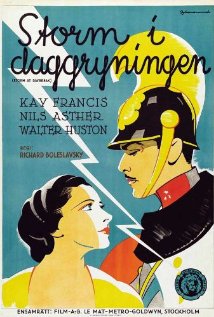
Kay Faces a Storm

Following the assassination of the Archduke Franz Ferdinand and the Duchess Sophia, a small town in Hungary begins to feel the effects of the war.  Kindly mayor Dushan Radovic (Walter Huston) and his friend, Captain Geza Petery (Nils Asther) do what they can to minimize the effects, but, they have problems.  The first is that Radovic is a Serbian, while Petery is Hungarian.  The second is that Geza and Petery's wife Irina (Kay Francis) have fallen desperately in love. 

Storm at Daybreak (1933) could have been a good movie.  The elements are there.  Unfortunately, the film is way too long, and feels as though it were padded for no very good reason.  A party scene seems to go on forever, and to no apparent purpose - it attempts to inject humor into a situation where there is precious little.  A scene in a railway yard brings Geza momentarily back into the lives of Irina and Dushan, but for no reason; he's gone in an instant, and it doesn't forward the action a jot.  One wonders what the writers were trying to accomplish.

The script makes Walter Huston's Dushan comes across as a complete moron who is unable to see that his wife and his supposed best friend are having real problems.  Despite the fact that Irina makes it clear that she would rather Geza not be around their home, Dushan keeps bringing him back, making it hard for two people who want to forget their feelings for one another to function.  And Huston, a remarkable actor in so many other roles (watch him in Dodsworth, for example) overacts horribly.    Also opting for over-the-top is C. Henry Gordon as the villainous Panto Nikitch.  He manages to twirl his mustache without even having one.   One can almost hear the director (Richard Boleslawski - this TCM article provides a bit more information about him) shouting "Give me MORE!!"  We wanted a lot less.
The New York Times review (the reviewer was Andre D. Senwald), though calling the film "dull entertainment", was far more impressed than we were with Huston (who "blusters picturesquely"), but not very complementary of Ms. Francis  (she "hardly seems suited to the enigmatic and mysterious qualities demanded in the rĂ´le of the wife.")  Quite honestly, Kay Francis is the best thing in the movie.  She doesn't have a whole lot to work with - the part is formulaic at best.  But she carefully underplays Irina, making her far more attractive.  That being said, a scene in which she runs out into a rainstorm in a huge dress (she could barely get it through the door) to warn her lover of impending doom, was almost ridiculous.  Not her fault - she actually GOT the dress through the door - but a true waste of her talents.
We have two favorite character actors present: Eugene Pallette as Janos, Geza's aide-de-camp, and Louise Closser Hale as Militza Brookska, the housekeeper in Dushan's home.  Attempts are made to milk their performances for some humor; mostly, it doesn't work (though Pallette does get all the best lines.)   By and large they are wasted, as is everyone else in the cast.

That the film is formulaic is not really a problem, usually it's a formula we like.  But this one is not going down as our favorite Kay Francis movie. 


Friday, May 2, 2014

Jean is Jealous of Loretta


Though Loretta Young (as Gallagher, the young reporter with no first name) is listed as the star of Platinum Blonde (1931), it's Jean Harlow as socialite Ann Schuyler who steals the film.  When reporter Stew Smith (Robert Williams) visits the Schuyler home to determine the validity of rumors about Ann's brother Michael, Stew is instantly smitten by the lovely Ann.  She is less impressed, but when Stew is able to retrieve (and return to the family) some incriminating letters written by Michael, Ann discovers that Stew is appealing indeed.  Their elopement is an anathema to her family, but Ann is determined to have Stew fit into HER world, whether Stew likes it or not.

This is a very enjoyable film, with good performances by Jean Harlow and Robert Williams.  As we mentioned, Young's name is above the title, but she doesn't stand a chance once Harlow shows up.  Harlow's Ann is quite appealing, perhaps because she doesn't seem as upper class and snooty as the rest of the Schuyler family.  This TCM Article discusses the problems Harlow had with sounding "sophisticated."  She especially had some difficulties with the word "library".  While director Frank Capra must have despaired at getting her to sound right, in the long run, it works in her favor.  We want to like them as a the couple, despite the fact that Ann is doing all she can to make her young husband into an upper-class twit.
That this is a pre-code film is readily apparent by the relationship between Stew and Ann. It's really one of lust more than of love.   Though Stew is clearly his own man, Ann is determined to tame him, and make him an appendage to her lifestyle.  She has no clear understanding of his career goals (he wants to write a play, for one thing) and would be quite satisfied if he stayed home and played at being a society husband.

Louise Closser Hale, a character actress we've admired before, is terrific as Ann's horror of a mother.  Mrs. Schuyler couldn't be a bigger snob, and her disregard for anyone not in her social circle makes her unlikeable AND humorous.  Her "consort" of sorts is Reginald Owen as lawyer Grayson.  Grayson does all of Mrs. Schuyler's dirty work, and enjoys every minute of it.  The character provides someone at whom Stew can direct his animosity, and Owen does an admirable job of keeping the character distasteful.  Also well worth watching is Halliwell Hobbes as Smythe, the butler.  We would expect this character (really, the only one in the house with any class) to be the worst snob, but Hobbes gives us a likeable fellow who really is open to all classes.  The party scene in which he interacts with Stew's friends is a riot.

Robert Williams, who played Stew, is also delightful.  This, unfortunately, was his last film. He died at the age of 37, the result of peritonitis from a ruptured appendix.  He had only made 7 films - two shorts and 5 full-length films (one a silent).  We've actually reviewed two of his talkies: Devotion and The Common Law.  This film demonstrates his breezy style and screen presence. 

Though Ann is the one with most of the good clothing, our Loretta gets one smashing evening dress that takes your breath away.  It's amusing that Stew specifically asks HOW she got a dress like that (on a reporter's salary).  We wondered the same thing.  The name of the costumer is not provided, but this dress proves his/her talents.

Interestingly, the film was originally called "Gallagher" after Young's character, but was changed to demonstrate the power Harlow had in the film.  Directed by Capra and written in part by Robert Riskin, it provides an early example of their collaborative genius.

As we mentioned before, one scene that particularly stuck with us was the singing argument between Ann and Stew.  As referenced in the TCM article above, it does seem almost improvised. It also appears that Harlow and Williams are having quite a good time:


Tuesday, July 9, 2013

Constance is Born to Love

T
Towards the end of World War I, a nurse in England, Doris Kendall (Constance Bennett) meets an American soldier (Joel McCrea as Captain Barry Craig).  They fall in love; he wants to marry her, but if he does, she will be sent back to America, and she desperately wants to stay in Europe to be near him.  They spend the night together, just before he leaves for the front.  And then, the floor falls out from under Doris when she learns that Barry is missing, presumed dead.  Thus begins Born to Love (1931).

Certainly, Born to Love is a melodrama, but a very well-done one, with enough twists and turns to keep you guessing til the end of the film.  Sure, we know that Barry isn't dead fairly early on, but that does not keep the suspense active - will Doris find out that Barry is alive in time? Will she leave her new husband (Paul Cavanagh as Sir Wilfred Drake)? There's more, but that would give too much away. 

We saw some interesting similarities to other films we have watched.  The scene in which we discover that Barry and Doris have been intimate is delicately handled.  The resulting out-of-wedlock baby reminded us of the post-code To Each His Own. Both are set during the First World War; both result in the mother having to make a decision about the child's (and their own) futures. And both are quite subtle in letting us know that more has happened than immediately meets the eye.  Late in the film, there is a tragic occurrence; the film uses a silhouette  convey the tragedy.  Interestingly the same technique was used in the 1937 Adventure in Manhattan, which also starred Joel McCrea. There is even a line of dialog that is remarkably similar.  McCrea appears to be the only common link between two film.  Is it possible he suggested the line? Or did the authors see Born to Love?  I suspect we will never know.  


Constance Bennett is excellent in this film.  We were again taken with her versatility as a screen actress.  She is able to move seamlessly from comedy to intense drama. And certainly the plot of this film demands an intensity of emotion.  Joel McCrea again plays a man who is not entirely likeable.  His Barry is selfish; he shows up after Doris has married, urging her to abandon her husband AND her child for him.  We wondered why he had never tried to communicate with her until then (a period of nearly a year).  He says he was very ill; could he not find a nurse willing to write to his fiance and let her know he was alive?  Those two things made us very distrustful of him; we saw him as quite childish and unreliable.  Which made us more sympathetic to Sir Wilfred.  Except that Sir Wilfred ultimately shows himself to be the biggest cad of all.  This man who originally seems kind, strong, and loving turns out to be cruel, cowardly, and sneaky.   As we said, this is not a simple film.

We have a couple of character actors to mention - Louise Closser Hale as Wilfred's aunt, Lady Agatha Ponsonby is quite good.  Her character is no-nonsense.  At first she doesn't seem to think all that much of Doris, yet when things get tough, she is gone.  As though she doesn't want to be involved in her nephew's calumny.  And Frederick Kerr  as Lord James Ponsonby (or Uncle James, as Doris calls him) is quite good as the only truly good man in the film.  He dislikes his nephew's actions, but has no control over him.  Uncle James' distress is quite evident, as is his affection for Doris.

Next time, we'll be seeing another Constance Bennett film.  We hope to see you then.


Monday, January 7, 2013

Nanny in Disguise

Devotion (1931) stars Ann Harding as Shirley Mortimer the maligned and ignored daughter of an intellectual family.  While assisting her family (Shirley runs the house. The rest of the family is “too busy”), she meets David Trent (Leslie Howard), a busy barrister in need of a nanny for his young son. Shirley is smitten with David, and decides to pursue their relationship by apply for the job as nanny. She facilitates this by inventing an older Cockney lady, Mrs. Halifax, and donning a grey wig, old clothing, and glasses. David, of course, is oblivious to the disguise, but it doesn’t take long for his client, Norman Harrington (Robert Williams) to realize that the wig is hiding an attractive, young woman.

It struck us that Shirley was the somewhat less unbalanced mother of Bette Davis’ Charlotte Vale (Now, Voyager). Both are looked down upon by their families, both seem to see themselves as unattractive.< However, Shirley decides NOT to have a nervous breakdown. Instead, she becomes someone else.

Though filmed in the Pre-code era, this isn’t really a Pre-code movie. Or is it? Norman has murdered his wife (and been found innocent, because the wife was a violent lush). And David has his own little secret (which we won’t reveal) that rather smacks of the Pre-code ethos.
Ann Harding is quite endearing as Shirley. Though her family doesn’t think so, she really does have a backbone, is smart, and ultimately quite attractive. Leslie Howard is appropriately befuddled as the overworked barrister. And then there is Robert Williams. Robert Osborne told us about his unfortunate, brief life – a life cut short just as he was receiving attention for his work. His Norman is JUST enough on the edge to make you wonder IF he was really a murderer. One is never quite sure if he is trustworthy or not. And watch for Louise Closser Hale as Shirley's witch of a mother. 

We leave you with a clip from the film. Next time, a real Pre-Code film!

Monday, November 5, 2012

Myrna in Egypt

In 1933's The Barbarian, Myrna Loy is NOT playing the exotic.  Ramon Novarro is. He is The Barbarian of the title - Jamil El Shehab, an Arabian prince, who has been working in the city as an erstwhile tourguide and ladies' man. Diana Standing (Myrna) arrives in town with her fiance Gerald Hume (Reginald Denny) and her companion Powers (Louise Closser Hale).  Jamil takes an immediate interest in Diana - she is somewhat less engaged by him.  There is some verbal dueling, some tricks played by Jamil on Gerald, and finally, Jamil kidnaps Diana.  

Today, we would probably say that Diana had Stockholm Syndrome, because, quite frankly, as physically attractive as Jamil is, he is really quite an unattractive individual. He is a bully, he is a male chauvanist, and finally, he is physically abusive.  Why Diana would want him in the end is beyond me. Then again, Gerald is no prince among men either. He's just a wimp who can't even stand up to his mother!

 Loy is just lovely, as always and one is sympathetic to her Diana.  The problem is, one can't understand why she doesn't just leave town with Powers (the always irrepressible Louise Closser Hale) and find a better man.  Certainly the two she's managed to dig up in Egypt should just be left in a pyramid somewhere with a mummy! This is not really a film that translates well in the 21st Century.  We really wanted Diana to get a better break.

And of course, it is ever so racy.  By today's standards, the hint of nudity in one of the scenes is bothing, but in 1933, it would be just enough to upset the would-be censors.

A quick scene from early in the film:

The film is worth a quick peek, especially for the scene where Diana argues with her future mother-in-law about the proper placement of her bridal veil. 
And here she is in the bridal veil
And don't miss the final scene - oh, my, the times they really HAVE changed (thank heavens)!

Monday, January 16, 2012

Carole Abjures Orchids

Carole Lombard's 1932 film No More Orchids is a delight from start to finish. Wealthy Anne Holt (Carole Lombard) is used to getting what she wants, until she meets Tony Gage (Lyle Talbot).  He has no money, and she is engaged to royalty, but love blooms, and Anne is quite willing to give up her wealth and position to be with the man she loves.  But, there is a fly in the ointment - her grandfather (C. Aubrey Smith), a rather malevolent individual who will use anything in his power to manipulate Anne into wedding his choice - Prince Carlos.

The cast here is just magnificent, especially Louise Closser Hale as Anne's outspoken grandmother. Hale is an absolute riot, and makes the picture.  From the second we see her, Ms. Hale steals the movie, and you look forward to her every appearance.  Also wonderful is C. Aubrey Smith as Anne's nasty grandfather.  The cameraman (Joseph August), has a field day, filming Smith at angles, and with lighting that make him appear as the devil.  And Smith seems to relish the cruelty that Mr. Cedric delights in imposing on those around him.  Finally, there is Lombard, who is just lovely as Anne.  She is funny and sweet; running the gamut from spoiled brat to loving daughter, without being maudlin. 
One interesting detail about the film is that it is a pre-code.  That becomes apparent when Lombard spends the night with Tony, and he later makes a comment that casts aspersions on her "honor". (She has been forced to break up with him; he doesn't know why and believes she has been toying with his affections.) It's quite suggestive!

We strongly recommend this neglected classic. Here's a scene from the film: