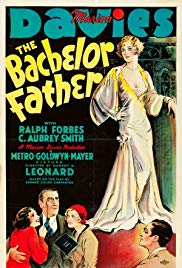
Sir Basil Winterton (C.Aubrey Smith) is The Bachelor Father (1931); though never married, he has managed to father three children with three different women. Now getting on in years and not in the best of health, he asks his lawyer John Ashley (Ralph Forbes) to locate the now-grown children: Geoffrey Trent (Ray Milland), Maria Credaro (Nena Quartaro), and Antoinette Flagg (Marion Davies), so that he can finally have a relationship with them. But, will they want a relationship with him? Marion Davies is thoroughly delightful as Tony (don't DARE to call her Antoinette!), a vibrant and winning young lady who is eager to discover a new family, but unwilling to compromised herself to do so. The audience knows early on that Tony is not actually the daughter of Sir Basil (she had a half-sister, also named Antoinette, who died before Tony's birth). The script - and Ms. Davies - make it transparent that Tony is not there for wealth, she's there simply to meet her father - and if she doesn't like him, she's leaving!! Marion Davies is an engaging actress who really should be seen more often. Though she was concerned about the move to talkies, she should not have been. Ignore the stories that she is the model for the untalented second Mrs. Kane in Citizen Kane - she's not. In his introduction to The Times We Had by Marion Davies, Mr Welles said: "Marion Davies was one of the most delightfully accomplished comediennes
in the whole history of the screen. She would have been a star if
Hearst had never happened. She was also a delightful and very
considerable person." (WellesNet) With all the stories about William Randolph Hearst being the model for Charles Foster Kane, it's often forgotten that Citizen Kane is a work of fiction. It is true that Hearst wanted her to succeed as a dramatic actress, but Ms. Davies far preferred comedy. Her comedic timing was impeccable, and while I'm sure she is an excellent dramatic actress, her gift really was in comedy, as is evidenced in this film (which she also produced).
There are many Marion Davies stories - this one is rather nice. After Cecil Beaton commented that she was one of the six most beautiful women in Hollywood, he was invited to photograph her. When she arrived, she was wearing a high-neck dress. He had hoped to photograph her with bare shoulders - so she cut up the dress to give him the picture he wanted (TCM article).
C. Aubrey Smith is delightful as the curmudgeony Sir Basil. Mr. Smith was reprising his role from the 1928 Broadway play. Even though this was a pre-code film, there were still issues (that were apparently disregarded) concerning the subject of the film. The Hays Office wanted the title of the film changed and no reference to the Broadway play, so that Sir Basil was not a bachelor, but multiply-divorced. As it was, because it was clear that the children were illegitimate, several countries and U.S. states changed the dialogue to muddy the children's status. As you can see by the advertisement below, the studio ignored the order. (AFI catalog).
This was Ray Milland's ninth film role, and while its not a big one, he does make an impression as Geoffrey, who despite his mother's antipathy (probably well-deserved) to Sir Basil, wants to form a relationship with his father. Mr. Milland worked for years, often as second lead, until he won an Oscar for The Lost Weekend (1945). But he had already done some really choice parts, including Gary Cooper's youngest brother in Beau Geste (1939), Ginger Roger's benefactor in The Major and the Minor (1942), and the musician who's house is haunted in The Uninvited (1944). Mr. Milland would act and direct until just before his death in 1986. He was survived by his wife of 54 years and two children.
Ralph Forbes doesn't have an awful lot to do - he's mainly there as a love interest for Tony (honestly, the butler, Larkin (played marvelously by Halliwell Hobbes) is more interesting than Mr. Forbes. Mr. Forbes had a substantial film career, that extended from silents to the television era; he also appeared in 14 Broadway plays between 1924 and 1950. He was briefly married to Ruth Chatterton and to Heather Angel. He died in 1951, at the age of 46.
A French version of the story, entitled Le père célibataire and starring Lili Damita, was released the same year as this version. Though successful upon release, the subject matter made sure it was not available for viewing after the Code was enforced. If you get a chance to see it, please do - we think you will enjoy it, and perhaps fall a little in love with Marion Davies.
Noir City DC was held in October 2018, and featured a number of fascinating films. Though I would have loved to have seen them all, having a job and other responsibilities precluded that. We were, however, able to see a double feature of two rarely shown films. The first was Destiny (1944), the story of Cliff Banks (Alan Curtis), an ex-con who has a penchant for getting himself involved with the wrong women. The second film was Flesh and Fantasy (1943), an anthology film - three stories that looked at superstition, dreams, and destiny. But more interesting than the films themselves was that fact that, at one point, they were to be one film. Eddie Muller, founder of the Film Noir Foundation (and the host of Noir Alley on TCM) introduced the films, and also hosted an impromptu discussion in the lobby of the AFI Silver Theatre on the intermission. He provided a fascinating look at the history of these two films, originally intended to be only one movie, with four separate, interrelated vignettes. Julien Duvivier had already been acknowledged as a great director, thanks to films like Pépé le Moko (1937), when World War II broke out. Like many of his compatriots, he left France to work in Hollywood, where he felt he would have more creative freedom (EuroChannel article). Mr. Duvivier was friendly with Charles Boyer and the two formed a production company. The result was Flesh and Fantasy, which would be distributed by Universal Studios. Only there was a problem. Universal executives thought the first vignette was too odd for their audience, and yanked it out of the film. Then, the following year, Universal decided release it with a frame built around the short (to make it feature length and "clarify" it). They called back actors Gloria Jean (Jane Broderick) and Alan Curtis, and over their protests, forced them to film this new, odd sequence. Mr. Duvivier refused to participate (ordering his name be removed from the picture), and Reginald Le Borg reluctantly assumed direction of the new section. The new film was Destiny (1944)
The difference in tone and texture between the two episodes is glaring. As Mr. Muller pointed out in his introduction, you know when Mr. Duvivier's sequence begins (and ends) without being told. His portion is dreamlike, but at the same time, intense and moody. Mr. Le Borg's portion is more matter-of-fact (it also doesn't help that the script he was given makes little-to-no sense. Cliff Banks is turned into an idiot in the frame story. I found the character more interesting as a monster). John Garfield had been the first choice for Cliff (when it was still part of Flesh and Fantasy).
Both Teresa Wright and Bonita Granville were considered for Ms. Jean's role (AFI Catalog).Gloria Jean was brought to Universal as a singing star in the mold of Deanna Durbin. She saw Flesh and Fantasy as a turning point in her career. Finally, she would be in a dramatic role (with almost no singing) with fine performers Like Edward G. Robinson and Barbara Stanwyck. But, when the studio pulled her segment from the film, she was devastated, and felt that this action prevented her from advancing in the film industry (The Hollywood Reporter, 2018). By then end of the 1940's, her film career was pretty much over. She did some television, but eventually worked as an executive secretary at Redken Laboratories; she retired from that job after 30 years with the company. She moved to Hawaii to live with her son, Angelo and daugher-in-law (Angelo died in 2017). A biography was published in 2005 (Gloria Jean: A Little Bit of Heaven by Scott and Jan MacGillivray). Ms. Jean died in August 2018 of heart failure and pneumonia. She was 92.
The three stories that make up Flesh and Fantasy were supposed to flow, one into the other. Despite the unnecessary interruptions of Robert Benchley (I'm not really a fan. He frequently just goes a bit too far in silliness for my taste), the vignettes do still waft from story to story. The first (sometimes called "Mardi Gras"), stars Betty Field as Henrietta, an embittered seamstress, who yearns for Michael (played by Robert Cummings), a law student who is unaware of the homely woman. It has a romantic tinge, and is reminiscent of The Enchanted Cottage (1945). Ms. Field does a good job with the part, and provides just the right touch of hope to a woman who has all but surrendered her life. Story two (often called "The Palmist") concerns Marshall Tyler (Edward G. Robinson), a businessman who is told by palm reader Septimus Podgers (Thomas Mitchell) that he will kill someone. Tyler becomes obsessed by the prophecy, and is plagued by voices encouraging to control the prediction by picking a victim now, so that he will not be accused of a crime. Mr. Robinson is a deft actor who portrays mania well (if you've never seen him in Scarlet Street (1945), give yourself a treat). He's ably supported by Mr. Mitchell (a superb character actor), along with Dame May Whitty (Lady Pamela Hardwick) and Anna Lee (Rowena). The final story features Charles Boyer as Paul Gaspar, a world-renowned high-wire performer who is having nightmares that see him falling from the wire as a lovely woman gasps in horror. While traveling back to America (and considering the future of his act), he meets Joan Stanley (Barbara Stanwyck), the woman whom he has seen in the dream. Romantic elements also infuse this story, and both Mr. Boyer and Ms. Stanwyck are excellent (and are excellent together). We also have Charles Winninger as King Lamarr, the sympathetic owner of the Paul's circus.
Originally titled For All We Know, Flesh and Fantasy also looked at actors Charles Laughton, Adolphe Menjou, Deanna Durbin and Greta Garbo as potential actors in the piece. (AFI catalog) All three stories in Flesh and Fantasy made it to radio: a Screen Guild Theatre radio broadcast on April 1945 starred Ella Rains and Charles Boyer in "The High-Wire Performer" episode; a July 1945 broadcast featured Edward G. Robinson and Vincent Price in "The Palmist" episode; and in September 1945 John Hodiak and Claire Trevor enacted the "Mardi Gras" Episode. Mr. Muller is hoping that one day, these films can be reassemble to finally show us the film Mr. Duvivier intended to release. In the meantime, I heartily suggest watching both films together, and let you mind wander over the possibilities. Here are trailers from both of the films:
The life of Lord Robert Clive (Ronald Colman) is recounted in Clive of India (1935), a somewhat fictionalized account of his beginnings as a clerk for the East India company through his rise as a military officer and later diplomatic official. Let's begin by saying that this is a very loose interpretation of the live of Robert Clive. For one thing, Lord Clive, as portrayed by Ronald Colman is a much nicer person than the real Lord Clive, who has been referred to by William Dalrymple as "an unstable sociopath" (The Guardian) because of his treatment of the Indian people. Clive's death is still a bit hazy - it's quite possible that he killed himself; at the very least, his dependence on opium was surely a contributing factor. Nevertheless, this filmed account of Clive makes him far more heroic than the real man ever was. (For more on Robert Clive, visit this Wikipedia article.)
Regardless of its take on history, this film belongs entirely to Ronald Colman. He is in nearly every scene, and dominates the movie. There are a number of fine supporting actors, but most have so little screen time, you are likely to miss some of them. Mr. Colman is not afraid to make Clive annoying at times. He's not really going for totally heroic - his Clive is ambitious, impulsive, violent at times, and a tad greedy. What the film does want to do is to mitigate Clive's attempted destruction of the Indian people in his quest for money (TCM article). It's all for their own good, and Colman is pretty much stuck with that attitude.
Loretta Young as Clive's wife, Margaret Maskelyne, is little more than window dressing. She is included to look supportive and sad, and gets to do very little else. A scene in which she leaves her sick child to accompany Clive back to India is created out of whole cloth - the Clives had nine children (four died in infancy), but their oldest boy, and the child born just before Robert and Margaret returned to India, Edward Clive, 1st Earl of Powis, lived to the age of 85. Why the screenwriters (R.J. Minney and W. P. Lipscomb) felt it necessary to insert this dismaying episode is beyond our ken. (It's also rather irksome that both parents refer to the child as "the boy". Really? Don't his parents know his name?)
Colin Clive, who has two very brief scenes as Clive's adversary Captain Johnstone, was in fact a descendant of Robert Clive. Colin Clive was nearing the end of his career, though his second turn as Dr. Frankenstein in The Bride of Frankenstein, was released in May of 1935 (our film was released in January). Mr. Clive started his film career as a leading man, but by 1935, he was becoming a supporting actor, perhaps due to his increasing dependence on alcohol. He died two years after Clive of India, of tuberculosis exacerbated by his alcoholism.
Even though he was only in a couple of scenes, it's always a pleasure to see Cesar Romero. Cast as Mir Jaffar, an Indian lord, Mr. Romero brought to mind his portrayal of Ram Das in The Little Princess (1939). We wondered if this role led to his being cast as Indians in both the The Little Princess and Wee Willie Winkie (1937). Mr. Romero always played his parts - even when portraying a villain - with a bit of a twinkle in his eyes. Clive of India is no exception; it would have been nice to have seen more of him in the film. Mr. Romero was not the first thought for the role - it was to have been given to George Regas (AFI catalog).
While there are some good scenes in the film - those with the battle elephants were quite impressive - this film is not going to be ranked among Mr. Colman's best. For Colman aficionados, it's worth a look. Otherwise, see Random Harvest or A Double Life.
Colonel Roy Cronin (Robert Taylor) is about to leave for the front during World War II. He walks across Waterloo Bridge (1940), and memories of his past enfold before us - memories of Myra Lester (Vivien Leigh), the girl he met on the bridge during an air raid in the last war, of their engagement, and of her fate. The long and the short of our film version discussion was that this was, hands down, a better film. One reason is because of the chemistry between Ms. Leigh and Mr. Taylor. Though she wanted her beau, Laurence Olivier to play Roy (he had a prior commitment and was unable to appear), and stated that Mr. Taylor's casting was "a typical piece of miscasting. I am afraid it will be a dreary job..." (TCM Article), it's clear from the get-go that this was a perfect casting choice. They had appeared together once before, in A Yank at Oxford(Ms. Leigh was the bad girl). Back in 1938, Mr. Taylor was clearly the star - here, we have equals, and that is one of the reasons this film works so well. We don't have to make allowances for a Roy who is obviously not as convincing as Myra. Because of their talent, you really watch the couple fall in love.
Ms. Leigh shines as Myra. This film takes the time to give us more backstory to Myra. It also cleans up her story quite a bit (we're not in the pre-code era any longer!). Myra is an innocent in the beginning. A budding ballerina, with a spot in the Kirowa Ballet Company, run by the delicious tyrant Madame Olga Kirowa (Maria Ouspenskaya). Ms. Leigh is totally convincing as we watch Myra descend into a life of prostitution - desperation and hopelessness reflect in her eyes and in her very posture. It's a beautiful performance from an always amazing actress. Ms. Leigh was born in India in 1913, and sent to England for schooling at age 6 (her parents didn't return to the UK until 1931). By 1932, she was married to Leigh Holman (they would remain friends until her death); the following year, she gave birth to her only child, Suzanne. Though Mr. Holman was not a fan of acting, Ms. Leigh returned to the theatre in 1935; her work there resulted in her receiving a contract from Alexander Korda. It was while she was appearing in the film Fire Over England (1937) that she met Laurence Olivier. The relationship - both theatrical and personal would endure beyond their divorce in 1960. Her career was a series of magnificent performances - both with Olivier and without. Her work with him in That Hamilton Woman (1941) is inspired, as is a wonderful performance in Caesar and Cleopatra (1945) with Claude Rains. Her theatrical roles also gained her much praise, most of it on the West End (often appearing opposite her husband). Ms. Leigh, however, was plagued by bouts of depression - her inability to become pregnant with Lord Olivier's child only exacerbated the condition. After their divorce, she began living with Jack Merivale; he was with her when she died of tuberculosis at age 53. Lord Olivier, who was in the hospital being treated for prostate cancer, rushed to her apartment, and helped Mr. Merivale plan the funeral. At a recent visit to England, I was able to see an exhibit with some of her papers - the Victoria and Albert Museum received the donation of her papers from daughter Suzanne Holman Farrington.
Similarly, Mr. Taylor is both charming and strong. The opening scene tells us so much. Though he is a good and forgiving man, and years have past since their love affair, we know that he still blames himself for Myra's fate. It is as though, when she gives him her good luck piece, she gives away all her luck. Roy has survived, but we know from Taylor's eyes that he is still married to Myra in his heart.
If there is anything that is a bit hard to believe, it is that Myra can't get a job. First of all, this is during wartime - fewer men should mean more jobs for women. Unlike Mae Clarke's Myra, this Myra makes it clear that she is not just looking for jobs as a performer. She's tried a restaurant and a dress shop. Can one imagine a dress shop turning away someone as stunning as Ms. Leigh because she has no experience? That one plot point is a bit of a stretch.
The film is also gifted with amazing character actors - Lucile Watson as Roy's mother, Lady Margaret Cronin is excellent. You yearn for Myra to confide in her - Ms. Watson transmits warmth and sympathy in her performance, and her hurt is palpable when Myra all but shoos her away.
We also loved Maria Ouspenskaya turn as the nasty ballet school teacher. She all but spits out her venom towards her students, who are merely cogs in her company and not real people at all. As the instigator of all Myra's and Kitty's (Virginia Field) pain, she is an evil delight.
The New York Timesreview was rapturous in their praise for Ms. Leigh - this was her first picture after Gone With the Wind (AFI catalog), and she did not disappoint them. They also spared some praise for Mr. Taylor, Ms. Watson, Ms. Field, and C. Aubrey Smith (as The Duke). If you only want to watch this story once, this is the one to pick (they even managed to get around the PCA's objections to the plot without degrading the plot). We'll leave you with Roy and Myra's encounter on Waterloo Bridge:
We aren't quite done with swashbucklers, as our film for this week is The Prisoner of Zenda (1937). Ronald Colman plays Major Rudolf Rassendyll, an English officer on a fishing trip to Ruritania, when he meets Colonel Zapt (C. Aubrey Smith) and Fritz von Tarlenheim (David Niven). Both are flabbergasted at Rassendyll's resemblance to King Rudolf V (also played by Colman); Rassendyll, it turns out, is descended from the Ruritania royalty on the wrong side of the blanket. The King is also amused at the resemblance, and invites Rassendyll to his palace for a night of conversation and drinking, at the end of which, the Rassendyll, Zapt and von Tarlenheim discover the King unconscious, his wine drugged by servants in the pay of his half-brother, Black Michael (Raymond Massey). With the King's coronation scheduled for that afternoon, Zapt convinces Rassendyll to step in for the King, for if King Rudolf doesn't show up, Michael will stage a coup to take over the goverment. Reluctantly, Rassendyll agrees, only to discover that Michael and his henchman Rupert of Hentzau (Douglas Fairbanks, Jr.) are all too quickly aware of the masquerade, and kidnap the King from his vacation palace. Add to the problems - Rassendyll has fallen head over heels in love with the Princess Flavia (Madeleine Carroll), Rudolf's betrothed.
With an absolutely magnificent cast, this is a film that is not be missed. Colman creates distinctive personalities in the characters of King Rudolf and Rassendyll (and given he has very little to work with when it come to the King - who we barely see - it is all the more exceptional). With his fantastic voice and his engaging personality, it is quite clear why Flavia would fall for him almost instantly, even when she thinks he is the King (who she dislikes).
His equal is Douglas Fairbanks, Jr as the arch-villain Rupert of Hentzau. Fairbanks gives him a sparkle that makes him attractive and treacherous at the same time. When the film was remade in 1952, James Mason took over the role; while Mason had the evil down perfectly, he just doesn't have the charm that Fairbanks does in the role. That little twinkle in his eyes, as he performs his nefarious deeds is the difference. Interestingly, Fairbanks badly wanted the lead role, and almost turned down the part of Rupert when that was offered instead. His father, Douglas Sr, is the one who talked him into doing it - he told him the character was "witty, irresistible, and as sly as Iago". That the part was "so actor-proof... that Rin Tin Tin could play the part and walk away with it!", we are inclined to disagree (in our opinions, Mason didn't walk away with it!). It's proof of the talent of Fairbanks, Jr. that he could make you look away from Colman on occasion. (This TCM article goes into more detail on the history of the film).
With actors like Mary Astor (as Michael's lover, Antoinette de Mauban), David Niven and Madeleine Carroll in the film, even the small parts are performed by experts. Niven, who had started in films in 1932, primarily in unbilled parts, was about to become a star. By 1939, he was the second lead in Wuthering Heights and starred (with Ginger Rogers) in Bachelor Mother. A versatile actor, noted for his wit (if you've never read his autobiography, The Moon's A Balloon, you owe yourself a treat - many stories of him and Errol Flynn and their bachelor pad are included), Niven was highly regarded in the Hollywood community; in his article for Niven's Star of the Month turn on TCM, Robert Osborne recalled being at an event where a group was laughing at someone's tales. Mr. Osborne surreptitiously wandered over, to discover Mr. Niven regaling the table with stories. Mr. Niven married twice - he was widowed when Primula Rollo died after falling down a flight of stairs during a game of hide and seek. Two years later, he wed Hjördis Tersmeden, and though they were together until his death in 1983 of ALS, it was allegedly not a happy marriage (Niven's close friends Roger Moore and Robert Wagner actively disliked her). Niven served in the British Army during the Second World War, returning home from America when war broke out. This hiatus had little effect on his career - he returned from military duty to make such excellent films as A Matter of Life and Death (1946), The Bishop's Wife (1947), and his Oscar-winning turn in Separate Tables (1958).
Madeleine Carroll is probably one of the most beautiful women in Hollywood history, but not only is she lovely, she is a strong, intelligent, and talented actress. You believe that Princess Flavia could lead a nation, thanks to Ms. Carroll's strength of character. After appearing in two Hitchcock films (his earliest "cool blonde") in Great Britain, Ms. Carroll came to America to appear in this film and The General Died at Dawn. The parts she was given were uneven in quality, and she left filmwork in 1949. She continued for a few years more in television (appearing, for example, in a Robert Montgomery Presents of "The Letter" in 1950). She also appeared on Broadway in Goodbye, My Fancy, in the role Joan Crawford would assume on screen). She also worked on film production aimed at promoting "better understanding among the peoples of the world". He efforts also helped to raise money for an orphanage housing children injured in France during World War II. She died in 1987, at age 81.
The film that we see today did change from the original concept. It seems there was a prologue and an epilogue that were filmed and never used. The film would have opened with the much older Rassendyll recounting the story of his adventures in Ruritania, now many years in the past. As the film ended, he would have learned of the death of Princess Flavia. Interestingly, this differs from the sequel written by Anthony Hope, entitled Rupert of Hentzau, in which Flavia become Queen after the deaths of King Rudolf and Rassendyll.
We'll close with the fencing scene from the end of the film. According to the AFI Catalog, David O. Selznick was not satisfied with the scenes originally filmed by John Cromwell and brought in W.S. Van Dyke to reshoot them. The fencing, as you will see, is excellent:
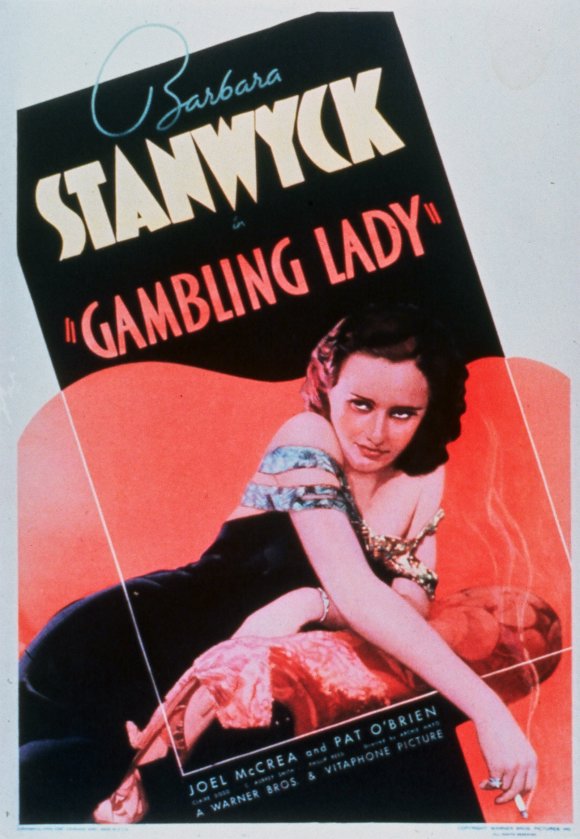
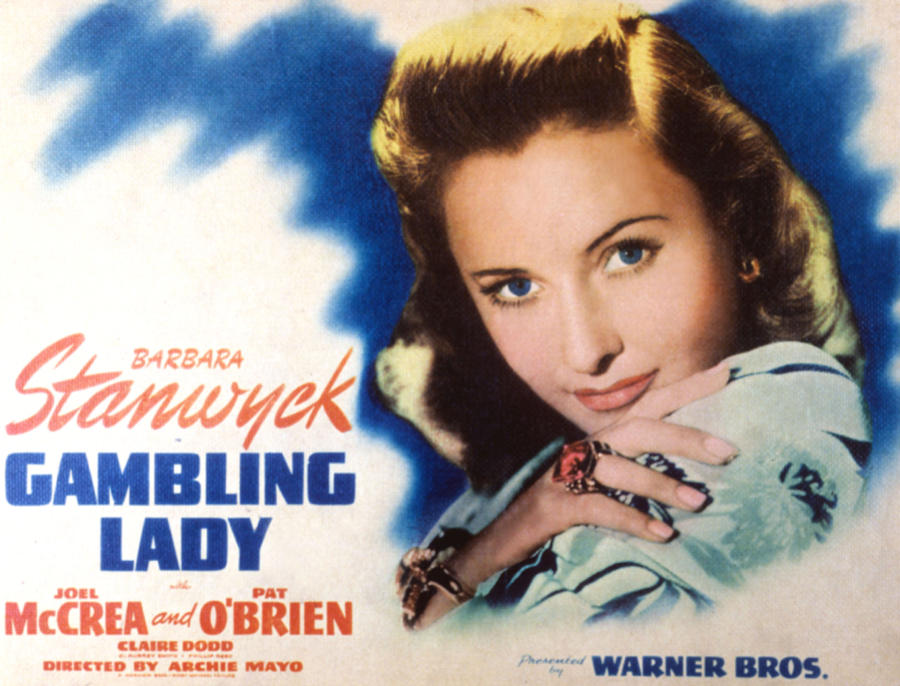
Gambling Lady (1934) is an engaging film, which stars Barbara Stanwyck as Jennifer "Lady" Lee. When her father, Mike (Robert Barrat) kills himself in despair over his debts to a gambling syndicate, Lady seeks employment in the one occupation she knows - gambling. Lady, like her father, is scrupulously honest, and takes a job with the syndicate on the proviso that they will run an honest game. When she discovers they have lied to her (and have placed someone into the game who is systematically cheating), she resigns and begins working on her own. While playing at a society party, she meets Garry Madison (Joel McCrea); they fall in love and he proposes marriage, to the concern of his father, Peter Madison (C. Aubrey Smith). But Peter, a gambler himself who knew and admired Mike Lee, comes to realize that Lady's love for Gerry is true, and consents to the marriage. However, the course of true love hits road bumps - the return of Garry's former girlfriend Sheila Aiken (Claire Dodd) and Garry's jealousy of Lady's friend Charlie Lang (Pat O'Brien). This is a good, fast-moving film, with a lot of story packed into 66 minutes. Stanwyck, as always, is excellent as Lady Lee, and her rapport with Joel McCrea (in their first of 6 films together) is evident. Particularly notable are two scenes: the first one has Lady playing cards with her rival Sheila, to Sheila's misfortune; the second immediately follows, and shows Garry and Lady frolicking in their bed as Garry tries to convince Lady to return Sheila's losses (this is, after all, a precode film). It's obvious in this second scene why Stanwyck and McCrea became a screen couple. When we viewed Banjo on My Knee several months ago (their second film together) we discussed their screen history. For more information on McCrea himself, please visit our blog post on Rockabye. The one criticism we have of his character in Gambling Lady is his jealousy towards Charlie - he should know his wife better. She is the soul of honesty; how could he even THINK that she would cheat on him?
We like Pat O'Brien, but he is somewhat wasted in the film - his screen time is small, and there are times when one wonders why Lady would pick Garry over Charlie (Garry can be quite petulant at times, while Charlie is always in Lady's corner). But, O'Brien has the acting chops to stand toe to toe with Stanwyck, and that is important here - we HAVE to understand Lady's loyalty to Charlie, even though he doesn't always play an honest game. And O'Brien has an inner integrity that makes his character almost admirable.
This is a film that is loaded with excellent character
portrayals. C. Aubrey Smith's Peter is one of them. A man of honor,
who loves his son and grows to love and even admire Lady, Smith gives us a memorable performance. A versatile actor, who could play
sweet (as he does here) or vile (see No More Orchids
for one of his more repugnant characters.) Smith began his living as a
professional cricketer, playing professionally from 1882-1890, and
highly regarded as a bowler. When he came to Hollywood, he continued to
play, forming the Hollywood Cricket Club, with fellow actors David
Niven, Laurence Olivier, Nigel Bruce, Leslie Howard, and Boris Karloff.
His acting career began in London - he, in fact, was the lead in The Prisoner of Zenda
(returning to the story in the 1937 film version, in which he played
the wise Colonel Zapt). He worked in silent films in England, then
ventured to Hollywood, where he became the unofficial head of the
"Hollywood Raj," or British film colony. In 1938 he was appointed a
Commander in the Order of the British Empire, and was knighted in 1944.
Married to Isabelle Wood from 1896 until his death in 1948, Smith was
an actor of note, appearing in such classics as The Four Feathers (1939), Wee Willie Winkie (1937), and Rebecca (1940). His final film, Little Women (1949) was released after his death from pneumonia.
Claire Dodd is also quite entertaining as the evil Sheila
Aiken; as mentioned above, her gambling scene with Stanwyck is one to
see - two pros matching wits (Stanwyck wins, but Dodd gives her a run
for her money). We discussed her career in some detail when we saw her
in Lawyer Man (1933). This New York Times review was quite complementary - and justifiably so - of Ms. Dodd in the film. Fellow blogger at Immortal Ephemera also singled out Ms. Dodd for praise. As discussed in this TCM article,
Stanwyck had some momentary trouble with director Archie Mayo when he
tried to pinch her. Not surprisingly, she handled the situation quickly
and firmly (and he didn't do it to her again). In 1949. Stanwyck would revisit the theme of gambling in The Lady Gambles, but the two films are in no way similar (the 1949 film is very much a social drama about gambling addiction). We'll leave you with the trailer from Gambling Lady, and a hearty recommendation to give it a try:
Trouble in Paradise (1932) is a film that requires you to keep your eyes on the screen. So much happens here that concentration is essential. The film opens when two thieves - Herbert Marshall (as Gaston Monescu) and Miriam Hopkins (as Lily) - meet and fall in love in Venice, as each attempts to rob the other one! The following year, they are still together and still on the prowl for victims. Enter wealthy widow Mariette Colet (Kay Francis); Gaston steals her purse, collects the reward for returning it, and convinces Mariette to hire him as her secretary (with Lily as his assistant). Sound simple? It's not. All of the characters are well developed, from our leads to various supporting characters. Besides the ever wonderful Ms. Francis - who makes Mariette a bit of an airhead, but a brainy one (yes, a contradiction, but this film is full of contradictions), we have Herbert Marshall being oh-so debonaire, and Miriam Hopkins. Quite honestly, Ms. Hopkins can be an annoying actress - she is mannered and at times over-blown. However, here she is quite funny as the naughty Lily. When she morphs into Gaston's assistant, Mlle. Votier, she is hysterical -wearing glasses, talking about her little brother, and her mother (who, of course, are sadly dead), and trying to be Mariette's new best friend. For supporting players, we have some remarkable actors: Edward Everett Horton as Gaston's Venice victim François Fileba, Charlie Ruggles as The Major, one of Mariette's many suitors (men she loves to lead on, but has no intention of marrying. She's quite happy being in control of her own life), and C Aubrey Smith as Giron, the Chairman of Mariette's company who has been embezzling from her for years. He is a riot when he threatens to resign... eventually. Director Ernst Lubitsch is having lots of fun here. Watch for the love scene between Mariette and Gaston. We know exactly what is going on, as their shadows superimpose on a bed. Lubitsch doesn't need to be crass; he easily gets his points across by innuendo. We also have gowns by Travis Banton, and gorgeous accessories and set design. A major focus of an early scene is a purse, and an exquisite purse it is! We end with a clip - including the purse!
Carole Lombard's 1932 film No More Orchids is a delight
from start to finish. Wealthy Anne Holt (Carole Lombard) is used to
getting what she wants, until she meets Tony Gage (Lyle Talbot). He has
no money, and she is engaged to royalty, but love blooms, and Anne is
quite willing to give up her wealth and position to be with the man she
loves. But, there is a fly in the ointment - her grandfather (C. Aubrey
Smith), a rather malevolent individual who will use anything in his
power to manipulate Anne into wedding his choice - Prince Carlos.
The
cast here is just magnificent, especially Louise Closser Hale as Anne's
outspoken grandmother. Hale is an absolute riot, and makes the
picture. From the second we see her, Ms. Hale steals the movie, and you
look forward to her every appearance. Also wonderful is C. Aubrey
Smith as Anne's nasty grandfather. The cameraman (Joseph August), has a
field day, filming Smith at angles, and with lighting that make him
appear as the devil. And Smith seems to relish the cruelty that Mr.
Cedric delights in imposing on those around him. Finally, there is
Lombard, who is just lovely as Anne. She is funny and sweet; running
the gamut from spoiled brat to loving daughter, without being maudlin.
One
interesting detail about the film is that it is a pre-code. That
becomes apparent when Lombard spends the night with Tony, and he later
makes a comment that casts aspersions on her "honor". (She has been
forced to break up with him; he doesn't know why and believes she has
been toying with his affections.) It's quite suggestive!
We strongly recommend this neglected classic. Here's a scene from the film:
For this meeting, we looked at Garbo's Queen Christina.
This is a wonderful film in so many ways. Let's begin at the beginning
- before we even see the glorious Garbo. We were so impressed by Cora
Sue Collins as the young Christina. Just her walk told her story. Only
six years old, but already with a mind of her own, and the ability to
rule, she is both amusing and enthralling. I look forward to seeing a
few more of this actress' films (she appears to have "retired" in 1945).
Then,
we get to Garbo. Her relationship with Aage (C. Aubrey Smith), her
body-man, is unique indeed. How many films actually show a man walking
unbidden into a woman's bedroom to awaken her for the day's work?
Immediately, we understand the dichotomy that is Christina. We quickly
discover she has a lover (Ian Keith, as Count Magnus) and perhaps
another one in the person of her lady-in-waiting, Ebba (Elizabeth
Young). The kiss that Christina bestows on her young maid, and her
anger at discovering Ebba with a young man point up that there is much
more to this relationship than merely that of a Queen and her
handmaiden.
Finally, we get to her nights with John Gilbert. How
is it that EVERY item in the room seems to be phallic? Even a bunch of
grapes make one sit up and take notice. We felt that John Gilbert is a
very underrated actor. We were not sure why his career ended so early.
As we all know, his voice was just fine. Perhaps a bit tenor, but
certainly not unpleasant, and the chemistry between him and Garbo is
palpable. His duel with Ian Keith was exciting; his death scene totally
moving. And then, there is Garbo again. Her face a mask of
determination and pain. I defy anyone to not be moved at the sight of
her staring off into her future. Here it is: