Another TCM Presents, this time The King and I (1956) starring Deborah Kerr, (Anna Leonowens) and Yul Brynner (King Mongkut). Based on the memoirs of Anna Leonowens, The English Governess and the Siamese Court (published in 1870) told the story - from her point of view, of course - of her years as royal governess to the wives and children of King Mongkut of Siam. It's been made three times as a film - first as the drama with Irene Dunne (who, ironicaly, had a magnificent singing voice in a non-musical role) Anna and the King of Siam (1946), then, this version, with the wonderful Deborah Kerr (who couldn't sing, and had the equally magnificent Marnie Nixon dubbing for her). Finally, the 1999 Anna and the King, with Jodie Foster in the role of Anna. All three films, and the book, are banned in Thailand, because of the portrayal of King Mongkut. This discussion from the New York Review of Books goes into some details about their antipathy to the story (the King is made to look ridiculous, Anna seems to get preeminence in billing and advertising). But, as they point out in the article, this is HOLLYWOOD history, not real history.
There are a number of differences between the 1946 and 1956 films - most, perhaps to soften the musical a bit. In Anna and the King of Siam, the break between Anna and King Mongkut (Rex Harrison) occurs when the King burns Tuptim (Linda Darnell) and her lover to death at the stake, whereas in The King and I, Anna becomes infuriated when the King threatens to whip (but is unable to do so) Tuptim (Rita Moreno). The drama ends with Anna remaining in Siam after the death of her son, whereas the musical ends with both mother and son remaining to support young Chulalongkorn (Patrick Adiarte). Historically, Anna's on, Louis Leonowens eventually returned to Siam to become a Captain in the Royal Cavalry (commissioned by his schoolfellow, the royal prince Chulalongkorn. married twice and had two children. He lived to age 63 (he and his wife died in the 1919 flu pandemic).
This
TCM article provides some background about the Broadway musical, and the introduction of Yul Brynner into the role that would make him a star. Brynner had no illusions about Broadway or film stardom - he was planning on being a director, as he assumed his rather exotic appearance would not make him a conventional leading man. In a sense, he was right, but he became so ingrained in this role (for which he won the Tony) that there was no question that he would be included in the film version - at least on the studio's part. He wanted to direct it (and star Marlon Brando as the King). However, some hard negotiations landed him the role, script approval, and a tidy sum of money - and an Oscar. It also led to him being seen AS a leading man, albeit an unconventional one, in such films as The Magnificent Seven (1960), Anastasia (1956), and Solomon and Sheba (1959). Nor was the film the end of Mr. Brynner's association with The King and I. He played the King in the 1978 and 1985 revivals of the play. He died four months after the second revival closed.
Unfortunately, we were not to see his illustrious co-star Gertrude Lawrence
in the film. Though Ms. Lawrence had first refusal on any film
version of the play, she died of cancer in 1954 (3 weeks after her
final appearance as Anna). Supportive of her co-star, one of her last
acts before her death was to arrange that Mr. Brynner's name appear on
the theatre marquee (her name had been the only one listed). With the exception of the vocal issues, however, Ms. Kerr is a worthy successor, an actress who can do more with a raised eyebrow than most can do with their whole body. And with a wardrobe of enormous period dresses, Ms. Kerr WEARS them - they never overwhelm her or her character.
A few days after we saw this film, we were at a Disney
concert (the Wolf Trap orchestra performing to clips of Disney films),
and my husband was struck by the similarities between the ballroom scene
in Beauty and the Beast and the Shall We Dance number in
The King and I. Below are two screen shots. Note the dresses - the
same wide skirt, the same off the shoulder top, and both are shades of
gold. Even the rooms bear a resemblance to one another. Coincidence? I
bet not!
This July, we lost the wonderful Marnie Nixon at age 86. I was lucky enough to see her perform (in a non-singing role) on Broadway in James Joyce's The Dead. Ms. Nixon was a gifted actress and singer, not just a voice behind the curtain, subbing for Deborah Kerr, Natalie Wood, and Audrey Hepburn. She did eventually get to sing in front of the camera - as Sister Sophia in The Sound of Music (she obviously did NOT need to ghost sing for the lead in THAT film!) Ms. Nixon sings the line: "She waltzes on her way to mass and whistles on the stair." While we often see the illustrious actresses listed above when we think of these films, when we hum the songs from The King and I or West Side Story, it is Marnie Nixon's voice that we hear in our head. It's fitting, I think to close with Ms. Nixon singing the Shall We Dance number.
This week, we again join Constance Bennett in a precode film. This one is Our Betters from 1933. Connie is Lady Pearl Saunders Grayston. We meet her as she has just married Lord Grayston (Alan Mowbray). She is determined to be a good wife to him, though she is aware that their marriage was one of convenience - he needs her money to
support his lifestyle. But Pearl finds almost immediately that her dreams of a life as a happy wife are naive. Her husband has no intention of giving up his mistress.
The film, taken from a play by W. Somerset Maugham, produced by David O. Selznick, directed by George Cukor, and with music by Max Steiner is not a great one, but it is interesting. Besides having some of the best behind-the-scenes talent in Hollywood, we have a fantastic performance by Bennett. Her Pearl becomes a society hostess, but one who is jaded and cold. We also want to pay homage to the fantastic costuming of Hattie Carnegie - take a look at the stunning (and scandalous) black dress Ms. Bennett wears to a party - it's a knockout! At one of her parties, we discover that she is planning to bring her sister, Bessie (Anita Louise) into the same lifestyle, by arranging her marriage to Lord Harry Bleane (Hugh Sinclair). Though Bessie seems willing, it soon becomes clear that she really loves Fleming Harvey (Charles Starrett). But everything begins to implode at a weekend outing to the Grayston estate, as we learn more about Pearl's rather seedy existence.
Among the party guest are GIlbert Roland. We enjoy him as an actor, but felt he was wasted here as the gigolo who pursues Pearl, but is involved with the wealthy Duchess Minnie. We also discover that Pearl is essentially destitute, thanks to her husband's bad handling of her finances, so she is using her wiles to "borrow" money from Arthur Fenwick (Minor Watson). Much of our conversation focused on the bartering of American heiresses for English titles. It is surprising that, in 1933 (this is a contemporary story), this was still going on. We especially discussed the life of Consuelo Vanderbilt, who was literally imprisoned by her mother until she consented the Duke of Marlborough
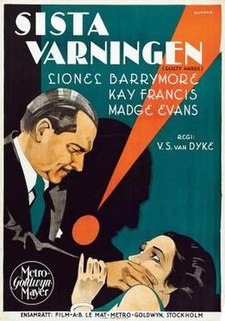
This week, we looked at a very underrated PreCode film from 1931. Guilty Hands stars Lionel Barrymore as Richard Grant, a lawyer who discovers that his beloved daughter is engaged to Gordon
Rich (Alan Mowbray), a client with a horrible reputation as a womanizer
and abuser (Rich probably murdered his last fiance). Grant tells Rich
that if Rich continues with his plan to marry Barbara Grant (Madge
Evans), Grant will kill him AND will get away with it. He will make
sure it is the "perfect murder".
It's not giving
too much away to reveal that Grant DOES kill Rich. But from there, we
will leave you in some amount of suspense. Kay Francis is wonderful
here as Rich's mistress, Marjorie West (this is a pre-code,
after all), who loves him in spite of his engagement to Barbara (and
fully intends to keep on seeing him after his marriage). When Rich
dies, Marjorie begins investigating his death. With some interesting
results.
Lionel Barrymore is fantastic. He is
sympathetic, and at the same time, sinister. You want to root for him,
but he is, after all, a murderer. Yet he did it for a good reason.
leading the audience to feel ambivalent about the conclusion. It is
also a plot that keeps you guessing, right to the very end. Will
Richard be caught? SHOULD he be caught? It's also fun to see Ms.
Francis' Marjorie take command as an amateur detective. Agatha Christie
was just beginning to write Miss Marple in 1926 (but only as a short
story in a magazine. She would not appear in book form til 1932). One
would need to go back, we suspect, to Wilkie Collins (The Lady and the Law, as well as The Woman in White) for an earlier female detective, so Guilty Hands heroine is quite a novel idea.
If you can see this picture, do so. It is worth your time. We think you will be surprised and will LOVE the ending. We'll leave you with a scene from early in the film:

 T
T