Guffy McGovern (Paul Douglas) is the foul-mouthed, angry manager of the Pittsburgh Pirates. The team is in last place in the National League, and his players loathe him. Sports writer Fred Bayles (Keenan Wynn) hates him - Guffy got him fired from his announcing job with the team - and Bayles is doing his best to return the favor. Then, one evening, Guffy hears a voice, which tells him that, if he can refrain from blaspheming, there will be Angels in the Outfield (1951) to help his team to a pennant. When this film was suggested to the group, one of the members was reluctant to include it. She's not a baseball fan, and was sure the film would bore her. She later admitted that she enjoyed the film a lot. The beauty of this movie is that, if you are a baseball fan, the film resonates with the enjoyment of the game, and the passion of the fans. If you don't like baseball, it really doesn't matter. Guffy's journey is one that could be anyone - he's a man who has shifted his life into one of anger and misanthropy. The movie is about him searching for the joy that can be present in anyone's life. Baseball is just the jumping off place. Paul Douglas is excellent as this very conflicted man. From his first appearance, his portrayal makes apparent that his conflicts are very deep. He dislikes everyone - no one on his team is exempt from his fury, not even players like Saul Hellman (Bruce Bennett) who used to be his friend. It's not just that the Pirates aren't winning; Guffy is pushing them into loss. His antagonism results in so much stress that the players freeze, and are unable to get past their anxiety (much like we saw with Pat Pemberton in Pat and Mike). It's enjoyable to see Guffy gradually relax and relate to those around him; we see the man beneath the acrimony and find he can be a pretty nice person. Mr. Douglas was not the first choice for the part - originally, Clark Gable was to have played Guffy (AFI catalog).
While it is true that Janet Leigh (Jennifer Paige) is rather young to play Paul Douglas' love interest (Mr. Douglas was 20 years her senior), she is very convincing as the household hints reporter who is sent to the ballpark to do a human interest piece on the Pirates and McGovern. It's made quite clear that Jennifer has no knowledge of baseball, but she has an inquiring mind, and quickly absorbs the niceties of the game. Ms. Leigh was on the verge of marrying Tony Curtis when she was filming this picture. A photo of her being carried from the ball field by Pirate outfielder Ralph Kiner hit the newspapers, intimating a relationship between the two. Mr. Curtis was assured by Ms. Leigh that it was all a fabrication (Janet Leigh: A Biography by Michaelangelo Capua)
This was Donna Corcoran's (Bridget White) first screen appearance. She comes from screen stock - her siblings Hugh, Brian, Kelly, Noreen (Kelly on Bachelor Father), and Kevin (Moochie from Spin and Marty) were all actors. She's winning as the little girl who summons the angels to assist her beloved Pirates, and you can well believe the growing affection of the two adults for this winsome child. Ms. Corcoran had a brief acting career; by 1963 (at the age of 21) she had retired from television and film. There are several other performances of note. The always enjoyable Spring Byington (Sister Edwitha) is fun as the baseball-loving head of the orphanage. Lewis Stone (Arnold P. Hapgood) as a judge tasked with deciding Guffy's competence gets one satisfying segment. Keenan Wynn is appropriately despicable as a nasty sports writer. There are brief appearances by Ellen Corby (Sister Veronica) and Barbara Billingsley (Hat-check Girl); by Bing Crosby (an owner of the Pittsburgh Pirates (TCM article)), Joe DiMaggio, and Ty Cobb. But the standout in his small role is Bruce Bennett. His portrayal of Saul fairly oozes with the exhaustion of a man who is in his last season in a game he loves. Mr. Bennett doesn't often get strong parts, but this is one in which he makes the most of a minor, but crucial role.
Because the marketers thought the overseas market would not understand the word "outfield", the name of the film in Europe was The Angels and the Pirates. In April, 1953, Ms. Leigh and Ms. Corcoran reprized their roles on the Lux Radio Theatre (with George Murphy as Guffy). In his book Mr. Deeds Goes to Yankee Stadium: Baseball Films in the Capra Tradition, author Wes D. Gehring discusses the influence of Frank Capra on this film. And certainly this is true. There is a certain Capraesque quality to the film. The New York Timesreview was primarily positive (though the reviewer wanted the New York Giants to win. I can sympathize). In short, this is an amiable movie well worth watching. We'll leave you with the trailer.
A dead body is discovered on a pier in New Orleans; the victim shot twice, making his death a clear-cut case of murder. But the medical examiner notices something odd, and calls in Public Health officer Dr. Clinton Reed (Richard Widmark). Reed determines the coroner's fears were justified - the victim Kochak (Lewis Charles) was suffering from pneumonic plague, and would have died within 24 hours - as will anyone he contaminated. Reed and Police Captain Warren (Paul Douglas) need to find the murderers before anyone else dies and there is a Panic in the Streets (1950).
This is a taut noir drama that doesn't waste any of its running time. With a strong cast, the film will keep you engaged til the very last moment. Richard Widmark is excellent as the Public Health Service officer who finds himself battling the clock - and the local police captain - I his attempt to locate men who are potentially carrying a virulent - and fatal - disease. He wasn't the first choice for the part - Dana Andrews was originally tagged for the role. As good as Mr. Widmark is - and he is good - the film's power is intensified by a riveting performance by Jack Palance (here credited as Walter Jack Palance) as Blackie, the gangster who murdered Kolchak. Mr. Palance emanates an air of danger, yet we see him interacting with the local community on a friendly basis. It's clear from his performance that Blackie can turn on a dime, and woe to the person who crosses him. Even the advertising poster (above) has Blackie as the dominant image - though Mr. Palance’s name does not even appear on the ad. This was Mr. Palance's first screen appearance (AFI Catalog) - he'd already done two television shows - and he makes an impressive debut. He would continue in television and films until 2004, winning an Academy Award for Supporting Actor for his performance in City Slickers (1991) (you can view his amusing acceptance speech here. He was 73 years old at the time).
It's always good to see Barbara Bel Geddes (Nancy Reed) in anything, and we wished she had more screen time (though, frankly, the film is not about her). Nancy provides a sounding board for Clinton; she allows him to vent his frustrations both about his job - which he clearly loves - and about the current investigation. (Linda Darnell was the person first cast as Nancy). We were impressed by the mature dialogue between the husband and wife (a couple discussing their choices regarding the expansion of their family), and by the equality in the marriage. The screenplay was based on a story by Edward and Edna Anhalt; we wondered if Ms. Bel Geddes dialogue was written by Ms. Anhalt, because Nancy sounds like a woman - not a man talking with a woman's voice (the Anhalt's won the 1950 Oscar for best story). Paul Douglas acts as Mr. Widmark's foil, a police detective who initially resents being posted on what he sees as an impossible - and seemingly ridiculous quest to find a murderer who might have a disease. It's not until he sees the effects of the plague - and begins to understand Dr. Reed's determination to stop its progress - that he becomes a true partner in the search for Blackie and his cohorts. Mr. Douglas is always a strong presence in any film, and does not disappoint here.
There are a two secondary players that are worth noting. Tommy Rettig of Lassie fame plays the Reed's son, Tommy. It's a small part, but instrumental in showing the family side of Clinton Reed. His genuine love and interest in his son provide insight into his belief in his family. In his second film role, Zero Mostel plays Fitch, one of Blackie's minions. The character is a rather repulsive little man, and honestly fades into the background. In his autobiography, Elia Kazan: A Life, Mr. Kazan claimed that he employed Mr. Mostel in spite of his being blacklisted. It didn't help - by 1952 Mr. Mostel was blacklisted completely and didn't work on television or film until 1959 (of course, Mr. Kazan would later name names, ensuring the safety of his own career (Los Angeles Times)). Mr. Mostel returned to New York and the theatre, and would eventually win three Tony Awards).
One character is not listed in the credits - Cleaver, the mortuary attendant who discovers the disease. It's a small role, but we were impressed by the professionalism of the man. IMDB says that the part is a cameo by director Kazan, but he really looks nothing like Kazan - this actor is a much bigger, and frankly, better looking man. I'd love to find out who played the part.
The City of New Orleans is also a character in the film, but it's not the New Orleans of Edna Ferber or Frances Parkington Keyes. This is a city of immigrants and of poverty. We see the docks and the underworld; none of the historic beauty of the French Quarter is visible in this film (TCM article).
The story was redone as a Lux Radio Theatre in March 1951, with Richard Widmark and Paul Douglas reprising their roles. The New York Timesreview was mostly positive, calling it "a generally gripping entertainment." We believe it's a film that will keep you watching til the very end. Here's a trailer to whet your appetite:
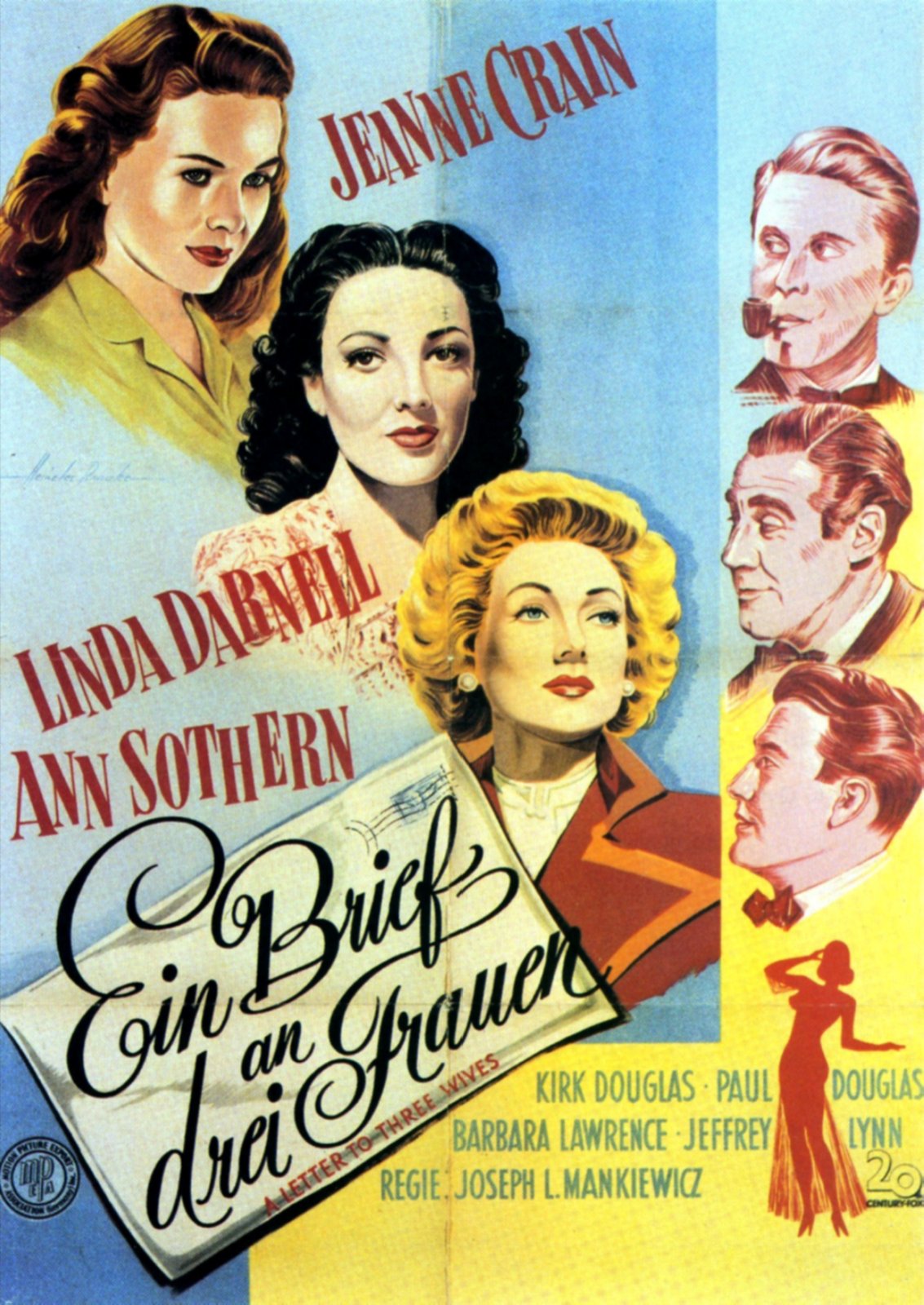
As Deborah Bishop (Jeanne Crain), Lora May Hollingsway (Linda Darnell), and Rita Phipps (Ann Sothern) are about to leave on a charity boat ride, a young man delivers A Letter to Three Wives (1949). The letter informs them that their "friend", Addie Ross (voiced with just the right amount of venom by Celeste Holm) has left town - with one of their husbands. Unable to leave the boat, the women spend the day worrying about their husbands and reviewing their marriages. Based on A Letter to Fives Wives by John Klempner (the film eliminated two wives, which tightens it up), this is an exceptional film, especially given that it is really a series of vignettes. The use of Addie's narration as a glue to hold together this tale of three marriages in trouble is both inspired and entertaining. That narration brings the tale to a different level, making the film a fully cohesive unit instead of a series of short stories. Two of the stories especially stand out. Rita and George Phipps (Kirk Douglas) are a relatively happy couple, but Rita, a successful radio writer, is trying to have it all - career, husband, and children. She's pretty good at doing it, but George is frustrated that he and their twins often take second place to the demands of her clients (ably represented by Mr. (Hobart Cavanaugh) and Mrs. (Florence Bates) Manleigh). Kirk Douglas plays George as an educated, reasonable and progressive man; he really doesn't mind that his wife works and that she out-earns him by quite a bit. Her job and her impressive salary afford them all a good life, and enable him to pursue his career - an underpaid high school teacher - without guilt. George loves his job and his wife. He just wishes that she wasn't constantly afraid, and would occasional say no to her clients unreasonable demands.
In flashback, we see the courtship of Lora May Finney (Linda Darnell) and Porter Hollingsway (Paul Douglas). Both are from the wrong side of the tracks (in Lora May's case, quite literally - she lives with her sister Georgianna (Barbara Lawrence) and mother, Ruth (Connie Gilchrist) on the edge of the train tracks). But Porter, the owner of a successful department store, is now well-off, and enamored of Lora May's beauty. But he is not interested in marriage; Porter's been married, and he didn't care for it. Plus, his ideal is Addie Ross - he keeps her picture on his piano, and talks about her "class," a quality he doesn't find in Lora May. Linda Darnell is impressive as the tough talking Lora May. The viewer is quick to realize that, despite her comments to the contrary, she loves Porter. But she knows the only way to keep him is to play the game his way - Porter likes to fight, and Lora May is more than willing to oblige him to get what she wants. To a point, of course. When Porter shows up at her front door, honking his horn for her to come out, Lora May ignores it: "Anybody wants me can come in and get me, this ain't a drive-in." For more on the life of Ms. Darnell, please see our blog post on her work in The Mark of Zorro (1940).
The third story, the marriage of Deborah and Brad Bishop (Jeffrey Lynn) is possibly the weakest of the three. It's not bad, its just that Deborah seems weak next to these two dynamic women. One sympathizes with her truly ugly dress, since we know she's not had time to procure a new one, but really, it is so hideous, it's hard to understand why even a simple farm girl would purchase it. And WHY does Rita have to TELL her to cut off those ugly flowers? But it should be acknowledged that Deborah has left the farm, the WACs, and her past life for a new, more upscale environment with a husband she really doesn't know - the story of Brad and Deborah is a brief glimpse into the marriages that began because of the war. Jeanne Crain began her film career at age 18, with a bit part in The Gang's All Here (1943). Winner of the Miss Pan Pacific pageant, she attracted the attention of film scouts; by 1945, she was starring in State Fair and Leave Her to Heaven. She could sing, dance, ice skate, and she was a pretty good actress, but also in 1945 she married Paul Brinkman, and began having babies - seven in total. She was pregnant during the filming of this movie, and may have lost the role of Eve in All About Eve due to one of her pregnancies. Regardless, her portfolio is quite impressive: I'm particularly fond of Cheaper by the Dozen (1950) and People Will Talk (1951) Ms. Crain and her husband remained married until his death in 2003, but after a messy divorce proceeding (which was never completed), they lived apart. She also lost two of her sons before she died in 2003 of a heart attack at age 78.
We've raved about Thelma Ritter (here playing Sadie Dugan) before, and she does not disappoint in this film. Whether it is her interactions with her pal, Ruth Finney or her sass when she is working as a maid for Rita Phipps, Ms. Ritter is the queen of the bon mot. Take, for example, her response to Rita's request that she wear a uniform: "The cap's out. Makes me look like a lamb chop with pants on." or her answer to the Manleighs about their radio program: "You know what I like about your program? Even when I'm running the vacuum I can understand it." At the same time, it is Sadie who cautions Ruth about her passion for her new refrigerator, when Ruth seemingly puts keeping it (in many respects, for Ruth, the refrigerator is a symbol of respectability) above her daughter's happiness: "
You got to make up your mind whether you want your kids happy or your icebox paid up." A number of different actors were proposed for the film, including both Joan Crawford and Ida Lupino as the voice of Addie Ross (AFI catalog). Though the film was nominated for Best Picture, Screenplay, and Directing Oscars (winning the latter two), no acting nominations came its way. Interestingly, Jeanne Crain, Kirk Douglas, and Celeste Holm were all nominated for other film work that same year (none of them won, however).
Contemporary critics received the film enthusiastically (see this New York Timesreview and this TCM article). Since then, regard for the film has increased, as is evident by this New Yorkerdiscussion, especially as a sophisticated examination of marriage. As Jeanine Basinger notes in her book I Do and I Don't: A History of Marriage in the Movies, films that actually examine marriage itself are rare. A Letter to Three Wives does this, and does it well.
Both Lux Radio Theatre (1950) and Screen Players Guild (1952) performed radio versions of the play. Then, in 1985, the story made its way to television, with Ann Sothern appearing as Ruth Finney in a version which starred Loni Anderson, Michele Lee, Stephanie Zimbalist as the three wives. We'll leave you with a trailer from the film - an introduction to the three wives.
The fishing town of Monterey, California is the setting of Clash by Night (1952), a film noir that features Barbara Stanwyck as Mae Doyle. Mae's been living in New York, the mistress of a wealthy married man. Though they were deeply in love, he was unable to divorce, and when he died, the small settlement he left her was taken back by her lover's family. Broke and depressed, May returns to her childhood home, now occupied by her brother Joe (Keith Andes). Mae's beauty and strength of character attracts a gentle fisherman Jerry D'Amato (Paul Douglas), as well as his friend, the cynical and callous Earl Pfeiffer (Robert Ryan). Though frightened of marriage, Mae decides that Jerry might be her salvation, even though she is dangerously attracted to Earl. Clash by Night is very intense film, and as such, it is hard to actually LIKE it. We have characters we can understand, but many of whom are terribly hard to admire. Stanwyck's Mae Doyle is at the top of the list. She was born in Monterey, but left because she hated it there. Now she's back, but she still hates the place. Why does she return? Wasn't there somewhere else she could go? And strong as she is, was it so impossible to stick it out in New York City, where it seemed she was happy? Stanwyck, in a sense, creates a character that is a cypher. We never really know Mae, a woman who wants to be happy, but can't seem to find real contentment. Her marriage to Jerry seems an act of desperation. And though she loves her child, her sorrow and pain after her daughter's birth hint at the least of post-partum depression- or perhaps we are just looking for an excuse for her misery.
Jerry, as played by Paul Douglas is a sympathetic character, but also a weak, and sometimes pathetic,man. His love for Mae is genuine. He is a good and loving father to their daughter, Gloria, but he is manipulated by everyone. Earl, who is supposedly his friend, ridicules him. His Uncle Vince (J. Carrol Naish) uses him as a source of money, and as a tool for vengeance on Mae (Uncle Vince's predilection for pornographic poster art, and his constant "requests" for money put Mae in the position of asking her husband to get Vince out of the house. You can't blame her for that). And Mae, who cares for him but has no love for him, consents to marry him - with his knowledge that there is no love - in order to have a caretaker and provider. So, while you feel for Jerry, it's difficult to like him, he is such a patsy.
Robert
Ryan, who played the part of Joe (Mae's brother) in the original
Broadway cast of the play, was the only cast member to appear in the
movie (the play featured Tallulah Bankhead as Mae and Lee J. Cobb as
Jerry). Ryan, as Earl, gives us a portrait of a man who is a lost
soul. Too intelligent for his job as a movie projectionist but too
unambitious to do anything else, Earl spends his life drinking too much
and ridiculing everyone and everything around him. Mae, who is
initially repulsed by Earl's negativity, finally responds both to his
sexuality and to his intellect. But in the final analysis, Earl is not
someone who can even take care of himself, much less a wife and child.
Should Mae leave with him, we wondered how long it would be before he
abandoned her and the child for which he has no regard or affection.
Perhaps the most attractive characters in the story are Joe and Peggy
(Marilyn Monroe). Peggy deeply loves Joe - and he loves her - but she
is no victim. Their love ultimately is one of equals, and will succeed
because of their commitment to one another. Ms. Monroe was really
breaking through in this small, but pivotal role. And while her
relationship with Stanwyck was cordial, the seeds of her later problems
had already begun. According to this TCM article,
director Fritz Lang was frustrated by her lateness and inability to
remember her lines. Stanwyck, however, never lost her cool, and would
do repeated takes when Monroe forgot her lines. Ultimately, Stanwyck
would comment, after Monroe's death that Monroe "drove Bob Ryan, Paul
Douglas, and myself out of our minds." However, "she didn't do it
viciously, and there was a sort of magic about her which we all
recognized at once."
The film, not surprisingly, changed a great deal of the play (by Clifford Odets). The setting is changed from Depression-era Staten Island, New York (which, of course, makes Mae's return far less drastic). And the endings of the play and film are far different (no spoilers, should you want more information take a look at this article in the AFI Catalog). Joan Crawford, Jeff Chandler, and Mala Powers were considered at one point for the parts of Mae, Earl and Peggy, all interesting choices. Regardless, without Stanwyck's powerful and layered performance, this film would likely have fallen apart (this New York Timesreview comments on the strength of the performances in a film that they don't necessarily think holds together).
As we've said before, any Stanwyck movie is worth a look, and this certainly is, not only for her, but also for strong performances from Robert Ryan and Paul Douglas. And the opportunity to see Marilyn Monroe before she became a love goddess is a treat. We will leave you with this clip from the film, in which Mae returns to her brother's home, and meets the woman he wants to marry.
Barbara Stanwyck has a relatively small part in Executive Suite (1954). She plays Julia O. Tredway, the daughter of the late head of the Tredway Corporation, a respected furniture manufacturer, now headed by Avery Bullard (voiced, but unseen, by Raoul Freeman). However, Julia and her love for Bullard are not the focus of the film; Executive Suite is the story of a critical moment in the history of the Tredway Corporation, as the company's various executives battle for control of the firm after the death of Bullard.
The film marks a reunion for Stanwyck and William Holden (McDonald "Don" Walling). Stanwyck was the star of Golden Boy (1939), and Holden was a newbie when he appeared in the title role. As the film rushes came in, Harry Cohn made it clear that was not satisfied with Holden's performance, and was going to replace him. Stanwyck defended him, and worked with him to improve his performance (Check out this TCM article for that story and others). Golden Boy became Holden's breakthrough role. Stanwyck and Holden remained friends, and he tried for years to convince the Academy to present her with an Honorary Oscar for her body of work. Ultimately, he did succeed, but by the time she received the award, he had died. In this video, you can will see Holden's praise of Stanwyck at the 1977 Oscars, and her moving acceptance speech in 1983 as she expresses her affection for her "Golden Boy".
The film actually belongs to Holden's Don Walling, the head of Tredway's research and development arm, and on his evolution into becoming a leader. Disillusioned by his mentor, Bullard, but nevertheless grieved by his death, Don becomes convinced that only he among the corporate vice presidents can keep Tredway afloat. His passion for a quality product and for the continued stability of the company put him at odds with other members of the board of directors. Holden gives Don the necessary sincerity and gravitas needed to lead a major corporation. He also demonstrates a devotion to his wife Mary Blemond Walling (June Allyson) and son Mike (Tim Considine). While some of his colleagues consider him too young to lead a company, the film focuses on his growth into the new position.
Also remarkable is Fredric March as
Loren Phineas Shaw, the chief financial officer for the company. Shaw's economies have put him at odds with Don, having advocated for and won approval of a cheap brand of furniture that, while enhancing the company's coffers, proves an embarrassment to the firm's employees and to many members of the board. March gives Shaw a number of small tics that quickly define his character for the viewer - watch how he constantly wipes his hands. His Shaw is a character you cannot like, and March is not afraid to make him, while not quite a villain, at the very least an unattractive individual.
A greater portion of the film's $1.25 million budget went to actors' salaries, and to good effect, because each actor gives a distinct three-dimensionality to the characters. Though only in about 3 scenes, Shelley Winters is excellent as Eva Bardeman, the secretary and mistress of Josiah Walter Dudley (Paul Douglas). Walter Pidgeon's
Frederick Y. Alderson gives us a man at the end of his career, who must face the fact that he will never rise to the heights of power that he always hoped was his future. But especially worth noting is the performance of Nina Foch as Bullard's executive secretary, Erica Martin. Foch was nominated for an Oscar for her brief, but powerful performance as a woman who is privy to her late employer's secrets, but who is the soul of discretion. In the clip below, Foch describes her conversations with the film's producer John Houseman and director, Robert Wise, as they took a tiny, weak part and made it into the small gem that you see today. To make Erica a real person, Foch and Wise created a backstory for her:
The film opens with point-of-view camera work. Since we are seeing the world through the eyes of Avery Bullard, his sudden death is quite shocking. As a result, we never actually see Bullard, not even a photo of him. This allows the audience to create their own picture of him, based on the various portraits that his colleagues paint.
Also very interesting is the credit role. We are all used to credits which show brief names of the characters' next to that of the actors, but Executive Suite gives us the characters full names - names that were not used within the film. We learn that Don Walling's name is actually MacDonald, and that his wife's maiden name is Blemond. Again, the character's begin to have a life outside the frame of the story - they have a past. They will have a future.
We were unfamiliar with Lucille Knoch, who the end credits inform us was Mrs. George Nyle Caswell (the wife of Louis Calhern's manipulative George Caswell - another masterful character creation), not his mistress, as we all had assumed. Ms. Knoch quite good in this part. She had a relatively short career - this was possibly the largest role she ever had. She seems to have stopped acting after 1957; she died in 1990.
Interestingly, the film did have a future, of sorts. It was made into a TV show from September 1976 through February 1977. It lasted for only 18 episodes, which is not surprising, considering the new show's competition was Monday Night Football, The Rockford Files, and the NBC Movie of the Week. Given that competition, it's shocking that it made it past the first month. Only the Don and Helen Walling characters continued in the TV show - they were played by Mitchell Ryan and Sharon Acker. Even the name of the company was changed in the prime-time soap opera. It was now the Cardway Corporation. You can see a advertisement for the show on YouTube.
We'll leave you with a trailer from the film - an introduction to all the characters, including Stanwyck's Julia Tredway: